REVIEW 3 major objections 4 minor 105 references
This paper claims that the toric code, under isotropic antiferromagnetic Heisenberg exchange, keeps its Z2 topological order intact at weak coupling, with the four topological sectors split only by an exponentially small amount, and melts i
Reviewed by Pith at T0; open to challenge. T0 means a machine referee read the full paper against a public rubric. the ladder, T0–T4 →
T0 review · deepseek-v4-flash
2026-08-02 18:41 UTC pith:DMQACN3H
load-bearing objection A well-executed analytic-numeric study of a new toric-code perturbation, but the claimed phase boundary rests on small-system NQS data with a known variational-metastability caveat. the 3 major comments →
The toric code under antiferromagnetic isotropic Heisenberg interactions
The pith
A machine-rendered reading of the paper's core claim, the machinery that carries it, and where it could break.
Core claim
For the toric code on an L×L torus with an added isotropic antiferromagnetic Heisenberg term, the paper's central claim is that the low-energy physics inside the code space splits into two regimes. At weak coupling, a Schrieffer-Wolff transformation shows that the effective Hamiltonian is dominated by local stabilizer renormalizations at O(J^2) and by vanishing three-body corrections; mixing between topological sectors arises only from non-contractible winding processes at order L, so the topological degeneracy splitting scales as J^L / Δ^{L-1} and vanishes exponentially with L. The authors further derive parity-dependent effective logical Hamiltonians for odd and even L, predicting specific
What carries the argument
The central analytical object is the Schrieffer-Wolff transformation in projector-resolvent form, which block-diagonalizes the perturbed Hamiltonian order by order and produces an effective Hamiltonian acting inside the toric-code ground space. The key identity is that the leading mixing between topological sectors is carried by non-contractible Wilson-loop operators, which can appear only at L-th order because a winding string requires L bond insertions; the corresponding coefficients scale as O(J^L / Δ^{L-1}). Complementary machinery includes the Marshall gauge transformation, which renders the Heisenberg-perturbed Hamiltonian stoquastic and allows real non-negative neural-network wavefunc
Load-bearing premise
The numerical search is assumed to reach the true symmetry-preserving ground state; because the topological-sector splitting is exponentially small at weak coupling, the optimizer can instead settle into a logically polarized state that mimics duality breaking, and the extracted Jc depends on warm-starting that avoids this trap.
What would settle it
Perform unbiased exact diagonalization or sign-problem-free quantum Monte Carlo simulations in the Marshall gauge on L=4,6,8 and check whether the fidelity-susceptibility peak and the Wilson-loop logarithmic-susceptibility peak both occur near J≈0.164, and whether the loop correlators follow the O(J^2) Schrieffer-Wolff dressing at small J. If the peak appears at a materially different coupling, or if the transition is first-order, the central estimate would be falsified. Alternatively, if a logically polarized state is the true ground state at very small J, then the duality-broken loop values
If this is right
- At weak coupling, the toric-code ground-state degeneracy is preserved up to exponential accuracy; the Heisenberg perturbation only multiplicatively renormalizes stabilizers and contractible loops at O(J^2), with no operator mixing among contractible loops until O(J^4).
- Topological sector mixing first appears at order L, so the splitting of the fourfold degeneracy scales as (J/Δ)^L, meaning the protection of the quantum memory becomes exponentially stronger as the system grows.
- The critical point Jc≈0.164 separates the Z2 topologically ordered phase from a fourfold-degenerate X/Z Néel phase with strongly suppressed y-magnetization, as seen through the plane ratio approaching unity.
- The fidelity-susceptibility peak, the Wilson-loop logarithmic susceptibility peak, and the departure of the Kitaev-Preskill topological entanglement entropy from −ln2 all point consistently to a breakdown of topological order near the same coupling.
- The Schrieffer-Wolff framework is presented as a systematic tool for analyzing generic two-body perturbations of the toric code, including ferromagnetic Heisenberg and XXZ-type anisotropies.
Where Pith is reading between the lines
- The order-L sector-mixing result suggests that any local perturbation with the same anyon-gap structure will split the toric-code degeneracy only at order L, making exponential topological protection generic rather than special to Heisenberg exchange.
- Because the Marshall gauge renders the Hamiltonian stoquastic, the Jc≈0.164 estimate could be checked with sign-problem-free quantum Monte Carlo on larger lattices than the L≤6 systems studied here, providing a direct test of the finite-size scaling.
- The even/odd L difference in Wilson-loop baselines implies that logical-correlation diagnostics on finite platforms must be interpreted with the lattice parity in mind; parity-odd and parity-even system sizes may show qualitatively different single-loop values even deep inside the topological phase.
- If the fourfold X/Z Néel phase is correct, the same Binder-cumulant and structure-factor diagnostics should apply to other duality-symmetric perturbations, such as XXZ anisotropy, and would predict a crossover in the plane ratio Rplane as the anisotropy is tuned.
Editorial analysis
A structured set of objections, weighed in public.
Referee Report
Summary. The paper studies the stability of the Z2 topological order of the toric code under an isotropic antiferromagnetic Heisenberg perturbation. The authors combine a Schrieffer-Wolff (SW) expansion with neural-network quantum state (NQS) variational calculations for L = 3, 4, 5, 6 on the torus. The SW analysis predicts that local stabilizers are renormalized at low order, while mixing of topological sectors appears only at order L, giving an exponentially small splitting. Numerically, they locate a breakdown of topological order at Jc ≈ 0.164 via fidelity susceptibility and a composite Wilson-loop susceptibility, and identify a fourfold-degenerate ±X/±Z Néel phase at larger J from staggered-magnetization moments and Binder cumulants.
Significance. If the central claims hold, the paper provides a useful benchmark for the robustness of topological order against a physically natural two-spin perturbation, and it demonstrates a practical analytic–numerical combination (SWT + symmetry-adapted NQS) that could be applied to other toric-code deformations. The SW derivation of exponentially small topological-sector mixing and the explicit even/odd-L structure is a valuable contribution. The paper also gives credit to the method: the NQS calculations are performed with explicit symmetry constraints, the SW expansion is carried out to several orders, and the numerical data for L = 3 are benchmarked against exact diagonalization.
major comments (3)
- [Section IV, Fig. 4] The finite-size scaling basis for Jc ≈ 0.164 is thin. Only four system sizes (L = 3–6) enter, the fitted exponent is 2/ν = 2.85 ± 0.54 (≈19% relative error), and no data collapse is shown for the fidelity susceptibility. Since the peak-position drift is extrapolated using Eq. (51) with 1/ν taken from the same noisy fit, the quoted Jc and its error bar inherit a strong model assumption. This is a load-bearing point because Jc is one of the two main quantitative claims. The manuscript should either provide a data-collapse plot, include more sizes or an independent scaling method, or downgrade the claim to a preliminary estimate.
- [Appendix D; Sec. II.D–E; Figs. 6, 13, 14] The Wilson-loop diagnostics and the fidelity susceptibility depend on the variational ground state being the symmetry-preserving branch, not a logically polarized metastable state. The paper states in Appendix D that for very small J the logical splitting is below variational resolution, that unconstrained runs converge to duality-broken states (⟨Wx⟩ ≫ ⟨Wz⟩), and that the warm-starting procedure still leaves a 'noticeable deviation' from duality (Fig. 6). It also states that there is essentially no energy difference between the polarized and duality-symmetric solutions. Because ¯Wd (Eq. (52)) and its logarithmic derivative (Eq. (53)) are built from these loop expectation values, and because the fidelity susceptibility (Eq. (48)) is evaluated on the same optimized states, a residual logical polarization directly biases the baseline and the peak position used to corroborate Jc. No independ
- [Appendix C.6; Sec. III.D, Eqs. (70)–(75)] The signs and hierarchies of the logical couplings t, u, v, w in Eq. (70) are asserted rather than derived. In particular, the statements t < 0, u > 0, |w| ≪ |u| for odd L, and the scaling estimates A_t ∼ 2^L · 2^{L/2}, A_u ∼ 8L for even L are used to predict the ground-state structure (Eqs. (72)–(75)) and the numerical baselines of the Wilson-loop products. These are not symmetry-enforced and depend on path counting and interference between winding processes. This is load-bearing because the even-L baseline prediction ⟨WxWx⟩, ⟨WzWz⟩ ≳ 1/2 is used to interpret Fig. 6 and the composite diagnostic ¯Wd. The authors should either provide a derivation of these signs/prefactors for finite L, or present a direct numerical verification of the effective logical Hamiltonian (e.g., by extracting the low-lying spectrum of the full Hamiltonian for small L and projecting onto the logical subspace).
minor comments (4)
- [Sec. II.F, Eq. (53)] The text referring to Eq. (53) says 'Eq. ((52))' when defining χ_W^{(ln)}; the equation number should be Eq. (53).
- [Fig. 10] The claim that U_4 converges 'systematically' to 1/3 with increasing L is not fully supported by the figure: for L = 4 the Binder cumulant appears not to be monotonic in J, and the L-dependence at fixed J is non-monotonic in places. Please clarify or soften the wording.
- [Sec. II.B, Eq. (21)] The Marshall transformation is applied to the AFM Heisenberg term, yielding −J(σxσx + σyσy) + Jσzσz, but the stoquasticity argument is only valid for a bipartite edge graph. The text should state explicitly that the edge graph of the square-lattice toric code is bipartite, which it does in Fig. 1(b) but not in the main text before Eq. (21).
- [Sec. IV, Fig. 9] The labels Sα = ⟨(m_stag^α)⟩² in the figure and Eq. (84) use the same symbol Sα as the structure factor in Eq. (85); the notation is confusing. Please use distinct symbols or define the relationship explicitly.
Circularity Check
No qualifying circularity: the SWT sector-mixing bound and the Jc estimate are not by-construction reductions of their inputs; minor self-citations and the Appendix D NQS metastability caveat are limitations, not definitional circularity.
full rationale
The derivation chain is not circular in the sense defined by the seven patterns. The central analytic claim—topological sector mixing first appears at order L with coefficients O(J^L/Delta^{L-1})—follows from the Schrieffer-Wolff expansion together with the graph-theoretic selection rule that a non-contractible string requires L bond insertions (Eqs. (70), (C20), (C43), and the discussion after Eq. (C25)). This is a parameter-free perturbative statement, not an input disguised as a result. The weak-coupling NQS energies are benchmarked independently against ED for L=3 and against the analytic O(J^2) SW curve (Fig. 2). The critical coupling Jc≈0.164 is extracted from finite-size scaling of fidelity-susceptibility peak heights and positions (Eqs. (49)-(51)) and is only corroborated by the logarithmic Wilson-loop susceptibility; neither observable is defined in terms of the other, and no fitted parameter is renamed as a prediction. The logical coefficients t,u,v,w in Appendix C6 are partly heuristic—e.g., the asserted scalings At~2^L*2^{L/2} and Au~8L are not derived in detail—but these enter the interpretation of weak-coupling baselines, not the definition of Jc. Appendix D openly concedes that unconstrained NQS can converge to logically polarized metastable states with essentially no energy difference from the duality-symmetric branch, and that warm-starting leaves a noticeable deviation. That is a genuine numerical metastability and verification limitation, but it is not a by-construction equivalence between input and output. The only self-citations, [33,34], support NQS expressivity as general background and are not load-bearing for the phase diagram. Therefore no circular step meets the evidentiary bar; the score of 2 reflects the minor self-citation and the admitted optimizer ambiguity, not circularity.
Axiom & Free-Parameter Ledger
free parameters (2)
- FSS shift exponent 1/ν (fitted as 2/ν=2.85±0.54) =
2/ν = 2.85 ± 0.54
- Drift amplitude a =
a = -0.086
axioms (5)
- domain assumption The Heisenberg-bond edge graph is bipartite, permitting a Marshall gauge that makes the Hamiltonian stoquastic.
- domain assumption The Schrieffer-Wolff expansion is controlled for J ≪ min(4Jm,4Je) and every intermediate state has a positive gap.
- domain assumption The transition is continuous, so the fidelity-susceptibility scaling form χF = L^{2/ν} Φ((J-Jc)L^{1/ν}) applies.
- ad hoc to paper The signs and hierarchies of the logical couplings (u>0, w>0, |w|≪|u|; t<0 for even L; A_t∼2^L·2^{L/2}, A_u∼8L) hold as estimated.
- domain assumption Classical angle distributions in Appendix E represent the quantum ordered-phase order-parameter distribution.
Cite this review
Pith. "Pith review of The toric code under antiferromagnetic isotropic Heisenberg interactions." pith.science (2026). https://pith.science/paper/DMQACN3H
@misc{pith2026260305707,
  author       = {Pith},
  title        = {Pith review of: The toric code under antiferromagnetic isotropic Heisenberg interactions},
  year         = {2026},
  howpublished = {\url{https://pith.science/paper/DMQACN3H}},
  note         = {Machine review of arXiv:2603.05707}
}
read the original abstract
We investigate the impact of an isotropic antiferromagnetic Heisenberg perturbation on the toric code, focusing on the resulting quantum phase transition and the nature of the phase that emerges beyond topological order. Using neural-network quantum states (NQS), we compute ground states over a wide range of Heisenberg couplings while fully respecting the exact symmetries of the model. In the weak-coupling regime, the numerical results are in excellent agreement with an effective low-energy description derived from a Schrieffer-Wolff (SW) transformation, providing analytic control over the perturbative breakdown of topological order. We show that the Heisenberg perturbation only renormalizes local operators at low orders, whereas mixing between topological sectors occurs only at a perturbative order proportional to the system size. At intermediate values of the Heisenberg interaction, the topological phase breaks down. We estimate the critical point through a combination of the fidelity susceptibility and the logarithmic susceptibility of non-contractible Wilson loops for various system sizes. Furthermore, we utilize the topological entanglement entropy to provide a comprehensive characterization of the phase transition. Beyond the transition, an antiferromagnetic $\pm X/\pm Z$ N\'eel phase emerges, characterized by a fourfold-degenerate symmetry-broken manifold, which is explicitly probed using staggered-magnetization-based diagnostics. Our results show how local two-spin interactions, which naturally arise in realistic implementations of the toric code, drive the breakdown of topological order. Moreover, we establish the SW approach as a systematic framework for analyzing such perturbations in combination with variational many-body methods.
Figures





Reference graph
Works this paper leans on
-
[1]
(C2) Let P be the projector onto the unperturbed code space (all Av = Bp = +1) and Q =1 −P its orthogonal complement
Setup: projectors, resolvent, and off-diagonal gauge For the SW derivation, it is convenient to allow separate stabilizer couplings, H SW 0 =−J e X v Av −J m X p Bp, H SW =H SW 0 +V, (C1) withVthe Heisenberg perturbation V=J X b=⟨i,j⟩ Xb +Y b +Z b , Xb =σ x i σx j , Y b =σ y i σy j , Z b =σ z i σz j . (C2) Let P be the projector onto the unperturbed code ...
-
[2]
Because of the near-degeneracy for even L discussed in Appendix D, they show slight deviation from the duality
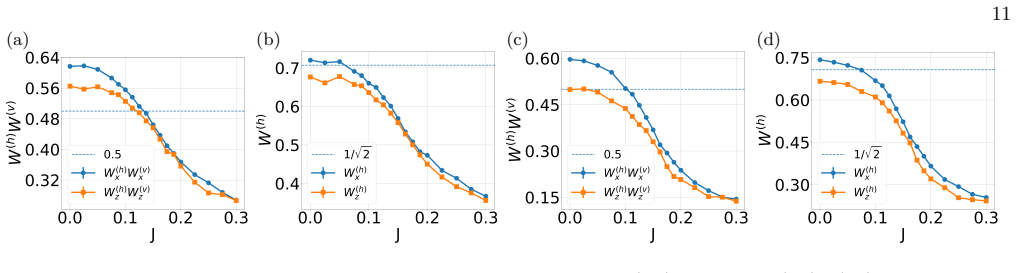
marks the topological regime, while the pronounced drop with J signals the approach to a topological phase transition and increased logical error propensity. Because of the near-degeneracy for even L discussed in Appendix D, they show slight deviation from the duality. (a) (b) FIG. 7. Composite non-contractible Wilson-loop diagnostic ¯Wd, defined in Eq. (...
-
[3]
cat-state
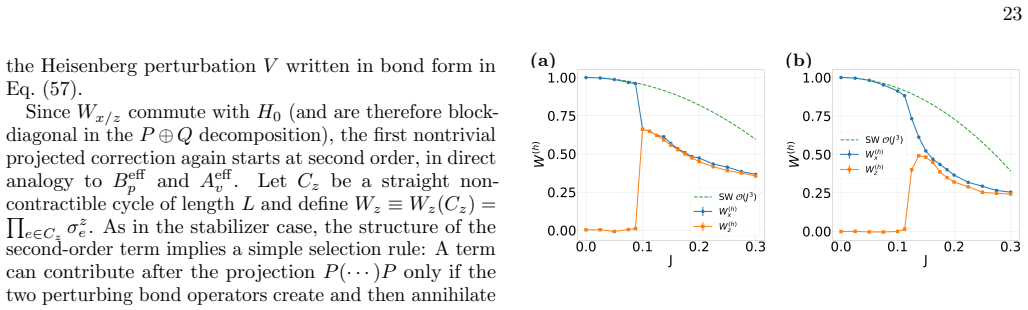
This confirms that the optimized finite-size ground state respects the Hamilto- nian duality. Furthermore, the loop products system- atically exceed the independent-qubit baseline of 1 /2, suggesting the presence of correlations between the log- ical sectors that are not captured by the simple mixing as predicted in Sec. C 6. We note that for very small J...
2056
-
[4]
Imposing the block-diagonal condition Eq
First-order generator,S 1 Expanding ˜H to first order gives ˜H = H SW 0 + V− [H SW 0 , S1]+O(J 2). Imposing the block-diagonal condition Eq. (C7) yields 0 =P V−[H SW 0 , S1] Q=Q V−[H SW 0 , S1] P.(C9) 17 Using P HSW 0 P = EP P and the identity (EP −H SW 0 )R = R(EP −H SW 0 ) = Q, one obtains the unique off-diagonal solution S1 =P V R−RV P, P S 1P=QS 1Q= 0...
-
[5]
Energy denominators from single-bond excitations To evaluate the expansion coefficients, we identify the excitation energies generated by a single bond operator acting on the ground space. The three components of the Heisenberg perturbation V create distinct anyonic configurations with corresponding energy gaps: •X b generates a pair of m-anyons on adjace...
-
[6]
back- tracking
Second-order expansion: Construction ofH (2) eff In the off-diagonal gauge, the second-order effective Hamiltonian takes the compact form H (2) eff =P V RV P.(C12) Writing V = J P b Vb with Vb ∈ {Xb, Yb, Zb}, each term P VbRVb′P is nonzero only if: (i) Vb creates a definite two- anyon excitation out of the code space, (ii) R contributes the corresponding ...
-
[7]
For a contribu- tion to be non-vanishing, the product of three single-bond operators must act as an identity or a logical operator within the code space
V anishing of the third-order corrections At third order, the effective Hamiltonian consists of terms with the schematic structure P V RV RV P(plus convention-dependent subtraction terms). For a contribu- tion to be non-vanishing, the product of three single-bond operators must act as an identity or a logical operator within the code space. However, on th...
-
[8]
Higher-order expansions: A logical-operator formalism At order n≥ 4, the effective Hamiltonian H (n) eff consists of operator structures generated by sequences of the per- turbation V and the reduced resolvent R, schematically 18 represented as P V RV R· · ·RV Pwith n insertions of V and (n− 1) resolvents R. These contributions fall into two categories: •...
-
[9]
Local stabilizers, which generate all contractible loop operators
-
[10]
Non-contractible Wilson loops, which wind around the cycles of the torus. Consequently, any gauge-invariant operator acting within the code space can be expanded in the generator set {Av},{B p},{W (h) x , W(v) x , W(h) z , W(v) z }.(C24) In particular, SW-generated terms generally appear as dec- orated winding operators: a non-contractible Wilson loop mul...
-
[11]
However, as reflected in the hierarchy above, these terms are exponen- tially suppressed with increasing system sizeL
Specifically, u( ¯X1 ¯X2 + ¯Z1 ¯Z2) favors aligned logical responses in both ¯X and ¯Z (enhancing ⟨ ¯X1 ¯X2⟩ and ⟨ ¯Z1 ¯Z2⟩ relative to the product-state estimate, 0.5), v( ¯X1 ¯Z2 + ¯Z1 ¯X2) locks ¯X of one qubit to ¯Z of the other (producing nonzero cross-correlators ⟨ ¯X1 ¯Z2⟩ and ⟨ ¯Z1 ¯X2⟩), and w ¯Y1 ¯Y2 generates additional two-qubit correlations w...
-
[12]
m”) loop encircling a single plaquette, while Av is the smallest electric (“ e
Dressing and mixing of contractible loop operators In the toric code, the plaquette and star stabilizers are the minimal contractible Z2 Wilson loops: Bp is the smallest magnetic (“m”) loop encircling a single plaquette, while Av is the smallest electric (“ e”) loop on the dual lattice. Any larger contractible Wilson loop can therefore be written as a pro...
-
[13]
Here S1 is the leading Schrieffer– Wolff generator defined in Eq
Dressing of non-contractible Wilson loops We define dressed non-contractible Wilson loops using the same SW unitary that generates Heff and the dressed stabilizers, W eff z ≡P eSWz e−SP, W eff x ≡P eSWx e−SP,(C71) with S = S1 + S2 + · · ·. Here S1 is the leading Schrieffer– Wolff generator defined in Eq. (C10), constructed from 23 the Heisenberg perturbat...
-
[14]
Kitaev, Fault-tolerant quantum computation by anyons, Annals of Physics303, 2 (2003)
A. Kitaev, Fault-tolerant quantum computation by anyons, Annals of Physics303, 2 (2003)
2003
-
[15]
Hamma, R
A. Hamma, R. Ionicioiu, and P. Zanardi, Ground state entanglement and geometric entropy in the kitaev model, Physics Letters A337, 22 (2005)
2005
-
[16]
Nayak, S
C. Nayak, S. H. Simon, A. Stern, M. Freedman, and S. Das Sarma, Non-abelian anyons and topological quan- tum computation, Rev. Mod. Phys.80, 1083 (2008)
2008
-
[17]
Bravyi, M
S. Bravyi, M. B. Hastings, and S. Michalakis, Topologi- cal quantum order: Stability under local perturbations, Journal of Mathematical Physics51, 093512 (2010)
2010
-
[18]
Dennis, A
E. Dennis, A. Kitaev, A. Landahl, and J. Preskill, Topolog- ical quantum memory, Journal of Mathematical Physics 43, 4452 (2002)
2002
-
[19]
P. A. Lee, N. Nagaosa, and X.-G. Wen, Doping a mott insulator: Physics of high-temperature superconductivity, Rev. Mod. Phys.78, 17 (2006)
2006
-
[20]
Senthil and M
T. Senthil and M. P. A. Fisher,Z2 gauge theory of electron fractionalization in strongly correlated systems, Phys. Rev. B62, 7850 (2000)
2000
-
[21]
M. A. Levin and X.-G. Wen, String-net condensation: A physical mechanism for topological phases, Phys. Rev. B 71, 045110 (2005)
2005
-
[22]
Kitaev, Anyons in an exactly solved model and beyond, Annals of Physics321, 2 (2006), january Special Issue
A. Kitaev, Anyons in an exactly solved model and beyond, Annals of Physics321, 2 (2006), january Special Issue
2006
-
[23]
D. S. Rokhsar and S. A. Kivelson, Superconductivity and the quantum hard-core dimer gas, Phys. Rev. Lett.61, 2376 (1988)
1988
-
[24]
Moessner and S
R. Moessner and S. L. Sondhi, Resonating valence bond phase in the triangular lattice quantum dimer model, Phys. Rev. Lett.86, 1881 (2001)
2001
-
[25]
Misguich, D
G. Misguich, D. Serban, and V. Pasquier, Quantum dimer model with extensive ground-state entropy on the kagome lattice, Phys. Rev. B67, 214413 (2003)
2003
-
[26]
Google Quantum AI, Suppressing quantum errors by scal- ing a surface code logical qubit, Nature614, 676 (2023)
2023
-
[27]
Yao, T.-X
X.-C. Yao, T.-X. Wang, H.-Z. Chen,et al., Experimental demonstration of topological error correction, Nature482, 489 (2012)
2012
-
[28]
Lu, W.-B
C.-Y. Lu, W.-B. Gao, O. G¨ uhne, X.-Q. Zhou, Z.-B. Chen, and J.-W. Pan, Demonstrating anyonic fractional statis- tics with a six-qubit quantum simulator, Phys. Rev. Lett. 102, 030502 (2009)
2009
-
[29]
K. J. Satzingeret al., Realizing topologically ordered states on a quantum processor, Science374, 1237 (2021)
2021
-
[30]
Acharyaet al.(Google Quantum AI and Collabora- tors), Quantum error correction below the surface code threshold, Nature638, 920 (2025)
R. Acharyaet al.(Google Quantum AI and Collabora- tors), Quantum error correction below the surface code threshold, Nature638, 920 (2025)
2025
-
[31]
F. Wu, Y. Deng, and N. Prokof’ev, Phase diagram of the toric code model in a parallel magnetic field, Phys. Rev. B85, 195104 (2012)
2012
-
[32]
Vidal, S
J. Vidal, S. Dusuel, and K. P. Schmidt, Low-energy effec- tive theory of the toric code model in a parallel magnetic field, Phys. Rev. B79, 033109 (2009)
2009
-
[33]
Dusuel, M
S. Dusuel, M. Kamfor, R. Or´ us, K. P. Schmidt, and J. Vidal, Robustness of a perturbed topological phase, Phys. Rev. Lett.106, 107203 (2011)
2011
-
[34]
Vidal, R
J. Vidal, R. Thomale, K. P. Schmidt, and S. Dusuel, Self- duality and bound states of the toric code model in a transverse field, Phys. Rev. B80, 081104 (2009)
2009
-
[35]
Karimipour, L
V. Karimipour, L. Memarzadeh, and P. Zarkeshian, Kitaev-ising model and the transition between topological and ferromagnetic order, Phys. Rev. A87, 032322 (2013)
2013
-
[36]
Trebst, P
S. Trebst, P. Werner, M. Troyer, K. Shtengel, and C. Nayak, Breakdown of a topological phase: Quantum phase transition in a loop gas model with tension, Phys. Rev. Lett.98, 070602 (2007)
2007
-
[37]
Carleo and M
G. Carleo and M. Troyer, Solving the quantum many-body problem with artificial neural networks, Science355, 602 (2017)
2017
-
[38]
Nomura, A
Y. Nomura, A. S. Darmawan, Y. Yamaji, and M. Imada, Restricted boltzmann machine learning for solving strongly correlated quantum systems, Phys. Rev. B96, 205152 (2017)
2017
-
[39]
Lange, A
H. Lange, A. Van de Walle, A. Abedinnia, and A. Bohrdt, From architectures to applications: a review of neural quantum states, Quantum Science and Technology9, 040501 (2024)
2024
-
[40]
Gao and L.-M
X. Gao and L.-M. Duan, Efficient representation of quan- tum many-body states with deep neural networks, Nature Communications8, 662 (2017)
2017
-
[41]
D.-L. Deng, X. Li, and S. Das Sarma, Quantum entangle- ment in neural network states, Phys. Rev. X7, 021021 (2017)
2017
-
[42]
Levine, O
Y. Levine, O. Sharir, N. Cohen, and A. Shashua, Quantum entanglement in deep learning architectures, Phys. Rev. Lett.122, 065301 (2019)
2019
-
[43]
Hibat-Allah, M
M. Hibat-Allah, M. Ganahl, L. E. Hayward, R. G. Melko, and J. Carrasquilla, Recurrent neural network wave func- tions, Phys. Rev. Res.2, 023358 (2020)
2020
-
[44]
Sharir, Y
O. Sharir, Y. Levine, N. Wies, G. Carleo, and A. Shashua, Deep autoregressive models for the efficient variational simulation of many-body quantum systems, Phys. Rev. Lett.124, 020503 (2020)
2020
-
[45]
can neural quantum states learn volume-law ground states?
Z. Denis, A. Sinibaldi, and G. Carleo, Comment on “can neural quantum states learn volume-law ground states?”, 26 Phys. Rev. Lett.134, 079701 (2025)
2025
-
[46]
Joshi, R
A. Joshi, R. Peters, and T. Posske, Ground state proper- ties of quantum skyrmions described by neural network quantum states, Phys. Rev. B108, 094410 (2023)
2023
-
[47]
Joshi, R
A. Joshi, R. Peters, and T. Posske, Quantum skyrmion dynamics studied by neural network quantum states, Phys. Rev. B110, 104411 (2024)
2024
-
[48]
Glasser, N
I. Glasser, N. Pancotti, M. August, I. D. Rodriguez, and J. I. Cirac, Neural-network quantum states, string-bond states, and chiral topological states, Phys. Rev. X8, 011006 (2018)
2018
-
[49]
J. Chen, S. Cheng, H. Xie, L. Wang, and T. Xiang, Equiva- lence of restricted boltzmann machines and tensor network states, Phys. Rev. B97, 085104 (2018)
2018
-
[50]
Huang and J
Y. Huang and J. E. Moore, Neural network representation of tensor network and chiral states, Phys. Rev. Lett.127, 170601 (2021)
2021
-
[51]
Hibat-Allah, E
M. Hibat-Allah, E. M. Inack, R. Wiersema, R. G. Melko, and J. Carrasquilla, Variational neural annealing, Nature Machine Intelligence3, 952 (2021)
2021
-
[52]
Valenti, E
A. Valenti, E. Greplova, N. H. Lindner, and S. D. Huber, Correlation-enhanced neural networks as interpretable variational quantum states, Phys. Rev. Res.4, L012010 (2022)
2022
-
[53]
Rende, S
R. Rende, S. Goldt, F. Becca, and L. L. Viteritti, Fine- tuning neural network quantum states, Phys. Rev. Res. 6, 043280 (2024)
2024
-
[54]
Bravyi, D
S. Bravyi, D. P. DiVincenzo, and D. Loss, Schrieffer–wolff transformation for quantum many-body systems, Annals of Physics326, 2793 (2011)
2011
-
[55]
Bravyi, D
S. Bravyi, D. P. Divincenzo, R. Oliveira, and B. M. Terhal, The complexity of stoquastic local hamiltonian problems, Quantum Info. Comput.8, 361–385 (2008)
2008
-
[56]
Troyer and U.-J
M. Troyer and U.-J. Wiese, Computational complexity and fundamental limitations to fermionic quantum monte carlo simulations, Phys. Rev. Lett.94, 170201 (2005)
2005
-
[57]
Marshall, Antiferromagnetism, Proceedings of the Royal Society of London
W. Marshall, Antiferromagnetism, Proceedings of the Royal Society of London. A. Mathematical and Physical Sciences232, 48 (1955)
1955
-
[58]
Liang, W.-Y
X. Liang, W.-Y. Liu, P.-Z. Lin, G.-C. Guo, Y.-S. Zhang, and L. He, Solving frustrated quantum many-particle models with convolutional neural networks, Phys. Rev. B 98, 104426 (2018)
2018
-
[59]
Liang, S.-J
X. Liang, S.-J. Dong, and L. He, Hybrid convolutional neural network and projected entangled pair states wave functions for quantum many-particle states, Phys. Rev. B103, 035138 (2021)
2021
-
[60]
K. Choo, T. Neupert, and G. Carleo, Two-dimensional frustrated J1−J2 model studied with neural network quan- tum states, Phys. Rev. B100, 125124 (2019)
2019
-
[61]
Szab´ o and C
A. Szab´ o and C. Castelnovo, Neural network wave func- tions and the sign problem, Phys. Rev. Res.2, 033075 (2020)
2020
-
[62]
M. Reh, M. Schmitt, and M. G¨ arttner, Optimizing design choices for neural quantum states, Phys. Rev. B107, 195115 (2023)
2023
-
[63]
Vieijra, C
T. Vieijra, C. Casert, J. Nys, W. De Neve, J. Haegeman, J. Ryckebusch, and F. Verstraete, Restricted boltzmann machines for quantum states with non-abelian or anyonic symmetries, Phys. Rev. Lett.124, 097201 (2020)
2020
-
[64]
Vieijra and J
T. Vieijra and J. Nys, Many-body quantum states with exact conservation of non-abelian and lattice symmetries through variational monte carlo, Phys. Rev. B104, 045123 (2021)
2021
-
[65]
Nomura and M
Y. Nomura and M. Imada, Dirac-type nodal spin liq- uid revealed by refined quantum many-body solver using neural-network wave function, correlation ratio, and level spectroscopy, Phys. Rev. X11, 031034 (2021)
2021
-
[66]
C. Roth and A. H. MacDonald, Group convolutional neural networks improve quantum state accuracy, arXiv preprint (2021), arXiv:2104.05085 [quant-ph]
Pith/arXiv arXiv 2021
-
[67]
Mezera, J
M. Mezera, J. Menˇ s ´ ıkov´ a, P. Bal´ aˇ z, and M.ˇZonda, Neural network quantum states analysis of the shastry-sutherland model, SciPost Physics Core6, 088 (2023)
2023
-
[68]
Zanardi and N
P. Zanardi and N. Paunkovi´ c, Ground state overlap and quantum phase transitions, Phys. Rev. E74, 031123 (2006)
2006
-
[69]
Zanardi, P
P. Zanardi, P. Giorda, and M. Cozzini, Information- theoretic differential geometry of quantum phase transi- tions, Phys. Rev. Lett.99, 100603 (2007)
2007
-
[70]
A. F. Albuquerque, F. Alet, C. Sire, and S. Capponi, Quantum critical scaling of fidelity susceptibility, Phys. Rev. B81, 064418 (2010)
2010
-
[71]
You, Y.-W
W.-L. You, Y.-W. Li, and S.-J. Gu, Fidelity, dynamic structure factor, and susceptibility in critical phenomena, Phys. Rev. E76, 022101 (2007)
2007
-
[72]
GU, Fidelity approach to quantum phase transi- tions, International Journal of Modern Physics B24, 4371 (2010)
S.-J. GU, Fidelity approach to quantum phase transi- tions, International Journal of Modern Physics B24, 4371 (2010)
2010
-
[73]
Kitaev and J
A. Kitaev and J. Preskill, Topological entanglement en- tropy, Phys. Rev. Lett.96, 110404 (2006)
2006
-
[74]
M. B. Hastings, I. Gonz´ alez, A. B. Kallin, and R. G. Melko, Measuring R´ enyi entanglement entropy in quantum monte carlo simulations, Phys. Rev. Lett.104, 157201 (2010), arXiv:1001.2335 [cond-mat.str-el]
Pith/arXiv arXiv 2010
-
[75]
A. J. Beekman, L. Rademaker, and J. van Wezel, An introduction to spontaneous symmetry breaking, SciPost Phys. Lect. Notes , 11 (2019)
2019
-
[76]
Jiang, H
H.-C. Jiang, H. Yao, and L. Balents, Spin liquid ground state of the spin-1/2 square j1–j2 heisenberg model, Phys- ical Review B86, 024424 (2012)
2012
-
[77]
St´ ephan, S
J.-M. St´ ephan, S. Furukawa, G. Misguich, and V. Pasquier, Shannon and entanglement entropies of one- and two- dimensional critical wave functions, Phys. Rev. B80, 184421 (2009)
2009
-
[78]
T. G. Kiely and E. J. Mueller, Role of conservation laws in the density matrix renormalization group, Physical Review B106, 235126 (2022)
2022
-
[79]
Y. You, E. Wybo, F. Pollmann, and S. L. Sondhi, Observ- ing quasiparticles through the entanglement lens, Physical Review B106, L161104 (2022)
2022
-
[80]
Laflorencie, Quantum entanglement in condensed mat- ter systems, Physics Reports646, 1 (2016)
N. Laflorencie, Quantum entanglement in condensed mat- ter systems, Physics Reports646, 1 (2016)
2016
discussion (0)
Sign in with ORCID, Apple, or X to comment. Anyone can read and Pith papers without signing in.