REVIEW 3 major objections 5 minor 1 cited by
A Dynamical Bulk-Boundary Correspondence in Two Dimensional Topological Matter
T0 review · 3 major / 5 minor · reviewed 2026-08-05 · deepseek-v4-flash
Pith's one-line read The paper establishes a dynamical bulk-boundary correspondence in two-dimensional topological matter: quenches into nontrivial phases produce in-gap Loschmidt bands that drive the boundary return rate.
desk verdict Real new observation of in-gap Loschmidt bands for 2D topological quenches, but the causal attribution to the boundary return rate is a fitted consistency check, not a proof. read the letter →
The pith
A machine-rendered reading of the paper's core claim, the machinery that carries it, and where it could break.
The reading
What carries the argument
The central object is the non-Hermitian dynamical Loschmidt matrix $\mathcal{M}(t)=1-C+C e^{-itH_1}$, where $C$ is the ground-state correlation matrix of the initial Hamiltonian; its determinant gives the Loschmidt amplitude and its eigenvalues $\lambda_i(t)$ the return rate. The load-bearing spectral feature is a band of in-gap eigenvalues with strictly linear dispersion $|\lambda_k|=v k$ that appears between successive critical times; Eq. (19) turns its width $2\Delta k$, degeneracy $\delta$, and edge value $\tilde\lambda$ into a quantitative prediction for the boundary return rate. The matrix also supplies the exponentially small ribbon-only eigenvalues that distinguish ribbon and flake b
What would settle it
For the $\nu:0\to1$ quench, fit the in-gap band dispersion at a fixed time to $|\lambda_k|=v k + a k^2$; a significant quadratic coefficient $a$ invalidates Eq. (19). Separately, enlarge the flake scaling to $N\sim 200$ and check whether $l_B(t)-\tilde l_B(t)$ vanishes or retains a $1/N^2$ term; a retained term means the scaling forms did not isolate the boundary contribution.
Extended reading notes
Core claim
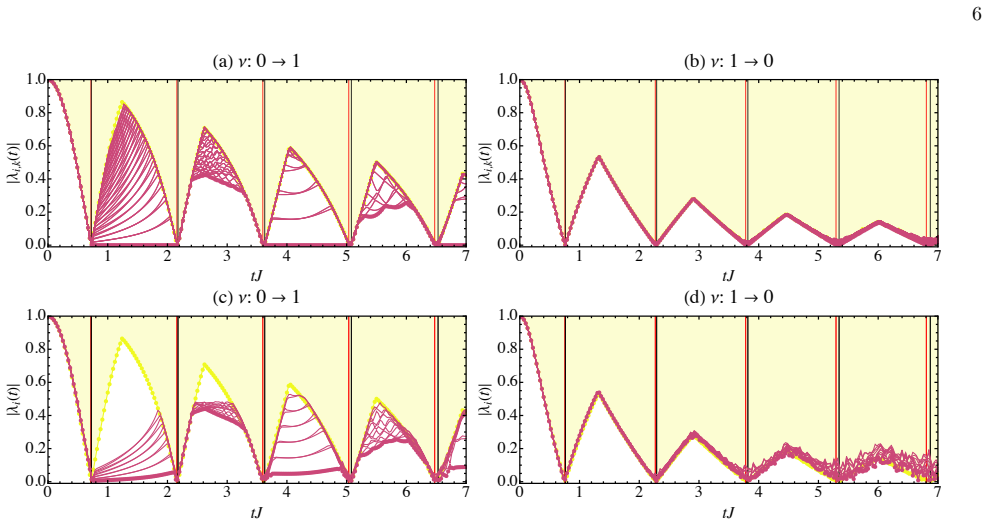
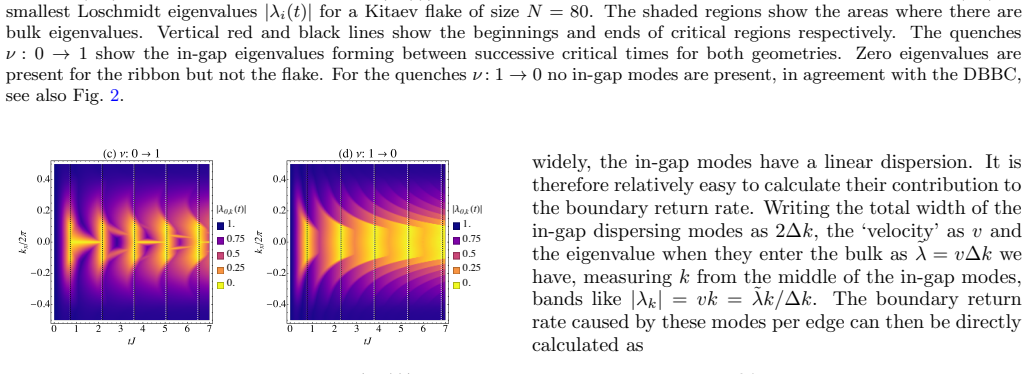
Using a spinless $p_x+ip_y$ superconductor on a square lattice (the two-dimensional Kitaev model), the authors quench between phases with Chern numbers $\nu=0$, $\nu=1$, and $\nu=-1$, and compute the Loschmidt amplitude from the determinant of the Loschmidt matrix $\mathcal{M}(t)=1-C+C e^{-itH_1}$. For quenches ending in a topologically non-trivial phase, the smallest eigenvalues of $\mathcal{M}$ form linear in-gap bands, $|\lambda_k|=v k$, between successive critical regions; for quenches into the trivial phase these bands are absent. Fitting the band width $2\Delta k$, the degeneracy $\delta$, and the edge eigenvalue $\tilde\lambda=v\Delta k$, they compute a boundary return rate $\tilde l_
Load-bearing premise
The central quantitative claim assumes the in-gap bands are strictly linear in momentum over their full width and that the finite-size scaling used to extract the boundary return rate captures only the boundary contribution, with no higher-order bulk corrections contaminating the result.
Editorial extensions
If this is right
- The boundary return rate $l_B(t)$ can act as a dynamical order parameter: large periodic boundary contributions appear if and only if the time-evolving Hamiltonian is topologically non-trivial.
- In-gap dispersing bands, not only zero-energy modes, generate the boundary signal, so the boundary return rate slopes downward between critical times instead of sitting at a plateau.
- The difference between open ribbons and fully open flakes is quantitatively the sum of exponentially small Loschmidt eigenvalues present only in the ribbon, tracing back to Majorana zero modes of the time-evolving Hamiltonian.
- The correspondence extends the one-dimensional dynamical bulk-boundary correspondence to ordinary two-dimensional topological insulators and superconductors and suggests that Loschmidt-matrix spectra can classify dynamical topological phenomena.
- Disorder robustness of the in-gap bands indicates the effect is topological rather than a finite-size artifact.
Reading between the lines
- The paper leaves implicit that the predicted $\tilde l_B$ depends on edge orientation through $\delta$ and $\Delta k$; cutting flakes along different lattice directions is a direct test.
- If a time-dependent topological index counting in-gap bands can be defined, the correspondence would move from empirical to derived; the band width and degeneracy are natural candidates for such an index.
- The same Loschmidt-matrix mechanism should appear in three-dimensional topological matter, where Fisher zeroes occupy volumes; the boundary contribution would then scale with surface area and in-gap sheets would replace bands.
- Momentum-resolved measurements of Loschmidt spectra in synthetic quantum systems should show the in-gap bands as bright lines, making the correspondence observable without finite-size scaling.
Signed reviews
Editorial analysis
A structured set of objections, weighed in public.
Referee Report
Summary. The manuscript presents numerical evidence for a dynamical bulk-boundary correspondence in a two-dimensional Kitaev lattice model. Following quenches into a topologically nontrivial phase, bands of in-gap eigenvalues appear in the spectrum of the Loschmidt matrix between successive critical times, while such bands are absent for quenches into the trivial phase. The authors propose Eq. (19), a formula for the boundary contribution to the return rate based on a linear-dispersion in-gap band, and fit parameters δ, Δk, and λ̃ to the same spectra. They report agreement between this fitted contribution and the boundary return rate extracted from finite-size scaling, concluding that the in-gap bands are directly responsible for the boundary term. Additional quenches and disorder checks are presented.
Significance. If established, the result would extend the dynamical bulk-boundary correspondence to two-dimensional topological matter and connect the spectrum of a non-Hermitian Loschmidt matrix to boundary contributions of the dynamical free energy. The clean qualitative observation—in-gap bands appear only for topological quenches and are robust to geometry and disorder—is valuable and likely correct. The paper includes data availability statements and multiple cross-checks. However, the quantitative causal link currently rests on a fitted linear-dispersion ansatz, so the paper's strongest claim is not yet fully supported.
major comments (3)
- [§IV A, Eq. (19)] The central quantitative claim is supported only by a consistency fit. Eq. (19) assumes a strictly linear in-gap dispersion |λ_k| = v|k| = λ̃|k|/Δk over a width 2Δk, and the parameters δ, Δk, and λ̃ are extracted from the same finite-size Loschmidt spectra whose boundary contribution they are meant to explain. No goodness-of-fit, error bars, or independent test of the linear form are provided. The agreement in Fig. 2 therefore does not distinguish the linear-band model from a generic curved dispersion, which would change the integral in Eq. (19). To make the causal claim load-bearing, please compute the boundary return rate directly from the sum over the in-gap eigenvalues, e.g. \tilde l_B^{direct}(t) = -1/(2N_x) ∑_{k∈in-gap} ln|λ_k(t)| for the ribbon and the analogous four-edge sum for the flake, without fitting, and compare with l_B(t) from the scaling forms. This would also validate t
- [§IV A, Eqs. (13)–(14), Fig. 7] The finite-size scaling forms are assumed to isolate the boundary term. In Eq. (13), with N_x fixed at 202 and N_y ∈ {200,...,700}, the 'bulk correction' A/(N_x N_y) is of the same order in 1/N_y as the boundary term itself, so the extraction of l_B(t) depends on the flake-derived A(t) being transferable to the ribbon geometry and on the absence of an O(1/N_y^2) correction. The ribbon scaling collapse in Fig. 7 is helpful, but the flake scaling and the extracted A(t) are not shown, and no sensitivity test to including a 1/N_y^2 term is reported. Please provide these, or justify the scaling forms from a controlled expansion, to rule out contamination of l_B(t) by bulk finite-size effects.
- [Appendix E and §IV A] The quantitative identification of l_B(t) with the in-gap-band contribution is demonstrated for one quench (ν:0→1) only. For the other topological quenches (ν:1→−1 and ν:1(Δ>0)→1(Δ<0)), the text states that 'a direct comparison to l_B(t) is hindered by insufficient system sizes to perform a stable scaling analysis' (Appendix E). The qualitative in-gap bands are visible, but the claim that they 'directly account' for the boundary return rate in general is not yet supported. Either provide a stable scaling comparison for at least one additional topological quench, or soften the central claim to a conjecture for these cases.
minor comments (5)
- [§II, Eq. (7)] The notation λ_i → (1, λ_k) is unclear. Please state explicitly that half the eigenvalues are identically 1 and only the λ_k sector is nontrivial.
- [Fig. 2 caption] The symbols are not defined in the main text; please state clearly that they are \tilde l_B and \tilde l_{B+0}, and indicate the time points at which they are evaluated.
- [Eq. (20)] The index i in α_i is not defined; specify that it labels the exponentially small zero modes of the ribbon.
- [Appendix C, Fig. 7] The y-axis label '104lB(t)/Ny' should read '10^4 l_B(t)/N_y'.
- [§IV A] The text introduces a 'velocity' v, but v never appears explicitly in Eq. (19). This is fine if v cancels in the derivation, but it should be noted or shown explicitly.
Circularity Check
No significant circularity: the central comparison is a consistency check between two independently extracted quantities, and the fitted in-gap band parameters do not enter the finite-size scaling that defines l_B(t).
full rationale
The paper's central quantitative claim is that in-gap bands of the Loschmidt matrix account for the boundary return rate. Although the band parameters (Δk, δ, λ̃, and α_i) are fitted from the same numerical Loschmidt spectra, the boundary return rate l_B(t) is obtained independently from the finite-size scaling of the full return rate via Eqs. (13)-(14). Eq. (19) is an integral over the fitted linear dispersion; it does not reduce to l_B by construction—the agreement in Fig. 2 could fail if the dispersion were curved or if the scaling forms were contaminated by bulk corrections. The paper's own wording, 'by fitting these in-gap bands,' correctly identifies the comparison as a consistency check rather than a parameter-free prediction. The self-citations to earlier DBBC work [13-16] motivate expectations but are not load-bearing; the 2D in-gap band calculation and the comparison to independently scaled l_B are performed in this paper. Concerns about the goodness of the linear-dispersion fit and possible 1/N^2 contamination in the scaling forms are correctness risks, not circularity. No step in the derivation is equivalent by definition to its inputs.
Assumptions & free parameters
free parameters (4)
- in-gap band degeneracy δ =
1 or 2 depending on geometry
- in-gap band half-width Δk =
time-dependent, extracted from spectra
- edge eigenvalue λ̃ =
time-dependent, extracted from spectra
- zero-mode decay rates α_i =
from exponential scaling
assumptions (4)
- standard math Loschmidt amplitude equals the determinant of the single-particle matrix M(t) = 1 - C + C e^{-itH_1} (Levitov/Klich formula).
- domain assumption The initial state is the half-filled ground state of H_0, i.e., f = N/2 filled bands.
- ad hoc to paper In-gap Loschmidt eigenvalues have a linear dispersion |λ_k| = v k over a width 2Δk.
- domain assumption Boundary return rate obeys the scaling forms l_N = l_bulk + 2 l_B/N_y + A/(N_x N_y) (ribbon) and l_N = l_bulk + 4 l_B/N + A/N^2 (flake).
Cite this review
Pith. "Pith review of A Dynamical Bulk-Boundary Correspondence in Two Dimensional Topological Matter." pith.science (2026). https://pith.science/paper/DN2C5RWN
@misc{pith2026250811521,
  author       = {Pith},
  title        = {Pith review of: A Dynamical Bulk-Boundary Correspondence in Two Dimensional Topological Matter},
  year         = {2026},
  howpublished = {\url{https://pith.science/paper/DN2C5RWN}},
  note         = {Machine review of arXiv:2508.11521}
}
read the original abstract
We provide strong numerical evidence for a dynamical bulk-boundary correspondence in two-dimensional topological matter which manifests itself as boundary contributions to the dynamical free energy and is governed by a two-dimensional non-Hermitian dynamical Loschmidt matrix -- a setting largely unexplored beyond one dimension. Following a quantum quench, in-gap bands emerge in the spectrum of the Loschmidt matrix between successive dynamical quantum phase transitions when the time-evolving Hamiltonian is topological, while they are absent for quenches into the trivial phase in all cases we have studied. By fitting these in-gap bands, we show that they account for the observed boundary contributions to the dynamical free energy thus supporting a direct connection between the spectrum of a non-Hermitian dynamical matrix and topological boundary contributions. Taken together with earlier studies of the one-dimensional case, our results provide a framework to understand and classify dynamical topological phenomena based on the spectral properties of certain non-Hermitian matrices.
Figures


Figures from the paper (7 more)


Forward citations
Cited by 1 Pith paper
-
On the Relation Between String Order Parameters, Entanglement, and Dynamical Quantum Phase Transitions in Topological Dynamics
String order parameter zeroes and entanglement spectrum crossings do not generally coincide with or indicate the critical times of dynamical quantum phase transitions in quenched 1D topological models.
Reference graph
Works this paper leans on
-
[1]
S. Ryu, A. P. Schnyder, A. Furusaki, and A. W. W. Lud- wig, Topological insulators and superconductors: Ten- fold way and dimensional hierarchy, New Journal of Physics 12, 65010 (2010)
2010
-
[2]
M. Z. Hasan and C. L. Kane, Colloquium: Topological insulators, Reviews of Modern Physics 82, 3045 (2010)
2010
-
[3]
Trifunovic and P
L. Trifunovic and P. W. Brouwer, Higher-Order Topo- logical Band Structures, physica status solidi (b) 258, 2000090 (2021)
2021
-
[4]
M. M. Ma´ ska, N. Sedlmayr, A. Kobia lka, and T. Doma´ nski, Unconventional topological transitions in a self-organized magnetic ladder, Physical Review B 103, 235419 (2021)
2021
-
[5]
C. K. Chiu, J. C. Teo, A. P. Schnyder, and S. Ryu, Classification of topological quantum matter with sym- metries, Reviews of Modern Physics 88, 035005 (2016)
2016
-
[6]
Trifunovic and P
L. Trifunovic and P. W. Brouwer, Higher-order bulk- boundary correspondence for topological crystalline phases, Physical Review X 9, 011012 (2019)
2019
-
[7]
M. Heyl, A. Polkovnikov, and S. Kehrein, Dynamical quantum phase transitions in the transverse-field ising model, Physical Review Letters 110, 135704 (2013)
2013
-
[8]
Andraschko and J
F. Andraschko and J. Sirker, Dynamical quantum phase transitions and the Loschmidt echo: A transfer matrix approach, Physical Review B 89, 125120 (2014)
2014
Show all 110 references
-
[9]
Heyl, Dynamical quantum phase transitions: A re- view, Reports on Progress in Physics 81, 054001 (2018)
M. Heyl, Dynamical quantum phase transitions: A re- view, Reports on Progress in Physics 81, 054001 (2018)
2018
-
[10]
Heyl, Dynamical quantum phase transitions: A brief survey, EPL (Europhysics Letters) 125, 26001 (2019)
M. Heyl, Dynamical quantum phase transitions: A brief survey, EPL (Europhysics Letters) 125, 26001 (2019)
2019
-
[11]
Sedlmayr, Dynamical Phase Transitions in Topo- logical Insulators, Acta Physica Polonica A 135, 1191 (2019)
N. Sedlmayr, Dynamical Phase Transitions in Topo- logical Insulators, Acta Physica Polonica A 135, 1191 (2019)
2019
-
[12]
Sirker, M
J. Sirker, M. Maiti, N. P. Konstantinidis, and N. Sedl- mayr, Boundary fidelity and entanglement in the sym- metry protected topological phase of the SSH model, Journal of Statistical Mechanics: Theory and Experi- ment 2014, P10032 (2014)
2014
-
[13]
Sedlmayr, P
N. Sedlmayr, P. Jaeger, M. Maiti, and J. Sirker, Bulk- boundary correspondence for dynamical phase transi- tions in one-dimensional topological insulators and su- perconductors, Physical Review B 97, 064304 (2018)
2018
-
[14]
Mas lowski and N
T. Mas lowski and N. Sedlmayr, Quasiperiodic dynam- ical quantum phase transitions in multiband topolog- ical insulators and connections with entanglement en- tropy and fidelity susceptibility, Physical Review B101, 014301 (2020)
2020
-
[15]
Mas lowski and N
T. Mas lowski and N. Sedlmayr, Dynamical bulk- boundary correspondence and dynamical quantum phase transitions in higher-order topological insulators, Physical Review B 108, 094306 (2023)
2023
-
[16]
Mas lowski and N
T. Mas lowski and N. Sedlmayr, The dynamical bulk boundary correspondence and dynamical quantum phase transitions in the Benalcazar-Bernevig-Hughes model, Journal of Physics: Condensed Matter 36, 10.1088/1361-648X/ad4a16 (2024)
2024 doi
-
[17]
Rigol, V
M. Rigol, V. Dunjko, and M. Olshanii, Thermalization and its mechanism for generic isolated quantum sys- tems, Nature 452, 854 (2008)
2008
-
[18]
Polkovnikov, K
A. Polkovnikov, K. Sengupta, A. Silva, and M. Ven- galattore, Colloquium : Nonequilibrium dynamics of closed interacting quantum systems, Reviews of Mod- ern Physics 83, 863 (2011)
2011
-
[19]
Rigol and M
M. Rigol and M. Srednicki, Alternatives to eigenstate thermalization, Physical Review Letters 108, 110601 (2012)
2012
-
[20]
Marino, M
J. Marino, M. Eckstein, M. S. Foster, and A. M. Rey, 10 0 1 2 3 40.0 0.2 0.4 0.6 0.8 1.0 tJ |λi,k(t)| (a)ν : 1 →- 1 0 1 2 3 40.0 0.2 0.4 0.6 0.8 1.0 tJ |λi,k(t)| (b)ν : 1 (Δ>0)→ 1 (Δ<0) FIG. 10. (a,b) 80 smallest Loschmidt eigenvalues |λi(t)| for a Kitaev ribbon of size 202 × ...
2022
-
[21]
´A. L. Corps and A. Rela˜ no, Theory of dynami- cal phase transitions in collective quantum systems, arXiv:2205.03443 [cond-mat, physics:quant-ph] (2022)
2022 arXiv
-
[22]
Vajna and B
S. Vajna and B. D´ ora, Disentangling dynamical phase transitions from equilibrium phase transitions, Physical Review B 89, 161105(R) (2014)
2014
-
[23]
Karrasch and D
C. Karrasch and D. Schuricht, Dynamical quantum phase transitions in the quantum Potts chain, Physical Review B 95, 075143 (2017)
2017
-
[24]
Jafari and H
R. Jafari and H. Johannesson, Decoherence from spin environments: Loschmidt echo and quasiparticle exci- tations, Physical Review B 96, 224302 (2017)
2017
-
[25]
Cheraghi and S
H. Cheraghi and S. Mahdavifar, Ineffectiveness of the Dzyaloshinskii–Moriya interaction in the dynamical quantum phase transition in the ITF model, Journal of Physics: Condensed Matter 30, 42LT01 (2018)
2018
-
[26]
Jafari, Dynamical Quantum Phase Transition and Quasi Particle Excitation, Scientific Reports 9, 2871 (2019)
R. Jafari, Dynamical Quantum Phase Transition and Quasi Particle Excitation, Scientific Reports 9, 2871 (2019)
2019
-
[27]
Wrze´ sniewski, I
K. Wrze´ sniewski, I. Weymann, N. Sedlmayr, and T. Doma´ nski, Dynamical quantum phase transitions in a mesoscopic superconducting system, Physical Review B 105, 094514 (2022)
2022
-
[28]
Karrasch and D
C. Karrasch and D. Schuricht, Dynamical phase transi- tions after quenches in nonintegrable models, Physical Review B 87, 195104 (2013)
2013
-
[29]
Heyl, Dynamical quantum phase transitions in sys- tems with broken-symmetry phases, Physical Review Letters 113, 205701 (2014)
M. Heyl, Dynamical quantum phase transitions in sys- tems with broken-symmetry phases, Physical Review Letters 113, 205701 (2014)
2014
-
[30]
Heyl, Scaling and Universality at Dynamical Quan- tum Phase Transitions, Physical Review Letters 115, 140602 (2015)
M. Heyl, Scaling and Universality at Dynamical Quan- tum Phase Transitions, Physical Review Letters 115, 140602 (2015)
2015
-
[31]
Sharma, S
S. Sharma, S. Suzuki, and A. Dutta, Quenches and dy- namical phase transitions in a nonintegrable quantum Ising model, Physical Review B 92, 104306 (2015)
2015
-
[32]
J. C. Halimeh and V. Zauner-Stauber, Dynamical phase diagram of quantum spin chains with long-range inter- actions, Physical Review B 96, 134427 (2017)
2017
-
[33]
Homrighausen, N
I. Homrighausen, N. O. Abeling, V. Zauner-Stauber, and J. C. Halimeh, Anomalous dynamical phase in quantum spin chains with long-range interactions, Phys- 11 ical Review B 96, 104436 (2017)
2017
-
[34]
J. C. Halimeh, M. Van Damme, V. Zauner-Stauber, and L. Vanderstraeten, Quasiparticle Origin of Dynamical Quantum Phase Transitions, Physical Review Research 2, 033111 (2020)
2020
-
[35]
Shpielberg, T
O. Shpielberg, T. Nemoto, and J. Caetano, Universal- ity in dynamical phase transitions of diffusive systems, Physical Review E 98, 052116 (2018)
2018
-
[36]
Zunkovic, M
B. Zunkovic, M. Heyl, M. Knap, and A. Silva, Dynam- ical Quantum Phase Transitions in Spin Chains with Long-Range Interactions: Merging different concepts of non-equilibrium criticality, Physical Review Letters 120, 130601 (2018)
2018
-
[37]
Srivastav, U
V. Srivastav, U. Bhattacharya, and A. Dutta, Dynam- ical quantum phase transitions in extended toric-code models, Physical Review B 100, 144203 (2019)
2019
-
[38]
Huang, D
Y.-P. Huang, D. Banerjee, and M. Heyl, Dynamical Quantum Phase Transitions in U(1) Quantum Link Models, Physical Review Letters 122, 250401 (2019)
2019
-
[39]
Gurarie, Dynamical quantum phase transitions in the random field Ising model, Physical Review A 100, 031601(R) (2019)
V. Gurarie, Dynamical quantum phase transitions in the random field Ising model, Physical Review A 100, 031601(R) (2019)
2019
-
[40]
Abdi, Dynamical quantum phase transition in Bose- Einstein condensates, Physical Review B 100, 184310 (2019)
M. Abdi, Dynamical quantum phase transition in Bose- Einstein condensates, Physical Review B 100, 184310 (2019)
2019
-
[41]
Puebla, Finite-component dynamical quantum phase transitions, Physical Review B 102, 220302(R) (2020)
R. Puebla, Finite-component dynamical quantum phase transitions, Physical Review B 102, 220302(R) (2020)
2020
-
[42]
Link and W
V. Link and W. T. Strunz, Dynamical Phase Transitions in Dissipative Quantum Dynamics with Quantum Op- tical Realization, Physical Review Letters 125, 143602 (2020)
2020
-
[43]
Sun and B.-B
G. Sun and B.-B. Wei, Dynamical quantum phase tran- sitions in a spin chain with deconfined quantum critical points, Physical Review B 102, 094302 (2020)
2020
-
[44]
Rylands, E
C. Rylands, E. A. Yuzbashyan, V. Gurarie, A. Zabalo, and V. Galitski, Loschmidt echo of far-from-equilibrium fermionic superfluids, Annals of Physics 435, 168554 (2021)
2021
-
[45]
Trapin, J
D. Trapin, J. C. Halimeh, and M. Heyl, Unconventional critical exponents at dynamical quantum phase transi- tions in a random Ising chain, Physical Review B 104, 115159 (2021)
2021
-
[46]
W. C. Yu, P. D. Sacramento, Y. C. Li, and H.-Q. Lin, Correlations and dynamical quantum phase transitions in an interacting topological insulator, Physical Review B 104, 085104 (2021)
2021
-
[47]
J. C. Halimeh, M. Van Damme, L. Guo, J. Lang, and P. Hauke, Dynamical phase transitions in quantum spin models with antiferromagnetic long-range interactions, Physical Review B 104, 115133 (2021)
2021
-
[48]
J. C. Halimeh, D. Trapin, M. Van Damme, and M. Heyl, Local measures of dynamical quantum phase transi- tions, Physical Review B 104, 075130 (2021)
2021
-
[49]
De Nicola, A
S. De Nicola, A. A. Michailidis, and M. Serbyn, En- tanglement View of Dynamical Quantum Phase Transi- tions, Physical Review Letters 126, 040602 (2021)
2021
-
[50]
Cheraghi and S
H. Cheraghi and S. Mahdavifar, Dynamical Quantum Phase Transitions in the 1D Nonintegrable Spin-1/2 Transverse Field XZZ Model, Annalen der Physik , 2000542 (2021)
2021
-
[51]
K. Cao, Z. Ming, and P. Tong, Dynamical quantum phase transition in quantum spin chains with gapless phases, arXiv:2106.00191 [cond-mat] (2021)
2021 arXiv
-
[52]
Bandyopadhyay, A
S. Bandyopadhyay, A. Polkovnikov, and A. Dutta, Ob- serving Dynamical Quantum Phase Transitions through Quasilocal String Operators, Physical Review Letters 126, 200602 (2021)
2021
-
[53]
Cheraghi and N
H. Cheraghi and N. Sedlmayr, Dynamical quantum phase transitions following double quenches: Persis- tence of the initial state vs dynamical phases, New Jour- nal of Physics 25, 103035 (2023)
2023
-
[54]
C. Y. Wong, H. Cheraghi, and W. C. Yu, Quantum spin fluctuations in dynamical quantum phase transitions, Physical Review B 108, 064305 (2023)
2023
-
[55]
Jurcevic, H
P. Jurcevic, H. Shen, P. Hauke, C. Maier, T. Brydges, C. Hempel, B. P. Lanyon, M. Heyl, R. Blatt, and C. F. Roos, Direct Observation of Dynamical Quantum Phase Transitions in an Interacting Many-Body System, Phys- ical Review Letters 119, 080501 (2017)
2017
-
[56]
Fl¨ aschner, D
N. Fl¨ aschner, D. Vogel, M. Tarnowski, B. S. Rem, D. S. L¨ uhmann, M. Heyl, J. C. Budich, L. Mathey, K. Sen- gstock, and C. Weitenberg, Observation of dynamical vortices after quenches in a system with topology, Na- ture Physics 14, 265 (2018)
2018
-
[57]
Zhang, G
J. Zhang, G. Pagano, P. W. Hess, A. Kyprianidis, P. Becker, H. Kaplan, A. V. Gorshkov, Z.-X. Gong, and C. Monroe, Observation of a many-body dynami- cal phase transition with a 53-qubit quantum simulator, Nature 551, 601 (2017)
2017
-
[58]
X.-Y. Guo, C. Yang, Y. Zeng, Y. Peng, H.-K. Li, H. Deng, Y.-R. Jin, S. Chen, D. Zheng, and H. Fan, Observation of a Dynamical Quantum Phase Transition by a Superconducting Qubit Simulation, Physical Re- view Applied 11, 044080 (2019)
2019
-
[59]
Smale, P
S. Smale, P. He, B. A. Olsen, K. G. Jackson, H. Sharum, S. Trotzky, J. Marino, A. M. Rey, and J. H. Thywissen, Observation of a transition between dynamical phases in a quantum degenerate Fermi gas, Science Advances 5, eaax1568 (2019)
2019
-
[60]
Nie, B.-B
X. Nie, B.-B. Wei, X. Chen, Z. Zhang, X. Zhao, C. Qiu, Y. Tian, Y. Ji, T. Xin, D. Lu, and J. Li, Experimen- tal Observation of Equilibrium and Dynamical Quan- tum Phase Transitions via Out-of-Time-Ordered Corre- lators, Physical Review Letters 124, 250601 (2020)
2020
-
[61]
Tian, H.-X
T. Tian, H.-X. Yang, L.-Y. Qiu, H.-Y. Liang, Y.-B. Yang, Y. Xu, and L.-M. Duan, Observation of Dynam- ical Quantum Phase Transitions with Correspondence in an Excited State Phase Diagram, Physical Review Letters 124, 043001 (2020)
2020
-
[62]
Sharma, A
S. Sharma, A. Russomanno, G. E. Santoro, and A. Dutta, Loschmidt echo and dynamical fidelity in pe- riodically driven quantum systems, Europhysics Letters 106, 67003 (2014)
2014
-
[63]
K. Yang, L. Zhou, W. Ma, X. Kong, P. Wang, X. Qin, X. Rong, Y. Wang, F. Shi, J. Gong, and J. Du, Floquet dynamical quantum phase transitions, Physical Review B 100, 085308 (2019)
2019
-
[64]
Zamani, R
S. Zamani, R. Jafari, and A. Langari, Floquet dynamical quantum phase transition in the extended XY model: Nonadiabatic to adiabatic topological transition, Phys- ical Review B 102, 144306 (2020)
2020
-
[65]
Zhou and Q
L. Zhou and Q. Du, Floquet dynamical quantum phase transitions in periodically quenched systems, Journal of Physics: Condensed Matter 33, 345403 (2021)
2021
-
[66]
Jafari and A
R. Jafari and A. Akbari, Floquet dynamical phase tran- sition and entanglement spectrum, Physical Review A 103, 012204 (2021)
2021
-
[67]
Hamazaki, Exceptional dynamical quantum phase 12 transitions in periodically driven systems, Nature Com- munications 12, 5108 (2021)
R. Hamazaki, Exceptional dynamical quantum phase 12 transitions in periodically driven systems, Nature Com- munications 12, 5108 (2021)
2021
-
[68]
Zamani, R
S. Zamani, R. Jafari, and A. Langari, Out-of-time-order correlations and Floquet dynamical quantum phase transition, Physical Review B 105, 094304 (2022)
2022
-
[69]
Luan, M.-Y
L.-N. Luan, M.-Y. Zhang, and L. Wang, Floquet dynam- ical quantum phase transitions of the XY spin-chain un- der periodic quenching, Physica A: Statistical Mechan- ics and its Applications 604, 127866 (2022)
2022
-
[70]
Jafari, A
R. Jafari, A. Akbari, U. Mishra, and H. Johannesson, Floquet dynamical quantum phase transitions under synchronized periodic driving, Physical Review B 105, 094311 (2022)
2022
-
[71]
B. Mera, C. Vlachou, N. Paunkovi´ c, V. R. Vieira, and O. Viyuela, Dynamical phase transitions at finite tem- perature from fidelity and interferometric Loschmidt echo induced metrics, Physical Review B 97, 094110 (2018)
2018
-
[72]
Sedlmayr, M
N. Sedlmayr, M. Fleischhauer, and J. Sirker, The fate of dynamical phase transitions at finite temperatures and in open systems, Physical Review B 97, 045147 (2018)
2018
-
[73]
Bhattacharya, S
U. Bhattacharya, S. Bandyopadhyay, and A. Dutta, Mixed state dynamical quantum phase transitions, Physical Review B 96, 180303(R) (2017)
2017
-
[74]
Heyl and J
M. Heyl and J. C. Budich, Dynamical topological quan- tum phase transitions for mixed states, Physical Review B 96, 180304(R) (2017)
2017
-
[75]
N. O. Abeling and S. Kehrein, Quantum quench dy- namics in the transverse field Ising model at nonzero temperatures, Physical Review B 93, 104302 (2016)
2016
-
[76]
J. Lang, B. Frank, and J. C. Halimeh, Dynamical Quan- tum Phase Transitions: A Geometric Picture, Physical Review Letters 121, 130603 (2018)
2018
-
[77]
J. Lang, B. Frank, and J. C. Halimeh, Concurrence of dynamical phase transitions at finite temperature in the fully connected transverse-field Ising model, Physical Review B 97, 174401 (2018)
2018
-
[78]
T. H. Kyaw, V. M. Bastidas, J. Tangpanitanon, G. Romero, and L.-C. Kwek, Dynamical quantum phase transitions and non-Markovian dynamics, Physical Re- view A 101, 012111 (2020)
2020
-
[79]
Starchl and L
E. Starchl and L. M. Sieberer, Relaxation to a Parity- Time Symmetric Generalized Gibbs Ensemble after a Quantum Quench in a Driven-Dissipative Kitaev Chain, Physical Review Letters 129, 220602 (2022)
2022
-
[80]
J. Naji, M. Jafari, R. Jafari, and A. Akbari, Dissipative Floquet Dynamical Quantum Phase Transition, Physi- cal Review A 105, 022220 (2022)
2022
-
[81]
Kawabata, A
K. Kawabata, A. Kulkarni, J. Li, T. Numasawa, and S. Ryu, Dynamical quantum phase transitions in Sachdev-Ye-Kitaev Lindbladians, Physical Review B 108, 075110 (2023)
2023
-
[82]
Jafari, A
R. Jafari, A. Akbari, M. Biderang, and J. Sirker, Noise- Affected Dynamical Quantum Phase Transitions (2025), arXiv:2504.03005 [cond-mat]
2025 arXiv
-
[83]
Schmitt and S
M. Schmitt and S. Kehrein, Dynamical quantum phase transitions in the Kitaev honeycomb model, Physical Review B 92, 075114 (2015)
2015
-
[84]
Vajna and B
S. Vajna and B. D´ ora, Topological classification of dynamical phase transitions, Physical Review B 91, 155127 (2015)
2015
-
[85]
R. Jafari, Quench dynamics and ground state fidelity of the one-dimensional extended quantum compass model in a transverse field, Journal of Physics A: Mathematical and Theoretical 49, 185004 (2016)
2016
-
[86]
Bhattacharya and A
U. Bhattacharya and A. Dutta, Interconnections be- tween equilibrium topology and dynamical quantum phase transitions in a linearly ramped Haldane model, Physical Review B 95, 184307 (2017)
2017
-
[87]
Jafari and H
R. Jafari and H. Johannesson, Loschmidt Echo Revivals: Critical and Noncritical, Physical Review Letters 118, 015701 (2017)
2017
-
[88]
Jafari, H
R. Jafari, H. Johannesson, A. Langari, and M. A. Martin-Delgado, Quench dynamics and zero-energy modes: The case of the Creutz model, Physical Review B 99, 054302 (2019)
2019
-
[89]
T. V. Zache, N. Mueller, J. T. Schneider, F. Jendrze- jewski, J. Berges, and P. Hauke, Dynamical Topolog- ical Transitions in the Massive Schwinger Model with a $\theta$ Term, Physical Review Letters 122, 050403 (2019)
2019
-
[90]
Okugawa, H
R. Okugawa, H. Oshiyama, and M. Ohzeki, Mirror- symmetry-protected dynamical quantum phase transi- tions in topological crystalline insulators, Physical Re- view Research 3, 043064 (2021)
2021
-
[91]
Rossi and F
L. Rossi and F. Dolcini, Nonlinear current and dynam- ical quantum phase transitions in the flux-quenched Su-Schrieffer-Heeger model, Physical Review B 106, 045410 (2022)
2022
-
[92]
J. C. Budich and M. Heyl, Dynamical topological order parameters far from equilibrium, Physical Review B 93, 085416 (2016)
2016
-
[93]
De Nicola, A
S. De Nicola, A. A. Michailidis, and M. Serbyn, En- tanglement and precession in two-dimensional dynami- cal quantum phase transitions, Physical Review B 105, 165149 (2022)
2022
-
[94]
Hashizume, I
T. Hashizume, I. P. McCulloch, and J. C. Halimeh, Dynamical phase transitions in the two-dimensional transverse-field Ising model, Physical Review Research 4, 013250 (2022)
2022
-
[95]
Brange, S
F. Brange, S. Peotta, C. Flindt, and T. Ojanen, Dy- namical quantum phase transitions in strongly corre- lated two-dimensional spin lattices following a quench, Physical Review Research 4, 033032 (2022)
2022
-
[96]
P. D. Sacramento and W. C. Yu, Distribution of Fisher zeros in dynamical quantum phase transitions of two- dimensional topological systems, Physical Review B 109, 134301 (2024)
2024
-
[97]
Kosior and M
A. Kosior and M. Heyl, Vortex loop dynamics and dy- namical quantum phase transitions in three-dimensional fermion matter, Physical Review B 109, L140303 (2024)
2024
-
[98]
Mas lowski, H
T. Mas lowski, H. Cheraghi, J. Sirker, and N. Sedlmayr, Fisher zeroes and dynamical quantum phase transitions for two- and three-dimensional models, Physical Review B 110, 224302 (2024)
2024
-
[99]
Huang and A
Z. Huang and A. V. Balatsky, Dynamical Quan- tum Phase Transitions: Role of Topological Nodes in Wave Function Overlaps, Physical Review Letters 117, 086802 (2016)
2016
-
[100]
C. B. Mendl and J. C. Budich, Stability of dynamical quantum phase transitions in quenched topological insu- lators: From multiband to disordered systems, Physical Review B 100, 224307 (2019)
2019
-
[101]
L. S. Levitov, H. Lee, and G. B. Lesovik, Electron count- ing statistics and coherent states of electric current, Journal of Mathematical Physics 37, 4845 (1996)
1996
-
[102]
Klich, An Elementary Derivation of Levitov’s For- 13 mula, in Quantum Noise in Mesoscopic Physics , NATO Advanced Science Series, Vol
I. Klich, An Elementary Derivation of Levitov’s For- 13 mula, in Quantum Noise in Mesoscopic Physics , NATO Advanced Science Series, Vol. 97, edited by Y. V. Nazarov (Kluwer Academic Press, Dordrecht, 2003) pp. 397–402
2003
-
[103]
Rossini, T
D. Rossini, T. Calarco, V. Giovannetti, S. Montangero, and R. Fazio, Decoherence induced by interacting quan- tum spin baths, Physical Review A 75, 032333 (2007)
2007
-
[104]
J. C. Y. Teo and C. L. Kane, Topological defects and gapless modes in insulators and superconductors, Phys- ical Review B 82, 115120 (2010)
2010
-
[105]
Sedlmayr, V
N. Sedlmayr, V. Kaladzhyan, C. Dutreix, and C. Bena, Bulk boundary correspondence and the existence of Ma- jorana bound states on the edges of 2D topological su- perconductors, Physical Review B 96, 184516 (2017)
2017
-
[106]
G lodzik and N
S. G lodzik and N. Sedlmayr, Quantized thermal Hall conductance and the topological phase diagram of a su- perconducting bismuth bilayer, Physical Review B 108, 184502 (2023)
2023
-
[107]
A. Y. Kitaev, Unpaired Majorana fermions in quantum wires, Physics-Uspekhi 44, 131 (2001)
2001
-
[108]
Sedlmayr and C
N. Sedlmayr and C. Bena, Visualizing Majorana bound states in one and two dimensions using the generalized Majorana polarization, Physical Review B 92, 115115 (2015)
2015
-
[109]
D. J. Thouless, M. Kohmoto, M. P. Nightingale, and M. Den Nijs, Quantized hall conductance in a two- Dimensional periodic potential, Physical Review Letters 49, 405 (1982)
1982
-
[110]
Mas lowski, J
T. Mas lowski, J. Sirker, and N. Sedlmayr, A Dynami- cal Bulk-Boundary Correspondence in Two Dimensional Topological Matter (2025)
2025
Reviewed August 5, 2026 · model on record in the stance chip above.
Discussion (0). Continue with ORCID to comment.