Controlling the non-Markovianity of quantum Brownian motion
Pith reviewed 2026-07-01 02:26 UTC · model grok-4.3
The pith
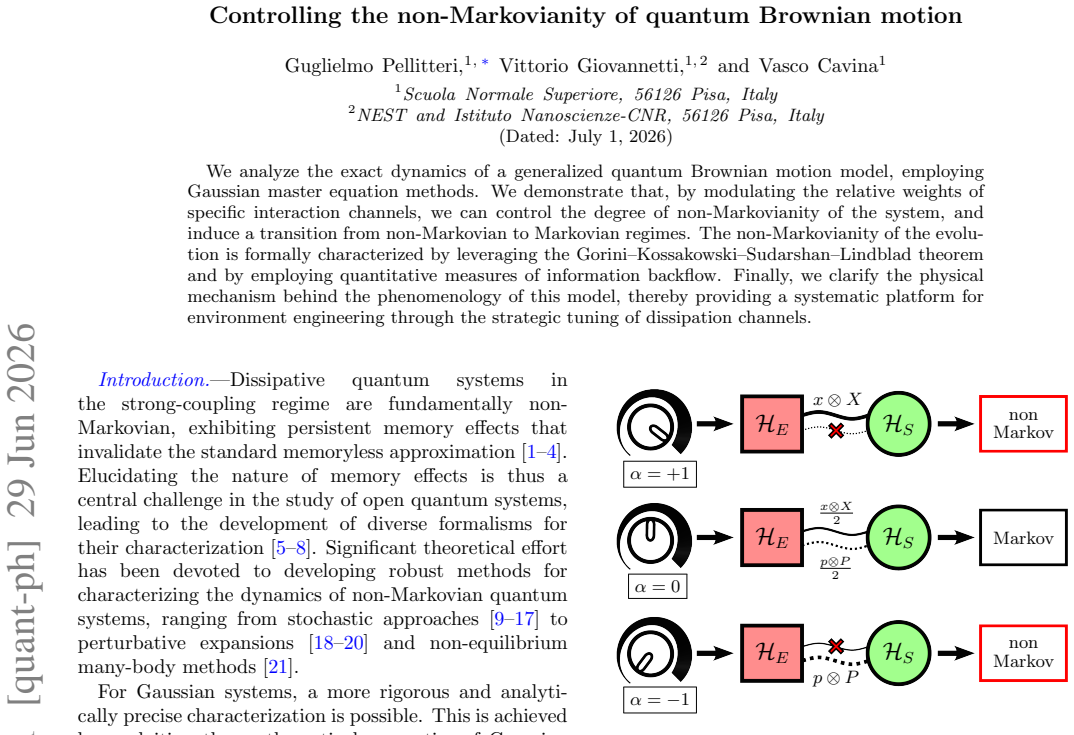
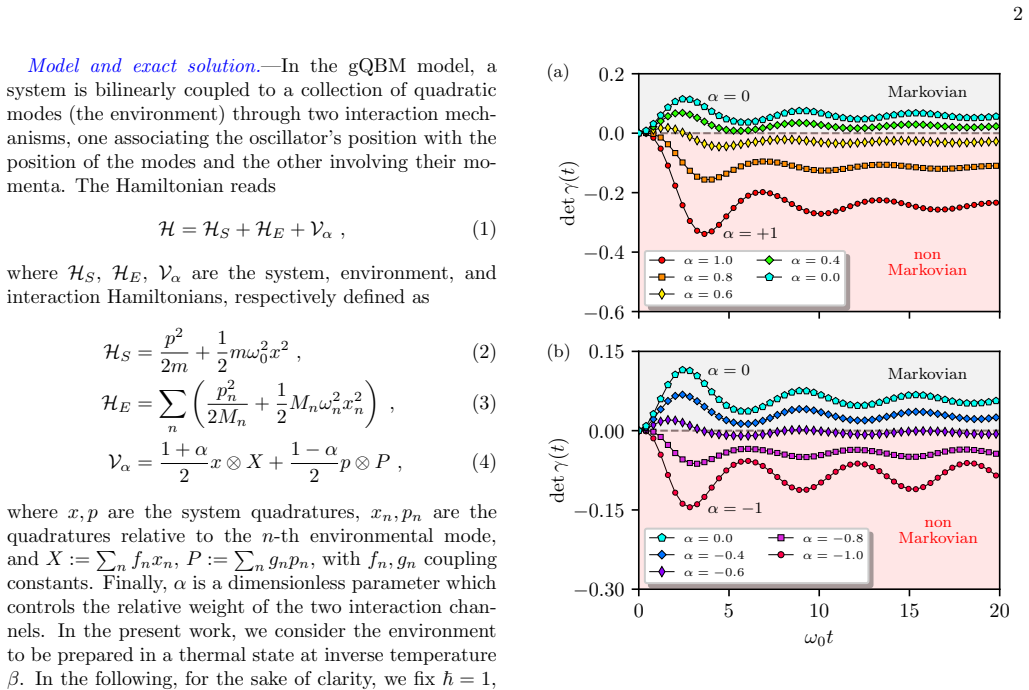
Modulating the relative weights of interaction channels in generalized quantum Brownian motion controls non-Markovianity and induces a Markovian transition.
A machine-rendered reading of the paper's core claim, the machinery that carries it, and where it could break.
Core claim
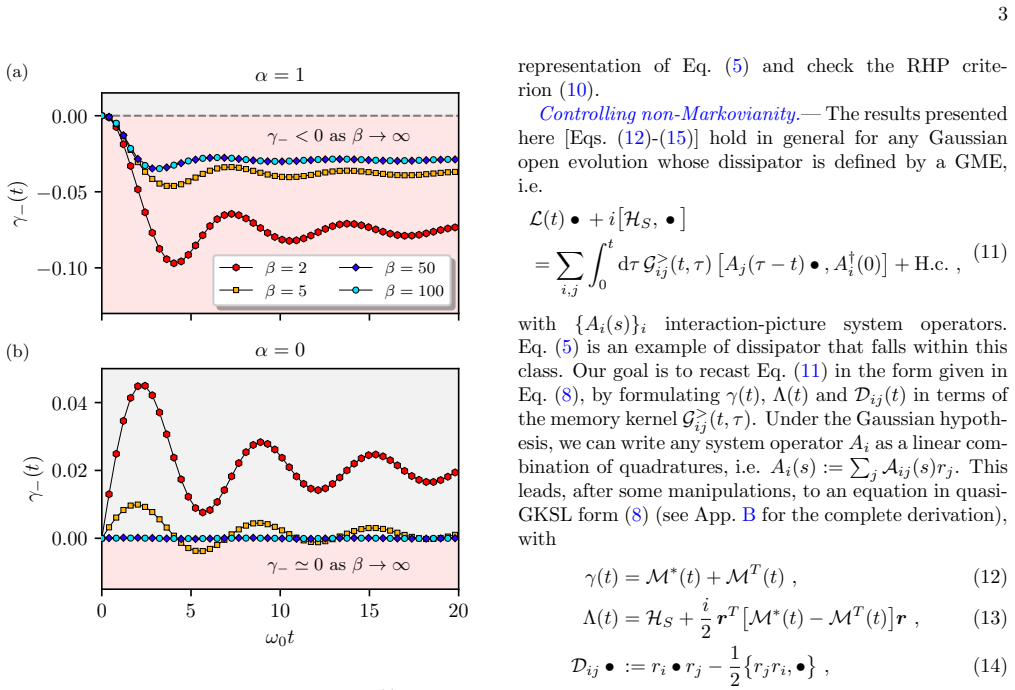
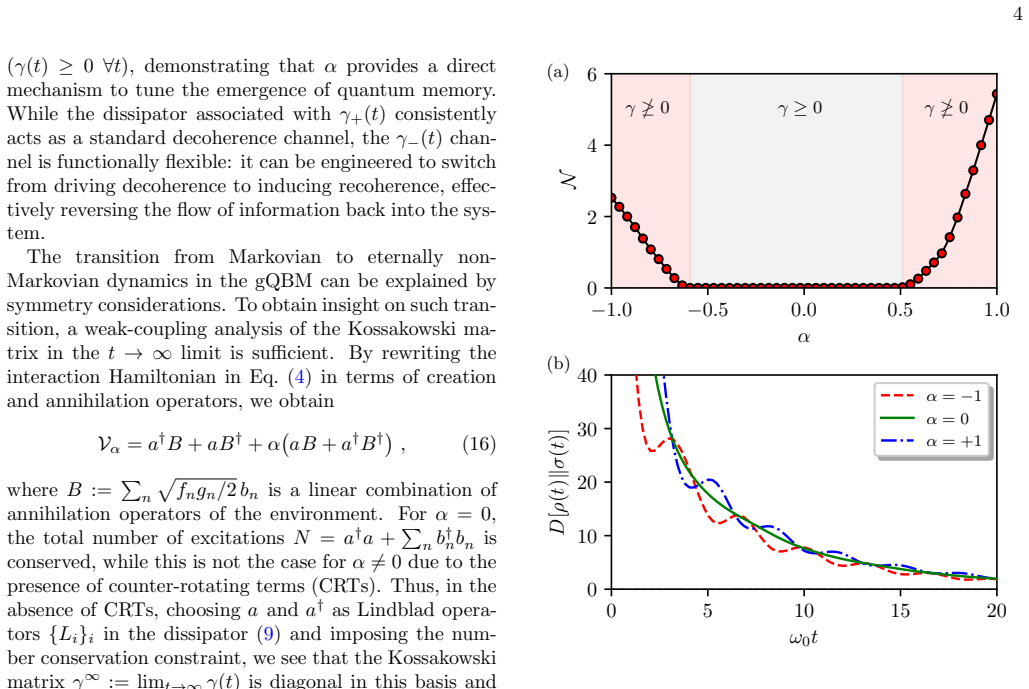
In the generalized quantum Brownian motion model the exact dynamics permit control of non-Markovianity by modulating the relative weights of specific interaction channels, producing a transition from non-Markovian to Markovian regimes. The transition is established through Gaussian master equation analysis and confirmed by formal application of the Gorini-Kossakowski-Sudarshan-Lindblad theorem along with quantitative information-backflow measures, thereby clarifying the underlying physical mechanism.
What carries the argument
Modulation of the relative weights of specific interaction channels in the generalized quantum Brownian motion model, analyzed via Gaussian master equations.
If this is right
- The degree of non-Markovianity can be tuned continuously by the channel weights.
- A transition to fully Markovian dynamics can be induced by suitable choice of weights.
- The physical mechanism responsible for the memory effects is identified through the channel structure.
- A systematic platform for environment engineering is obtained by deliberate tuning of dissipation channels.
Where Pith is reading between the lines
- The same weighting approach may be tested in other open quantum systems to achieve custom memory properties.
- Engineered Markovian limits could simplify the design of error-correction protocols that assume memoryless noise.
Load-bearing premise
The generalized quantum Brownian motion model admits an exact description via Gaussian master equations that allow independent adjustment of interaction channel weights to change the non-Markovian character.
What would settle it
A calculation or simulation in which varying the relative weights of the interaction channels leaves all quantitative non-Markovianity measures unchanged would falsify the claimed control.
Figures
read the original abstract
We analyze the exact dynamics of a generalized quantum Brownian motion model, employing Gaussian master equation methods. We demonstrate that, by modulating the relative weights of specific interaction channels, we can control the degree of non-Markovianity of the system, and induce a transition from non-Markovian to Markovian regimes. The non-Markovianity of the evolution is formally characterized by leveraging the Gorini--Kossakowski--Sudarshan--Lindblad theorem and by employing quantitative measures of information backflow. Finally, we clarify the physical mechanism behind the phenomenology of this model, thereby providing a systematic platform for environment engineering through the strategic tuning of dissipation channels.
Editorial analysis
A structured set of objections, weighed in public.
Referee Report
Summary. The manuscript analyzes the exact dynamics of a generalized quantum Brownian motion model using Gaussian master equation methods. It demonstrates that modulating the relative weights of specific interaction channels controls the degree of non-Markovianity and induces a transition from non-Markovian to Markovian regimes. Non-Markovianity is characterized using the Gorini-Kossakowski-Sudarshan-Lindblad theorem and quantitative information-backflow measures, with clarification of the underlying physical mechanism to enable systematic environment engineering via dissipation-channel tuning.
Significance. If the central claims hold, the work provides a concrete platform for environment engineering in open quantum systems by strategic tuning of interaction channels, which is relevant for quantum control and decoherence management. The reliance on exact Gaussian master equations and standard non-Markovianity quantifiers is a strength, as is the focus on physically motivated modulation of channels rather than ad-hoc parameters.
minor comments (3)
- [§2] §2 (model definition): the generalized QBM Hamiltonian and the precise form of the interaction channels whose weights are modulated should be stated explicitly with all coupling constants labeled, to allow readers to verify the claimed independence of modulation.
- [Figure 3] Figure 3 (or equivalent): the plotted non-Markovianity measure versus weight parameter lacks error bars or sensitivity analysis; adding a panel showing the GKSL generator eigenvalues would strengthen the Markovian-transition claim.
- The manuscript does not discuss whether the reported transition survives weak-coupling approximations or finite-temperature corrections; a brief remark on the regime of validity would improve clarity.
Simulated Author's Rebuttal
We thank the referee for the positive assessment of our work, the recognition of its relevance for environment engineering, and the recommendation of minor revision. No specific major comments were raised in the report.
Circularity Check
No significant circularity detected
full rationale
The derivation relies on standard Gaussian master equation techniques and the Gorini-Kossakowski-Sudarshan-Lindblad theorem to characterize non-Markovianity via information backflow measures. The central claim—that relative weights of interaction channels can be modulated to induce a non-Markovian to Markovian transition—is presented as a direct consequence of the model construction and exact solvability, without any reduction of predictions to fitted inputs, self-definitional loops, or load-bearing self-citations. No step equates a derived quantity to its own inputs by construction.
Axiom & Free-Parameter Ledger
axioms (1)
- domain assumption The dynamics of the generalized quantum Brownian motion model are exactly solvable using Gaussian master equation methods.
Reference graph
Works this paper leans on
-
[1]
Li, G.-C
C.-F. Li, G.-C. Guo, and J. Piilo, Non-Markovian quan- tum dynamics: What is it good for?, EPL128, 30001 (2020)
2020
-
[2]
de Vega and D
I. de Vega and D. Alonso, Dynamics of non-Markovian open quantum systems, Rev. Mod. Phys.89, 015001 (2017)
2017
-
[3]
Breuer, E.-M
H.-P. Breuer, E.-M. Laine, J. Piilo, and B. Vacchini, Colloquium: Non-Markovian dynamics in open quantum systems, Rev. Mod. Phys.88, 021002 (2016)
2016
-
[4]
Chru´ sci´ nski, Dynamical maps beyond Markovian regime, Phys
D. Chru´ sci´ nski, Dynamical maps beyond Markovian regime, Phys. Rep.992, 1 (2022)
2022
-
[5]
Breuer, E.-M
H.-P. Breuer, E.-M. Laine, and J. Piilo, Measure for the degree of non-Markovian behavior of quantum processes in open systems, Phys. Rev. Lett.103, 210401 (2009)
2009
-
[6]
Rivas, A
A. Rivas, A. D. K. Plato, S. F. Huelga, and M. B. Plenio, Markovian master equations: a critical study, New J. Phys.12, 113032 (2010)
2010
-
[7]
Vacchini, A
B. Vacchini, A. Smirne, E.-M. Laine, J. Piilo, and H.-P. Breuer, Markovianity and non-Markovianity in quantum and classical systems, New J. Phys.13, 093004 (2011)
2011
-
[8]
Nonclassical energy-change distribution as a witness of non-Markovian quantum dynamics
M. Pezzutto, A. Corr, G. D. Chiara, S. Lorenzo, and S. Gherardini, Nonclassical energy-change distribu- 6 tion as a witness of non-Markovian quantum dynamics, arXiv:2605.26818 (2026)
work page internal anchor Pith review Pith/arXiv arXiv 2026
-
[9]
J. T. Stockburger and H. Grabert, Non-Markovian quan- tum state diffusion, Chem. Phys.268, 249 (2001)
2001
-
[10]
J. T. Stockburger and H. Grabert, Exactc-number repre- sentation of non-Markovian quantum dissipation, Phys. Rev. Lett.88, 170407 (2002)
2002
-
[11]
J. T. Stockburger, Simulating spin-boson dynamics with stochastic Liouville-von Neumann equations, Chem. Phys.296, 159 (2004)
2004
-
[12]
Tanimura, Stochastic Liouville, Langevin, Fokker- Planck, and master equation approaches to quantum dis- sipative systems, J
Y. Tanimura, Stochastic Liouville, Langevin, Fokker- Planck, and master equation approaches to quantum dis- sipative systems, J. Phys. Soc. Jpn.75, 082001 (2006)
2006
-
[13]
Tilloy, Time-local unraveling of non-Markovian stochastic Schr¨ odinger equations, Quantum1, 29 (2017)
A. Tilloy, Time-local unraveling of non-Markovian stochastic Schr¨ odinger equations, Quantum1, 29 (2017)
2017
-
[14]
Y. Zhou, Y. Yan, and J. Shao, Stochastic simulation of quantum dissipative dynamics, EPL72, 334 (2005)
2005
-
[15]
Gasbarri and L
G. Gasbarri and L. Ferialdi, Stochastic unravelings of non-Markovian completely positive and trace-preserving maps, Phys. Rev. A98, 042111 (2018)
2018
-
[16]
Yan and J
Y.-A. Yan and J. Shao, Equivalence of stochastic for- mulations and master equations for open systems, Phys. Rev. A97, 042126 (2018)
2018
-
[17]
Cavina, A
V. Cavina, A. D’Abbruzzo, and V. Giovannetti, Unifying quantum stochastic methods using Wick’s theorem on the Keldysh contour, Phys. Rev. Res.7, 043262 (2025)
2025
-
[18]
Grifoni and P
M. Grifoni and P. H¨ anggi, Driven quantum tunneling, Phys. Rep.304, 229 (1998)
1998
-
[19]
Colla, H.-P
A. Colla, H.-P. Breuer, and G. Gasbarri, Unveiling coher- ent dynamics in non-Markovian open quantum systems: Exact expression and recursive perturbation expansion, Phys. Rev. A112, L050203 (2025)
2025
-
[20]
Colla, H.-P
A. Colla, H.-P. Breuer, and G. Gasbarri, Recursive per- turbation approach to time-convolutionless master equa- tions: Explicit construction of generalized Lindblad gen- erators for arbitrary open systems, Phys. Rev. A112, 052222 (2025)
2025
-
[21]
N. W. Talarico, S. Maniscalco, and N. Lo Gullo, A scal- able numerical approach to the solution of the Dyson equation for the non-equilibrium single-particle Green’s function, Phys. Status Solidi B256, 1800501 (2019)
2019
-
[22]
Heinosaari, A
T. Heinosaari, A. S. Holevo, and M. M. Wolf, The semigroup structure of Gaussian channels, Quantum Inf. Comput.10, 619–635 (2010)
2010
-
[23]
Torre, W
G. Torre, W. Roga, and F. Illuminati, Non-Markovianity of Gaussian channels, Phys. Rev. Lett.115, 070401 (2015)
2015
-
[24]
Liuzzo-Scorpo, W
P. Liuzzo-Scorpo, W. Roga, L. A. M. Souza, N. K. Bernardes, and G. Adesso, Non-Markovianity hierarchy of Gaussian processes and quantum amplification, Phys. Rev. Lett.118, 050401 (2017)
2017
-
[25]
A. S. Holevo,Quantum Systems, Channels, Informa- tion: A Mathematical Introduction, De Gruyter Studies in Mathematical Physics, Vol. 16 (Walter de Gruyter, Berlin, Boston, 2012)
2012
-
[26]
Ferialdi, Exact closed master equation for Gaussian non-Markovian dynamics, Phys
L. Ferialdi, Exact closed master equation for Gaussian non-Markovian dynamics, Phys. Rev. Lett.116, 120402 (2016)
2016
-
[27]
B. L. Hu, J. P. Paz, and Y. Zhang, Quantum Brownian motion in a general environment: Exact master equation with nonlocal dissipation and colored noise, Phys. Rev. D45, 2843 (1992)
1992
-
[28]
Zhang, P.-Y
W.-M. Zhang, P.-Y. Lo, H.-N. Xiong, M. W.-Y. Tu, and F. Nori, General non-Markovian dynamics of open quan- tum systems, Phys. Rev. Lett.109, 170402 (2012)
2012
-
[29]
D’Abbruzzo, V
A. D’Abbruzzo, V. Giovannetti, and V. Cavina, Exact non-Markovian master equations: A generalized deriva- tion for Gaussian systems, Phys. Rev. Lett.135, 240401 (2025)
2025
-
[30]
G. Pellitteri, V. Giovannetti, and V. Cavina, Exact quan- tum transport in non-Markovian open Gaussian systems, arXiv:2602.21190 (2026)
-
[31]
Lorenzo, F
S. Lorenzo, F. Plastina, and M. Paternostro, Tuning non- Markovianity by spin-dynamics control, Phys. Rev. A87, 022317 (2012)
2012
-
[32]
J.-L. Tang, G. Alvarado Barrios, E. Solano, and F. Al- barr´ an-Arriagada, Tunable non-Markovianity for bosonic quantum memristors, Entropy25, 756 (2023)
2023
-
[33]
Roccati and D
F. Roccati and D. Cilluffo, Controlling Markovianity with chiral giant atoms, Phys. Rev. Lett.133, 063603 (2024)
2024
-
[34]
Wittemer, G
M. Wittemer, G. Clos, H.-P. Breuer, U. Warring, and T. Schaetz, Measurement of quantum memory effects and its fundamental limitations, Phys. Rev. A97, 020102 (2018)
2018
-
[35]
J. F. Haase, P. J. Vetter, T. Unden, A. Smirne, J. Rosskopf, B. Naydenov, A. Stacey, F. Jelezko, M. B. Plenio, and S. F. Huelga, Controllable non-Markovianity for a spin qubit in diamond, Phys. Rev. Lett.121, 060401 (2018)
2018
-
[36]
Kukita, Y
S. Kukita, Y. Kondo, and M. Nakahara, Controllable non-Markovianity in phase relaxation, New J. Phys.22, 103048 (2020)
2020
-
[37]
B.-H. Liu, L. Li, Y.-F. Huang, C.-F. Li, G.-C. Guo, E.-M. Laine, J. Piilo, and H.-P. Breuer, Experimental control of the transition from Markovian to non-Markovian dynam- ics of open quantum systems, Nat. Phys.7, 931 (2011)
2011
-
[38]
Tang, C.-F
J.-S. Tang, C.-F. Li, Y.-L. Li, X.-B. Zou, G.-C. Guo, H.-P. Breuer, E.-M. Laine, and J. Piilo, Measuring non-Markovianity of processes with controllable system- environment interaction, Europhys. Lett.97, 10002 (2012)
2012
-
[39]
Liu, D.-Y
B.-H. Liu, D.-Y. Cao, Y.-F. Huang, C.-F. Li, G.-C. Guo, E.-M. Laine, H.-P. Breuer, and J. Piilo, Photonic real- ization of nonlocal memory effects and non-Markovian quantum probes, Sci. Rep.3, 1781 (2013)
2013
-
[40]
Cialdi, D
S. Cialdi, D. Brivio, E. Tesio, and M. G. A. Paris, Pro- grammable entanglement oscillations in a non-Markovian channel, Phys. Rev. A83, 042308 (2011)
2011
-
[41]
Cialdi, M
S. Cialdi, M. A. C. Rossi, C. Benedetti, B. Vacchini, D. Tamascelli, S. Olivares, and M. G. A. Paris, All-optical quantum simulator of qubit noisy channels, Appl. Phys. Lett.110, 081107 (2017)
2017
-
[42]
Chiuri, C
A. Chiuri, C. Greganti, L. Mazzola, M. Paternostro, and P. Mataloni, Linear optics simulation of quantum dephas- ing channels, Sci. Rep.2, 968 (2012)
2012
-
[43]
J. Jin, V. Giovannetti, R. Fazio, F. Sciarrino, P. Mat- aloni, A. Crespi, and R. Osellame, All-optical implemen- tation of collision-based evolutions of open quantum sys- tems, Phys. Rev. A91, 012122 (2015)
2015
-
[44]
A. O. Caldeira and A. J. Leggett, Path integral ap- proach to quantum Brownian motion, Physica A121, 587 (1983)
1983
-
[45]
A. J. Leggett, S. Chakravarty, A. T. Dorsey, M. P. Fisher, A. Garg, and W. Zwerger, Dynamics of the dissipative two-state system, Rev. Mod. Phys.59, 1 (1987)
1987
-
[46]
Einsiedler, A
S. Einsiedler, A. Ketterer, and H.-P. Breuer, Non- Markovianity of quantum Brownian motion, Phys. Rev. A102, 022228 (2020). 7
2020
-
[47]
Ferialdi and A
L. Ferialdi and A. Smirne, Momentum coupling in non- Markovian quantum Brownian motion, Phys. Rev. A96, 012109 (2017)
2017
-
[48]
Breuer and F
H.-P. Breuer and F. Petruccione,The Theory of Open Quantum Systems(Oxford University Press, 2007)
2007
-
[49]
Rivas, S
´A. Rivas, S. F. Huelga, and M. B. Plenio, Entanglement and non-Markovianity of quantum evolutions, Phys. Rev. Lett.105, 050403 (2010)
2010
-
[50]
Rivas, S
A. Rivas, S. F. Huelga, and M. B. Plenio, Quantum non- Markovianity: characterization, quantification and de- tection, Rep. Prog. Phys.77, 094001 (2014)
2014
-
[51]
Gorini, A
V. Gorini, A. Kossakowski, and E. C. G. Sudarshan, Completely positive dynamical semigroup ofN-level sys- tems, J. Math. Phys.17, 821 (1976)
1976
-
[52]
Lindblad, On the generators of quantum dynamical semigroups, Commun
G. Lindblad, On the generators of quantum dynamical semigroups, Commun. Math. Phys.48, 119 (1976)
1976
-
[53]
quasi-GKSL
We shall use the nomenclature “quasi-GKSL” to distin- guish form (8) from the proper GKSL form, which re- quiresγ, Λ andD ij to be time-independent, andγ≥0 as a sufficient and necessary condition for completely pos- itive and trace-preserving dynamics
-
[54]
Megier, D
N. Megier, D. Chru´ sci´ nski, J. Piilo, and W. T. Strunz, Eternal non-Markovianity: from random unitary to markov chain realisations, Sci. Rep.7, 6379 (2017)
2017
-
[55]
M. J. Hall, J. D. Cresser, L. Li, and E. Andersson, Canon- ical form of master equations and characterization of non- Markovianity, Phys. Rev. A89, 042120 (2014)
2014
-
[56]
M¨ akel¨ a and M
H. M¨ akel¨ a and M. M¨ ott¨ onen, Effects of the rotating-wave and secular approximations on non-Markovianity, Phys. Rev. A88, 052111 (2013)
2013
-
[57]
M. B. Ruskai, Beyond strong subadditivity? Improved bounds on the contraction of generalized relative entropy, Rev. Math. Phys.06, 1147 (1994)
1994
-
[58]
K. P. Seshadreesan, L. Lami, and M. M. Wilde, R´ enyi relative entropies of quantum channels, J. Math. Phys. 59, 072204 (2018)
2018
-
[59]
D. A. Lidar, I. L. Chuang, and K. B. Whaley, Decoherence-free subspaces for quantum computation, Phys. Rev. Lett.81, 2594 (1998)
1998
-
[60]
Z. Liu, Y. Xiao, and Z. Cai, Non-Markovian noise suppression simplified through channel representation, arXiv:2412.11220 (2024)
work page internal anchor Pith review Pith/arXiv arXiv 2024
-
[61]
Wang and X
K. Wang and X. Li, Non-Markovian noise mitigation: Practical implementation, error analysis, and the role of spectral properties of the environment, Phys. Rev. A 112, 012406 (2025)
2025
- [62]
-
[63]
Abiuso and V
P. Abiuso and V. Giovannetti, Non-Markov enhancement of maximum power for quantum thermal machines, Phys. Rev. A99, 052106 (2019)
2019
-
[64]
Strasberg, G
P. Strasberg, G. Schaller, N. Lambert, and T. Brandes, Nonequilibrium thermodynamics in the strong coupling and non-Markovian regime based on a reaction coordi- nate mapping, New J. Phys.18, 073007 (2016)
2016
-
[65]
Thomas, N
G. Thomas, N. Siddharth, S. Banerjee, and S. Ghosh, Thermodynamics of non-Markovian reservoirs and heat engines, Phys. Rev. E97, 062108 (2018)
2018
-
[66]
X. Y. Zhang, X. L. Huang, and X. X. Yi, Quantum Otto heat engine with a non-Markovian reservoir, J. Phys. A: Math. Theor.47, 455002 (2014)
2014
-
[67]
A. L. Fetter and J. D. Walecka,Quantum Theory of Many-Particle Systems(McGraw–Hill, New York, 1971)
1971
-
[68]
G. F. Giuliani and G. Vignale,Quantum Theory of the Electron Liquid(Cambridge University Press, Cam- bridge, England, 2005)
2005
-
[69]
Kamenev,Field Theory of Non-Equilibrium Systems (Cambridge University Press, 2011)
A. Kamenev,Field Theory of Non-Equilibrium Systems (Cambridge University Press, 2011)
2011
-
[70]
Serafini,Quantum continuous variables: a primer of theoretical methods(CRC press, 2017)
A. Serafini,Quantum continuous variables: a primer of theoretical methods(CRC press, 2017)
2017
-
[71]
retarded
S. Olivares, Quantum optics in the phase space: A tuto- rial on Gaussian states, Eur. Phys. J. Spec. Top.203, 3 (2012). Appendix A: Exact Gaussian master equation for the gQBM model This Appendix is organized as follows. First, we recap the framework of exact Gaussian master equations (GMEs) and apply it to describe the exact dynamics of the gQBM model. T...
2012
discussion (0)
Sign in with ORCID, Apple, or X to comment. Anyone can read and Pith papers without signing in.