REVIEW 3 major objections 5 minor 3 cited by
Fastest spinning millisecond pulsars: indicators for quark matter in neutron stars?
T0 review · 3 major / 5 minor · reviewed 2026-08-11 · deepseek-v4-flash
Pith's one-line read Fastest-spinning pulsars may contain quark-matter cores, this paper argues.
desk verdict A solid, model-dependent study that adds a useful empirical relation and a plausible quark-matter interpretation of J0952-0607, but the f-mode threshold is assumed, not computed. read the letter →
The pith
A machine-rendered reading of the paper's core claim, the machinery that carries it, and where it could break.
The reading
What carries the argument
The central object is the hybrid equation of state built by the Maxwell construction: a hadronic DD2npY-T equation of state for hypernuclear matter matched to the confining relativistic density functional (RDF) quark matter model with color superconductivity, parameterized by the ABPR form p = (A4 $μ^{4}$)/($2π^{2}$) + ($Δ^{2}$ $μ^{2}$)/$π^{2}$ − B, where A4, Δ, and B depend on the two free couplings ηV (vector) and ηD (diquark). The ratio of vector to scalar coupling sets the stiffness of quark matter and thereby the maximum hybrid star mass, while the diquark coupling sets the onset density of deconfinement. The rotating star configurations are computed with the RNS code, which solves the Einstein equations for axisymmetric uniformly rotating perfect-fluid stars, yielding the Kepler frequency, the onset of quasi-radial oscillations, and the T/W instability criterion.
What would settle it
A decisive test is the discovery of a pulsar with a spin frequency clearly above 716 Hz: the paper predicts that a hadronic-only equation of state would be excluded for any such object at its measured mass, while the hybrid equations of state with strong vector coupling remain viable up to Kepler frequencies near 2.9 kHz. A clean radius measurement of J0952-0607 (for example by NICER) that is consistent with the hadronic mass-radius relation would similarly weaken the quark-core interpretation.
Extended reading notes
Core claim
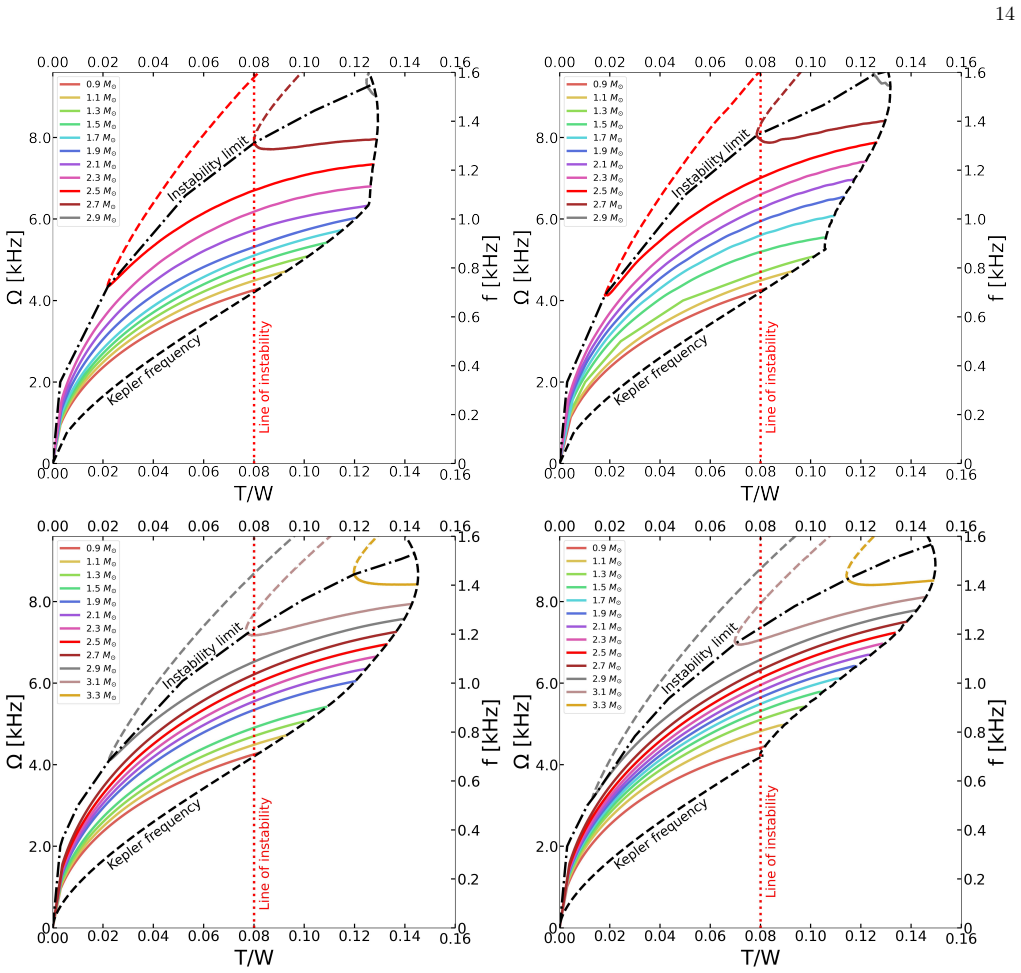
The paper argues that the observed mass and spin of the black-widow pulsar J0952-0607 (gravitational mass 2.35 ± 0.17 solar masses, spin 709 Hz) lie within the stable region for hybrid stars with a strong vector coupling (ηV = 0.452, ηD = 0.775 or 0.780), whereas for the purely hadronic DD2npY-T hypernuclear equation of state this pulsar lies beyond the stability limit at the 1σ level. Rotation shifts the onset of deconfinement to higher masses, and for these parameter sets the quark matter core extends enough to support the high mass at high spin. The same analysis maps the regions of angular velocity and mass where stars are hadronic, hybrid, or unstable, and shows that the gravitational-radiation-driven f-mode instability (T/W ≤ 0.08) excludes parameter values ηV ≲ 0.27 for the heaviest spinning stars. The paper also shows that the empirical C-factor in the Kepler-frequency relation fK = C(M/M⊙)^{1/2}(R/10 km)^{-3/2} rises from C ≈ 1.088 kHz for hadronic stars to C ≈ 1.16 kHz for hybrid stars with quark cores, and provides an analytic parametrization of C as a function of the quark onset mass.
Load-bearing premise
The central claim depends on the choice of quark matter model: if the real deconfined phase has a different stiffness or transition density than the RDF model with ABPR parametrization, then the purely hadronic equation of state might also accommodate J0952-0607, and the conclusion that this pulsar requires quark matter would no longer follow.
Editorial extensions
If this is right
- If J0952-0607 has a quark matter core, then the heaviest millisecond pulsars become direct evidence that deconfinement occurs inside neutron stars, not only in mergers or heavy-ion collisions.
- The revised C-factor relation gives a simple tool to convert a measured pulsar spin frequency into a lower bound on the mass and radius of a non-rotating star, now applicable to hybrid stars with early deconfinement.
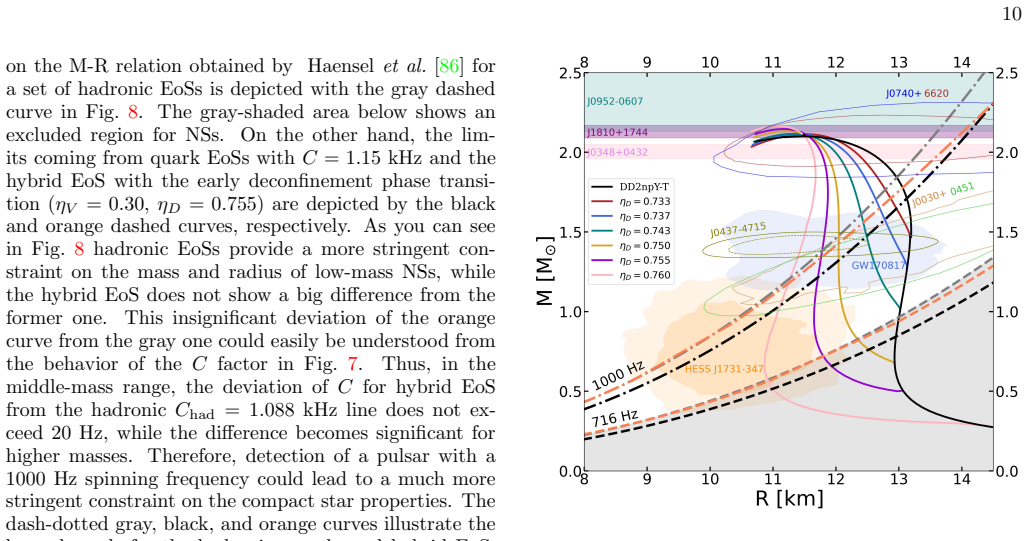
- The radius upper limits R1.4 ≤ 14.90 km (from the 716 Hz pulsar J1748-2446ad) and R1.4 ≤ 11.90 km (for a hypothetical 1000 Hz pulsar) sharpen the constraints on the dense matter equation of state, with the 1000 Hz case strongly discriminating between hadronic and hybrid scenarios.
- The T/W ≤ 0.08 stability window for J0952-0607 excludes vector couplings ηV ≲ 0.27 in this model family, providing a microphysical constraint on quark matter parameters.
- The clustering of observed millisecond pulsars with similar spin frequencies finds a natural explanation in the spin-evolution model where the deconfinement transition slows down the spin-down rate, producing a waiting-time pile-up.
Reading between the lines
- If a pulsar spinning near or above 1000 Hz is ever found, the paper's framework predicts that a hadronic-only equation of state would be ruled out for it, making the search for such objects a direct test of quark matter in neutron stars.
- The paper's C-factor parametrization could be tested against future NICER-style mass-radius measurements of rapidly rotating pulsars: a measured radius for a known spinning mass that violates the hadronic lower bound would independently support the hybrid interpretation.
- The stability window analysis suggests a sharper population-level test: if several heavy millisecond pulsars are found above the T/W threshold for hadronic configurations but below it for hybrid ones, the statistical clustering of spins and masses would separate hadronic from hybrid equations of state.
- The constraint ηV ≳ 0.27 from the f-mode instability effectively implies that any allowed quark matter description must be rather stiff, which could be compared with lattice or perturbative QCD estimates of the speed of sound at several times nuclear saturation density.
Editorial analysis
A structured set of objections, weighed in public.
Referee Report
Summary. The paper studies rapidly rotating hybrid neutron stars built from a hypernuclear relativistic density functional hadronic phase (DD2npY-T) and a color-superconducting confining RDF quark phase (ABPR parametrization), matched by a Maxwell construction. Using the RNS code, the authors compute rotating configurations, analyze the Kepler frequency and the empirical C(M) relation, and compare the fastest millisecond pulsars against stability regions in the mass–frequency plane. The central claim is that the heaviest and fastest galactic pulsar J0952-0607 (M=2.35±0.17 M⊙, f=709 Hz) can be described by hybrid stars with strong vector coupling ηV=0.452, while the purely hadronic hypernuclear DD2npY-T configuration cannot, and that this constitutes an indication for quark matter in neutron stars. The paper also quotes radius limits R1.4≤14.90 km and R0.7<11.49 km derived from the revised C(M) relation.
Significance. The numerical core of the paper is sound: the RNS code is a well-tested tool for rapidly rotating relativistic stars, and the EoSs are taken from prior work, so the reported sequences and stability maps are valuable. The study usefully extends the empirical C(M) relation to hybrid stars with an early deconfinement transition, and the proposed 1000 Hz pulsar forecast is a concrete, falsifiable prediction. The most striking physical conclusion, that J0952-0607 is incompatible with the specific hadronic DD2npY-T EoS but compatible with the favored hybrid set, is interesting and would be important if robust. However, the central comparison relies on a constant T/W=0.08 f-mode instability threshold that is assumed, not computed, for a 2.35 M⊙ near-maximum-mass star, and the comparison against hadronic matter is made with only one hadronic EoS. The radius limits are also calibrated on the same model family that they constrain. These issues are load-bearing for the paper's headline claims, although they appear addressable with additional calculations or a more careful framing.
major comments (3)
- [Section V, Figs. 12–13] The exclusion ηV≲0.27 and the viability of the favored ηV=0.452 set both rest on the assumption that the l=m=2 f-mode instability onset is T/W=0.08 for the 2.35 M⊙ J0952-0607 configuration, with the value taken from 1.4 M⊙ stars. The text justifies this by the 'weak dependence of the instability limit on the star's mass', but the CFS instability boundary depends on the mode eigenfunction and on the damping timescale, both of which are sensitive to compactness and to the EoS. No f-mode calculation, or even a bracketing estimate, is provided for the actual hybrid sequences. This is load-bearing: if the true threshold for the favored sequence lies below its T/W value, J0952-0607 would be unstable and the central comparison with the hadronic EoS would collapse. Please either compute the f-mode instability boundary for these configurations or demonstrate that a range of thresholds, including values below 0.08, leaves the conclusion unchanged.
- [Section IV, Eq. (21)] The logistic C(M) parametrization is fitted to the same hybrid EoS family that is then used to derive the upper radius limits quoted in the abstract (R1.4≤14.90 km, R0.7<11.49 km). The fit residuals are reported as 'maximal deviations ±8 Hz and relative error below 1%', but no propagation of this uncertainty into the radius limits is given, and the limits are presented as direct constraints. Because the relation is calibrated on the model set, these numbers should be presented as model-dependent estimates with propagated errors, not as independent bounds on R1.4 or R0.7.
- [Section V and abstract] The statement that J0952-0607 is 'out of reach' for the purely hadronic hypernuclear configuration is based on a single hadronic EoS, DD2npY-T, and no maximum mass or maximum Kepler mass for this EoS is quoted in the paper. A stiffer hadronic EoS, or a different hyperon coupling, could in principle reach 2.35 M⊙ at 709 Hz, so the claim should be qualified as a statement about the DD2npY-T family, or supported by a scan over hadronic EoSs. Without that, the title's suggestion that MSPs are 'indicators for quark matter' goes beyond the presented evidence.
minor comments (5)
- [Sec. II C, Eq. (3)] Equation (3) contains a typo: the two derivatives in the expression for Δε are both written as dpq/dμ; the second should be dph/dμ.
- [Sec. IV, text after Eq. (21)] The statement that the logistic function has 'inflection point equal to E(Monset)·M K' is not correct as written; for the form in Eq. (21) the inflection point in M_K is (D+ln5)/E, so the sentence should be rewritten.
- [Fig. 13 caption] The caption and text should clarify whether the cyan hatched region is computed for the fixed rest mass 2.1 M⊙ (gravitational mass ~1.9 M⊙) shown in the right panel or separately for a gravitational mass of 2.35 M⊙; as written, the panel label and the text are confusing.
- [Sec. III B, Fig. 5] The fitted oblateness coefficient 2√a≈0.772 is quoted without an uncertainty; the lower panels show deviations up to 6%, so an error bar on the fit value should be given.
- [Sec. II C, after the back-bending discussion] A stray displayed formula 'dJ/dεc|Mb=const > 0' appears in the text after the paragraph discussing back-bending; this fragment should be removed or integrated into a proper sentence.
Circularity Check
No significant circularity: the central J0952-0607 comparison tests the hybrid EoS against external mass/spin data; the C(M) fit and T/W=0.08 threshold are model limitations, not reductions to inputs.
full rationale
The central derivation chain is not circular. The hybrid EoS is constructed by Maxwell matching of the DD2npY-T hadronic EoS to the RDF quark EoS (Eq. 1, Secs. II.A-II.C); the free couplings eta_V and eta_D are restricted by previously published fits and by external constraints (NICER radii, GW170817 tidal deformability, maximum mass), not by the J0952-0607 datum. The claim that J0952-0607 falls in the stable hybrid region while the hadronic-only DD2npY-T sequence cannot reach it (Sec. V, Fig. 10) is a genuine model-vs-data comparison using the independently measured mass of 2.35 +/- 0.17 solar masses and spin of 709.21 Hz (Table III). The assumed constant f-mode threshold T/W = 0.08, justified by 'the weak dependence of the instability limit on the star's mass' (Sec. V), is an extrapolation and a correctness risk, but it is an assumption, not a circular reduction. The C(M) parametrization (Eq. 21) is fitted to the authors' own hybrid sequences and then used to derive radius upper limits such as R1.4 <= 14.90 km; this makes those limits model-dependent predictions rather than independent constraints, but the 716 Hz frequency used is external and the fit was not tuned to the radius bounds, so this is a minor internal-fit concern rather than a circularity affecting the main J0952-0607 conclusion. Self-citations to Refs. [46,47,52] provide the model parameterization and special-point motivation; none is a uniqueness theorem invoked to forbid alternatives.
Assumptions & free parameters
free parameters (4)
- ηV (vector meson coupling ratio) =
0.30, 0.452
- ηD (diquark coupling ratio) =
0.733 to 0.780
- Logistic fit constants for C(M) =
δC=0.072 kHz, denominator 5, D=7.5Monset+0.7, E=3Monset+2
- Oblateness coefficient 2√a =
0.772
assumptions (6)
- domain assumption The DD2npY-T EoS describes hypernuclear matter and satisfies current mass, radius, and tidal deformability constraints.
- domain assumption The confining RDF quark matter model with color superconductivity, parametrized by the ABPR formula (Eq. 1), represents dense quark matter.
- domain assumption The Maxwell construction is adequate for the hadron-quark phase transition in neutron stars.
- standard math Uniform rotation and a perfect-fluid stress-energy tensor describe millisecond pulsars.
- domain assumption The non-axisymmetric instability onsets at T/W = 0.08 for all stellar masses.
- domain assumption The empirical Kepler frequency relation fK = C (M/M⊙)^(1/2) (R/10km)^(-3/2) with a fitted C is valid for deriving radius constraints.
Cite this review
Pith. "Pith review of Fastest spinning millisecond pulsars: indicators for quark matter in neutron stars?." pith.science (2026). https://pith.science/paper/DNP3OF6U
@misc{pith2026241207758,
  author       = {Pith},
  title        = {Pith review of: Fastest spinning millisecond pulsars: indicators for quark matter in neutron stars?},
  year         = {2026},
  howpublished = {\url{https://pith.science/paper/DNP3OF6U}},
  note         = {Machine review of arXiv:2412.07758}
}
abstract
We study rotating hybrid stars, with a particular emphasis on the effect of a deconfinement phase transition on their properties at high spin. Our analysis is based on a hybrid equation of state (EoS) with a phase transition from hypernuclear matter to color-superconducting quark matter, where both phases are described within a relativistic density functional approach. By varying the vector meson and diquark couplings in the quark matter phase, we obtain different hybrid star sequences with varying extension of the quark matter core, ensuring consistency with astrophysical constraints from mass, radius and tidal deformability measurements. As a result, we demonstrate the impact of an increasing rotational frequency on the maximum gravitational mass, the central energy density of compact stars, the appearance of the quasi-radial oscillations and non-axisymmetric instabilities. We demonstrate that for the most favorable parameter sets with a strong vector coupling, hybrid star configurations with color superconducting quark matter core can describe the fastest spinning and heaviest galactic neutron star (NS) J0952-0607, while it is out of reach for the purely hadronic hypernuclear star configuration. We also revise the previously proposed empirical relation between the Kepler frequency, gravitational mass, and radius of non-rotating NSs, obtained based on the assumption that all NSs, up to the heaviest, are hadronic. We show how the phase transition to quark matter alters this relation and, consequently, the constraints on the dense matter EoS. Our findings reveal that incorporating the hybrid EoS has significant implications for the constraints on the properties of strongly interacting matter and NSs, placing the upper limit on $R_{1.4} \leq 14.90$ km and $R_{0.7}<11.49$ km (considering 716 Hz frequency limit from J1748+2446ad) and $R_{1.4}\leq$11.90~km (for 1000 Hz).
Figures


Figures from the paper (10 more)





Forward citations
Cited by 3 Pith papers
-
Bayesian analysis of hybrid neutron star EOS constraints within an instantaneous nonlocal chiral quark matter model
Bayesian fits to pulsar and GW170817 data favor hybrid neutron stars with an early color-superconducting quark core and maximum masses around 2.15 to 2.22 solar masses.
-
Rapidly Spinning Massive Pulsars as an Indicator of Quark Deconfinement
Within a tuned hybrid equation of state, a color-superconducting quark core—absent from the hyperonic hadronic model—is needed to reach the mass and spin of PSR J0952–0607.
-
Probing Neutron Star Interiors and the Properties of Cold Ultra-dense Matter with the SKAO
SKAO's sensitivity, surveys and sub-arraying will deliver tighter NS mass, MoI, spin, glitch and precession constraints that, with X-ray and GW data, probe cold ultra-dense matter.
Reference graph
Works this paper leans on
-
[1]
Bhattacharya and E
D. Bhattacharya and E. P. J. van den Heuvel, Phys. Rep. 203, 1 (1991)
1991
-
[2]
Wijnands and M
R. Wijnands and M. van der Klis, Nature 394, 344 (1998)
1998
-
[3]
S. Guillot et al. , Astrophys. J. Lett. 887, L27 (2019), arXiv:1912.05708 [astro-ph.HE]. 3 The complete pulsar catalog with mass measurements can be accessed at https://www3.mpifr-bonn.mpg.de/staff/pfreire/ NS_masses.html
arXiv 2019
-
[4]
R. W. Romani, D. Kandel, A. V. Filippenko, T. G. Brink, and W. Zheng, Astrophys. J. Lett. 934, L17 (2022), arXiv:2207.05124 [astro-ph.HE]
arXiv 2022
- [5]
-
[6]
Do the fastest-spinning pulsars contain quark matter?
B. Koberlein, “Do the fastest-spinning pulsars contain quark matter?” https://phys.org/news/2024-12-fastest- pulsars-quark.html (2024), accessed: 2025-02-13
2024
-
[7]
I. A. Rather, U. Rahaman, M. Imran, H. C. Das, A. A. Usmani, and S. K. Patra, Phys. Rev. C 103, 055814 (2021), arXiv:2102.04067 [nucl-th]. 19
arXiv 2021
-
[8]
P. L. Espino and V. Paschalidis, Phys. Rev. D 105, 043014 (2022), arXiv:2105.05269 [astro-ph.HE]
arXiv 2022
Show all 130 references
-
[9]
Sen and G
D. Sen and G. Chaudhuri, J. Phys. G 49, 075201 (2022), arXiv:2205.00338 [nucl-th]
2022 arXiv
-
[10]
Tsaloukidis, P
L. Tsaloukidis, P. S. Koliogiannis, A. Kanakis-Pegios, and C. C. Moustakidis, Phys. Rev. D 107, 023012 (2023), arXiv:2210.15644 [astro-ph.HE]
2023 arXiv
-
[11]
P. N. Moreno, F. J. Llanes-Estrada, and E. Lope-Oter, Annals Phys. 459, 169487 (2023), arXiv:2307.15366 [nucl-th]
2023 arXiv
-
[12]
Kramer et al
M. Kramer et al. , Science 314, 97 (2006), arXiv:astro- ph/0609417
2006
-
[13]
Bejger, T
M. Bejger, T. Bulik, and P. Haensel, Mon. Not. Roy. Astron. Soc. 364, 635 (2005), arXiv:astro-ph/0508105
2005 arXiv
-
[14]
Kramer and N
M. Kramer and N. Wex, Class. Quant. Grav. 26, 073001 (2009)
2009
-
[15]
Raaijmakers et al
G. Raaijmakers et al. , Astrophys. J. Lett. 887, L22 (2019), arXiv:1912.05703 [astro-ph.HE]
2019 arXiv
-
[16]
R. W. Romani, D. Kandel, A. V. Filippenko, T. G. Brink, and W. Zheng, Astrophys. J. Lett. 908, L46 (2021), arXiv:2101.09822 [astro-ph.HE]
2021 arXiv
-
[17]
J. W. T. Hessels, S. M. Ransom, I. H. Stairs, P. C. C. Freire, V. M. Kaspi, and F. Camilo, Science 311, 1901 (2006), arXiv:astro-ph/0601337
2006 arXiv
-
[18]
Haskell, J
B. Haskell, J. L. Zdunik, M. Fortin, M. Bejger, R. Wi- jnands, and A. Patruno, Astron. Astrophys. 620, A69 (2018), arXiv:1805.11277 [astro-ph.HE]
2018 arXiv
-
[19]
Patruno, B
A. Patruno, B. Haskell, and N. Andersson, Astrophys. J. 850, 106 (2017), arXiv:1705.07669 [astro-ph.HE]
2017 arXiv
-
[20]
N. K. Glendenning and F. Weber, Astrophys. J. Lett. 559, L119 (2001), arXiv:astro-ph/0003426
2001 arXiv
-
[21]
Bejger, D
M. Bejger, D. Blaschke, P. Haensel, J. L. Zdunik, and M. Fortin, Astron. Astrophys. 600, A39 (2017), arXiv:1608.07049 [astro-ph.HE]
2017 arXiv
-
[22]
J. L. Friedman, L. Parker, and J. R. Ipser, Astrophys. J. 304, 115 (1986)
1986
-
[23]
Komatsu, Y
H. Komatsu, Y. Eriguchi, and I. Hachisu, Mon. Not. Roy. Astron. Soc. 237, 355 (1989)
1989
-
[24]
G. B. Cook, S. L. Shapiro, and S. A. Teukolsky, Astro- phys. J. 422, 227 (1994)
1994
-
[25]
G. B. Cook, S. L. Shapiro, and S. A. Teukolsky, Astro- phys. J. 424, 823 (1994)
1994
-
[26]
Stergioulas and J
N. Stergioulas and J. L. Friedman, Astrophys. J. 444, 306 (1995), arXiv:astro-ph/9411032
1995 arXiv
-
[27]
C. J. Kr¨ uger, K. D. Kokkotas, P. Manoharan, and S. H. V¨ olkel, Front. Astron. Space Sci.8, 736918 (2021), arXiv:2110.00393 [gr-qc]
2021 arXiv
-
[28]
Weber, M
F. Weber, M. Orsaria, and R. Negreiros, in Com- pact Stars in the QCD Phase Diagram III (2013) arXiv:1307.1103 [astro-ph.SR]
2013 arXiv
-
[29]
M. V. Beznogov, J. Novak, D. Page, and A. R. Raduta, Astrophys. J. 942, 72 (2023), arXiv:2206.04539 [astro- ph.HE]
2023 arXiv
-
[30]
P. G. Krastev, B.-A. Li, and A. Worley, Astrophys. J. 676, 1170 (2008), arXiv:0709.3621 [astro-ph]
2008 arXiv
-
[31]
N. K. Largani, T. Fischer, A. Sedrakian, M. Cierniak, D. E. Alvarez-Castillo, and D. B. Blaschke, Mon. Not. Roy. Astron. Soc. 515, 3539 (2022), arXiv:2112.10439 [astro-ph.HE]
2022 arXiv
-
[32]
C. J. Kr¨ uger and S. H. V¨ olkel, Phys. Rev. D108, 124056 (2023), arXiv:2309.05643 [gr-qc]
2023 arXiv
-
[33]
J. L. Zdunik, M. Bejger, P. Haensel, and E. Gourgoul- hon, Astron. Astrophys. 450, 747 (2006), arXiv:astro- ph/0509806
2006
-
[34]
Dimmelmeier, M
H. Dimmelmeier, M. Bejger, P. Haensel, and J. L. Zdunik, Mon. Not. Roy. Astron. Soc. 396, 2269 (2009), arXiv:0901.3819 [astro-ph.SR]
2009 arXiv
-
[35]
Ippolito, M
N. Ippolito, M. Ruggieri, D. Rischke, A. Sedrakian, and F. Weber, Phys. Rev. D 77, 023004 (2008), arXiv:0710.3874 [astro-ph]
2008 arXiv
-
[36]
S. K. Dhiman, G. Mahajan, and B. K. Agrawal, Nucl. Phys. A 836, 183 (2010)
2010
-
[37]
N. S. Ayvazyan, G. Colucci, D. H. Rischke, and A. Sedrakian, Astron. Astrophys. 559, A118 (2013), arXiv:1308.3053 [astro-ph.SR]
2013 arXiv
-
[38]
Bhattacharyya, I
S. Bhattacharyya, I. Bombaci, D. Bandyopadhyay, A. V. Thampan, and D. Logoteta, New Astron. 54, 61 (2017), arXiv:1701.03489 [astro-ph.HE]
2017 arXiv
-
[39]
S. L. Shapiro and S. A. Teukolsky, Black holes, white dwarfs, and neutron stars: The physics of compact ob- jects (1983)
1983
-
[40]
M. C. Miller et al., Astrophys. J. Lett. 887, L24 (2019), arXiv:1912.05705 [astro-ph.HE]
2019 arXiv
-
[41]
T. E. Riley et al. , Astrophys. J. Lett. 887, L21 (2019), arXiv:1912.05702 [astro-ph.HE]
2019 arXiv
-
[42]
M. C. Miller et al., Astrophys. J. Lett. 918, L28 (2021), arXiv:2105.06979 [astro-ph.HE]
2021 arXiv
-
[43]
T. E. Riley et al. , Astrophys. J. Lett. 918, L27 (2021), arXiv:2105.06980 [astro-ph.HE]
2021 arXiv
- [44]
-
[45]
Antoniadis et al
J. Antoniadis et al. , Science 340, 6131 (2013), arXiv:1304.6875 [astro-ph.HE]
2013 arXiv
-
[46]
Ivanytskyi and D
O. Ivanytskyi and D. Blaschke, Phys. Rev. D 105, 114042 (2022), arXiv:2204.03611 [nucl-th]
2022 arXiv
-
[47]
G¨ artlein, O
C. G¨ artlein, O. Ivanytskyi, V. Sagun, and D. Blaschke, Phys. Rev. D 108, 114028 (2023), arXiv:2301.10765 [nucl-th]
2023 arXiv
-
[48]
Alford, M
M. Alford, M. Braby, M. W. Paris, and S. Reddy, As- trophys. J. 629, 969 (2005), arXiv:nucl-th/0411016
2005 arXiv
-
[49]
Shahrbaf, D
M. Shahrbaf, D. Blaschke, S. Typel, G. R. Farrar, and D. E. Alvarez-Castillo, Phys. Rev. D 105, 103005 (2022), arXiv:2202.00652 [nucl-th]
2022 arXiv
-
[50]
B. P. Abbott et al. (LIGO Scientific, Virgo), Phys. Rev. Lett. 121, 161101 (2018), arXiv:1805.11581 [gr-qc]
2018 arXiv
-
[51]
Typel, J
S. Typel, J. Phys. G 45, 114001 (2018)
2018
-
[52]
Ivanytskyi and D
O. Ivanytskyi and D. B. Blaschke, Particles 5, 514 (2022), arXiv:2209.02050 [nucl-th]
2022 arXiv
-
[53]
N. K. Glendenning, Phys. Rev. D 46, 1274 (1992)
1992
-
[54]
Maslov, N
K. Maslov, N. Yasutake, A. Ayriyan, D. Blaschke, H. Grigorian, T. Maruyama, T. Tatsumi, and D. N. Voskresensky, Phys. Rev. C 100, 025802 (2019), arXiv:1812.11889 [nucl-th]
2019 arXiv
-
[55]
D. N. Voskresensky, M. Yasuhira, and T. Tatsumi, Phys. Lett. B 541, 93 (2002), arXiv:nucl-th/0109009
2002 arXiv
-
[56]
D. N. Voskresensky, M. Yasuhira, and T. Tatsumi, Nucl. Phys. A 723, 291 (2003), arXiv:nucl-th/0208067
2003 arXiv
-
[57]
Abgaryan, D
V. Abgaryan, D. Alvarez-Castillo, A. Ayriyan, D. Blaschke, and H. Grigorian, Universe 4, 94 (2018), arXiv:1807.08034 [astro-ph.HE]
2018 arXiv
-
[58]
Cierniak and D
M. Cierniak and D. Blaschke, Astron. Nachr. 342, 819 (2021), arXiv:2106.06986 [nucl-th]
2021 arXiv
-
[59]
Ivanytskyi and D
O. Ivanytskyi and D. Blaschke, Eur. Phys. J. A 58, 152 (2022), arXiv:2205.03455 [nucl-th]
2022 arXiv
-
[60]
Z. F. Seidov, Soviet Astronomy 15, 347 (1971)
1971
-
[61]
Astro- physical aspects of general relativistic mass twin stars,
D. Blaschke, D. E. Alvarez-Castillo, A. Ayriyan, H. Grigorian, N. K. Largani, and F. Weber, “Astro- physical aspects of general relativistic mass twin stars,” 20 (2020) pp. 207–256, arXiv:1906.02522 [astro-ph.HE]
2020 arXiv
-
[62]
V. P. Goncalves, J. C. Jim´ enez, and L. Lazzari, Eur. Phys. J. C 82, 1117 (2022), arXiv:2206.10513 [nucl-th]
2022 arXiv
-
[63]
Chanlaridis, D
S. Chanlaridis, D. Ohse, D. E. Alvarez-Castillo, J. An- toniadis, D. Blaschke, V. Danchev, N. Langer, and D. Misra, (2024), arXiv:2409.04755 [astro-ph.HE]
2024 arXiv
-
[64]
N. K. Glendenning, S. Pei, and F. Weber, Phys. Rev. Lett. 79, 1603 (1997), arXiv:astro-ph/9705235
1997 arXiv
-
[65]
Sagert, T
I. Sagert, T. Fischer, M. Hempel, G. Pagliara, J. Schaffner-Bielich, A. Mezzacappa, F. K. Thielemann, and M. Liebendorfer, Phys. Rev. Lett. 102, 081101 (2009), arXiv:0809.4225 [astro-ph]
2009 arXiv
-
[66]
Cipolletta, C
F. Cipolletta, C. Cherubini, S. Filippi, J. Rueda, and R. Ruffini, Physical Review D 92 (2015), 10.1103/phys- revd.92.023007
2015 doi
-
[67]
Chakraborty, K
C. Chakraborty, K. P. Modak, and D. Bandyopadhyay, Astrophys. J. 790, 2 (2014), arXiv:1402.6108 [astro- ph.HE]
2014 arXiv
-
[68]
Paschalidis and N
V. Paschalidis and N. Stergioulas, Living Rev. Rel. 20, 7 (2017), arXiv:1612.03050 [astro-ph.HE]
2017 arXiv
-
[69]
Poisson and J
E. Poisson and J. Doucot, Phys. Rev. D 95, 044023 (2017), arXiv:1612.04255 [gr-qc]
2017 arXiv
-
[70]
J. M. Baarden, in Les Houches Summer School of The- oretical Physics: Black Holes (1973) pp. 241–290
1973
-
[71]
R. C. Tolman, Phys. Rev. 55, 364 (1939)
1939
-
[72]
J. R. Oppenheimer and G. M. Volkoff, Phys. Rev. 55, 374 (1939)
1939
-
[73]
Stergioulas, Living Rev
N. Stergioulas, Living Rev. Rel. 1, 8 (1998), arXiv:gr- qc/9805012
1998
-
[74]
Cierniak and D
M. Cierniak and D. Blaschke, Eur. Phys. J. ST 229, 3663 (2020), arXiv:2009.12353 [astro-ph.HE]
2020 arXiv
-
[75]
Gravitation theory and gravitational col- lapse,
B. K. Harrison, K. S. Thorne, M. Wakano, and J. A. Wheeler, “Gravitation theory and gravitational col- lapse,” (1965)
1965
-
[76]
Gourgoulhon, P
E. Gourgoulhon, P. Haensel, and D. Gondek, Astron. Astrophys. 294, 747 (1995)
1995
-
[77]
Sagun, G
V. Sagun, G. Panotopoulos, and I. Lopes, Phys. Rev. D 101, 063025 (2020), arXiv:2002.12209 [astro-ph.HE]
2020 arXiv
-
[78]
D. M. Sedrakyan and E. V. Chubaryan, Astrophysics 4, 87 (1968)
1968
-
[79]
D. M. Sedrakyan and E. V. Chubaryan, Astrophysics 4, 227 (1968)
1968
-
[80]
Chubarian, H
E. Chubarian, H. Grigorian, G. S. Poghosyan, and D. Blaschke, Astron. Astrophys. 357, 968 (2000), arXiv:astro-ph/9903489
2000 arXiv
-
[81]
Konstantinou and S
A. Konstantinou and S. M. Morsink, Astrophys. J. 934, 139 (2022), arXiv:2206.12515 [astro-ph.HE]
2022 arXiv
-
[82]
J. B. Hartle, Astrophys. J. 150, 1005 (1967)
1967
-
[83]
J. B. Hartle and K. S. Thorne, Astrophys. J. 153, 807 (1968)
1968
-
[84]
S. L. Shapiro, S. A. Teukolsky, and I. Wasserman, As- troph. J. 272, 702 (1983)
1983
-
[85]
S. L. Shapiro, S. A. Teukolsky, and I. Wasserman, Na- ture 340, 451 (1989)
1989
-
[86]
Haensel, J
P. Haensel, J. L. Zdunik, M. Bejger, and J. M. Lattimer, Astron. Astrophys. 502, 605 (2009), arXiv:0901.1268 [astro-ph.SR]
2009 arXiv
-
[87]
J. M. Lattimer and M. Prakash, Science 304, 536 (2004), arXiv:astro-ph/0405262
2004 arXiv
-
[88]
Riahi, S
R. Riahi, S. Z. Kalantari, and J. A. Rueda Hernan- dez, Phys. Rev. D 99, 043004 (2019), arXiv:1902.00349 [astro-ph.HE]
2019 arXiv
-
[89]
Breu and L
C. Breu and L. Rezzolla, Mon. Not. Roy. Astron. Soc. 459, 646 (2016), arXiv:1601.06083 [gr-qc]
2016 arXiv
-
[90]
Musolino, C
C. Musolino, C. Ecker, and L. Rezzolla, Astrophys. J. 962, 61 (2024), arXiv:2307.03225 [gr-qc]
2024 arXiv
-
[91]
Doroshenko, V
V. Doroshenko, V. Suleimanov, G. P¨ uhlhofer, and et al., Nature Astronomy 6, 1444 (2022)
2022
-
[92]
G. K. Jaisawal, Z. F. Bostancım, T. Boztepe, T. G¨ uver, T. E. Strohmayer, D. R. Ballantyne, J. H. Beck, E. G¨ o˘ g¨ u¸ s, D. Altamirano, Z. Arzoumanian, D. Chakrabarty, K. C. Gendreau, S. Guillot, R. M. Lud- lam, M. Ng, A. Sanna, and J. Chenevez, Astrophys. J. 975, 67 (2024)
2024
-
[93]
Guver, P
T. Guver, P. Wroblewski, L. Camarota, and F. Ozel, Astrophys. J. 719, 1807 (2010), arXiv:1002.3825 [astro- ph.HE]
2010 arXiv
-
[94]
G. S. Poghosyan, H. Grigorian, and D. Blaschke, Astro- phys. J. Lett. 551, L73 (2001), arXiv:astro-ph/0101002
2001 arXiv
-
[95]
Fonseca et al
E. Fonseca et al. , Astrophys. J. Lett. 915, L12 (2021), arXiv:2104.00880 [astro-ph.HE]
2021 arXiv
-
[96]
P. S. Koliogiannis and C. C. Moustakidis, Astrophys. J. 912, 69 (2021), arXiv:2007.10424 [astro-ph.HE]
2021 arXiv
-
[97]
R. A. Managan, Astrophys. J. 294, 463 (1985)
1985
-
[98]
J. L. Friedman, J. R. Ipser, and L. Parker, Astrophys. J. 304, 115 (1986)
1986
-
[99]
S. M. Morsink, N. Stergioulas, and S. R. Blattnig, As- trophys. J. 510, 854 (1999), arXiv:gr-qc/9806008
1999 arXiv
-
[100]
Di Clemente, M
F. Di Clemente, M. Mannarelli, and F. Tonelli, Phys. Rev. D 101, 103003 (2020), arXiv:2002.09483 [gr-qc]
2020 arXiv
-
[101]
Y. Suwa, T. Yoshida, M. Shibata, H. Umeda, and K. Takahashi, Mon. Not. Roy. Astron. Soc. 481, 3305 (2018), arXiv:1808.02328 [astro-ph.HE]
2018 arXiv
-
[102]
Sagun, E
V. Sagun, E. Giangrandi, T. Dietrich, O. Ivanytskyi, R. Negreiros, and C. Providˆ encia, Astrophys. J. 958, 49 (2023), arXiv:2306.12326 [astro-ph.HE]
2023 arXiv
-
[103]
R. Nan, D. Li, C. Jin, Q. Wang, L. Zhu, W. Zhu, H. Zhang, Y. Yue, and L. Qian, Int. J. Mod. Phys. D 20, 989 (2011), arXiv:1105.3794 [astro-ph.IM]
2011 arXiv
-
[104]
P. V. Padmanabh et al. , (2023), 10.1093/mn- ras/stad1900, arXiv:2303.09231 [astro-ph.HE]
2023 arXiv
- [105]
- [106]
-
[107]
P. S. Ray et al. (STROBE-X Science Working Group), (2019), arXiv:1903.03035 [astro-ph.IM]
2019 arXiv
-
[108]
Zhang et al
S.-N. Zhang et al. (eXTP), Sci. China Phys. Mech. As- tron. 62, 29502 (2019), arXiv:1812.04020 [astro-ph.IM]
2019 arXiv
-
[109]
C. J. Clark et al. , Nature Astron. 7, 451 (2023), arXiv:2301.10995 [astro-ph.HE]
2023 arXiv
-
[110]
Strader et al
J. Strader et al. , Astrophys. J. 872, 42 (2019), arXiv:1812.04626 [astro-ph.HE]
2019 arXiv
-
[111]
Serylak et al
M. Serylak et al. , Astron. Astrophys. 665, A53 (2022), arXiv:2203.00607 [astro-ph.HE]
2022 arXiv
-
[112]
P. C. C. Freire et al., Mon. Not. Roy. Astron. Soc. 412, 2763 (2011), arXiv:1011.5809 [astro-ph.GA]
2011 arXiv
-
[113]
P. V. Padmanabh et al. , Astron. Astrophys. 686, A166 (2024), arXiv:2403.17799 [astro-ph.HE]
2024 arXiv
-
[114]
Arzoumanian et al
Z. Arzoumanian et al. (NANOGrav), Astrophys. J. Suppl. 235, 37 (2018), arXiv:1801.01837 [astro-ph.HE]
2018 arXiv
-
[115]
R. W. Romani, A. V. Filippenko, and S. B. Cenko, Astrophys. J. 804, 115 (2015), arXiv:1503.05247 [astro- ph.HE]
2015 arXiv
-
[116]
Shamohammadi et al., Mon
M. Shamohammadi et al., Mon. Not. Roy. Astron. Soc. 520, 1789 (2023), arXiv:2212.04051 [astro-ph.HE]
2023 arXiv
-
[117]
S. M. Ransom et al. , Nature 505, 520 (2014), arXiv:1401.0535 [astro-ph.SR]. 21
2014 arXiv
-
[118]
B. C. Andersen and S. M. Ransom, Astrophys. J. Lett. 863, L13 (2018), arXiv:1807.07900 [astro-ph.HE]
2018 arXiv
-
[119]
Liu et al
K. Liu et al. , Mon. Not. Roy. Astron. Soc. 499, 2276 (2020), arXiv:2009.12544 [astro-ph.HE]
2020 arXiv
-
[120]
Gautam, P
T. Gautam, P. C. C. Freire, J. Wu, V. Venkatra- man Krishnan, M. Kramer, E. D. Barr, M. Bailes, and A. D. Cameron, Astron. Astrophys. 682, A103 (2024), arXiv:2311.13563 [astro-ph.HE]
2024 arXiv
-
[121]
E. D. Barr, P. C. C. Freire, M. Kramer, D. J. Champion, M. Berezina, C. G. Bassa, A. G. Lyne, and B. W. Stappers, Mon. Not. Roy. Astron. Soc.465, 1711 (2017), arXiv:1611.03658 [astro-ph.HE]
2017 arXiv
-
[122]
P. C. C. Freire et al., Mon. Not. Roy. Astron. Soc. 471, 857 (2017), arXiv:1706.04908 [astro-ph.HE]
2017 arXiv
-
[123]
Corongiu et al., Astron
A. Corongiu et al., Astron. Astrophys. 671, A72 (2023), arXiv:2301.04055 [astro-ph.HE]
2023 arXiv
-
[124]
Desvignes et al
G. Desvignes et al. (EPTA), Mon. Not. Roy. Astron. Soc. 458, 3341 (2016), arXiv:1602.08511 [astro-ph.HE]
2016 arXiv
-
[125]
Geyer et al
M. Geyer et al. , Astron. Astrophys. 674, A169 (2023), arXiv:2304.09060 [astro-ph.HE]
2023 arXiv
-
[126]
Stovall et al
K. Stovall et al. , Astrophys. J. 870, 74 (2019), arXiv:1809.05064 [astro-ph.HE]
2019 arXiv
-
[127]
Begin, A search for fast pulsars in globular clusters , Ph.D
S. Begin, A search for fast pulsars in globular clusters , Ph.D. thesis, University of British Columbia (2006)
2006
-
[128]
R. S. Lynch, P. C. C. Freire, S. M. Ransom, and B. A. Jacoby, Astrophys. J. 745, 109 (2012), arXiv:1112.2612 [astro-ph.HE]
2012 arXiv
-
[129]
W. W. Zhu et al. , Astrophys. J. 881, 165 (2019), arXiv:1907.05046 [astro-ph.SR]
2019 arXiv
-
[130]
Ridolfi, P
A. Ridolfi, P. C. C. Freire, Y. Gupta, and S. M. Ran- som, Mon. Not. Roy. Astron. Soc. 490, 3860 (2019), arXiv:1909.06163 [astro-ph.HE]
2019 arXiv
Reviewed August 11, 2026 · model on record in the stance chip above.
Discussion (0). Continue with ORCID to comment.