REVIEW 4 major objections 4 minor 24 references
The paper claims that the most useful repair examples for a brittle visuomotor policy are the ones exposing its fragile action responses, and that these can be found offline by measuring action drift under task-preserving counterfactual nui
Reviewed by Pith at T0; open to challenge. T0 means a machine referee read the full paper against a public rubric. the ladder, T0–T4 →
T0 review · deepseek-v4-flash
2026-08-01 14:21 UTC pith:DNVQF2KX
load-bearing objection A well-specified, honest paper whose data-efficiency result is solid on candidate-covered conditions but does not survive contact with held-out generalization as cleanly as the abstract implies. the 4 major comments →
It's Not Just More Demos: Counterfactual Action Sensitivity Coverage for Data-Efficient Robust Robot Imitation
The pith
A machine-rendered reading of the paper's core claim, the machinery that carries it, and where it could break.
Core claim
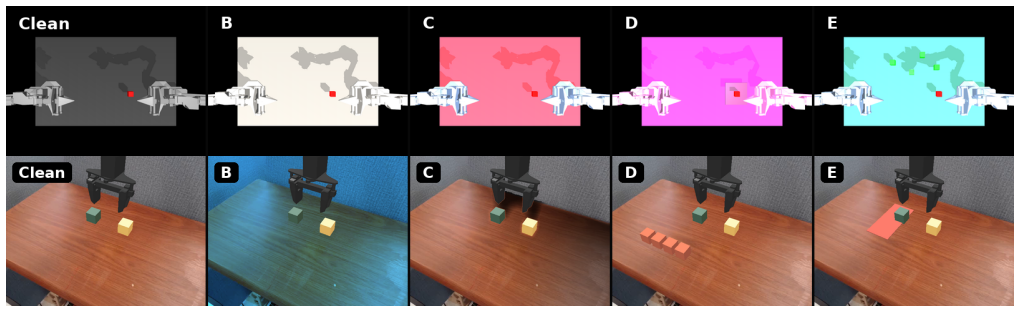
The central claim is that a brittle visuomotor policy can serve as its own probe: comparing its predicted actions on paired clean and nuisance observations, where the expert action is identical by construction, yields an offline fragility signal that ranks visual conditions by how much they break the policy. The paper calls this signal action drift and shows that it correlates with rollout failure across nuisance conditions, with rank correlations of 0.95 and 0.88 on the two tasks. It then argues that selecting repairs by drift score alone is suboptimal because high-drift examples can be redundant, and instead selects candidates that cover diverse response shapes. The reported numbers are th
What carries the argument
The central object is the paired counterfactual observation (clean scene paired with nuisance scene) constructed to preserve the expert action, together with the action-drift vector, the normalized difference between the policy's predicted actions on the pair. Drift magnitude ranks candidate nuisances; drift response features, summary statistics of that difference over time and action dimensions, define distinct response modes. A kernel affinity over those features feeds a greedy coverage objective that picks a budget-sized repair set spanning diverse high-drift modes. The selected nuisance observations are paired with the original demonstration actions and used to fine-tune the policy from
Load-bearing premise
The load-bearing premise is that every nuisance intervention really is task-preserving, meaning the demonstrated expert action remains the correct action after the visual change; if a subtle change alters the intended task, action drift misreads a legitimate action change as fragility and mislabels the selected repairs.
What would settle it
Construct a set of nuisances that deliberately changes the intended goal, violating the equality a*(s_c)=a*(s_n), while keeping the same visual shift magnitudes; if drift ranks these task-changing shifts as high-priority repairs, the signal conflates task change with nuisance fragility. Also, evaluate a held-out nuisance family absent from the candidate pool: if response-guided repair with a budget of 30 cannot beat random selection at the same budget on that condition despite the pool containing useful candidates, the coverage objective has failed.
If this is right
- Robustness repair can be planned offline, before deployment, by auditing the trained policy against task-preserving counterfactuals.
- At small repair budgets, response-diverse selection is more effective than the same number of random examples, and can match the effect of much larger random budgets.
- Action drift is a policy-specific fragility signal: the same nuisance condition that is benign for one policy can be destructive for another, so repair data should be chosen per policy rather than per task.
- Held-out transfer is partial and limited by candidate-pool coverage; large random budgets still transfer best, identifying candidate coverage as the main bottleneck.
Where Pith is reading between the lines
- A testable extension is to average drift over multiple action samples or output distributions for stochastic or diffusion policies; single-sample drift may understate fragility when the policy is multimodal.
- The same signal could be inverted into a live data-acquisition policy: during a distribution shift, redirect data collection toward the highest-drift scenarios rather than re-collecting random demonstrations.
- The coverage principle suggests that the best repair set is not intrinsic to the data but depends on the current policy, so the same candidate pool would yield different selections for different checkpoints, which is a checkable prediction.
- Pairing drift with rollout-derived or ensemble-disagreement signals might overcome the candidate-coverage limit that the paper explicitly acknowledges.
Editorial analysis
A structured set of objections, weighed in public.
Referee Report
Summary. The paper proposes Counterfactual Nuisance Behaviour Cloning (CFNBC), an offline data-selection framework for repairing visuomotor imitation policies that are brittle to task-preserving visual nuisances. CFNBC generates paired clean/nuisance observations under an action-preserving assumption, measures the change in the policy's predicted action ('action drift'), and selects a small, response-diverse repair set by greedily maximizing weighted response coverage. The selected counterfactual samples, labelled with inherited expert actions, are mixed with clean demonstrations to fine-tune the nominal policy. Experiments on MuJoCo bimanual cube transfer and SimplerEnv cube stacking report that drift strongly ranks nuisance-induced failure and that K=20--30 selected candidates outperform matched-budget random selection, sometimes approaching the performance of much larger random repair budgets. The core idea is clearly presented and the offline, rollout-free selection signal is appealing.
Significance. If the central data-efficiency claim holds, CFNBC would be a useful contribution to the growing literature on data-centric robustness for imitation learning: it turns a policy-specific sensitivity measure into a practical data-selection rule that does not require online rollouts or success labels. The paper explicitly builds on established ideas (counterfactual/action-preserving augmentation, active imitation, distribution-shift benchmarks) and contributes a well-specified selection objective. The reported correlations (Spearman rho=0.95/0.88) are strong and the controlled comparisons between selection strategies are well motivated. However, the significance is tempered by the empirical evidence base: the main quantitative claims rest on three-seed point estimates with no error bars, and the headline 'approaching much larger random budgets' is not supported on held-out nuisance instantiations. The authors are candid about these limitations, but the abstract and introduction present the stronger reading.
major comments (4)
- [§IV (Training seeds and uncertainty) and Table II] The central data-efficiency claim—that K=20--30 response-guided candidates substantially outperform matched-budget random selection—is supported by three-seed averages with no variance, no error bars, and no significance test. The paper itself states: 'we use these means to reduce dependence on a single run, but do not claim statistical significance with n=3.' Since the margins in Table II (e.g., Cube transfer All nuis. 0.96 vs 0.56 for random K=20; Cube stacking 0.76 vs 0.60 for random K=30) could plausibly change under typical seed variance for ACT fine-tuning, the quantitative strength of the central claim is not yet established. Please provide per-seed results, confidence intervals, or a larger number of seeds, or explicitly downgrade the claim to a preliminary finding.
- [§V-D and Appendix D (Table IV)] The headline claim that selected repair sets 'approach the performance of much larger random repair budgets' is only true on the seen 22-condition evaluation. On held-out nuisance instantiations, Table IV shows a large gap: for Cube transfer, response-guided K=20 attains held-out mean 0.57 vs 0.90 for random K=500; for Cube stacking, held-out worst is 0.02 vs 0.28. The paper acknowledges this in §V-D ('CFNBC is only as good as the candidate response set' and 'held-out transfer is partial'), but the abstract and Section I state the 'approaching larger random budgets' conclusion without this caveat. The central claim should be narrowed to candidate-covered nuisance conditions, or additional evidence is needed that transfer improves with response-guided selection beyond matched budgets.
- [§III-A, Eq. (1), and Appendix B] The load-bearing premise is that all generated nuisances are task-preserving, i.e., a*(s_c)=a*(s_n) for every paired observation. Appendix B asserts this by construction, but for local support changes (a cloth patch under the manipulated objects) there is a real risk that contact geometry or friction changes the feasible or intended action, especially in the bimanual cube transfer task. The paper does not validate this assumption, e.g., by checking that the expert action succeeds under the nuisance condition or that the task state remains unchanged. If any candidate intervention changes the intended action without detection, action drift conflates nuisance sensitivity with task-relevant change and the repair set is mislabelled. Please add an explicit validation protocol or at least an ablation showing results are robust to filtering out candidates with large physical-side-effect risk.
- [§III-C and Appendix A] The selection objective in Eq. (4) uses response features and an RBF affinity with free parameters (lambda_cf, kernel bandwidth sigma), and the reported drift-weighted score additionally multiplies by normalized drift. The greedy selection procedure is clear, but the choice of summary statistics (mean/std/mean-abs/max-abs) and the median-distance sigma are presented as implementation details without sensitivity analysis. Since the entire method is an offline selection rule, it is important to know how robust the selection is to these choices. A sensitivity study (e.g., varying sigma and the response-feature specification) would strengthen the claim that the gains come from response-guided coverage rather than from incidental properties of the particular affinity function.
minor comments (4)
- [Figure 3 and §V-B] The Spearman correlations are computed over nuisance conditions that are also used to build the candidate response set and to evaluate the main repair results. Please clarify the relationship between the plotted conditions and the candidate pool, and state whether the correlation includes all 22 conditions or a subset. This does not invalidate the signal, but it affects how 'offline' and 'prediction' should be interpreted.
- [Abstract and Section I] The phrase 'without requiring rollout success labels or online policy execution' is accurate for the selection stage, but the candidate pool is still generated in a simulator with a task-preserving nuisance generator. Consider adding a sentence clarifying that the method is offline with respect to policy rollouts, not necessarily with respect to simulation access.
- [Table II] The 'Gain vs nominal' column for Random (high-budget) 500 in Cube transfer reports 0.70, while All nuis. is 1.00 and nominal is 0.30. This is consistent, but the column label could be misread as the gain of the high-budget random method over the low-budget random method. Please rename to 'Gain vs nominal (All nuis.)'.
- [Appendix D, Table IV] The 'Held-out gap' column is defined as the difference between seen and held-out all-nuisance performance, but the column header does not make clear which direction is positive. Please add a footnote or caption explaining the sign convention.
Circularity Check
No significant circularity found: action drift is an independent policy-output signal, selection does not use success labels, and no load-bearing step reduces to its own inputs.
full rationale
I examined the derivation chain from Eq. (1) (task-preserving counterfactuals), through action drift Eq. (2), response-guided selection Eq. (4), and fine-tuning Eq. (6). No step reduces by construction to its inputs. Action drift is computed from the nominal policy's predicted actions on paired clean/nuisance inputs and is never fitted to rollout success labels; the Spearman correlations in Fig. 3 and the held-out results in Table IV are separate empirical validations. Eq. (4) maximizes response-feature coverage, not observed success, and the evaluation is through independent rollouts. The main evaluation shares the 22-condition nuisance space with the candidate pool, which makes the 'seen-condition' results partly self-referential in a broad sense, but this is an experimental scope concern, not a definitional or fitted-input circularity; the held-out results explicitly mitigate it. The paper also disclaims statistical significance with n=3, which is a robustness concern, not circularity. No load-bearing self-citations, imported uniqueness theorems, or ansatz-by-citation are present. The paper explicitly acknowledges that repair is bounded by candidate-set coverage, which is a stated limitation rather than a circular step. Therefore the derivation is self-contained with respect to circularity.
Axiom & Free-Parameter Ledger
free parameters (2)
- lambda_cf (counterfactual loss weight) =
0.5
- RBF kernel bandwidth sigma =
median non-zero pairwise distance in candidate pool
axioms (4)
- domain assumption Task-preserving counterfactual assumption: a*(s_c)=a*(s_n) in Eq. (1), so inherited expert actions remain valid under nuisances.
- domain assumption Local action drift in normalized action space is a usable proxy for closed-loop rollout failure.
- domain assumption Candidate response set covers deployment nuisance response modes.
- ad hoc to paper Response features (mean, std, mean-abs, max-abs over timesteps/action dims) with RBF affinity capture semantically similar policy response modes.
read the original abstract
Visuomotor imitation learning has demonstrated success for manipulation tasks. However, the trained policies remain brittle to visual `nuisances', with even minor task-preserving variations such as lighting, distractions or changes in colour result in heavy degradation of the trained policy's performance. While increasing data diversity can improve robustness, it is unclear which additional demonstrations are informative for a particular trained policy. We propose Counterfactual Nuisance Behaviour Cloning (CFNBC), an offline data-selection framework for targeted robustness repair. Starting from a nominal policy trained on `clean' demonstrations, CFNBC generates paired clean and nuisance observations that preserve the expert action, then measures \emph{action drift}: the change in the policy's predicted action under a nuisance that should not alter the desired behaviour. This provides a policy-specific sensitivity signal for selecting a compact, response-diverse repair set from a larger candidate pool, without requiring rollout success labels or online policy execution. We show in MuJoCo bimanual cube transfer and SimplerEnv cube stacking that action drift correlates with nuisance-induced failure, and that response-guided repair with only $20$--$30$ selected candidates substantially outperforms matched-budget random selection while approaching the performance of much larger random repair budgets. These results support a data-centric view of robustness repair: the most useful data are not necessarily the most numerous, visually diverse, or obviously difficult, but the examples that cover fragile response modes of the current policy.
Figures


Reference graph
Works this paper leans on
-
[1]
Solving rubik’s cube with a robot hand.arXiv preprint arXiv:1910.07113, 2019
Ilge Akkaya, Marcin Andrychowicz, Maciek Chociej, Mateusz Litwin, Bob McGrew, Arthur Petron, Alex Paino, Matthias Plappert, Glenn Powell, Raphael Ribas, et al. Solving rubik’s cube with a robot hand.arXiv preprint arXiv:1910.07113, 2019
Pith/arXiv arXiv 1910
-
[2]
Rocoda: Counterfactual data augmen- tation for data-efficient robot learning from demon- strations
Ezra Ameperosa, Jeremy A Collins, Mrinal Jain, and Animesh Garg. Rocoda: Counterfactual data augmen- tation for data-efficient robot learning from demon- strations. In2025 IEEE International Conference on Robotics and Automation (ICRA), pages 13250–13256. IEEE, 2025
2025
-
[3]
Causal confusion in imitation learning.Advances in neural information processing systems, 32, 2019
Pim De Haan, Dinesh Jayaraman, and Sergey Levine. Causal confusion in imitation learning.Advances in neural information processing systems, 32, 2019
2019
-
[4]
Robust visual sim-to-real transfer for robotic manipulation
Ricardo Garcia, Robin Strudel, Shizhe Chen, Etienne Arlaud, Ivan Laptev, and Cordelia Schmid. Robust visual sim-to-real transfer for robotic manipulation. In2023 IEEE/RSJ International Conference on Intelligent Robots and Systems (IROS), pages 992–999. ieee, 2023
2023
-
[5]
Ryan Hoque, Ashwin Balakrishna, Ellen Novoseller, Albert Wilcox, Daniel S Brown, and Ken Goldberg. Thriftydagger: Budget-aware novelty and risk gating for interactive imitation learning.arXiv preprint arXiv:2109.08273, 2021
Pith/arXiv arXiv 2021
-
[6]
Hg-dagger: Inter- active imitation learning with human experts
Michael Kelly, Chelsea Sidrane, Katherine Driggs- Campbell, and Mykel J Kochenderfer. Hg-dagger: Inter- active imitation learning with human experts. In2019 International Conference on Robotics and Automation (ICRA), pages 8077–8083. IEEE, 2019
2019
-
[7]
Xuanlin Li, Kyle Hsu, Jiayuan Gu, Karl Pertsch, Oier Mees, Homer Rich Walke, Chuyuan Fu, Ishikaa Lunawat, Isabel Sieh, Sean Kirmani, et al. Evaluating real-world robot manipulation policies in simulation.arXiv preprint arXiv:2405.05941, 2024
Pith/arXiv arXiv 2024
-
[8]
Active domain randomiza- tion
Bhairav Mehta, Manfred Diaz, Florian Golemo, Christo- pher J Pal, and Liam Paull. Active domain randomiza- tion. InConference on Robot Learning, pages 1162–
-
[9]
R3m: A universal visual representation for robot manipulation.arXiv preprint arXiv:2203.12601, 2022
Suraj Nair, Aravind Rajeswaran, Vikash Kumar, Chelsea Finn, and Abhinav Gupta. R3m: A universal visual representation for robot manipulation.arXiv preprint arXiv:2203.12601, 2022
Pith/arXiv arXiv 2022
-
[10]
Rep- resentation learning with contrastive predictive coding
Aaron van den Oord, Yazhe Li, and Oriol Vinyals. Rep- resentation learning with contrastive predictive coding. arXiv preprint arXiv:1807.03748, 2018
Pith/arXiv arXiv 2018
-
[11]
An algo- rithmic perspective on imitation learning.Foundations and Trends® in Robotics, 7(1-2):1–179, 2018
Takayuki Osa, Joni Pajarinen, Gerhard Neumann, J An- drew Bagnell, Pieter Abbeel, and Jan Peters. An algo- rithmic perspective on imitation learning.Foundations and Trends® in Robotics, 7(1-2):1–179, 2018
2018
-
[12]
Open x-embodiment: Robotic learning datasets and rt-x models: Open x-embodiment collaboration 0
Abby O’Neill, Abdul Rehman, Abhiram Maddukuri, Ab- hishek Gupta, Abhishek Padalkar, Abraham Lee, Acorn Pooley, Agrim Gupta, Ajay Mandlekar, Ajinkya Jain, et al. Open x-embodiment: Robotic learning datasets and rt-x models: Open x-embodiment collaboration 0. In2024 IEEE International Conference on Robotics and Automation (ICRA), pages 6892–6903. IEEE, 2024
2024
-
[13]
Wilbert Pumacay, Ishika Singh, Jiafei Duan, Ranjay Kr- ishna, Jesse Thomason, and Dieter Fox. The colosseum: A benchmark for evaluating generalization for robotic manipulation.arXiv preprint arXiv:2402.08191, 2024
Pith/arXiv arXiv 2024
-
[14]
Un- supervised feature learning for manipulation with con- trastive domain randomization
Carmel Rabinovitz, Niko Grupen, and Aviv Tamar. Un- supervised feature learning for manipulation with con- trastive domain randomization. In2021 IEEE Interna- tional Conference on Robotics and Automation (ICRA), pages 10153–10159. IEEE, 2021
2021
-
[15]
A reduction of imitation learning and structured prediction to no-regret online learning
St ´ephane Ross, Geoffrey Gordon, and Drew Bagnell. A reduction of imitation learning and structured prediction to no-regret online learning. InProceedings of the fourteenth international conference on artificial intelli- gence and statistics, pages 627–635. JMLR Workshop and Conference Proceedings, 2011
2011
-
[16]
Realm: A real-to-sim validated benchmark for generalization in robotic manipulation.IEEE Robotics and Automation Letters, 2026
Martin Sedlacek, Pavlo Yefanov, Georgy Ponimatkin, Jai Bardhan, Simon Pilc, Mederic Fourmy, Evangelos Kazakos, Cees GM Snoek, Josef Sivic, and Vladimir Petrik. Realm: A real-to-sim validated benchmark for generalization in robotic manipulation.IEEE Robotics and Automation Letters, 2026
2026
-
[17]
Time-contrastive networks: Self- supervised learning from video
Pierre Sermanet, Corey Lynch, Yevgen Chebotar, Jas- mine Hsu, Eric Jang, Stefan Schaal, Sergey Levine, and Google Brain. Time-contrastive networks: Self- supervised learning from video. In2018 IEEE inter- national conference on robotics and automation (ICRA), pages 1134–1141. IEEE, 2018
2018
-
[18]
Domain ran- domization for transferring deep neural networks from simulation to the real world
Josh Tobin, Rachel Fong, Alex Ray, Jonas Schneider, Wojciech Zaremba, and Pieter Abbeel. Domain ran- domization for transferring deep neural networks from simulation to the real world. In2017 IEEE/RSJ in- ternational conference on intelligent robots and systems (IROS), pages 23–30. IEEE, 2017
2017
-
[19]
Mujoco: A physics engine for model-based control
Emanuel Todorov, Tom Erez, and Yuval Tassa. Mujoco: A physics engine for model-based control. In2012 IEEE/RSJ international conference on intelligent robots and systems, pages 5026–5033. IEEE, 2012
2012
-
[20]
Chang, Leonidas J
Fanbo Xiang, Yuzhe Qin, Kaichun Mo, Yikuan Xia, Hao Zhu, Fangchen Liu, Minghua Liu, Hanxiao Jiang, Yifu Yuan, He Wang, Li Yi, Angel X. Chang, Leonidas J. Guibas, and Hao Su. Sapien: A simulated part-based interactive environment. InProceedings of the IEEE/CVF Conference on Computer Vision and Pattern Recognition (CVPR), pages 11097–11107, June 2020
2020
-
[21]
Decomposing the generalization gap in imitation learning for visual robotic manipulation
Annie Xie, Lisa Lee, Ted Xiao, and Chelsea Finn. Decomposing the generalization gap in imitation learning for visual robotic manipulation. In2024 IEEE Interna- tional Conference on Robotics and Automation (ICRA), pages 3153–3160. IEEE, 2024
2024
-
[22]
Barlow twins: Self-supervised learning via redundancy reduction
Jure Zbontar, Li Jing, Ishan Misra, Yann LeCun, and St´ephane Deny. Barlow twins: Self-supervised learning via redundancy reduction. InInternational conference on machine learning, pages 12310–12320. PMLR, 2021
2021
-
[23]
Tony Z Zhao, Vikash Kumar, Sergey Levine, and Chelsea Finn. Learning fine-grained bimanual manipulation with low-cost hardware.arXiv preprint arXiv:2304.13705, 2023
Pith/arXiv arXiv 2023
-
[24]
Aloha unleashed: A simple recipe for robot dexterity.arXiv preprint arXiv:2410.13126, 2024
Tony Z Zhao, Jonathan Tompson, Danny Driess, Pete Florence, Kamyar Ghasemipour, Chelsea Finn, and Ayzaan Wahid. Aloha unleashed: A simple recipe for robot dexterity.arXiv preprint arXiv:2410.13126, 2024. APPENDIXA CFNBC ALGORITHM ANDIMPLEMENTATIONDETAILS This appendix provides the full CFNBC procedure used in the experiments, including candidate response ...
Pith/arXiv arXiv 2024
discussion (0)
Sign in with ORCID, Apple, or X to comment. Anyone can read and Pith papers without signing in.