REVIEW 4 major objections 5 minor 34 references
QS4D: Quantization-aware training for efficient hardware deployment of structured state-space sequential models
T0 review · 4 major / 5 minor · reviewed 2026-08-06 · deepseek-v4-flash
Pith's one-line read Quantization-aware training lets S4D state-space models drop to 5–6 bit precision with under 1% accuracy loss, cutting computational effort by up to two orders of magnitude, shrinking memory about tenfold, and making the models tolerant…
desk verdict Useful systems paper, but the headline complexity numbers rest on an unverified convolutional-mode proxy; the hardware demo uses coarser quantization and doesn't close the gap. read the letter →
The pith
A machine-rendered reading of the paper's core claim, the machinery that carries it, and where it could break.
The reading
What carries the argument
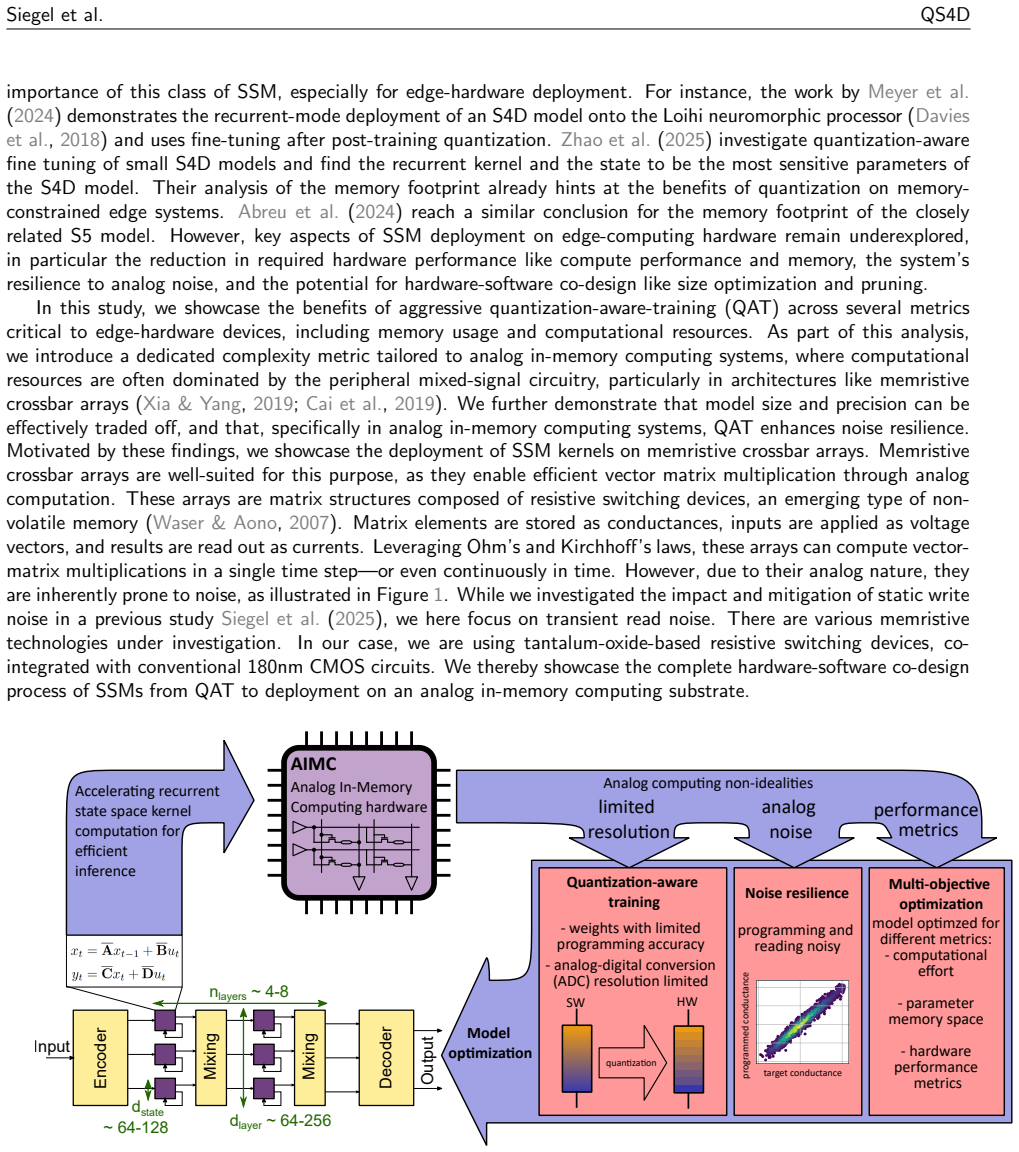
The central object is the S4D model, a structured state-space sequence model whose transition matrix is diagonalized so that each kernel's recurrent state update becomes an elementwise multiplication. The mechanism carrying the argument is quantization-aware training with a straight-through estimator: the forward pass rounds each parameter and activation onto an equally spaced integer ladder centered on zero, while the backward pass treats the rounding as an identity so gradients can flow. Because the model is trained in convolutional mode, state quantization is emulated by quantizing the input and convolutional kernel to half the target state precision, a proxy the paper explicitly notes is not numerically identical to recurrent computation. On the hardware side, the IMSSA mapping places the $A$, $B$, and $C$ operations of a kernel into one memristive crossbar array, with the output read from a one-time-step-delayed state, so the whole kernel executes as a single vector-matrix multiplication.
What would settle it
Run a QAT-trained S4D model in true recurrent mode on a memristive crossbar array at the bit widths of Table 1 on a longer, multi-class task, and compare hardware accuracy to the convolutional-emulation prediction; if the extra error exceeds 1% while the emulation said it would not, the emulation proxy is the point of failure.
Extended reading notes
Core claim
The paper claims that quantization-aware training (QAT) is the enabling step for deploying S4D structured state-space models on edge hardware: with QAT, all core parameters — the diagonal transition matrix $A$, the output vectors $C$, the trainable time steps $\Delta t$, the encoder, decoder, mixing layers, and inter-layer activations — can be projected onto an equally spaced integer ladder and trained with a straight-through estimator until the model tolerates 5–6 bit homogeneous precision with under 1% extra error, a far more aggressive quantization than post-training quantization allows. The consequence is that computational effort (ACE) falls by up to two orders of magnitude, memory footprint by about a factor of ten, and the ADC peripheral complexity of an analog in-memory implementation by several fold, while the model simultaneously becomes more tolerant of transient read noise and more prunable at the level of whole kernels. The paper closes by showing that a small keyword-spotting S4D kernel can be programmed onto a memristive crossbar array via the IMSSA mapping, recovering 95.3% accuracy against a 95.8% software baseline.
Load-bearing premise
The load-bearing premise is that quantization emulated during convolutional-mode training faithfully predicts how the recurrent computation will behave on the analog chip; the paper itself notes in Section 2.1 that the two computations do not give exactly the same numerical results.
Editorial extensions
If this is right
- On the three tasks studied, homogeneous quantization to 5–6 bits with QAT keeps additional error below 1%, where PTQ already fails at 10–16 bits; individual parameters such as $\Delta t$ can fall to 1 bit.
- Computational effort, measured by ACE, drops 11–24x with PTQ and a further 2–11.5x with QAT, pushing the combined reduction toward two orders of magnitude; model memory shrinks by roughly 10x and ADC read-out complexity by several fold.
- QAT-trained models degrade more gracefully under transient read noise on the recurrent matrix, and training with explicit Gaussian noise on top restores some quantization loss and improves all models.
- Aggressive quantization enables structural pruning of entire kernels, with more than half the first-layer kernels removable at 7 bits on the sequential CIFAR10 task, and this pruning advantage grows as bit width drops.
- A complete S4D kernel can be mapped onto a single 64x64 memristive crossbar array, and the programmed hardware reached 95.3% accuracy on a two-class keyword-spotting subset, close to the 95.8% software model.
Reading between the lines
- The convolutional-emulation proxy for state quantization means the headline two-orders-of-magnitude complexity gain is validated in software emulation; the small hardware demo is a two-class keyword spotter, so the gain at scale still needs a recurrent-mode hardware check.
- Because QAT behaves like noise injection, combining it with explicit noise training and device-aware programming could close the residual software–hardware accuracy gap further, a combination the paper only explores separately.
- The pruning result suggests QAT changes the loss landscape so that entire recurrent kernels become redundant; an automated co-design loop could search over bit width, state dimension, and kernel count together.
- The same recipe may transfer to selective SSMs such as Mamba, but their input-dependent dynamics would need a different state-quantization emulation, so the gains are not automatic.
Editorial analysis
A structured set of objections, weighed in public.
Referee Report
Summary. The paper studies quantization-aware training (QAT) of S4D structured state-space models for edge deployment. It introduces an indirect state quantization by quantizing the convolutional kernel and input, compares QAT against post-training quantization on sCIFAR10, Pathfinder, and a Heidelberg Digits keyword-spotting subset, and reports maximum bit widths that stay below a 1%-additional-error threshold. From those bit levels, the paper derives reductions in three hardware-oriented metrics: arithmetic complexity (ACE), parameter memory, and an ADC peripheral complexity measure. It also examines size-versus-precision trade-offs, structural pruning of complete kernels, robustness to transient analog noise, and finally reports a small memristive crossbar-array deployment of an S4D kernel. The central claims are that QAT can reduce SSM complexity by up to two orders of magnitude, improves noise robustness, and enables structural pruning.
Significance. If the claims hold, the paper provides a practical hardware-software co-design recipe for S4D-style models on edge and analog in-memory substrates, with concrete bit-width-to-metric mappings that are useful for accelerator design. Strengths include the systematic PTQ-versus-QAT comparison across three tasks and several parameter groups, algebraically transparent complexity metrics, explicit noise-robustness experiments, and a real memristive hardware demonstration with a calibrated write/read noise treatment. The main risk is that the headline complexity reductions are computed from quantization levels obtained in convolutional-mode emulation, while the recurrent-mode deployment that hardware actually executes is only checked on a much coarser, small model; the lack of error bars on all accuracy experiments further tempers the strength of the quantitative claims.
major comments (4)
- [§2.1, §3, Table 1 vs. Table 3] The central two-orders-of-magnitude complexity claim is computed from quantization levels found in convolutional-mode QAT, but Section 2.1 states that this indirect state quantization 'does not yield the exact same numerical results as the recurrent computation' and that the state is never explicitly computed. In the recurrent deployment mode (Eq. 3), quantization errors in A, B, C, Δ, and activations propagate through the recurrence, so the aggressive levels in Table 1 (e.g., HD: homogeneous QAT 5 bits, A 1 bit, state 3 bits) may not transfer. The hardware check in Table 3 uses substantially coarser settings (rstate/ract = 8 bits, rkernelweights = 4 bits, N = 14, H = 3) on a two-class HD subset, so it does not validate the aggressive QAT levels. A recurrent-mode inference test using the Table 1 quantized parameters, or direct recurrent-mode QAT, is needed before the headline complexity reductions can be considered established for real deployments.
- [Table 1, Figures 2 and 4] All reported accuracy numbers appear to be single-run results with no error bars or seed information. Because the headline gains are defined by a 1%-additional-error threshold (e.g., QAT 5 vs. 6 bits on HD, or PTQ 10 vs. 9 bits on sCIFAR10), the reported bit-level differences need to be distinguished from run-to-run variation. The 100.0% baseline accuracy for Heidelberg Digits in Table 1 is unexplained; please state the test-set size and confirm whether this value is rounded, since a rounded 100% baseline makes the 'below 1% additional error' criterion ill-defined.
- [§2.4, Table 2] The structural-pruning claim is presented as a benefit of QAT, but Table 2 is captioned 'Post training pruning' and the pruning method is not specified. No importance criterion, threshold, retraining protocol, or data-split details are provided, so it is unclear whether the larger pruning margins for 7-bit models reflect a property induced by QAT or simply the action of an unspecified criterion on different weight distributions. To support the statement that QAT 'enables structural pruning,' report the pruning algorithm and verify that the pruned models remain within the stated error budget after pruning.
- [§5.3.1–5.3.2, Eqs. (6)–(7)] Equations (6) and (7) contain unmatched parentheses and ambiguous operator precedence in the encoder/decoder terms: 'H*(n_in + n_out * r_act * r_coder' and 'H*(n_in + n_out * r_coder'. As written, the metric values in Figure 3 cannot be reproduced unambiguously. Please write the terms as H*(n_in + n_out)*r_act*r_coder and H*(n_in + n_out)*r_coder, or specify the intended grouping, and define all variables consistently.
minor comments (5)
- [§1, §2.2] There are several typos: 'quantization-aware training (QTA)' should be 'QAT', 'going the the left' should be 'going to the left', and the phrase 'perfect memory tasks' in the Discussion overstates what the benchmarks measure.
- [Figure 2 caption] The caption line '4 bits 4 bits 2 bits 4 bits / 7 bits3 bits1 bit 1 bit' is unclear; each subplot should be labeled with the parameter being quantized, and the PTQ/QAT line styles need to be defined in a legend.
- [§2.5, Figure 4] The noise-robustness plots would benefit from explicit axis definitions and error bars; the caption says 'the large range of the x-axis should be noted' but does not state the units or the noise injection point precisely enough for reproduction.
- [§3, Table 4] The comparison with the Jetson Nano is not apples-to-apples: the technology nodes differ (180nm custom chip vs. 20nm commercial GPU), and it is unclear whether the reported throughput is measured or theoretical peak, or whether the comparison includes the ADC/DAC and programming overhead of the memristive system. Please specify the measurement conditions and workload for both systems.
- [§5.2.1, Eq. (5)] The quantization formula should state whether the scaling grid is per-tensor or per-channel and should define how zero is handled; this detail is relevant because the encoder/decoder and recurrent parameters may need different ranges.
Circularity Check
No significant circularity: QAT gains are benchmark-driven, hardware results include independent chip measurements, and self-citations are not load-bearing.
full rationale
The core QAT-versus-PTQ comparison is evaluated on external benchmarks (sequential CIFAR10, Pathfinder, and Heidelberg Digits) and does not reduce to a fitted parameter. The complexity reductions in Figure 3 are arithmetic consequences of Equations 6-8 applied to the quantization levels obtained in training; this is an openly stated engineering calculation, not a prediction disguised as a fit. The state-quantization emulation is explicitly flagged in Section 2.1 as approximate ('it should be noted that this does not yield the exact same numerical results as the recurrent computation'), so it is a validation caveat rather than a circular step. The hardware deployment uses the authors' own IMSSA architecture (Siegel et al. 2025) and memristor tuning method (Yang et al. 2025), but these self-citations supply independent chip measurements and device models, including the measured 95.3% mCBA accuracy versus 95.8% software accuracy in Table 3, and no uniqueness or forced-choice argument is imported from them. No step defines the claimed result in terms of itself; the main risk is transfer of convolutional-mode quantization to recurrent-mode hardware, which is a correctness and generalization concern, not circularity.
Assumptions & free parameters
free parameters (2)
- state quantization split factor =
k/2
- common constant maximum value for kernel parameters =
not reported
assumptions (6)
- standard math Zero-order-hold discretization of the continuous SSM (Equation 3) is a valid discrete approximation.
- domain assumption Dropping the low-rank residual of A in S4D has only minor impact on task performance.
- standard math Straight-through estimator with forward-only quantization is a valid training procedure for QAT.
- domain assumption Emulated fixed-point quantization on GPU float32 arithmetic represents low-precision hardware behavior.
- ad hoc to paper Quantization itself is a form of noise, so QAT is equivalent to training with noise.
- domain assumption Memristive devices can be programmed to 3 bits per cell with the stated tuning method.
Cite this review
Pith. "Pith review of QS4D: Quantization-aware training for efficient hardware deployment of structured state-space sequential models." pith.science (2026). https://pith.science/paper/DPDKGA4U
@misc{pith2026250706079,
  author       = {Pith},
  title        = {Pith review of: QS4D: Quantization-aware training for efficient hardware deployment of structured state-space sequential models},
  year         = {2026},
  howpublished = {\url{https://pith.science/paper/DPDKGA4U}},
  note         = {Machine review of arXiv:2507.06079}
}
read the original abstract
Structured State Space models (SSM) have recently emerged as a new class of deep learning models, particularly well-suited for processing long sequences. Their constant memory footprint, in contrast to the linearly scaling memory demands of Transformers, makes them attractive candidates for deployment on resource-constrained edge-computing devices. While recent works have explored the effect of quantization-aware training (QAT) on SSMs, they typically do not address its implications for specialized edge hardware, for example, analog in-memory computing (AIMC) chips. In this work, we demonstrate that QAT can significantly reduce the complexity of SSMs by up to two orders of magnitude across various performance metrics. We analyze the relation between model size and numerical precision, and show that QAT enhances robustness to analog noise and enables structural pruning. Finally, we integrate these techniques to deploy SSMs on a memristive analog in-memory computing substrate and highlight the resulting benefits in terms of computational efficiency.
Figures


Figures from the paper (2 more)


Reference graph
Works this paper leans on
-
[1]
" write newline "" before.all 'output.state := FUNCTION article output.bibitem format.authors "author" output.check author format.key output output.year.check new.block format.title "title" output.check new.block crossref missing format.jour.vol output format.article.crossref output.nonnull format.pages output if new.block note output fin.entry FUNCTION b...
-
[2]
Q-S5: Towards Quantized State Space Models
Abreu, S., Pedersen, J. E., Heckel, K. M., & Pierro, A. (2024). Q-s5: Towards quantized state space models. arXiv preprint arXiv:2406.09477\/
work page Pith review arXiv 2024
-
[3]
B., Aydin, G., Puthankattil, S
Ay, B., Yildirim, O., Talo, M., Baloglu, U. B., Aydin, G., Puthankattil, S. D., & Acharya, U. R. (2019). Automated depression detection using deep representation and sequence learning with EEG signals. Journal of medical systems\/ 43\/ (7), 1--12
work page 2019
-
[4]
Ballinger, B., Hsieh, J., Singh, A., Sohoni, N., Wang, J., Tison, G. H., Marcus, G. M., Sanchez, J. M., Maguire, C., Olgin, J. E., et al. (2018). Deepheart: semi-supervised sequence learning for cardiovascular risk prediction. In Thirty-Second AAAI Conference on Artificial Intelligence
work page 2018
-
[5]
Hardware Aware Training for Efficient Keyword Spotting on General Purpose and Specialized Hardware
Blouw, P., Malik, G., Morcos, B., Voelker, A. R., & Eliasmith, C. (2020). Hardware aware training for efficient keyword spotting on general purpose and specialized hardware. arXiv preprint arXiv:2009.04465\/
work page Pith review arXiv 2020
-
[6]
Cai, F., Correll, J. M., Lee, S. H., Lim, Y., Bothra, V., Zhang, Z., Flynn, M. P., & Lu, W. D. (2019). A fully integrated reprogrammable memristor--cmos system for efficient multiply--accumulate operations. Nature Electronics\/ 2\/ (7), 290--299
work page 2019
-
[7]
Chiang, H.-Y., Chang, C.-C., Frumkin, N., Wu, K.-C., & Marculescu, D. (2024). Quamba: A post-training quantization recipe for selective state space models. arXiv preprint arXiv:2410.13229\/
arXiv 2024
-
[8]
Cramer, B., Stradmann, Y., Schemmel, J., & Zenke, F. (2020). The heidelberg spiking data sets for the systematic evaluation of spiking neural networks. IEEE Transactions on Neural Networks and Learning Systems\/ 33\/ (7), 2744--2757
work page 2020
Show all 34 references
-
[9]
Dao, T., & Gu, A. (2024). Transformers are ssms: Generalized models and efficient algorithms through structured state space duality. arXiv preprint arXiv:2405.21060\/
2024 arXiv
-
[10]
H., Dimou, G., Joshi, P., Imam, N., Jain, S., et al
Davies, M., Srinivasa, N., Lin, T.-H., Chinya, G., Cao, Y., Choday, S. H., Dimou, G., Joshi, P., Imam, N., Jain, S., et al. (2018). Loihi: A neuromorphic manycore processor with on-chip learning. Ieee Micro\/ 38\/ (1), 82--99
2018
-
[11]
Esteva, A., Robicquet, A., Ramsundar, B., Kuleshov, V., DePristo, M., Chou, K., Cui, C., Corrado, G., Thrun, S., & Dean, J. (2019). A guide to deep learning in healthcare. Nature medicine\/ 25\/ (1), 24--29
2019
-
[12]
Gu, A., & Dao, T. (2023). Mamba: Linear-time sequence modeling with selective state spaces. arXiv preprint arXiv:2312.00752\/
2023 arXiv
-
[13]
Gu, A., Dao, T., Ermon, S., Rudra, A., & R \'e , C. (2020). Hippo: Recurrent memory with optimal polynomial projections. Advances in neural information processing systems\/ 33 , 1474--1487
2020
-
[14]
Gu, A., Goel, K., Gupta, A., & R \'e , C. (2022). On the parameterization and initialization of diagonal state space models. Advances in Neural Information Processing Systems\/ 35 , 35971--35983
2022
-
[15]
Gu, A., Goel, K., & R \'e , C. (2021). Efficiently modeling long sequences with structured state spaces. arXiv preprint arXiv:2111.00396\/
2021 arXiv
-
[16]
F., Bordelon, B., Muennighoff, N., Paul, M., Pehlevan, C., R \'e , C., & Raghunathan, A
Kumar, T., Ankner, Z., Spector, B. F., Bordelon, B., Muennighoff, N., Paul, M., Pehlevan, C., R \'e , C., & Raghunathan, A. (2024). Scaling laws for precision. arXiv preprint arXiv:2411.04330\/
2024 arXiv
-
[17]
Li, C., Ignowski, J., Sheng, X., Wessel, R., Jaffe, B., Ingemi, J., Graves, C., & Strachan, J. P. (2020). CMOS -integrated nanoscale memristive crossbars for cnn and optimization acceleration. IEEE International Memory Workshop\/
2020
-
[18]
Ma, S., Wang, H., Ma, L., Wang, L., Wang, W., Huang, S., Dong, L., Wang, R., Xue, J., & Wei, F. (2024). The era of 1-bit llms: All large language models are in 1.58 bits. arXiv preprint arXiv:2402.17764\/
2024 arXiv
-
[19]
M., Weidel, P., Plank, P., Campos-Macias, L., Shrestha, S
Meyer, S. M., Weidel, P., Plank, P., Campos-Macias, L., Shrestha, S. B., Stratmann, P., & Richter, M. (2024). A diagonal structured state space model on loihi 2 for efficient streaming sequence processing. arXiv preprint arXiv:2409.15022\/
2024 arXiv
-
[20]
Ott, J., Lin, Z., Zhang, Y., Liu, S.-C., & Bengio, Y. (2016). Recurrent neural networks with limited numerical precision. arXiv preprint arXiv:1608.06902\/
2016 arXiv
-
[21]
Z., Ibanez-Guzman, J., Li, G., Piazzoni, A., Wang, P., & Santra, A
Pandharipande, A., Cheng, C.-H., Dauwels, J., Gurbuz, S. Z., Ibanez-Guzman, J., Li, G., Piazzoni, A., Wang, P., & Santra, A. (2023). Sensing and machine learning for automotive perception: A review. IEEE Sensors Journal\/ 23\/ (11), 11097--11115
2023
-
[22]
Siegel, S., Yang, M.-J., & Strachan, J.-P. (2025). Imssa: Deploying modern state-space models on memristive in-memory compute hardware. In 2025 IEEE International Symposium on Circuits and Systems (ISCAS) , pp.\ 1--5
2025
-
[23]
T., Warrington, A., & Linderman, S
Smith, J. T., Warrington, A., & Linderman, S. W. (2022). Simplified state space layers for sequence modeling. arXiv preprint arXiv:2208.04933\/
2022 arXiv
-
[24]
Tang, S., Ma, L., Li, H., Sun, M., & Shen, Z. (2024). Bi-mamba: Towards accurate 1-bit state space models. arXiv preprint arXiv:2411.11843\/
2024
-
[25]
Tay, Y., Dehghani, M., Abnar, S., Shen, Y., Bahri, D., Pham, P., Rao, J., Yang, L., Ruder, S., & Metzler, D. (2020). Long range arena: A benchmark for efficient transformers. arXiv preprint arXiv:2011.04006\/
2020 arXiv
-
[26]
Vaswani, A. (2017). Attention is all you need. Advances in Neural Information Processing Systems\/
2017
-
[27]
Voelker, A., Kaji \'c , I., & Eliasmith, C. (2019). Legendre memory units: Continuous-time representation in recurrent neural networks. Advances in neural information processing systems\/ 32
2019
-
[28]
Waser, R., & Aono, M. (2007). Nanoionics-based resistive switching memories. Nature materials\/ 6\/ (11), 833--840
2007
-
[29]
Xia, Q., & Yang, J. J. (2019). Memristive crossbar arrays for brain-inspired computing. Nature materials\/ 18\/ (4), 309--323
2019
-
[30]
Yang, M.-J., & Strachan, J. P. (2023). State-space modeling and tuning of memristors for neuromorphic computing applications. ICONS '23: Proceedings of the 2023 International Conference on Neuromorphic Systems\/
2023
-
[31]
Yang, M.-J., Yu, Z., Pedretti, G., Neftci, E., & Strachan, J. P. (2025). Improved memristor control using device physics and deep reinforcement learning. In 2025 IEEE International Conference on Artificial Intelligence Circuits and Systems (AICAS) , pp.\ 1--5
2025
-
[32]
P., & Neftci, E
Yu, Z., Yang, M.-J., Finkbeiner, J., Siegel, S., Strachan, J. P., & Neftci, E. (2024). The ouroboros of memristors: Neural networks facilitating memristor programming. In 2024 IEEE International Conference on Artificial Intelligence Circuits and Systems (AICAS) , pp.\ 1--5
2024
-
[33]
Zhang, Y., Zhang, Z., & Lew, L. (2022). Pokebnn: A binary pursuit of lightweight accuracy. In Proceedings of the IEEE/CVF Conference on Computer Vision and Pattern Recognition , pp.\ 12475--12485
2022
-
[34]
Zhao, L., Torchet, T., Payvand, M., Kriener, L., & Moro, F. (2025). Quantizing small-scale state-space models for edge ai. arXiv preprint arXiv:2506.12480\/
2025 arXiv
Reviewed August 6, 2026 · model on record in the stance chip above.
Discussion (0). Sign in to comment.