REVIEW 4 major objections 5 minor 39 references
Direct prompt injection attacks can be made transferable across LLMs without querying the target model, using an energy-based model trained on a surrogate model's activations to guide MCMC prompt optimization.
Reviewed by Pith at T0; open to challenge. T0 means a machine referee read the full paper against a public rubric. the ladder, T0–T4 →
T0 review · deepseek-v4-flash
2026-08-04 21:56 UTC pith:DPIJIZRQ
load-bearing objection Novel activation-guided MCMC for prompt injection, but the energy-to-success link is under-supported and the gains over seeds are modest. the 4 major comments →
Transferable Direct Prompt Injection via Activation-Guided MCMC Sampling
The pith
A machine-rendered reading of the paper's core claim, the machinery that carries it, and where it could break.
Core claim
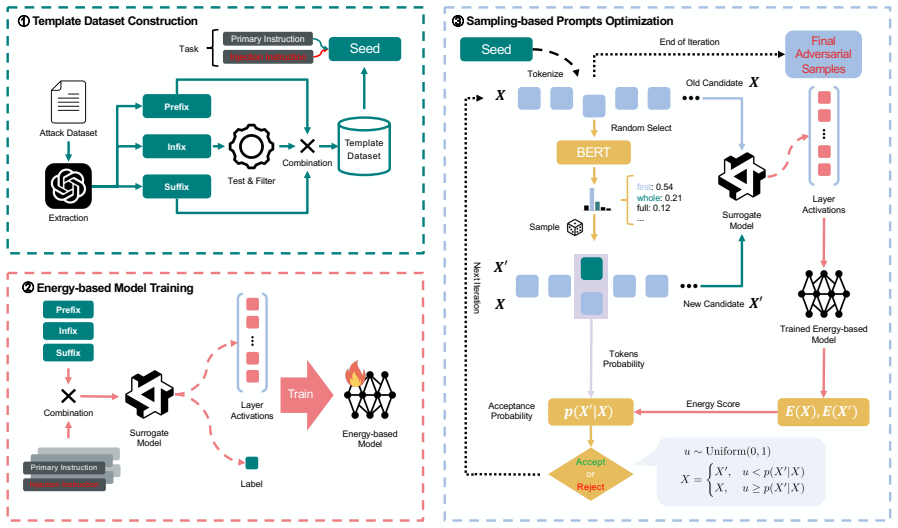
The central claim is that activation patterns inside a surrogate LLM carry enough information about prompt-injection success to guide generation of transferable black-box attacks. The authors build a binary classifier (success/failure) on layer-25 activations of Qwen2.5-7B-Instruct and treat its logits as an energy function; lower energy means more attack-like. They then run a Metropolis-style MCMC sampler over tokens, proposing replacements with BERT and accepting or rejecting by the energy ratio corrected by the MLM's proposal probability. Across five victim models and seven tasks, the optimized prompts beat white-box (GCG), gray-box (AutoDAN), and black-box (PromptFuzz) baselines in trans
What carries the argument
Energy-based model derived from a binary activation classifier: for activations x, E(x) = -log(exp(f_0(x)) + exp(f_1(x))). Trained with cross-entropy on 16,000 labeled prompt/activation pairs from a surrogate model, it defines a landscape over prompts. The MCMC acceptance rule p(X'|X) = min(1, exp(-E(X')) p_MLM(X_i|X_{-i}) / (exp(-E(X)) p_MLM(X'_i|X_{-i})) uses this energy to steer token replacements toward lower-energy (more attack-like) prompts while BERT supplies natural proposals.
Load-bearing premise
The energy score, computed from how confidently a classifier labels a prompt's activations as an attack, is assumed to rank prompts by how likely they are to actually take over a victim model—rather than merely matching the training distribution of the surrogate.
What would settle it
On a held-out set of seed prompts, record the energy score and the attack success rate on several victim models, then check the Pearson correlation. If prompts with lower energy do not consistently produce higher ASR across victims, or if randomly generated BERT replacements without energy guidance match the success rate, the claim that activation-guided energy drives transferability is falsified.
If this is right
- A black-box attacker can craft transferable injection prompts using only one surrogate model and no queries to the target model.
- Prompt injection can succeed on commercial models hardened against known manual attack patterns.
- Generated attack prompts generalize to new tasks beyond those used to train the energy model.
- Low perplexity in the generated prompts means perplexity-based filtering is not a sufficient defense.
- The activation-energy link offers an interpretable signal for auditing or detecting injection attempts.
Where Pith is reading between the lines
- The paper does not isolate whether the energy landscape itself is the active ingredient; an ablation replacing the EBM with a random-walk or perplexity-only objective would clarify this, and that experiment is not reported.
- The same activation-energy signal could be repurposed defensively: monitor whether a prompt's activations drift into low-energy regions associated with successful injections.
- The template decomposition into prefix, infix, and suffix suggests attack components are modular; a testable extension is whether energy-guided recombination transfers to multimodal LLMs or tool-use agents.
- Because the EBM is trained on a single surrogate, its guidance may become brittle when victim models use different alignment methods; testing on more diverse model families would map the limits of the transferability claim.
Editorial analysis
A structured set of objections, weighed in public.
Referee Report
Summary. The paper proposes a black-box Direct Prompt Injection (DPI) attack framework. It builds a template dataset from Tensor Trust by decoupling attack prompts into prefix/infix/suffix, collects hidden-state activations from a surrogate LLM (Qwen2.5-7B-Instruct or Llama-3.1-8B-Instruct), trains a binary classifier as an energy-based model (EBM), and then uses token-level MCMC sampling with BERT proposals to optimize seed prompts. The acceptance rule combines EBM energies with MLM probabilities, and the lowest-energy sample in the chain is selected. The method is evaluated on five LLMs and seven CYBERSECEVAL tasks, reporting ASR 49.6% vs. 44.6% for Initial Prompts, ASR-T 44.1% vs. 41.3% for the Qwen2.5 surrogate, and 36.6% ASR on unseen tasks. The paper claims superior cross-model and cross-task transferability and provides an interpretability analysis linking activations to attack success.
Significance. If the central mechanism is sound, the paper makes a useful contribution: a black-box DPI attack that does not query the victim, uses surrogate activations rather than gradients, produces relatively natural prompts, and transfers to a closed model (GPT-4o-mini) where manual prompts fail. The use of an energy-based model over activations is a novel idea in this threat model. However, the key energy-to-attack-success link is not established, and the main results show only modest and uneven gains over the Initial Prompts baseline. The absence of ablations, confidence intervals, and a detailed evaluation protocol makes the central claim conditional on further evidence.
major comments (4)
- [Eq. (5), Sec. 4.2.3, Table 1] Eθ(x) = -log(exp(f0(x)) + exp(f1(x))) is minimized whenever the binary classifier is confident in either class, not only when the attack succeeds. The paper asserts that lower energy corresponds to more effective attack prompts (Sec. 4.2.3) and uses this in Eq. (8) and Algorithm 1. Table 1 contains a direct counterexample: for Ours(Llama3.1), the ASR on Llama3.1 is 36.80%, below the Initial Prompts ASR of 44.40% on the same model, even though the optimized prompts were selected by lowest energy from Llama3.1 activations. The authors must provide held-out, per-sample energy-ASR correlations and an energy-free MCMC baseline; otherwise the guidance mechanism is unsupported.
- [Figure 5 / Sec. 4.2.3] The claimed validation of the energy-ASR relationship (-0.979 Pearson) uses mean energy per ASR bin, is in-sample, has no error bars, and no held-out check. Binned correlations can be misleading. Since Algorithm 1 selects the lowest-energy sample on the same surrogate used to train the EBM, the apparent alignment is partly a selection artifact. Please report per-sample correlations on held-out tasks (e.g., Tasks 6-7) and on victims that are not surrogates (Qwen2, Llama3, GPT-4o-mini for the Qwen2.5 row), with confidence intervals.
- [Table 1 / Sec. 4.1 (Metrics)] The transfer improvements over Initial Prompts are modest and uneven. For Ours(Qwen2.5), ASR-T is 44.10 vs. 41.30; per-model gains vs. Initial are +4.2 (Qwen2), +5.0 (Llama3), 0.0 (GPT-4o-mini), and -0.4 (Llama3.1). No confidence intervals or significance tests are provided, and there is no ablation that removes energy guidance (e.g., random acceptance or BERT-only random search). Without such baselines, the reported gains cannot be attributed to activation-guided MCMC, and the central claim of superior cross-model transferability is not fully supported.
- [Appendix B / Sec. 4.1] The manuscript states that LLM-based evaluation implementation details are provided in Appendix B, but Appendix B only lists tasks and judge functions; it does not describe the LLM judge prompt, decoding parameters, or how judgments are aggregated. Per-task sample counts and standard deviations are also missing. This prevents assessment of whether the reported differences are statistically meaningful and hampers reproducibility.
minor comments (5)
- [Algorithm 1, line 4] Typo: 'Replacing the i-th token X(t)i of X(t)' should be 'Replace the i-th token'.
- [Eq. (7)] The term log Z(θ) appears inside the sum over i; if Z is the global partition over all x,y, it should be outside the sum. Clarify the normalization convention.
- [Eq. (8)] The notation p(X′|X) denotes the acceptance probability, not a transition probability. Consider using α(X′|X) to avoid confusion with the proposal distribution.
- [Table 1] Specify exactly which models are excluded from ASR-T for each row, since both Qwen2.5 and Llama3.1 are used as surrogates in different rows and the definition of 'white-box model' is row-dependent.
- [Figure 4] The energy score decreases over iterations, but without a corresponding ASR trace this does not demonstrate improved attack effectiveness. Add an ASR-vs-iteration plot or clarify that energy decrease alone is not evidence of success.
Circularity Check
No significant circularity: the EBM-guided MCMC pipeline is a surrogate-model optimization with independently measured transfer results.
full rationale
The paper's derivation chain is: collect activations and success/failure labels from a surrogate model; train a binary classifier and reinterpret its logits as an EBM energy (Eqs. 1-7); run MCMC whose acceptance ratio uses that energy (Eq. 8) to propose prompt edits; measure ASR on the surrogate and on other models. None of these steps defines the predicted quantity in terms of the fitted quantity by construction. The energy is a function of classifier logits, not of attack-success labels; the claim that lower energy tracks higher ASR is an empirical correlation checked in Fig. 5, not an identity. Final ASR values are obtained by actually executing attacks, not read off the EBM. The cross-model transfer claim is measured on victim models other than the surrogate (ASR-T) and on unseen tasks, so it is not forced by the training objective. The EBM and MCMC machinery are cited from independent prior work, and there are no load-bearing self-citations. Concerns about whether the energy landscape truly aligns with attack success are validity/robustness issues rather than circularity. Therefore no circular step can be exhibited.
Axiom & Free-Parameter Ledger
free parameters (5)
- Activation layer index for EBM =
25
- Number of top infixes after filtering =
35
- EBM MLP hidden dimensions =
1024, 256
- Number of training samples and tasks =
20,000 / 7 tasks
- MCMC proposal model =
BERT
axioms (4)
- standard math A binary classifier can be interpreted as an energy-based model (Grathwohl et al., 2020).
- domain assumption Surrogate model activations transfer across different LLM architectures.
- domain assumption The MCMC sampler with BERT proposals will efficiently explore the space of high-threat prompts.
- domain assumption Success/failure labels from the surrogate model are reliable proxies for victim model behavior.
Cite this review
Pith. "Pith review of Transferable Direct Prompt Injection via Activation-Guided MCMC Sampling." pith.science (2026). https://pith.science/paper/DPIJIZRQ
@misc{pith2026250907617,
  author       = {Pith},
  title        = {Pith review of: Transferable Direct Prompt Injection via Activation-Guided MCMC Sampling},
  year         = {2026},
  howpublished = {\url{https://pith.science/paper/DPIJIZRQ}},
  note         = {Machine review of arXiv:2509.07617}
}
read the original abstract
Direct Prompt Injection (DPI) attacks pose a critical security threat to Large Language Models (LLMs) due to their low barrier of execution and high potential damage. To address the impracticality of existing white-box/gray-box methods and the poor transferability of black-box methods, we propose an activations-guided prompt injection attack framework. We first construct an Energy-based Model (EBM) using activations from a surrogate model to evaluate the quality of adversarial prompts. Guided by the trained EBM, we employ the token-level Markov Chain Monte Carlo (MCMC) sampling to adaptively optimize adversarial prompts, thereby enabling gradient-free black-box attacks. Experimental results demonstrate our superior cross-model transferability, achieving 49.6% attack success rate (ASR) across five mainstream LLMs and 34.6% improvement over human-crafted prompts, and maintaining 36.6% ASR on unseen task scenarios. Interpretability analysis reveals a correlation between activations and attack effectiveness, highlighting the critical role of semantic patterns in transferable vulnerability exploitation.
Figures



Reference graph
Works this paper leans on
-
[1]
Sahar Abdelnabi, Aideen Fay, Giovanni Cherubin, Ahmed Salem, and Mario Fritz. 2024. https://doi.org/10.48550/ARXIV.2406.00799 Are you still on track!? catching LLM task drift with activations . CoRR, abs/2406.00799
-
[2]
Abien Fred Agarap. 2018. https://arxiv.org/abs/1803.08375 Deep learning using rectified linear units (relu) . CoRR, abs/1803.08375
Pith/arXiv arXiv 2018
-
[3]
AgentGPT. 2023. https://github.com/reworkd/AgentGPT [link]
work page 2023
-
[4]
AutoGPT. 2023. https://github.com/Significant-Gravitas/AutoGPT [link]
work page 2023
-
[5]
Sizhe Chen, Julien Piet, Chawin Sitawarin, and David A. Wagner. 2024. https://doi.org/10.48550/ARXIV.2402.06363 StruQ : Defending against prompt injection with structured queries . CoRR, abs/2402.06363
-
[6]
Coeeter. 2023. https://github.com/Coeeter/emailgpt [link]
work page 2023
-
[7]
Jacob Devlin, Ming - Wei Chang, Kenton Lee, and Kristina Toutanova. 2019. https://doi.org/10.18653/V1/N19-1423 BERT: pre-training of deep bidirectional transformers for language understanding . In Proceeding of the 17th Conference of the North American Chapter of the Association for Computational Linguistics (NAACL'19), pages 4171--4186. Association for C...
-
[8]
Abhimanyu Dubey, Abhinav Jauhri, Abhinav Pandey, Abhishek Kadian, and Ahmad Al-Dahle . 2024. https://doi.org/10.48550/ARXIV.2407.21783 The llama 3 herd of models . CoRR, abs/2407.21783
-
[9]
Freysa. 2024. https://www.freysa.ai/act-i [link]
work page 2024
-
[10]
Futurism. 2023. https://futurism.com/the-byte/car-dealership-ai [link]
work page 2023
-
[11]
Leo Gao, Tom Dupr \' e la Tour, Henk Tillman, Gabriel Goh, Rajan Troll, Alec Radford, Ilya Sutskever, Jan Leike, and Jeffrey Wu. 2024. https://doi.org/10.48550/ARXIV.2406.04093 Scaling and evaluating sparse autoencoders . CoRR, abs/2406.04093
-
[12]
GitHub. 2023. https://github.com/features/copilot [link]
work page 2023
-
[13]
Will Grathwohl, Kuan-Chieh Wang, J \"o rn-Henrik Jacobsen, David Duvenaud, and Mohammad Norouzi. 2020. https://doi.org/10.48550/arXiv.1912.03263 Your classifier is secretly an energy based model and you should treat it like one . In Proceeding of the 8th International Conference on Learning Representations (ICLR'20). OpenReview.net
-
[14]
Xingang Guo, Fangxu Yu, Huan Zhang, Lianhui Qin, and Bin Hu. 2024. COLD-attack : Jailbreaking LLMs with stealthiness and controllability. In Proceeding of the 41st International Conference on Machine Learning (ICML'24), pages 16974--17002. PMLR
work page 2024
-
[15]
Huggingface. 2023. https://openaipublic.blob.core.windows.net/neuron-explainer/paper/index.html [link]
work page 2023
-
[16]
Fred Jelinek, Robert L Mercer, Lalit R Bahl, and James K Baker. 1977. Perplexity—a measure of the difficulty of speech recognition tasks. The Journal of the Acoustical Society of America, 62(S1):S63--S63
work page 1977
-
[17]
Aounon Kumar and Himabindu Lakkaraju. 2024. https://doi.org/10.48550/ARXIV.2404.07981 Manipulating large language models to increase product visibility . CoRR, abs/2404.07981
-
[18]
Hao Li, Xiaogeng Liu, and Chaowei Xiao. 2024. https://doi.org/10.48550/ARXIV.2410.22770 Injecguard: Benchmarking and mitigating over-defense in prompt injection guardrail models . CoRR, abs/2410.22770
-
[19]
Xiaogeng Liu, Nan Xu, Muhao Chen, and Chaowei Xiao. 2024. https://doi.org/10.48550/arXiv.2310.04451 AutoDAN : Generating stealthy jailbreak prompts on aligned large language models . In Proceeding of the 12st International Conference on Learning Representations (ICLR'24). OpenReview.net
-
[20]
Ilya Loshchilov and Frank Hutter. 2019. https://openreview.net/forum?id=Bkg6RiCqY7 Decoupled weight decay regularization . In Proceeding of the 7th International Conference on Learning Representations (ICLR'19). OpenReview.net
work page 2019
-
[21]
Fatemehsadat Mireshghallah, Kartik Goyal, and Taylor Berg-Kirkpatrick . 2022. https://doi.org/10.18653/v1/2022.acl-long.31 Mix and match: Learning-free controllable text generationusing energy language models . In Proceeding of the 60st Annual Meeting of the Association for Computational Linguistics (ACL'22), pages 401--415, Dublin, Ireland. Association f...
-
[22]
OpenAI. 2023. https://openaipublic.blob.core.windows.net/neuron-explainer/paper/index.html Language models can explain neurons in language models
work page 2023
-
[23]
OWASP. 2024. https://genai.owasp.org/resource/owasp-top-10-for-llm-applications-2025 [link]
work page 2024
-
[24]
Dario Pasquini, Martin Strohmeier, and Carmela Troncoso. 2024. https://doi.org/10.1145/3689932.3694764 Neural exec: Learning (and learning from) execution triggers for prompt injection attacks . In Proceeding of the 2024 Workshop on Artificial Intelligence and Security (AISec '24), pages 89--100, Salt Lake City UT USA. ACM
-
[25]
Yao Qiang, Xiangyu Zhou, Saleh Zare Zade, Mohammad Amin Roshani, Douglas Zytko, and Dongxiao Zhu. 2024. https://doi.org/10.48550/ARXIV.2402.13459 Learning to poison large language models during instruction tuning . CoRR, abs/2402.13459
-
[26]
Lianhui Qin, Sean Welleck, Daniel Khashabi, and Yejin Choi. 2022. http://papers.nips.cc/paper\_files/paper/2022/hash/3e25d1aff47964c8409fd5c8dc0438d7-Abstract-Conference.html COLD decoding: Energy-based constrained text generation with langevin dynamics . In Proceedings of the 35th International Conference on Neural Information Processing Systems (NeurIPS'22)
work page 2022
-
[27]
Manli Shu, Jiongxiao Wang, Chen Zhu, Jonas Geiping, Chaowei Xiao, and Tom Goldstein. 2023. http://papers.nips.cc/paper\_files/paper/2023/hash/c2a8060fd22744b38177d9e428a052e0-Abstract-Conference.html On the exploitability of instruction tuning . In Proceedings of the 37th International Conference on Neural Information Processing Systems (NeurIPS'23)
work page 2023
-
[28]
Yang Song and Diederik P. Kingma. 2021. https://arxiv.org/abs/2101.03288 How to train your energy-based models . CoRR, abs/2101.03288
Pith/arXiv arXiv 2021
-
[29]
Sam Toyer, Olivia Watkins, Ethan Adrian Mendes, Justin Svegliato, and Luke Bailey. 2024. https://doi.org/10.48550/arXiv.2311.01011 Tensor trust: Interpretable prompt injection attacks from an online game . In Proceeding of the 21st International Conference on Learning Representations (ICLR'24). OpenReview.net
-
[30]
Shengye Wan, Cyrus Nikolaidis, Daniel Song, David Molnar, and James Crnkovich. 2024. https://doi.org/10.48550/ARXIV.2408.01605 CYBERSECEVAL 3: Advancing the evaluation of cybersecurity risks and capabilities in large language models . CoRR, abs/2408.01605
-
[31]
An Yang, Baosong Yang, Binyuan Hui, Bo Zheng, Bowen Yu, Chang Zhou, Chengpeng Li, Chengyuan Li, Dayiheng Liu, Fei Huang, Guanting Dong, Haoran Wei, Huan Lin, Jialong Tang, Jialin Wang, Jian Yang, Jianhong Tu, Jianwei Zhang, Jianxin Ma, Jianxin Yang, Jin Xu, Jingren Zhou, Jinze Bai, Jinzheng He, Junyang Lin, Kai Dang, Keming Lu, Keqin Chen, Kexin Yang, Mei...
-
[32]
An Yang, Baosong Yang, Beichen Zhang, Binyuan Hui, Bo Zheng, Bowen Yu, Chengyuan Li, Dayiheng Liu, Fei Huang, Haoran Wei, Huan Lin, Jian Yang, Jianhong Tu, Jianwei Zhang, Jianxin Yang, Jiaxi Yang, Jingren Zhou, Junyang Lin, Kai Dang, Keming Lu, Keqin Bao, Kexin Yang, Le Yu, Mei Li, Mingfeng Xue, Pei Zhang, Qin Zhu, Rui Men, Runji Lin, Tianhao Li, Tingyu X...
-
[33]
Jiahao Yu, Xingwei Lin, Zheng Yu, and Xinyu Xing. 2023. https://doi.org/10.48550/ARXIV.2309.10253 GPTFUZZER : Red teaming large language models with auto-generated jailbreak prompts . CoRR, abs/2309.10253
-
[34]
Jiahao Yu, Yangguang Shao, Hanwen Miao, Junzheng Shi, and Xinyu Xing. 2024. https://doi.org/10.48550/ARXIV.2409.14729 PROMPTFUZZ: harnessing fuzzing techniques for robust testing of prompt injection in llms . CoRR, abs/2409.14729
-
[35]
Qiusi Zhan, Zhixiang Liang, Zifan Ying, and Daniel Kang. 2024. https://doi.org/10.18653/V1/2024.FINDINGS-ACL.624 Injecagent: Benchmarking indirect prompt injections in tool-integrated large language model agents . In Proceeding of the 62nd Annual Meeting of the Association for Computational Linguistics (ACL'24), pages 10471--10506. Association for Computa...
-
[36]
Andy Zou, Long Phan, Sarah Chen, James Campbell, and Phillip Guo. 2023 a . https://doi.org/10.48550/ARXIV.2310.01405 Representation engineering: A top-down approach to AI transparency . CoRR, abs/2310.01405
-
[37]
Zico Kolter, and Matt Fredrikson
Andy Zou, Zifan Wang, J. Zico Kolter, and Matt Fredrikson. 2023 b . https://doi.org/10.48550/ARXIV.2307.15043 Universal and transferable adversarial attacks on aligned language models . CoRR, abs/2307.15043
-
[38]
online" 'onlinestring :=
ENTRY address archivePrefix author booktitle chapter edition editor eid eprint eprinttype howpublished institution journal key month note number organization pages publisher school series title type volume year doi pubmed url lastchecked label extra.label sort.label short.list INTEGERS output.state before.all mid.sentence after.sentence after.block STRING...
-
[39]
write newline
" write newline "" before.all 'output.state := FUNCTION n.dashify 't := "" t empty not t #1 #1 substring "-" = t #1 #2 substring "--" = not "--" * t #2 global.max substring 't := t #1 #1 substring "-" = "-" * t #2 global.max substring 't := while if t #1 #1 substring * t #2 global.max substring 't := if while FUNCTION word.in bbl.in capitalize " " * FUNCT...
discussion (0)
Sign in with ORCID, Apple, or X to comment. Anyone can read and Pith papers without signing in.