REVIEW 3 major objections 4 minor 48 references
Abstract notation engineering—replacing recurring low-level construct configurations with higher-level visual patterns—improves perceived clarity and user preference for DCR process models without harming decode accuracy.
Reviewed by Pith at T0; open to challenge. T0 means a machine referee read the full paper against a public rubric. the ladder, T0–T4 →
T0 review · deepseek-v4-flash
2026-08-03 04:46 UTC pith:DPKTGVET
load-bearing objection Genuinely new method for abstracting recurring visual configurations in modeling languages, honestly evaluated but with an unproven semantic-equivalence gap and only perceptual evidence; worth refereeing, needs revision. the 3 major comments →
Improving the Understandability of Conceptual Models via Abstract Notation Engineering
The pith
A machine-rendered reading of the paper's core claim, the machinery that carries it, and where it could break.
Core claim
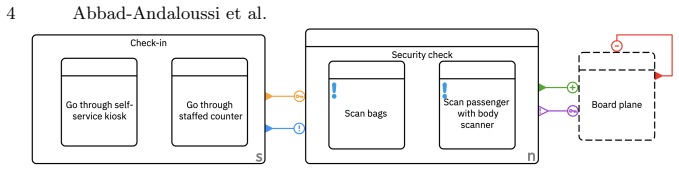
The discovery is that understandability can be improved at the level of recurring configurations of constructs, not just individual symbols. For each of nine common workflow patterns (e.g., Sequence, Deferred Choice, Exists), the authors define the pattern's intended behavior with traces, encode it as a self-contained DCR graph fragment using an encapsulation rule that forbids relations crossing the fragment boundary, and design a visual symbol and label for it through a two-round expert elicitation survey. The empirical study found significant improvements in perceived empirical and pragmatic quality and in user preference for DeCleaR over standard DCR, with no significant difference in the
What carries the argument
The central mechanism is the behavioral encoding: each pattern is translated into a DCR graph fragment with the encapsulation rule that no relation may cross the fragment's boundary, making the abstraction self-contained and substitutable. Paired with this, the four-step method (pattern identification via corpus analysis and expert refinement, formalization via trace-based behavioral specification and encodings, visual design via symbol elicitation, and empirical validation with mixed quantitative-qualitative methods) provides a replicable pipeline. The encapsulation rule is what lets a pattern behave as a unit, so the paper's empirical benefits attach to the abstraction as a unit rather tha
Load-bearing premise
The behavioral encodings of the nine patterns (Section 4.2, Figure 3) correctly capture the intended semantics of each pattern in DCR, despite the lack of a formal equivalence proof.
What would settle it
For any single DeCleaR pattern, find an execution trace that is valid under the pattern's intended behavioral specification (as stated in Table 1 or the text) but is not a valid execution of its DCR encoding in Figure 3, or vice versa; model-checking trace equivalence for each pattern would settle it. Also, if a replication with more participants and all nine patterns showed a significant decline in answer correctness for DeCleaR, the 'no degradation' claim would be contradicted.
If this is right
- If DeCleaR's perceived quality benefits hold, tool builders can implement the encodings as transformation rules or visual overlays, preserving existing DCR execution, simulation, and verification support.
- Other notations (Declare, BPMN, UML, ER) could run the same four-step method to build their own pattern abstractions, since the method is language-agnostic.
- The perception-performance gap implies that future iterations should address how abstractions interact with surrounding relations, suggesting a concrete design direction for refining DeCleaR.
- A broader evaluation covering all nine patterns and a larger participant group could reveal whether the accuracy gap remains unchanged, a question the paper explicitly defers to future work.
- For educators and practitioners, pattern-based abstractions bridge domain vocabulary and formal notation, potentially lowering the expertise barrier to declarative modeling adoption.
Where Pith is reading between the lines
- The method could be applied to static notations: the need for associative entities in ER diagrams or auxiliary nodes in workflow nets is exactly the kind of low-level configuration the method targets, so analogous 'DeCleaR-like' abstractions might be built for those languages.
- The stable accuracy result hints that perceived quality and decoding accuracy are driven by different cognitive mechanisms; a plausible testable hypothesis is that DeCleaR reduces perceived complexity but not actual cognitive load unless the surrounding relation structure is also simplified.
- The paper's frequency-based cutoff (top seven patterns with 18+ occurrences, eighth with only 7) offers a quick, principled heuristic for other languages: prioritize patterns with a sharp frequency drop as natural abstraction candidates.
- A direct extension is an eye-tracking study comparing DeCleaR vs standard DCR to see whether the perception-performance gap reflects altered gaze patterns—for instance, less time searching for pattern meaning, but equal time resolving inter-pattern relations.
Editorial analysis
A structured set of objections, weighed in public.
Referee Report
Summary. The paper proposes a language-agnostic method, called abstract notation engineering, for improving the understandability of conceptual modeling notations. The method consists of four steps: pattern identification, pattern formalization, visual notation design, and empirical validation. The authors instantiate the method on Dynamic Condition Response (DCR) graphs, producing DeCleaR, a set of nine pattern abstractions that replace low-level DCR configurations. They report a counterbalanced within-subject experiment with 14 participants on four selected patterns, claiming significant improvements in perceived empirical quality (H2), pragmatic quality (H3), and user preference (H4) over standard DCR graphs, while answer correctness (H1) showed no significant difference. The paper argues that DeCleaR improves user experience without degrading objective decoding accuracy, and that the method is transferable to other modeling languages.
Significance. If the claims are substantiated, this work makes a valuable contribution to conceptual modeling notation design by shifting the focus from individual symbol improvements to reusable pattern-level abstractions with an explicit encapsulation rule and a systematic evaluation process. The method is grounded in established frameworks (PoN, Semiology of Graphics, SEQUAL) and the empirical study uses a mixed-methods design with counterbalancing, validated questionnaire items, and inter-rater reliability (Cohen's κ=0.82). The authors also provide an online repository with materials and full pattern encodings. These strengths are significant. However, the central claim about DeCleaR's benefits is weakened by two load-bearing gaps: (1) the behavioral encodings in Fig. 3 lack a rigorous semantic equivalence proof, and (2) the empirical evaluation covers only 4 of 9 patterns, making the abstract's general claim exceed the evidence. The paper is a useful proof-of-concept but requires further verification and scope adjustments.
major comments (3)
- [§4.2, Fig. 3] The behavioral encodings of the nine patterns are presented as DCR fragments, but the paper does not provide a formal equivalence proof between the trace-based behavioral specifications (Step 2.1) and these DCR fragments. The text states 'We refer the reader to our repository for a detailed explanation of the DCR construct configuration underlying each pattern' but the repository is not a substitute for a rigorous argument in the paper. Without a proof—or at least a model-checked verification for all valid/invalid traces—the empirical results for H2–H4 may be measuring the perceived quality of constructs whose actual DCR semantics differ from the intended patterns. This is load-bearing because the central claim presupposes that each DeCleaR symbol faithfully abstracts the corresponding DCR pattern. Please add a formal equivalence proof or an automated verification step for each pattern,
- [§4.4 (Experiment Design)] The empirical study evaluates only four of the nine DeCleaR patterns (Bounded Exists at least N times, Sequence, Explicit Initialization, Explicit Termination), selected through anonymous co-author voting. The abstract and introduction make a general claim: 'DeCleaR improves perceived empirical quality, pragmatic quality, and user preference over standard DCR graphs.' This generalization to all nine patterns is not supported by the data. Either run experiments on the remaining patterns or explicitly restrict the claim to the four tested patterns (and adjust the abstract accordingly). Also, because the pattern selection was not randomized or theory-driven, the observed effects may reflect patterns that are particularly amenable to abstraction.
- [§4.4 (Analysis and Cross-Synthesis)] The statistical reporting is incomplete. For the Wilcoxon signed-rank tests (H2, H3, H4), only p-values and median differences are reported. Please include effect sizes (e.g., matched rank-biserial correlation) and confidence intervals for the median differences. With n=14, p-values alone are fragile. Moreover, the H1 non-significance (p=0.23) is incorrectly interpreted in the Abstract as 'without degrading objective decoding accuracy.' A non-significant result does not demonstrate equivalence; it only fails to reject the null. Use an equivalence test (e.g., TOST with a pre-specified bound) or soften the claim to 'no significant difference in answer correctness was detected.'
minor comments (4)
- [Fig. 2] Typo in the repeat-loop label: 'theoritical saturation' should be 'theoretical saturation'.
- [§2.3] The explanation of the Condition relation 'e→f: f cannot be executed until e has been executed, or e is excluded' is imprecise. In standard DCR semantics, a condition is satisfied if e is executed OR e is excluded (i.e., exclusion makes the condition vacuously true). Clarify this to avoid confusion, especially because the notion of exclusion is used heavily in the encodings.
- [Table 1 / §4.2] The Sequence definition 'requiring the entire sequence to complete once initiated' is slightly inconsistent with the valid trace A→B→C→A→B→C, which suggests that each initiation of the first event must eventually be followed by the full sequence. Rephrase to clarify that the pattern applies per occurrence (e.g., 'each occurrence of the first event must be followed by the remaining events in order').
- [§4.4] Please report the Likert scale range (e.g., 1–7) and explain how median Δ (e.g., +0.667) is computed, so that the magnitude of the effects is interpretable.
Circularity Check
No significant circularity: the empirical claims are measured after design, not derived from fitted inputs.
full rationale
The paper's central claim is empirical: participants perceived DeCleaR patterns as having higher empirical quality, pragmatic quality, and preference compared with standard DCR representations. There is no fitted parameter that is later relabeled as a prediction, and the method's four steps (pattern identification, formalization, visual design, validation) are not defined in terms of the results they produce. The design choices—pattern selection, symbol design, and the tested pattern subset—are informed by author expertise and co-author voting, but the evaluation uses different participants, identical base models, and a counterbalanced within-subject design, so the measured outcomes are not forced by construction. Some cited sources are authored by contributors to this paper (e.g., [42] for the DCR notational variant, [31] for the corpus, [47] for 'behavioral encodings'), but none is load-bearing in a circular way: the notational variant is a presentational detail, the corpus is an external data source, and the behavioral encodings are described and illustrated in the paper itself rather than being merely imported from the citation. The main validity risk is different from circularity: the semantic equivalence between DeCleaR patterns and their DCR encodings is asserted and deferred to the authors' repository ('We refer the reader to our repository for a detailed explanation of the DCR construct configuration underlying each pattern [5]' and the encapsulation rule is stated but not mechanically verified). If an encoding were semantically wrong, the perceptual results would apply to a different construct, but that would be a correctness or evidence-quality issue, not a reduction of the claim to its inputs. The limitation section also acknowledges the narrow scope ('limited participant group and covered few patterns'), which further supports treating the study as an empirical demonstration rather than a closed derivation. Overall, no step in the derivation chain is equivalent by definition to its inputs.
Axiom & Free-Parameter Ledger
free parameters (1)
- Pattern-frequency cutoff =
7 occurrences (8th-ranked pattern)
axioms (6)
- domain assumption The 43 workflow patterns of Russell et al. [38] form an appropriate catalogue of recurring process behaviors.
- domain assumption The 50-text corpus [31] is representative of real declarative process descriptions.
- ad hoc to paper The constructed behavioral encodings (Fig. 3) faithfully implement the trace-based behavioral specifications and satisfy the encapsulation rule.
- domain assumption The six-member Delphi panel yields symbol/label designs matching practitioners' mental schemas.
- domain assumption Fourteen DCR-familiar participants and four patterns suffice to test the hypotheses.
- domain assumption The adapted SEQUAL questionnaire items [35] validly measure perceived empirical and pragmatic quality.
invented entities (1)
-
DeCleaR pattern abstractions (Sequence, Deferred Choice, Bounded Exists, Explicit Initialization, Explicit Termination, Exists, isAbsent, Precedes, LeadsTo)
no independent evidence
read the original abstract
Conceptual modeling supports the design, analysis, and communication of the properties of complex systems, yet conceptual models can be difficult to understand when domain-level abstractions must be encoded through low-level constructs required mainly for semantic conformity. Prior work has mainly improved how existing individual constructs are visually represented. We shift the focus from individual constructs to recurring configurations of constructs, and propose abstract notation engineering as a language-agnostic method for replacing such configurations with higher-level, semantically transparent constructs. The method comprises pattern identification, pattern formalization, visual notation design, and empirical validation. We instantiate it for Dynamic Condition Response (DCR) graphs, where common workflow patterns require elaborate low-level configurations. The resulting extension, DeCleaR, replaces such configurations with compact pattern-based abstractions. The results of our empirical validation show that DeCleaR improves perceived empirical quality, pragmatic quality, and user preference over standard DCR graphs.
Figures


Reference graph
Works this paper leans on
-
[1]
SoSyM (2020)
Abbad Andaloussi, A., Zerbato, F., Burratin, A., Slaats, T., Hildebrandt, T., We- ber, B.: Exploring how users engage with hybrid process artifacts based on declar- ative process models: a behavioral analysis based on eye-tracking and think-aloud. SoSyM (2020)
2020
-
[2]
Abbad-Andaloussi, A., Buch-Lorentsen, J., L´ opez, H.A., Slaats, T., Weber, B.: Exploring the modeling of declarative processes using a hybrid approach. In: ER. pp. 162–170. Springer (2019)
2019
-
[3]
Expert Systems with Applications233, 120924 (2023) Understandability of Conceptual Models via Abstract Notation Engineering 15
Abbad-Andaloussi, A., Burattin, A., Slaats, T., Kindler, E., Weber, B.: Complexity in declarative process models: Metrics and multi-modal assessment of cognitive load. Expert Systems with Applications233, 120924 (2023) Understandability of Conceptual Models via Abstract Notation Engineering 15
2023
-
[4]
Pro- cess Science2(1), 19 (2025)
Abbad-Andaloussi, A., Franceschetti, M., L´ opez, H.A., Schreiber, C., Weber, B.: When a model gives you mixed signals: cognitive effects and visual behavior. Pro- cess Science2(1), 19 (2025)
2025
-
[5]
Abbad-Andaloussi, A., Sch¨ utt, D.J., Kasper Solhøj Jørgensen, T.v.D.L., L´ opez, H.A.: Improving the understandability of conceptual models via abstract notation engineering (online repository),https://github.com/aminobest/DeCleaR
-
[6]
Information Systems91, 101505 (2020)
Andaloussi, A.A., Burattin, A., Slaats, T., Kindler, E., Weber, B.: On the declara- tive paradigm in hybrid business process representations: A conceptual framework and a systematic literature study. Information Systems91, 101505 (2020)
2020
-
[7]
University of Wisconsin press (1983)
Bertin, J.: Semiology of graphics. University of Wisconsin press (1983)
1983
-
[8]
Information Systems p
Blasilli, G., Ferro, L.S., Lenti, S., Maggi, F.M., Marrella, A., Catarci, T.: Improving the understandability of declarative process discovery results using easydeclare. Information Systems p. 102667 (2025)
2025
-
[9]
In: ICPM
Caballero-Villalobos, J., Jensen, S., L´ opez, H.A.: 3DCR: A tool for immersive process mining. In: ICPM. CEUR-WS (2024)
2024
-
[10]
In: EDOC Workshop
Carvalho, R., Boubaker, A., Gonzalez-Huerta, J., Mili, H., Ringuette, S., Charif, Y.: On the analysis of cmmn expressiveness: revisiting workflow patterns. In: EDOC Workshop. pp. 1–8 (2016)
2016
-
[11]
Data & Knowledge Engineering157, 102413 (2025)
Christfort, A.K., Cosma, V.P., Debois, S., Hildebrandt, T.T., Slaats, T.: Static and dynamic techniques for iterative test-driven modelling of dynamic condition response graphs. Data & Knowledge Engineering157, 102413 (2025)
2025
-
[12]
Debois, S., Hildebrandt, T., Slaats, T.: Hierarchical declarative modelling with refinement and sub-processes. In: BPM. pp. 18–33. Springer (2014)
2014
-
[13]
Debois, S., L´ opez, H.A., Slaats, T., Andaloussi, A.A., Hildebrandt, T.T.: Chain of events: modular process models for the law. In: iFM. pp. 368–386. Springer (2020)
2020
-
[14]
Dumas, M., La Rosa, M., Mendling, J., Reijers, H.A., et al.: Fundamentals of business process management, vol. 1. Springer (2013)
2013
-
[15]
In: Proceedings of the 21st international conference on Software engineering
Dwyer, M.B., Avrunin, G.S., Corbett, J.C.: Patterns in property specifications for finite-state verification. In: Proceedings of the 21st international conference on Software engineering. pp. 411–420 (1999)
1999
-
[16]
SoSyM15(1), 119–146 (2016)
Elgammal, A., Turetken, O., van den Heuvel, W.J., Papazoglou, M.: Formalizing and appling compliance patterns for business process compliance. SoSyM15(1), 119–146 (2016)
2016
-
[17]
In: International Workshop on Business Process Modeling, De- velopment and Support
Fahland, D., L¨ ubke, D., Mendling, J., Reijers, H., Weber, B., Weidlich, M., Zu- gal, S.: Declarative versus imperative process modeling languages: The issue of understandability. In: International Workshop on Business Process Modeling, De- velopment and Support. pp. 353–366. Springer (2009)
2009
-
[18]
BISE59(1), 41–67 (2017)
Figl, K.: Comprehension of procedural visual business process models: a literature review. BISE59(1), 41–67 (2017)
2017
-
[19]
Figl, K., Di Ciccio, C., Reijers, H.A.: Do declarative process models help to reduce cognitive biases related to business rules? In: ER 2020. pp. 119–133. Springer (2020)
2020
-
[20]
Genon, N., Heymans, P., Amyot, D.: Analysing the cognitive effectiveness of the bpmn 2.0 visual notation. In: SLE. pp. 377–396. Springer (2010)
2010
-
[21]
In: International IFIP Working Conference on Enterprise Interoperability
Han, Z., Zhang, L., Ling, J., Huang, S.: Control-flow pattern based transformation from uml activity diagram to yawl. In: International IFIP Working Conference on Enterprise Interoperability. pp. 129–145. Springer (2012)
2012
-
[22]
Softwaretechnik-Trends36(2), 53–56 (2016)
Hanser, M., Di Ciccio, C., Mendling, J., et al.: A new notational framework for declarative process modeling. Softwaretechnik-Trends36(2), 53–56 (2016)
2016
-
[23]
In: FSEN
Hildebrandt, T., Mukkamala, R.R., Slaats, T.: Nested dynamic condition response graphs. In: FSEN. pp. 343–350. Springer (2011) 16 Abbad-Andaloussi et al
2011
-
[24]
In: ICSSP
Hildebrandt, T.T., Andaloussi, A.A., Christensen, L.R., Debois, S., Healy, N.P., L´ opez, H.A., Marquard, M., Møller, N.L., Petersen, A.C., Slaats, T., et al.: Eco- know: Engineering effective, co-created and compliant adaptive case management systems for knowledge workers. In: ICSSP. pp. 155–164 (2020)
2020
-
[25]
arXiv preprint arXiv:1110.4161 (2011)
Hildebrandt, T.T., Mukkamala, R.R.: Declarative event-based workflow as dis- tributed dynamic condition response graphs. arXiv preprint arXiv:1110.4161 (2011)
Pith/arXiv arXiv 2011
-
[26]
OUP Oxford (2011)
Holmqvist, K., Nystr¨ om, M., Andersson, R., Dewhurst, R., Jarodzka, H., van de Weijer, J.: Eye Tracking: A comprehensive guide to methods and measures. OUP Oxford (2011)
2011
-
[27]
In: BPM Forum
Jensen, S.J., L´ opez, H.A.: Towards immersive environments for declarative process models. In: BPM Forum. pp. 214–231. Springer (2024)
2024
-
[28]
Springer (2016)
Karagiannis, D., Mayr, H.C., Mylopoulos, J.: Domain-specific conceptual modeling. Springer (2016)
2016
-
[29]
In: HICSS
Keramidis, P., Hildebrandt, T.T.: On the business value of declarative business process management. In: HICSS. pp. 5631–5640 (2026)
2026
-
[30]
Springer Science & Business Media (2012)
Krogstie, J.: Model-based development and evolution of information systems: A Quality Approach. Springer Science & Business Media (2012)
2012
-
[31]
L´ opez, H.A., Feng, B., Lindner, J., Franceschetti, M., Abbad-Andaloussi, A.: Am- biguity detection in business process descriptions: An evidence and an automated approach. In: BPM. pp. 379–396. Springer (2025)
2025
-
[32]
In: POEM
L´ opez, H.A., Simon, V.D.: How to (re) design declarative process notations? a view from the lens of cognitive effectiveness frameworks. In: POEM. CEUR-WS (2022)
2022
-
[33]
IEEE Trans
Moody, D.: The “physics” of notations: toward a scientific basis for constructing visual notations in software engineering. IEEE Trans. Softw. Eng.35(6), 756–779 (2009)
2009
-
[34]
Information & management42(1) (2004)
Okoli, C., Pawlowski, S.D.: The delphi method as a research tool: an example, design considerations and applications. Information & management42(1) (2004)
2004
-
[35]
Ieee Access13, 140742–140770 (2025)
Pacheco, D., Aveiro, D., Pinto, D., Freitas, V.: User-perceived quality and func- tional suitability of representations of demo’s process and fact models: Conclusions from a family of three studies. Ieee Access13, 140742–140770 (2025)
2025
-
[36]
In: EDOC 2007
Pesic, M., Schonenberg, H., Van der Aalst, W.M.: Declare: Full support for loosely- structured processes. In: EDOC 2007. pp. 287–287. IEEE (2007)
2007
-
[37]
Reijers, H.A., Slaats, T., Stahl, C.: Declarative modeling–an academic dream or the future for bpm? In: BPM. pp. 307–322. Springer (2013)
2013
-
[38]
Russell, N.C., Ter Hofstede, A.H., Van Der Aalst, W.M., Mulyar, N.A.: Workflow control-flow patterns: A revised view (2006)
2006
-
[39]
SAGE Publications, 4th edn
Salda˜ na, J.: The Coding Manual for Qualitative Researchers. SAGE Publications, 4th edn. (2021)
2021
-
[40]
In: FSEN
Siegmund, J., Peitek, N., Parnin, C., Apel, S., Hofmeister, J., K¨ astner, C., Begel, A., Bethmann, A., Brechmann, A.: Measuring neural efficiency of program com- prehension. In: FSEN. pp. 140–150 (2017)
2017
-
[41]
Scholarpedia3(12), 5345 (2008)
Todorovic, D.: Gestalt principles. Scholarpedia3(12), 5345 (2008)
2008
-
[42]
In: CoopIS
Trinh, D.M.T., Abbad-Andaloussi, A., L´ opez, H.A.: On the semantic transparency of declarative process models: the case of constraints. In: CoopIS. pp. 217–236. Springer (2023)
2023
-
[43]
Turetken, O., Rompen, T., Vanderfeesten, I., Dikici, A., van Moll, J.: The effect of modularity representation and presentation medium on the understandability of business process models in bpmn. In: BPM. pp. 289–307. Springer (2016) Understandability of Conceptual Models via Abstract Notation Engineering 17
2016
-
[44]
IEEE Transactions on Cognitive and Developmental Systems14(1), 164–180 (2022)
Winter, M., Pryss, R., Probst, T., Baß, J., Reichert, M.: Measuring the cognitive complexity in the comprehension of modular process models. IEEE Transactions on Cognitive and Developmental Systems14(1), 164–180 (2022)
2022
-
[45]
Wohlin, C., Runeson, P., H¨ ost, M., Ohlsson, M.C., Regnell, B., Wessl´ en, A., et al.: Experimentation in software engineering. vol. 236. Springer (2012)
2012
-
[46]
In: 10th IEEE international conference on collaborative computing: networking, applications and worksharing
Zeising, M., Sch¨ onig, S., Jablonski, S.: Towards a common platform for the support of routine and agile business processes. In: 10th IEEE international conference on collaborative computing: networking, applications and worksharing. IEEE (2014)
2014
-
[47]
In: FormaliSE ’26
Zhou, Y., L´ opez, H.A.: A compositional approach to mapping bpmn to dcr for cross-paradigm process modeling. In: FormaliSE ’26. vol. To appear (2026)
2026
-
[48]
Zugal, S.: Applying Cognitive Psychology for Improving the Creation, Understand- ing and Maintenance of Business Process Models. Ph.D. thesis, University of Inns- bruck (2013)
2013
discussion (0)
Sign in with ORCID, Apple, or X to comment. Anyone can read and Pith papers without signing in.