REVIEW 3 major objections 5 minor 300 references
Next-generation GW detectors plus kilonovae can pin the neutron-star radius to ~0.2 km and H0 to ~1 km/s/Mpc in an ideal year of multi-messenger BNS events.
Reviewed by Pith at T0; open to challenge. T0 means a machine referee read the full paper against a public rubric. the ladder, T0–T4 →
T0 review · grok-4.5
2026-07-31 07:20 UTC pith:DQW74DN6
load-bearing objection Solid end-to-end ET/CE multi-messenger forecast plus real hierarchical Bayesian joint inference; the ~0.2 km / ~1 km s−1 Mpc−1 numbers are explicitly ideal-scenario and should be read that way. the 3 major comments →
Binary neutron stars in the next-generation era: Multi-messenger detection prospects and constraints on the equation of state, mass distribution, and cosmology
The pith
A machine-rendered reading of the paper's core claim, the machinery that carries it, and where it could break.
Core claim
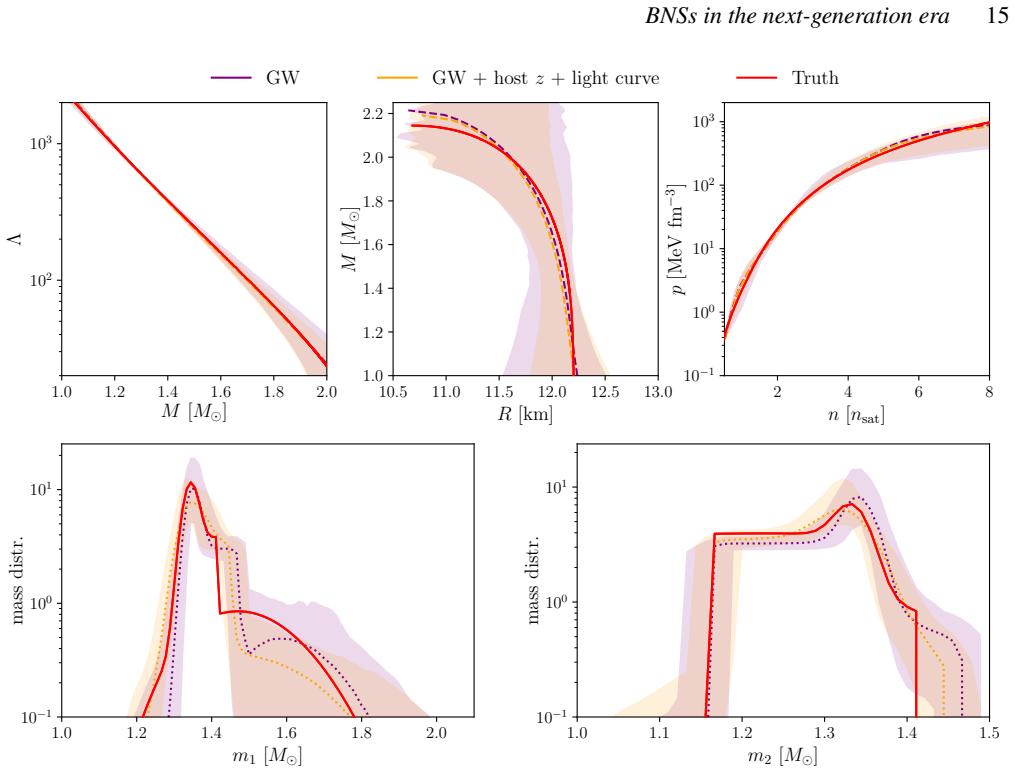
In an ideal injection-recovery campaign focused on ET, the multi-messenger sample of kilonova-associated binary neutron stars can constrain the canonical neutron-star radius R1.4 to within about 0.2 km and H0 to within about 1 km s−1 Mpc−1 while recovering the main features of the mass distribution; kilonova light-curve posteriors have negligible impact on the equation of state once gravitational-wave tidal information is included, but they improve cosmological parameter recovery.
What carries the argument
Joint hierarchical Bayesian inference on equation-of-state, mass-distribution, and cosmological hyperparameters, with per-event posteriors represented by normalizing flows so the population likelihood can be evaluated efficiently and selection effects reweighted after sampling.
Load-bearing premise
The quoted radius and Hubble precisions assume perfect knowledge of the gravitational-wave waveform and kilonova emission models, with injection and recovery done with identical models and fitting formulae, so real model mismatch is set to zero.
What would settle it
After one year of real ET (or ET+CE) multi-messenger binary neutron star detections, measure whether the hierarchical posterior on R1.4 is actually at the ~0.2 km level and H0 at the ~1 km s−1 Mpc−1 level when independent nuclear or X-ray radius priors and independent H0 anchors are compared, or whether systematics in waveforms and ejecta models broaden or bias those intervals beyond the ideal forecast.
If this is right
- ET alone should deliver tens of multi-messenger BNS events per year at the assumed merger rate, enough for sub-kilometer radius and percent-level H0 constraints in the ideal case.
- Adding Cosmic Explorer multiplies the multi-messenger yield by several times, mainly through tighter sky localizations that enable more successful follow-up.
- Equation-of-state inference will be driven by the handful of highest-SNR events with clear tides, not by sheer event count.
- Kilonova light curves are more valuable for cosmology (distance/inclination and bias control) than for further tightening the dense-matter equation of state once GW tides are precise.
- Late-time radio surveys can still recover tens of afterglows even when early optical counterparts are missed.
Where Pith is reading between the lines
- If waveform or ejecta-model systematics remain at the levels the paper flags, the real R1.4 and H0 errors will be set by those systematics rather than by the statistical floor of ~0.2 km and ~1 km/s/Mpc.
- The strong dependence of counterpart counts on the mass distribution (narrow versus wide, via prompt-collapse fraction) means an early multi-messenger sample will itself diagnose whether the Galactic narrow distribution or a broader one is closer to truth.
- Because selection effects and inclination bias are hard to model exactly, cosmological analyses may need light-curve or jet information even when gravitational-wave SNRs are high.
- Microphysical nuclear parameters (beyond bulk pressure near a few times saturation) will stay loosely constrained unless nuclear theory priors are folded in.
Editorial analysis
A structured set of objections, weighed in public.
Referee Report
Summary. The paper forecasts multi-messenger BNS detection rates with ET and CE under two mass distributions and a fixed local merger rate of 106.6 Gpc^{-3} yr^{-1}, using a staged mock follow-up algorithm for prompt GRBs, UVOIR counterparts, and late afterglows. It then performs fully Bayesian hierarchical injection-recovery on the identified KN events (ET-only) to jointly constrain the EOS, mass distribution, and cosmology. In an ideal scenario with identical inject/recover models, the authors report R_{1.4} constrained to ~0.2 km and H_0 to ~1 km s^{-1} Mpc^{-1}, with KN light curves having negligible impact on the EOS but helping cosmological inference via inclination–distance constraints.
Significance. This is a substantial and timely contribution that unifies population synthesis, multi-messenger detection modeling, and hierarchical Bayesian inference in one framework. Strengths include the use of full Bayesian single-event posteriors (not FIM approximations) with normalizing flows, direct microphysical EOS sampling via jester/TOV solutions, publicly available analysis scripts, and an explicit comparison of GW-only versus multi-messenger hierarchical posteriors. The detection-rate tables and the ideal-scenario precision forecasts will be useful benchmarks for ET/CE science cases, provided the idealizations are kept clearly in view.
major comments (3)
- [Abstract; Sec. 4.4; Apps. D–E] Sec. 4.4 and Apps. D–E state that GW waveforms and KN/ejecta models are identical at injection and recovery, and that the same NR-informed ejecta–mass fits used to build the catalogues are reused in the hierarchical likelihood (Eqs. 35–38). The headline R_{1.4} ≲ 0.2 km and H_0 ≲ 1 km s^{-1} Mpc^{-1} claims (abstract; Sec. 5) are therefore calibrated only under zero model mismatch. The paper already cites waveform systematics, ≳50% atomic/thermalization ejecta errors, and NR-fit differences as real-data failure modes. These caveats should be elevated into the abstract and conclusion so that the quoted intervals are not read as robust forecasts; a short quantitative stress test (e.g., one mismatched KN morphology or one alternate ejecta fit) would substantially strengthen the claim.
- [Appendix G; Sec. 4.2.2; Tables 6–7] Appendix G approximates p_det(λ) with a neural-network SNR cut plus a single Rubin i-band magnitude threshold, then clips extreme weights. The text notes that this imperfect reweighting leaves residual bias in mass-distribution hyperparameters (e.g., α and m_u for the narrow model; m_max for the wide model; Tables 6–7). Because selection correction is load-bearing for population and cosmology inference (less so for R_{1.4}, which is dominated by a few high-SNR tides), the paper should either (i) demonstrate that EOS/H_0 intervals are stable under alternate p_det prescriptions, or (ii) more clearly separate which quoted constraints are robust to the App. G approximation.
- [Sec. 2.3; Fig. 3; Table 4] Sec. 2.3 tunes the Blandford–Znajek fudge factor η_0 so that the synthetic Fermi/GBM fluence distribution matches observations (Fig. 3). GRB and afterglow detection counts in Table 4 and Fig. 5 therefore partly reflect this calibration rather than an ab initio jet model. The paper should state more explicitly which science conclusions (especially afterglow rates and the fraction of UVOIR counterparts that are pure GRB afterglows) inherit from this tuning, versus those driven by the KN channel alone.
minor comments (5)
- [Table 4] Table 4 bracketed afterglow numbers (late-time surveys without prior UVOIR) are useful but easy to misread; a one-sentence clarification in the caption would help.
- [Sec. 4.2.2; Fig. 6] The modest radius bias toward smaller R at fixed tight M–Λ (Sec. 4.2.2, Fig. 6) is attributed to CSE flexibility; a brief note on whether a different high-density extension would remove the bias would aid interpretation.
- [Sec. 4.2.1; Eq. (39)] Eq. (39) replaces the Puecher & Dietrich classifier with a simple k_coll cut for jax compatibility. State the fraction of catalogue events for which the two criteria disagree, if available.
- [Sec. 3.1; Sec. 4.3] Several typos and notation nits: “s (PSDs)” → “PSDs” (Sec. 3.1); “the proposed the proposed cosmology” (Sec. 4.3); inconsistent use of Ω_0 vs Ω_m.
- [Fig. 5] Fig. 5 orange/green patches distinguishing KN vs GRB-afterglow contributions are valuable; ensure the 30% flux criterion is restated in the caption.
Circularity Check
Standard next-gen injection–recovery forecast; only mild circularity is η0 tuned to Fermi short-GRB fluences. Central R1.4/H0 widths are conditional ideal-scenario results, not forced by definition.
specific steps
-
fitted input called prediction
[Sec. 2.3, Eqs. (18)–(19), Fig. 3]
"Moreover, we have tuned the fudge factor in Eq. (19a) to η0 = 0.016, so that the resulting fluence distribution matches the Fermi/GBM short GRB samples (Colombo et al. 2022; Loffredo et al. 2025), more details are provided below. ... To ensure consistency between our ad-hoc prescriptions for the gamma-ray energy Eγ and the observed short GRB population, we tuned η0 in such a way that our results roughly agree with the fluence distribution of short Fermi/GBM GRBs"
η0 is adjusted until the synthetic bolometric fluence histogram reproduces the observed Fermi/GBM short-GRB sample (Fig. 3, including the 0.6 duty-cycle rescaling). Projected prompt-GRB and GRB-afterglow detection counts therefore partly inherit that calibration by construction rather than arising as independent first-principles forecasts. This does not force the paper’s headline R1.4 or H0 intervals, which come from KN-selected GW hierarchical runs, but it does make the GRB multi-messenger rate panels non-predictive for the tuned observable.
full rationale
The paper is a forward population-synthesis and hierarchical injection–recovery study. Detection counts and hierarchical posteriors are generated from explicit mock catalogues (fixed local rate 106.6 Gpc−3 yr−1, two mass models, QMC-RMF3 EOS) and a mock EM follow-up algorithm; the abstract and Sec. 4 explicitly label the R1.4 ≲ 0.2 km and H0 ≲ 1 km s−1 Mpc−1 figures as an “ideal scenario.” Recovered precision is not algebraically equal to any fitted input: it is set by network SNRs, number of KN-selected events, and tidal information content under matched inject/recover models (disclosed in Sec. 4.4 and Apps. D–E). Self-citations (possis/fiesta surrogates, jester, prior multi-messenger pipelines) supply tools and priors, not load-bearing uniqueness theorems. The sole clear fitted-input step is the Blandford–Znajek fudge factor η0, tuned so the synthetic short-GRB fluence histogram matches Fermi/GBM; that forces intermediate GRB rate/fluence plots (Fig. 3) but does not determine the EOS or H0 hierarchical widths, which are driven by GW tides plus host redshifts (and secondarily KN light curves). Selection-effect reweighting (App. G) is approximate and visibly biases some mass-distribution hyperparameters, but that is a modelling limitation, not a circular reduction of the central claims. Overall circularity is minor and proportionate to score 2.
Axiom & Free-Parameter Ledger
free parameters (7)
- local merger rate density Rn / R(0) =
R(0)=106.6 Gpc−3 yr−1
- Blandford–Znajek fudge factor η0 =
η0=0.016
- wind-to-disk mass fraction ζ distributions =
prompt: TN(0.2,0.1); remnant: TN(0.5,0.2)
- gamma-ray efficiency ηγ =
U(0.01,0.15)
- ISM density prior for afterglows =
U(−5,0) in log10 cm−3
- instrument ΔΩ and dL follow-up thresholds =
network-dependent cuts in App. B
- EM systematic magnitude floor σsys =
U(0.3,1) mag
axioms (8)
- domain assumption Source-frame merger rate follows Madau–Dickinson SFR convolved with exponential delay-time distribution independent of mass/spin.
- domain assumption Single EOS (QMC-RMF3) and perfect spin–orbit alignment for all catalogue events.
- domain assumption Prompt collapse and ejecta masses given by specified NR fits / ML classifier (or k_coll MTOV proxy in inference).
- domain assumption GW detection if network SNR>12; 90% sky area from Fisher matrix (gwfish), 100% duty cycle.
- ad hoc to paper Counterpart 'detected' after ≥2 filter/epoch/instrument flags with no impostor contamination and random tiling order.
- domain assumption Host cosmological redshift known to 1% Gaussian error; flat ΛCDM with only H0, Ω0 free in cosmology runs.
- ad hoc to paper Hierarchical likelihood uses NF density estimates of single-event posteriors and approximate p_det reweighting with clipping.
- ad hoc to paper Injected and recovered GW/KN models are identical (no waveform or radiative-transfer mismatch).
invented entities (2)
-
Mock multi-messenger follow-up algorithm (staged UVOIR + late afterglow surveys)
no independent evidence
-
Extended possis ML surrogate geometry for wide ejecta parameter space
no independent evidence
read the original abstract
Next-generation gravitational-wave (GW) observatories will provide crucial insights into the nature of neutron star (NS) matter and the cosmological expansion history. We estimate the number of multi-messenger detections from binary neutron stars (BNS) with the Einstein Telescope (ET) and Cosmic Explorer (CE), and project the resulting constraints on the equation of state (EOS), BNS mass distribution, and cosmology via joint hierarchical Bayesian inference. Assuming a local merger rate of 106.6 Gpc$^{-3}$ yr$^{-1}$ and considering two different mass functions, a narrow one centred around 1.4 $M_\odot$ and a wide one ranging between 1.1--2 $M_\odot$, we find that for ET, our mock follow-up algorithm results in at least $\sim40$ and up to $\sim100$ successfully identified electromagnetic counterparts per year, depending on the detector layout and mass distribution. In a joint network with CE, the number of multi-messenger detections can range from $\sim 200$ to $\sim500$. Additionally, several more afterglows from gamma-ray bursts or KNe could be found with dedicated late-time observations. Based on the identified multi-messenger events, we perform an injection campaign to hierarchically constrain the EOS, mass distribution, and cosmology in a fully Bayesian framework. Focussing on ET alone, we show how in an ideal scenario, GW signals, KNe, and host galaxy redshifts can constrain the canonical NS radius $R_{1.4}$ within $\sim 0.2$ km and the Hubble constant $H_0$ within $\sim 1$ km s$^{-1}$ Mpc$^{-1}$, while recovering the essential features of the mass distribution. By comparing inference results that rely solely on GW data and those that incorporate light curve information, we find that while KN light-curve posteriors have a negligible impact on the EOS constraints, they can benefit the inference of cosmological parameters.
Figures




Reference graph
Works this paper leans on
-
[1]
Abac, Adrian and Dietrich, Tim and Buonanno, Alessandra and Steinhoff, Jan and Ujevic, Maximiliano. New and robust gravitational-waveform model for high-mass-ratio binary neutron star systems with dynamical tidal effects. Phys. Rev. D. 2024. doi:10.1103/PhysRevD.109.024062. arXiv:2311.07456
Pith/arXiv arXiv 2024
-
[2]
Inferring Prompt Black-Hole Formation in Neutron Star Mergers from Gravitational-Wave Data
Agathos, Michalis and Zappa, Francesco and Bernuzzi, Sebastiano and Perego, Albino and Breschi, Matteo and Radice, David. Inferring Prompt Black-Hole Formation in Neutron Star Mergers from Gravitational-Wave Data. Phys. Rev. D. 2020. doi:10.1103/PhysRevD.101.044006. arXiv:1908.05442
Pith/arXiv arXiv 2020
-
[3]
Aksulu, M. D. and Wijers, R. A. M. J. and van Eerten, H. J. and van der Horst, A. J. Exploring the GRB population: robust afterglow modelling. Mon. Not. Roy. Astron. Soc. 2022. doi:10.1093/mnras/stac246. arXiv:2106.14921
Pith/arXiv arXiv 2022
-
[4]
Alexander, K. D. and others. The Electromagnetic Counterpart of the Binary Neutron Star Merger LIGO/VIRGO GW170817. VI. Radio Constraints on a Relativistic Jet and Predictions for Late-Time Emission from the Kilonova Ejecta. Astrophys. J. Lett. 2017. doi:10.3847/2041-8213/aa905d. arXiv:1710.05457
Pith/arXiv arXiv 2017
-
[5]
and Brodie, Liam and Haber, Alexander and Tews, Ingo
Alford, Mark G. and Brodie, Liam and Haber, Alexander and Tews, Ingo. Relativistic mean-field theories for neutron-star physics based on chiral effective field theory. Phys. Rev. C. 2022. doi:10.1103/PhysRevC.106.055804. arXiv:2205.10283
Pith/arXiv arXiv 2022
-
[6]
and Brodie, Liam and Haber, Alexander and Tews, Ingo
Alford, Mark G. and Brodie, Liam and Haber, Alexander and Tews, Ingo. Tabulated equations of state from models informed by chiral effective field theory. Phys. Scripta. 2023. doi:10.1088/1402-4896/ad03c8. arXiv:2304.07836
Pith/arXiv arXiv 2023
-
[7]
and Anand, Shreya and Alqassimi, Khalid and Guessoum, Nidhal and Singer, Leo P
Almualla, Mouza and Coughlin, Michael W. and Anand, Shreya and Alqassimi, Khalid and Guessoum, Nidhal and Singer, Leo P. Dynamic scheduling: target of opportunity observations of gravitational wave events. Mon. Not. Roy. Astron. Soc. 2020. doi:10.1093/mnras/staa1498. arXiv:2003.09718
Pith/arXiv arXiv 2020
-
[8]
Andreoni, I. and others. Follow up of GW170817 and its electromagnetic counterpart by Australian-led observing programs. Publ. Astron. Soc. Austral. 2017. doi:10.1017/pasa.2017.65. arXiv:1710.05846
Pith/arXiv arXiv 2017
-
[9]
Target-of-opportunity Observations of Gravitational-wave Events with Vera C
Andreoni, Igor and others. Target-of-opportunity Observations of Gravitational-wave Events with Vera C. Rubin Observatory. Astrophys. J. Supp. 2022. doi:10.3847/1538-4365/ac617c. arXiv:2111.01945
Pith/arXiv arXiv 2022
-
[10]
Enabling kilonova science with Nancy Grace Roman Space Telescope
Andreoni, Igor and others. Enabling kilonova science with Nancy Grace Roman Space Telescope. Astropart. Phys. 2024. doi:10.1016/j.astropartphys.2023.102904. arXiv:2307.09511
arXiv 2024
-
[11]
Rubin ToO 2024: Envisioning the Vera C
Andreoni, Igor and others. Rubin ToO 2024: Envisioning the Vera C. Rubin Observatory LSST Target of Opportunity program. 2024. arXiv:2411.04793
Pith/arXiv arXiv 2024
-
[12]
Optical Follow-up of Gravitational-wave Events with Las Cumbres Observatory
Arcavi, Iair and others. Optical Follow-up of Gravitational-wave Events with Las Cumbres Observatory. Astrophys. J. Lett. 2017. doi:10.3847/2041-8213/aa910f. arXiv:1710.05842
Pith/arXiv arXiv 2017
-
[13]
BILBY: A user-friendly Bayesian inference library for gravitational-wave astronomy
Ashton, Gregory and others. BILBY: A user-friendly Bayesian inference library for gravitational-wave astronomy. Astrophys. J. Suppl. 2019. doi:10.3847/1538-4365/ab06fc. arXiv:1811.02042
Pith/arXiv arXiv 2019
-
[14]
JWST's GLIMPSE: an overview of the deepest probe of early galaxy formation and cosmic reionization. arXiv e-prints , keywords =. doi:10.48550/arXiv.2511.07542 , archivePrefix =. 2511.07542 , primaryClass =
-
[15]
Baka, Tomasz and Narola, Harsh and Janquart, Justin and Samajdar, Anuradha and Dietrich, Tim and Van Den Broeck, Chris. Overlapping signals in next-generation gravitational wave observatories: A recipe for selecting the best parameter estimation technique. Phys. Rev. D. 2025. doi:10.1103/8cwp-mxcd. arXiv:2507.10304
arXiv 2025
-
[16]
Baker, A. Makai and Lasky, Paul D. and Thrane, Eric and Golomb, Jacob. Significant challenges for astrophysical inference with next-generation gravitational-wave observatories. Phys. Rev. D. 2025. doi:10.1103/n6t6-5wn3. arXiv:2503.04073
arXiv 2025
-
[17]
Banerjee, Biswajit and others. Pre-merger alert to detect prompt emission in very-high-energy gamma-rays from binary neutron star mergers: Einstein Telescope and Cherenkov Telescope Array synergy. Astron. Astrophys. 2023. doi:10.1051/0004-6361/202345850. arXiv:2212.14007
Pith/arXiv arXiv 2023
-
[18]
and Dietrich, Tim and Groom, Steven L
Barna, Tyler and Reed, Brandon and Andreoni, Igor and Coughlin, Michael W. and Dietrich, Tim and Groom, Steven L. and Laz, Theophile Jegou du and Pang, Peter T. H. and Purdum, Josiah N. and Rusholme, Ben. An online framework for fitting fast transient light curves. Mon. Not. Roy. Astron. Soc. 2024. doi:10.1093/mnras/stae1164. arXiv:2404.17515
Pith/arXiv arXiv 2024
-
[19]
IIb or not IIb: A Catalog of ZTF Kilonova Imposters
Barna, Tyler and others. IIb or not IIb: A Catalog of ZTF Kilonova Imposters. Publ. Astron. Soc. Pac. 2025. doi:10.1088/1538-3873/adf578. arXiv:2506.15900
Pith/arXiv arXiv 2025
-
[20]
Barthelmy, S. D. and others. The Burst Alert Telescope (BAT) on the Swift MIDEX mission. Space Sci. Rev. 2005. doi:10.1007/s11214-005-5096-3. arXiv:astro-ph/0507410
Pith/arXiv arXiv 2005
-
[21]
Bauswein, A. and Baumgarte, T. W. and Janka, H. -T. Prompt merger collapse and the maximum mass of neutron stars. Phys. Rev. Lett. 2013. doi:10.1103/PhysRevLett.111.131101. arXiv:1307.5191
Pith/arXiv arXiv 2013
-
[22]
Biscoveanu, Sylvia and Talbot, Colm and Vitale, Salvatore. The effect of spin mismodelling on gravitational-wave measurements of the binary neutron star mass distribution. Mon. Not. Roy. Astron. Soc. 2022. doi:10.1093/mnras/stac347. arXiv:2111.13619
Pith/arXiv arXiv 2022
-
[23]
Biswas, Bhaskar and Rosswog, Stephan. Simultaneously constraining the neutron star equation of state and mass distribution through multimessenger observations and nuclear benchmarks. Phys. Rev. D. 2025. doi:10.1103/8lv3-1ywb. arXiv:2408.15192
Pith/arXiv arXiv 2025
-
[24]
The role of peculiar velocity uncertainties in standard siren cosmology
Blake, Chris and Turner, Ryan J. The role of peculiar velocity uncertainties in standard siren cosmology. 2025. arXiv:2509.03101
arXiv 2025
-
[25]
Blandford, R. D. and Znajek, R. L. Electromagnetic extractions of energy from Kerr black holes. Mon. Not. Roy. Astron. Soc. 1977. doi:10.1093/mnras/179.3.433
-
[26]
Bellm, E. C. and others. The Zwicky Transient Facility: System Overview, Performance, and First Results. Publ. Astron. Soc. Pac. doi:10.1088/1538-3873/aaecbe , archivePrefix =
-
[27]
Beniamini, Paz and Nava, Lara and Barniol Duran, Rodolfo and Piran, Tsvi. Energies of GRB blast waves and prompt efficiencies as implied by modelling of X-ray and GeV afterglows. Mon. Not. Roy. Astron. Soc. 2015. doi:10.1093/mnras/stv2033. arXiv:1504.04833
Pith/arXiv arXiv 2015
-
[28]
A revised analysis of gamma-ray bursts prompt efficiencies
Beniamini, Paz and Nava, Lara and Piran, Tsvi. A revised analysis of gamma-ray bursts prompt efficiencies. Mon. Not. Roy. Astron. Soc. 2016. doi:10.1093/mnras/stw1331. arXiv:1606.00311
Pith/arXiv arXiv 2016
-
[29]
Beniamini, Paz and Duran, Rodolfo Barniol and Petropoulou, Maria and Giannios, Dimitrios. Ready, Set, Launch: Time Interval between a Binary Neutron Star Merger and Short Gamma-Ray Burst Jet Formation. Astrophys. J. Lett. 2020. doi:10.3847/2041-8213/ab9223. arXiv:2001.00950
Pith/arXiv arXiv 2020
-
[30]
Bernuzzi, Sebastiano and Magistrelli, Fabio and Jacobi, Maximilian and Logoteta, Domenico and Perego, Albino and Radice, David. Long-lived neutron-star remnants from asymmetric binary neutron star mergers: element formation, kilonova signals and gravitational waves. Mon. Not. Roy. Astron. Soc. 2025. doi:10.1093/mnras/staf1147. arXiv:2409.18185
Pith/arXiv arXiv 2025
-
[31]
Bisero, S. and Vergani, S. D. and Loffredo, E. and Branchesi, M. and Hazra, N. and Dupletsa, U. and Anderson, R. I. Multi-messenger observations of binary neutron star mergers: Synergies between next-generation gravitational wave interferometers and wide-field, high-multiplex spectroscopic facilities. Astron. Astrophys. 2026. doi:10.1051/0004-6361/2025562...
arXiv 2026
-
[32]
Bonaldi, A. and others. Square Kilometre Array Science Data Challenge 1: analysis and results. Mon. Not. Roy. Astron. Soc. 2020. doi:10.1093/mnras/staa3023. arXiv:2009.13346
Pith/arXiv arXiv 2020
-
[33]
Science with the Einstein Telescope: a comparison of different designs
Branchesi, Marica and others. Science with the Einstein Telescope: a comparison of different designs. JCAP. 2023. doi:10.1088/1475-7516/2023/07/068. arXiv:2303.15923
Pith/arXiv arXiv 2023
-
[34]
Anticipated Performance of the Square Kilometre Array -- Phase 1 (SKA1)
Braun, Robert and Bonaldi, Anna and Bourke, Tyler and Keane, Evan and Wagg, Jeff. Anticipated Performance of the Square Kilometre Array -- Phase 1 (SKA1). 2019. arXiv:1912.12699
Pith/arXiv arXiv 2019
-
[35]
Breschi, Matteo and Bernuzzi, Sebastiano and Godzieba, Daniel and Perego, Albino and Radice, David. Constraints on the Maximum Densities of Neutron Stars from Postmerger Gravitational Waves with Third-Generation Observations. Phys. Rev. Lett. 2022. doi:10.1103/PhysRevLett.128.161102. arXiv:2110.06957
Pith/arXiv arXiv 2022
-
[36]
Impact of Systematic Modeling Uncertainties on Kilonova Property Estimation
Brethauer, Daniel and Kasen, Daniel and Margutti, Raffaella and Chornock, Ryan. Impact of Systematic Modeling Uncertainties on Kilonova Property Estimation. Astrophys. J. 2024. doi:10.3847/1538-4357/ad7d83. arXiv:2408.02731
Pith/arXiv arXiv 2024
-
[37]
Bulla, Mattia. POSSIS: predicting spectra, light curves and polarization for multi-dimensional models of supernovae and kilonovae. Mon. Not. Roy. Astron. Soc. 2019. doi:10.1093/mnras/stz2495. arXiv:1906.04205
Pith/arXiv arXiv 2019
-
[38]
Bulla, Mattia. The critical role of nuclear heating rates, thermalization efficiencies, and opacities for kilonova modelling and parameter inference. Mon. Not. Roy. Astron. Soc. 2023. doi:10.1093/mnras/stad232. arXiv:2211.14348
Pith/arXiv arXiv 2023
-
[39]
and Goldstein, Adam and Pelassa, Veronique and Troja, Eleonora
Burns, Eric and Connaughton, Valerie and Zhang, Bin-Bin and Lien, Amy and Briggs, Michael S. and Goldstein, Adam and Pelassa, Veronique and Troja, Eleonora. Do the Fermi Gamma-Ray Burst Monitor and Swift Burst Alert Telescope see the Same Short Gamma-Ray Bursts?. Astrophys. J. 2016. doi:10.3847/0004-637X/818/2/110. arXiv:1512.00923
Pith/arXiv arXiv 2016
-
[40]
Cabezas, Alberto and Corenflos, Adrien and Lao, Junpeng and Louf, Rémi and others , title = ". 2024. arXiv:2402.10797
Pith/arXiv arXiv 2024
-
[41]
Exploiting the Einstein Telescope to solve the Hubble tension
Califano, Matteo and de Martino, Ivan and Vernieri, Daniele and Capozziello, Salvatore. Exploiting the Einstein Telescope to solve the Hubble tension. Phys. Rev. D. 2023. doi:10.1103/PhysRevD.107.123519. arXiv:2208.13999
Pith/arXiv arXiv 2023
-
[42]
Camisasca, A. E. and Steele, I. A. and Bulla, M. and Guidorzi, C. and Shrestha, M. Optimizing the observation of optical kilonovae with medium-size telescopes. Mon. Not. Roy. Astron. Soc. 2023. doi:10.1093/mnras/stad1102. arXiv:2307.04031
Pith/arXiv arXiv 2023
-
[43]
Lensing bias on cosmological parameters from bright standard sirens
Canevarolo, Sofia and Chisari, Nora Elisa. Lensing bias on cosmological parameters from bright standard sirens. Mon. Not. Roy. Astron. Soc. 2024. doi:10.1093/mnras/stae1713. arXiv:2310.12764
Pith/arXiv arXiv 2024
-
[44]
Capote, E. and others. Advanced LIGO detector performance in the fourth observing run. Phys. Rev. D. 2025. doi:10.1103/PhysRevD.111.062002. arXiv:2411.14607
Pith/arXiv arXiv 2025
-
[45]
CE DCC document T2000017-v9
Kuns, Kevin and Fulda, Paul and Barsotti, Lisa and Evans, Matthew. CE DCC document T2000017-v9. 2025
2025
-
[46]
and Perkins, Scott and Yagi, Kent and Yunes, Nicol \'a s
Chatterjee, Deep and Hegade K R, Abhishek and Holder, Gilbert and Holz, Daniel E. and Perkins, Scott and Yagi, Kent and Yunes, Nicol \'a s. Cosmology with Love: Measuring the Hubble constant using neutron star universal relations. Phys. Rev. D. 2021. doi:10.1103/PhysRevD.104.083528. arXiv:2106.06589
Pith/arXiv arXiv 2021
-
[47]
doi:10.5281/zenodo.14809193 , url =
Chatterjee, Debarati and Davis, Philip and Dexheimer, Veronica and Ishizuka, Chikako and Klähn, Thomas and Mancini, Marco and Oertel, Micaela and Novak, Jêrome and Pais, Helena and Providência, Constança and Raduta, Adriana R and Servillat, Mathieu and Tolos, Laura and Typel, Stefan , title =. doi:10.5281/zenodo.14809193 , url =
-
[48]
A two per cent Hubble constant measurement from standard sirens within five years
Chen, Hsin-Yu and Fishbach, Maya and Holz, Daniel E. A two per cent Hubble constant measurement from standard sirens within five years. Nature. 2018. doi:10.1038/s41586-018-0606-0. arXiv:1712.06531
Pith/arXiv arXiv 2018
-
[49]
Systematic Uncertainty of Standard Sirens from the Viewing Angle of Binary Neutron Star Inspirals
Chen, Hsin-Yu. Systematic Uncertainty of Standard Sirens from the Viewing Angle of Binary Neutron Star Inspirals. Phys. Rev. Lett. 2020. doi:10.1103/PhysRevLett.125.201301. arXiv:2006.02779
Pith/arXiv arXiv 2020
-
[50]
Mitigating the Counterpart Selection Effect for Standard Sirens
Chen, Hsin-Yu and Talbot, Colm and Chase, Eve A. Mitigating the Counterpart Selection Effect for Standard Sirens. Phys. Rev. Lett. 2024. doi:10.1103/PhysRevLett.132.191003. arXiv:2307.10402
Pith/arXiv arXiv 2024
-
[51]
An Overview of CHIME, the Canadian Hydrogen Intensity Mapping Experiment
Amiri, Mandana and others. An Overview of CHIME, the Canadian Hydrogen Intensity Mapping Experiment. Astrophys. J. Supp. 2022. doi:10.3847/1538-4365/ac6fd9. arXiv:2201.07869
Pith/arXiv arXiv 2022
-
[52]
Ciolfi, Riccardo and Kalinani, Jay Vijay. Magnetically Driven Baryon Winds from Binary Neutron Star Merger Remnants and the Blue Kilonova of 2017 August. Astrophys. J. Lett. 2020. doi:10.3847/2041-8213/abb240. arXiv:2004.11298
Pith/arXiv arXiv 2017
-
[53]
and Yakut, Kadri and Giacomazzo, Bruno
C okluk, Kutay A. and Yakut, Kadri and Giacomazzo, Bruno. General relativistic simulations of high-mass binary neutron star mergers: rapid formation of low-mass stellar black holes. Mon. Not. Roy. Astron. Soc. 2023. doi:10.1093/mnras/stad3752. arXiv:2301.09635
Pith/arXiv arXiv 2023
-
[54]
Multi-messenger Observations of Binary Neutron Star Mergers in the O4 Run
Colombo, Alberto and Salafia, Om Sharan and Gabrielli, Francesco and Ghirlanda, Giancarlo and Giacomazzo, Bruno and Perego, Albino and Colpi, Monica. Multi-messenger Observations of Binary Neutron Star Mergers in the O4 Run. Astrophys. J. 2022. doi:10.3847/1538-4357/ac8d00. arXiv:2204.07592
Pith/arXiv arXiv 2022
-
[55]
and Nava, Lara and Giacomazzo, Bruno and Colpi, Monica
Colombo, Alberto and Salafia, Om Sharan and Ghirlanda, Giancarlo and Iacovelli, Francesco and Mancarella, Michele and Broekgaarden, Floor S. and Nava, Lara and Giacomazzo, Bruno and Colpi, Monica. Multi-messenger observations in the Einstein Telescope era: Binary neutron star and black hole neutron star mergers. Astron. Astrophys. 2025. doi:10.1051/0004-6...
arXiv 2025
-
[56]
Corsi, Alessandra and others. Astro2020 Science White Paper: Radio Counterparts of Compact Object Mergers in the Era of Gravitational-Wave Astronomy. 2019. arXiv:1903.10589
Pith/arXiv arXiv 2019
-
[57]
Cowperthwaite, P. S. and others. The Electromagnetic Counterpart of the Binary Neutron Star Merger LIGO/Virgo GW170817. II. UV, Optical, and Near-infrared Light Curves and Comparison to Kilonova Models. Astrophys. J. Lett. 2017. doi:10.3847/2041-8213/aa8fc7. arXiv:1710.05840
Pith/arXiv arXiv 2017
-
[58]
Coughlin, Michael W. and others. Optimizing searches for electromagnetic counterparts of gravitational wave triggers. Mon. Not. Roy. Astron. Soc. 2018. doi:10.1093/mnras/sty1066. arXiv:1803.02255
Pith/arXiv arXiv 2018
-
[59]
and Dietrich, Tim and Margalit, Ben and Metzger, Brian D
Coughlin, Michael W. and Dietrich, Tim and Margalit, Ben and Metzger, Brian D. Multimessenger Bayesian parameter inference of a binary neutron star merger. Mon. Not. Roy. Astron. Soc. 2019. doi:10.1093/mnrasl/slz133. arXiv:1812.04803
Pith/arXiv arXiv 2019
-
[60]
Coughlin, Michael W. and others. Optimizing multitelescope observations of gravitational-wave counterparts. Mon. Not. Roy. Astron. Soc. 2019. doi:10.1093/mnras/stz2485. arXiv:1909.01244
Pith/arXiv arXiv 2019
-
[61]
Coulter, D. A. and others. Swope Supernova Survey 2017a (SSS17a), the Optical Counterpart to a Gravitational Wave Source. Science. 2017. doi:10.1126/science.aap9811. arXiv:1710.05452
Pith/arXiv arXiv 2017
-
[62]
Dall'Osso, Simone and Stratta, Giulia and Perna, Rosalba and de Cesare, Giovanni and Stella, Luigi. Magnetar Central Engines in Gamma-Ray Bursts Follow the Universal Relation of Accreting Magnetic Stars. Astrophys. J. Lett. 2023. doi:10.3847/2041-8213/acccec. arXiv:2305.00029
Pith/arXiv arXiv 2023
-
[63]
D \'a lya, Gergely and Galg \'o czi, G \'a bor and Dobos, L \'a szl \'o and Frei, Zsolt and Heng, Ik Siong and Macas, Ronaldas and Messenger, Christopher and Raffai, P \'e ter and de Souza, Rafael S. GLADE: A galaxy catalogue for multimessenger searches in the advanced gravitational-wave detector era. Mon. Not. Roy. Astron. Soc. 2018. doi:10.1093/mnras/st...
Pith/arXiv arXiv 2018
-
[64]
D'Avanzo, P. and others. The evolution of the X-ray afterglow emission of GW 170817/ GRB 170817A in XMM-Newton observations. Astron. Astrophys. 2018. doi:10.1051/0004-6361/201832664. arXiv:1801.06164
Pith/arXiv arXiv 2018
-
[65]
Soares-Santos, M. and others. The Electromagnetic Counterpart of the Binary Neutron Star Merger LIGO/Virgo GW170817. I. Discovery of the Optical Counterpart Using the Dark Energy Camera. Astrophys. J. Lett. 2017. doi:10.3847/2041-8213/aa9059. arXiv:1710.05459
Pith/arXiv arXiv 2017
-
[66]
Scolnic, D. and others. How Many Kilonovae Can Be Found in Past, Present, and Future Survey Data Sets?. Astrophys. J. Lett. 2018. doi:10.3847/2041-8213/aa9d82. arXiv:1710.05845
Pith/arXiv arXiv 2018
-
[67]
Bom, Clecio R. and others. Designing an Optimal Kilonova Search Using DECam for Gravitational-wave Events. Astrophys. J. 2024. doi:10.3847/1538-4357/ad0462. arXiv:2302.04878
Pith/arXiv arXiv 2024
-
[68]
Constraining Binary Neutron Star Populations using Short Gamma-Ray Burst Observations
De Santis, Alessio Ludovico and Ronchini, Samuele and Santoliquido, Filippo and Branchesi, Marica. Constraining Binary Neutron Star Populations using Short Gamma-Ray Burst Observations. 2026. arXiv:2602.13391
Pith/arXiv arXiv 2026
-
[69]
Dessart, L. and Ott, C. D. and Burrows, A. and Rosswog, S. and Livne, E. Neutrino signatures and the neutrino-driven wind in Binary Neutron Star Mergers. Astrophys. J. 2009. doi:10.1088/0004-637X/690/2/1681. arXiv:0806.4380
Pith/arXiv arXiv 2009
-
[70]
Dhani, Arnab and Camilletti, Alessandro and Radice, David and Kashyap, Rahul and Sathyaprakash, Bangalore and Logoteta, Domenico and Perego, Albino. Distinguishing prompt-collapse binary neutron star mergers from binary black Holes: Tidal effects and remnant properties. Phys. Rev. D. 2025. doi:10.1103/2yng-9l9s
-
[71]
Gravitational waves and mass ejecta from binary neutron star mergers: Effect of the stars' rotation
Dietrich, Tim and Bernuzzi, Sebastiano and Ujevic, Maximiliano and Tichy, Wolfgang. Gravitational waves and mass ejecta from binary neutron star mergers: Effect of the stars' rotation. Phys. Rev. D. 2017. doi:10.1103/PhysRevD.95.044045. arXiv:1611.07367
Pith/arXiv arXiv 2017
-
[72]
Dietrich, Tim and Coughlin, Michael W. and Pang, Peter T. H. and Bulla, Mattia and Heinzel, Jack and Issa, Lina and Tews, Ingo and Antier, Sarah. Multimessenger constraints on the neutron-star equation of state and the Hubble constant. Science. 2020. doi:10.1126/science.abb4317. arXiv:2002.11355
Pith/arXiv arXiv 2020
-
[73]
Dobie, D. and Murphy, T. and Kaplan, D. L. and Ghosh, S. and Bannister, K. W. and Hunstead, R. W. An optimised gravitational wave follow-up strategy with the Australian Square Kilometre Array Pathfinder. Publ. Astron. Soc. Austral. 2019. doi:10.1017/pasa.2019.9. arXiv:1903.01481
Pith/arXiv arXiv 2019
-
[74]
and Hotokezaka, Kenta and Ataides, Juan Pablo Bonilla and Mahony, Elizabeth K
Dobie, Dougal and Murphy, Tara and Kaplan, David L. and Hotokezaka, Kenta and Ataides, Juan Pablo Bonilla and Mahony, Elizabeth K. and Sadler, Elaine M. Radio afterglows from compact binary coalescences: prospects for next-generation telescopes. Mon. Not. Roy. Astron. Soc. 2021. doi:10.1093/mnras/stab1468. arXiv:2105.08933
Pith/arXiv arXiv 2021
-
[75]
Evolution and afterglow emission of gamma-ray burst jets from binary neutron star mergers
Dreas, Emma and Salafia, Om Sharan and Pavan, Andrea and Ciolfi, Riccardo and Celotti, Annalisa. Evolution and afterglow emission of gamma-ray burst jets from binary neutron star mergers. 2026. arXiv:2601.08714
arXiv 2026
-
[76]
Drout, M. R. and others. Light Curves of the Neutron Star Merger GW170817/SSS17a: Implications for R-Process Nucleosynthesis. Science. 2017. doi:10.1126/science.aaq0049. arXiv:1710.05443
Pith/arXiv arXiv 2017
-
[77]
Du, Yun-Fei and Yorgancioglu, Emre Seyit and Yi, Shu-Xu and Cao, Tian-Yong and Zhang, Shuang-Nan. A systematic study of binary neutron star merger rate density history using simulated gravitational wave and short gamma-ray burst observations. 2025. arXiv:2507.04019
Pith/arXiv arXiv 2025
-
[78]
and Quataert, Eliot and Kasen, Daniel and Klion, Hannah
Duffell, Paul C. and Quataert, Eliot and Kasen, Daniel and Klion, Hannah. Jet Dynamics in Compact Object Mergers: GW170817 Likely had a Successful Jet. Astrophys. J. 2018. doi:10.3847/1538-4357/aae084. arXiv:1806.10616
Pith/arXiv arXiv 2018
-
[79]
Dupletsa, Ulyana and Harms, Jan and Banerjee, Biswajit and Branchesi, Marica and Goncharov, Boris and Maselli, Andrea and Oliveira, Ana Carolina Silva and Ronchini, Samuele and Tissino, Jacopo. gwfish: A simulation software to evaluate parameter-estimation capabilities of gravitational-wave detector networks. Astron. Comput. 2023. doi:10.1016/j.ascom.2022...
arXiv 2023
-
[80]
and Paschalidis, Vasileios and Pretorius, Frans and Tsokaros, Antonios
East, William E. and Paschalidis, Vasileios and Pretorius, Frans and Tsokaros, Antonios. Binary neutron star mergers: Effects of spin and post-merger dynamics. Phys. Rev. D. 2019. doi:10.1103/PhysRevD.100.124042. arXiv:1906.05288
Pith/arXiv arXiv 2019
discussion (0)
Sign in with ORCID, Apple, or X to comment. Anyone can read and Pith papers without signing in.