REVIEW 3 major objections 4 minor 76 references
An exactly solved two-bath collision model shows that a dephasing bath slows qubit relaxation at strong coupling and receives no heat.
Reviewed by Pith at T0; open to challenge. T0 means a machine referee read the full paper against a public rubric. the ladder, T0–T4 →
An exact solution of a two-bath collision model shows nonadditive bath effects at strong coupling, including dephasing-induced slowing of relaxation and zero heat flow to the dephasing bath.
T0 review reviewed 2026-08-04 challenge →
load-bearing objection Exact two-bath collision model with a clean zero-heat result; the nonadditivity claim survives the additive-baseline check, but the derivations are stated rather than shown. the 3 major comments →
Collisional model with dissipative and dephasing baths: Nonadditive effects at strong coupling
The pith
A machine-rendered reading of the paper's core claim, the machinery that carries it, and where it could break.
The reading
Core claim
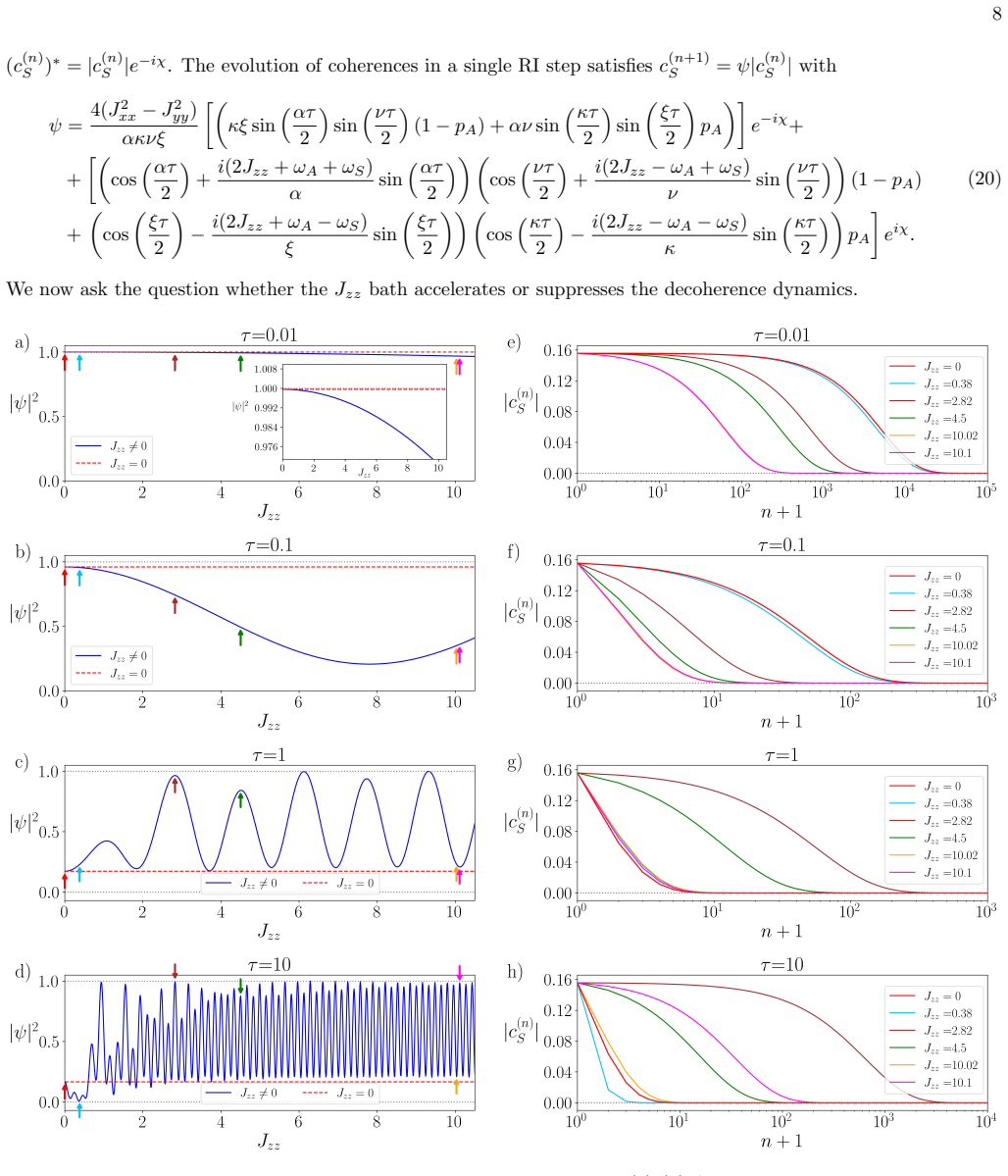
The central claim is that coupling a qubit to a dephasing bath while also coupling it to a dissipative bath produces cooperative, nonadditive dynamics that is exactly solvable in the repeated-interaction scheme. The solution is a one-step recursion for the ground-state population, p^{(n+1)} - p^{(∞)} = η (p^{(n)} - p^{(∞)}), with η given by Eq. (10) as a sum of four sinusoidal terms built from the microscopic composite frequencies ξ, ν, κ, and α. Since Jzz enters these frequencies as a detuning, a large dephasing coupling pushes η toward 1 and slows population relaxation; the same exact solution yields coherence dynamics through Eq. (20), where Jzz accelerates decoherence for short collision
What carries the argument
The load-bearing object is the collision unitary U(τ) = exp(-i H_tot τ), applied once per step to the system together with one fresh thermal ancilla from each bath, followed by tracing out the ancillas. All dynamical results follow from the exact single-step recursion for populations, with relaxation coefficient η in Eq. (10), and for coherences, with coefficient ψ in Eq. (20), both expressed through the four composite energies ξ, ν, κ, and α that mix Jxx, Jyy, Jzz, and the system and ancilla frequencies. The zero-heat result rests on the commutator [H_tot, H_A^(2)] = 0, which holds because both the dephasing interaction and the dephasing ancilla Hamiltonian act only through σz factors, maki
Load-bearing premise
The nonadditivity claim assumes the correct additive baseline is the single-bath (Jzz = 0) case; if sequentially applying the dissipative and dephasing collision maps gave the same relaxation coefficient η as the simultaneous map, the claimed cooperativity would be an artifact of the chosen comparison. This premise enters around Eqs. (10), (13), and (16).
What would settle it
Compare the relaxation coefficient of the sequential composition T_dephasing ∘ T_dissipative (first a dephasing collision, then a dissipative collision) with the simultaneous-map coefficient η in Eq. (10); if the two coincide at strong Jzz, the claimed nonadditive slowing is an artifact of the baseline. Alternatively, measure the energy change of the dephasing ancillas in any physical realization of this collision model: any nonzero heat absorbed by the dephasing bath would contradict the exact zero-heat result of Eq. (32).
If this is right
- For Jzz large compared with Jxx, Jyy, and the bare frequencies, the relaxation coefficient η moves toward 1, so the dephasing bath slows—and can nearly freeze—population relaxation; the paper identifies this as a Zeno-type regime.
- In the short-collision Lindblad limit, the dephasing bath affects populations only at fourth order in τ through a product Jxy² Jzz² term; at weak coupling the dynamics is additive, while at strong coupling the cross term is a direct nonadditive signature.
- In the Jτ ≫ 1 limit of weak but long collisions, increasing Jzz can either speed up or slow down population and coherence relaxation together, with the effect alternating as the coupling energy is scanned.
- The number of collision steps n* needed to prepare a thermal state is nonmonotonic in Jzz: a small dephasing coupling speeds thermalization, while a large coupling makes it more resource-intensive.
- Heat exchange with the dephasing bath is exactly zero in every collision step because the relevant Hamiltonian commutation holds identically; energy flows exclusively through the dissipative bath, contrary to what strong-coupling quantum-master-equation studies had suggested.
Where Pith is reading between the lines
- Editorial extension: the zero-heat result is purely algebraic—it survives any coupling strength, any temperature, and even unequal bath temperatures, because it relies only on the commutator. This suggests any collision model that preserves the diagonal-dephasing coupling form will also show zero heat to the dephasing bath, regardless of how strongly it affects dynamics.
- Editorial extension: the paper leaves implicit that the alternating acceleration/suppression in the Jτ ≫ 1 regime gives a sharp experimental handle: scanning Jzz (or equivalently Jτ) should produce multiple crossings with the Jzz = 0 relaxation curve, each crossing markable as a transition between Zeno-like and anti-Zeno-like behavior.
- Editorial extension: an immediate testable extension is to run the same exact recursion with the two baths at different temperatures; the population dynamics remains exactly solvable, and the prediction that heat still flows only to the dissipative bath could be checked directly in a nonequilibrium steady state.
Editorial analysis
A structured set of objections, weighed in public.
Referee Report
Summary. The paper studies a repeated-interaction (collision) model in which a central qubit interacts simultaneously with two qubit baths: a 'dissipative' bath via σ_x, σ_y couplings and a 'dephasing' bath via a σ_z coupling. The authors state exact recursive formulas for the ground-state population and for the coherence, analyze several physically motivated limits (resonant energy-conserving, short collisions, large J_zz, and the Jτ≫1 regime), and use these to show that the dephasing bath can slow or, in certain parameter regions, accelerate population relaxation. They also compute per-collision heat and work, and prove that the dephasing bath receives zero heat by showing [H_tot,H_A^(2)]=0. The results are used to discuss thermal-state preparation runtime and are contrasted with strong-coupling quantum-master-equation predictions that do allow heat flow to the dephasing bath.
Significance. If correct, the paper is a useful contribution to the collision-model literature. Its main assets are (i) an exactly solvable two-bath model with noncommuting system coupling operators, (ii) explicit analytical evidence for strong-coupling nonadditivity, e.g. the J_xy²J_zz² cross term in Eq. (16), and (iii) a clean, direct proof that the dephasing bath's free energy is conserved in every collision. I checked several limits: the formulas reduce correctly for J_zz=0, for J_xx=J_yy, for large J_zz, and in the short-collision expansion. The referee's concern about the missing additive baseline can be settled: in the resonant energy-conserving case, sequential composition of the two single-bath maps gives η_seq=1−sin²(2J_xyτ), while the simultaneous map Eq. (13) gives η_sim=1−[4J_xy²/(4J_xy²+J_zz²)]sin²(τ√(4J_xy²+J_zz²)); these are generically different, so the nonadditivity claim is not an artifact. The weaknesses are mainly presentational and verifiability-related: the central formulas are stated without derivation, and the additive baseline is never defined explicitly.
major comments (3)
- [Secs. III A and III B, Eqs. (10), (12), (20)] The exact recursion relations for populations and coherences are the foundation of the paper, but they are presented without derivation ('We compute exactly one step... We find'). The appendices provide expansions and a comparison with a Heisenberg single-bath model, but not the calculation leading to Eqs. (10), (12), and (20). Since all central claims rest on these expressions, please include a derivation or a detailed outline (e.g., diagonalization of H_tot followed by partial tracing), and ideally a numerical check for generic parameters.
- [Sec. III A, around Eqs. (13) and (16)] The word 'nonadditive' is used without defining the additive baseline. The natural reference is the sequential composition of the two single-bath collision maps. The manuscript compares only to J_zz=0 and to a single Heisenberg bath (Appendix B). In the resonant energy-conserving case, sequential composition gives η_seq=1−sin²(2J_xyτ), whereas Eq. (13) gives η_sim=1−[4J_xy²/(4J_xy²+J_zz²)]sin²(τ√(4J_xy²+J_zz²)); these differ generically, so the nonadditivity conclusion survives. Please add this baseline explicitly and use it to define additive versus nonadditive behavior.
- [Sec. V vs Sec. III A 3] The summary states that 'in the stroboscopic-Lindblad limit, cooperative effects disappeared and the dynamics was reduced to the expected additive form of the RI model,' but Sec. III A 3 and Eq. (16) identify a cross term J_xy²J_zz² in this same limit (fourth order in τ) and explicitly call it nonadditivity. Please distinguish the leading-order Lindblad limit from higher-order strong-coupling corrections, or revise the summary. As written, the paper contradicts itself on a point central to the claimed regime of nonadditivity.
minor comments (4)
- [Eq. (5)] The parameter c_A is introduced in the ancilla density matrix but is never used; the thermal state should set c_A=0. Please clarify.
- [Sec. III A 4] The notation 'Jτ1' is ambiguous. If the intended scaling is Jτ≫1, as suggested by the phrase 'long collisions' in the summary, the symbol should be typeset accordingly. If Jτ is actually of order 1, the dropping of the α,κ oscillatory terms in Eq. (17) needs justification.
- [Eq. (14)] In the large-J_zz limit, all four parameters in Eq. (11) are approximated by 2J_zz. This is acceptable only up to O(ω/J_zz) corrections; please state this approximation explicitly.
- [Abstract and Eq. (12)] Minor typos: 'characteristicslowing down' in the abstract should be 'characteristic slowing down', and the last sentence of the abstract contains a stray 'the'. Equation (12) is typeset very densely; please simplify or reformat so the parentheses and notation can be checked.
Circularity Check
No significant circularity: the dynamics and heat results are derived directly from the model, with no fitted parameters or self-citation chain forcing the conclusions.
full rationale
The paper's central results—the population relaxation coefficient eta (Eq. 10), the steady-state population (Eq. 12), the coherence decay coefficient (Eq. 20), and the vanishing heat to the dephasing bath (Eq. 32)—are obtained by direct exact computation of the one-step collision map (Eq. 7) from the model Hamiltonian (Eq. 4). No parameter is fitted to data, and no target conclusion is assumed as an input. The no-heat-to-dephasing-bath result is proven explicitly by the commutator in Eq. (34), which is a theorem from the model definitions rather than an imported conclusion. Self-citations to Ref. [17] are used only for the trace-distance runtime bound (Eq. 28) and for the procedural remark about extracting eta from the prefactor of p_S^(n); neither is load-bearing for the nonadditivity claim, and the runtime formula is separately verified numerically in Fig. 6. The nonadditive claim rests on the analytic expressions, e.g., Eq. (13) differing from the Jzz=0 case and the mixed Jxy^2 Jzz^2 term in the expansion (Eq. 16). Although the paper does not explicitly compute the sequential composition of the two single-bath maps as an 'additive' baseline, this is an interpretive/comparison choice, not a circular derivation: the reported results follow from the model without assuming the conclusion. No circular step can be quoted from the paper.
Axiom & Free-Parameter Ledger
axioms (5)
- domain assumption Each bath is an ensemble of identical noninteracting ancilla qubits prepared in the same Gibbs state and refreshed after each collision.
- domain assumption The system-bath interactions are the specific Pauli couplings of Eqs. (2)-(3): dissipative via sigma_x and sigma_y, dephasing via sigma_z.
- domain assumption The two baths are at equal inverse temperature beta in the dynamics analysis.
- ad hoc to paper Heat is defined as the change in the ancilla free Hamiltonian during a collision, Eqs. (29) and (31).
- domain assumption In the large-Jzz and J-tau-limit approximations, subleading energy parameters are dropped.
Cite this review
Pith. "Pith review of Collisional model with dissipative and dephasing baths: Nonadditive effects at strong coupling." pith.science (2026). https://pith.science/paper/DRHIHQYR
@misc{pith2026250910988,
  author       = {Pith},
  title        = {Pith review of: Collisional model with dissipative and dephasing baths: Nonadditive effects at strong coupling},
  year         = {2026},
  howpublished = {\url{https://pith.science/paper/DRHIHQYR}},
  note         = {Machine review of arXiv:2509.10988}
}
read the original abstract
The repeated interaction model provides a framework for emulating and analyzing the dynamics of open quantum systems. We explore here the dynamics generated by this protocol in a system that is simultaneously coupled to two baths through noncommuting system operators. One bath is made to couple to nondiagonal elements of the system, thus it induces dissipative dynamics, while the other couples to diagonal elements, and by itself it generates pure dephasing. By solving the problem analytically exactly, we show that when both baths act concurrently, a strong system-bath coupling gives rise to nonadditive effects in the dynamics. A prominent signature of this nonadditivity is the characteristic {\it slowing down} of population relaxation, driven by the influence of the dephasing bath. Beyond dynamics, we investigate the thermodynamic behavior of the model. Previous studies, using quantum master equations, showed that strong system-bath coupling created bath-cooperativity in this model, allowing heat exchange to the dephasing (diagonally coupled) bath. We find instead that, under the repeated interaction scheme, heat flows exclusively to the dissipative bath (coupled through nondiagonal elements). Our results highlight the need for a deeper understanding of the types of open quantum system dynamics and steady-state phenomena that emerge within the repeated interaction framework and the relation of this protocol to other common open quantum system techniques.
Figures




Reference graph
Works this paper leans on
-
[1]
In this limit, 5 the parameters defined in Eq
Energy conserving and resonance limit,Jxx =J yy ,ω A =ω S To gain insight into the impact of the bathJ zz on the relaxation dynamics of system, we consider the energy conserving case, that is, we setJ xx =J yy ≡J xy and work under the resonant condition,ω A =ω S ≡ω. In this limit, 5 the parameters defined in Eq. (11) reduce toξ=ν= 2 q 4J 2xy +J 2zz ,κ= 2(...
-
[2]
III A 1, we do not enforce the coupling parametersJ xx andJ yy to be equal, nor demand resonant frequencies
LargeJ zz limit Generalizing the conclusion from Sec. III A 1, we do not enforce the coupling parametersJ xx andJ yy to be equal, nor demand resonant frequencies. However, we require thatJ zz ≫J xx, Jyy , ωS, ωA. In this limit, all the parameters in Eq. (11) are approximated by 2J z, and we get from Eq. (10) that η≈1− J 2 + +J 2 − J 2zz sin2(Jzz τ).(14) O...
-
[3]
In this limit, the RI dynamics is reduced to a Lindblad-type QME [9, 15, 17, 28, 58]
The Stroboscopic-Lindblad limit We consider now the short collision time limit: we assumeτ≪ω −1,τ≪J −1 xx , but withJ 2 xxτa constant, and similarly forJ yy andJ zz . In this limit, the RI dynamics is reduced to a Lindblad-type QME [9, 15, 17, 28, 58]. We expand the coefficientη, Eq. (10), in series ofτaroundτ= 0, stopping at the fourth order, η= 1−2(J 2 ...
-
[4]
(10) in the so-calledJ τ1 limit [17, 18]
TheJ τ1limit We now analyze Eq. (10) in the so-calledJ τ1 limit [17, 18]. This limit is achieved under three assumptions: (i) ωA =ω S ≡ω(resonant condition); (ii)J xx, Jyy , Jzz ≪ω(weak-coupling); (iii)J nnτorder of 1, forn=x, y, z. In this limit, the energy parameters defined in Eq. (11) simplify toα, κ≈2ω, ξ, ν≈2 p (Jxx +J yy )2 +J 2zz andα, κ≫ξ, ν. As ...
-
[5]
Slowing down relaxation is beneficial for maintaining quantum states
Summary of observations: population dynamics The question we posed was whether dephasing in the form of coupling to theJ zz bath slows or accelerates the population relaxation dynamics. Slowing down relaxation is beneficial for maintaining quantum states. Accelerating relaxation is important for thermal state preparation applications. We largely identifie...
-
[6]
(20) reduces to ψ= ei(ω+Jzz )τ cos ντ 2 + i2Jzz ν sin ντ 2 (1−p A) +e i(ω−Jzz )τ cos ντ 2 − i2Jzz ν sin ντ 2 pA eiχ .(21) Here, the energy parameters of Eq
Energy conserving and resonance limit,Jxx =J yy ,ω A =ω S In the energy conserving limit,J xx =J yy ≡J xy, and under the resonance condition,ω S =ω A ≡ω, Eq. (20) reduces to ψ= ei(ω+Jzz )τ cos ντ 2 + i2Jzz ν sin ντ 2 (1−p A) +e i(ω−Jzz )τ cos ντ 2 − i2Jzz ν sin ντ 2 pA eiχ .(21) Here, the energy parameters of Eq. (11) reduce toξ=ν= 2 q 4J 2xy +J 2zz ,κ= 2...
-
[7]
(22) we get |ψ|2 ≈1−4p A(1−p A) sin2(2Jzz τ).(24) As we indeed see in with Fig
LargeJ zz limit In the strong decoherence limit, i.e.,J zz τ≫1,J zz ≫J xx, Jyy ,ω, we haveν≈2J zz and thus from Eq. (22) we get |ψ|2 ≈1−4p A(1−p A) sin2(2Jzz τ).(24) As we indeed see in with Fig. 4, the decoherence rate oscillates with a frequency that depends onJ zz and an amplitude that depends on temperature. At low temperature,p A →1, and the decohere...
-
[8]
We assume for simplicity thatJ xx =J yy ≡J xy
Stroboscopic-Lindblad limit We now study the dynamics in the small collision time limit, arriving at the Lindblad limit, see Appendix A. We assume for simplicity thatJ xx =J yy ≡J xy. Expanding Eq. (22) in a series up to the fourth order inτaroundτ= 0 we get |ψ|2 = 1−4J 2 xyτ 2 −16J 2 zz pA(1−p A)τ 2 + 64 3 τ 4 (1−p A)p AJ 2 zz 2J 2 xy +J 2 zz + 16 3 J 4 ...
-
[9]
III A 4, the energy parameters in Eq
TheJ τ1limit Under the assumptions of theJ τ1 limit introduced in Sec. III A 4, the energy parameters in Eq. (11) simplify to α,κ≈2ω,ξ,ν≈ p 4(Jxx +J yy )2 + 4J2zz . From Eq. (21), we have that |ψ|2 = 1−sin 2 ντ 2 1− J 2 zz 4J 2 +J 2zz (1−2p A)2 .(26) AssumingJ xx, Jyy , Jzz ∼J, we get |ψ|2 ≈1−sin 2 √ 5J τ 1− 1 5 (1−2p A)2 ,(27) which we compare to Eq. (23...
-
[10]
Quantum Software Consortium: Exploring Distributed Quantum Solutions for Canada
Summary of observations: Coherence dynamics What is the impact ofJ zz on the decoherence process? We identify regimes where population and coherence dynamics go hand in hand, and regimes where they follow opposite trends. (i) When the interaction energies are order of frequency andJ zz is large, we identify regimes of accelerated dynamics under short coll...
-
[11]
(9), the equation of motion for the ground state population can be written as ˙pS(t) =− 1−η τ pS(t) + 1−η τ p(∞) S .(A1) As can be seen from Eq
Populations Based on Eq. (9), the equation of motion for the ground state population can be written as ˙pS(t) =− 1−η τ pS(t) + 1−η τ p(∞) S .(A1) As can be seen from Eq. (10), the rate 1−η τ stays constant asτ→0 + [17]. Explicitly, Eq. (16) is derived under the short collision time limit and assuming resonant frequencies and energy conserving interactions...
-
[12]
Coherences In the short collision time limit, the expansion ofψ, Eq. (20) to the third order inτaroundτ= 0, provides ψ=e iχ 1 +i(2J zz (1−2p A) +ω S)τ− J 2 xx +J 2 yy + 2Jzz (Jzz + (1−2p A)ωS) + ω2 S 2 τ 2 −i 1 6 8Jzz (J 2 xx +J 2 yy +J 2 zz )(1−2p A) + 4JxxJyy ωA + 4(J2 xx +J 2 yy + 3J2 zz )ωS + 6Jzz (1−2p A)ω2 S +ω 3 S τ 3 +e −iχ(J 2 xx −J 2 yy )τ 2 +O(...
-
[13]
Giusteri G G, Recrosi F, Schaller G and Celardo G L 2017 Interplay of different environments in open quantum systems: Breakdown of the additive approximationPhys. Rev. E96 012113
2017
-
[14]
Maguire H, Iles-Smith J and Nazir A 2019 Environmental Nonadditivity and Franck-Condon physics in Nonequilibrium Quantum SystemsPhys. Rev. Lett.123 093601
2019
-
[15]
Palm T and Nalbach P 2021 Suppressing relaxation through dephasingPhys. Rev. A103 022206
2021
-
[16]
Thorbeck T, Xiao Z, Kamal A and Govia L C G 2024 Readout-Induced Suppression and Enhancement of Superconducting Qubit LifetimesPhys. Rev. Lett.132 090602
2024
-
[17]
Greenfield S, Kamal A, Dressel J and Levenson-Falk E 2025 A unified picture for quantum Zeno and anti-Zeno effects arXiv:2506.12679
arXiv 2025
-
[18]
Garwo la J and Segal D 2024 Open quantum systems with noncommuting coupling operators: An analytic approachPhys. Rev. B110 174304
2024
-
[19]
Chen J, Garwo la J and Segal D 2025 Suppression of decoherence dynamics by a dissipative bath at strong couplingPhys. Rev. A112 022209
2025
-
[20]
McElvogue R, Mitchell A K, Landi G T and Campbell S 2025 Nonequilibrium steady states in multi-bath quantum collision models arXiv:2507.13860
arXiv 2025
-
[21]
Ciccarello F, Lorenzo S, Giovannetti V and Palma G M 2022 Quantum collision models: Open system dynamics from repeated interactionsPhysics Reports954 1–70
2022
-
[22]
Grimmer D, Layden D, Mann R B and Mart ´ ın-Mart ´ ınez E 2016 Open dynamics under rapid repeated interactionPhys. Rev. A94 032126
2016
-
[23]
Ziman M, ˇStelmachoviˇ c P and Buˇ zek V 2005 Description of Quantum Dynamics of Open Systems Based on Collision-Like ModelsOpen Syst. Inf. Dyn.12 81–91
2005
-
[24]
Scarani V, Ziman M, ˇStelmachoviˇ c P, Gisin N and Buˇ zek V 2002 Thermalizing Quantum Machines: Dissipation and EntanglementPhys. Rev. Lett.88 097905
2002
-
[25]
Bruneau L, Joye A and Merkli M 2014 Repeated interactions in open quantum systemsJ. Math. Phys.55 075204
2014
-
[26]
Luchnikov I A and Filippov S N 2017 Quantum evolution in the stroboscopic limit of repeated measurementsPhys. Rev. A95 022113
2017
-
[27]
Guarnieri G, Morrone D, C ¸ akmak B, Plastina F and Campbell S 2020 Non-equilibrium steady-states of memoryless quantum collision modelsPhys. Lett. A384 126576
2020
-
[28]
Cattaneo M, De Chiara G, Maniscalco S, Zambrini R and Giorgi G L 2021 Collision Models Can Efficiently Simulate Any Multipartite Markovian Quantum DynamicsPhys. Rev. Lett.126 130403
2021
-
[29]
Prositto A, Forbes M and Segal D 2025 Equilibrium and nonequilibrium steady states with the repeated interaction protocol: Relaxation dynamics and energetic costQuantum Sci. Technol
2025
-
[30]
Ramon-Escandell C, Prositto A and Segal D 2025 Thermal state preparation by repeated interactions at and beyond the Lindblad limit arXiv:2506.12166
arXiv 2025
-
[31]
Tabanera-Bravo J, Parrondo J M R, Esposito M and Barra F 2023 Thermalization and Dephasing in Collisional Reservoirs Phys. Rev. Lett.130 200402
2023
-
[32]
Phys.24 023018
Tabanera J, Luque I, Jacob S L, Esposito M, Barra F and Parrondo J M R 2022 Quantum collisional thermostatsNew J. Phys.24 023018
2022
-
[33]
Rep.5 14873
Barra F 2015 The thermodynamic cost of driving quantum systems by their boundariesSci. Rep.5 14873
2015
-
[34]
Strasberg P, Schaller G, Brandes T and Esposito M 2017 Quantum and Information Thermodynamics: A Unifying Frame- work Based on Repeated InteractionsPhys. Rev. X7 021003
2017
-
[35]
Seah S, Perarnau-Llobet M, Haack G, Brunner N and Nimmrichter S 2021 Quantum Speed-Up in Collisional Battery ChargingPhys. Rev. Lett.127 100601
2021
-
[36]
Salvia R, Perarnau-Llobet M, Haack G, Brunner N and Nimmrichter S 2023 Quantum advantage in charging cavity and spin batteries by repeated interactionsPhys. Rev. Research5 013155
2023
-
[37]
Alves G O, Santos M A F and Landi G T 2024 Collisional thermometry for Gaussian systemsPhys. Rev. A110 052421
2024
-
[38]
Harrington P M, Mueller E J and Murch K W 2022 Engineered dissipation for quantum information scienceNature Reviews Physics4 660–671
2022
-
[39]
Yosifov A, Iyer A, Ebler D and Vedral V 2024 Quantum homogenization as a quantum steady-state protocol on noisy intermediate-scale quantum hardwarePhys. Rev. A109 032624
2024
-
[40]
Pocrnic M, Segal D and Wiebe N 2025 Quantum simulation of Lindbladian dynamics via repeated interactions J.Phys. A: Math. Theor.58 305302
2025
-
[41]
Erbanni R, Xu X, Demarie T F and Poletti D 2023 Simulating quantum transport via collisional models on a digital quantum computerPhys. Rev. A108 032619
2023
-
[42]
Di Bartolomeo G, Vischi M, Feri T, Bassi A and Donadi S 2024 Efficient quantum algorithm to simulate open systems through a single environmental qubitPhys. Rev. Research6 043321
2024
-
[43]
Lloyd J and Abanin D A 2025 Quantum thermal state preparation for near-term quantum processors arXiv:2506.21318
arXiv 2025
-
[44]
Ding Z, Zhan Y, Preskill J and Lin L 2025 End-to-End Efficient Quantum Thermal and Ground State Preparation Made Simple arXiv:2508.05703
arXiv 2025
-
[45]
Hagan M and Wiebe N 2025 The Thermodynamic Cost of Ignorance: Thermal State Preparation with One Ancilla Qubit arXiv:2502.03410 19
Pith/arXiv arXiv 2025
-
[46]
Langbehn J, Mouloudakis G, King E, Menu R, Gornyi I, Morigi G, Gefen Y and Koch C P 2025 Universal cooling of quantum systems via randomized measurements arXiv:2506.11964
arXiv 2025
-
[47]
Lloyd J, Michailidis A A, Mi X, Smelyanskiy V and Abanin D A 2025 Quasiparticle Cooling Algorithms for Quantum Many-Body State PreparationPRX Quantum6 010361
2025
-
[48]
Taranto P, Lipka-Bartosik P, Rodr ´ ıguez-Briones N A, Perarnau-Llobet M, Friis N, Huber M and Bakhshinezhad P 2025 Efficiently Cooling Quantum Systems with Finite Resources: Insights from Thermodynamic GeometryPhys. Rev. Lett. 134 070401
2025
-
[49]
Polla S, Herasymenko Y and O’Brien T E 2021 Quantum digital coolingPhys. Rev. A104 012414
2021
-
[50]
Cubitt T S 2023 Dissipative ground state preparation and the Dissipative Quantum Eigensolver arXiv:2303.11962
Pith/arXiv arXiv 2023
-
[51]
Puente D A, Motzoi F, Calarco T, Morigi G and Rizzi M 2024 Quantum state preparation via engineered ancilla resetting Quantum8 1299
2024
-
[52]
Cattaneo M, Rossi M A C, Garc ´ ıa-P´ erez G, Zambrini R and Maniscalco S 2023 Quantum Simulation of Dissipative Collective Effects on Noisy Quantum ComputersPRX Quantum4 010324
2023
-
[53]
Bassman Oftelie L, De Pasquale A and Campisi M 2024 Dynamic Cooling on Contemporary Quantum ComputersPRX Quantum5 030309
2024
-
[54]
Chen C-F, Kastoryano M J, Brand˜ ao F G S L and Gily´ en A 2023 Quantum Thermal State Preparation arXiv:2303.18224
Pith/arXiv arXiv 2023
-
[55]
Zhan Y, Ding Z, Huhn J, Gray J, Preskill J, Chan G K-L and Lin L 2025 Rapid quantum ground state preparation via dissipative dynamics arXiv:2503.15827
arXiv 2025
-
[56]
Rouz´ e C, Fran¸ ca D S and Alhambra´A M 2024 Optimal quantum algorithm for Gibbs state preparation arXiv:2411.04885
arXiv 2024
-
[57]
Rouz´ e C, Fran¸ ca D S and Alhambra´A M 2025 Efficient Thermalization and Universal Quantum Computing with Quantum Gibbs Samplers Proceedings of the 57th Annual ACM Symposium on Theory of Computing STOC ’25: 57th Annual ACM Symposium on Theory of Computing (Prague Czechia: ACM) pp 1488–95
2025
-
[58]
Consiglio M, Settino J, Giordano A, Mastroianni C, Plastina F, Lorenzo S, Maniscalco S, Goold J and Apollaro T J G 2024 Variational Gibbs state preparation on noisy intermediate-scale quantum devicesPhys. Rev. A110 012445
2024
-
[59]
Quantum Eng.6 1–12
Ilin Y and Arad I 2025 Dissipative Variational Quantum Algorithms for Gibbs State PreparationIEEE Trans. Quantum Eng.6 1–12
2025
-
[60]
Feng J-J, Wu B and Wilczek F 2022 Quantum Computing by Coherent CoolingPhys. Rev. A105 052601
2022
-
[61]
Zhang D, Bosse J L and Cubitt T 2023 Dissipative Quantum Gibbs Sampling arXiv:2304.04526
Pith/arXiv arXiv 2023
-
[62]
Lin L 2025 Dissipative Preparation of Many-Body Quantum States: Towards Practical Quantum Advantage arXiv:2505.21308
arXiv 2025
-
[63]
Purkayastha A, Guarnieri G, Campbell S, Prior J and Goold J 2021 Periodically refreshed baths to simulate open quantum many-body dynamicsPhys. Rev. B104 045417
2021
-
[64]
Shtanko O and Movassagh R 2023 Preparing thermal states on noiseless and noisy programmable quantum processors arXiv:2112.14688v2
Pith/arXiv arXiv 2023
-
[65]
Amin M H, Andriyash E, Rolfe J, Kulchytskyy B and Melko R 2018 Quantum Boltzmann MachinePhys. Rev. X8 021050
2018
-
[66]
Breuer H P and Petruccione F 2002 The Theory of Open Quantum Systems (Oxford University Press)
2002
-
[67]
Duan C, Hsieh C-Y, Liu J, Wu J and Cao J 2020 Unusual Transport Properties with Noncommutative System–Bath Coupling OperatorsJ. Phys. Chem. Lett.11 4080–5
2020
-
[68]
Brenes M, Garwo la J and Segal D 2025 Optimal qubit-mediated quantum heat transfer via noncommuting operators and strong coupling effectsPhys. Rev. B111 235440
2025
-
[69]
Anto-Sztrikacs N, Ivander F and Segal D 2022 Quantum thermal transport beyond second order with the reaction coordinate mappingThe Journal of Chemical Physics156 214107
2022
-
[70]
Ciccarello F 2017 Collision models in quantum opticsQuantum Measurements and Quantum Metrology4 53
2017
-
[71]
Marcantoni S and Merkli M 2025 Ultrastrong coupling, nonselective measurement and quantum Zeno dynamicsQuantum 9 1656
2025
-
[72]
Itano W M, Heinzen D J, Bollinger J J and Wineland D J 1990 Quantum Zeno effectPhys. Rev. A41 2295–300
1990
-
[73]
Zheng H, Zhu S Y and Zubairy M S 2008 Quantum Zeno and Anti-Zeno Effects: Without the Rotating-Wave Approximation Phys. Rev. Lett.101 200404
2008
-
[74]
Rep.6 29497
Chaudhry A Z 2016 A general framework for the Quantum Zeno and anti-Zeno effectsSci. Rep.6 29497
2016
-
[75]
Facchi P, Nakazato H and Pascazio S 2001 From the Quantum Zeno to the Inverse Quantum Zeno EffectPhys. Rev. Lett. 86 2699–703
2001
-
[76]
Kaulakys B and Gontis V 1997 Quantum anti-Zeno effectPhys. Rev. A56 1131–7
1997
This paper was first reviewed by deepseek-v4-flash on August 4, 2026.
discussion (0)
Sign in with ORCID, Apple, or X to comment. Anyone can read and Pith papers without signing in.