REVIEW 3 major objections 4 minor 31 references
Target search on DNA by interacting molecules: First-passage approach
T0 review · 3 major / 4 minor · reviewed 2026-08-14 · deepseek-v4-flash
Pith's one-line read Two interacting molecules can find a DNA target fastest at an intermediate dimer-dissociation rate, rather than as fully bound or fully independent particles.
desk verdict Nice idea and clean analytic limits, but the headline non-monotonic result is built on simulations whose association step is never specified; needs revision before I'd trust it. read the letter →
The pith
A machine-rendered reading of the paper's core claim, the machinery that carries it, and where it could break.
The reading
What carries the argument
The carrying object is the reversible dimer complex: two monomers hop with rate $\mu_1$, associate at rate $k_a$ when co-located, dissociate at rate $k_d$, and the complex itself hops with rate $\mu_2 < \mu_1$. Detailed balance ties $k_a/k_d$ to the interaction energy $E$, so tuning $k_d$ is physically tuning the strength of protein-protein attraction. The target site has an unbinding rate $k_{\rm off}$, and the search completes only when both molecules are on the target simultaneously. The argument combines first-passage survival-probability calculations in the non-interacting and strong-attraction limits with kinetic Monte Carlo simulations for the general regime.
What would settle it
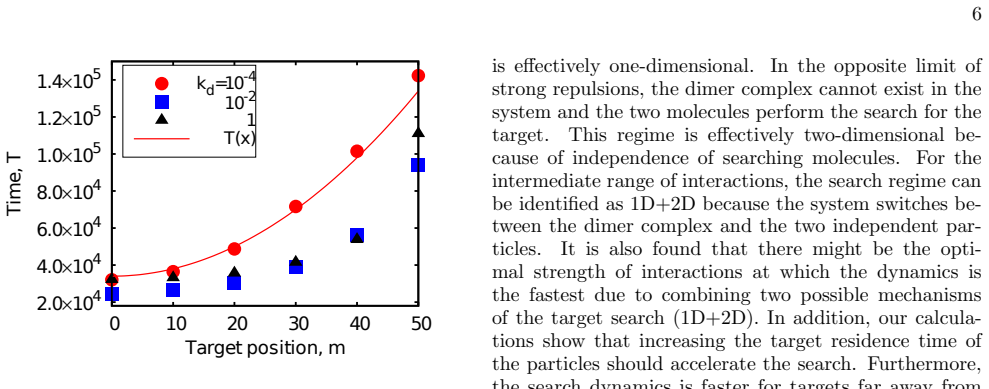
Repeat the simulations behind Fig. 3 with the dimer hopping rate $\mu_2$ larger than the monomer rate $\mu_1$ while keeping all other rates fixed: if the mean first-passage time versus $k_d$ still shows a minimum, the proposed slow-dimer mechanism cannot be the cause. A cleaner test is a single scan with $\mu_2/\mu_1 > 1$; the paper’s interpretation predicts the mixed-regime minimum should disappear.
Extended reading notes
Core claim
For two molecules that reversibly form a complex on a one-dimensional DNA segment, the mean first-passage time to simultaneous target occupancy is non-monotonic as a function of the dimer dissociation rate $k_d$, provided the dimer moves more slowly than the monomers. At large $k_d$ the molecules act independently and the search is effectively two-dimensional; at small $k_d$ the search is carried by a long-lived dimer and is effectively one-dimensional. In between, a mixed “1D+2D” regime can be fastest, and the paper explains this by an optimal balance between the dimer’s slow but directed progress and the monomers’ faster but wider exploration. The paper also finds that longer target residence times (smaller $k_{\rm off}$) accelerate the two-molecule search and that targets away from lattice boundaries are reached sooner, with the non-monotonic dependence most visible for short residence times.
Load-bearing premise
The non-monotonic optimum assumes that a two-molecule complex moves more slowly along DNA than a single molecule does; if that ordering is reversed, the mixed-search speed-up predicted here would not hold.
Editorial extensions
If this is right
- If the mixed regime is fastest, the cell can accelerate gene activation by tuning transcription-factor dimerization affinity to an intermediate value rather than maximizing or minimizing protein-protein binding.
- Longer target residence times for a single molecule speed up the two-molecule completion, so proteins that bind their target strongly once they arrive reduce the time the other molecule needs to find it.
- Targets located away from the segment boundaries are found faster, and the effect persists across interaction strengths.
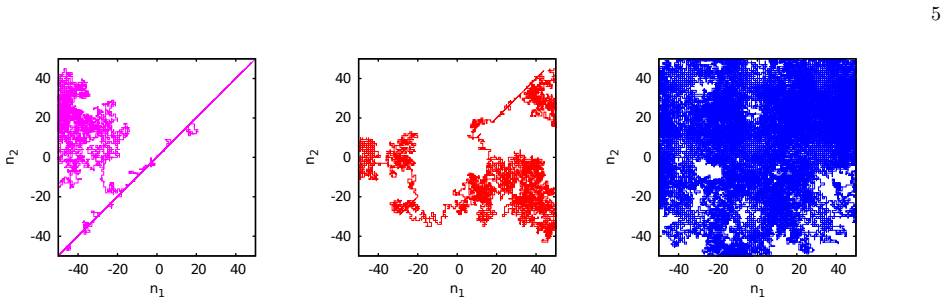
- The three search regimes imply distinct trajectory signatures: diagonal-bound motion for dimers, broad independent exploration for repulsion, and intermittent diagonal excursions for the mixed regime.
- The non-monotonic optimum appears at short target residence times, so experiments with fast-dissociating transcription factors are the likeliest place to see it.
Reading between the lines
- Because $k_a/k_d = \exp(-E/k_B T)$, the optimal $k_d$ corresponds to a finite window of binding free energy; mutations that shift $E$ by a few $k_B T$ could move a pair between fast and slow regimes.
- With more than two molecules, the same machinery would add another encounter bottleneck, so the optimal dissociation rate may shift or the non-monotonic minimum may sharpen; the paper’s construction can be extended to $N>2$ by simulation.
- Real searches include 3D excursions; replacing the one-dimensional lattice by an intermittent 3D+1D walk should preserve the qualitative minimum but change its location, which could be tested in stretched-DNA or single-molecule experiments with two labelled proteins.
Signed reviews
Editorial analysis
A structured set of objections, weighed in public.
Referee Report
Summary. The paper proposes a minimal one-dimensional lattice model in which two interacting molecules search for a target site on DNA. The molecules can reversibly associate into a dimer that also diffuses along the lattice, and the search is completed when both molecules are simultaneously present at the target. The authors analyze strong-repulsion and strong-attraction limits with first-passage formulas and perform kinetic Monte Carlo simulations for the general regime. Their central claim is that the mean first-passage time is non-monotonic in the dimer dissociation rate kd, so that an intermediate interaction strength gives the fastest target search. They also study the effects of target residence time and target position, and they interpret the intermediate regime as a beneficial combination of effectively one-dimensional and two-dimensional search mechanisms.
Significance. If the central claim is correct, the paper addresses a real gap in the protein target-search literature, where intermolecular interactions are usually neglected and a non-monotonic optimum in interaction strength would be a nontrivial, potentially testable prediction. The limiting-case analytical expressions, such as the L^2 scaling for two independent particles and the approximate complex-search formula, are transparent and are shown to agree with simulations. The physical interpretation via a 1D+2D trade-off is plausible and connects to facilitated-diffusion ideas. However, the headline non-monotonic result currently rests on simulations whose association protocol is not specified and that are shown without statistical error bars, so the significance is conditional on those simulations being reproducible and statistically robust.
major comments (3)
- [Section II, Simulation method] The simulation protocol is incomplete because no association event is specified. The model definition includes the association rate ka and the detailed-balance relation ka/kd = exp(-E/kBT), but the described Monte Carlo algorithm lists only monomer moves, dimer dissociation/moves, monomer unbinding, and the dissociation event; nothing states what happens when two monomers occupy the same site, with what probability per time step, or what value of ka was used for the reported curves. Since the general-regime data in Fig. 3 depend on the coexistence of monomers and dimers, which is governed by ka/kd, the central non-monotonic claim cannot currently be reproduced or independently assessed. The authors should add the association update rule (including how simultaneous arrivals are treated), the ka values used for each figure, and a check that the limits ka >> mu1 and ka << mu1 are realized as claimed.
- [Fig. 3 and Section III.C] The headline non-monotonic dependence of the mean first-passage time on the dissociation rate kd is presented as smooth curves without error bars, numbers of Monte Carlo runs, or raw data points. The dip at intermediate kd, especially for mu2/mu1 = 0.2, may be modest compared with stochastic fluctuations, and the reader cannot determine whether the reported minimum is statistically significant. Please add standard errors or other uncertainty measures, report the number of independent runs, and preferably show individual simulation points on the plot.
- [Section III.C and Figs. 4-5] The additional general-regime results in Figs. 4 and 5 are generated with the same underspecified association protocol. Once the association rule and ka values are supplied, these figures should be regenerated or at least explicitly linked to the specified parameter set. Without this, the heat map in Fig. 5 and the trajectory interpretation in Fig. 4 inherit the reproducibility problem of the central simulation claim.
minor comments (4)
- [Section III.C] The text 'two articles move independently' appears to be a typo for 'two particles move independently'.
- [Fig. 5 caption and axes] The axes labeled 'Log[kd]' and 'Log[koff]' do not specify the logarithm base, and the color-bar values have no units; using for example 'log10(kd/mu1)' would improve clarity.
- [Section II] The assumption mu2 < mu1 is stated as a general expectation, and the non-monotonic optimum is demonstrated only in this regime. It would be useful to state explicitly that the predicted intermediate optimum is conditioned on mu2 < mu1 and to add a sentence or a simulation showing what happens when mu2 >= mu1.
- [Section III.A, Eq. (3)] The exponential approximation for the single-particle survival probability is an assumption; Fig. 2 shows good agreement for the integrated quantities used, but a brief comment on the range of lattice sizes and time scales for which this approximation is reliable would be helpful.
Circularity Check
No circularity: the central MFPT results are simulation observations, and the analytical limits use standard random-walk formulas that are independently verified by simulation.
full rationale
The paper's two analytical limits (Secs. III-A and III-B) rest on the single-particle mean first-passage time t1 = (2L^2+L)/(6mu1) and on the encounter-time expression Tn, both attributed to ref. [31] (Veksler and Kolomeisky, including the present author Kolomeisky). This is a self-citation, but it is not load-bearing circularity: the formulas are parameter-free standard results for 1D random walks, and the paper independently verifies them by kinetic Monte Carlo simulation in Fig. 2 and by agreement with the limiting curves in Fig. 3. The formulas are inputs, not predictions derived from the target result. The headline non-monotonic dependence on kd (Fig. 3) is presented as a simulation observation with an explanatory 1D+2D mechanism, not as a fitted prediction: no data are fitted and no output is obtained by construction from an input. The model's assumption mu2 < mu1 is an explicit physical assumption, not a circular redefinition. One genuine weakness exists but it is not circular: Section II's 'Simulation method' never assigns a value or update rule for ka, even though the model defines ka and the detailed-balance relation ka/kd = exp(-E/kBT) ties it to the interaction energy. This leaves the general-regime simulations difficult to reproduce, but reproducibility is a different concern from circularity. The finite-residence-time contribution is taken from ref. [11] (Grebenkov), an external source, and is used only to contextualize the koff dependence. Overall, no prediction in the paper is equivalent by construction to its inputs, and no load-bearing argument reduces to an unverified self-citation chain.
Assumptions & free parameters
free parameters (5)
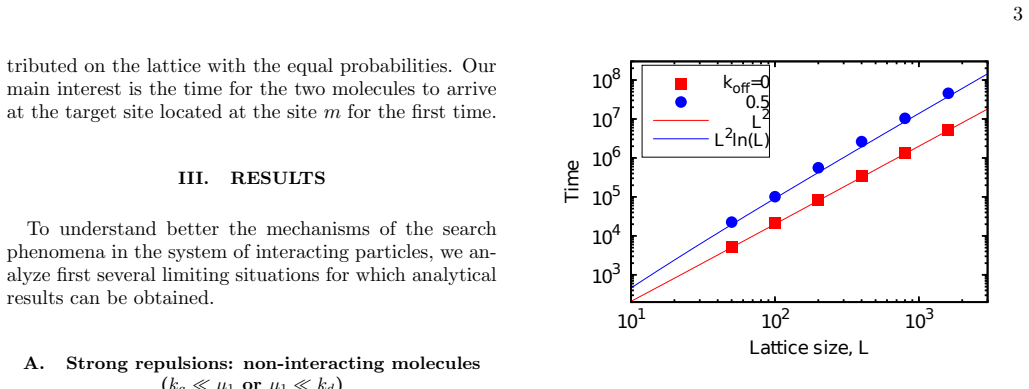
- mu1 (monomer hopping rate) =
0.25 (time unit)
- mu2/mu1 (complex hopping ratio) =
0.05, 0.1, 0.2 (Fig. 3)
- koff (target unbinding rate) =
0.25 in Figs. 2-4; varied in Fig. 5
- kd (dimer dissociation rate) =
varied from 10^-5 to 1
- ka (association rate) =
not stated
assumptions (6)
- ad hoc to paper Survival probability of a single particle is exponential, S(1,t) approximately exp(-t/t1)
- standard math When koff = mu1, the target acts as a reflecting boundary and two independent particles map to a 2D search with MFPT proportional to L^2 ln L
- ad hoc to paper Dimer initial encounter positions are uniformly distributed over lattice sites (Eq. 8)
- domain assumption Complex diffuses slower than monomers, mu2 < mu1
- domain assumption Detailed balance ka/kd = exp(-E/kBT) links interaction energy to rates
- standard math Random-walk first-passage formulas t1=(2L^2+L)/(6mu1) and Tn=(L/2-n)(3L/2+n+1)/(2mu2)
Cite this review
Pith. "Pith review of Target search on DNA by interacting molecules: First-passage approach." pith.science (2026). https://pith.science/paper/DRN5RT2K
@misc{pith2026190803597,
  author       = {Pith},
  title        = {Pith review of: Target search on DNA by interacting molecules: First-passage approach},
  year         = {2026},
  howpublished = {\url{https://pith.science/paper/DRN5RT2K}},
  note         = {Machine review of arXiv:1908.03597}
}
read the original abstract
Gene regulation is one of the most important fundamental biological processes in living cells. It involves multiple protein molecules that locate specific sites on DNA and assemble gene initiation or gene repression multi-molecular complexes. While the protein search dynamics for DNA targets has been intensively investigated, the role of inter-molecular interactions during the genetic activation or repression remains not well quantified. Here we present a simple one-dimensional model of target search for two interacting molecules that can reversibly form a dimer molecular complex, which also participates in the search process. In addition, the proteins have finite residence times on specific target sites, and the gene is activated or repressed when both proteins are simultaneously present at the target. The model is analyzed using first-passage analytical calculations and Monte Carlo computer simulations. It is shown that the search dynamics exhibits a complex behavior depending on the strength of inter-molecular interactions and on the target residence times. We also found that the search time shows a non-monotonic behavior as a function of the dissociation rate for the molecular complex. Physical-chemical arguments to explain these observations are presented. Our theoretical approach highlights the importance of molecular interactions in the complex process of gene activation/repression by multiple transcription factor proteins.
Figures


Figures from the paper (2 more)
Reference graph
Works this paper leans on
-
[1]
Bruce Alberts, Dennis Bray, Karen Hopkin, Alexander D Johnson, Julian Lewis, Martin Raff, Keith Roberts, and Peter Walter. Essential cell biology . Garland Science, 2013
work page 2013
-
[2]
Loops in dna: an overview of experimental and theoretical ap- proaches
J-F Allemand, S Cocco, N Douarche, and G Lia. Loops in dna: an overview of experimental and theoretical ap- proaches. The European Physical Journal E , 19(3):293– 302, 2006
work page 2006
-
[3]
Generalized fa- cilitated diffusion model for dna-binding proteins with search and recognition states
Maximilian Bauer and Ralf Metzler. Generalized fa- cilitated diffusion model for dna-binding proteins with search and recognition states. Biophysical journal , 102 (10):2321–2330, 2012
work page 2012
-
[4]
From first-passage times of random walks in confinement to geometry- controlled kinetics
Olivier B´ enichou and R Voituriez. From first-passage times of random walks in confinement to geometry- controlled kinetics. Physics Reports , 539(4):225–284, 2014
work page 2014
-
[5]
Intermittent search strategies
Olivier B´ enichou, C Loverdo, M Moreau, and R Voi- turiez. Intermittent search strategies. Reviews of Modern Physics, 83(1):81, 2011
work page 2011
-
[6]
Otto G Berg and Clas Blomberg. Association kinetics with coupled diffusional flows: special application to the lac repressor-operator system. Biophysical chemistry, 4 (4):367–381, 1976
work page 1976
-
[7]
First-passage times for random walks in bounded domains
S Condamin, O B´ enichou, and M Moreau. First-passage times for random walks in bounded domains. Physical 7 review letters, 95(26):260601, 2005
work page 2005
-
[8]
Sylvain Condamin, Olivier B´ enichou, and Michel Moreau. Random walks and brownian motion: A method of computation for first-passage times and related quan- tities in confined geometries. Physical Review E , 75(2): 021111, 2007
work page 2007
Show all 31 references
-
[9]
Kinetics of target site localization of a protein on dna: a stochastic approach
M Coppey, O B´ enichou, R Voituriez, and M Moreau. Kinetics of target site localization of a protein on dna: a stochastic approach. Biophysical journal, 87(3):1640– 1649, 2004
2004
-
[10]
Eukaryotic transcriptional dynamics: from single molecules to cell populations
Antoine Coulon, Carson C Chow, Robert H Singer, and Daniel R Larson. Eukaryotic transcriptional dynamics: from single molecules to cell populations. Nature Reviews Genetics, 14(8):572, 2013
2013
-
[11]
First passage times for multiple par- ticles with reversible target-binding kinetics.The Journal of Chemical Physics , 147(13):134112, 2017
Denis S Grebenkov. First passage times for multiple par- ticles with reversible target-binding kinetics.The Journal of Chemical Physics , 147(13):134112, 2017
2017
-
[12]
How do site- specific dna-binding proteins find their targets? Nucleic acids research, 32(10):3040–3052, 2004
Stephen E Halford and John F Marko. How do site- specific dna-binding proteins find their targets? Nucleic acids research, 32(10):3040–3052, 2004
2004
-
[13]
The lac repressor displays facilitated diffusion in living cells
Petter Hammar, Prune Leroy, Anel Mahmutovic, Erik G Marklund, Otto G Berg, and Johan Elf. The lac repressor displays facilitated diffusion in living cells. Science, 336 (6088):1595–1598, 2012
2012
-
[14]
Tuned polymerization of the transcription factor yan limits off-dna sequestration to confer context-specific repression
C Matthew Hope, Jemma L Webber, Sherzod A Tokamov, and Ilaria Rebay. Tuned polymerization of the transcription factor yan limits off-dna sequestration to confer context-specific repression. eLife, 7:e37545, 2018
2018
-
[15]
How pro- teins search for their specific sites on dna: the role of dna conformation
Tao Hu, A Yu Grosberg, and BI Shklovskii. How pro- teins search for their specific sites on dna: the role of dna conformation. Biophysical journal, 90(8):2731–2744, 2006
2006
-
[16]
Sequence heterogene- ity and the dynamics of molecular motors
Yariv Kafri and David R Nelson. Sequence heterogene- ity and the dynamics of molecular motors. Journal of Physics: Condensed Matter , 17(47):S3871, 2005
2005
-
[17]
Physics of protein–dna interac- tions: mechanisms of facilitated target search
Anatoly B Kolomeisky. Physics of protein–dna interac- tions: mechanisms of facilitated target search. Physical Chemistry Chemical Physics , 13(6):2088–2095, 2011
2011
-
[18]
Motor proteins and molecular motors
Anatoly B Kolomeisky. Motor proteins and molecular motors. CRC press, 2015
2015
-
[19]
First passage time distribu- tion of multiple impatient particles with reversible bind- ing
SD Lawley and JB Madrid. First passage time distribu- tion of multiple impatient particles with reversible bind- ing. The Journal of Chemical Physics , 150(21):214113, 2019
2019
-
[20]
Disentangling the many layers of eukaryotic tran- scriptional regulation
Katherine M Lelli, Matthew Slattery, and Richard S Mann. Disentangling the many layers of eukaryotic tran- scriptional regulation. Annual review of genetics , 46:43– 68, 2012
2012
-
[21]
Molec- ular cell biology
Harvey Lodish, James E Darnell, Arnold Berk, Chris A Kaiser, Monty Krieger, Matthew P Scott, Anthony Bretscher, Hidde Ploegh, Paul Matsudaira, et al. Molec- ular cell biology . Macmillan, 2008
2008
-
[22]
First- passage phenomena and their applications
Ralf Metzler, Gleb Oshanin, and Sidney Redner. First- passage phenomena and their applications . World Scien- tific, 2014
2014
-
[23]
How a protein searches for its site on dna: the mechanism of facilitated diffusion
Leonid Mirny, Michael Slutsky, Zeba Wunderlich, Anahita Tafvizi, Jason Leith, and Andrej Kosmrlj. How a protein searches for its site on dna: the mechanism of facilitated diffusion. Journal of Physics A: Mathematical and Theoretical, 42(43):434013, 2009
2009
-
[24]
Physical biology of the cell
Rob Phillips, Julie Theriot, Jane Kondev, and Hernan Garcia. Physical biology of the cell . Garland Science, 2012
2012
-
[25]
A guide to first-passage processes
Sidney Redner. A guide to first-passage processes . Cam- bridge University Press, 2001
2001
-
[26]
The lac represser-operator interaction: Iii
Arthur D Riggs, Suzanne Bourgeois, and Melvin Cohn. The lac represser-operator interaction: Iii. kinetic stud- ies. Journal of molecular biology , 53(3):401–417, 1970
1970
-
[27]
Classes of fast and specific search mechanisms for pro- teins on dna
M Sheinman, O B´ enichou, Y Kafri, and R Voituriez. Classes of fast and specific search mechanisms for pro- teins on dna. Reports on Progress in Physics , 75(2): 026601, 2012
2012
-
[28]
Molecular search with conformational change: One-dimensional discrete- state stochastic model
Jaeoh Shin and Anatoly B Kolomeisky. Molecular search with conformational change: One-dimensional discrete- state stochastic model. The Journal of Chemical Physics, 149(17):174104, 2018
2018
-
[29]
Mechanisms of protein search for targets on dna: theoretical insights
Alexey Shvets, Maria Kochugaeva, and Anatoly Kolomeisky. Mechanisms of protein search for targets on dna: theoretical insights. Molecules, 23(9):2106, 2018
2018
-
[30]
Protein–dna bind- ing: complexities and multi-protein codes
Trevor Siggers and Raluca Gordan. Protein–dna bind- ing: complexities and multi-protein codes. Nucleic Acids Research, 42(4):2099–2111, 2013
2013
-
[31]
Speed- selectivity paradox in the protein search for targets on dna: is it real or not? The Journal of Physical Chem- istry B, 117(42):12695–12701, 2013
Alex Veksler and Anatoly B Kolomeisky. Speed- selectivity paradox in the protein search for targets on dna: is it real or not? The Journal of Physical Chem- istry B, 117(42):12695–12701, 2013
2013
Reviewed August 14, 2026 · model on record in the stance chip above.
Discussion (0). Continue with ORCID to comment.