REVIEW 2 major objections 6 minor 29 references
ArVoice: A Multi-Speaker Dataset for Arabic Speech Synthesis
T0 review · 2 major / 6 minor · reviewed 2026-08-07 · deepseek-v4-flash
Pith's one-line read ArVoice introduces an open-source Arabic speech corpus with 83.52 hours across 11 voices and fully diacritized transcripts, and argues it is the largest dataset built specifically for Arabic speech synthesis.
desk verdict Useful multi-speaker Arabic TTS resource, but the paper contradicts itself on whether all human speech is diacritized; that flaw needs fixing before the corpus claims hold. read the letter →
The pith
A machine-rendered reading of the paper's core claim, the machinery that carries it, and where it could break.
The reading
What carries the argument
The object that carries the argument is the aligned pair of audio and fully diacritized transcript. A diacritized Arabic transcript writes short vowels, gemination, and other pronunciation cues as marks on the consonants; without them, written Arabic under-specifies pronunciation and a text-to-speech system cannot reliably determine which word is intended. The construction pipeline turns source texts from existing corpora into such pairs by cleaning sentences, having voice talents record them, manually correcting the transcripts to match the audio, normalizing the older Arabic Speech Corpus spellings back to standard orthography, and then generating synthetic parallel speech from the same transcripts. The synthetic-voice component extends the same text across multiple voices, which is what makes parallel voice conversion and data augmentation possible.
What would settle it
Retranscribe Parts 1 and 2 with at least two independent native speakers of Modern Standard Arabic, measure how often their diacritic choices agree, and run a phone-level forced aligner that lines each sound in the audio up with the written transcript; if agreement is low or the aligner finds systematic mismatches between what was said and what is written, the transcript-accuracy premise fails.
Extended reading notes
Core claim
ArVoice is presented as the largest open-source Arabic dataset curated specifically for speech synthesis, with 83.52 hours spread across 11 voices: 7 human voices totaling about 10 hours and synthetic voices generated from the same transcripts. Four human voices were professionally recorded from diacritized MSA text, two from undiacritized MSA news text, and one comes from a corrected subset of the Arabic Speech Corpus; the synthetic part is generated by two commercial text-to-speech systems from the processed transcripts and is intended for augmentation and voice conversion. Every transcript is fully diacritized, and the paper argues that this is what makes the corpus usable for end-to-end and multi-speaker synthesis. The paper validates the corpus by training three open-source text-to-speech systems and two voice-conversion systems, reporting that diacritized input, more speakers, and synthetic data augmentation each improve measured TTS quality, and that both voice-conversion models achieve substantial speaker similarity.
Load-bearing premise
The load-bearing premise is that the diacritized transcripts, especially the manually proofread ones in Parts 1 and 2, accurately reflect how the recorded audio is pronounced; if those vowel marks are systematically wrong, every speech model trained on the corpus inherits the errors even though the corpus is still large and open.
Editorial extensions
If this is right
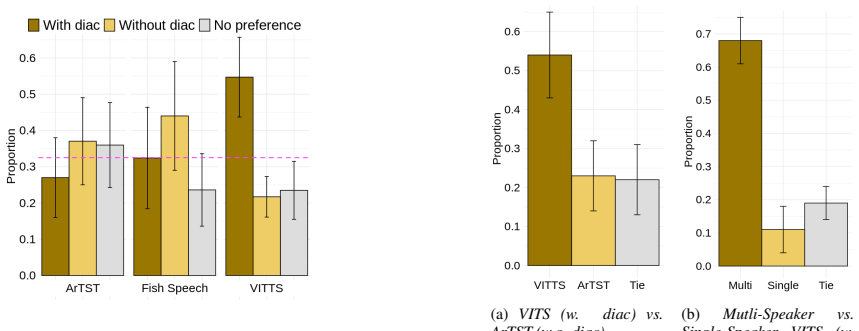
- Researchers can train multi-speaker Arabic text-to-speech models on open data; the paper's best end-to-end model trained on all human voices was preferred over a single-speaker model for the same target voice.
- Adding diacritics to transcripts improves end-to-end TTS intelligibility: the best variant with diacritics achieved 20.67% speech-recognition word error rate versus 35.69% without diacritics.
- The synthetic parallel speech can be used as training augmentation: adding it to the best end-to-end TTS model cut absolute word error rate by 8.2 percentage points, and a plurality of listeners preferred the augmented model.
- The same synthetic parallel speech supports voice conversion: the parallel voice-conversion system reached a 0.95 false acceptance rate and 0.72 speaker similarity score, with the non-parallel system slightly lower.
- Because every transcript is fully diacritized, the corpus also offers a platform for speech-based diacritic restoration, automatic speech recognition, and deepfake detection, as the authors note.
Reading between the lines
- A natural extension the authors do not run is to measure inter-annotator agreement on the diacritized transcripts of Parts 1 and 2; if forced alignment between transcripts and audio shows systematic mismatches, the corpus's core value would need to be reassessed.
- Because the synthetic speech in Part 4 is generated from the same final transcripts used by the human speakers in Parts 1 and 3, those subsets provide a human-synthetic parallel corpus; the paper uses it for augmentation and voice conversion but does not explore prosody transfer between the human and synthetic conditions.
- The 'largest open-source Arabic dataset curated for speech synthesis' claim depends on how one distinguishes TTS-oriented corpora from larger ASR-oriented Arabic corpora; a practical test is to train the same TTS recipe on an ASR corpus and see whether curation, not merely size, is what drives the reported quality gains.
Editorial analysis
A structured set of objections, weighed in public.
Referee Report
Summary. The paper introduces ArVoice, a multi-speaker Modern Standard Arabic (MSA) speech corpus intended for speech synthesis research. The corpus has four parts: (1) new professional recordings from four voice talents reading diacritized Tashkeela-derived texts, (2) recordings from two additional talents reading non-diacritized Khaleej texts, (3) a modified and corrected subset of the Arabic Speech Corpus (ASC), and (4) synthetic speech generated from the Part 1 and Part 3 transcripts using commercial Google TTS systems. The authors report 83.52 total hours across 11 voices, of which 10 hours are human speech from 7 speakers. They also present baseline experiments: multi-speaker TTS with three open-source models (ArTST-tts, VITS, Fish-Speech), with/without diacritics comparisons, synthetic data augmentation effects, and two voice conversion models (AAS-VC and KNN-VC). The dataset is publicly released with licensing conditions.
Significance. If the claims hold, ArVoice is a potentially valuable resource for Arabic TTS and related tasks: it is explicitly positioned as the largest open-source Arabic corpus curated for speech synthesis, with more speakers than existing single-speaker corpora (ASC, ClArTTS) and with a public release. The paper provides detailed construction steps, manual transcript correction, ASR-based validation of Part 3 using three external models, and reproducible baseline code links. These strengths are real and should be credited. However, the central claim of a 'fully diacritized' corpus is compromised by the treatment of Part 2, and the reported synthetic voice count is internally inconsistent; these issues affect the dataset description and the validity of the TTS comparisons.
major comments (2)
- [3.2 / 3.4 / 4.1 / Abstract] Section 3.2 states that Part 2 transcripts were extracted from the non-diacritized Khaleej Corpus and that the two voice talents were instructed to read the text 'according to what seemed most natural to them,' with no post-hoc diacritization step described. Section 3.4 explicitly excludes Part 2 from synthetic generation because it 'contains no diacritics.' Yet Section 4.1 says the TTS models were fine-tuned on 'Parts 1,2,3 ... the human voices with diacritized text,' and the Abstract and Conclusion describe the entire corpus as having 'diacritized transcriptions' or 'fully diacritized' transcripts. If Part 2 indeed lacks diacritics, then about 1.88 hours (19% of the human speech) does not carry the core annotation, and the with/without diacritics TTS comparison in Section 4.1 is confounded because the two Part 2 speakers would receive identical text in both conditions. The authors must either document and apply an explicit diacritization procedure for Part 2, or revise the corpus description and the TTS experiment claims to accurately reflect the undiacritized nature of that subset.
- [1 vs Abstract / Conclusion / 3.4] The Introduction states that the dataset contains '8×∼9 hours of parallel synthesized speech,' which implies eight synthetic audio sets at roughly nine hours each. In contrast, the Abstract, Conclusion, and Section 3.4 report four synthetic voices (two male and two female). Section 3.4 mentions generating audio with 'both the Standard and premium Wavenet models' for these four voices, which could yield eight variants, but the manuscript never defines what counts as a synthetic 'voice' or a synthetic 'hour' in this accounting. This ambiguity directly affects the advertised total duration of 83.52 hours and the number-of-voices claim, and it must be resolved for the dataset statistics to be verifiable.
minor comments (6)
- [3.5] The sentence 'This part of ArVoice consists in total of about 9 hours of training and 0.86 hours of test data' is unclear: the numbers sum to 9.86 hours rather than the 10.0 hours shown in Table 3, and it is not specified which 'part' this refers to (the human subset as a whole, or Part 3 specifically).
- [Table 3] The table rows are garbled in the current typesetting; for example, '1 m aa m Egypt' appears to concatenate Part, Gender, ID, and Origin. Please separate the columns unambiguously so that each speaker's attributes are readable.
- [4.1] The preference test section says 'we randomly sampled 25 transcripts from the test set' but does not state which test set is meant (ASC test set, a held-out portion of Part 1, or a combination). Please specify the test set composition and whether it covers all speakers.
- [4.1] In the intelligibility evaluation, Fish-Speech is reported with WER above 100%. Since word error rate can exceed 100% due to insertions, a brief explanation or a note that this reflects insertion errors would help the reader interpret the result.
- [Acknowledgments] The sentence 'We thank the five hired voice artists and our co-author, Samar Magdy, for contributing their voice' should be 'their voices,' and the number 'five' appears inconsistent with the six voice talents described in Sections 3.1 and 3.2 (four in Part 1 and two in Part 2).
- [1] The phrase '8×∼9 hours' is typographically awkward; please write it as '8 × ~9 hours' or rephrase to clarify the number of synthetic voices and the approximate duration per voice.
Circularity Check
No circular derivation: ArVoice's dataset construction and TTS/VC baselines are empirical, and self-cited ASR results are independently corroborated by external models.
full rationale
The paper is a dataset and empirical-benchmarking contribution rather than a formal derivation, so most circularity patterns (fitted inputs renamed as predictions, uniqueness theorems, ansatz smuggling) do not apply. The central claim—that ArVoice is the largest open-source Arabic dataset curated for speech synthesis—is established by corpus statistics and comparison with prior resources, not by a self-referential argument. Self-citations exist: ArTST [15] is used both as an ASR validator in Table 2 and as a TTS baseline/evaluator in Section 4.1, and GPT-4 prompting from [13] is used for Part 3 transcript normalization. However, these are not load-bearing in a circular sense: the Part 3 validation is corroborated by two external ASR systems (Nvidia CTC-large and Whisper-large), and the TTS conclusions rely primarily on subjective native-speaker preference tests rather than on ArTST's own ASR numbers. The paper does contain a notable internal consistency issue: Section 3.2 states that Part 2 transcripts are non-diacritized, Section 3.4 excludes Part 2 from synthetic generation 'as it contains no diacritics,' yet Section 4.1 claims fine-tuning on 'Parts 1,2,3 ... the human voices with diacritized text.' This is a missing-support or documentation problem, not a circular derivation, because it does not make any conclusion equivalent to its inputs by construction. For those reasons, the circularity score is 0.
Assumptions & free parameters
free parameters (2)
- Sentence segment length thresholds =
min 20, max 50 characters
- Speaker similarity threshold for FAR =
0.5
assumptions (6)
- domain assumption The Al Jazeera portion of the Tashkeela corpus contains Modern Standard Arabic text suitable for speech synthesis.
- domain assumption Manual proofreading by the authors is sufficient to guarantee that diacritized transcripts match the spoken audio.
- domain assumption ASR word error rate is a valid proxy for the intelligibility of synthesized speech.
- domain assumption GPT-4 with manual correction restores standard Arabic spelling from ASC's pronunciation-normalized transcripts.
- standard math Student-t confidence intervals apply to aggregated preference-test proportions.
- domain assumption Synthetic speech generated by Google TTS is usable for data augmentation and voice conversion despite uncertain quality.
Cite this review
Pith. "Pith review of ArVoice: A Multi-Speaker Dataset for Arabic Speech Synthesis." pith.science (2026). https://pith.science/paper/DS36KDCY
@misc{pith2026250520506,
  author       = {Pith},
  title        = {Pith review of: ArVoice: A Multi-Speaker Dataset for Arabic Speech Synthesis},
  year         = {2026},
  howpublished = {\url{https://pith.science/paper/DS36KDCY}},
  note         = {Machine review of arXiv:2505.20506}
}
read the original abstract
We introduce ArVoice, a multi-speaker Modern Standard Arabic (MSA) speech corpus with diacritized transcriptions, intended for multi-speaker speech synthesis, and can be useful for other tasks such as speech-based diacritic restoration, voice conversion, and deepfake detection. ArVoice comprises: (1) a new professionally recorded set from six voice talents with diverse demographics, (2) a modified subset of the Arabic Speech Corpus; and (3) high-quality synthetic speech from two commercial systems. The complete corpus consists of a total of 83.52 hours of speech across 11 voices; around 10 hours consist of human voices from 7 speakers. We train three open-source TTS and two voice conversion systems to illustrate the use cases of the dataset. The corpus is available for research use.
Figures
Reference graph
Works this paper leans on
-
[1]
Introduction Speech synthesis technologies, such as Text-to-Speech (TTS), and V oice conversion (VC), have shown remarkable progress in quality and naturalness, particularly with the availability of large-scale, high-quality datasets. However, for mid-low re- source languages, such as Arabic, the availability of clean and well-curated speech corpora remai...
-
[2]
ArVoice: A Multi-Speaker Dataset for Arabic Speech Synthesis
Related Works Large and diverse Arabic datasets have been developed for speech tasks; yet, most of them are suitable for ASR, and few are designed for TTS. The main open-source speech datasets developed specifically for TTS are: ASC and ClArTTS. Both are single-speaker datasets featuring a male speaker. ASC (Arabic Speech Corpus) [10] is the most widely k...
work page Pith review arXiv 2025
-
[3]
Dataset Construction ArV oice comprises both human and synthetic voices. In this section, we describe each part of ArV oice and provide justifica- tion for design decisions where applicable. 3.1. ArV oice Part 1 (Human) Text Sources: Modern Standard Arabic text was sourced from the Tashkeela Corpus [11], which consists of fully diacritized Arabic text, mo...
work page 2020
-
[4]
Baselines In this section, we describe two speech synthesis tasks: multi-speaker text-to-speech (TTS) and voice conversion (VC), trained using ArVoice. 4.1. TTS Synthesis Experiments Models: Text-to-Speech synthesis experiments were carried out using three open-source models: ArTST-tts [15], VITS [17] 6https://cloud.google.com/text-to-speech and Fish-Spee...
-
[5]
Conclusion We described ArV oice, a multi-speaker dataset for speech syn- thesis in Modern Standard Arabic. The dataset consists of 11 voices in total, 7 of which are human voices, and 4 are syn- thetic with parallel text. We illustrated the usability of ArV oice in multi-speaker TTS, demonstrating the advantage of using di- acritized transcripts. In addi...
-
[6]
This work was partially funded by a Google research award (11/2023)
Acknowledgments We thank the five hired voice artists and our co-author, Samar Magdy, for contributing their voice to research. This work was partially funded by a Google research award (11/2023). 10https://github.com/bshall/knn-vc https://github.com/rufaelfekadu/seq2seq-vc 11huggingface.co/speechbrain/spkrec-ecapa-voxceleb 12The ground truth SS score was 0.81
work page 2023
-
[7]
Cmu wilderness multilingual speech dataset,
A. W. Black, “Cmu wilderness multilingual speech dataset,” in ICASSP 2019-2019 IEEE International Conference on Acoustics, Speech and Signal Processing (ICASSP). IEEE, 2019, pp. 5971– 5975
work page 2019
-
[8]
Speech recognition challenge in the wild: Arabic mgb-3,
A. Ali, S. V ogel, and S. Renals, “Speech recognition challenge in the wild: Arabic mgb-3,” in 2017 IEEE Automatic Speech Recog- nition and Understanding Workshop (ASRU). IEEE, 2017, pp. 316–322
2017
Show all 29 references
-
[9]
QASR: QCRI aljazeera speech resource a large scale annotated Arabic speech corpus,
H. Mubarak, A. Hussein, S. A. Chowdhury, and A. Ali, “QASR: QCRI aljazeera speech resource a large scale annotated Arabic speech corpus,” in Proceedings of the 59th Annual Meeting of the Association for Computational Linguistics and the 11th International Joint Conference on N...
2021
-
[10]
Masc: Massive arabic speech corpus,
M. Al-Fetyani, M. Al-Barham, G. Abandah, A. Alsharkawi, and M. Dawas, “Masc: Massive arabic speech corpus,” in 2022 IEEE Spoken Language Technology Workshop (SLT). IEEE, 2023, pp. 1006–1013
2022
-
[11]
Diacritic recognition perfor- mance in arabic asr,
H. Aldarmaki and A. Ghannam, “Diacritic recognition perfor- mance in arabic asr,” in Interspeech 2023, 2023, pp. 361–365
2023
-
[12]
Automatic restora- tion of diacritics for speech data sets,
S. Shatnawi, S. Alqahtani, and H. Aldarmaki, “Automatic restora- tion of diacritics for speech data sets,” in Proceedings of the 2024 Conference of the North American Chapter of the Association for Computational Linguistics: Human Language Technologies (Vol- ume 1: Long Papers...
2024
-
[13]
Clartts: An open-source classical arabic text-to-speech corpus,
A. Kulkarni, A. Kulkarni, S. A. M. Shatnawi, and H. Aldarmaki, “Clartts: An open-source classical arabic text-to-speech corpus,” in Interspeech 2023, 2023, pp. 5511–5515
2023
-
[14]
Robust speech recognition via large-scale weak supervision,
A. Radford, J. W. Kim, T. Xu, G. Brockman, C. McLeavey, and I. Sutskever, “Robust speech recognition via large-scale weak supervision,” in International Conference on Machine Learning, 2022. [Online]. Available: https://api.semanticscholar. org/CorpusID:252923993
2022
-
[15]
ArzEn: A speech corpus for code-switched Egyptian Arabic-English,
I. Hamed, N. T. Vu, and S. Abdennadher, “ArzEn: A speech corpus for code-switched Egyptian Arabic-English,” in Proceedings of the Twelfth Language Resources and Evaluation Conference, N. Calzolari, F. B ´echet, P. Blache, K. Choukri, C. Cieri, T. Declerck, S. Goggi, H. Isahara...
2020
-
[16]
V oxblink: A large scale speaker verification dataset on camera,
Y . Lin, X. Qin, G. Zhao, M. Cheng, N. Jiang, H. Wu, and M. Li, “V oxblink: A large scale speaker verification dataset on camera,” ICASSP 2024 - 2024 IEEE International Conference on Acoustics, Speech and Signal Processing (ICASSP), pp. 10 271–10 275, 2023. [Online]. Available...
2024
-
[17]
Modern standard arabic phonetics for speech synthesis,
N. Halabi, “Modern standard arabic phonetics for speech synthesis,” Ph.D. dissertation, University of Southampton, July
-
[18]
Fish-Speech: Leveraging large language models for advanced multilingual Text-to-Speech synthesis,
S. Liao, Y . Wang, T. Li, Y . Cheng, R. Zhang, R. Zhou, and Y . Xing, “Fish-Speech: Leveraging large language models for advanced multilingual Text-to-Speech synthesis,” arXiv (Cornell University) , 11 2024. [Online]. Available: http://arxiv.org/abs/2411.01156
2024 arXiv
-
[19]
Tashkeela: Novel corpus of arabic vo- calized texts, data for auto-diacritization systems,
T. Zerrouki and A. Balla, “Tashkeela: Novel corpus of arabic vo- calized texts, data for auto-diacritization systems,” Data in Brief, vol. 11, 02 2017
2017
-
[20]
We also fine-tuned KNN-VC [21], a non-parallel VC model that converts source into target speech by replacing each frame (a) VITS (w
on the same dataset to improve waveform synthesis qual- ity. We also fine-tuned KNN-VC [21], a non-parallel VC model that converts source into target speech by replacing each frame (a) VITS (w. diac) vs. ArTST (w.o. diac) (b) Mutli-Speaker vs. Single-Speaker VITS (w. diac) Fig...
-
[21]
Comparison of topic identification methods for arabic language,
M. Abbas and K. Sma ¨ıli, “Comparison of topic identification methods for arabic language,” in International Conference on Re- cent Advances in Natural Language Processing-RANLP 2005, no. 14-17, 2005
2005
-
[22]
STTATTS: Unified speech-to-text and text-to-speech model,
H. O. Toyin, H. Li, and H. Aldarmaki, “STTATTS: Unified speech-to-text and text-to-speech model,” in Findings of the Association for Computational Linguistics: EMNLP 2024 , Y . Al- Onaizan, M. Bansal, and Y .-N. Chen, Eds. Miami, Florida, USA: Association for Computational Lin...
2024
-
[23]
ArTST: Arabic text and speech transformer,
H. O. Toyin, A. Djanibekov, A. Kulkarni, and H. Aldarmaki, “ArTST: Arabic text and speech transformer,” in Proceedings of ArabicNLP 2023 . Singapore (Hybrid): Association for Computational Linguistics, Dec. 2023, pp. 41–51. [Online]. Available: https://aclanthology.org/2023.ar...
2023
-
[24]
Fast conformer with linearly scalable attention for efficient speech recognition,
D. Rekesh, N. R. Koluguri, S. Kriman, S. Majumdar, V . Noroozi, H. Huang, O. Hrinchuk, K. Puvvada, A. Kumar, J. Balam et al., “Fast conformer with linearly scalable attention for efficient speech recognition,” in2023 IEEE Automatic Speech Recognition and Understanding Workshop...
2023
-
[25]
Conditional variational autoencoder with adversarial learning for end-to-end text-to-speech,
J. Kim, J. Kong, and J. Son, “Conditional variational autoencoder with adversarial learning for end-to-end text-to-speech,” in Inter- national Conference on Machine Learning . PMLR, 2021, pp. 5530–5540
2021
-
[27]
Aas-vc: On the generalization ability of automatic alignment search based non- autoregressive sequence-to-sequence voice conversion,
W.-C. Huang, K. Kobayashi, and T. Toda, “Aas-vc: On the generalization ability of automatic alignment search based non- autoregressive sequence-to-sequence voice conversion,” 2023. [Online]. Available: https://arxiv.org/abs/2309.07598
2023 arXiv
-
[28]
Parallel wavegan: A fast waveform generation model based on generative adversarial net- works with multi-resolution spectrogram,
R. Yamamoto, E. Song, and J.-M. Kim, “Parallel wavegan: A fast waveform generation model based on generative adversarial net- works with multi-resolution spectrogram,” in ICASSP 2020-2020 IEEE International Conference on Acoustics, Speech and Signal Processing (ICASSP). IEEE, ...
2020
-
[29]
V oice conversion with just nearest neighbors,
M. Baas, B. van Niekerk, and H. Kamper, “V oice conversion with just nearest neighbors,” in Proc. Interspeech 2023, 2023, pp. 2053–2057
2023
-
[2016]
Available: https://eprints.soton.ac.uk/409695/
[Online]. Available: https://eprints.soton.ac.uk/409695/
Reviewed August 7, 2026 · model on record in the stance chip above.
Discussion (0). Continue with ORCID to comment.