REVIEW 3 major objections 4 minor 4 cited by
A parity-symmetric nonlinear coupling keeps transmon qubits free of measurement-induced transitions up to about 300 readout photons.
Reviewed by Pith at T0; open to challenge. T0 means a machine referee read the full paper against a public rubric. the ladder, T0–T4 →
T0 review · deepseek-v4-flash
2026-08-05 05:35 UTC pith:DS7NXF6T
load-bearing objection Real experimental progress on MIST suppression, but the '300 photons' headline is softer than it looks: the y-axis leans on outlier renormalization and the x-axis on a linear extrapolation. the 3 major comments →
Suppression of measurement-induced state transitions in cos{φ}-coupling transmon readout
The pith
A machine-rendered reading of the paper's core claim, the machinery that carries it, and where it could break.
Core claim
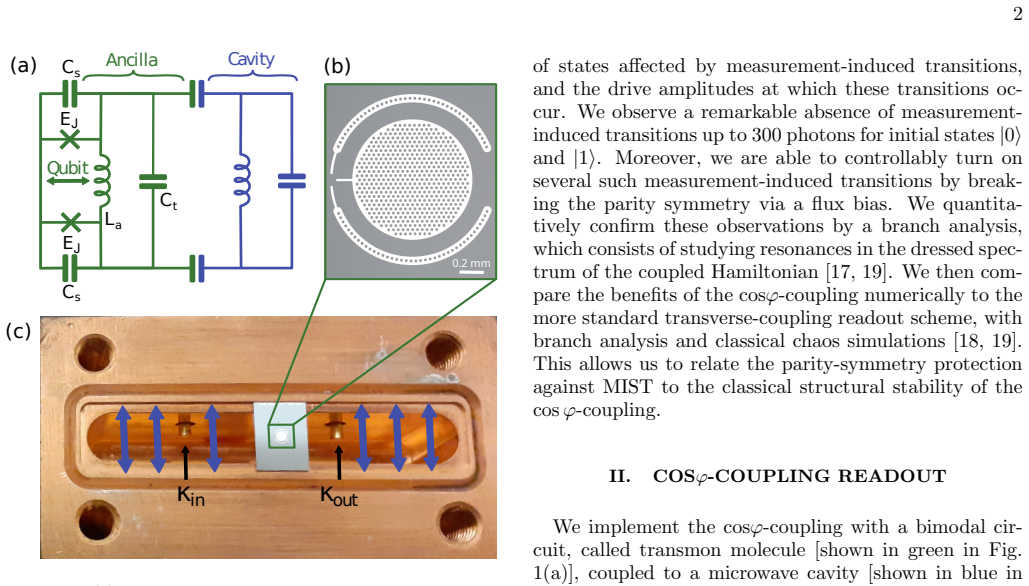
At zero flux, the cosφ coupling exchanges only even numbers of qubit and cavity excitations, because the coupled operators are cos(φq) and cos[φc(c+c†)]. The one-photon exchange that drives measurement-induced transitions in the standard transverse scheme is therefore absent, and the first drive harmonic that can affect the transmon is 2ωd, whose matrix elements are exponentially small at the large detuning used here. The measurements show a plateau in P(0|0) ≈ 97% up to 373 photons and P(1|1) ≈ 90% up to 326 photons, with strong non-QND features appearing only around 300 photons. When flux is tuned to −0.04Φ₀, parity is broken and the predicted |0⟩↔|4⟩ and |1⟩↔|5⟩ resonances appear at 81 an
What carries the argument
The cosφ-coupling parity symmetry: the qubit couples to the cavity through cos(φq) times cos[φc(c+c†)], so the selection rule allows only processes that exchange even numbers of excitations. At zero flux, odd-photon transitions are forbidden outright; at finite detuning, the remaining even processes are suppressed because the lowest relevant drive harmonic is 2ωd rather than ωd. Branch analysis of the dressed spectrum, tracking the transmon excitation number versus cavity occupation, locates the allowed resonances, and classical Poincaré sections test whether the same symmetry prevents chaotic ionization.
Load-bearing premise
The x-axis photon number is calibrated by the qubit AC Stark shift up to 150 photons and then extended linearly; if that calibration bends above 150 photons, the absolute location of the 300-photon plateau is unverified.
What would settle it
Measure the MIST plateau with an independent photon-number calibration valid beyond 150 photons, for example direct output-power or sideband-based photon counting. If, after re-scaling, P(0|0) drops below its plateau at a true photon number far below 300, the experimental claim of MIST-freedom fails; if any odd-photon transition appears at zero flux under the corrected calibration, the parity-symmetry argument fails.
If this is right
- Readout can be operated at hundreds of photons while preserving the qubit state, directly increasing signal-to-noise and speed for QND measurement.
- Multi-state single-shot classification up to |5⟩ enables direct leakage detection and state assignment during error-correction cycles.
- Flux bias becomes a fast knob to switch specific measurement-induced transitions on and off, useful for spectroscopy and controlled leakage injection.
- The parity argument extends to other strong off-resonant drives, suggesting the cosφ coupling is a stable platform for parametric operations, not just readout.
- Equivalent transverse couplings at the same dispersive shift develop avoided crossings and a chaotic layer, explaining why transverse readout ionizes where cosφ readout does not.
Where Pith is reading between the lines
- A likely limit of the quantitative claim is the calibration: with a corrected photon scale the 300-photon number may shift, but the symmetry-based existence of a wide MIST-free window would not depend on the exact endpoint.
- The even-parity selection rule should also suppress one-photon drive-induced transitions during parametric gates involving the same readout mode; testing two-qubit or reset operations at high power would extend the result.
- The flux-activated |0⟩↔|4⟩ and |1⟩↔|5⟩ crossings could be repurposed as deliberate multi-photon transitions for qudit control or as sensitive flux sensors.
- A concrete future prediction: in a cosφ device with smaller qubit–cavity detuning, so that 2ωd/ωq is not large, the plateau should shorten because the exponential suppression weakens; a variable-detuning sample could test this.
Editorial analysis
A structured set of objections, weighed in public.
Referee Report
Summary. The manuscript reports an experimental and theoretical study of measurement-induced state transitions (MIST) in a transmon readout based on a cosφ coupling. At zero flux, the authors measure P(0|0)≈97% and P(1|1)≈90% plateaus up to roughly 373 and 326 photons respectively, and attribute the absence of MIST to a parity symmetry that forbids odd-excitation exchange. At nonzero flux, they observe MIST at ~81 photons (|0⟩→|4⟩) and ~13 photons (|1⟩→|5⟩), and use branch analysis and AC-Stark extrapolation to locate the resonances. They also compare the cosφ coupling to a transversely coupled model via branch analysis and classical Poincaré sections, concluding that the former is structurally stable against chaos and MIST.
Significance. The central claim is significant: it identifies a circuit-level symmetry that can suppress MIST and provides experimental evidence for it. The parity-symmetry selection rule is parameter-free, and the 81-photon MIST position is predicted from an independent AC-Stark extrapolation of the |0⟩–|4⟩ transition (Appendix K), which is a strong check. The multi-state single-shot readout up to |5⟩ is a useful technical contribution. However, the headline 'free of MIST up to >300 photons' rests on two measurement assumptions—outlier removal and an extrapolated photon calibration—that need to be quantified before the claim is fully established.
major comments (3)
- [Appendix G, Fig. 2(b,c)] Appendix G states: 'For computing the probabilities, we take out the outliers from the statistic and renormalize by the remaining total population.' The plateau values P(0|0)≈97% and P(1|1)≈90% are therefore computed after discarding single-shot points that fall outside all thresholds. MIST events that produce intermediate or ambiguous final states would be preferentially excluded if they land outside the six 2σ blobs. The manuscript does not report the outlier fraction as a function of drive power, so the plateau could partly reflect selective removal of MIST events rather than their absence. Please report the outlier fraction versus ¯n (and versus initial state), and either include unclassified points as a separate outcome or demonstrate that the outlier fraction is small and power-independent.
- [Appendix I] The photon-number axis is calibrated from the AC Stark shift up to 150 photons and then linearly extrapolated for the MIST data ('This calibration is linearly extrapolated to higher powers for the scales of the MIST measurements'). The claims of MIST-free behavior at >300 photons and the resonance positions at 81 and 13 photons depend on this extrapolation. If the AC Stark shift becomes nonlinear above 150 photons, the calibrated x-axes of Figs. 2 and 3 are incorrect. Please either extend the calibration into the relevant power range, or state the maximum verified photon number and adjust the headline claim accordingly.
- [Sec. III, Appendix E, Appendix J.1] The white crosses in Fig. 3 are labeled as predictions of the branch analysis. However, the model parameters are fitted to spectroscopic data that include the flux dependence of the transmon 04 transition (Appendix E), and the same model is used for the branch analysis. Thus the |0⟩–|4⟩ MIST locus is not fully independent of the data it is compared with. The 81-photon prediction in Appendix K is genuinely independent, but for Fig. 3 the agreement is better described as a consistency check within the fitted model. It would strengthen the paper to state this distinction explicitly.
minor comments (4)
- [Fig. 2(b,c)] No error bars or confidence intervals are shown for P(i|i). Since the plateau claim is quantitative, a statement of statistical uncertainty (or a note that error bars are smaller than the line width) would be helpful.
- [Sec. III] The statement that states |6+⟩ are 'guaranteed to not overlap with the lower identifiable states' is too strong given that the threshold placement is based on simulation and finite SNR. Suggest 'do not overlap in simulation' or adding the measured separation.
- [Appendix D] The derived parameter list contains repeated notation α_a for both the ancilla anharmonicity and the ancilla-like polariton anharmonicity. Please use distinct symbols or clarify.
- [Abstract / Conclusion] The phrase 'free of MIST up to high powers, with more than 300 photons' should be qualified by 'in the calibrated power range' if the photon calibration is not extended beyond 150 photons.
Circularity Check
No significant circularity: the central zero-flux MIST suppression follows from Hamiltonian parity symmetry and independently measured plateaus; the nonzero-flux branch analysis is a genuine model prediction, and the cited caveats are experimental risks rather than derivation circularity.
full rationale
The paper's central claim—absence of MIST at zero flux up to ~300 photons—is not circular. It rests on two independent legs: (i) the parity symmetry of the cosφ-coupling Hamiltonian, Eq. (1), which forbids odd-parity transitions and is demonstrated explicitly in Sec. III via the matrix-element structure of Eq. (2); and (ii) the measured conditional-probability plateaus in Fig. 2(b,c). The branch analysis at zero flux shows exact crossings rather than avoided crossings (Fig. 10), so the theoretical statement is parameter-free and not fitted to the MIST data. The nonzero-flux predictions, marked as white crosses in Fig. 3, come from exact diagonalization of Eq. (A12) using parameters fitted in Appendix E to low-power spectroscopy. Although the fit includes the |0>–|4> transition frequency, the predicted MIST photon-number positions also depend on the drive-dependent dressed-spectrum (AC Stark) shifts, which are not fitted to the MIST features; this is a legitimate model prediction, not an input renamed as output. Appendix K's '81-photon prediction' is best read as a consistency check: it linearly extrapolates the measured AC Stark shift of ω04 to the cavity frequency and finds agreement with the independently measured MIST dip. That agreement is not tautological, since the MIST population-transfer feature is separately measured, but the wording 'predicted' overstates its independence. The manuscript's own caveats—Appendix I's linear extrapolation of the photon calibration beyond 150 photons and Appendix G's removal of outliers before computing P(i|i)—are real experimental limitations that could affect the quantitative x-axis and the y-axis respectively, but they are not cases where a derivation reduces to its inputs by construction. No load-bearing self-citation, imported uniqueness theorem, or ansatz-smuggling-via-citation was found. The circularity score is therefore low despite these measurement-care caveats.
Axiom & Free-Parameter Ledger
free parameters (5)
- Josephson energy E_J =
h * 3.96 GHz
- Transmon charging energy E_Cq =
h * 0.0734 GHz
- Cavity-like polariton frequency omega_c =
2*pi * 7.294 GHz
- Ancilla-cavity linear coupling g_ac =
2*pi * 215 MHz
- Dispersive shift chi_qc =
2*pi * -2.02 MHz
axioms (4)
- standard math cos(phi_q) and cos(phi_c(c+c_dagger)) only couple states differing by an even number of excitations, enforcing parity conservation of the coupling.
- domain assumption The ancilla-like polariton remains in its ground state throughout the readout protocol, so the two-mode Hamiltonian of Eq. (1) is sufficient.
- domain assumption The non-QND breakdown of the plateau above roughly 300 photons is due to cavity bistability or invalid Taylor expansion of the cos-phi coupling, not to MIST.
- domain assumption Classical Poincare sections and Chirikov's resonance-overlap criterion are reliable indicators of quantum ionization/MIST robustness.
Cite this review
Pith. "Pith review of Suppression of measurement-induced state transitions in cos{\phi}-coupling transmon readout." pith.science (2026). https://pith.science/paper/DS7NXF6T
@misc{pith2026250905126,
  author       = {Pith},
  title        = {Pith review of: Suppression of measurement-induced state transitions in cos\phi-coupling transmon readout},
  year         = {2026},
  howpublished = {\url{https://pith.science/paper/DS7NXF6T}},
  note         = {Machine review of arXiv:2509.05126}
}
read the original abstract
Drive-induced unwanted state transitions (DUST) are limiting both for microwave readout and parametric operations of superconducting qubits. Among them, measurement-induced state transitions (MIST) are due to intrinsic resonances described by the readout Hamiltonian. They were previously studied with a qubit linearly coupled to its readout mode, which constitutes the usual readout Hamiltonian. Since MIST can appear even at moderate powers, they limit the readout SNR and the QND readout fidelity. In this work, we study the high-power readout regime in a different transmon readout scheme, implementing a nonlinear coupling called the cos{\phi}-coupling. This coupling stems from a transmon molecule circuit and has symmetry properties that suppress nonparity-conserving MIST. We succeed in performing multi-state single-shot readout up to the fifth excited state of the transmon, which enables us to identify leakage pathways from the computational subspace. The measurements indicate that the system is free of MIST up to high powers, with more than 300 photons in the readout mode. The MIST can be controllably turned on by breaking the parity symmetry of the coupling using flux-tuning. These experimental results are corroborated by branch analysis and simulations of the classical chaotic dynamics, showing that the cos{\phi}-coupling is very robust to readout photons compared to the usual transverse coupling.
Figures


Forward citations
Cited by 4 Pith papers
-
Collapse and Inversion of the Josephson Potential in a Strongly Driven Superconducting Circuit
The Josephson potential of a transmon collapses and inverts under a strong fast flux drive, dynamically stabilizing the qubit at φ=π, as shown by spectroscopy and readout.
-
A high-fidelity two-qubit gate for multimode superconducting P-mon qubits
A 180 ns CZ gate with 99.62(4)% fidelity realized on P-mon qubits via resonant mediator-mode coupling, with ZZ interactions suppressed below 3.6(5) kHz.
-
Measurement-induced state transitions in multi-qubit transmon processors
In two-transmon systems, a spectator qubit lowers the MIST threshold of the readout qubit and can itself be affected by the readout qubit's transitions, with a coupler further modifying both effects.
-
Probing excited-state dynamics of transmon ionization
Experimental verification that transmon ionization under strong readout drives is a controllable Landau-Zener transition, with quantitative measurements of critical photon numbers and population transfer matching a se...
Reference graph
Works this paper leans on
-
[1]
(J1) agree qualitatively with the re- sults of Eq
Branch analysis For the branch analysis studies presented in the main text, we have checked that Floquet simulations (not pre- sented here) of Eq. (J1) agree qualitatively with the re- sults of Eq. (A12), as expected [18, 19], and with the branch analysis of three-mode Hamiltonian Eq. (A10). We commit to Eq. (A12) in order to achieve high pho- ton numbers...
-
[2]
(A12) to a transversely coupled transmon Hamiltonian
Comparisons to a transversely coupled transmon In the main text we have compared the cosφ-coupled transmon molecule of Eq. (A12) to a transversely coupled transmon Hamiltonian. Here, for completeness, we pro- vide the details for the analysis of the latter, which are standard [17–19]. For the transversely coupled transmon we consider the Hamiltonian ˆH= ˆ...
-
[3]
Classical dynamics In this section we consider the stability towards clas- sical chaos of the cosφ-coupled or transversely coupled transmon. We perform this analysis on classical limits of the corresponding transmon-mode Hamiltonians: cosφ- coupled transmon Eq. (J1), or transversely coupled trans- mon Eq. (J5). In the following, all observables are re- pl...
-
[4]
Constraints on cavity frequency from Chirikov’s criterion Chirikov’s heuristic criterion [40, 41] states that a chaotic layer can appear wherever the separatrices corre- sponing to stationary resonances approach overlap. This criterion is known to be too crude, in the sense that chaotic regions can appear at lower drive strengths. Thus to preclude chaos, ...
-
[5]
P. D. Kurilovich, T. Connolly, C. G. L. Bøttcher, D. K. Weiss, S. Hazra, V. R. Joshi, A. Z. Ding, H. Nho, S. Di- amond, V. D. Kurilovich, W. Dai, V. Fatemi, L. Frun- zio, L. I. Glazman, and M. H. Devoret, High-frequency readout free from transmon multi-excitation resonances (2025), arXiv:2501.09161 [quant-ph]
Pith/arXiv arXiv 2025
-
[6]
J. Koch, T. M. Yu, J. Gambetta, A. A. Houck, D. I. Schuster, J. Majer, A. Blais, M. H. Devoret, S. M. Girvin, and R. J. Schoelkopf, Charge-insensitive qubit design de- rived from the Cooper pair box, Physical Review A76, 042319 (2007)
2007
-
[7]
Blais, A
A. Blais, A. L. Grimsmo, S. Girvin, and A. Wallraff, Circuit quantum electrodynamics, Reviews of Modern Physics93, 025005 (2021)
2021
-
[8]
Krantz, M
P. Krantz, M. Kjaergaard, F. Yan, T. P. Orlando, S. Gus- tavsson, and W. D. Oliver, A quantum engineer’s guide to superconducting qubits, Applied Physics Reviews6, 021318 (2019)
2019
-
[9]
R. Acharya, D. A. Abanin, L. Aghababaie-Beni, I. Aleiner, T. I. Andersen, M. Ansmann, F. Arute, K. Arya, A. Asfaw, N. Astrakhantsev, J. Atalaya, R. Babbush, D. Bacon, B. Ballard, J. C. Bardin, J. Bausch, A. Bengtsson, A. Bilmes, S. Blackwell, S. Boixo, G. Bortoli, A. Bourassa, J. Bovaird, L. Brill, M. Broughton, D. A. Browne, B. Buchea, B. B. Buck- ley, D...
work page 2025
-
[10]
Fast multiplexed superconducting qubit readout with intrinsic Purcell filtering
P. Spring, L. Milanovic, Y. Sunada, S. Wang, A. Loo, S. Tamate, and Y. Nakamura, Fast multiplexed super- conducting qubit readout with intrinsic Purcell filtering (2024), arXiv:2409.04967 [quant-ph]
work page internal anchor Pith review Pith/arXiv arXiv 2024
-
[11]
Swiadek, R
F. Swiadek, R. Shillito, P. Magnard, A. Remm, C. Hellings, N. Lacroix, Q. Ficheux, D. C. Zanuz, G. J. Norris, A. Blais, S. Krinner, and A. Wallraff, Enhancing Dispersive Readout of Superconducting Qubits through Dynamic Control of the Dispersive Shift: Experiment and Theory, PRX Quantum5, 040326 (2024)
2024
-
[12]
W. Dai, S. Hazra, D. K. Weiss, P. D. Kurilovich, T. Connolly, H. K. Babla, S. Singh, V. R. Joshi, A. Z. Ding, P. D. Parakh, J. Venkatraman, X. Xiao, L. Frun- zio, and M. H. Devoret, Spectroscopy of drive-induced unwanted state transitions in superconducting circuits, arXiv 10.48550/arXiv.2506.24070 (2025), 2506.24070
-
[13]
D. Sank, Z. Chen, M. Khezri, J. Kelly, R. Barends, B. Campbell, Y. Chen, B. Chiaro, A. Dunsworth, A. Fowler, E. Jeffrey, E. Lucero, A. Megrant, J. Mu- tus, M. Neeley, C. Neill, P. O’Malley, C. Quintana, P. Roushan, A. Vainsencher, T. White, J. Wenner, A. N. Korotkov, and J. M. Martinis, Measurement-Induced State Transitions in a Superconducting Qubit: Bey...
work page 2016
-
[14]
Khezri, A
M. Khezri, A. Opremcak, Z. Chen, K. C. Miao, M. McEwen, A. Bengtsson, T. White, O. Naaman, D. Sank, A. N. Korotkov, Y. Chen, and V. Smelyan- skiy, Measurement-induced state transitions in a super- conducting qubit: Within the rotating-wave approxima- tion, Physical Review Applied20, 054008 (2023)
2023
-
[15]
Walter, P
T. Walter, P. Kurpiers, S. Gasparinetti, P. Mag- nard, A. Potoˇ cnik, Y. Salath´ e, M. Pechal, M. Mon- dal, M. Oppliger, C. Eichler, and A. Wallraff, Rapid High-Fidelity Single-Shot Dispersive Readout of Super- conducting Qubits, Physical Review Applied7, 054020 (2017)
2017
-
[16]
L. Chen, H.-X. Li, Y. Lu, C. W. Warren, C. J. Kriˇ zan, S. Kosen, M. Rommel, S. Ahmed, A. Osman, 19 J. Bizn´ arov´ a, A. Fadavi Roudsari, B. Lienhard, M. Ca- puto, K. Grigoras, L. Gr¨ onberg, J. Govenius, A. F. Kockum, P. Delsing, J. Bylander, and G. Tancredi, Transmon qubit readout fidelity at the threshold for quantum error correction without a quantum-...
work page 2023
-
[17]
Shillito, A
R. Shillito, A. Petrescu, J. Cohen, J. Beall, M. Hauru, M. Ganahl, A. G. Lewis, G. Vidal, and A. Blais, Dynam- ics of Transmon Ionization, Physical Review Applied18, 034031 (2022)
2022
-
[18]
Cohen, A
J. Cohen, A. Petrescu, R. Shillito, and A. Blais, Remi- niscence of Classical Chaos in Driven Transmons, PRX Quantum4, 020312 (2023)
2023
-
[19]
D. H. Slichter, R. Vijay, S. J. Weber, S. Boutin, M. Bois- sonneault, J. M. Gambetta, A. Blais, and I. Siddiqi, Measurement-Induced Qubit State Mixing in Circuit QED from Up-Converted Dephasing Noise, Physical Re- view Letters109, 153601 (2012)
work page 2012
-
[20]
T. Thorbeck, Z. Xiao, A. Kamal, and L. C. G. Govia, Readout-Induced Suppression and Enhancement of Su- perconducting Qubit Lifetimes, Physical Review Letters 132, 090602 (2024)
work page 2024
-
[21]
T. Connolly, P. D. Kurilovich, V. D. Kurilovich, C. G. L. Bøttcher, S. Hazra, W. Dai, A. Z. Ding, V. R. Joshi, H. Nho, S. Diamond, D. K. Weiss, V. Fatemi, L. Frun- zio, L. I. Glazman, and M. H. Devoret, Full characteriza- tion of measurement-induced transitions of a supercon- ducting qubit, arXiv 10.48550/arXiv.2506.05306 (2025), 2506.05306
-
[22]
Verney, R
L. Verney, R. Lescanne, M. H. Devoret, Z. Leghtas, and M. Mirrahimi, Structural Instability of Driven Joseph- son Circuits Prevented by an Inductive Shunt, Physical Review Applied11, 024003 (2019)
2019
- [23]
- [24]
-
[25]
M. F. Dumas, B. Groleau-Par´ e, A. McDonald, M. H. Mu˜ noz-Arias, C. Lled´ o, B. D’Anjou, and A. Blais, Measurement-Induced Transmon Ionization, Physical Review X14, 041023 (2024)
2024
-
[26]
R. Lescanne, L. Verney, Q. Ficheux, M. H. Devoret, B. Huard, M. Mirrahimi, and Z. Leghtas, Escape of a Driven Quantum Josephson Circuit into Unconfined States, Physical Review Applied11, 014030 (2019)
work page 2019
-
[27]
M. F´ echant, M. F. Dumas, D. B´ enˆ atre, N. Gosling, P. Lenhard, M. Spiecker, W. Wernsdorfer, B. D’Anjou, A. Blais, and I. M. Pop, Offset Charge Dependence of Measurement-Induced Transitions in Transmons, arXiv 10.48550/arXiv.2505.00674 (2025), 2505.00674
-
[28]
M. Xia, C. Lled´ o, M. Capocci, J. Repicky, B. D’Anjou, I. Mondragon-Shem, R. Kaufman, J. Koch, A. Blais, and M. Hatridge, Exceeding the Parametric Drive Strength Threshold in Nonlinear Circuits, arXiv 10.48550/arXiv.2506.03456 (2025), 2506.03456
-
[29]
A. J. Kerman, Quantum information processing us- ing quasiclassical electromagnetic interactions between qubits and electrical resonators, New J. Phys.15, 123011 (2013)
work page 2013
-
[30]
P.-M. Billangeon, J. S. Tsai, and Y. Nakamura, Circuit- QED-based scalable architectures for quantum informa- tion processing with superconducting qubits, Phys. Rev. B91, 094517 (2015)
work page 2015
-
[31]
R. Dassonneville, T. Ramos, V. Milchakov, L. Planat, E. Dumur, F. Foroughi, J. Puertas, S. Leger, K. Bharad- waj, J. Delaforce, C. Naud, W. Hasch-Guichard, J. J. Garc ´ ıa-Ripoll, N. Roch, and O. Buisson, Fast High- Fidelity Quantum Nondemolition Qubit Readout via a Nonperturbative Cross-Kerr Coupling, Physical Review X10, 011045 (2020)
work page 2020
-
[32]
R. Dassonneville, T. Ramos, V. Milchakov, C. Mori, L. Planat, F. Foroughi, C. Naud, W. Hasch-Guichard, J. Garc ´ ıa-Ripoll, N. Roch, and O. Buisson, Transmon- qubit readout using an in situ bifurcation amplification in the mesoscopic regime, Physical Review Applied20, 044050 (2023)
work page 2023
-
[33]
Didier, J
N. Didier, J. Bourassa, and A. Blais, Fast Quantum Non- demolition Readout by Parametric Modulation of Lon- gitudinal Qubit-Oscillator Interaction, Physical Review Letters115, 203601 (2015)
2015
- [34]
-
[35]
C. Mori, V. Milchakov, F. D’Esposito, L. Ruela, S. Ku- mar, V. N. Suresh, W. Ardati, D. Nicolas, Q. Ficheux, N. Roch, T. Ramos, and O. Buisson, High-power read- out of a transmon qubit using a nonlinear coupling, arXiv:2507.03642 [quant-ph] (2025), arXiv:2507.03642 [quant-ph]
Pith/arXiv arXiv 2025
-
[36]
K. V. Salunkhe, S. Kundu, S. Das, J. Deshmukh, 20 M. P. Patankar, and R. Vijay, The quantromon: A qubit-resonator system with orthogonal qubit and read- out modes, arXiv 10.48550/arXiv.2501.17439 (2025), 2501.17439
work page internal anchor Pith review Pith/arXiv arXiv doi:10.48550/arxiv.2501.17439 2025
-
[37]
Inductively shunted transmon qubit with tunable transverse and longitudinal coupling
S. Richer, N. Maleeva, S. T. Skacel, I. M. Pop, and D. Di- Vincenzo, Inductively shunted transmon qubit with tun- able transverse and longitudinal coupling, Physical Re- view B96, 174520 (2017), 1708.04917
work page internal anchor Pith review Pith/arXiv arXiv 2017
-
[38]
Y. Ye, J. B. Kline, A. Yen, G. Cunningham, M. Tan, A. Zang, M. Gingras, B. M. Niedzielski, H. Stickler, K. Serniak, M. E. Schwartz, and K. P. O’Brien, Near- ultrastrong nonlinear light-matter coupling in supercon- ducting circuits (2024), arXiv:2404.19199 [quant-ph]
work page internal anchor Pith review Pith/arXiv arXiv 2024
-
[39]
Benchmarking the readout of a superconducting qubit for repeated measurements
S. Hazra, W. Dai, T. Connolly, P. Kurilovich, Z. Wang, L. Frunzio, and M. Devoret, Benchmarking the readout of a superconducting qubit for repeated measurements (2024), arXiv:2407.10934 [quant-ph]
work page internal anchor Pith review Pith/arXiv arXiv 2024
-
[40]
Efficient decoupling of a non-linear qubit mode from its environment
F. Pfeiffer, M. Werninghaus, C. Schweizer, N. Bruck- moser, L. Koch, N. J. Glaser, G. B. P. Huber, D. Bunch, F. X. Haslbeck, M. Knudsen, G. Krylov, K. Liegener, A. Marx, L. Richard, J. H. Romeiro, F. A. Roy, J. Schirk, C. Schneider, M. Singh, L. S¨ odergren, I. Tsitsilin, F. Wallner, C. A. Riofr ´ ıo, and S. Filipp, Efficient Decou- pling of a Nonlinear Q...
work page internal anchor Pith review Pith/arXiv arXiv 2024
-
[41]
B. V. Chirikov, A universal instability of many- dimensional oscillator systems, Phys. Rep.52, 263 (1979)
1979
-
[42]
M. Abramowitz and I. A. Stegun,Handbook of mathemat- ical functions: with formulas, graphs, and mathematical tables, Vol. 55 (Courier Corporation, 1964)
work page 1964
-
[43]
C. Wang, F.-M. Liu, H. Chen, Y.-F. Du, C. Ying, J.-W. Wang, Y.-H. Huo, C.-Z. Peng, X. Zhu, M.-C. Chen, C.- Y. Lu, and J.-W. Pan, 99.9%-fidelity in measuring a su- perconducting qubit, arXiv 10.48550/arXiv.2412.13849 (2024), 2412.13849
-
[44]
D. McClure, H. Paik, L. Bishop, M. Steffen, J. M. Chow, and J. M. Gambetta, Rapid Driven Reset of a Qubit Readout Resonator, Physical Review Applied5, 011001 (2016)
work page 2016
-
[45]
F. R. Ong, M. Boissonneault, F. Mallet, A. Palacios- Laloy, A. Dewes, A. C. Doherty, A. Blais, P. Bertet, D. Vion, and D. Esteve, Circuit QED with a Nonlin- ear Resonator: ac-Stark Shift and Dephasing, Physical Review Letters106, 167002 (2011)
work page 2011
-
[46]
A. J. Lichtenberg and M. A. Lieberman,Regular and Chaotic Dynamics(Springer, New York, NY, USA)
-
[47]
Lecocq, I
F. Lecocq, I. M. Pop, Z. Peng, I. Matei, T. Crozes, T. Fournier, C. Naud, W. Guichard, and O. Buisson, Junction fabrication by shadow evaporation without a suspended bridge, Nanotechnology22, 315302 (2011)
2011
-
[48]
G. J. Dolan, Offset masks for lift-off photoprocessing, Ap- plied Physics Letters31, 337 (1977)
1977
-
[49]
G. M. Zaslavski ˆ ı, R. Z. Sagdeev, D. A. Usikov, A. A. Chernikov, and A. R. Sagdeeva,Weak Chaos and Quasi- Regular Patterns(Cambridge University Press, Cam- bridge, England, UK, 1991)
work page 1991
-
[50]
N. Bubner and R. Graham, Quantum dynamics in a chaotic separatrix layer, Phys. Rev. A43, 1783 (1991)
work page 1991
-
[51]
A. Petrescu, M. Malekakhlagh, and H. E. T¨ ureci, Life- time renormalization of driven weakly anharmonic su- perconducting qubits. II. The readout problem, Physical Review B101, 134510 (2020)
work page 2020
-
[52]
M. Malekakhlagh, E. Magesan, and D. C. McKay, First- principles analysis of cross-resonance gate operation, Physical Review A102, 042605 (2020)
work page 2020
-
[53]
A. Petrescu, C. Le Calonnec, C. Leroux, A. Di Paolo, P. Mundada, S. Sussman, A. Vrajitoarea, A. A. Houck, and A. Blais, Accurate methods for the analysis of strong- drive effects in parametric gates, Phys. Rev. Appl.19, 044003 (2023)
work page 2023
-
[54]
According to this, one identifies a change of variables that locally describes the dynamics Eq
used in the main text. According to this, one identifies a change of variables that locally describes the dynamics Eq. (J8) in terms of an undriven pendu- lum. These regions in phase space are determined by 17 resonances between the phase oscillation frequency ˙φq and a harmonic of the drivenω d. Chirikov’s criterion states that whenever the separatrices ...
-
[55]
Ficheux,Quantum trajectories with incompatible deco- herence channels, Ph.D
Q. Ficheux,Quantum trajectories with incompatible deco- herence channels, Ph.D. thesis, Paris Sciences et Lettres (2018)
work page 2018
-
[56]
Ranadive, M
A. Ranadive, M. Esposito, L. Planat, E. Bonet, C. Naud, O. Buisson, W. Guichard, and N. Roch, Kerr reversal in Josephson meta-material and traveling wave parametric amplification, Nature Communications13, 1737 (2022)
2022
-
[57]
Scqubits: a Python package for superconducting qubits
P. Groszkowski and J. Koch, Scqubits: a Python pack- age for superconducting qubits, Quantum5, 583 (2021), arXiv:2107.08552 [quant-ph]
work page internal anchor Pith review Pith/arXiv arXiv 2021
-
[58]
D. I. Schuster, A. Wallraff, A. Blais, L. Frunzio, R.-S. Huang, J. Majer, S. M. Girvin, and R. J. Schoelkopf, ac Stark Shift and Dephasing of a Superconducting Qubit Strongly Coupled to a Cavity Field, Physical Review Let- ters94, 123602 (2005)
work page 2005
-
[60]
B. V. Chirikov, Resonance processes in magnetic traps, The Soviet Journal of Atomic Energy6, 464 (1960)
work page 1960
-
[750]
This is consistent with the absence of chaos in the Poincar´ e section of Fig. 4(b). For a transversely coupled transmon, however, the equivalent condition is written in terms of the 0 th and the first odd harmonic±ω d, that is 1 2 ωd ωp ≫ q |J0(2φc √ ¯n)|+ q |J1(2φc √ ¯n)|,(J13) ext/2 (a) (b) FIG. 11.Spectroscopy and AC Stark shift of the qubit|0⟩ to|4⟩t...
discussion (0)
Sign in with ORCID, Apple, or X to comment. Anyone can read and Pith papers without signing in.