REVIEW 3 major objections 4 minor 14 references
Efficient Discovery of Expressive Multi-label Rules using Relaxed Pruning
T0 review · 3 major / 4 minor · reviewed 2026-08-14 · deepseek-v4-flash
Pith's one-line read This paper claims that relaxing the pruning of multi-label rule heads biases learning toward larger, more expressive heads without hurting predictive accuracy or training time.
desk verdict Useful, well-scoped extension: the lift-based relaxed pruning idea works, the macro-averaged optimality claim is sound for the paper's own head-average heuristic, and the real weaknesses are empirical and presentational, not mathematical. read the letter →
The pith
A machine-rendered reading of the paper's core claim, the machinery that carries it, and where it could break.
The reading
What carries the argument
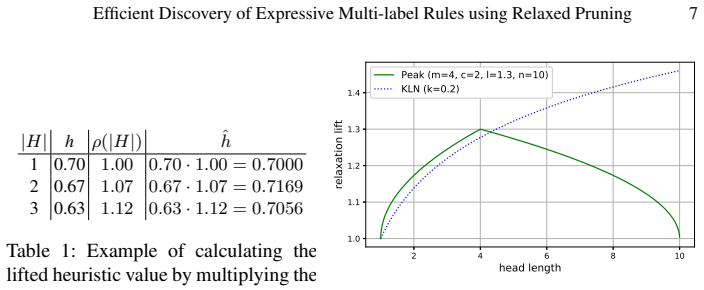
The load-bearing object is the 'relaxation lift': a function $\rho:\mathbb{R}^+\to\mathbb{R}$ that multiplies a candidate rule's heuristic $h$ to produce a lifted score $\hat{h}=h\cdot\rho(|H|)$, with $\rho$ increasing in head size for the KLN form $\rho(x)=1+k\ln x$ and peaking at a chosen size $m$ for the peak form. The lift is what reorders the search: since heads of equal length share the same multiplier, the best lifted head of length $k$ is the best unlifted head of that length, and under macro-averaged decomposable measures that head is obtained by combining the $k$ best single-label heads. The algorithm exploits this by walking the outer-left path of the search tree (always adding the best remaining label) and using the eventual decrease of the unlifted heuristic to bound how much lift longer heads could possibly gain. The named identities are the KLN and peak relaxation lift functions; their role is to bias the search toward larger heads while preserving the worst-case linear-in-labels evaluation cost.
What would settle it
Train the relaxed learner on a multi-label dataset whose labels are constructed to be independent of one another; if the lifted search still selects large heads and the held-out Hamming accuracy or F-measure drops relative to the unrelaxed baseline, the lift is rewarding coverage that carries no label-dependence signal. A more direct check is to exhaustively enumerate all heads on a small label space (say 6 labels) and compare the head chosen by Algorithm 1 with the true maximum of the lifted score, for both macro- and micro-averaged objectives.
Extended reading notes
Core claim
The central discovery is a pruning strategy that turns a bias toward single-label heads into a tunable bias toward larger multi-label heads without changing the asymptotic cost of training. Given a decomposable evaluation measure, the standard approach combines only the single-label heads that reach the maximum heuristic value; the paper shows this is suboptimal when scores are lifted. Its Algorithm 1 evaluates single-label heads once, then builds candidate heads of every length by repeatedly adding the best remaining single-label head, computes the lifted score $\hat{h}=h\cdot\rho(|H|)$, and prunes once an upper bound $\hat{h}_{\mathrm{upper}}=h_k\cdot\max_{k<i\le n}\rho(i)$ falls below the best lifted score seen. Because the normal heuristic value of a macro-averaged decomposable measure cannot increase when more labels are added, the resulting head is provably the best lifted head of any length; for micro-averaged measures the same procedure is an empirically effective approximation. The paper also fixes the head during body refinement and requires each assignment to have at least one true positive and each rule at least as many true positives as false positives, which keeps the lift from rewarding vacuous coverage.
Load-bearing premise
The load-bearing premise is that multiplying a rule's heuristic score by a head-size-dependent lift keeps the ranking aligned with how useful the rule actually is; if the lift over-rewards coverage, the search will favor generic large-headed rules that fail to generalize, and the paper's ad-hoc constraints and per-dataset tuning are the only guard against that.
Editorial extensions
If this is right
- Rule sets learned with relaxed pruning are typically more compact: fewer rules, fewer body conditions, and larger heads are reported across datasets, which makes the discovered label dependencies easier to inspect.
- Training time does not necessarily increase with the relaxed search; the experiments report frequent speedups of 10-25%, attributed to fewer rules and fewer refinement candidates.
- The plug-in character of the approach means any rule learner that uses decomposable evaluation measures and pruning by decomposability can adopt the same relaxation without altering its rule representation.
- Under macro-averaged Hamming accuracy and macro F-measure, the paper's guarantee is that the search returns the head with the highest lifted score, so the bias is a deliberate, controlled trade-off rather than an uncontrolled heuristic effect.
- For micro-averaged F-measure the relaxed search is an approximation, and the empirical results show comparable predictive performance nonetheless.
Reading between the lines
- Editorial inference: the same lift mechanism could serve as a regularization dial on new datasets, letting a user choose how much coverage is worth a small drop in per-label heuristic quality; the paper tunes this per dataset by cross-validation but does not propose a principled setting rule.
- Editorial inference: if the lift is calibrated on label co-occurrence frequency rather than head size alone, the method might generalize to datasets where rare labels need protection from being swallowed by frequent-label heads.
- Editorial inference: a direct test of the bias is whether relaxed pruning discovers dependencies that are not visible to label-condition rules; the paper's exemplary rules suggest this but the quantitative comparison is left open.
- Editorial inference: because the approximation for micro-averaged measures has no guarantee, a small empirical study on label spaces with strong correlations could reveal cases where the greedy best-remaining-label order misses the optimal lifted head even though the macro case is exact.
Signed reviews
Editorial analysis
A structured set of objections, weighed in public.
Referee Report
Summary. The paper proposes a plug-in modification to the multi-label rule learning algorithm of Rapp et al. [12] that relaxes the pruning of the label search space by multiplying a candidate rule's heuristic value by a 'relaxation lift' that grows with the number of labels in the head. The central theoretical claim is that for macro-averaged evaluation measures, the modified search (Algorithm 1) still finds the head with the highest lifted heuristic value, with strict upper bounds on computational complexity. The method is evaluated on seven multi-label datasets, where it induces fewer rules with larger heads, often trains faster, and achieves predictive performance comparable to the baseline. Two families of lift functions (KLN and peak) are introduced, and a sensitivity analysis is reported.
Significance. If the theoretical guarantee were valid, the paper would provide a useful and principled mechanism for biasing separate-and-conquer rule learning toward expressive multi-label heads, with linear-time construction of candidate heads and a clean pruning bound. The paper also contributes an open-source implementation and a detailed sensitivity analysis, which are valuable for reproducibility. However, the central theoretical claim is undermined by an internal inconsistency between the evaluation definitions in Section 2.2 and the decomposition used in Section 4. The empirical evidence, while suggestive, is too weak to support the 'no drawbacks' conclusion: only seven datasets are used, no significance tests or error bars are reported, and the lift parameters are tuned per dataset. The contribution is therefore currently an interesting heuristic with a plausible but unproven rationale rather than a method with demonstrated guarantees.
major comments (3)
- [Section 4, Algorithm 1] The assertion 'we can calculate their normal heuristic value as the average of the single-label heads’ heuristic values' is false under the paper's own evaluation definitions in Section 2.2. With macro-averaging as defined in Eq. (2) and with unpredicted labels counted as TN/FN, the macro-averaged F-measure of a head H is h(H) = (1/n)Σ_{i∈H} F_i = Σ_{i∈H} h({i}), not the average of the single-label head values. For macro-averaged Hamming accuracy, h(H) is not expressible as an average of h({i}) values at all, because the contribution of unpredicted labels changes with H. The example in Figure 1 confirms this: h({ŷ1}) = h({ŷ2}) = 2/3, but h({ŷ1,ŷ2}) = 3/4. Consequently, the h_k values used in Algorithm 1 and the upper bound ĥ_upper = h_k·max_{k<i≤n} ρ(i) do not correspond to the lifted macro-averaged heuristic of the constructed heads, and the stated guarantee that relaxed pruning finds the best lifted head for macro-averaged measures is unsupported.
- [Section 2.2, Eq. (1)] The entries of the atomic confusion matrix labeled FN and TN are swapped. As written, the bottom-left entry (1−y_i)(1−ŷ_i) corresponds to an absent label with no prediction, which the text says should be counted as TN, not FN; the bottom-right entry y_i(1−ŷ_i) corresponds to a present label with no prediction, which should be FN. As written, Eq. (1) would yield (TP+TN)/(TP+FP+TN+FN) = 5/12 for the single-label head {ŷ1} in Figure 1, not the printed 2/3. This is a load-bearing definitional error that affects the reproducibility of all heuristic computations in the paper.
- [Abstract and Section 5, Table 3] The abstract's claim that the approach 'does not come with drawbacks in terms of training time or predictive performance' is not supported by the evidence presented. Table 3 shows more losses than wins for several objectives (e.g., HA+ has 2 wins vs. 4 losses; Mac FM+ has 1 win vs. 5 losses), and the comparison is based on seven datasets without significance tests, error bars, or standard deviations. The training-time comparison in Figure 4 likewise appears to report a single run per dataset. The empirical support for the central 'no drawbacks' claim is therefore not yet convincing.
minor comments (4)
- [Section 5, footnote] The GitHub URL in the footnote is corrupted by non-ASCII artifacts (the '/uni000000...' sequence) and must be replaced with the correct URL.
- [Section 5, experimental setup] The sentence 'we transferred our additions to fix the heads and impose constraints on the learned rules as discussed earlier' is ambiguous: it should state explicitly whether the baseline also uses the head-fixing and constraint additions, so that the comparison isolates relaxed pruning.
- [Section 4, 'Constraints on Rules'] The constraints TP ≥ FP and 'each label assignment yields at least one TP' are introduced without a formal analysis of how they interact with the search guarantee in Algorithm 1; in particular, it is not specified whether the algorithm returns the best lifted head among all heads or among heads satisfying the constraints.
- [Section 5, Figure 3] The sensitivity analysis for the KLN lift function is shown only for FLAGS; reporting analogous plots for at least one or two other datasets would help establish that the observed trends are not dataset-specific.
Circularity Check
No substantial circularity; the lifted heuristic and relaxed search are new objectives, and the paper's central claims rest on experiments rather than on input-output equivalence.
full rationale
The paper's central contribution is a new objective (lifted heuristic, Eq. 5) and a modified search (Algorithm 1). Neither is defined in terms of the empirical outcomes it is used to explain: the lift functions are introduced as tunable bias mechanisms, and the claim that relaxed pruning yields larger multi-label heads is a direct consequence of the search objective rather than a disguised restatement of a fitted result. The macro-averaged optimality argument in Section 4 is a mathematical claim about combining the best single-label heads; although the identity used there may be questionable under the paper's definition of macro-averaging with unpredicted labels counted as TN/FN, that is an internal correctness issue, not a circularity in which an output equals an input by construction. The paper does rely on the authors' prior work [12] for the base algorithm and decomposability definition, but that reliance is standard prior-work support and is not the load-bearing source of the new claim. The predictive performance and runtime conclusions are supported by the experiments in Section 5 with lift settings selected on training folds; reporting test results after model selection is not equivalent to fitting the reported outcome. No step reduces a prediction to its own input, and no fitted parameter is renamed as a prediction.
Assumptions & free parameters
free parameters (4)
- k (KLN lift parameter) =
tuned per dataset, not reported
- m (peak position) =
tuned per dataset, not reported
- lmax (peak lift maximum) =
tuned per dataset, not reported
- c (peak curvature) =
tuned per dataset, not reported
assumptions (4)
- domain assumption Decomposability of Hamming accuracy and macro-averaged F-measure under the confusion-matrix counting scheme.
- standard math For macro-averaged measures, the heuristic value of a multi-label head is the average of the single-label head values.
- domain assumption The greedy separate-and-conquer search, with the lifted heuristic as the local scoring function, leads to models with good global predictive performance.
- ad hoc to paper The constraint TP >= FP and the requirement that each label assignment yields at least one TP prevent degenerate rules.
Cite this review
Pith. "Pith review of Efficient Discovery of Expressive Multi-label Rules using Relaxed Pruning." pith.science (2026). https://pith.science/paper/DT2VBZ2C
@misc{pith2026190806874,
  author       = {Pith},
  title        = {Pith review of: Efficient Discovery of Expressive Multi-label Rules using Relaxed Pruning},
  year         = {2026},
  howpublished = {\url{https://pith.science/paper/DT2VBZ2C}},
  note         = {Machine review of arXiv:1908.06874}
}
read the original abstract
Being able to model correlations between labels is considered crucial in multi-label classification. Rule-based models enable to expose such dependencies, e.g., implications, subsumptions, or exclusions, in an interpretable and human-comprehensible manner. Albeit the number of possible label combinations increases exponentially with the number of available labels, it has been shown that rules with multiple labels in their heads, which are a natural form to model local label dependencies, can be induced efficiently by exploiting certain properties of rule evaluation measures and pruning the label search space accordingly. However, experiments have revealed that multi-label heads are unlikely to be learned by existing methods due to their restrictiveness. To overcome this limitation, we propose a plug-in approach that relaxes the search space pruning used by existing methods in order to introduce a bias towards larger multi-label heads resulting in more expressive rules. We further demonstrate the effectiveness of our approach empirically and show that it does not come with drawbacks in terms of training time or predictive performance.
Figures


Figures from the paper (1 more)

Reference graph
Works this paper leans on
-
[12]
Exploiting anti-monotonicity of multi-label evaluation measures for inducing multi-label rules
Michael Rapp, Eneldo Loza Menc ´ıa, and Johannes F¨urnkranz. Exploiting anti-monotonicity of multi-label evaluation measures for inducing multi-label rules. InPacific-Asia Conference on Knowledge Discovery and Data Mining, 2018. 16 Y . Klein, M. Rapp, E. Loza Menc ´ıa
work page 2018
-
[1]
Effective rule-based multi-label classification with learning classifier systems
Miltiadis Allamanis, Fani A Tzima, and Pericles A Mitkas. Effective rule-based multi-label classification with learning classifier systems. In International Conference on Adaptive and Natural Computing Algorithms, 2013
work page 2013
-
[2]
An evolutionary multi label classification using associative rule mining for spatial preferences
J Arunadevi and V Rajamani. An evolutionary multi label classification using associative rule mining for spatial preferences. IJCA Special Issue on Artificial Intelligence Techniques- Novel Approaches and Practical Applications, 2011
work page 2011
-
[3]
Evolving multi-label clas- sification rules with gene expression programming: A preliminary study
Jos ´e Luis ´Avila-Jim´enez, Eva Gibaja, and Sebasti ´an Ventura. Evolving multi-label clas- sification rules with gene expression programming: A preliminary study. In International Conference on Hybrid Artificial Intelligence Systems, 2010
work page 2010
-
[4]
Francisco Charte, Antonio J Rivera, Mar ´ıa Jos´e del Jes´us, and Francisco Herrera. LI-MLC: A label inference methodology for addressing high dimensionality in the label space for multilabel classification. IEEE Transactions on Neural Networks and Learning Systems , 25(10), 2014
work page 2014
-
[5]
On label dependence and loss minimization in multi-label classification
Krzysztof Dembczy ´nski, Willem Waegeman, Weiwei Cheng, and Eyke H ¨ullermeier. On label dependence and loss minimization in multi-label classification. Machine Learning, 88(1-2), 2012
work page 2012
-
[6]
Interpretable decision sets: A joint framework for description and prediction
Himabindu Lakkaraju, Stephen H Bach, and Jure Leskovec. Interpretable decision sets: A joint framework for description and prediction. In International Conference on Knowledge Discovery and Data Mining, 2016
work page 2016
-
[7]
Multi-label Classification based on Association Rules with Application to Scene Classification
Bo Li, Hong Li, Min Wu, and Ping Li. Multi-label Classification based on Association Rules with Application to Scene Classification. In International Conference for Young Computer Scientists, 2008
work page 2008
Show all 14 references
-
[8]
Learning interpretable rules for multi-label classification
Eneldo Loza Menc ´ıa, Johannes F¨urnkranz, Eyke H¨ullermeier, and Michael Rapp. Learning interpretable rules for multi-label classification. In Explainable and Interpretable Models in Computer Vision and Machine Learning. Springer, 2018
2018
-
[9]
Learning rules for multi-label classification: A stacking and a separate-and-conquer approach
Eneldo Loza Menc ´ıa and Frederik Janssen. Learning rules for multi-label classification: A stacking and a separate-and-conquer approach. Machine Learning, 105(1), 2016
2016
-
[10]
Discovering and exploiting deterministic label relationships in multi-label learning
Christina Papagiannopoulou, Grigorios Tsoumakas, and Ioannis Tsamardinos. Discovering and exploiting deterministic label relationships in multi-label learning. In ACM SIGKDD International Conference on Knowledge Discovery and Data Mining, 2015
2015
-
[11]
Multi-label classification with label constraints
Sang-Hyeun Park and Johannes F ¨urnkranz. Multi-label classification with label constraints. In ECML PKDD 2008 Workshop on Preference Learning, 2008
2008
-
[13]
Multiple labels associative classifi- cation
Fadi A Thabtah, Peter I Cowling, and Yonghong Peng. Multiple labels associative classifi- cation. Knowledge and Information Systems, 9(1), 2006
2006
-
[14]
Mining multi-label data
Grigorios Tsoumakas, Ioannis Katakis, and Ioannis Vlahavas. Mining multi-label data. In Data Mining and Knowledge Discovery Handbook. Springer, 2009
2009
Reviewed August 14, 2026 · model on record in the stance chip above.
Discussion (0). Continue with ORCID to comment.