REVIEW 3 major objections 1 minor 19 references
Re-Centering Humans in LLM Personalization
T0 review · 3 major / 1 minor · reviewed 2026-06-28 · grok-4.3
Pith's one-line read Human data shows current LLM personalization systems produce responses no better than generic ones.
desk verdict New human judgment data on three personalization stages flags real gaps versus synthetic data, but sampling details are missing so generalization is unclear. read the letter →
The pith
A machine-rendered reading of the paper's core claim, the machinery that carries it, and where it could break.
The reading
What carries the argument
A three-stage decomposition of personalization consisting of user attribute extraction from conversations, relevance pairing with new prompts, and incorporation of attributes into generated responses, measured using a dataset of 550 human conversations and thousands of human judgments.
What would settle it
Finding a set of real human conversations where state-of-the-art models extract attributes accurately, select ones matching human relevance judgments, and produce responses that humans consistently prefer over generic responses would falsify the observed limitations.
Extended reading notes
Core claim
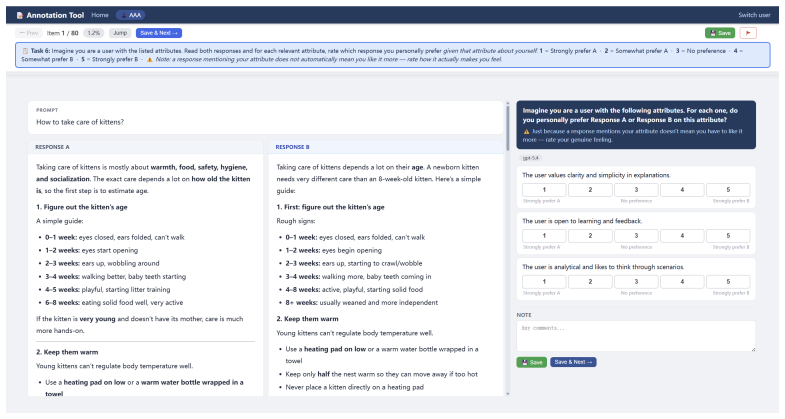
Incorporating human data into the evaluation of LLM personalization reveals limitations at each of the three stages. Models struggle to extract attributes from human conversations, disagree with human judgments on which attributes are relevant, and generate personalized responses that humans judge no better than generic responses, even as LLM judges rate them as superior. Two lightweight training-based interventions improve performance on the first two stages, but reward models trained to predict personalization quality show only modest correlation with human ratings.
Load-bearing premise
That breaking personalization into attribute extraction, relevance selection, and response incorporation is the appropriate way to assess performance, and that the 550 collected conversations reflect real user needs.
Editorial analysis
A structured set of objections, weighed in public.
Referee Report
Summary. The paper argues that synthetic-data evaluations of LLM personalization miss key limitations, and that human data across three stages—attribute extraction from conversations, relevance pairing with new prompts, and incorporation into responses—reveals consistent model shortcomings. Using 550 collected human conversations and associated judgments (5,949 on extraction, 11,919 on pairing, 1,101 on response quality), it reports that models struggle to extract attributes, disagree with humans on relevance, and produce personalized outputs that humans rate no better than generic ones (despite LLM judges favoring them); two lightweight interventions improve automated evaluation alignment in the first two stages, but learned reward models show only modest correlation with human ratings in the third. The collected data is positioned as a foundation for future human-aligned personalization research.
Significance. If the human data collection is representative, the work is significant for shifting the field from synthetic benchmarks toward human-centered evaluation of personalization pipelines. The explicit provision of the judgment dataset and the demonstration that LLM judges diverge from humans on personalization quality are concrete contributions that could support more reliable automated proxies.
major comments (3)
- [Abstract] Abstract and data-collection description: the central claim that human data reveals general system limitations at each of the three stages rests on the 550 conversations being representative of real-user personalization needs, yet no information is supplied on sourcing platform, participant recruitment, demographics, topic distribution, or selection criteria. Without these details the reported gaps (poor extraction, relevance disagreement, no human preference for personalized outputs) cannot be generalized beyond the specific sample.
- [Abstract] Judgment collection (Abstract): no statistical tests, inter-annotator agreement figures, or sampling methodology for the 5,949 / 11,919 / 1,101 judgments are reported. This absence directly undermines confidence in the directional findings that models “struggle,” “disagree,” and produce outputs “no better than generic responses.”
- [Abstract] Three-stage decomposition (Abstract): the paper takes the decomposition into extraction, relevance pairing, and incorporation as given without justification or comparison to alternative pipelines; if this decomposition does not capture primary bottlenecks in deployed personalization systems, the observed limitations may not generalize.
minor comments (1)
- [Abstract] The abstract states that the collected data “provides a foundation,” but does not indicate whether the dataset will be released or under what license.
Simulated Author's Rebuttal
We thank the referee for their constructive comments on our manuscript. We address each major comment below and will make revisions to improve clarity and transparency around our data collection and methodology.
read point-by-point responses
-
Referee: [Abstract] Abstract and data-collection description: the central claim that human data reveals general system limitations at each of the three stages rests on the 550 conversations being representative of real-user personalization needs, yet no information is supplied on sourcing platform, participant recruitment, demographics, topic distribution, or selection criteria. Without these details the reported gaps (poor extraction, relevance disagreement, no human preference for personalized outputs) cannot be generalized beyond the specific sample.
Authors: We agree that details on data sourcing are necessary to assess generalizability. The current manuscript provides limited information on collection procedures. In the revised version, we will add a dedicated subsection in the methods describing the sourcing platform, recruitment process, demographics (where available), topic distribution, and selection criteria for the 550 conversations. revision: yes
-
Referee: [Abstract] Judgment collection (Abstract): no statistical tests, inter-annotator agreement figures, or sampling methodology for the 5,949 / 11,919 / 1,101 judgments are reported. This absence directly undermines confidence in the directional findings that models “struggle,” “disagree,” and produce outputs “no better than generic responses.”
Authors: We acknowledge that the abstract and main text lack explicit reporting of inter-annotator agreement, sampling details, and statistical tests for the judgments. In the revision, we will add these elements, including agreement metrics and any significance testing, to the methods and results sections to support the reported findings. revision: yes
-
Referee: [Abstract] Three-stage decomposition (Abstract): the paper takes the decomposition into extraction, relevance pairing, and incorporation as given without justification or comparison to alternative pipelines; if this decomposition does not capture primary bottlenecks in deployed personalization systems, the observed limitations may not generalize.
Authors: The decomposition is motivated by common stages in personalization pipelines, but we agree that explicit justification is warranted. In the revision, we will add a short paragraph in the introduction motivating the three stages with references to related work and briefly discussing alternative decompositions to clarify why these stages are analyzed. revision: yes
Circularity Check
No significant circularity in empirical evaluation
full rationale
This is an empirical data-collection study with no equations, fitted parameters, self-referential definitions, or derivation chains. Claims rest on direct comparisons between model outputs and 550 human conversations plus associated judgments (5,949 + 11,919 + 1,101). The three-stage framework is an evaluation scaffold, not a mathematical result that reduces to its inputs by construction. No self-citation load-bearing steps or ansatz smuggling are present; the work is self-contained against external human benchmarks.
Assumptions & free parameters
assumptions (1)
- domain assumption Human judgments collected via the described protocol reliably reflect what users find useful in personalized responses.
Cite this review
Pith. "Pith review of Re-Centering Humans in LLM Personalization." pith.science (2026). https://pith.science/paper/DTD547IP
@misc{pith2026260606614,
  author       = {Pith},
  title        = {Pith review of: Re-Centering Humans in LLM Personalization},
  year         = {2026},
  howpublished = {\url{https://pith.science/paper/DTD547IP}},
  note         = {Machine review of arXiv:2606.06614}
}
read the original abstract
Despite growing interest, most evaluations of large language models' (LLMs') personalization abilities have relied on synthetic data. It remains unclear how well current personalization systems work for real users. In this paper, we study the gap in LLM personalization performance when using synthetic versus human data. We collect human conversations (550 conversations) and judgments across three stages of personalization: extracting user attributes from conversations (5,949 judgments), pairing relevant attributes with new prompts (11,919), and incorporating relevant attributes into a personalized response (1,101). Incorporating human data reveals system limitations at each stage. Models struggle to extract attributes from human conversations, disagree with human judgments on relevant attributes, and generate personalized responses that humans judge no better than generic responses (though that LLM judges widely rate as better). We introduce two lightweight training-based interventions that shift automated personalization evaluation closer to human data in our first two stages. However, in our third stage we find that learned reward models achieve only modest correlation with human ratings, suggesting that human-aligned personalization quality judgments are difficult to model directly. Our collected data provides a foundation for studying how models should extract, select, and incorporate user information in ways that humans find useful.
Figures


Figures from the paper (5 more)


Reference graph
Works this paper leans on
-
[1]
Fine-grained analysis of propaganda in news articles. InProceedings of the 2019 Conference on Empirical Methods in Natural Language Processing and the 9th International Joint Conference on Natu- ral Language Processing (EMNLP-IJCNLP), pages 5636–5646, Hong Kong, China. Association for Com- putational Linguistics. Aida Mostafazadeh Davani, Mark Díaz, and V...
2019
-
[2]
Association for Computational Linguistics
Can LLM be a personalized judge? InFind- ings of the Association for Computational Linguistics: EMNLP 2024, pages 10126–10141, Miami, Florida, USA. Association for Computational Linguistics. Linfeng Du, Ye Yuan, Zichen Zhao, Fuyuan Lyu, Emil- iano Penaloza, Xiuying Chen, Zipeng Sun, Jikun Kang, Laurent Charlin, Xue Liu, and 1 others
2024
-
[3]
Optimizing User Profiles via Contextual Bandits for Retrieval-Augmented LLM Personalization
Optimizing user profiles via contextual bandits for retrieval-augmented llm personalization.arXiv preprint arXiv:2601.12078. Google DeepMind. 2026. Gemma 4. https:// deepmind.google/models/gemma/gemma-4/. Ac- cessed: 2026-05-26. Aaron Grattafiori, Abhimanyu Dubey, Abhinav Jauhri, Abhinav Pandey, Abhishek Kadian, Ahmad Al- Dahle, Aiesha Letman, Akhil Mathu...
work page Pith review arXiv 2026
-
[4]
MixSD: Mixed Contextual Self-Distillation for Knowledge Injection
Memory OS of AI agent. InProceedings of the 2025 Conference on Empirical Methods in Natural Language Processing, pages 25961–25970, Suzhou, China. Association for Computational Linguistics. Omar Khattab, Arnav Singhvi, Paridhi Maheshwari, Zhiyuan Zhang, Keshav Santhanam, Sri Vard- hamanan, Saiful Haq, Ashutosh Sharma, Thomas T. Joshi, Hanna Moazam, Heathe...
work page Pith review arXiv 2025
-
[5]
Evaluating very long-term conversational memory of LLM agents. InProceedings of the 62nd Annual Meeting of the Association for Computational Linguistics (Volume 1: Long Papers), pages 13851– 13870, Bangkok, Thailand. Association for Compu- tational Linguistics. Shuhaib Mehri, Priyanka Kargupta, Tal August, and Dilek Hakkani-Tür. 2026a. Multisession- colla...
-
[6]
HybridFlow: A Flexible and Efficient RLHF Framework
Accessed: 2026-05-26. Nils Reimers and Iryna Gurevych. 2019. Sentence- BERT: Sentence embeddings using Siamese BERT- networks. InProceedings of the 2019 Conference on Empirical Methods in Natural Language Processing and the 9th International Joint Conference on Natu- ral Language Processing (EMNLP-IJCNLP), pages 3982–3992, Hong Kong, China. Association fo...
work page Pith review arXiv 2026
-
[7]
InFindings of the Association for Computational Linguistics: EMNLP 2023, pages 12047–12064
Cue-cot: Chain-of-thought prompting for re- sponding to in-depth dialogue questions with llms. InFindings of the Association for Computational Linguistics: EMNLP 2023, pages 12047–12064. Benjamin Warner, Antoine Chaffin, Benjamin Clavié, Orion Weller, Oskar Hallström, Said Taghadouini, Alexis Gallagher, Raja Biswas, Faisal Ladhak, Tom Aarsen, Griffin Thom...
2023
-
[8]
Toward personalized llm-powered agents: Foundations, evaluation, and future directions.arXiv preprint arXiv:2602.22680. Lechen Zhang, Tolga Ergen, Lajanugen Logeswaran, Moontae Lee, and David Jurgens. 2026. SPRIG: Improving large language model performance by sys- tem prompt optimization. InThe Fourteenth Interna- tional Conference on Learning Representat...
Show all 19 references
-
[9]
is_english
and clustered per user using agglomera- tive clustering (average linkage). We manually inspected four cosine similarity thresholds (0.6, 0.7, 0.8, 0.9) on a held-out sample of users; 0.7 offered the best balance, leaving almost no dupli- cate attributes while only occasionally...
2020
-
[10]
Ignore ASSISTANT messages as evidence
Use only USER messages for reasoning . Ignore ASSISTANT messages as evidence
-
[11]
Inference is encouraged even for implied attributes , but use lower confidence
-
[12]
Each attribute should describe a stable , general aspect of the USER , not a one - time statement
-
[13]
0.6 -0.89: Clearly implied or repeated hints
Confidence scale : 0.9 -1.0: Explicitly stated or very clear . 0.6 -0.89: Clearly implied or repeated hints . 0.3 -0.59: Weakly implied or uncertain . 0.1 -0.29: Very speculative but plausible
-
[14]
Makes sense
Be exhaustive . Include as many distinct personalizable attributes as possible . Return only the JSON object . Do not include any explanation or comments . Conversation : { transcript } I.4 Uncertain Attribute Inference Stage 1 of uncertain attribute categorization: GPT- 5.4 i...
-
[15]
Assign exactly one category
-
[16]
Prefer an existing candidate category when it clearly fits
-
[17]
Create a new category only when the existing candidates would blur an important distinction
-
[18]
Keep new category names short , general , reusable
-
[19]
classifications
Do not create near - duplicates of existing categories . The two seed categories are especially important : - o v er g e ne r a li z at i o n : the attribute makes a broader , stronger , or more stable claim than the evidence supports . - attribute - not - standalone : the att...
Reviewed June 28, 2026 · model on record in the stance chip above.
Discussion (0). Continue with ORCID to comment.