REVIEW 3 major objections 5 minor 2 cited by
This paper proves that at θ=π/4, where the bilinear and biquadratic couplings of a spin-1 Kitaev chain are equal and positive, the Hamiltonian reduces to a sum of projectors that forbid maximal spin along each bond; the resulting zero-energ
Reviewed by Pith at T0; open to challenge. T0 means a machine referee read the full paper against a public rubric. the ladder, T0–T4 →
T0 review · deepseek-v4-flash
2026-08-04 09:49 UTC pith:DTLAZCF4
load-bearing objection A genuinely new exactly solvable point in a spin-1 chain, with a plausible but unproven 2^N+1 degeneracy claim — worth refereeing, but the referee should push hard on the counting. the 3 major comments →
Exact Fractionalized Ground States in an Extended Spin-1 Kitaev Chain
The pith
A machine-rendered reading of the paper's core claim, the machinery that carries it, and where it could break.
Core claim
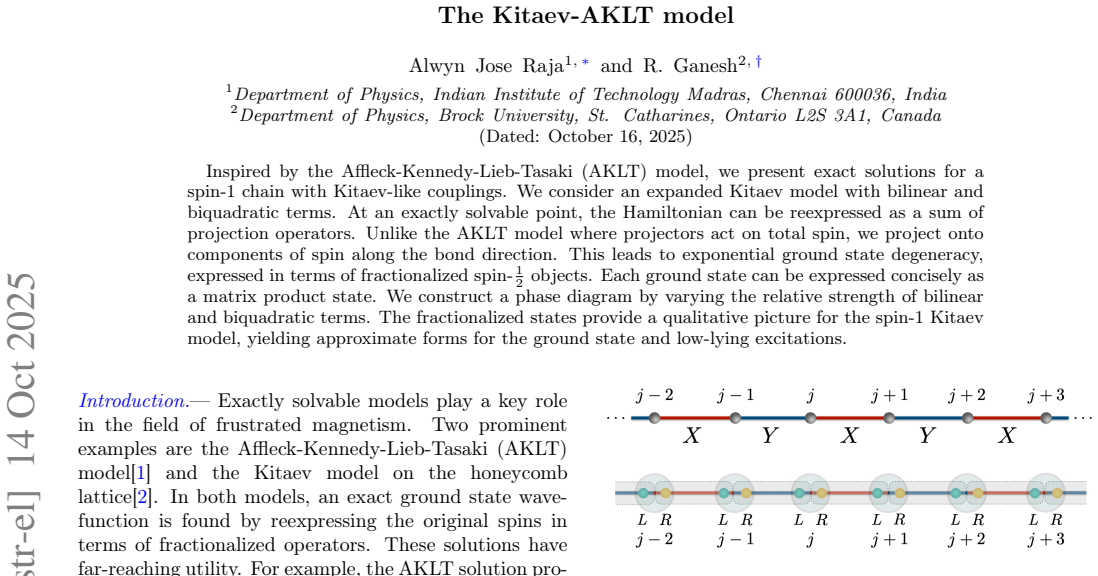
At θ=π/4 (K=Q>0), the Hamiltonian becomes √2 Σ [P(S^x_{2j}+S^x_{2j+1}=±2) + P(S^y_{2j+1}+S^y_{2j+2}=±2)]. Every state annihilated by all these projectors is a zero-energy ground state. The authors construct 2^N such states by placing each pair of spin-1/2 partons on a bond in either a singlet or the appropriate triplet (|t_x⟩ on X bonds, |t_y⟩ on Y bonds), then projecting to the physical spin-1 space. The projected wavefunctions, though non-orthogonal, span a 2^N-dimensional space after orthogonalization via the bond conserved quantities W_k; the symmetric combination of two direct product states lies inside this space, while the antisymmetric combination is an additional orthogonal ground s
What carries the argument
The central object is the fractionalized representation: each spin-1 is split into left and right spin-1/2 partons; on each bond the two inner partons form one of two bond-states (singlet or triplet with zero net moment along the bond axis), chosen so that the total bond spin along that axis can never reach ±2. This makes every projector in Eq. 3 annihilate the state. The bond conserved quantities W_k (products of π rotations) act on the bond-variables as a three-site XZX operator, turning the orthogonalization problem into the exactly solvable cluster model; the ground states of that model, contracted with the parton MPS, yield bond-dimension-four MPS ground states indexed by the W eigenval
Load-bearing premise
The central load-bearing premise is that, after projecting the 2^N parton bond configurations onto the physical spin-1 space at every site, exactly one linear dependence arises for every even N—so the fractionalized states span a space of dimension 2^N−1, and together with the two direct-product states give degeneracy 2^N+1; the paper demonstrates this explicitly only for N=2 and asserts it for larger N.
What would settle it
Compute the ground-state degeneracy at θ=π/4 for a periodic chain of N=8 or N=10 by exact diagonalization, and simultaneously build the Gram matrix of the 2^N projected fractionalized states. If the rank of the Gram matrix is not 2^N−1, or if the total zero-energy dimension is not 2^N+1, the counting claim is wrong.
If this is right
- The K=Q point is a rigorously solvable quantum spin chain with exponential (2^N+1) ground-state degeneracy, a rare quantum counterpart to classical ice-like degeneracy.
- The fractionalized MPS ansatz, specifically the uniform w=+1 state, gives near-unit overlap with the exact ground state near θ=π/4 and substantial overlap at θ=0, offering a concrete variational description of the spin-1 Kitaev chain.
- The first excited manifold of the spin-1 Kitaev chain is approximated by single spin-flip states in the w variables, matching the N-fold degeneracy found by exact diagonalization.
- The phase boundaries at θ=π/4 and 3π/4 are marked by transitions between a degenerate product-state phase and a unique phase in which bond invariants are uniformly +1.
- Open chains inherit a (2^{N+1}-1)-fold degeneracy, with edge states that behave like free spin-1/2 moments analogous to AKLT edge physics.
Where Pith is reading between the lines
- The parton construction here is a rare case where projection onto the physical subspace produces an exactly known, exponentially large manifold; the N=2 example shows one naive parton state is redundant, and the paper's claim that the same occurs for all even N invites a full linear-independence proof—a natural rigorous follow-up.
- The equivalence between the orthogonalization problem and the cluster model suggests that the uniform w=+1 phase may host symmetry-protected topological order in the bond-variable representation, with string order parameters that could be measured in future work.
- The same parton+bond-projector recipe might produce exactly solvable points for spin-2 or higher chains and for lattices where each spin has coordination equal to 2S, analogous to the AKLT generalization; the key requirement is a bond-state with zero net moment along the bond axis.
- One could test the variational ansatz further by including two-spin-flip w configurations; the overlap data in Fig. 5 suggest corrections grow with system size, so a finite-size scaling analysis of the overlap could identify where the uniform-w ansatz fails.
Editorial analysis
A structured set of objections, weighed in public.
Referee Report
Summary. The manuscript studies a spin-1 chain with alternating X/Y Kitaev-type bilinear and biquadratic couplings. At θ = π/4, the authors show (Supplement II) that the Hamiltonian can be rewritten as a sum of projectors onto the ±2 eigenvalues of the bond spin component. They construct 2^N valence-bond-type states by placing on each bond either a singlet or a bond-direction triplet of spin-1/2 partons and projecting onto the physical spin-1 space at each site. They also identify two alternating direct-product states; one combination is claimed to lie within the fractionalized manifold, while the antisymmetric combination gives one extra state, yielding a total ground-state degeneracy 2^N+1. Using conserved bond operators W_k, they map the orthogonalization problem to the exactly solvable cluster model and provide explicit bond-dimension-4 MPS matrices. They further propose a phase diagram and use the fractionalized states as variational ansätze for the spin-1 Kitaev chain.
Significance. If the central degeneracy claim is correct, this is a valuable exactly solvable point with extensive ground-state degeneracy and explicit MPS representations, complementing the AKLT construction. The algebraic projector identity (Eq. S16) is verified explicitly; the W-operator action is derived in detail; and the manuscript supplies explicit 4×4 MPS matrices for each W-sector (Eqs. S31–S32), making the construction independently checkable. The numerical overlap data with exact diagonalization support the variational use of the states. The main weakness is that the one-state-per-W-sector statement and the completeness of the ground-state subspace are asserted rather than proved; this is the decisive issue for the central result. A rigorous injectivity or kernel-dimension proof would substantially strengthen the paper.
major comments (3)
- [Role of conserved quantities; Supplement IX] The assertion that the 2^N contracted MPS states Φ_w of Fig. 3(c) are nonzero, and that each W-eigensector contains exactly one fractionalized state, is not proved. The only explicit linear-dependence analysis is for the N=2 open chain (Eq. S18); the generalization to arbitrary even N is merely asserted. Supplement IX treats only the uniform w=-1 sector, and its argument for orthogonality of the antisymmetric product state invokes 'the fact that each {w} sector allows for one fractionalized state' — precisely the statement at issue. Because the 2^N+1 degeneracy and the completeness of the fractionalized ground-state subspace rest on this point, the authors need a proof of injectivity of the physical projection ∏_j P^{S=1}_j on the 2^N-dimensional bond-state space, or a transfer-matrix evaluation of the norm in Eq. S33 for arbitrary w.
- [Supplement III; periodic-boundary counting] The open-chain counting (2^{N+1}-1) in Supplement III does not directly imply the periodic-boundary degeneracy 2^N+1. The periodic chain has N bonds and no dangling spinons, and the linear-dependence structure is different from the open case; the N=2 PBC case has only 2^N=4 candidate states rather than eight. Even if 2^N+1 independent zero-energy states have been constructed, the paper does not provide an upper bound showing that no additional zero-energy states exist. Exact diagonalization for N≤12 is numerical evidence, not a proof. An explicit kernel-dimension computation for the sum of projectors in Eq. (3) is needed.
- [Phase diagram; Eq. (S28)] For π/4 < θ < π/2, the decomposition in Eq. (S28) establishes that the two alternating direct-product states are zero-energy ground states, but it does not establish that they are the only ones. Since H_{π/4} itself has 2^N+1 zero modes, one must show that adding (sinθ−cosθ)H_{π/2} lifts all zero modes except the two product states. The claim of a doubly degenerate intermediate phase is therefore not rigorously established by the argument presented.
minor comments (5)
- [Eq. (2)] The definition of W_{2j+1} is missing the factor iπ in the second exponential: as written it reads e^{i S^x_{2j+2}}, which is not of the same form as W_{2j} and would not be the expected symmetry operator.
- [Main text after orthogonalization paragraph] The text says the fractionalized states are orthogonalized 'to form a set of 2N distinct states.' This should read 2^N distinct states.
- [Supplement VII, Eq. (S30)] The displayed formulas for B^{0,↑}_X, B^{0,↓}_X, and B^{0,↓}_Y use M^{+1}; the correct local projector is M^0. The final matrices appear to be correct, so this is a typo in the labeling.
- [Eq. (1)] For a finite chain, the index range of j and the modulo-N convention for periodic boundary conditions should be stated explicitly; as written, j runs over all integers.
- [Supplement III] The sentence 'We find the same situation for any even N, with (2^{N+1}-1) linearly independent states' is asserted without proof. If this open-chain result is needed, a proof or a clear derivation would strengthen the supplement.
Circularity Check
No significant circularity: the θ=π/4 exact solution is derived self-contained from spin-1 algebra and external cluster-model results; the one-state-per-w-sector counting is a rigor gap, not a circular reduction.
full rationale
The exact solvable point at θ=π/4 is derived without assuming its own conclusion. Equation (3) is obtained from the spin-1 operator algebra (Supplement II), and the fractionalized bond-state construction is explicitly designed to be annihilated by the projectors in the Hamiltonian. The orthogonalization procedure uses the cluster model, whose exact solution is a known external result (Supp. V and refs. [12–20]); the cluster-model MPS is not imported through a circular self-citation. The variational overlaps in Fig. 5 are checked against exact diagonalization rather than fitted, and the only self-citation (Ref. [8]) is used for the known four-fold degeneracy of the pure spin-1 Kitaev chain, not for the central solvable-point derivation. The one load-bearing concern is the counting of independent projected fractionalized states: the paper asserts in conclusion (i) that there are 2^N legitimate wavefunctions, and Supplement IX relies on 'each {w} sector allows for one fractionalized state' to prove orthogonality of the antisymmetric direct-product state. Supplement III explicitly analyzes linear dependence only for N=2 and states without proof that the same holds for all even N. This is a genuine mathematical gap in the exact-degeneracy claim, but it is not circular: the construction does not assume the degeneracy it purports to prove, and the one-per-sector statement is not equivalent by construction to the projector Hamiltonian. No fitted parameter is relabeled as a prediction, and no argument reduces to a self-citation chain. Therefore the paper has no significant circularity, though its exact 2^N+1 degeneracy claim would benefit from a complete independence/nonvanishing proof.
Axiom & Free-Parameter Ledger
axioms (5)
- standard math Spin-1 operators satisfy (S^α)^3 = S^α, used in the projector decomposition (Supplement II).
- domain assumption The parton decomposition S^λ_j → σ^λ_{j,L} + σ^λ_{j,R} is a valid representation of the spin-1 Hilbert space after projecting onto the symmetric (spin-1) sector at each site.
- standard math The cluster model Hamiltonian Ĥ = -Σ σ^x_{k-1} σ^z_k σ^x_{k+1} has the MPS ground state given in Fig. 3(b) / Eq. 10.
- domain assumption The ground state degeneracy at θ=π/4 is exactly 2^N+1; this depends on the linear independence of the orthogonalized wavefunctions.
- domain assumption The phase diagram for θ<π/4 and θ>3π/4 is inferred by adiabatic continuity from solvable points and perturbation theory around θ=3π/2.
read the original abstract
Inspired by the Affleck-Kennedy-Lieb-Tasaki (AKLT) model, we present exact solutions for a spin-1 chain with Kitaev-like couplings. We consider an expanded Kitaev model with bilinear and biquadratic terms. At an exactly solvable point, the Hamiltonian can be reexpressed as a sum of projection operators. Unlike the AKLT model where projectors act on total spin, we project onto components of spin along the bond direction. This leads to exponential ground state degeneracy, expressed in terms of fractionalized spin-$\frac{1}{2}$ objects. Each ground state can be expressed concisely as a matrix product state. We construct a phase diagram by varying the relative strength of bilinear and biquadratic terms. The fractionalized states provide a qualitative picture for the spin-1 Kitaev model, yielding approximate forms for the ground state and low-lying excitations.
Figures


Forward citations
Cited by 2 Pith papers
-
Crossover and Changeover in Spin-1 Kitaev-$\Gamma$ Chain with Uniaxial Single-ion Anisotropy
A spin-1 Kitaev-Gamma chain with single-ion anisotropy exhibits a Kitaev-to-large-D crossover and a changeover to an SU(2)₂ WZW continuous transition with emergent conformal symmetry.
-
Kitaev Meets Affleck-Kennedy-Lieb-Tasaki: Competing Quantum Disorder in Spin-3/2 Honeycomb Systems
Quantum fluctuations in the S=3/2 honeycomb model interpolating between Kitaev and AKLT states melt classical and semi-classical orders into a quantum-entangled phase with suppressed spin correlations and enhanced ent...
Reference graph
Works this paper leans on
-
[1]
Affleck, T
I. Affleck, T. Kennedy, E. H. Lieb, and H. Tasaki, Rig- orous results on valence-bond ground states in antiferro- magnets, Phys. Rev. Lett.59, 799 (1987)
1987
-
[2]
Kitaev, Anyons in an exactly solved model and be- yond, Annals of Physics321, 2 (2006)
A. Kitaev, Anyons in an exactly solved model and be- yond, Annals of Physics321, 2 (2006)
2006
-
[3]
Schollwöck, T
U. Schollwöck, T. Jolicœur, and T. Garel, Onset of in- commensurability at the valence-bond-solid point in the S=1 quantum spin chain, Phys. Rev. B53, 3304 (1996)
1996
-
[4]
5(a) which plots the overlap of this ansatz with the true ground state obtained from exact diagonaliza- tion
We examine this proposition in Fig. 5(a) which plots the overlap of this ansatz with the true ground state obtained from exact diagonaliza- tion. As seen from the figure, the overlap is nearly unity whenθis just below π 4 and decreases asθapproaches zero. It diminishes with increasing system size, while retaining a reasonably strong magnitude. In particul...
2022
-
[5]
Golinelli, T
O. Golinelli, T. Jolicœur, and E. S. Sørensen, Incom- mensurability in the magnetic excitations of the bilinear- biquadratic spin-1 chain, The European Physical Jour- nal B - Condensed Matter and Complex Systems11, 199 (1999)
1999
-
[6]
Affleck, T
I. Affleck, T. Kennedy, E. H. Lieb, and H. Tasaki, Va- lence bond ground states in isotropic quantum antiferro- magnets, Communications in Mathematical Physics115, 477 (1988)
1988
-
[7]
D. Sen, R. Shankar, D. Dhar, and K. Ramola, Spin- 1 Kitaev model in one dimension, Physical Review B—Condensed Matter and Materials Physics82, 195435 (2010)
2010
-
[8]
J. S. Gordon and H.-Y. Kee, Insights into the anisotropic spin-s Kitaev chain, Physical Review Research4, 013205 (2022)
2022
-
[9]
A. J. Raja, R. Narayanan, and R. Ganesh, Spin-basis wavefunctions for the one-dimensional Kitaev model, arXiv preprint arXiv:2509.21771 (2025)
Pith/arXiv arXiv 2025
-
[10]
Supplemental material
-
[11]
U.Schollwöck,Thedensity-matrixrenormalizationgroup in the age of matrix product states, Annals of physics 326, 96 (2011)
2011
-
[12]
J. I. Cirac, D. Pérez-García, N. Schuch, and F. Ver- straete, Matrix product states and projected entangled pair states: Concepts, symmetries, theorems, Rev. Mod. Phys.93, 045003 (2021)
2021
-
[13]
Tasaki,Physics and Mathematics of Quantum Many- Body Systems, Graduate Texts in Physics (Springer, Cham, 2020) pp
H. Tasaki,Physics and Mathematics of Quantum Many- Body Systems, Graduate Texts in Physics (Springer, Cham, 2020) pp. XVIII + 525, 245 b/w illustrations, 2 colour illustrations. Topics: Strongly Correlated Sys- tems, Superconductivity, Mathematical Physics, Statis- tical Physics and Dynamical Systems, Phase Transi- tions and Multiphase Systems, Mathematic...
2020
-
[14]
T.-C. Wei, R. Raussendorf, and I. Affleck, Some as- pects of Affleck–Kennedy–Lieb–Tasaki models: Tensor network, physical properties, spectral gap, deformation, and quantum computation, inEntanglement in Spin Chains: From Theory to Quantum Technology Applica- tions, edited by A. Bayat, S. Bose, and H. Johannesson (Springer International Publishing, Cham, ...
2022
-
[15]
Suzuki, Relationship among exactly soluble models of critical phenomena
M. Suzuki, Relationship among exactly soluble models of critical phenomena. i: 2d ising model, dimer problem and the generalized XY-model, Progress of Theoretical Physics46, 1337 (1971)
1971
-
[16]
Raussendorf and H
R. Raussendorf and H. J. Briegel, A one-way quantum computer, Physical review letters86, 5188 (2001)
2001
-
[17]
J. P. Keating and F. Mezzadri, Random matrix theory and entanglement in quantum spin chains, Communica- tions in mathematical physics252, 543 (2004)
2004
-
[18]
W. Son, L. Amico, R. Fazio, A. Hamma, S. Pascazio, and V.Vedral,Quantumphasetransitionbetweenclusterand antiferromagnetic states, Europhysics Letters95, 50001 (2011)
2011
-
[19]
Verresen, R
R. Verresen, R. Moessner, and F. Pollmann, One- dimensional symmetry protected topological phases and their transitions, Phys. Rev. B96, 165124 (2017)
2017
-
[20]
Yanagihara and K
Y. Yanagihara and K. Minami, Exact solution of a cluster model with next-nearest-neighbor interaction, Progress of Theoretical and Experimental Physics2020, 113A01 (2020)
2020
-
[21]
Sadaf and V
F. Sadaf and V. Subrahmanyam, Quantum correlations in a cluster spin model with three-spin interactions, Jour- nal of Physics A: Mathematical and Theoretical58, 135301 (2025)
2025
-
[22]
B. S. Shastry and B. Sutherland, Exact ground state of a quantum mechanical antiferromagnet, Physica B+ C 108, 1069 (1981)
1981
-
[23]
F. D. M. Haldane, Exact Jastrow-Gutzwiller resonating- valence-bond ground state of the spin-1 2 antiferromag- netic Heisenberg chain with 1/r2 exchange, Phys. Rev. Lett.60, 635 (1988)
1988
-
[24]
B. S. Shastry, Exact solution of an S=1/2 Heisenberg antiferromagnetic chain with long-ranged interactions, Phys. Rev. Lett.60, 639 (1988)
1988
-
[25]
C. K. Majumdar and D. K. Ghosh, On next-nearest- neighbor interaction in linear chain. i, Journal of Mathe- matical Physics10, 1388 (1969)
1969
-
[26]
Kitaev, Fault-tolerant quantum computation by anyons, Annals of Physics303, 2 (2003)
A. Kitaev, Fault-tolerant quantum computation by anyons, Annals of Physics303, 2 (2003)
2003
-
[27]
H. J. Changlani, D. Kochkov, K. Kumar, B. K. Clark, and E. Fradkin, Macroscopically degenerate exactly solv- able point in the spin-1/2kagome quantum antiferromag- net, Phys. Rev. Lett.120, 117202 (2018)
2018
-
[28]
S. R. Manmana, A. M. Läuchli, F. H. L. Essler, and F. Mila, Phase diagram and continuous pair-unbinding transition of the bilinear-biquadratic S=1 Heisenberg chaininamagneticfield,Phys.Rev.B83,184433(2011)
2011
-
[29]
Takhtajan, The picture of low-lying excitations in the isotropicHeisenbergchainofarbitraryspins,PhysicsLet- ters A87, 479 (1982)
L. Takhtajan, The picture of low-lying excitations in the isotropicHeisenbergchainofarbitraryspins,PhysicsLet- ters A87, 479 (1982)
1982
-
[30]
Babujian, Exact solution of the one-dimensional isotropic Heisenberg chain with arbitrary spins S, Physics Letters A90, 479 (1982)
H. Babujian, Exact solution of the one-dimensional isotropic Heisenberg chain with arbitrary spins S, Physics Letters A90, 479 (1982)
1982
-
[31]
Babujian, Exact solution of the isotropic Heisen- berg chain with arbitrary spins: Thermodynamics of the model, Nuclear Physics B215, 317 (1983)
H. Babujian, Exact solution of the isotropic Heisen- berg chain with arbitrary spins: Thermodynamics of the model, Nuclear Physics B215, 317 (1983)
1983
-
[32]
G. V. Uimin, One-dimensional problem for S = 1 with modified antiferromagnetic Hamiltonian, Soviet Journal of Experimental and Theoretical Physics Letters12, 225 (1970)
1970
-
[33]
C. K. Lai, Lattice gas with nearest-neighbor interaction in one dimension with arbitrary statistics, Journal of Mathematical Physics15, 1675 (1974)
1974
-
[34]
Sutherland, Model for a multicomponent quantum system, Phys
B. Sutherland, Model for a multicomponent quantum system, Phys. Rev. B12, 3795 (1975). 6
1975
-
[35]
den Nijs and K
M. den Nijs and K. Rommelse, Preroughening transitions in crystal surfaces and valence-bond phases in quantum spin chains, Phys. Rev. B40, 4709 (1989)
1989
-
[36]
Caspers and W
W. Caspers and W. Magnus, Some exact excited states in a linear antiferromagnetic spin system, Physics letters A88, 103 (1982)
1982
-
[37]
D. P. Arovas, Two exact excited states for the s= 1 aklt chain, Physics Letters A137, 431 (1989)
1989
-
[38]
Moudgalya, S
S. Moudgalya, S. Rachel, B. A. Bernevig, and N. Reg- nault, Exact excited states of nonintegrable models, Phys. Rev. B98, 235155 (2018)
2018
-
[39]
Moudgalya, N
S. Moudgalya, N. Regnault, and B. A. Bernevig, Entan- glement of exact excited states of affleck-kennedy-lieb- tasaki models: Exact results, many-body scars, and vio- lation of the strong eigenstate thermalization hypothesis, Phys. Rev. B98, 235156 (2018)
2018
-
[40]
Sen and N
D. Sen and N. Surendran, Spin-1 chain with spin-1 2 exci- tations in the bulk, Phys. Rev. B75, 104411 (2007)
2007
-
[41]
W.-L. You, G. Sun, J. Ren, W. C. Yu, and A. M. Oleś, Quantum phase transitions in the spin-1 Kitaev- heisenberg chain, Physical Review B102, 144437 (2020)
2020
-
[42]
Z. Wei, Z. Du, X. Cao, W.-L. You, and Y. Lu, Quantum criticality and emergent orders in the spin- 1 bilinear-biquadratic-Kitaev chain, arXiv preprint arXiv:2508.05216 (2025)
arXiv 2025
-
[43]
Q. Luo, S. Hu, and H.-Y. Kee, Unusual excitations and double-peak specific heat in a bond-alternating spin-1 K- γchain, Physical Review Research3, 033048 (2021)
2021
-
[44]
Pohle, N
R. Pohle, N. Shannon, and Y. Motome, Spin nematics meet spin liquids: Exotic quantum phases in the spin- 1 bilinear-biquadratic model with Kitaev interactions, Physical Review B107, L140403 (2023)
2023
-
[45]
The Kitaev-AKLT model
W. Li, S. Yang, M. Cheng, Z.-X. Liu, and H.-H. Tu, Topology and criticality in the resonating Affleck- Kennedy-Lieb-Tasaki loop spin liquid states, Physical Review B89, 174411 (2014). Supplemental Material for “The Kitaev-AKLT model” Alwyn Jose Raja1 and R. Ganesh2 1Department of Physics, Indian Institute of Technology Madras, Chennai 600036, India 2Depar...
2014
-
[46]
Of the 9 states, 7 are ground states: i.|1⟩ 1|0⟩2, ii.|0⟩ 1|1⟩2, iii.|1⟩ 1| −1⟩2, iv.| −1⟩ 1|1⟩2, v.|0⟩ 1|0⟩2 vi.| −1⟩ 1|0⟩2, vii.|0⟩ 1| −1⟩2
is given by ˆP( ˆSz 1 + ˆSz 2 )=±2 = 1 2 ˆSz 1 ˆSz 2 + ( ˆSz 1 )2( ˆSz 2 )2 .(S17) The Hilbert space for this problem is 9-dimensional, arising from two spin-1 moments. Of the 9 states, 7 are ground states: i.|1⟩ 1|0⟩2, ii.|0⟩ 1|1⟩2, iii.|1⟩ 1| −1⟩2, iv.| −1⟩ 1|1⟩2, v.|0⟩ 1|0⟩2 vi.| −1⟩ 1|0⟩2, vii.|0⟩ 1| −1⟩2. We have labelled states at each site as|S= 1,...
-
[47]
ˆP S=1 1L,1R ˆP S=1 2L,2R n | ↑1L⟩|s1R,2L⟩| ↑2R⟩ o =|1⟩ 1|0⟩2 − |0⟩1|1⟩2,
-
[48]
ˆP S=1 1L,1R ˆP S=1 2L,2R n | ↑1L⟩|s1R,2L⟩| ↓2R⟩ o = 1√ 2 |1⟩1| −1⟩2 −2|0⟩ 1|0⟩2 , 8
-
[49]
ˆP S=1 1L,1R ˆP S=1 2L,2R n | ↓1L⟩|s1R,2L⟩| ↑2R⟩ o = 1√ 2 2|0⟩1|0⟩2 − | −1⟩1|1⟩2 ,
-
[50]
ˆP S=1 1L,1R ˆP S=1 2L,2R n | ↓1L⟩|s1R,2L⟩| ↓2R⟩ o =|0⟩ 1| −1⟩2 − | −1⟩1|0⟩2,
-
[51]
ˆP S=1 1L,1R ˆP S=1 2L,2R n | ↑1L⟩|tz1R,2L ⟩| ↑2R⟩ o =|1⟩ 1|0⟩2 +|0⟩ 1|1⟩2,
-
[52]
ˆP S=1 1L,1R ˆP S=1 2L,2R n | ↑1L⟩|tz1R,2L ⟩| ↓2R⟩ o = 1√ 2 |1⟩1| −1⟩2 + 2|0⟩1|0⟩2 ,
-
[53]
ˆP S=1 1L,1R ˆP S=1 2L,2R n | ↓1L⟩|tz1R,2L ⟩| ↑2R⟩ o = 1√ 2 2|0⟩1|0⟩2 +| −1⟩1|1⟩2 ,
-
[54]
Here, ˆP S=1 is an operator that projects two spin-1 2 objects onto the physical spin-1 subspace
ˆP S=1 1L,1R ˆP S=1 2L,2R n | ↓1L⟩|tz1R,2L ⟩| ↓2R⟩ o =|0⟩ 1| −1⟩2 +| −1⟩1|0⟩2. Here, ˆP S=1 is an operator that projects two spin-1 2 objects onto the physical spin-1 subspace. From these equations, we see that the eight states are not linearly independent, as ˆP S=1 1L,1R ˆP S=1 2L,2R n | ↑1L⟩|s1R,2L⟩| ↓2R⟩+| ↓1L⟩|s1R,2L⟩| ↑2R⟩+| ↑1L⟩|tz1R,2L ⟩| ↓2R⟩ − |...
-
[55]
The former ensures that the(ˆSx 2j ˆSx 2j+1)2 term contributes zero, while the latter ensures that the(ˆSy 2j ˆSy 2j+1)2 vanishes
In either state, every bond has one site in the|Sx = 0⟩state and one site|S y = 0⟩state. The former ensures that the(ˆSx 2j ˆSx 2j+1)2 term contributes zero, while the latter ensures that the(ˆSy 2j ˆSy 2j+1)2 vanishes. With open boundary conditions, multiple arrangements of|Sx = 0⟩,|S y = 0⟩and|S z = 0⟩states produce zero- energy eigenstates. Exact diago...
-
[56]
Here, we seek to describe certain qualitative features of this wavefunction
In terms of the bond conserved quantities, this state has allw’s set to+1. Here, we seek to describe certain qualitative features of this wavefunction. This state can be approximated as a linear superposition of fractionalized states of the form shown in Fig. 1. The bond conserved quantities place strong constraints on the form of the linear superposition...
-
[57]
ˆSx 2j ˆSx 2j+1 acting once : ˆSx 2j ˆSx 2j+1 {...|Sz = 0⟩2j|Sz = 0⟩2j+1...}={...|S y = 0⟩2j|Sy = 0⟩2j+1...},
-
[58]
ˆSx 2j ˆSx 2j+1 acting twice : ˆSx 2j ˆSx 2j+1 {...|Sy = 0⟩2j|Sy = 0⟩2j+1...}={...|S z = 0⟩2j|Sz = 0⟩2j+1...},
-
[59]
ˆSy 2j+1 ˆSy 2j+2 acting once : ˆSy 2j+1 ˆSy 2j+2 {...|Sz = 0⟩2j+1|Sz = 0⟩2j+2...}={...|S x = 0⟩2j+1|Sx = 0⟩2j+2...},
-
[60]
ˆSy 2j+1 ˆSy 2j+2 acting twice : ˆSy 2j+1 ˆSy 2j+2 {...|Sx = 0⟩2j+1|Sx = 0⟩2j+2...}={...|S z = 0⟩2j+1|Sz = 0⟩2j+2...},
-
[61]
ˆSx 2j ˆSx 2j+1 acting once followed byˆSy 2j+1 ˆSy 2j+2 : ˆSy 2j+1 ˆSy 2j+2 {...|Sy = 0⟩2j|Sy = 0⟩2j+1...}= 0,
-
[62]
In each expression, the right hand side is un-normalised and defined up to a global phase
ˆSy 2j+1 ˆSy 2j+2 acting once followed byˆSx 2j ˆSx 2j+1 : ˆSx 2j ˆSx 2j+1 {...|Sx = 0⟩2j+1|Sx = 0⟩2j+2...}= 0. In each expression, the right hand side is un-normalised and defined up to a global phase. Based on these relations, we conclude that:
-
[63]
The lowest-order energy correction is obtained at second order
-
[64]
They involve replacing pairs of|Sz = 0⟩’s on X bonds (Y bonds) with|S y = 0⟩’s (|Sx = 0⟩’s)
Intermediate states lie in the uniformw= +1sector. They involve replacing pairs of|Sz = 0⟩’s on X bonds (Y bonds) with|S y = 0⟩’s (|Sx = 0⟩’s). This retains the uniform+1value of bond conserved quantities. 16
-
[65]
The lowest order corrections have |Sy = 0⟩’s placed on a single X bond or|Sx = 0⟩’s placed on a single Y bond, with|Sz = 0⟩on the remaining N−2sites
Conserved quantities are unchanged atallorders in perturbation theory. The lowest order corrections have |Sy = 0⟩’s placed on a single X bond or|Sx = 0⟩’s placed on a single Y bond, with|Sz = 0⟩on the remaining N−2sites. The next order correction has either|S y = 0⟩’s on any 2 X bonds,|Sx = 0⟩’s on any 2 Y bonds or 2 non-consecutive X and Y bonds with|Sy ...
-
[66]
In the vicinity ofθ= 3π 2 , the state with|Sz = 0⟩placed on all the sites has the highest weight in the ground state eigenvector, followed by theNstates with either|Sy = 0⟩’s placed on a single X bond or|Sx = 0⟩’s placed on a single Y bond
-
[67]
As the conserved quantities are unchanged at all orders in perturbation theory, we obtain an expansive region aroundθ= 3π 2 where the ground state is in the uniformw= +1sector
discussion (0)
Sign in with ORCID, Apple, or X to comment. Anyone can read and Pith papers without signing in.