BPBO: Blindness-Preserving Brickwork Optimization by Certified Region Resynthesis
Pith reviewed 2026-06-30 06:32 UTC · model grok-4.3
The pith
BPBO performs certified local resynthesis on blind quantum computation brickwork patterns while preserving blindness.
A machine-rendered reading of the paper's core claim, the machinery that carries it, and where it could break.
Core claim
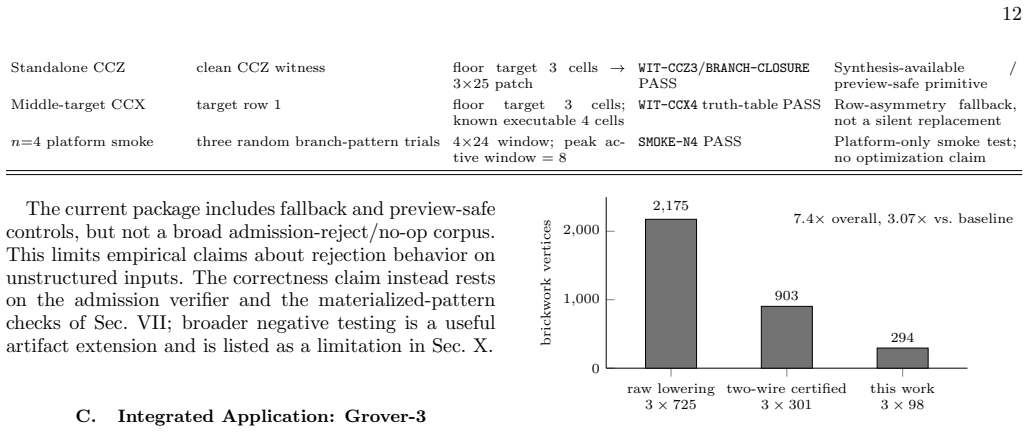
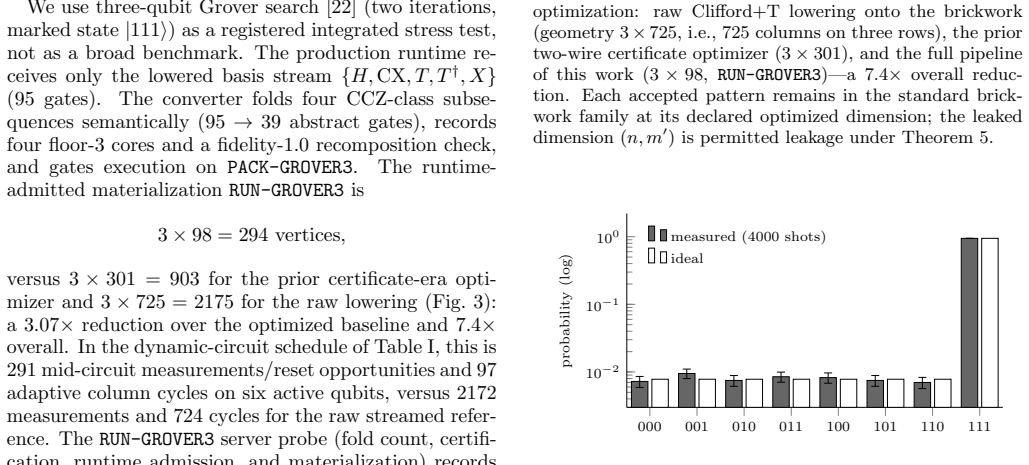
BPBO detects regions, supplies semantic floors or executable witnesses, and accepts a replacement only after branch-frame, output-frame, and blinding-behavior checks; the security statement is a compatibility result that preserves UBQC blindness at the declared dimensions and remains compatible with inherited verification guarantees under explicit test-round conditions, without a new trap-soundness theorem, as shown by reductions such as Grover-3 from 3 x 725 to 3 x 98 while preserving expected marked-state statistics.
What carries the argument
The resynthesis procedure that applies branch-frame, output-frame, and blinding-behavior checks after each candidate replacement to certify that the change does not alter overall blindness or verification properties.
Load-bearing premise
The branch-frame, output-frame, and blinding-behavior checks performed after each candidate replacement are sufficient to guarantee that the resynthesized region does not alter the overall blindness or verification properties of the full pattern.
What would settle it
Running the same client computation on both the original and an optimized pattern and observing a statistically significant difference in output distribution or a detectable leak of computation information would falsify the blindness-preservation claim.
Figures
read the original abstract
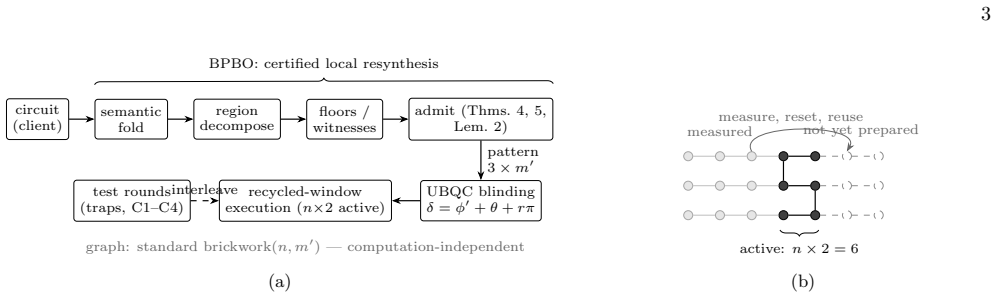
Universal blind quantum computation (UBQC) hides a client's computation by using a computation-independent BFK09 brickwork graph and encoding the computation in measurement angles, which limits the use of graph-changing optimizations. We study blindness-preserving brickwork optimization (BPBO): certified local resynthesis of BFK09-compatible brickwork patterns below the blinding layer. BPBO detects one-, two-, and three-wire regions; for each candidate region it either proves a semantic floor or supplies an executable witness, and it accepts a replacement only after its branch-frame, output-frame, and blinding behavior have been checked. The optimized outputs remain standard brickwork patterns and are evaluated with a logical qubit-recycled UBQC execution stack that runs arbitrary-length patterns using n x 2 active logical qubits. The layer evidence includes a one-wire H-count floor, a two-wire CNOT-cost floor, a three-wire parity-ledger floor, a clean three-cell CCZ witness whose optimality claim is scoped to the CNOT+T phase-gadget family, and an endpoint-target three-cell CCX/Toffoli application witness; the fixed middle-target CCX case is retained as a four-cell fallback. The security statement is a compatibility result: BPBO preserves UBQC blindness at the declared optimized dimensions and remains compatible with inherited verification guarantees under explicit test-round conditions, without introducing a new trap-soundness theorem. On Bell/CX, Grover-2, endpoint-Toffoli, and Grover-3 evaluation cases, BPBO demonstrates certified local reductions; in the largest case, Grover-3, the materialized pattern is reduced from 3 x 725 to 3 x 98 while preserving the expected marked-state statistics up to sampling noise.
Editorial analysis
A structured set of objections, weighed in public.
Referee Report
Summary. The paper introduces blindness-preserving brickwork optimization (BPBO) for universal blind quantum computation (UBQC) based on BFK09 brickwork patterns. It performs certified local resynthesis on one-, two-, and three-wire regions by proving semantic floors or supplying executable witnesses, accepting replacements only after branch-frame, output-frame, and blinding-behavior checks. The security claim is a compatibility result that inherits UBQC blindness without a new trap-soundness theorem. The work supplies layer evidence (one-wire H-count floor, two-wire CNOT-cost floor, three-wire parity-ledger floor, clean three-cell CCZ witness scoped to CNOT+T phase gadgets, endpoint-target CCX/Toffoli witness) and evaluates on Bell/CX, Grover-2, endpoint-Toffoli, and Grover-3 cases, reporting a reduction from 3×725 to 3×98 in the largest instance while preserving marked-state statistics up to sampling noise. A logical qubit-recycled UBQC execution stack is used to handle arbitrary-length patterns.
Significance. If the three post-replacement checks are formally shown to suffice for global blindness preservation, the result would enable concrete resource reductions in blind quantum computation while remaining compatible with existing verification. Explicit witnesses for optimality floors in specific gate families and the demonstrated size reductions (particularly the Grover-3 case) are concrete strengths; the compatibility framing avoids overclaiming new security theorems. The approach is scoped to BFK09-compatible brickwork and does not alter the overall pattern class.
major comments (1)
- [Security statement] Security statement (abstract and corresponding section): the manuscript states that BPBO is a compatibility result that preserves UBQC blindness via the branch-frame, output-frame, and blinding-behavior checks, but supplies no lemma or reduction showing that satisfaction of these three local conditions implies the standard BFK09 blindness definition (i.e., that the joint distribution of measurement outcomes on the full pattern remains independent of the client's secret angles) when the resynthesized region is embedded in an arbitrary surrounding brickwork. This is load-bearing for the central security claim.
minor comments (2)
- The definitions of 'semantic floor' and 'executable witness' are used repeatedly but would benefit from an explicit introductory paragraph or table that distinguishes the two notions and lists which regions receive which treatment.
- Table or figure summarizing the four evaluation cases (Bell/CX, Grover-2, endpoint-Toffoli, Grover-3) with before/after dimensions and the specific witness or floor applied would improve readability of the results section.
Simulated Author's Rebuttal
We thank the referee for their careful reading and for highlighting this central point on the security statement. We address the comment below.
read point-by-point responses
-
Referee: [Security statement] Security statement (abstract and corresponding section): the manuscript states that BPBO is a compatibility result that preserves UBQC blindness via the branch-frame, output-frame, and blinding-behavior checks, but supplies no lemma or reduction showing that satisfaction of these three local conditions implies the standard BFK09 blindness definition (i.e., that the joint distribution of measurement outcomes on the full pattern remains independent of the client's secret angles) when the resynthesized region is embedded in an arbitrary surrounding brickwork. This is load-bearing for the central security claim.
Authors: We agree that the manuscript does not supply an explicit lemma or reduction proving that the three local checks imply preservation of the standard BFK09 blindness definition under arbitrary embedding. This is a substantive gap in the current security argument. In the revised manuscript we will add a formal lemma in the security section establishing the required implication: if a local resynthesis satisfies the branch-frame, output-frame, and blinding-behavior conditions, then the joint distribution of all server measurement outcomes on the full pattern remains identical to that of the original BFK09 pattern (hence independent of the client's secret angles). The lemma will be proved by showing that the checks guarantee (i) identical boundary entanglement and (ii) identical local outcome distributions, allowing the original BFK09 blindness argument to carry over unchanged to the composite pattern. We will also update the abstract and main text to reference this lemma explicitly. revision: yes
Circularity Check
No circularity; security is explicit compatibility with external BFK09
full rationale
The paper states its security result as a compatibility claim that inherits UBQC blindness from the standard external BFK09 framework without a new trap-soundness theorem or any reduction of the central claim to fitted parameters, self-citations, or definitional loops. The optimization method relies on described post-replacement checks and layer evidence (H-count floor, CNOT-cost floor, etc.) that are presented as independent of the target statistics. No quoted step equates a prediction to its input by construction, and the derivation remains self-contained against the external benchmark of BFK09.
Axiom & Free-Parameter Ledger
axioms (1)
- domain assumption BFK09 brickwork patterns and their blindness properties
invented entities (2)
-
one-, two-, and three-wire BPBO regions
no independent evidence
-
semantic floor and executable witness
no independent evidence
Reference graph
Works this paper leans on
-
[1]
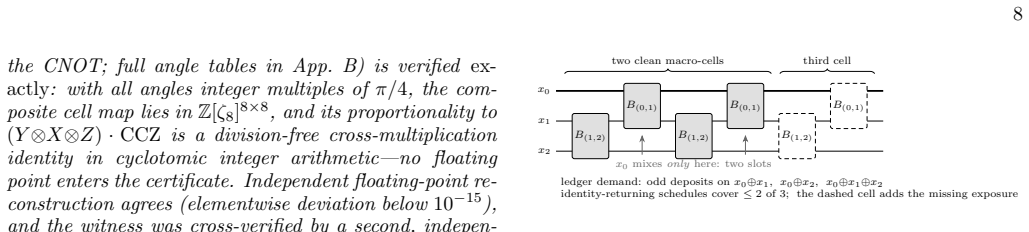
The requirement and the obstruction By the parity-ledger analysis of Sec. V, every phase- gadget realization of CCZ modulo a single-qubit Pauli frame must deposit odd (T-family) phases onall seven parity forms—the deposit syndrome is a representation- independent invariant (Lemma 3, App. A)—and in par- ticular on the threex 0-containing paritiesx 0⊕x1,x 0...
-
[2]
rotation
How the witness is constructed: two synthesis principles The witness is not a lucky search result; it is produced by a reusable procedure built on two principles. Lemma 1(Frame-chained synthesis).LetT 1, . . . , Tk be per-cell targets withT k · · ·T1 =U. Solve the cells se- quentially againstresidue-adaptedtargets: celljreal- izesP j Gj Tj R† j−1 exactly,...
-
[3]
Parity-Ledger Necessity For aπ/4-valued diagonal 3-qubit phase function in the CNOT+T/ phase-gadget scope, write the phase over parity forms:φ(x) = π 4 P L cL χL(x) withc L ∈Z 8,L ranging over the seven nonempty subsets of{x 0, x1, x2} andχ L(x) =L i∈L xi. A gadget realization specifies its deposits explicitly, so itcomes witha representationφ= P i ai χLi...
-
[4]
U∈ R F (n, k) up to the model’s gauge and Pauli-frame dressing
The Supply–Demand Floor (Theorem 1) Proof.LetUadmit ak-cell realization in the classF, i.e. U∈ R F (n, k) up to the model’s gauge and Pauli-frame dressing. Orbit-invariance ofDmakesD(U) well de- fined on the dressed target, and the over-approximation 17 property then placesD(U)∈S(k). By definition of floorD(U),D(U)/∈S(j) for allj <floor D(U). Hence no rea...
-
[5]
Hence RBFK(1, k) ={h≤2k}for everyk
Wire-Count Instantiations (Corollaries 1, 2) Proof sketch (Corollary 1).Both directions are general ink.Supply(upper bound): one cell’s wire chain isR zHR zHR z—exactly two Hadamards with freeA- phases—sokconcatenated cells realize, by construction, exactly the alternating words with at most 2kHadamards (adjacent phases merge).Demand(achievability): any U...
-
[6]
Two-Cell Schedule Coverage and Theorem 2 Lemma 4(Coverage).Model a clean two-macro-cell window generously: the two-rung blocks act on their wire pairs byanyelement ofGL(2,F 2)(including SWAP), and odd deposits may be placed on every parity form carried by a wire at a block boundary or inside a block’s two-form span; the net linear action must return to th...
-
[7]
Verification Protocol of Theorem 3 Proof (verification).The witness is an explicit artifact: three 3×8 angle tables overA(App. B). Verifica- tion separates four layers. First, the floating transfer- matrix contraction on the production geometry equals (Y⊗X⊗Z)·CCZ after global-phase alignment with max- imum elementwise deviation below 10 −15; a brute-force...
-
[8]
By induc- tion,R j := (U j · · ·U1)(Tj · · ·T1)† =P j Gj: indeed UjRj−1(Tj−1 · · ·T1) =P jGjTj(Tj−1 · · ·T1)
Proof of Lemma 1 (Frame-Chained Synthesis) Proof.DefineR 0 =Iand let celljrealize exactly Uj =P j Gj Tj R† j−1 withP j a Pauli tensor andG j a per-wire Hadamard gauge (G k =I). By induc- tion,R j := (U j · · ·U1)(Tj · · ·T1)† =P j Gj: indeed UjRj−1(Tj−1 · · ·T1) =P jGjTj(Tj−1 · · ·T1). Atj=k, Rk =P k, i.e.U k · · ·U1 =P k (Tk · · ·T1). The residue normal ...
-
[9]
Proof.In the pattern’s column gauge, columncapplies a diagonal layer (the measurement phases and the rung CZs) followed by a hop Hadamard on every wire
Proof of Theorem 4 (Branch-Frame Closure) The proof rests on four exact single- and two-qubit identities, each verified in isolation: (a)R z(t)X=e it X Rz(−t), (b) CZ (X⊗I) = (X⊗Z) CZ, (c)|− t⟩=|+ t+π⟩, R z(t+π) =R z(t)Z, (d)HX=ZH, HZ=XH. Proof.In the pattern’s column gauge, columncapplies a diagonal layer (the measurement phases and the rung CZs) followe...
-
[10]
Condition on a public value of δand on the past transcript
Proof of Theorem 5 (Blindness Preservation) Proof.The server-visible protocol view has three compo- nents.Graph: the rewrites introduce no non-standard topology—after materialization the graph is the stan- dard brickwork determined by (n, m′) alone.Angles: per qubit,δ=ϕ ′ +θ+rπwith fresh uniformθon the cyclic groupAand uniformr; thereforeδis uniform and i...
-
[11]
independent implemen- tation
Proof of Lemma 2 (Round Indistinguishability) Proof.Compare the pre-abort view components across round types at fixed (n, m ′), conditioning on the past transcript.Graph: identical by construction.Received qubits: computation rounds send|+ θ⟩,θuniform (⇒I/2 per qubit); test rounds send dummies|z⟩,zuniform (I/2) or traps|+ θ⟩(I/2); preparations are indepen...
-
[12]
A. M. Childs, Secure assisted quantum computation, Quantum Information and Computation5, 456 (2005), arXiv:quant-ph/0111046
work page internal anchor Pith review Pith/arXiv arXiv 2005
-
[13]
Raussendorf and H
R. Raussendorf and H. J. Briegel, A one-way quantum computer, Physical Review Letters86, 5188 (2001)
2001
-
[14]
Universal blind quantum computation
A. Broadbent, J. Fitzsimons, and E. Kashefi, Univer- sal blind quantum computation, inProc. 50th Annual IEEE Symposium on Foundations of Computer Science 22 (FOCS)(2009) pp. 517–526, arXiv:0807.4154
work page internal anchor Pith review Pith/arXiv arXiv 2009
-
[15]
J. F. Fitzsimons and E. Kashefi, Unconditionally verifi- able blind quantum computation, Physical Review A96, 012303 (2017), arXiv:1203.5217
work page internal anchor Pith review Pith/arXiv arXiv 2017
-
[16]
D. Leichtle, L. Music, E. Kashefi, and H. Ollivier, Verifying BQP computations on noisy devices with minimal overhead, PRX Quantum2, 040302 (2021), arXiv:2109.04042
-
[17]
P. Drmota, D. P. Nadlinger, D. Main, B. C. Nichol, E. M. Ainley, D. Leichtle, A. Mantri, E. Kashefi, R. Srinivas, G. Araneda, C. J. Ballance, and D. M. Lucas, Verifiable blind quantum computing with trapped ions and single photons, Physical Review Letters132, 150604 (2024), arXiv:2305.02936
-
[18]
Polacchi, D
B. Polacchi, D. Leichtle, G. Carvacho, G. Milani, N. Spagnolo, M. Kaplan, E. Kashefi, and F. Sciarrino, Experimental verifiable multiclient blind quantum com- puting on a Qline architecture, Physical Review Letters 134, 200603 (2025)
2025
-
[19]
V. Danos, E. Kashefi, and P. Panangaden, The mea- surement calculus, Journal of the ACM54, 8 (2007), arXiv:0704.1263
work page internal anchor Pith review Pith/arXiv arXiv 2007
-
[20]
W. Simmons, Relating measurement patterns to circuits via Pauli flow (2021), arXiv:2109.05654 [quant-ph]
-
[21]
T. McElvanney and M. Backens, Complete flow- preserving rewrite rules for MBQC patterns with Pauli measurements (2022), arXiv:2205.02009 [quant-ph]
-
[22]
S. Sunami and M. Fukushima, Graphix: optimizing and simulating measurement-based quantum computation on local-Clifford decorated graph (2022), arXiv:2212.11975
- [23]
-
[24]
M. Amy, D. Maslov, and M. Mosca, Polynomial-time T- depth optimization of Clifford+T circuits via matroid partitioning, IEEE Transactions on Computer-Aided De- sign of Integrated Circuits and Systems33, 1476 (2014), arXiv:1303.2042
work page internal anchor Pith review Pith/arXiv arXiv 2014
-
[25]
M. DeCross, E. Chertkov, M. Kohagen, and M. Foss- Feig, Qubit-reuse compilation with mid-circuit measure- ment and reset, Physical Review X13, 041057 (2023), arXiv:2210.08039
-
[26]
Simulation of Two-Qubit Grover Algorithm in MBQC with Universal Blind Quantum Computation
Y. Lee and D. Chung, Simulation of two-qubit Grover algorithm in MBQC with universal blind quantum com- putation (2025), arXiv:2503.09099 [quant-ph]
work page internal anchor Pith review Pith/arXiv arXiv 2025
-
[27]
D. E. Browne, E. Kashefi, M. Mhalla, and S. Perdrix, Generalized flow and determinism in measurement-based quantum computation, New Journal of Physics9, 250 (2007), arXiv:quant-ph/0702212
work page internal anchor Pith review Pith/arXiv arXiv 2007
-
[28]
Improved Simulation of Stabilizer Circuits
S. Aaronson and D. Gottesman, Improved simulation of stabilizer circuits, Physical Review A70, 052328 (2004), arXiv:quant-ph/0406196
work page internal anchor Pith review Pith/arXiv arXiv 2004
-
[29]
The Heisenberg Representation of Quantum Computers
D. Gottesman, The Heisenberg representation of quan- tum computers (1998), arXiv:quant-ph/9807006
work page internal anchor Pith review Pith/arXiv arXiv 1998
- [30]
-
[31]
Nonlocal properties of two-qubit gates and mixed states and optimization of quantum computations
Y. Makhlin, Nonlocal properties of two-qubit gates and mixed states and optimization of quantum computa- tions, Quantum Information Processing1, 243 (2002), arXiv:quant-ph/0002045
work page internal anchor Pith review Pith/arXiv arXiv 2002
-
[32]
V. V. Shende, S. S. Bullock, and I. L. Markov, Syn- thesis of quantum-logic circuits, IEEE Transactions on Computer-Aided Design of Integrated Circuits and Sys- tems25, 1000 (2006), arXiv:quant-ph/0406176
work page internal anchor Pith review Pith/arXiv arXiv 2006
-
[33]
L. K. Grover, A fast quantum mechanical algorithm for database search, inProc. 28th Annual ACM Symposium on Theory of Computing (STOC)(1996) pp. 212–219, arXiv:quant-ph/9605043
work page internal anchor Pith review Pith/arXiv arXiv 1996
-
[34]
Gheorghiu, T
A. Gheorghiu, T. Kapourniotis, and E. Kashefi, Verifi- cation of quantum computation: An overview of exist- ing approaches, Theory of Computing Systems63, 715 (2019)
2019
-
[35]
S. Barz, E. Kashefi, A. Broadbent, J. F. Fitzsi- mons, A. Zeilinger, and P. Walther, Demonstration of blind quantum computing, Science335, 303 (2012), arXiv:1110.1381
work page internal anchor Pith review Pith/arXiv arXiv 2012
-
[36]
Optimal Blind Quantum Computation
A. Mantri, C. A. P´ erez-Delgado, and J. F. Fitzsimons, Optimal blind quantum computation, Physical Review Letters111, 230502 (2013), arXiv:1306.3677
work page internal anchor Pith review Pith/arXiv arXiv 2013
-
[37]
Mahadev, Classical verification of quantum computa- tions, inProc
U. Mahadev, Classical verification of quantum computa- tions, inProc. 59th Annual IEEE Symposium on Founda- tions of Computer Science (FOCS)(2018) pp. 259–267, arXiv:1804.01082
- [38]
-
[39]
Yang, M.-Q
Z. Yang, M.-Q. Bai, and Z. Mo, The brickwork state with fewer qubits in blind quantum computation, Quantum Information Processing21, 125 (2022)
2022
-
[40]
S. Ma, C. Zhu, X. Liu, H. Li, and S. Li, Universal blind quantum computation with improved brickwork states, Physical Review A109, 012606 (2024)
2024
-
[41]
Fast and efficient exact synthesis of single qubit unitaries generated by Clifford and T gates
V. Kliuchnikov, D. Maslov, and M. Mosca, Fast and ef- ficient exact synthesis of single qubit unitaries generated by Clifford and T gates, Quantum Information and Com- putation13, 607 (2013), arXiv:1206.5236
work page internal anchor Pith review Pith/arXiv arXiv 2013
-
[42]
N. J. Ross and P. Selinger, Optimal ancilla-free Clif- ford+T approximation ofz-rotations, Quantum Informa- tion and Computation16, 901 (2016), arXiv:1403.2975
work page internal anchor Pith review Pith/arXiv arXiv 2016
-
[43]
A. Javadi-Abhari, M. Treinish, K. Krsulich, C. J. Wood, J. Lishman, J. Gacon, S. Martiel, P. D. Nation, L. S. Bishop, A. W. Cross, B. R. Johnson, and J. M. Gambetta, Quantum computing with Qiskit (2024), arXiv:2405.08810 [quant-ph]
work page internal anchor Pith review Pith/arXiv arXiv 2024
discussion (0)
Sign in with ORCID, Apple, or X to comment. Anyone can read and Pith papers without signing in.