REVIEW 3 major objections 4 minor 16 references
Mixed-Timescale Beamforming and Power Splitting for Massive MIMO Aided SWIPT IoT Network
T0 review · 3 major / 4 minor · reviewed 2026-08-14 · deepseek-v4-flash
Pith's one-line read The paper proposes a mixed-timescale joint beamforming and power splitting scheme for massive MIMO SWIPT IoT networks, solved by an online stochastic successive convex approximation algorithm that provably reaches stationary solutions…
desk verdict A useful mixed-timescale SWIPT design whose general convergence claim rests on an unproven (and likely false) equivalence between a rate bound and the true ergodic rate. read the letter →
The pith
A machine-rendered reading of the paper's core claim, the machinery that carries it, and where it could break.
The reading
What carries the argument
The carrying mechanism is the two-timescale decomposition together with a chain of convex surrogates. At each short-term slot, a fractional programming block coordinate descent (FP-BCD) algorithm uses a Lagrangian dual transform and complex quadratic transformation to turn the rate expressions into a tractable form, and majorization-minimization with a first-order Taylor expansion handles the nonconvex nonlinear energy-harvesting constraint; a sample average approximation with $N$ channel-error samples makes the expectations finite. On the long-term timescale, a concave surrogate function with proximal regularization and a recursively updated weight vector $v^t$ drive a projected closed-form update of each power splitter $\rho_k$. Theorem 2 supplies an exponential convergence guarantee for the short-term solver, and Theorem 3 chains that to the almost-sure stationarity of the mixed-timescale iterates.
What would settle it
On a small instance where the ergodic rate and its bounds can be evaluated exactly, numerically maximize the true ergodic rate and each bound separately over a coarse grid of power splitter values. If the maximizing power splitter differs, the bound-optimizer equivalence fails. Alternatively, run MO-SSCA on a synthetic channel distribution and compare its limiting utility with a brute-force search over $\rho$ on the true objective; a gap would refute the claim that the algorithm maximizes the intended utility.
Extended reading notes
Core claim
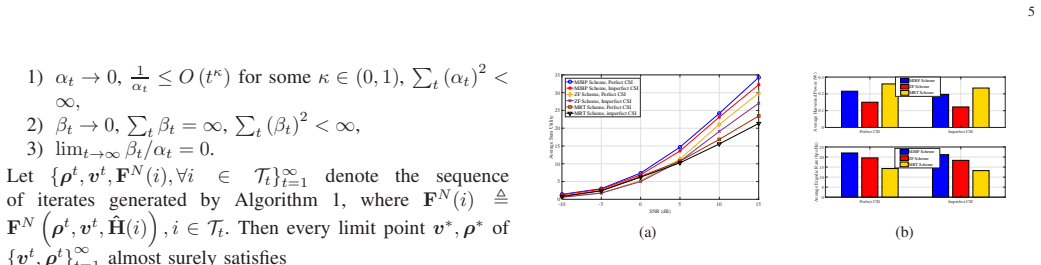
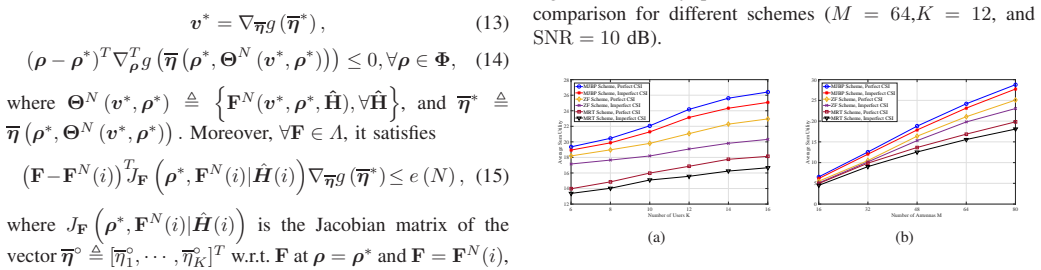
The central claim is that the mixed-timescale problem—choosing beamformers per imperfect channel realization and power splitters per channel statistics—can be solved to stationarity by the proposed MO-SSCA algorithm. Theorem 3 states that every limit point of the iterates satisfies the first-order stationary conditions for the utility maximization problem, up to an error that vanishes exponentially as the number of channel-error samples grows. The paper also claims that the MJBP scheme meaningfully outperforms MRT and ZF baselines in average sum utility, and that the gains widen as the number of users grows and remain consistent as the number of antennas grows.
Load-bearing premise
The load-bearing premise is that the lower and upper bounds on the ergodic rate derived in Proposition 1 have the same optimal power-splitting and beamforming solution as the true ergodic rate; the paper asserts this without proof, so the objective being optimized may be a surrogate that differs from the intended network utility.
Editorial extensions
If this is right
- If the convergence result holds, MO-SSCA gives a principled way to optimize general utility functions in massive MIMO SWIPT without perfect CSI, using only slow updates of power splitters.
- The joint design should let operators reduce feedback overhead: power splitter settings are broadcast once per channel-statistics coherence interval rather than per channel block.
- The performance gains over MRT and ZF imply that optimizing the beamformer and the splitter together matters more as inter-user interference grows with the number of users.
- Because the short-term subproblem is convex after transformation, each online step can be solved with standard convex solvers, making the scheme implementable.
- The exponential convergence in sample size suggests that a modest number of channel-error samples suffices, limiting computational cost.
Reading between the lines
- The same two-timescale template could be applied to other slow variables in massive MIMO, such as user scheduling, hybrid precoding phases, or resource allocation, where fast beamformers track instantaneous CSI.
- If the equivalence between optimizing the ergodic-rate bounds and the true ergodic rate fails, one could replace the surrogate by an unbiased stochastic gradient of the true rate and retrain the long-term update; this is a direct testable modification.
- The simulation setup, with a small number of paths and 64 antennas, suggests the scheme could be prototyped on a testbed; a useful experiment would measure how the gain over ZF changes under measured, non-Laplacian angular spreads.
- The convergence proof omits details by citing an existing approach, so a re-derivation in a journal version would be needed before relying on the guarantee in a system design.
Signed reviews
Editorial analysis
A structured set of objections, weighed in public.
Referee Report
Summary. The paper considers a downlink massive MIMO SWIPT IoT network where the transmit beamformer adapts to imperfect CSI while receive power splitters adapt only to long-term channel statistics. It formulates a mixed-timescale network utility maximization problem, proposes an online stochastic successive convex approximation algorithm (MO-SSCA) with a short-term fractional-programming block-coordinate-descent inner loop and a long-term surrogate update, and claims the algorithm converges to stationary solutions. The simulation study reports gains over MRT and ZF baselines across SNR, number of users, and number of antennas.
Significance. If the theoretical claims were fully supported, the paper would provide a practical mixed-timescale design for massive MIMO SWIPT under imperfect CSI and a useful template for two-timescale stochastic optimization. The system model and algorithmic architecture are clearly described, the short-term steps build on standard tools (SAA, fractional programming, MM), and the simulations cover several operating regimes. However, the central substitution of the true ergodic rate by an upper bound is not an equivalent reformulation for general utilities, and the main convergence theorem is not proved in the paper. These gaps currently prevent the main claims from being accepted as stated.
major comments (3)
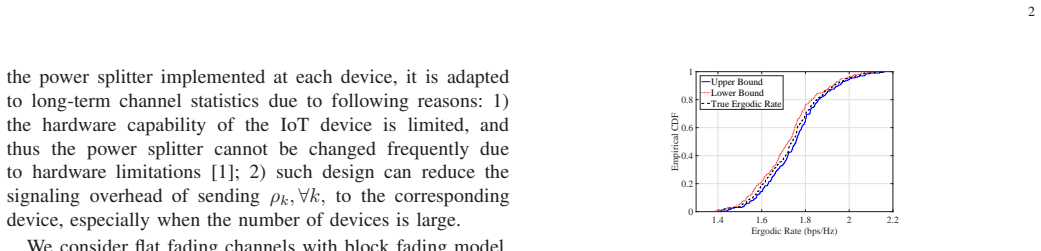
- [Section II, Proposition 1 and Eq. (2)] The assertion 'From Proposition 1, optimizing the lower and upper bound provide the same optimal solution' is not established and is false for the stated utility class. The lower bound r_k - C_k and the upper bound r_k differ by the constant C_k, so for linear utilities their maximizers coincide, but for a general concave nondecreasing g, sum_k g(r_k - C_k + gamma_k e_k) and sum_k g(r_k + gamma_k e_k) can have different argmaxes. More importantly, the true ergodic rate is not equal to either bound; the actual gap between r_k and the true rate depends on F and rho through terms of the form (1/T) sum_m log_2(1 + T Var(h_k^H f_m)/(rho_k sigma_k^2 + delta_k^2)), so replacing the true rate with r_k changes the objective by a variable-dependent term. Figure 2 only demonstrates pointwise tightness of the bounds at a simulated operating point, not optimizer equivalence. Consequently, problem P is a surrogate problem, and Theorem 3, even if valid, establishes stationarity for the surrogate rather than for the original ergodic-rate utility.
- [Section III-C, Theorem 3] The main convergence theorem is stated without proof. The sentence 'Theorem 3 can be proven by a similar approach in [7]' is not an adequate proof because [7] addresses a different system (hybrid compression for C-RAN) and does not include the nonlinear energy-harvesting model or the SAA short-term subproblem used here. Since Theorem 3 is the basis for the claim that Algorithm 1 converges to stationary solutions of P, a full proof, or a precise identification of a theorem in [7] from which it follows with stated modifications, is required.
- [Section III-A, Eq. (4) and problem (8)] As printed, the objective in Eq. (4) contains a positive term (w^n_k)^H w^n_k (rho_k(Gamma^n_k + sigma^2_k) + delta^2_k). With q and w fixed, Gamma^n_k is convex quadratic in F, so this term is convex in F; maximizing it over the convex set Lambda is not a convex problem. The text then states that problem (8) is convex and can be solved by CVX, which contradicts the displayed equations. Please verify the sign of the quadratic penalty in Eq. (4) and either correct it or provide a convexity argument for (8). If the sign is a typographical error, the correction is straightforward, but as written the short-term convergence of Algorithm 2 is not justified.
minor comments (4)
- [Section II, Eq. (1)] Equation (1) is malformed as printed: the penalty term 'log_2(1 + T rho_k sigma^2_k + delta_k Var(h_k^H f_m))' lacks a fraction bar and correct parentheses; please re-typeset the expression.
- [Section III-A, Lemma 1] In Lemma 1, the phrase 'solves the problem in (1)' should refer to problem P3 or Eq. (3), since Eq. (1) is a rate expression, not an optimization problem.
- [Section IV] The relation between the coherence interval T = 400 and the stated 'coherence time of 2 ms and a coherence bandwidth of 200 kHz' should be specified explicitly, as the product of time and bandwidth does not by itself determine T.
- [Throughout] There are several typographical errors, including 'postive' after Eq. (9) and 'an second-order cone programming' in the introduction; please proofread the manuscript.
Circularity Check
No circular derivation: the algorithm and simulations are not fitted to their claimed outputs; cited prior theorems are independent, so remaining gaps are correctness risks rather than circularity.
full rationale
The paper's derivation chain is self-contained in the required sense. Problem P is explicitly defined using the bounded ergodic rate r_k from Proposition 1, and the algorithm's convergence (Theorem 3) is delegated to a similar proof in [7]; neither step makes the conclusion its own premise. The Proposition 1 assertion that optimizing the lower and upper bounds 'provide the same optimal solution' is an unproven equivalence for general concave utilities—the bounds differ by a constant independent of F and rho, which preserves argmaxes only for linear g—but this is a technical gap between the true ergodic-rate problem and the surrogate P, not a circular reduction. Similarly, Theorem 2's proof invokes the MM convergence result of [11] and [14], and Theorem 3's proof is delegated to [7]; these are citations to independently stated and proved theorems, not to the present paper's conclusions or fitted parameters. The simulation comparison against fixed-MRT and fixed-ZF baselines is an external numerical experiment in which no parameter is fitted to produce the claimed gain. Thus no circular step is exhibited; the identified issues are completeness/correctness concerns, not self-definitional reasoning.
Assumptions & free parameters
free parameters (4)
- Proximal regularization constant tau
- Step-size sequences alpha_t and beta_t
- SAA sample count N =
200
- Utility weight gamma_k =
10 for all users
assumptions (6)
- domain assumption The BS knows the channel statistics and the error variance omega_k^2 for each device.
- domain assumption Channel error phi_k is independent of the estimate h_hat_k and Gaussian with covariance omega_k^2 I.
- ad hoc to paper Optimizing the upper and lower bounds of the ergodic rate yields the same optimal solution as optimizing the true ergodic rate.
- domain assumption The objective function g is concave, non-decreasing, and has Lipschitz continuous derivative.
- domain assumption The short-term FP-BCD algorithm satisfies the MM framework assumptions of [11, Theorem 4.4] and the SAA uniform convergence assumptions of [14, Theorem 3.1].
- ad hoc to paper Theorem 3 can be proven by the same approach as in [7].
Cite this review
Pith. "Pith review of Mixed-Timescale Beamforming and Power Splitting for Massive MIMO Aided SWIPT IoT Network." pith.science (2026). https://pith.science/paper/DVAUE63V
@misc{pith2026190807408,
  author       = {Pith},
  title        = {Pith review of: Mixed-Timescale Beamforming and Power Splitting for Massive MIMO Aided SWIPT IoT Network},
  year         = {2026},
  howpublished = {\url{https://pith.science/paper/DVAUE63V}},
  note         = {Machine review of arXiv:1908.07408}
}
read the original abstract
Traditional simultaneous wireless information and power transfer (SWIPT) with power splitting assumes perfect channel state information (CSI), which is difficult to obtain especially in the massive multiple-input-multiple-output (MIMO) regime. In this letter, we consider a mixed-timescale joint beamforming and power splitting (MJBP) scheme to maximize general utility functions under a power constraint in the downlink of a massive MIMO SWIPT IoT network. In this scheme, the transmit digital beamformer is adapted to the imperfect CSI, while the receive power splitters are adapted to the long-term channel statistics only due to the consideration of hardware limit and signaling overhead. The formulated optimization problem is solved using a mixed-timescale online stochastic successive convex approximation (MO-SSCA) algorithm. Simulation results reveal significant gain over the baselines.
Figures

Figures from the paper (1 more)
Reference graph
Works this paper leans on
-
[7]
Two-timescale hybrid compression and forward for massive MIMO aided C-RAN,
A. Liu, X. Chen, W. Y u, V . Lau, and M. Zhao, “Two-timescale hybrid compression and forward for massive MIMO aided C-RAN,” IEEE Trans. Signal Process. , vol. 67, no. 9, pp. 2484–2498, Mar 2019
work page 2019
-
[1]
M. Swan, “Sensor mania! the Internet of things, wearable computing, objective metrics, and the quantified self 2.0,” J. Sens. Actuator Netw , vol. 1, no. 3, pp. 217–253, 2012
work page 2012
-
[2]
MIMO broadcasting for simultaneou s wire- less information and power transfer,
R. Zhang and C. K. HO, “MIMO broadcasting for simultaneou s wire- less information and power transfer,” IEEE Trans. Wireless Commun. , vol. 12, no. 5, pp. 1989–2001, May 2013
work page 1989
-
[3]
Joint transmit beamfo rming and receive power splitting for MISO SWIPT systems,
Q. Shi, L. Liu, W. Xu, and R. Zhang, “Joint transmit beamfo rming and receive power splitting for MISO SWIPT systems,” IEEE Trans. Wireless Commun., vol. 13, no. 6, pp. 3269–3280, Apr 2014
work page 2014
-
[4]
Q. Shi, W. Xu, T. Chang, Y . Wang, and E. Song, “Joint beamfo rming and power splitting for MISO interference channel with SWIPT: A n SOCP relaxation and decentralized algorithm,” IEEE Trans. Signal Process. , vol. 62, no. 23, pp. 6194–6208, Dec 2014
work page 2014
-
[5]
Optimal downlink transmi ssion in Massive MIMO enabled SWIPT systems with zero-forcing preco ding,
G. Dong, H. Zhang, and D. Y uan, “Optimal downlink transmi ssion in Massive MIMO enabled SWIPT systems with zero-forcing preco ding,” IEEE Global Commun. Conf. , Dec 2014
work page 2014
-
[6]
On the ergodic rate lower bounds with applicat ions to masssive MIMO,
G. Caire, “On the ergodic rate lower bounds with applicat ions to masssive MIMO,” IEEE Trans. Wireless Commun. , vol. 17, no. 5, pp. 3258–3268, May 2018
work page 2018
-
[8]
Pract ical non- linear energy harvesting model and resource allocation for SWIPT systems,
E. Boshkovska, D. Ng, N. Zlatanov, and R. Schober, “Pract ical non- linear energy harvesting model and resource allocation for SWIPT systems,” IEEE Commun. Lett. , vol. 19, no. 12, pp. 2082–2085, Dec. 2015
work page 2015
Show all 16 references
-
[9]
Shapiro, D
A. Shapiro, D. Dentcheva, and A. Ruszczynski, Lecture on stochastic programming: modeling and theory . SIAM, 2009
2009
-
[10]
Fractional programming for communic ation systems – Part II: Uplink scheduling via matching,
K. Shen and W. Y u, “Fractional programming for communic ation systems – Part II: Uplink scheduling via matching,” IEEE Trans. Signal Process., vol. 66, no. 10, pp. 2631–2644, Mar 2018
2018
-
[11]
An expanded theoretic al treatment of iteration-dependent majorize-minimize algorithms,
M. W. Jacobson and J. A. Fessler, “An expanded theoretic al treatment of iteration-dependent majorize-minimize algorithms,” IEEE Transactions on Image Processing , vol. 16, no. 10, pp. 2411–2422, Oct 2007
2007
-
[12]
CVX Research, Inc. CVX: Matlab software for disciplin ed convex programming, version 2.0 beta
“CVX Research, Inc. CVX: Matlab software for disciplin ed convex programming, version 2.0 beta.” Sep, 2012. [Online]. Avail able: http:// cvxr.com/cvx
2012
-
[13]
Optimal of MIM O device- to-device networks via matrix fractional programming: A mi norization- maximization approach,
K. Shen, W. Y u, L. Zhao, and D. P . Palomar, “Optimal of MIM O device- to-device networks via matrix fractional programming: A mi norization- maximization approach,” arXiv.org:1808.05678, 2019
2019 arXiv
-
[14]
A note on uniform exponential converge nce of sample average approximation of random functions,
H. Sun and H. Xu, “A note on uniform exponential converge nce of sample average approximation of random functions,” J. Math. Anal. Appl, pp. 698–708, 2012
2012
-
[15]
[Online]
Technical Specification Group Radio Access Network; Furthe r Advancements for E-UTRA Physical Layer Aspects , 3GPP TR 36.814. [Online]. Available: http://www.3gpp.org
-
[16]
Marzetta, E
T. Marzetta, E. G. Larsson, H. Y ang, and H. Ngo, Fundamentals of Massive MIMO . Cambridge, U.K.: Cambridge University Press, 2016
2016
Reviewed August 14, 2026 · model on record in the stance chip above.
Discussion (0). Continue with ORCID to comment.