REVIEW 4 major objections 4 minor 1 cited by
Robust Visual Servoing under Human Supervision for Assembly Tasks
T0 review · 4 major / 4 minor · reviewed 2026-08-16 · deepseek-v4-flash
Pith's one-line read Robustified control barrier functions guarantee that a camera never loses sight of the fiducial marker it is servoing toward, despite bounded calibration error in the camera pose.
desk verdict Useful systems paper with a genuinely new CBF-robustification analysis, but the headline visibility guarantee rests on a false geometric claim and an unimplementable constraint; worth engaging, but the proof needs real revision. read the letter →
The pith
A machine-rendered reading of the paper's core claim, the machinery that carries it, and where it could break.
The reading
What carries the argument
The load-bearing object is the control barrier function $h_{ij}({}^{C_t}x_j) = {}^{C_t}a_i^T {}^{C_t}x_j$, the signed distance from ArUco corner $j$ to visibility plane $i$, which defines the safe set of camera views that keep the marker detectable; a companion barrier $h_z = {}^{A_t}C_{t,z} - \zeta$ keeps the camera in front of the marker. The paper's robustification replaces the unknown true camera frame $C_t$ and image corner set $C$ with a virtual frame $\tilde{C}_t$ and a deflated corner set $\tilde{C}$ such that the virtual field of view is a subset of the true field of view for every pose error allowed by Assumption 1, turning an uncertain visibility constraint into a known conservative one. The theorems give an explicit recipe: push the virtual camera back by $\delta / \min_i a_{i,z}$ for translation errors, shrink the image corners around projected uncertainty circles for rotation errors, and combine both in Theorem 3. Because the marker coordinates in the virtual frame are not measured directly, Problem 4 replaces each term of condition (9) by a worst-case lower bound computed from the estimated pose and the error bounds; enforcement is a quadratic program that, after robustification, is solved by seeding a non-convex solver with the nominal QP solution.
What would settle it
Take a robot whose camera-to-hand transformation is deliberately offset from the assumed one by more than $\delta$ in translation or $\epsilon$ in rotation, run the robustified controller so that conditions (9) hold, and record whether any ArUco corner leaves the image plane; if a corner exits while (9) is satisfied, the theorem's guarantee is falsified.
Extended reading notes
Core claim
The central claim is formalized as follows: if barrier conditions (9), with parameters set according to Theorem 3, are always satisfied, then every ArUco corner $x_j$ stays inside the true camera field of view $V_{C_t}$ for all time, provided Assumption 1 holds. The parameters are chosen by solving the robustification problem as two simpler subproblems: Theorem 1 places the virtual camera frame $\tilde{C}_t$ a distance $\delta / \min_i a_{i,z}$ behind the nominal camera along its optical axis to absorb the translation error bound $\delta$; Theorem 2, via Algorithm 1, shrinks the assumed image corners inward by the projected uncertainty circles generated by the rotation error bound $\epsilon$; Theorem 3 combines both corrections. The paper also establishes that the human-in-the-loop blending law (15) with the adaptive rule of Algorithm 2 lets a human command the end-effector with as much authority as possible while the quadratic program still enforces marker visibility.
Load-bearing premise
The load-bearing premise is Assumption 1: the camera's translation and rotation relative to the end-effector are actually bounded by the known values $\delta$ and $\epsilon$; if real calibration error exceeds those bounds, the robustified barrier conditions no longer guarantee visibility.
Editorial extensions
If this is right
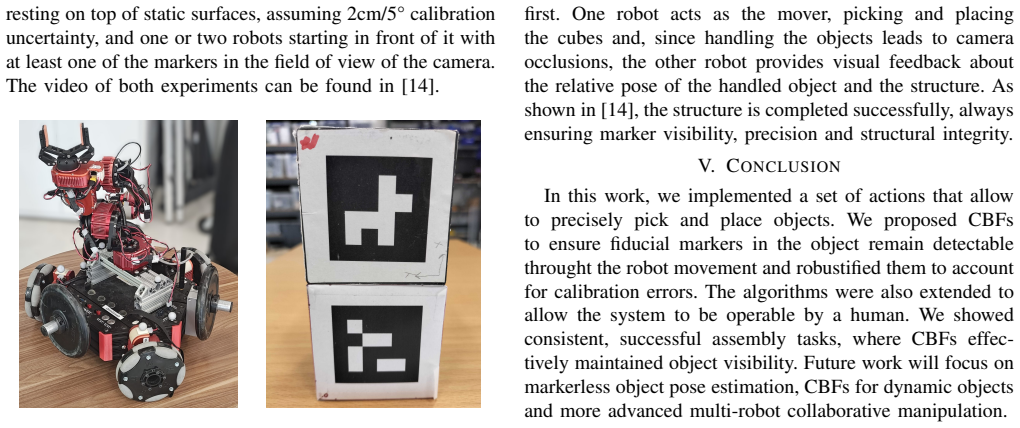
- A robot using the proposed controller can perform pick-and-place motions without the tracked fiducial marker ever leaving the camera image, as the two-robot three-block assembly experiment demonstrates.
- Given known calibration-error bounds $\delta$ and $\epsilon$, the barrier parameters can be computed by a closed-form backward shift and a simple image-corner-shrinking algorithm, removing the need for heuristic safety margins.
- Human-in-the-loop steering becomes safety-constrained: the adaptive weight $\beta$ gives the human maximum authority when the marker is far from the visibility planes and automatically defers to the servoing controller as the safety margin shrinks.
- The eye-to-hand helper robot supplies the relative pose between the handled object and the structure, so the system no longer needs to know the exact structure pose and avoids occlusions caused by the carried object.
Reading between the lines
- The same inflation-and-deflation principle could be transferred to other image-space constraints, for instance keeping a tracked object inside a zoom window or away from the image boundary, whenever the camera pose uncertainty is bounded.
- Because the robustified constraints turn the quadratic program non-convex, a practical failure mode outside the paper's experiments is a non-convex solver landing in a local minimum that violates a barrier; a convex reformulation or a constraint-satisfaction certificate would make the guarantee fully deployment-safe.
- The guarantee is worst-case over the whole uncertainty ball, so typical runs may be unnecessarily conservative; an online estimate of the actual calibration residual could tighten the barriers adaptively and yield faster motions.
- The visibility-certificate argument is not specific to ArUco markers: it uses only projection geometry and a bounded pose error, so with a suitable error model it could apply to the markerless 6-DoF pose estimators the paper lists as future work.
Signed reviews
Editorial analysis
A structured set of objections, weighed in public.
Referee Report
Summary. The paper proposes a framework for mobile manipulators to perform pick-and-place assembly tasks using position-based visual servoing with Control Barrier Functions (CBFs) to keep ArUco marker corners inside the camera field of view. The contribution is a robustification of the CBF constraints against bounded camera-pose errors (translation bound δ, rotation bound ε), a human-in-the-loop blending scheme, and experimental demonstrations on 6-DoF mobile arms, including a three-block tower assembly. The central theoretical claim is that if the robustified barrier conditions (9) with parameters from Theorem 3 are satisfied, then all marker corners remain in the true camera field of view at all times.
Significance. A certified visibility guarantee for position-based visual servoing under camera calibration uncertainty would be a useful contribution, and the paper addresses a relevant practical problem. The system-level integration, the HIL formulation, and the clear problem decomposition in Section III are strengths. However, the central theoretical result is not established: Theorem 2 rests on an incorrect geometric claim, Theorem 3 is only sketched, and the implementable robust constraints in Problem 4 rely on an unproven lower-bounding scheme and a non-convex solver without feasibility guarantees. The experimental validation is qualitative and consists of a single run of each scenario. Given these issues, the paper's main claim of a certified visibility guarantee is not currently supported.
major comments (4)
- [Section III.D, Theorem 2 and Algorithm 1] The proof of Theorem 2 states that applying all rotations with ||θu||≤ε to a corner visibility vector yields a set whose gnomonic projection onto the image plane is a circle centered at the nominal corner. This is false for off-axis corners: the central projection of a spherical cap whose axis is not the optical axis is an ellipse, not a circle. Algorithm 1 then uses a single test rotation per corner and places the shrunken image corners at distance r_j/√2 along the diagonals. Since the true uncertainty region is elliptical and the chosen radius is not shown to dominate its extent in all directions, the inclusion V_{\tilde C}(K,\tilde C) ⊆ V_F(K,C) for all F∈P(0,ε) is not guaranteed. Consequently, the headline conclusion after Theorem 3 that satisfying (9) ensures x_j ∈ V_Ct is unsupported.
- [Section III.D, Theorem 3] The proof of Theorem 3 merely states that the translation robustification of Theorem 1 and the rotation robustification of Theorem 2 'when combined' yield (11). No argument handles simultaneous translation and rotation errors. Theorem 1 assumes F_tR_{\tilde C}=I; under a simultaneous rotation, the sufficient condition (12) no longer follows from the same z-offset choice. Even if Theorem 2 were corrected, the combined guarantee would require a new proof that accounts for the coupling of translation and rotation in the set P(δ,ε).
- [Section III.D, Remark 2 and Problem 4] Remark 2 admits that condition (9) cannot be enforced directly because sensors provide C_t x_j rather than \tilde C_t x_j. The proposed replacement via lower bounds \tilde Θ_k is stated without proof: the minimization formulas for Θ2 and Θ3, including the cases where φ0+ε>π, are asserted rather than derived. Moreover, the resulting robust QP is non-convex and is solved by warm-starting from the nominal QP; the statement that the solver 'always succeeded experimentally' is anecdotal and does not provide a feasibility or optimality guarantee. For a certified visibility claim, the robust constraints must be shown to be conservative and feasible by construction.
- [Section IV.B and Assumption 1] Assumption 1 requires known bounds δ and ε on the camera pose error, but the experiments simply assume 2 cm and 5° without measuring or certifying the true calibration error. If the actual error exceeds these assumed bounds, the robustified barrier constraints and the visibility guarantee do not apply. A claim of certified robustness needs either a calibration procedure that verifies the bounds or an experimental measurement of the error distribution.
minor comments (4)
- [Section II.B / III.A] The relation between the image coordinate frame I and the camera frame C is described twice (Section II.B and Section III.A) with slightly different emphasis; a single consolidated definition would improve readability.
- [Problem 4, Rodrigues formula] The Rodrigues formula is written as 'vrot = vcos(θ) + (k×v)sin(θ + k(k·v)(1 − cos(θ))', which is missing a closing parenthesis and is dimensionally inconsistent; the formula should be corrected and the derivation of the minimizers should be shown.
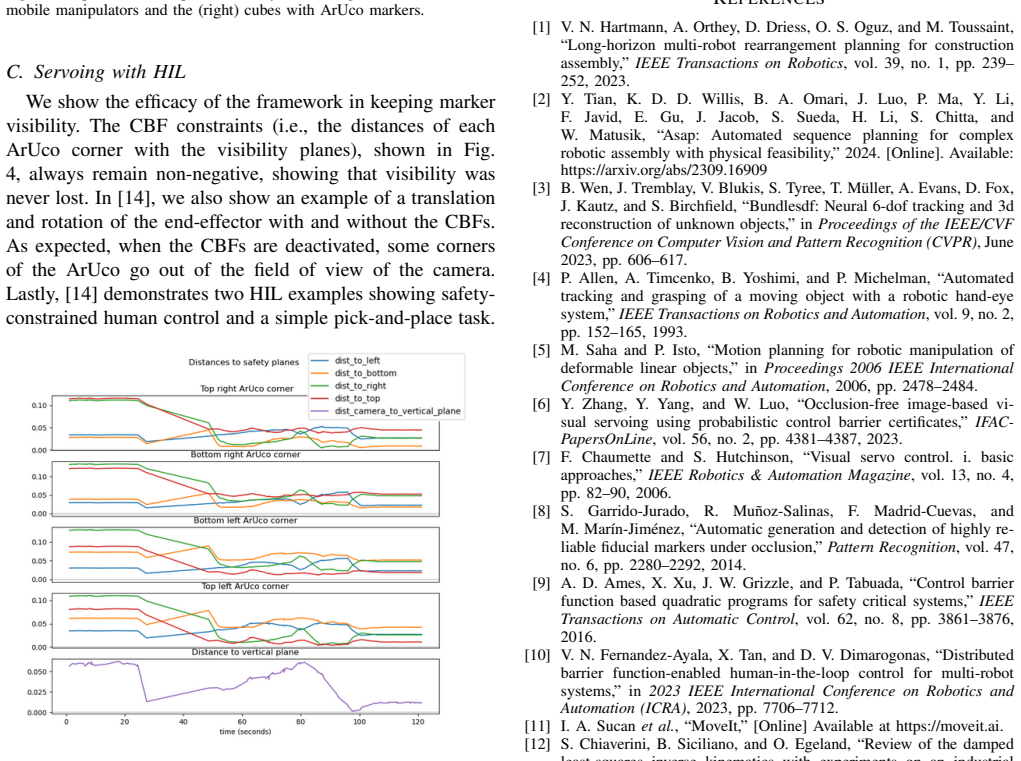
- [Section IV.C] The experimental evaluation reports a single execution for each scenario; repeating the trials and reporting statistics such as success rate or minimum barrier value would substantially strengthen the empirical claims.
- [Conclusion] The word 'throughout' is misspelled as 'throught' in the conclusion; the sentence should also specify which quantities are plotted in Fig. 4, since the caption alone is terse.
Circularity Check
No significant circularity; the robust visibility guarantee is derived from assumed error bounds and a geometric construction, not fitted to data.
full rationale
The robustification chain is self-contained: Assumption 1 fixes δ and ε as known bounds; Theorem 1 computes the translated frame \tilde{C}_t from δ and the visibility-plane normals; Algorithm 1 constructs \tilde{C} from ε by projecting worst-case rotated corner rays; and Theorem 3 combines them to obtain the inclusion V_{\tilde{C}_t}(\tilde{K},\tilde{C}) ⊆ V_{F_t}(K,C) for all F_t ∈ P(δ,ε). The barrier constraints in (9) and their Problem-4 lower bounds are derived from this inclusion and from the camera/end-effector kinematics, so the claim that satisfying (9) with Theorem-3 parameters implies x_j ∈ V_{C_t} follows from the stated assumptions rather than from fitting any visibility outcome. The only self-referential element is the reuse of the authors' prior HIL blending rule from [10]; it is used as a building block for (15) and Algorithm 2 and is not load-bearing for Theorem 3, so it does not create circularity. The alleged geometric error in Theorem 2 (circle versus ellipse) would be a correctness flaw if real, not a circular reduction, and is therefore not reflected in this score.
Assumptions & free parameters
free parameters (6)
- δ (camera translation error bound) =
2 cm (assumed in experiments)
- ε (camera rotation error bound) =
5° (assumed in experiments)
- ζ (camera-to-marker forward clearance) =
not stated
- α (class-K function for CBFs) =
not stated
- σ (visual servoing gain) =
not stated
- β_max and h_safe (HIL parameters) =
not stated
assumptions (5)
- domain assumption Assumption 1: camera frame pose error is bounded by δ in translation and ε in rotation.
- domain assumption The pinhole camera model with known intrinsics K is accurate.
- domain assumption The ArUco pose estimation returns the marker corner positions in the camera frame, with negligible noise (noiseless sensor assumption).
- standard math Control barrier function theory: any Lipschitz u satisfying (3) renders the safe set forward invariant (Ames et al. [9]).
- standard math The interaction matrix and visual servoing control law from [7] are correct.
Cite this review
Pith. "Pith review of Robust Visual Servoing under Human Supervision for Assembly Tasks." pith.science (2026). https://pith.science/paper/DVJ43QSY
@misc{pith2026250412506,
  author       = {Pith},
  title        = {Pith review of: Robust Visual Servoing under Human Supervision for Assembly Tasks},
  year         = {2026},
  howpublished = {\url{https://pith.science/paper/DVJ43QSY}},
  note         = {Machine review of arXiv:2504.12506}
}
read the original abstract
We propose a framework enabling mobile manipulators to reliably complete pick-and-place tasks for assembling structures from construction blocks. The picking uses an eye-in-hand visual servoing controller for object tracking with Control Barrier Functions (CBFs) to ensure fiducial markers in the blocks remain visible. An additional robot with an eye-to-hand setup ensures precise placement, critical for structural stability. We integrate human-in-the-loop capabilities for flexibility and fault correction and analyze robustness to camera pose errors, proposing adapted barrier functions to handle them. Lastly, experiments validate the framework on 6-DoF mobile arms.
Figures


Figures from the paper (1 more)
Forward citations
Cited by 1 Pith paper
-
From Pixels to Shelf: An Integrated Robotic System for Autonomous Supermarket Stocking with a Mobile Manipulator
An integrated mobile manipulator system achieved 98.3% pick-and-place success in 724 mock supermarket stocking events, at 68.2 seconds per item, still slower than human workers.
Reference graph
Works this paper leans on
-
[1]
Long-horizon multi-robot rearrangement planning for construction assembly,
V . N. Hartmann, A. Orthey, D. Driess, O. S. Oguz, and M. Toussaint, “Long-horizon multi-robot rearrangement planning for construction assembly,” IEEE Transactions on Robotics , vol. 39, no. 1, pp. 239– 252, 2023
work page 2023
-
[2]
Asap: Automated sequence planning for complex robotic assembly with physical feasibility,
Y . Tian, K. D. D. Willis, B. A. Omari, J. Luo, P. Ma, Y . Li, F. Javid, E. Gu, J. Jacob, S. Sueda, H. Li, S. Chitta, and W. Matusik, “Asap: Automated sequence planning for complex robotic assembly with physical feasibility,” 2024. [Online]. Available: https://arxiv.org/abs/2309.16909
arXiv 2024
-
[3]
Bundlesdf: Neural 6-dof tracking and 3d reconstruction of unknown objects,
B. Wen, J. Tremblay, V . Blukis, S. Tyree, T. M¨uller, A. Evans, D. Fox, J. Kautz, and S. Birchfield, “Bundlesdf: Neural 6-dof tracking and 3d reconstruction of unknown objects,” in Proceedings of the IEEE/CVF Conference on Computer Vision and Pattern Recognition (CVPR), June 2023, pp. 606–617
work page 2023
-
[4]
Automated tracking and grasping of a moving object with a robotic hand-eye system,
P. Allen, A. Timcenko, B. Yoshimi, and P. Michelman, “Automated tracking and grasping of a moving object with a robotic hand-eye system,” IEEE Transactions on Robotics and Automation, vol. 9, no. 2, pp. 152–165, 1993
work page 1993
-
[5]
Motion planning for robotic manipulation of deformable linear objects,
M. Saha and P. Isto, “Motion planning for robotic manipulation of deformable linear objects,” in Proceedings 2006 IEEE International Conference on Robotics and Automation , 2006, pp. 2478–2484
work page 2006
-
[6]
Occlusion-free image-based vi- sual servoing using probabilistic control barrier certificates,
Y . Zhang, Y . Yang, and W. Luo, “Occlusion-free image-based vi- sual servoing using probabilistic control barrier certificates,” IFAC- PapersOnLine, vol. 56, no. 2, pp. 4381–4387, 2023
work page 2023
-
[7]
Visual servo control. i. basic approaches,
F. Chaumette and S. Hutchinson, “Visual servo control. i. basic approaches,” IEEE Robotics & Automation Magazine , vol. 13, no. 4, pp. 82–90, 2006
work page 2006
-
[8]
Automatic generation and detection of highly re- liable fiducial markers under occlusion,
S. Garrido-Jurado, R. Mu ˜noz-Salinas, F. Madrid-Cuevas, and M. Mar´ın-Jim´enez, “Automatic generation and detection of highly re- liable fiducial markers under occlusion,” Pattern Recognition, vol. 47, no. 6, pp. 2280–2292, 2014
2014
Show all 14 references
-
[9]
Control barrier function based quadratic programs for safety critical systems,
A. D. Ames, X. Xu, J. W. Grizzle, and P. Tabuada, “Control barrier function based quadratic programs for safety critical systems,” IEEE Transactions on Automatic Control , vol. 62, no. 8, pp. 3861–3876, 2016
2016
-
[10]
Distributed barrier function-enabled human-in-the-loop control for multi-robot systems,
V . N. Fernandez-Ayala, X. Tan, and D. V . Dimarogonas, “Distributed barrier function-enabled human-in-the-loop control for multi-robot systems,” in 2023 IEEE International Conference on Robotics and Automation (ICRA), 2023, pp. 7706–7712
2023
-
[11]
I. A. Sucan et al., “MoveIt,” [Online] Available at https://moveit.ai
-
[12]
Review of the damped least-squares inverse kinematics with experiments on an industrial robot manipulator,
S. Chiaverini, B. Siciliano, and O. Egeland, “Review of the damped least-squares inverse kinematics with experiments on an industrial robot manipulator,” IEEE Transactions on Control Systems Technol- ogy, vol. 2, no. 2, pp. 123–134, 1994
1994
-
[13]
Bidirectional fast marching trees : An optimal sampling-based algorithm for bidirectional motion planning,
J. A. Starek, E. Schmerling, L. Janson, and M. Pavone, “Bidirectional fast marching trees : An optimal sampling-based algorithm for bidirectional motion planning,” 2014. [Online]. Available: https://api.semanticscholar.org/CorpusID:5854461
2014
-
[14]
Robust visual servoing under human supervision for assembly tasks,
DHSG, “Robust visual servoing under human supervision for assembly tasks,” Youtube. [Online]. Available: https://youtu.be/H-026w3QBA8
Reviewed August 16, 2026 · model on record in the stance chip above.
Discussion (0). Continue with ORCID to comment.