Relativistic Gravity-Induced Entanglement via Frame Dragging
Pith reviewed 2026-07-01 05:48 UTC · model grok-4.3
The pith
Frame dragging produces an entanglement phase between a rotating mass and interferometer paths that matches proper time difference and incorporates gravitational retardation.
A machine-rendered reading of the paper's core claim, the machinery that carries it, and where it could break.
Core claim
Both the Schrödinger evolution under the quantized Lense-Thirring Hamiltonian and the on-shell action of linearized quantum gravity in the stationary-phase approximation yield identical entanglement phases for the rotational degrees of freedom of the source and the paths of the test particle; this common phase equals the proper-time difference between the arms and is modified by gravitational retardation, thereby furnishing an explicit, relativistically causal description within linearized gravity.
What carries the argument
The entanglement phase generated by the frame-dragging (Lense-Thirring) interaction in an interferometric geometry, evaluated equivalently via quantized Hamiltonian dynamics and via the stationary-phase path integral of linearized quantum gravity.
If this is right
- The entanglement phase remains consistent with the proper-time difference between interferometer arms.
- Gravitational retardation appears explicitly in the path-integral derivation and preserves relativistic causality.
- The effect accesses post-Newtonian features of gravity unavailable in Newtonian-limit proposals.
- Under the invoked locality assumptions, the entanglement would witness non-classicality of the gravitational field.
Where Pith is reading between the lines
- The same frame-dragging mechanism could be adapted to other rotational quantum systems, such as atomic clocks or superconducting rings, to produce analogous entanglement signatures.
- Because the two derivations agree, the result supplies a cross-check that could be used to validate future numerical or approximate treatments of relativistic quantum gravity.
- If the mediator-locality premise holds, tabletop rotation-based experiments become viable complements to existing Newtonian gravity-induced-entanglement proposals.
Load-bearing premise
That the standard locality and mediator assumptions from earlier gravity-induced-entanglement arguments continue to apply, so that observed entanglement can be read as evidence for non-classical gravity.
What would settle it
An experimental measurement showing either zero entanglement phase or a phase that deviates from the calculated proper-time difference in a rotating-mass interferometer setup would falsify the central prediction.
Figures
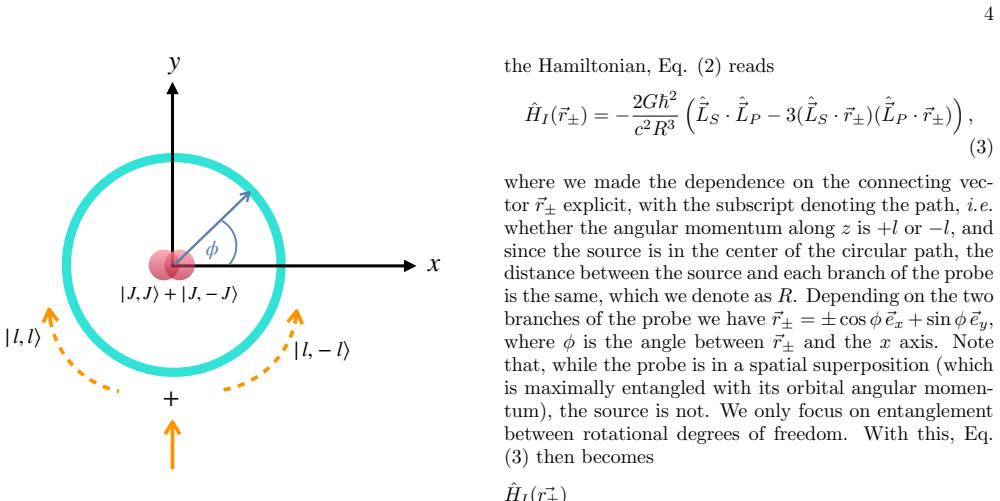
read the original abstract
Gravity-induced entanglement has been proposed as a method for testing the non-classical nature of gravity via tabletop experiments. While most existing proposals are restricted to the Newtonian limit, the frame dragging effect offers access to genuinely post-Newtonian features of the gravitational interaction and remains comparatively less explored. Here, we study gravity-induced entanglement generated by frame dragging in an interferometric setting and compute the entanglement phase between the rotational degrees of freedom of a source mass and the paths of a particle in two complementary ways: (i) via Schr\"odinger evolution with a quantized Lense-Thirring Hamiltonian in the large angular momentum limit, and (ii) via the on-shell action of linearized quantum gravity within the stationary phase approximation. Both approaches yield the same entanglement phase, consistent with the proper time difference between the interferometer arms. The path integral derivation further reveals how gravitational retardation modifies the entanglement phase, thereby making the local, relativistically causal linearized-gravity description explicit. Under the standard locality/mediator assumptions used in existing arguments, the resulting entanglement would witness non-classicality of the gravitational interaction.
Editorial analysis
A structured set of objections, weighed in public.
Referee Report
Summary. The manuscript computes the entanglement phase generated by frame dragging in an interferometric GIE setup via two routes: (i) Schrödinger evolution under a quantized Lense-Thirring Hamiltonian in the large angular-momentum limit and (ii) the stationary-phase on-shell action of linearized quantum gravity. Both routes produce identical phases that match the proper-time difference between arms; the path-integral route additionally exhibits explicit retardation and local causality. The non-classicality interpretation is stated conditionally on the locality/mediator assumptions standard in the Newtonian GIE literature.
Significance. If the two calculational routes are independent, the work supplies a concrete post-Newtonian observable whose phase is shown to be consistent with proper time while also displaying retardation. The dual-method agreement and explicit treatment of causality constitute a strength that partially addresses concerns about whether the result is tautological. The conditional non-classicality claim follows the same logical structure already accepted in the Newtonian GIE literature.
minor comments (2)
- [Abstract] The abstract states that the two methods are 'independent' and 'complementary,' but the manuscript would benefit from an explicit sentence (e.g., near the end of the introduction) clarifying which steps in each derivation are logically independent of the proper-time difference.
- Notation for the large-J limit and the stationary-phase approximation should be cross-referenced between the Hamiltonian and path-integral sections to make the agreement easier to trace.
Simulated Author's Rebuttal
We thank the referee for their positive assessment of the manuscript, including recognition of the independent calculational routes, the explicit retardation effects, and the conditional non-classicality claim under standard locality assumptions. We are pleased that the work is recommended for acceptance.
Circularity Check
No significant circularity; derivation self-contained
full rationale
The manuscript derives the entanglement phase via two independent routes (quantized Lense-Thirring Hamiltonian in large-J limit; stationary-phase on-shell action of linearized quantum gravity) and reports exact numerical agreement plus explicit retardation in the path-integral route. This agreement is presented as a consistency check against the known proper-time difference, not as a prediction derived from that difference. The non-classicality claim is explicitly conditional on locality/mediator assumptions imported from prior GIE literature rather than re-derived or self-cited as load-bearing. No step reduces by construction to its own inputs, no fitted parameter is relabeled a prediction, and no uniqueness theorem or ansatz is smuggled via self-citation. The calculation is therefore externally falsifiable against the two distinct formalisms and against the geometric proper-time benchmark.
Axiom & Free-Parameter Ledger
axioms (1)
- domain assumption Standard locality/mediator assumptions suffice to interpret entanglement as evidence of non-classical gravity
Reference graph
Works this paper leans on
-
[1]
The entangling phase is thus given by ∆ = ∆S/ℏ
The initial state of the whole system is then given by |Ψi⟩= 1√ 2 (| ↑⟩+| ↓⟩)⊗ 1√ 2 (|L⟩+|R⟩).(29) Applying the unitary evolution (28) to the above, the state becomes |Ψf ⟩= 1 2 h | ↑⟩ e iS−J ℏ |L⟩+e iS+J ℏ |R⟩ +| ↓⟩ e iS+J ℏ |L⟩+e iS−J ℏ |R⟩ i =1 2 e iS+J ℏ h | ↑⟩ e i∆S ℏ |L⟩+|R⟩ +| ↓⟩ |L⟩+e i∆S ℏ |R⟩ i .(30) Note that the factor exp[iS+J /ℏ] in the fron...
-
[2]
Calculation ofS sp Substituting the energy-momentum tensor of the probe particle, Eq. (10), into the integral (21), we have Ssp = m0 4 Z dtd3rhsource µν (r, t)V µν probe(t)δ(3)(r−q(t)).(A1) From the metric perturbation (16)-(19), it follows that hsource µν (t,r)V µν probe(t) = 2GM γ(t) |r| 1 + v(t)2 c2 + 4GJ(t− |r|/c)γ(t) c2|r|3 (yvx(t)−xv y(t)).(A2) Henc...
-
[3]
Calculation ofS ps From (12) and (22), we have Sps = Gm0 c4 Z dtd3r T source µν (t,r) ¯V µν probe(˜t) | ˜d| − ˜d·v( ˜t)/c ,(A7) where ˜t= ˜t(t,r) is the solution ofc(t− ˜t) =|r−q( ˜t)|, and ˜d= ˜d(t,r) =r−q( ˜t(t,r)). Using (13) and (15), the numerator in the integral is calculated to be T source µν (t,r) ¯V µν probe(˜t) =γ( ˜t) 1 2 c2(c2 +v( ˜t)2)M+c 2J(...
-
[4]
Proof of Eq. (A12) To prove (A12), we start with the definition of ˜t: c(t− ˜t) =|r−q( ˜t)|.(A15) Taking the total differential of the above equation yields c(dt−d ˜t) = r−q( ˜t) |r−q( ˜t)| ·(dr−v( ˜t)d˜t),(A16) which gives c− (r−q( ˜t))·v( ˜t) |r−q( ˜t)| d˜t=cdt− (r−q( ˜t))·dr |r−q( ˜t)| .(A17) Hence, ∂˜t ∂x =− x−x p(˜t) c|r−q( ˜t)| −(r−q( ˜t))·v( ˜t) =−...
-
[5]
Rosenfeld, ¨Uber die gravitationswirkungen des lichtes, Zeitschrift f¨ ur Physik65, 589 (1930)
L. Rosenfeld, ¨Uber die gravitationswirkungen des lichtes, Zeitschrift f¨ ur Physik65, 589 (1930)
1930
-
[6]
Rosenfeld, Zur quantelung der wellenfelder, Annalen 12 der Physik397, 113 (1930)
L. Rosenfeld, Zur quantelung der wellenfelder, Annalen 12 der Physik397, 113 (1930)
1930
-
[7]
DeWitt-Morette and D
C. DeWitt-Morette and D. Rickles,The Role of Gravita- tion in Physics: Report from the 1957 Chapel Hill Con- ference(Edition Open Access (Max Planck Research Li- brary for the History and Development of Knowledge), 2011)
1957
-
[8]
Colella, A
R. Colella, A. W. Overhauser, and S. A. Werner, Obser- vation of gravitationally induced quantum interference, Physical Review Letters34, 1472 (1975)
1975
-
[9]
L. Lami, J. S. Pedernales, and M. B. Plenio, Testing the quantumness of gravity without entanglement, Physical Review X14, 021022 (2024)
2024
-
[10]
A noise inequality for classical forces
D. Kafri and J. M. Taylor, A noise inequality for classical forces (2013), arXiv:1311.4558 [quant-ph]
work page internal anchor Pith review Pith/arXiv arXiv 2013
-
[11]
Kafri, J
D. Kafri, J. M. Taylor, and G. J. Milburn, A classical channel model for gravitational decoherence, New Jour- nal of Physics16, 065020 (2014)
2014
-
[12]
N. H. Lindner and A. Peres, Testing quantum superpo- sitions of the gravitational field with Bose–Einstein con- densates, Physical Review A71, 024101 (2005)
2005
-
[13]
S. Bose, A. Mazumdar, G. W. Morley, H. Ulbricht, M. Toroˇ s, M. Paternostro, A. A. Geraci, P. F. Barker, M. Kim, and G. Milburn, Spin entanglement witness for quantum gravity, Physical Review Letters119, 240401 (2017)
2017
-
[14]
Marletto and V
C. Marletto and V. Vedral, Gravitationally induced en- tanglement between two massive particles is sufficient evidence of quantum effects in gravity, Physical Review Letters119, 240402 (2017)
2017
-
[15]
Marletto and V
C. Marletto and V. Vedral, When can gravity path- entangle two spatially superposed masses?, Physical Re- view D98, 046001 (2018)
2018
-
[16]
Marletto and V
C. Marletto and V. Vedral, Witnessing non-classicality beyond quantum theory, Physical Review D102, 086012 (2020)
2020
-
[17]
M. J. W. Hall and M. Reginatto, On two recent proposals for witnessing nonclassical gravity, Journal of Physics A: Mathematical and Theoretical51, 085303 (2018)
2018
-
[18]
R. J. Marshman, A. Mazumdar, and S. Bose, Locality and entanglement in table-top testing of the quantum na- ture of linearized gravity, Physical Review A101, 052110 (2020)
2020
-
[19]
T. D. Galley, F. Giacomini, and J. H. Selby, A no-go theorem on the nature of the gravitational field beyond quantum theory, Quantum6, 779 (2022)
2022
-
[20]
Belenchia, R
A. Belenchia, R. M. Wald, F. Giacomini, E. Castro-Ruiz, ˇC. Brukner, and M. Aspelmeyer, Quantum superposition of massive objects and the quantization of gravity, Phys- ical Review D98, 126009 (2018)
2018
-
[21]
Rydving, E
E. Rydving, E. Aurell, and I. Pikovski, Do gedanken ex- periments compel quantization of gravity?, Physical Re- view D104, 086024 (2021)
2021
-
[22]
Carney, Newton, entanglement, and the graviton, Physical Review D105, 024029 (2022)
D. Carney, Newton, entanglement, and the graviton, Physical Review D105, 024029 (2022)
2022
-
[23]
D. L. Danielson, G. Satishchandran, and R. M. Wald, Gravitationally mediated entanglement: Newtonian field versus gravitons, Physical Review D105, 086001 (2022)
2022
-
[24]
Mart´ ın-Mart´ ınez and T
E. Mart´ ın-Mart´ ınez and T. R. Perche, What gravity me- diated entanglement can really tell us about quantum gravity, Physical Review D108, L101702 (2023)
2023
-
[25]
Christodoulou and C
M. Christodoulou and C. Rovelli, On the possibility of laboratory evidence for quantum superposition of geome- tries, Physics Letters B792, 64 (2019)
2019
-
[26]
Christodoulou, A
M. Christodoulou, A. Di Biagio, R. Howl, and C. Rov- elli, Gravity entanglement, quantum reference systems, degrees of freedom, Classical and Quantum Gravity40, 047001 (2023)
2023
-
[27]
Christodoulou and C
M. Christodoulou and C. Rovelli, On the possibility of experimental detection of the discreteness of time, Fron- tiers in Physics8, 207 (2020)
2020
-
[28]
L.-Q. Chen, F. Giacomini, and C. Rovelli, Quantum states of fields for quantum split sources, Quantum7, 958 (2023)
2023
-
[29]
Fragkos, M
V. Fragkos, M. Kopp, and I. Pikovski, On inference of quantization from gravitationally induced entanglement, AVS Quantum Science4, 045601 (2022)
2022
-
[30]
Aziz and R
J. Aziz and R. Howl, Classical theories of gravity produce entanglement, Nature646, 813 (2025)
2025
-
[31]
Di Biagio, The simple reason why classical gravity can entangle (2025), arXiv:2511.02683 [gr-qc]
A. Di Biagio, The simple reason why classical gravity can entangle (2025), arXiv:2511.02683 [gr-qc]
-
[32]
C. Marletto and V. Vedral, Classical gravity can- not mediate entanglement by local means (2025), arXiv:2510.19969 [quant-ph]
-
[33]
When does entanglement through gravity imply gravitons?
N. Mitrakos, M. Papageorgiou, T. R. Perche, and M. Christodoulou, When does entanglement through gravity imply gravitons?, arXiv preprint arXiv:2601.03214 (2026)
work page internal anchor Pith review Pith/arXiv arXiv 2026
-
[34]
Trillo and M
D. Trillo and M. Navascu´ es, Di´ osi-penrose model of clas- sical gravity predicts gravitationally induced entangle- ment, Physical Review D111, L121101 (2025)
2025
-
[35]
Spaventa, L
G. Spaventa, L. Lami, and M. B. Plenio, On tests of the quantum nature of gravitational interactions in presence of non-linear corrections to quantum mechanics, Quan- tum7, 1157 (2023)
2023
-
[36]
Anastopoulos, M
C. Anastopoulos, M. Lagouvardos, and K. Savvidou, Gravitational effects in macroscopic quantum systems: a first-principles analysis, Classical and Quantum Gravity 38, 155012 (2021)
2021
-
[37]
S. L. Ludescher, L. D. Loveridge, T. D. Galley, and M. P. M¨ uller, Gravity-mediated entanglement via infinite- dimensional systems, Journal of Physics A: Mathemat- ical and Theoretical59, 215302 (2026)
2026
-
[38]
Weller-Davies, Is there a ‘smoking gun’ test for quan- tum gravity?, Nature646, 809 (2025)
Z. Weller-Davies, Is there a ‘smoking gun’ test for quan- tum gravity?, Nature646, 809 (2025)
2025
-
[39]
Angeli and M
O. Angeli and M. Carlesso, Entanglement in markovian hybrid classical-quantum theories of gravity, Physical Re- view D112, 024047 (2025)
2025
-
[40]
J. Oppenheim and Z. Weller-Davies, Covariant path inte- grals for quantum fields back-reacting on classical space- time, arXiv preprint arXiv:2302.07283 (2023)
-
[41]
C. Marletto, J. Oppenheim, V. Vedral, and E. Wilson, Classical gravity cannot mediate entanglement, arXiv preprint arXiv:2511.07348 (2025)
-
[42]
Aspelmeyer, Quantum entanglement by gravity as tests of gravitational collapse models ` a la di´ osi and pen- rose, Comptes Rendus
M. Aspelmeyer, Quantum entanglement by gravity as tests of gravitational collapse models ` a la di´ osi and pen- rose, Comptes Rendus. Physique27, 1 (2026)
2026
-
[43]
T. Feng, V. Vedral, and C. Marletto, Collapse-based models for gravity do not violate the entanglement-based witness of nonclassicality, Physical Review D113, 104055 (2026)
2026
-
[44]
Can classical theories of gravity produce entanglement?
A. Gundhi, G. Infantino, and A. Bassi, Can classical the- ories of gravity produce entanglement?, arXiv preprint arXiv:2604.19696 (2026)
work page internal anchor Pith review Pith/arXiv arXiv 2026
-
[45]
M. D. Schneider, N. Huggett, and N. Linnemann, A demonstration that classical gravity does not pro- duce entanglement, Classical and Quantum Gravity 10.1088/1361-6382/ae6f62 (2025)
-
[46]
Lin and S
F.-L. Lin and S. Mondal, Can newtonian gravity pro- 13 duce quantum entanglement?, Physical Review D113, L061901 (2026)
2026
-
[47]
No, classical gravity does not entangle quantized matter fields
L. Di´ osi, No, classical gravity does not entangle quantized matter fields, arXiv preprint arXiv:2511.00852 (2025)
work page internal anchor Pith review Pith/arXiv arXiv 2025
-
[48]
N. Boulle and G. Franzmann, Subsystems (in) depen- dence in gie proposals, arXiv preprint arXiv:2512.17024 (2025)
-
[49]
H. Xue, Z. Tang, C. Yang, Z. Han, Z. Kan, and Y. Liu, Aziz and howl’s gravity-induced entanglement channel is essentially classical mechanics, arXiv preprint arXiv:2604.16276 (2026)
work page internal anchor Pith review Pith/arXiv arXiv 2026
-
[50]
M. J. Hall and M. Reginatto, On two recent proposals for witnessing nonclassical gravity, Journal of Physics A: Mathematical and Theoretical51, 085303 (2018)
2018
-
[51]
Huggett, N
N. Huggett, N. Linnemann, and M. D. Schneider,Quan- tum Gravity in a Laboratory?(Cambridge University Press, 2023)
2023
-
[52]
S. Bose, I. Fuentes, A. A. Geraci, S. M. Khan, S. Qvar- fort, M. Rademacher, M. Rashid, M. Toroˇ s, H. Ulbricht, and C. C. Wanjura, Massive quantum systems as inter- faces of quantum mechanics and gravity, Reviews of Mod- ern Physics97, 015003 (2025)
2025
-
[53]
Carney, P
D. Carney, P. C. E. Stamp, and J. M. Taylor, Tabletop experiments for quantum gravity: a user’s manual, Clas- sical and Quantum Gravity36, 034001 (2019)
2019
-
[54]
Christodoulou, A
M. Christodoulou, A. Di Biagio, M. Aspelmeyer, ˇC. Brukner, C. Rovelli, and R. Howl, Locally mediated entanglement in linearized quantum gravity, Physical Re- view Letters130, 100202 (2023)
2023
-
[55]
T. B. Lanta˜ no, L. Petruzziello, S. F. Huelga, and M. B. Plenio, Angular Momentum Entanglement Mediated By General Relativistic Frame Dragging, Quantum10, 2042 (2026)
2042
-
[56]
Petruzziello, T
L. Petruzziello, T. B. Lanta˜ no Pinto, S. F. Huelga, and M. B. Plenio, Experimental witness for general relativis- tic effects in quantum mechanics, Int. J. Mod. Phys. D 34, 2544026 (2025)
2025
-
[57]
Wakakuwa, Detectability of post-newtonian classical and quantum gravity via quantum clock interferometry, Phys
E. Wakakuwa, Detectability of post-newtonian classical and quantum gravity via quantum clock interferometry, Phys. Rev. D113, 086008 (2026)
2026
-
[58]
M. Zych, F. Costa, I. Pikovski, and ˇC. Brukner, Quantum interferometric visibility as a witness of general relativis- tic proper time, Nature Communications2, 505 (2011)
2011
-
[59]
Roura, Gravitational redshift in quantum-clock inter- ferometry, Physical Review X10, 021014 (2020)
A. Roura, Gravitational redshift in quantum-clock inter- ferometry, Physical Review X10, 021014 (2020)
2020
-
[60]
Chen and F
L.-Q. Chen and F. Giacomini, Quantum effects in gravity beyond the newton potential from a delocalised quantum source, Physical Review X15, 031063 (2025)
2025
-
[61]
J. M. Cohen and B. Mashhoon, Standard clocks, inter- ferometry, and gravitomagnetism, Physics Letters A181, 353 (1993)
1993
-
[62]
Ciufolini and J
I. Ciufolini and J. A. Wheeler,Gravitation and inertia (Princeton university press, 1995)
1995
-
[63]
R. M. Wald, Gravitational spin interaction, Physical Re- view D6, 406 (1972)
1972
-
[64]
C. W. Misner, K. S. Thorne, and J. A. Wheeler,Gravi- tation(W. H. Freeman, San Francisco, 1973)
1973
-
[65]
B. M. Barker and R. F. O’Connell, Gravitational two-body problem with arbitrary masses, spins, and quadrupole moments, Physical Review D12, 329 (1975)
1975
-
[66]
Weinberg,Gravitation and Cosmology: Principles and Applications of the General Theory of Relativity(John Wiley and Sons, New York, 1972)
S. Weinberg,Gravitation and Cosmology: Principles and Applications of the General Theory of Relativity(John Wiley and Sons, New York, 1972)
1972
-
[67]
G¨ ull¨ u and B
I. G¨ ull¨ u and B. Tekin, Spin-spin interactions in massive gravity and higher derivative gravity theories, Physics Letters B728, 268 (2014)
2014
discussion (0)
Sign in with ORCID, Apple, or X to comment. Anyone can read and Pith papers without signing in.