REVIEW 3 major objections 4 minor 65 references
Dissipation engineering of fermionic long-range order beyond Lindblad
T0 review · 3 major / 4 minor · reviewed 2026-08-06 · deepseek-v4-flash
Pith's one-line read Dissipative η-pairing long-range order survives spin exchange and requires a bath spectral density that is symmetric about zero energy and wide enough to cover the model's transitions.
desk verdict Useful extension of dissipative eta-pairing to the tUJ model, but the Redfield symmetry criterion is not physically established—it is baked into the symmetrized bath spectrum of Eq. (24). read the letter →
The pith
A machine-rendered reading of the paper's core claim, the machinery that carries it, and where it could break.
The reading
What carries the argument
The central object is Yang's η algebra, $\eta^+=\sum_i(-1)^i c^{\dagger}_{i\uparrow}c^{\dagger}_{i\downarrow}$, $\eta^-=(\eta^+)^\dagger$, $\eta^z$, which commutes with the tUJ Hamiltonian at half filling while the dephasing jump operators $L_j=s^z_j=n_{\uparrow,j}-n_{\downarrow,j}$ commute with $\eta^\pm$. Under Lindblad dephasing the spin sector is driven to infinite temperature while charge-sector correlations survive. In the Redfield treatment the rotated jump operator $L_j(\tau)=\int_0^\tau \alpha(s)e^{-iHs}L_j e^{iHs}ds$ becomes non-Hermitian unless the spectral density $J(\omega)$ is symmetric, and a narrow cutoff leaves some dissipative channels closed; both effects suppress the distance-invariant η-correlations.
What would settle it
Simulate the same $tUJ$ chain coupled to a structured bath with a numerically exact non-perturbative method at $\gamma=2t$ and check whether distance-independent $\langle\eta^+_i\eta^-_{i+j}\rangle$ still appears only for symmetric, wide-enough spectral densities; if it appears for asymmetric or narrow baths, the criterion is an artifact of the Redfield approximation.
Extended reading notes
Core claim
The paper shows that the Lindblad mechanism for stabilizing η-pairing off-diagonal long-range order survives in the tUJ model and, for structured baths, the steady state exhibits distance-independent correlations $\langle\eta^+_i\eta^-_{i+j}\rangle$ only when the bath spectral density is even around $\omega=0$ and its cutoff covers the relevant transition-energy range of the Hamiltonian. It further finds that going beyond Lindblad does not break the strong symmetry protecting η-pairing, yet the steady state can still lose the translational invariance of the correlations, so the ODLRO is genuinely tied to the Lindblad-type structure of the dissipation rather than to the symmetry alone.
Load-bearing premise
The Bloch-Redfield master equation with a zero-temperature bath and a manually symmetrized spectral density remains accurate at $\gamma=2t$, even though the dissipation rate is not small compared with the energy scales $t$ and $U$.
Editorial extensions
If this is right
- The symmetry-based dissipative preparation of η-pairing superfluidity, originally formulated for the Hubbard model, works unchanged when a planar spin-exchange term $J$ is added, so the tUJ model is a viable target for cavity-QED emulators.
- For any realistic structured bath, the protocol succeeds only if $J(\omega)$ is approximately even about $\omega=0$ over the transition-energy range of $H$; a bath that is flat only on one side will not produce ODLRO.
- The frequency cutoff $\omega_c$ must be at least as large as the largest relevant transition energy; below that, the steady-state η-correlations are not translationally invariant.
- Even with the strong η symmetry intact, non-Lindblad dissipation can change the steady state, so the preparation scheme is robust only around a Lindblad-type description.
- Moving away from the Markovian limit generally lowers the condensate fraction and lengthens the convergence time, with an Ohmic linear spectral density staying closest to the Markovian result.
Reading between the lines
- The symmetry-plus-cutoff criterion is plausibly general: any dissipative protocol that relies on a strong symmetry to protect a target sector should require the bath to open all symmetry-preserving dissipative channels across the relevant spectral range, not just to preserve the algebra.
- A direct experimental test would be to tune a cavity or bosonic reservoir so that its coupling strength varies asymmetrically in frequency and to measure the distance dependence of the η-correlations; the paper predicts ODLRO will disappear when the asymmetry enters the Hamiltonian's transition range.
- The Lorentzian results in the appendix suggest that a centered, sufficiently broad Lorentzian behaves like the Markovian limit whereas a shifted one slows convergence; this could be used as a finite-size diagnostic, with the optimal Lorentzian width tracking the system's largest transition energy.
Signed reviews
Editorial analysis
A structured set of objections, weighed in public.
Referee Report
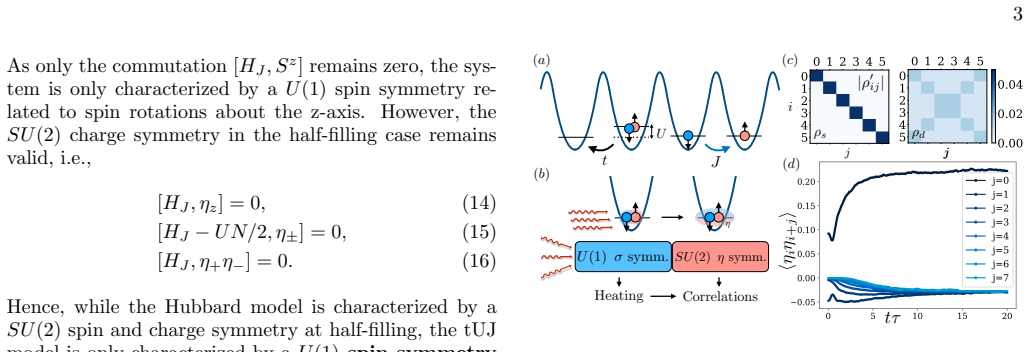
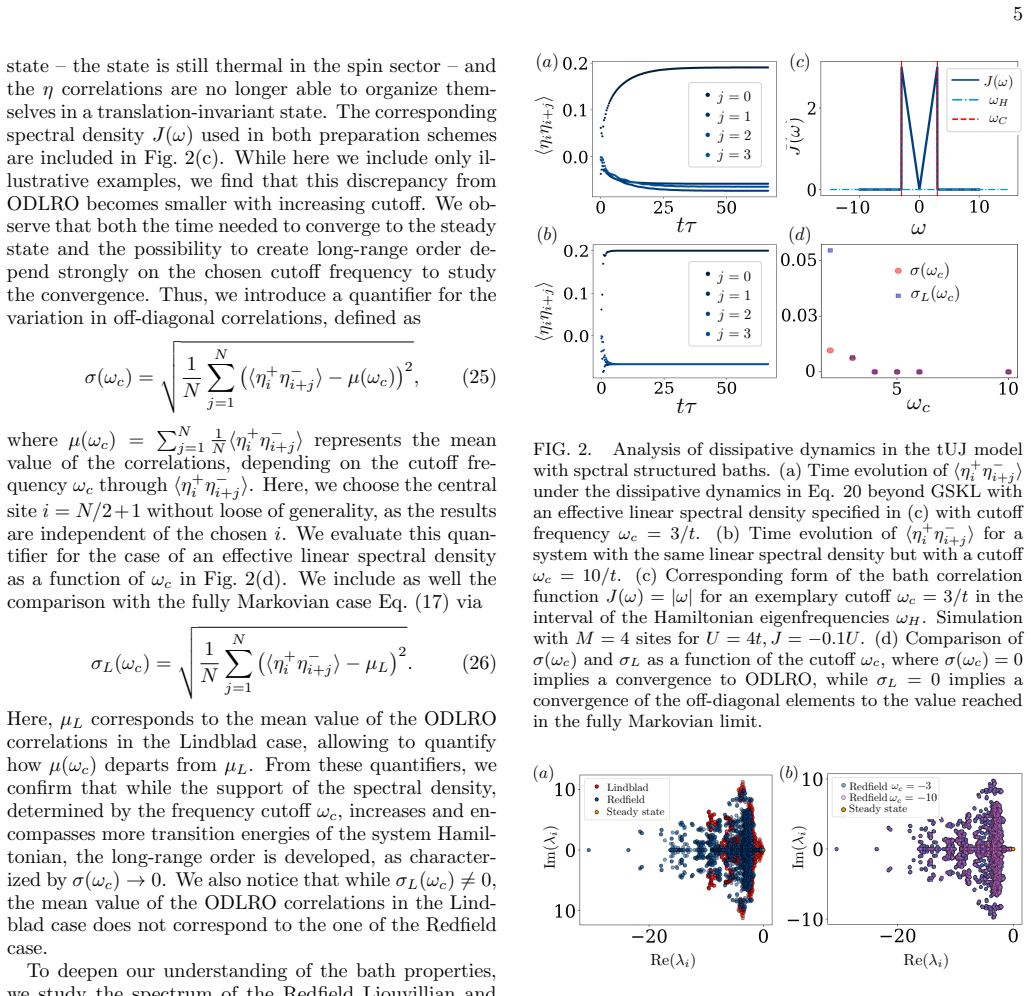
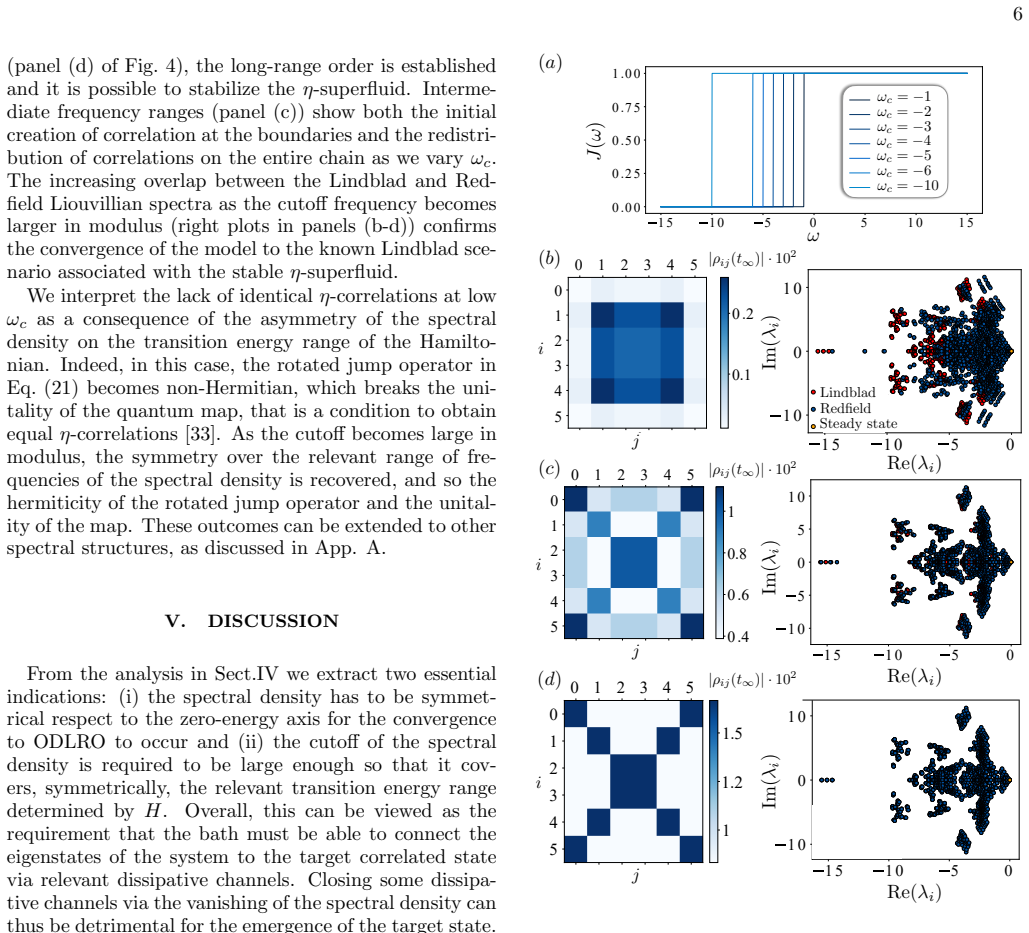
Summary. The manuscript studies dissipative preparation of η-pairing off-diagonal long-range order (ODLRO) in the tUJ model, extending the mechanism of Tindall et al. (PRL 123, 030603). In the Lindblad part (Sec. III), spin dephasing with jump operators L_j = s^z_j is shown numerically, for M=8 sites, to produce a steady state with distance-independent ⟨η_i^+ η_{i+j}^-⟩, indicating that the mechanism survives the spin-exchange term J. In the Redfield part (Secs. IV–V), the flat bath is replaced by structured spectral densities, using Eq. (24) with an extended lower integration limit; numerical results show that for J(ω)=|ω| a sufficiently large cutoff is needed, and for a step-like J(ω)=θ(ω−ω_c) a sufficiently negative step position is needed to approach ODLRO. Section V condenses these observations into two criteria: the spectral density should be symmetric about zero and should symmetrically cover the relevant transition-energy range. Appendices A and B add Lorentzian and multi-peak spectral densities and numerical details.
Significance. If correct, the paper would generalize a known symmetry-based dissipative preparation to the tUJ model and would provide a simple frequency-domain design rule for structured baths, which is potentially useful for cavity-QED implementations. The Lindblad extension is a nontrivial numerical result, and the paper is honest about the sufficient-condition character of its ODLRO criterion and about the parameter-specificity of some Appendix A results. However, the Redfield part is presently a heuristic numerical criterion rather than a demonstrated physical law: the master-equation model in Eq. (24) uses a symmetrized bath correlation function, the simulated coupling strength is outside the weak-coupling regime, and no finite-size or sampling-error analysis supports the σ(ω_c)→0 claim. With those gaps closed, or with the claims suitably restated as conditional on an engineered symmetric bath, the criterion could become a practical guideline.
major comments (3)
- [Sec. IV, Eq. (24)] The replacement of the one-sided zero-temperature bath correlation function of Eq. (22) by the two-sided integral with an even J(ω) is not a harmless extension. For an even, positive J, α(s) is real and even, which is the correlation function of classical (infinite-temperature) noise, not of the zero-temperature Bose bath stated in Eq. (22); a physical quantum bath obeys α(−s)=α(s)^* with the negative-frequency weight fixed by detailed balance. Since every Redfield simulation in Figs. 2–4 uses this symmetrized α(s), the conclusion in Sec. V that J must be symmetric about zero is at least partly imposed by construction. Please either re-derive the analysis with the one-sided spectrum J(ω≥0) of Eq. (22) and test the same cutoff/asymmetry questions, or restate the central claim as applying to an engineered symmetric (effective-infinite-temperature) bath.
- [Sec. IV and Appendix B] The Bloch-Redfield master equation is used with γ=2 (in units of t) while U=4t and t=1, so the dissipation rate is not small compared with the system energy scales. The paper gives no check of the Born-Markov or secular assumptions and no check of complete positivity of the resulting Redfield dynamics, which is known to be violated in general. The cutoff and symmetry dependences in Figs. 2–4 and the Liouvillian spectra in Fig. 3 could therefore be artifacts of the Redfield approximation rather than properties of the dissipative preparation scheme. Please add a validity test such as a small-γ extrapolation, a comparison with a non-perturbative method, or a positivity check on ρ(t), and restrict the conclusions to the regime in which Redfield is controlled.
- [Sec. IV, Eq. (25) and Fig. 2(d)] The central quantifier σ(ω_c) is evaluated at M=4 (with M=8 in Fig. 1) without finite-size scaling, and no error bars or uncertainty propagation are given for σ, μ, or σ_L even though the data come from quantum-jump Monte Carlo with N=2000 trajectories (Fig. 1) or 1000 trajectories (Appendix B). Because ODLRO is a thermodynamic-limit statement and the claim is that σ(ω_c)→0 as ω_c grows, the paper should demonstrate that the cutoff threshold and the j-independence of the correlations are stable under system-size and sampling-error variation. As written, the criterion is a heuristic numerical observation rather than a demonstrated property.
minor comments (4)
- [Throughout] There are several typos and wording errors that should be corrected: 'particule-hole' (Sec. II), 'implentations' and 'impassibility of realizing a SF state' (Secs. IV–V), 'without loose of generality' near Eq. (25), and 'ORDLO' in the caption of Fig. 3.
- [Fig. 1 caption] The caption says 'M = 6 particles at half-filling' for the projections in panel (c), while elsewhere M denotes the number of lattice sites; please use a consistent notation such as 'M=6 sites at half-filling (N=M particles)'.
- [Fig. 4 and Sec. IV.B] The step-like spectral density J(ω)=θ(ω−ω_c) is described as a 'cutoff', but it is a one-sided step whose support is [ω_c,∞). The text should clarify how varying ω_c from 0 to large negative values changes the symmetry of the spectral density over the relevant transition-energy range, since the terminology 'low cutoff' and 'large cutoff' is confusing for this functional form.
- [Appendix A, Fig. 7] The note in Appendix A states that in Fig. 7 the super-Ohmic, sub-Ohmic, and Lorentzian values are specific and do not represent a general trend. This caveat should be carried into the main text where the Ohmic-like bath is described as performing best, to avoid overgeneralization from a single parameter choice.
Circularity Check
No circularity: numerical Redfield results are independent; the bath-symmetry criterion is a modeling conclusion, not an input.
full rationale
The paper's central claims are supported by direct computation rather than by importing the target result. In Sec. III, Eq. (17) is solved numerically for the tUJ model, with η-pairing ODLRO diagnosed from the simulated two-point correlators in Fig. 1(d); Eq. (19) verifies [L_j, η±] = 0 in the text. Ref. [33] supplies the external Lindblad benchmark and is not by any of the present authors; it is used as a comparison, not as a proof that the tUJ version works. The Redfield analysis in Sec. IV defines the spectral-density dependence through Eq. (24) and measures convergence through σ(ωc) and σL(ωc) in Eqs. (25)-(26). No parameter is fitted to the target ODLRO, and symmetric J is not used in the definition of ODLRO; the Sec. V conditions ('the spectral density has to be symmetrical respect to the zero-energy axis' and the cutoff must cover the relevant transition range) are interpretations of the observed steady-state behavior. The main caveat, that extending Eq. (22) to Eq. (24) may impose a symmetric or infinite-temperature-like bath and that γ = 2t may lie outside the Bloch-Redfield weak-coupling regime, is a physical-modeling and validity limitation rather than a circular reduction; it does not make the derivation equivalent to its inputs. Self-citations by the authors appear only in background and experimental contexts and are not load-bearing for the central derivation.
Assumptions & free parameters
free parameters (5)
- Dissipative rate gamma =
2t (t=1)
- On-site interaction U =
4t
- Spin-exchange J =
-0.1U
- Spectral density cutoffs omega_c =
3/t and 10/t (linear); -1, -5, -10 (step)
- Spectral density amplitude =
Not explicitly stated for J(w) proportional to |w|; implied by gamma=2t in the Markovian limit
assumptions (4)
- domain assumption The Redfield/Bloch-Redfield master equation (20)-(24) with zero-temperature bath and negative-frequency extension describes the open-system dynamics to sufficient accuracy.
- domain assumption A finite chain of M=4 or 8 sites at half filling with distance-invariant eta correlations indicates ODLRO in the thermodynamic limit.
- standard math The Lindblad result of Tindall et al. [33] regarding unital dephasing and eta-symmetry protection is correct.
- standard math Yang's criterion and the eta-SU(2) algebra at half filling.
Cite this review
Pith. "Pith review of Dissipation engineering of fermionic long-range order beyond Lindblad." pith.science (2026). https://pith.science/paper/DWG4GZ5M
@misc{pith2026250700553,
  author       = {Pith},
  title        = {Pith review of: Dissipation engineering of fermionic long-range order beyond Lindblad},
  year         = {2026},
  howpublished = {\url{https://pith.science/paper/DWG4GZ5M}},
  note         = {Machine review of arXiv:2507.00553}
}
read the original abstract
We investigate the possibility of engineering dissipatively long-range order that is robust against heating in strongly interacting fermionic systems, relevant for atoms in cavity QED. It was previously shown [Tindall et al. Phys.Rev.Lett. 123, 030603 (2019)] that it is possible to stabilize long-range order in a Hubbard model by exploiting a dissipative mechanism in the Lindblad limit, this latter being valid for spectrally unstructured baths. Here, we first show that this mechanism still holds when including additional spin-exchange interactions in the model, that is for the tUJ model. Moreover, by means of a Redfield approach that goes beyond the Lindblad case, we show how the stability of the engineered state depends crucially on properties of the bath spectral density and discuss the feasibility of those properties in an experiment.
Figures
Figures from the paper (3 more)


Reference graph
Works this paper leans on
-
[1]
Jaksch, C
D. Jaksch, C. Bruder, J. I. Cirac, C. W. Gardiner, and P. Zoller, Phys. Rev. Lett. 81, 3108 (1998)
1998
- [2]
-
[3]
J. Yago Malo, L. Lepori, L. Gentini, and M. L. M. Chio- falo, Technologies 12 (2024)
work page 2024
-
[4]
Gross and W
C. Gross and W. S. Bakr, Nature Physics17, 1316 (2021)
2021
-
[5]
W. S. Bakr, J. I. Gillen, A. Peng, S. F¨ olling, and M. Greiner, Nature 462, 74 (2009)
work page 2009
- [6]
-
[7]
Breuer and F
H.-P. Breuer and F. Petruccione, The Theory of Open Quantum Systems (Oxford University Press, 2007)
2007
-
[8]
de Vega and D
I. de Vega and D. Alonso, Rev. Mod. Phys. 89, 015001 (2017)
2017
Show all 65 references
-
[9]
Weimer, A
H. Weimer, A. Kshetrimayum, and R. Or´ us, Rev. Mod. Phys. 93, 015008 (2021)
2021
-
[10]
T. D. Farokh Mivehvar, Francesco Piazza and H. Ritsch, Advances in Physics 70, 1 (2021), https://doi.org/10.1080/00018732.2021.1969727
2021
-
[11]
Schmidt, H
D. Schmidt, H. Tomczyk, S. Slama, and C. Zimmermann, 10 Phys. Rev. Lett. 112, 115302 (2014)
2014
-
[12]
Gangl and H
M. Gangl and H. Ritsch, Phys. Rev. A 61, 043405 (2000)
2000
-
[13]
Mivehvar, S
F. Mivehvar, S. Ostermann, F. Piazza, and H. Ritsch, Phys. Rev. Lett. 120, 123601 (2018)
2018
-
[14]
Klinner, M
J. Klinner, M. Lindholdt, B. Nagorny, and A. Hem- merich, Phys. Rev. Lett. 96, 023002 (2006)
2006
-
[15]
A. J. Koll´ ar, A. T. Papageorge, K. Baumann, M. A. Ar- men, and B. L. Lev, New Journal of Physics 17, 043012 (2015)
2015
-
[16]
V. D. Vaidya, Y. Guo, R. M. Kroeze, K. E. Ballantine, A. J. Koll´ ar, J. Keeling, and B. L. Lev, Phys. Rev. X 8, 011002 (2018)
2018
-
[17]
Gopalakrishnan, B
S. Gopalakrishnan, B. L. Lev, and P. M. Goldbart, Phys. Rev. Lett. 107, 277201 (2011)
2011
-
[18]
Gopalakrishnan, B
S. Gopalakrishnan, B. L. Lev, and P. M. Goldbart, Na- ture Physics 5, 845 (2009)
2009
-
[19]
K. E. Ballantine, B. L. Lev, and J. Keeling, Phys. Rev. Lett. 118, 045302 (2017)
2017
-
[20]
Torggler, S
V. Torggler, S. Kr¨ amer, and H. Ritsch, Phys. Rev. A95, 032310 (2017)
2017
-
[21]
Rotondo, M
P. Rotondo, M. Marcuzzi, J. P. Garrahan, I. Lesanovsky, and M. M¨ uller, Journal of Physics A: Mathematical and Theoretical 51, 115301 (2018)
2018
-
[22]
Fiorelli, M
E. Fiorelli, M. Marcuzzi, P. Rotondo, F. Carollo, and I. Lesanovsky, Phys. Rev. Lett. 125, 070604 (2020)
2020
-
[23]
B. P. Marsh, Y. Guo, R. M. Kroeze, S. Gopalakrishnan, S. Ganguli, J. Keeling, and B. L. Lev, Phys. Rev. X 11, 021048 (2021)
2021
-
[24]
Bentsen, T
G. Bentsen, T. Hashizume, A. S. Buyskikh, E. J. Davis, A. J. Daley, S. S. Gubser, and M. Schleier-Smith, Phys. Rev. Lett. 123, 130601 (2019)
2019
-
[25]
Baumann, C
K. Baumann, C. Guerlin, F. Brennecke, and T. Esslinger, Nature 464, 1301 (2010)
2010
-
[26]
Klinder, H
J. Klinder, H. Keßler, M. Wolke, L. Mathey, and A. Hemmerich, Proceedings of the Na- tional Academy of Sciences 112, 3290 (2015), https://www.pnas.org/doi/pdf/10.1073/pnas.1417132112
2015 doi
-
[27]
Benary, C
J. Benary, C. Baals, E. Bernhart, J. Jiang, M. R¨ ohrle, and H. Ott, New Journal of Physics 24, 103034 (2022)
2022
-
[28]
Ferri, R
F. Ferri, R. Rosa-Medina, F. Finger, N. Dogra, M. Sori- ente, O. Zilberberg, T. Donner, and T. Esslinger, Phys. Rev. X 11, 041046 (2021)
2021
-
[29]
Greiner, O
M. Greiner, O. Mandel, T. Esslinger, T. W. H¨ ansch, and I. Bloch, Nature 415, 39 (2002)
2002
-
[30]
Q. Chen, J. Stajic, S. Tan, and K. Levin, Physics Reports 412, 1 (2005)
2005
-
[31]
J. Jin, A. Biella, O. Viyuela, L. Mazza, J. Keeling, R. Fazio, and D. Rossini, Phys. Rev. X 6, 031011 (2016)
2016
-
[32]
T. E. Lee, S. Gopalakrishnan, and M. D. Lukin, Phys. Rev. Lett. 110, 257204 (2013)
2013
-
[33]
Tindall, B
J. Tindall, B. Buˇ ca, J. R. Coulthard, and D. Jaksch, Phys. Rev. Lett. 10.1103/PhysRevLett.123.030603 (2019)
2019 doi
-
[34]
Lindblad, Communications in Mathematical Physics 48, 119 (1976)
G. Lindblad, Communications in Mathematical Physics 48, 119 (1976)
1976
-
[35]
Gorini, A
V. Gorini, A. Kossakowski, and E. C. G. Su- darshan, Journal of Mathematical Physics 17, 821 (1976), https://pubs.aip.org/aip/jmp/article- pdf/17/5/821/19090720/821 1 online.pdf
1976
-
[36]
C. N. Yang, Phys. Rev. Lett. 63, 2144 (1989)
1989
-
[37]
D. F. Agterberg, J. S. Davis, S. D. Edkins, E. Fradkin, D. J. Van Harlingen, S. A. Kivelson, P. A. Lee, L. Radz- ihovsky, J. M. Tranquada, and Y. Wang, Annual Review of Condensed Matter Physics 11, 231–270 (2020)
2020
-
[38]
H. Zhao, R. Blackwell, M. Thinel, T. Handa, S. Ishida, X. Zhu, A. Iyo, H. Eisaki, A. N. Pasupathy, and K. Fujita, Nature 618, 940–945 (2023)
2023
-
[39]
Zhang, L.-H
S.-B. Zhang, L.-H. Hu, and T. Neupert, Nature Commu- nications 15, 10.1038/s41467-024-45951-3 (2024)
2024 doi
-
[40]
Colella, R
E. Colella, R. Citro, M. Barsanti, D. Rossini, and M.-L. Chiofalo, Phys. Rev. B 97, 134502 (2018)
2018
-
[41]
Schlawin and D
F. Schlawin and D. Jaksch, Phys. Rev. Lett. 123, 133601 (2019)
2019
-
[42]
Camacho-Guardian, R
A. Camacho-Guardian, R. Paredes, and S. F. Caballero- Ben ´ ıtez, Phys. Rev. A96, 051602 (2017)
2017
-
[43]
E. J. Davis, G. Bentsen, L. Homeier, T. Li, and M. H. Schleier-Smith, Phys. Rev. Lett. 122, 010405 (2019)
2019
-
[44]
M. A. Norcia, R. J. Lewis-Swan, J. R. K. Cline, B. Zhu, A. M. Rey, and J. K. Thompson, Science361, 259 (2018), https://www.science.org/doi/pdf/10.1126/science.aar3102
2018 doi
-
[45]
Baier, D
S. Baier, D. Petter, J. H. Becher, A. Patscheider, G. Na- tale, L. Chomaz, M. J. Mark, and F. Ferlaino, Phys. Rev. Lett. 121, 093602 (2018)
2018
-
[46]
Mazurenko, C
A. Mazurenko, C. S. Chiu, G. Ji, M. F. Parsons, M. Kan´ asz-Nagy, R. Schmidt, F. Grusdt, E. Demler, D. Greif, and M. Greiner, Nature 545, 462 (2017)
2017
-
[47]
A. G. Redfield, IBM J. Res. Dev. 1, 19 (1957)
1957
-
[48]
Tindall, Realising Complex Quantum States of Matter via Symmetries and Heating (PhD thesis, University of Oxford) (2021)
J. Tindall, Realising Complex Quantum States of Matter via Symmetries and Heating (PhD thesis, University of Oxford) (2021)
2021
-
[49]
Klein, M
A. Klein, M. Bruderer, S. R. Clark, and D. Jaksch, New Journal of Physics 9, 411 (2007)
2007
-
[50]
Damanet, A
F. Damanet, A. J. Daley, and J. Keeling, Phys. Rev. A 99, 033845 (2019)
2019
-
[51]
Palacino and J
R. Palacino and J. Keeling, Phys. Rev. Res. 3, L032016 (2021)
2021
-
[52]
Debecker, J
B. Debecker, J. Martin, and F. Damanet, Phys. Rev. Lett. 133, 140403 (2024)
2024
-
[53]
Debecker, J
B. Debecker, J. Martin, and F. Damanet, Phys. Rev. A 110, 042201 (2024)
2024
-
[54]
Debecker, L
B. Debecker, L. Pausch, J. Louvet, T. Bastin, J. Mar- tin, and F. Damanet, The role of non-markovian dissi- pation in quantum phase transitions: tricriticality, spin squeezing, and directional symmetry breaking (2025), arXiv:2504.11317 [quant-ph]
2025 arXiv
-
[55]
Johansson, P
J. Johansson, P. Nation, and F. Nori, Computer Physics Communications 10.1016/j.cpc.2012.02.021 (2012)
2012 doi
-
[56]
Buˇ ca, J
B. Buˇ ca, J. Tindall, and D. Jaksch, Nature Communica- tions 10, 1730 (2019)
2019
-
[57]
Lucchesi and M
L. Lucchesi and M. L. Chiofalo, Phys. Rev. Lett. 123, 060406 (2019)
2019
-
[58]
Kruchinin, H
S. Kruchinin, H. Nagao, and S. Aono, Modern Aspects of Superconductivity (WORLD SCIENTIFIC, 2010)
2010
-
[59]
A. J. Daley, P. O. Fedichev, and P. Zoller, Phys. Rev. A 69, 022306 (2004)
2004
-
[60]
Bruderer, A
M. Bruderer, A. Klein, S. R. Clark, and D. Jaksch, Phys. Rev. A 76, 011605 (2007)
2007
-
[61]
C. Chin, R. Grimm, P. Julienne, and E. Tiesinga, Rev. Mod. Phys. 82, 1225 (2010)
2010
-
[62]
Mandel, M
O. Mandel, M. Greiner, A. Widera, T. Rom, T. W. H¨ ansch, and I. Bloch, Physical review letters 91 1 , 010407 (2003)
2003
-
[63]
Yang, H.-N
B. Yang, H.-N. Dai, H. Sun, A. Reingruber, Z.-S. Yuan, and J.-W. Pan, Phys. Rev. A 96, 011602 (2017)
2017
-
[64]
Bernier, P
J.-S. Bernier, P. Barmettler, D. Poletti, and C. Kollath, Phys. Rev. A 87, 063608 (2013)
2013
-
[65]
Y. Shin, M. W. Zwierlein, C. H. Schunck, A. Schirotzek, and W. Ketterle, Phys. Rev. Lett. 97, 030401 (2006)
2006
Reviewed August 6, 2026 · model on record in the stance chip above.
Discussion (0). Continue with ORCID to comment.