REVIEW 104 references
From stability of Langevin diffusion to convergence of proximal MCMC for non-log-concave sampling
T0 review · reviewed 2026-08-07 · deepseek-v4-flash
Pith's one-line read PSGLA is proven to converge for non-convex composite potentials, up to a step-size bias, via a new drift-stability bound for inexact ULA.
The pith
A machine-rendered reading of the paper's core claim, the machinery that carries it, and where it could break.
The reading
This paper removes that convexity restriction. It first proves that two inexact Langevin chains with similar drifts have stationary laws that are close, with no extra discretization error term. It then rewrites PSGLA as a standard inexact ULA on a shadow chain driven by the drift b_gamma, and uses Moreau envelope calculus to show this drift is regular and dissipative. The resulting Theorem 3 gives exponential convergence to the smoothed target mu_gamma proportional to e^{-f-g_gamma}, with a bias of order gamma^{1/(2p)}, and a separate proposition shows mu_gamma approaches the true target pi as gamma goes to zero.
Experiments on 2D Gaussian mixtures and image inpainting suggest PnP-PSGLA mixes faster than PnP-ULA and restores images competitively. However, the proof relies on technical conditions, especially strong convexity at infinity of the Moreau envelope, which the authors admit are hard to verify and which are not checked for the neural denoiser used in the experiments.
Extended reading notes
Core claim
Theorem 3: Under Assumptions 2-3, for all gamma below a threshold and all k, Wp(pYk, mu_gamma) <= C1 r^{k gamma} + C2 gamma^{1/(2p)} and Wp(pXk, nu_gamma) <= C3 r^{k gamma} + C4 gamma^{1/(2p)}, where mu_gamma is proportional to e^{-f-g_gamma} and nu_gamma is its pushforward by the proximal operator. If correct, PSGLA samples the smoothed target geometrically fast, with bias that vanishes as gamma goes to zero.
Load-bearing premise
Assumption 3(ii): the Moreau envelope g_gamma is mu-strongly convex at infinity with mu >= 8 Lf + 4 Lg uniformly for small gamma. This is the only mechanism that makes the shadow drift b_gamma weakly dissipative (Lemma 21) and hence the shadow chain geometrically ergodic; the authors call it technical and hard to verify in practice (Appendix B). If it fails, Theorem 3's exponential convergence bound is not established. The companion Assumption 3(i), requiring g to be smooth on the prox image, is also restrictive but the authors acknowledge it.
Editorial analysis
A structured set of objections, weighed in public.
Assumptions & free parameters
assumptions (6)
- domain assumption Assumption 1: drifts are L-Lipschitz and weakly dissipative at infinity with constants L, R, m.
- domain assumption Assumption 2: f is Lf-smooth; g is rho-weakly convex with gamma rho < 1.
- domain assumption Assumption 3(i): g is Lg-smooth on Prox_gamma g(R^d).
- ad hoc to paper Assumption 3(ii): g_gamma is mu-strongly convex at infinity with mu >= 8 Lf + 4 Lg.
- standard math Girsanov theorem and strong-solution existence for Lipschitz SDEs.
- standard math Geometric ergodicity and moment bounds for weakly dissipative ULA chains from [23].
Cite this review
Pith. "Pith review of From stability of Langevin diffusion to convergence of proximal MCMC for non-log-concave sampling." pith.science (2026). https://pith.science/paper/DWMFZA4D
@misc{pith2026250514177,
  author       = {Pith},
  title        = {Pith review of: From stability of Langevin diffusion to convergence of proximal MCMC for non-log-concave sampling},
  year         = {2026},
  howpublished = {\url{https://pith.science/paper/DWMFZA4D}},
  note         = {Machine review of arXiv:2505.14177}
}
read the original abstract
We consider the problem of sampling distributions stemming from non-convex potentials with Unadjusted Langevin Algorithm (ULA). We prove the stability of the discrete-time ULA to drift approximations under the assumption that the potential is strongly convex at infinity. In many context, e.g. imaging inverse problems, potentials are non-convex and non-smooth. Proximal Stochastic Gradient Langevin Algorithm (PSGLA) is a popular algorithm to handle such potentials. It combines the forward-backward optimization algorithm with a ULA step. Our main stability result combined with properties of the Moreau envelope allows us to derive the first proof of convergence of the PSGLA for non-convex potentials. We empirically validate our methodology on synthetic data and in the context of imaging inverse problems. In particular, we observe that PSGLA exhibits faster convergence rates than Stochastic Gradient Langevin Algorithm for posterior sampling while preserving its restoration properties.
Figures
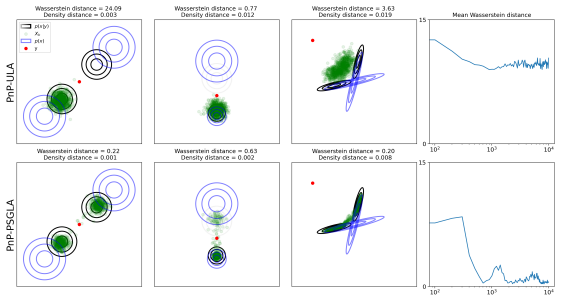


Figures from the paper (4 more)


Reference graph
Works this paper leans on
-
[1]
Credibility intervals for the reproduction number of the Covid-19 pandemic using proximal Langevin samplers
Patrice Abry, Gersende Fort, Barbara Pascal, and Nelly Pustelnik. Credibility intervals for the reproduction number of the Covid-19 pandemic using proximal Langevin samplers. In 31th European Signal Processing Conference (EUSIPCO), 2023
2023
-
[2]
What regularized auto-encoders learn from the data- generating distribution
Guillaume Alain and Yoshua Bengio. What regularized auto-encoders learn from the data- generating distribution. The Journal of Machine Learning Research, 15(1):3563–3593, 2014
2014
-
[3]
Cor- rection to: convex analysis and monotone operator theory in Hilbert spaces
Heinz H Bauschke, Patrick L Combettes, Heinz H Bauschke, and Patrick L Combettes. Cor- rection to: convex analysis and monotone operator theory in Hilbert spaces. Springer, 2017
2017
-
[4]
Langevin Monte Carlo beyond Lipschitz gradient continuity
Matej Benko, Iwona Chlebicka, Jorgen Endal, and Bła˙zej Miasojedow. Langevin Monte Carlo beyond Lipschitz gradient continuity. In Proceedings of the AAAI Conference on Artificial Intelligence, volume 39, pages 15541–15549, 2025
2025
-
[5]
Langevin Monte Carlo and JKO splitting
Espen Bernton. Langevin Monte Carlo and JKO splitting. In Conference on Learning Theory, pages 1777–1798. PMLR, 2018
2018
-
[6]
Alternating proximal-gradient steps for (stochastic) nonconvex-concave minimax problems
Radu Ioan Bo¸ t and Axel Böhm. Alternating proximal-gradient steps for (stochastic) nonconvex-concave minimax problems. SIAM Journal on Optimization , 33(3):1884–1913, 2023. 10
1913
-
[7]
Sampling from a log- concave distribution with compact support with proximal Langevin Monte Carlo
Nicolas Brosse, Alain Durmus, Éric Moulines, and Marcelo Pereyra. Sampling from a log- concave distribution with compact support with proximal Langevin Monte Carlo. In Confer- ence on Learning Theory, pages 319–342. PMLR, 2017
2017
-
[8]
The tamed unadjusted Langevin algorithm
Nicolas Brosse, Alain Durmus, Éric Moulines, and Sotirios Sabanis. The tamed unadjusted Langevin algorithm. Stochastic Processes and their Applications, 129(10):3638–3663, 2019
2019
Show all 104 references
-
[9]
Finite-time analysis of projected Langevin Monte Carlo
Sebastien Bubeck, Ronen Eldan, and Joseph Lehec. Finite-time analysis of projected Langevin Monte Carlo. Advances in Neural Information Processing Systems, 28, 2015
2015
-
[10]
An overview of existing methods and recent advances in sequential monte carlo
Olivier Cappé, Simon J Godsill, and Eric Moulines. An overview of existing methods and recent advances in sequential monte carlo. Proceedings of the IEEE, 95(5):899–924, 2007
2007
-
[11]
Sampling is as easy as learning the score: theory for diffusion models with minimal data assumptions
Sitan Chen, Sinho Chewi, Jerry Li, Yuanzhi Li, Adil Salim, and Anru R Zhang. Sampling is as easy as learning the score: theory for diffusion models with minimal data assumptions. arXiv preprint arXiv:2209.11215, 2022
2022 arXiv
-
[12]
Convergence of Langevin MCMC in KL-divergence
Xiang Cheng and Peter Bartlett. Convergence of Langevin MCMC in KL-divergence. In Algorithmic learning theory, pages 186–211. PMLR, 2018
2018
-
[13]
Analysis of Langevin Monte Carlo from Poincare to Log-Sobolev
Sinho Chewi, Murat A Erdogdu, Mufan Li, Ruoqi Shen, and Shunshi Zhang. Analysis of Langevin Monte Carlo from Poincare to Log-Sobolev. In Po-Ling Loh and Maxim Raginsky, editors, Proceedings of Thirty Fifth Conference on Learning Theory, volume 178 of Proceed- ings of Machine L...
2022
-
[14]
Score-based diffusion models for accelerated mri
Hyungjin Chung and Jong Chul Ye. Score-based diffusion models for accelerated mri. Med- ical image analysis, 80:102479, 2022
2022
-
[15]
Diffusion posterior sampling for general noisy inverse problems
Hyungjin Chung, Jeongsol Kim, Michael Thompson Mccann, Marc Louis Klasky, and Jong Chul Ye. Diffusion posterior sampling for general noisy inverse problems. In The Eleventh International Conference on Learning Representations, 2022
2022
-
[16]
Nonsmooth analysis and optimization
Frank H Clarke. Nonsmooth analysis and optimization. In Proceedings of the international congress of mathematicians, volume 5, pages 847–853. Citeseer, 1983
1983
-
[17]
Plug-and-play split gibbs sam- pler: embedding deep generative priors in bayesian inference
Florentin Coeurdoux, Nicolas Dobigeon, and Pierre Chainais. Plug-and-play split gibbs sam- pler: embedding deep generative priors in bayesian inference. IEEE Transactions on Image Processing, 2024
2024
-
[18]
User’s guide to viscosity solutions of second order partial differential equations
Michael G Crandall, Hitoshi Ishii, and Pierre-Louis Lions. User’s guide to viscosity solutions of second order partial differential equations. Bulletin of the American mathematical society, 27(1):1–67, 1992
1992
-
[19]
Optimal scaling results for Moreau-Yosida Metropolis-adjusted Langevin algorithms
Francesca R Crucinio, Alain Durmus, Pablo Jiménez, and Gareth O Roberts. Optimal scaling results for Moreau-Yosida Metropolis-adjusted Langevin algorithms. Bernoulli, 31(3):1889– 1907, 2025
1907
-
[20]
User-friendly guarantees for the langevin monte carlo with inaccurate gradient
Arnak Dalalyan and Avetik Karagulyan. User-friendly guarantees for the langevin monte carlo with inaccurate gradient. Stochastic Processes and their Applications , 129(12):5278– 5311, 2019
2019
-
[21]
Stochastic model-based minimization of weakly convex functions
Damek Davis and Dmitriy Drusvyatskiy. Stochastic model-based minimization of weakly convex functions. SIAM Journal on Optimization, 29(1):207–239, 2019
2019
-
[22]
Convergence of denoising diffusion models under the manifold hypoth- esis
Valentin De Bortoli. Convergence of denoising diffusion models under the manifold hypoth- esis. Transactions on Machine Learning Research, 2022
2022
-
[23]
Convergence of diffusions and their discretizations: from continuous to discrete processes and back, 2019
Valentin De Bortoli and Alain Durmus. Convergence of diffusions and their discretizations: from continuous to discrete processes and back, 2019. URL https://arxiv.org/abs/ 1904.09808
2019 arXiv
-
[24]
Ergodic bsdes under weak dissipative assumptions
Arnaud Debussche, Ying Hu, and Gianmario Tessitore. Ergodic bsdes under weak dissipative assumptions. Stochastic Processes and their applications, 121(3):407–426, 2011. 11
2011
-
[25]
Mulog, or how to apply gaussian denoisers to multi-channel sar speckle reduction? IEEE Transactions on Image Processing, 26(9):4389–4403, 2017
Charles-Alban Deledalle, Loic Denis, Sonia Tabti, and Florence Tupin. Mulog, or how to apply gaussian denoisers to multi-channel sar speckle reduction? IEEE Transactions on Image Processing, 26(9):4389–4403, 2017
2017
-
[26]
Markov chains: Basic definitions
Randal Douc, Eric Moulines, Pierre Priouret, Philippe Soulier, Randal Douc, Eric Moulines, Pierre Priouret, and Philippe Soulier. Markov chains: Basic definitions. Springer, 2018
2018
-
[27]
Nonasymptotic convergence analysis for the unadjusted Langevin algorithm
Alain Durmus and Eric Moulines. Nonasymptotic convergence analysis for the unadjusted Langevin algorithm. The Annals of Applied Probability, 2017
2017
-
[28]
Efficient bayesian computation by prox- imal markov chain monte carlo: when langevin meets moreau
Alain Durmus, Eric Moulines, and Marcelo Pereyra. Efficient bayesian computation by prox- imal markov chain monte carlo: when langevin meets moreau. SIAM Journal on Imaging Sciences, 11(1):473–506, 2018
2018
-
[29]
Analysis of Langevin Monte Carlo via convex optimization
Alain Durmus, Szymon Majewski, and Bła ˙zej Miasojedow. Analysis of Langevin Monte Carlo via convex optimization. Journal of Machine Learning Research, 20(73):1–46, 2019
2019
-
[30]
Reflection couplings and contraction rates for diffusions
Andreas Eberle. Reflection couplings and contraction rates for diffusions. Probability theory and related fields, 166:851–886, 2016
2016
-
[31]
On the kantorovich–rubinstein theorem
David A Edwards. On the kantorovich–rubinstein theorem. Expositiones Mathematicae, 29 (4):387–398, 2011
2011
-
[32]
Tweedie’s formula and selection bias
Bradley Efron. Tweedie’s formula and selection bias. Journal of the American Statistical Association, 106(496):1602–1614, 2011
2011
-
[33]
Proximal Langevin sam- pling with inexact proximal mapping
Matthias J Ehrhardt, Lorenz Kuger, and Carola-Bibiane Schönlieb. Proximal Langevin sam- pling with inexact proximal mapping. SIAM Journal on Imaging Sciences, 17(3):1729–1760, 2024
2024
-
[34]
Proximal interacting particle langevin algorithms, 2024
Paula Cordero Encinar, Francesca R Crucinio, and O Deniz Akyildiz. Proximal interacting particle langevin algorithms, 2024. URL https://arxiv.org/abs/2406.14292
2024 arXiv
-
[35]
Pot: Python optimal transport
Rémi Flamary, Nicolas Courty, Alexandre Gramfort, Mokhtar Z Alaya, Aurélie Boisbunon, Stanislas Chambon, Laetitia Chapel, Adrien Corenflos, Kilian Fatras, Nemo Fournier, et al. Pot: Python optimal transport. Journal of Machine Learning Research, 22(78):1–8, 2021
2021
-
[36]
Covid19 reproduction number: Credibility intervals by blockwise proximal monte carlo samplers
Gersende Fort, Barbara Pascal, Patrice Abry, and Nelly Pustelnik. Covid19 reproduction number: Credibility intervals by blockwise proximal monte carlo samplers. IEEE Transac- tions on Signal Processing, 71:888–900, 2023
2023
-
[37]
Convexity in ReLU Neural Networks: beyond ICNNs?, 2025
Anne Gagneux, Mathurin Massias, Emmanuel Soubies, and Rémi Gribonval. Convexity in ReLU Neural Networks: beyond ICNNs?, 2025. URL https://arxiv.org/abs/2501. 03017
2025
-
[38]
Stochastic relaxation, gibbs distributions, and the bayesian restoration of images
Stuart Geman and Donald Geman. Stochastic relaxation, gibbs distributions, and the bayesian restoration of images. IEEE Transactions on pattern analysis and machine intelligence, 1984
1984
-
[39]
Adaptive rejection metropolis sampling within gibbs sampling
Wally R Gilks, Nicky G Best, and Keith KC Tan. Adaptive rejection metropolis sampling within gibbs sampling. Journal of the Royal Statistical Society Series C: Applied Statistics , 44(4):455–472, 1995
1995
-
[40]
Learning weakly convex regulariz- ers for convergent image-reconstruction algorithms
Alexis Goujon, Sebastian Neumayer, and Michael Unser. Learning weakly convex regulariz- ers for convergent image-reconstruction algorithms. SIAM Journal on Imaging Sciences, 17 (1):91–115, 2024
2024
-
[41]
A characterization of proximity operators
Rémi Gribonval and Mila Nikolova. A characterization of proximity operators. Journal of Mathematical Imaging and Vision, 62(6):773–789, 2020
2020
-
[42]
Agem: Solving linear inverse problems via deep priors and sampling
Bichuan Guo, Yuxing Han, and Jiangtao Wen. Agem: Solving linear inverse problems via deep priors and sampling. Advances in Neural Information Processing Systems, 32, 2019
2019
-
[43]
Provable benefit of annealed Langevin Monte Carlo for non-log-concave sampling
Wei Guo, Molei Tao, and Yongxin Chen. Provable benefit of annealed Langevin Monte Carlo for non-log-concave sampling. International Conference of Learning Representation, 2025. 12
2025
-
[44]
Penalized overdamped and under- damped langevin monte carlo algorithms for constrained sampling.Journal of machine learn- ing research, 25(263):1–67, 2024
Mert Gurbuzbalaban, Yuanhan Hu, and Lingjiong Zhu. Penalized overdamped and under- damped langevin monte carlo algorithms for constrained sampling.Journal of machine learn- ing research, 25(263):1–67, 2024
2024
-
[45]
Convex analysis and minimization al- gorithms I: Fundamentals, volume 305
Jean-Baptiste Hiriart-Urruty and Claude Lemaréchal. Convex analysis and minimization al- gorithms I: Fundamentals, volume 305. Springer science & business media, 1996
1996
-
[46]
On proximal point-type algorithms for weakly convex functions and their connection to the backward euler method
Tim Hoheisel, Maxime Laborde, and Adam Oberman. On proximal point-type algorithms for weakly convex functions and their connection to the backward euler method. Optimization Online, 2010
2010
-
[47]
Gradient step denoiser for con- vergent plug-and-play
Samuel Hurault, Arthur Leclaire, and Nicolas Papadakis. Gradient step denoiser for con- vergent plug-and-play. In International Conference on Learning Representations (ICLR’22), 2022
2022
-
[48]
Convergent plug-and-play with proximal denoiser and unconstrained regularization parameter
Samuel Hurault, Antonin Chambolle, Arthur Leclaire, and Nicolas Papadakis. Convergent plug-and-play with proximal denoiser and unconstrained regularization parameter. Journal of Mathematical Imaging and Vision, pages 1–23, 2024
2024
-
[49]
The performance of the unadjusted langevin algorithm without smoothness assumptions
Tim Johnston, Iosif Lytras, Nikolaos Makras, and Sotirios Sabanis. The performance of the unadjusted langevin algorithm without smoothness assumptions. arXiv preprint arXiv:2502.03458, 2025
2025
-
[50]
Local convergence of an inexact proximal algorithm for weakly convex functions, 2023
Valdines Leite de Sousa Junior, Lucas Vidal de Meireles, Samara Costa Lima, and Gilson do Nascimento Silva. Local convergence of an inexact proximal algorithm for weakly convex functions, 2023. URL https://arxiv.org/abs/2308.02014
2023 arXiv
-
[51]
Stochastic solutions for linear inverse problems using the prior implicit in a denoiser
Zahra Kadkhodaie and Eero Simoncelli. Stochastic solutions for linear inverse problems using the prior implicit in a denoiser. Advances in Neural Information Processing Systems , 34:13242–13254, 2021
2021
-
[52]
On a space of totally additive functions
Leonid Vasilevich Kantorovich and SG Rubinshtein. On a space of totally additive functions. Vestnik of the St. Petersburg University: Mathematics, 13(7):52–59, 1958
1958
-
[53]
Brownian motion and stochastic calculus, volume 113
Ioannis Karatzas and Steven Shreve. Brownian motion and stochastic calculus, volume 113. Springer Science & Business Media, 1991
1991
-
[54]
Denoising diffusion restora- tion models
Bahjat Kawar, Michael Elad, Stefano Ermon, and Jiaming Song. Denoising diffusion restora- tion models. Advances in Neural Information Processing Systems, 35:23593–23606, 2022
2022
-
[55]
Accelerated Bayesian imaging by relaxed proximal-point Langevin sampling
Teresa Klatzer, Paul Dobson, Yoann Altmann, Marcelo Pereyra, Jesús María Sanz-Serna, and Konstantinos C Zygalakis. Accelerated Bayesian imaging by relaxed proximal-point Langevin sampling. SIAM Journal on Imaging Sciences, 17(2):1078–1117, 2024
2024
-
[56]
Projected stochastic gradient Langevin algorithms for constrained sam- pling and non-convex learning
Andrew Lamperski. Projected stochastic gradient Langevin algorithms for constrained sam- pling and non-convex learning. InConference on Learning Theory, pages 2891–2937. PMLR, 2021
2021
-
[57]
A note on the measurability of convex sets
Robert Lang. A note on the measurability of convex sets. Archiv der Mathematik, 47:90–92, 1986
1986
-
[58]
On maximum a posteriori estimation with plug & play priors and stochastic gradient descent
Rémi Laumont, Valentin De Bortoli, Andrés Almansa, Julie Delon, Alain Durmus, and Marcelo Pereyra. On maximum a posteriori estimation with plug & play priors and stochastic gradient descent. Journal of Mathematical Imaging and Vision, 65(1):140–163, 2023
2023
-
[59]
Bayesian imaging using Plug & Play Priors: When Langevin meets Tweedie
Rémi Laumont, Valentin De Bortoli, Andrés Almansa, Julie Delon, Alain Durmus, and Marcelo Pereyra. Bayesian imaging using Plug & Play Priors: When Langevin meets Tweedie. SIAM Journal on Imaging Sciences, 15(2):701–737, 2022
2022
-
[60]
A proximal algorithm for sampling from non-smooth potentials
Jiaming Liang and Yongxin Chen. A proximal algorithm for sampling from non-smooth potentials. In 2022 Winter Simulation Conference (WSC), pages 3229–3240, 2022
2022
-
[61]
Statistics of random processes: I
Robert Liptser, Albert Nikolaevich Shiriaev, and Albert N Shiryaev. Statistics of random processes: I. General theory, volume 1. Springer Science & Business Media, 2001. 13
2001
-
[62]
Ergodic bsdes and related pdes with neumann boundary conditions under weak dissipative assumptions
Pierre-Yves Madec. Ergodic bsdes and related pdes with neumann boundary conditions under weak dissipative assumptions. Stochastic Processes and their Applications , 125(5):1821– 1860, 2015
2015
-
[63]
Stochastic differential equations and applications
Xuerong Mao. Stochastic differential equations and applications. Elsevier, 2007
2007
-
[64]
A database of human seg- mented natural images and its application to evaluating segmentation algorithms and measur- ing ecological statistics
David Martin, Charless Fowlkes, Doron Tal, and Jitendra Malik. A database of human seg- mented natural images and its application to evaluating segmentation algorithms and measur- ing ecological statistics. In Proceedings eighth IEEE international conference on computer vision...
2001
-
[65]
Proximité et dualité dans un espace hilbertien
Jean-Jacques Moreau. Proximité et dualité dans un espace hilbertien. Bulletin de la Société mathématique de France, 93:273–299, 1965
1965
-
[66]
Inf-convolution, sous-additivité, convexité des fonctions numériques
Jean Jacques Moreau. Inf-convolution, sous-additivité, convexité des fonctions numériques. Journal de Mathématiques Pures et Appliquées, 1970
1970
-
[67]
Improved bounds for discretization of Langevin diffusions: Near-optimal rates without convexity
Wenlong Mou, Nicolas Flammarion, Martin J Wainwright, and Peter L Bartlett. Improved bounds for discretization of Langevin diffusions: Near-optimal rates without convexity. Bernoulli, 28(3):1577–1601, 2022
2022
-
[68]
Unadjusted langevin algorithm for non-convex weakly smooth potentials, 2021
Dao Nguyen, Xin Dang, and Yixin Chen. Unadjusted langevin algorithm for non-convex weakly smooth potentials, 2021. URL https://arxiv.org/abs/2101.06369
2021 arXiv
-
[69]
Second-order analysis of the moreau–yosida and the lasry–lions regulariza- tions
Nina Ovcharova. Second-order analysis of the moreau–yosida and the lasry–lions regulariza- tions. Optimization Methods & Software, 25(1):109–116, 2010
2010
-
[70]
Proximal markov chain monte carlo algorithms
Marcelo Pereyra. Proximal markov chain monte carlo algorithms. Statistics and Computing, 26:745–760, 2016
2016
-
[71]
Learning max- imally monotone operators for image recovery
Jean-Christophe Pesquet, Audrey Repetti, Matthieu Terris, and Yves Wiaux. Learning max- imally monotone operators for image recovery. SIAM Journal on Imaging Sciences , 14(3): 1206–1237, 2021
2021
-
[72]
Optimal scaling for the proximal Langevin algorithm in high dimensions
Natesh S Pillai. Optimal scaling for the proximal Langevin algorithm in high dimensions. Journal of Machine Learning Research, 25(404):1–32, 2024
2024
-
[73]
A survey on sampling and probe methods for inverse problems
Roland Potthast. A survey on sampling and probe methods for inverse problems. Inverse Problems, 22(2):R1, 2006
2006
-
[74]
On the stability of the stochastic gradient Langevin algo- rithm with dependent data stream
Miklós Rásonyi and Kinga Tikosi. On the stability of the stochastic gradient Langevin algo- rithm with dependent data stream. Statistics & Probability Letters, 182:109321, 2022
2022
-
[75]
Plug-and-play posterior sampling under mismatched measurement and prior models
Marien Renaud, Jiaming Liu, Valentin De Bortoli, Andrés Almansa, and Ulugbek S Kamilov. Plug-and-play posterior sampling under mismatched measurement and prior models. The Twelfth International Conference on Learning Representations, 2023
2023
-
[76]
Plug-and-play image restoration with Stochastic deNOising REgularization
Marien Renaud, Jean Prost, Arthur Leclaire, and Nicolas Papadakis. Plug-and-play image restoration with Stochastic deNOising REgularization. InForty-first International Conference on Machine Learning, 2024
2024
-
[77]
Convergence analysis of a proximal stochastic denoising regularization algorithm
Marien Renaud, Julien Hermant, and Nicolas Papadakis. Convergence analysis of a proximal stochastic denoising regularization algorithm. In International Conference on Scale Space and Variational Methods in Computer Vision, pages 17–29. Springer, 2025
2025
-
[78]
Langevin diffusions and Metropolis-Hastings algo- rithms
Gareth O Roberts and Osnat Stramer. Langevin diffusions and Metropolis-Hastings algo- rithms. Methodology and computing in applied probability, 4:337–357, 2002
2002
-
[79]
Exponential convergence of Langevin distributions and their discrete approximations
Gareth O Roberts and Richard L Tweedie. Exponential convergence of Langevin distributions and their discrete approximations. Bernoulli, pages 341–363, 1996
1996
-
[80]
Variational analysis, volume 317
R Tyrrell Rockafellar and Roger J-B Wets. Variational analysis, volume 317. Springer Sci- ence & Business Media, 2009. 14
2009
-
[81]
The little engine that could: Regular- ization by denoising (red)
Yaniv Romano, Michael Elad, and Peyman Milanfar. The little engine that could: Regular- ization by denoising (red). SIAM Journal on Imaging Sciences, 10(4):1804–1844, 2017
2017
-
[82]
Solving linear inverse problems provably via posterior sampling with latent dif- fusion models
Litu Rout, Negin Raoof, Giannis Daras, Constantine Caramanis, Alex Dimakis, and Sanjay Shakkottai. Solving linear inverse problems provably via posterior sampling with latent dif- fusion models. Advances in Neural Information Processing Systems, 36:49960–49990, 2023
2023
-
[83]
Nonlinear total variation based noise removal algorithms
Leonid I Rudin, Stanley Osher, and Emad Fatemi. Nonlinear total variation based noise removal algorithms. Physica D: nonlinear phenomena, 60(1-4):259–268, 1992
1992
-
[84]
Primal dual interpretation of the proximal stochastic gradient langevin algorithm
Adil Salim and Peter Richtarik. Primal dual interpretation of the proximal stochastic gradient langevin algorithm. Advances in Neural Information Processing Systems , 33:3786–3796, 2020
2020
-
[85]
Stochastic proximal Langevin algorithm: Potential splitting and nonasymptotic rates
Adil Salim, Dmitry Kovalev, and Peter Richtárik. Stochastic proximal Langevin algorithm: Potential splitting and nonasymptotic rates. Advances in Neural Information Processing Sys- tems, 32, 2019
2019
-
[86]
Weakly convex regularisers for inverse problems: Convergence of critical points and primal- dual optimisation
Zakhar Shumaylov, Jeremy Budd, Subhadip Mukherjee, and Carola-Bibiane Schönlieb. Weakly convex regularisers for inverse problems: Convergence of critical points and primal- dual optimisation. Forty-first International Conference on Machine Learning, 2024
2024
-
[87]
Generative modeling by estimating gradients of the data distribution
Yang Song and Stefano Ermon. Generative modeling by estimating gradients of the data distribution. Advances in neural information processing systems, 32, 2019
2019
-
[88]
Bayesian inference in thresh- old models using gibbs sampling
D Andersen Sorensen, S Andersen, D Gianola, and I Korsgaard. Bayesian inference in thresh- old models using gibbs sampling. Genetics Selection Evolution, 27(3):229–249, 1995
1995
-
[89]
Provable prob- abilistic imaging using score-based generative priors
Yu Sun, Zihui Wu, Yifan Chen, Berthy T Feng, and Katherine L Bouman. Provable prob- abilistic imaging using score-based generative priors. IEEE Transactions on Computational Imaging, 2024
2024
-
[90]
Deepinverse: A deep learning frame- work for inverse problems in imaging
J Tachella, D Chen, S Hurault, M Terris, and A Wang. Deepinverse: A deep learning frame- work for inverse problems in imaging. url: https://deepinv. github. io/deepinv, 2023
2023
-
[91]
Pareto smoothed importance sampling
Aki Vehtari, Daniel Simpson, Andrew Gelman, Yuling Yao, and Jonah Gabry. Pareto smoothed importance sampling. Journal of Machine Learning Research, 25(72):1–58, 2024
2024
-
[92]
Plug-and-play priors for model based reconstruction
Singanallur V Venkatakrishnan, Charles A Bouman, and Brendt Wohlberg. Plug-and-play priors for model based reconstruction. In 2013 IEEE global conference on signal and infor- mation processing, pages 945–948. IEEE, 2013
2013
-
[93]
Optimal transport: old and new, volume 338
Cédric Villani et al. Optimal transport: old and new, volume 338. Springer, 2008
2008
-
[94]
Split-and-augmented gibbs sam- pler—application to large-scale inference problems
Maxime V ono, Nicolas Dobigeon, and Pierre Chainais. Split-and-augmented gibbs sam- pler—application to large-scale inference problems. IEEE Transactions on Signal Process- ing, 67(6):1648–1661, 2019
2019
-
[95]
Image quality assess- ment: from error visibility to structural similarity
Zhou Wang, Alan C Bovik, Hamid R Sheikh, and Eero P Simoncelli. Image quality assess- ment: from error visibility to structural similarity. IEEE transactions on image processing , 13(4):600–612, 2004
2004
-
[96]
Learning pseudo-contractive denoisers for inverse problems
Deliang Wei, Peng Chen, and Fang Li. Learning pseudo-contractive denoisers for inverse problems. In Forty-first International Conference on Machine Learning, 2024
2024
-
[97]
Sampling as optimization in the space of measures: The Langevin dynamics as a composite optimization problem
Andre Wibisono. Sampling as optimization in the space of measures: The Langevin dynamics as a composite optimization problem. In Conference on Learning Theory, pages 2093–3027. PMLR, 2018
2018
-
[98]
Convergence of the inexact Langevin algorithm and score-based generative models in KL divergence
Kaylee Yingxi Yang and Andre Wibisono. Convergence of the inexact Langevin algorithm and score-based generative models in KL divergence. NeurIPS 2022 Workshop on Score- Based Methods, 2022. 15
2022
-
[99]
Plug- and-play image restoration with deep denoiser prior
Kai Zhang, Yawei Li, Wangmeng Zuo, Lei Zhang, Luc Van Gool, and Radu Timofte. Plug- and-play image restoration with deep denoiser prior. IEEE Transactions on Pattern Analysis and Machine Intelligence, 44(10):6360–6376, 2021
2021
-
[100]
The unrea- sonable effectiveness of deep features as a perceptual metric
Richard Zhang, Phillip Isola, Alexei A Efros, Eli Shechtman, and Oliver Wang. The unrea- sonable effectiveness of deep features as a perceptual metric. In Proceedings of the IEEE conference on computer vision and pattern recognition, pages 586–595, 2018
2018
-
[101]
Denoising diffusion models for plug-and-play image restoration
Yuanzhi Zhu, Kai Zhang, Jingyun Liang, Jiezhang Cao, Bihan Wen, Radu Timofte, and Luc Van Gool. Denoising diffusion models for plug-and-play image restoration. InProceedings of the IEEE/CVF Conference on Computer Vision and Pattern Recognition , pages 1219–1229, 2023. Appendix...
2023
-
[102]
1 2 Z T 0 ⟨b1((wu)u∈[0,T ], t), dwt⟩ −1 4 Z T 0 ∥b1((wu)u∈[0,T ], t)∥2dt # dµW dµ2 ((wu)u∈[0,T ], t) = exp
So we get that rγ ≤ R0 = max 8(R + 1) + 4∥∇g(0)∥ Lg , 2 s ginf − g(0) Lg + (R + 1)2 ! . Therefore, we get from (36) that ∀γ ∈ [0, 1 2Lg ] and ∀x ∈ Rd \ B(0, R0), g(x) ≤ g(0) + ⟨∇g(0), x⟩ + Lg 2 ∥x∥2 ≤ 1 2γ (∥x∥ −R − 1)2 + ginf . 37 By combining the previous inequality and Equa...
-
[103]
As a consequence, ∀t ∈ (t0, t1), u(t) < R2 0 and ∀t ∈ [0, 1] \ [t0, t1], u(t) > R2
-
[104]
By definition z0, z1 ∈ B(0, R0), therefore ∥z0 − z1∥ ≤2R0
We denote z0 = x + t0(y − x) z1 = x + t1(y − x). By definition z0, z1 ∈ B(0, R0), therefore ∥z0 − z1∥ ≤2R0. Then t1 − t0 = ∥z1 − x∥ ∥y − x∥ − ∥z0 − x∥ ∥y − x∥ = ∥z1 − z0∥ ∥y − x∥ ≤ 2R0 ∥y − x∥ ≤ 1 2 , (83) because ∥y − x∥ ≥4R0. We can now estimate the quantity of interest ⟨∇gγ...
Reviewed August 7, 2026 · model on record in the stance chip above.
Discussion (0). Continue with ORCID to comment.