REVIEW 3 major objections 5 minor 32 references
Sentence Curve Language Models
T0 review · 3 major / 5 minor · reviewed 2026-08-03 · deepseek-v4-flash
Pith's one-line read The paper argues that replacing static word-embedding targets with B-spline sentence-curve targets induces a global-structure regularization in diffusion language models, and that models using this target achieve state-of-the-art DLM transl
desk verdict Genuinely new target representation with plausible BLEU gains, but the global-structure theory is not just unproven—the linear algebra likely says the opposite. read the letter →
The pith
A machine-rendered reading of the paper's core claim, the machinery that carries it, and where it could break.
The reading
What carries the argument
The mechanism is the pair of linear maps E = P B and P ≈ E B+. The columns of B are B-spline basis functions, so each control point contributes to multiple word positions, and B+ (the left pseudo-inverse) selects one representative curve for a given sentence. In the diffusion backbone, the noised curve is fed into the model and the denoised curve is mapped back to embeddings for the diffusion and anchor losses. The theoretical engine is the identity CE_Y = CE_P − E_Y[KL(P|Y,X)] + C together with the error weighting ||B+V||², whose global-versus-local error-importance ratio is bounded by the eigenvalue ratio λ_max/λ_min of B+(B+)ᵀ. When this ratio is large, coherent sentence-wide errors are p
What would settle it
Train SCLM with B+ replaced by a fixed random matrix with the same eigenvalue spectrum (e.g., an orthogonal rotation of B+); if the BLEU gains persist unchanged, the curve geometry itself is not the active ingredient. Alternatively, measure the alignment between the dominant right-singular vectors of B+ and the empirical errors V = E_Y − E_hat of a trained baseline diffusion model; near-zero alignment would falsify the claim that sentence-curve prediction upweights global errors.
Extended reading notes
Core claim
The central claim is that the right object for a non-autoregressive model to predict is not the static word-embedding sequence E_Y, but the sentence curve P_Y satisfying E_Y = P_Y B, where B is a B-spline basis matrix. Because each control point feeds into several word embeddings, the curve carries cross-word information. The paper proves that the MLE objective under curve prediction becomes CE_Y = CE_P − E_Y[KL(P|Y,X)] + C, so the model must also choose among the fiber of curves that map back to the same sentence. It further shows that the objective weights an error V by ||B+V||², so coherent sentence-level errors can receive more importance when B+ has a spread eigenvalue spectrum. SCLM ap
Load-bearing premise
The load-bearing premise is that B-spline smoothness in the word-embedding space corresponds to linguistically meaningful sentence-level structure and that the pseudo-inverse B+ fiber chosen by the model preserves enough information to decode the sentence; Lemma 4.3 proves only an upper bound on the global/local error-importance ratio, so without additional alignment between B+'s dominant directions and real sentence-error patterns, the claimed regularization mechanism—and th
Editorial extensions
If this is right
- SCLM with sentence-curve targets reaches the highest reported BLEU among diffusion LMs on IWSLT14 (En→De and De→En) and WMT14 (En→De and De→En), matching an autoregressive Transformer on WMT14 En→De.
- SCLM trains and converges stably without sequence-level knowledge distillation, in contrast to many DLM baselines that rely on an autoregressive teacher.
- The theoretical decomposition implies that curve prediction adds fiber-level supervision: the KL term in CE_Y = CE_P − E_Y[KL(P|Y,X)] + C regularizes the model against following only the fine-grained word-level supervision.
- Higher control-point counts and lower curve degrees improve reconstruction fidelity of the B and B+ mappings, giving a practical hyperparameter regime where information loss is small.
- In semi-AR N-gram prediction, SCLM improves average perplexity and raises distance correlations among predicted word logits, consistent with the claimed global-structure effect.
Reading between the lines
- One extension the paper leaves open is applying sentence-curve targets to autoregressive LMs, where word-level targets may also bias training toward local accuracy; the regularization story would predict reduced exposure-bias artifacts.
- Because the B+ pseudo-inverse is just one fiber choice, a learned or stochastic inverse could trade a little decodability for more diverse sentence curves, directly addressing the paper's own diversity limitation.
- A testable implication is that curve degree η acts as a global-versus-local dial: very high η should improve long-range coherence metrics while slightly hurting lexical choice, a prediction that could be checked on a long-sentence split.
- If the global-structure effect transfers, sentence-curve targets could be combined with contextualized target embeddings only when a simple decoder remains available, since the paper identifies decodability as the key constraint on any alternative target representation.
Editorial analysis
A structured set of objections, weighed in public.
Referee Report
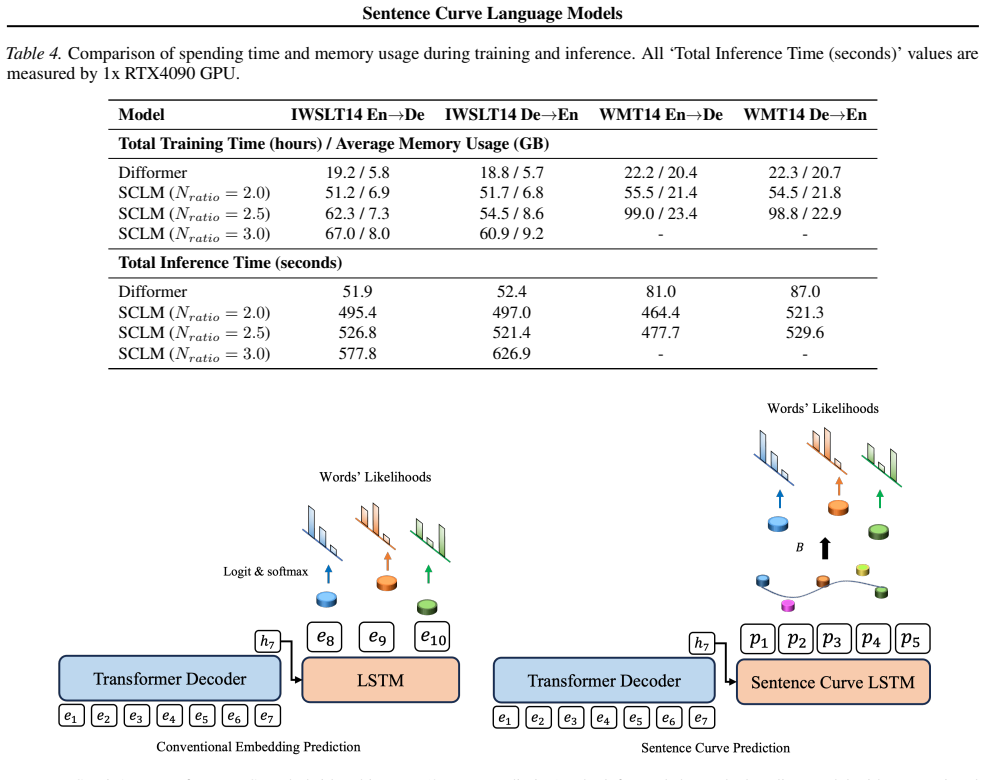
Summary. The paper proposes a target-side representation for diffusion and non-autoregressive language models. Instead of predicting per-token word embeddings, the backbone model predicts control points of a B-spline sentence curve whose sampled points equal the target embedding sequence. The forward map EY = P B and an approximate inverse P ≈ E B+ are used to feed noised curves into the denoiser and to map denoised curves back to embeddings for loss computation. The authors claim a theoretical result (Lemma 4.3) showing that sentence-curve prediction up-weights sentence-level global errors, and support it with experiments on IWSLT14/WMT14 NMT, LM1B language modeling, and semi-AR analyses, reporting state-of-the-art results among DLMs when trained with knowledge distillation.
Significance. The idea is timely and potentially useful: target-side representations for DLMs have received less attention than input representations, and replacing static word embeddings with a structured continuous target is a clean, generally applicable modification. The paper is honest about computational overhead and includes derivations in the appendix, which is a strength. However, the central theoretical claim is not established. Lemma 4.3 contains a norm mismatch and a false inequality, and an upper bound on a ratio cannot show that global errors receive higher importance. In fact, for standard B-spline collocation matrices the relevant Gram inverse is high-pass, so the stated mechanism is doubtful and may be inverted. The empirical results are interesting but would need code and error bars to fully substantiate a SOTA claim; the theoretical section needs major revision or removal.
major comments (3)
- The proof of R(B+) ≤ λmax/λmin is invalid. First, the inequality (Σ_i k_{max,i})^2 ≤ Σ_i k_{max,i}^2 is false; Cauchy-Schwarz gives a factor L. Second, V_global and V_local,i are not norm-matched: ∥V_global∥_F = 1 while ∥V_local,i∥_F = √d, so the d-dimensional computation yields R = (1/L) 1^T G 1 / (d G_ii) ≤ λmax/(d λmin), not the displayed bound. Third, and most importantly, an upper bound on R cannot establish the paper's claim that global errors receive 'substantially higher importance'; the bound is compatible with R < 1. For the standard B-spline collocation matrix B, B^T B is a low-pass Gram matrix of smooth overlapping basis functions, so G = (B^T B)^{-1} is high-pass; the dominant error directions are oscillatory/local, not the uniform 'global' direction 1_{d×L}. Thus the linear algebra points in the opposite direction. This is the main load-bearing theoretical claim; it must be
- The paper equates 'global structure' with smoothness of the B-spline curve in Euclidean embedding space. Lemma 4.3 analyzes alignment with eigenvectors of B+(B+)⊤, which depends only on the B-spline basis and sampling grid; it does not by itself establish a connection to syntactic or semantic sentence-level structure. The empirical distance-correlation analysis in Section 5.4 shows higher correlations for SCLMs, but it does not identify the mechanism. Unless the link between low-frequency B-spline errors and linguistically global structure is made explicit and tested, the theoretical interpretation should be stated as a hypothesis rather than a demonstrated regularization effect.
- The ablation table for K has empty entries for K=2,3,4, and footnote 6 states that 'measurements for varying values of K are not yet complete; we guess larger K to further increase computational cost.' The claim that N_ratio and K are the primary computational-cost factors is therefore unsupported. In addition, Table 1 and Figure 5 report single runs without error bars or code release, making the SOTA and convergence claims hard to verify. The empirical contribution would be substantially strengthened by releasing code and reporting variance or multiple seeds.
minor comments (5)
- The equation CE_Y = CE_P − E_Y[KL(P|Y,X)] + C is correct only if KL denotes KL(pdata(P|Y,X) || pθ(P|Y,X)). The main-text phrase 'Maximizing this KL term' is confusing; since the term appears with a minus sign, the direction of the regularization should be stated explicitly.
- The reconstruction-error analysis uses random Gaussian sequences rather than real sentence embeddings. To support the claim that the B+ fiber choice preserves enough information to decode sentences, the analysis should be repeated on actual embedded text, ideally with downstream metric evaluation.
- The dimensions of B and B+ are not stated consistently: B is introduced as N×L but B+ is described as (B^T B)^{-1}B^T ∈ R^{L×N}; the composition P ≈ E B+ requires the order of arguments to be made explicit throughout the paper.
- The 'state-of-the-art among DLMs' claim should be qualified: SCLM w/o KD is not reported on WMT14, and some baselines (e.g., Transformer, Difformer) are evaluated by the authors under their own environment. Reporting the exact evaluation config and variance would aid comparison.
- Minor typos and formatting issues: 'we proposesentence curve' (Section 1), 'Nraito' for 'N_ratio' in Appendix B.2, and inconsistent spacing in equations. These do not affect the substance.
Circularity Check
The empirical benchmark results are independent, but the claimed 'global structure regularization' reduces to the definition of error importance as ||B+V||^2; the theoretical mechanism is either definitional or unproved.
-
self definitional
[Section 4.3, Lemma 4.3 and the paragraph after Eqs. 5-6; Appendix A.3, Lemma A.6]
"Define the error importance as I(V) = ||B+V||^2. ... Eq. 5 shows that the contribution of an error V to the objective is determined by its alignment with B+. Consequently, SCLMs emphasize error directions that are consistent with the structure imposed by the sentence curve mapping. The smoothness property of the B-spline basis therefore encourage coherent, sentence-level error patterns."
The claimed regularization effect is not derived from an independent characterization of sentence-level global structure; it is the definition of I(V). That errors aligned with B+ receive larger weight is a restatement of I(V)=||B+V||^2, not a discovered property. The labels 'global' and 'sentence-level' are imported from the B-spline construction. Moreover Eq. 6 is only an upper bound, R <= lambda_max/lambda_min, so it cannot establish that global errors dominate; if 'global' is defined as 'aligned with B+', the conclusion is true by construction, while if 'global' means linguistic sentence-level structure, the mechanism is unsupported. The BLEU/LM1B results are external evidence and are not themselves circular.
full rationale
The empirical core is self-contained: SCLM uses a precomputed B/B+ pair and is evaluated against external SacreBLEU/perplexity benchmarks; hyperparameters are selected on validation, not fitted to the test claims. No load-bearing self-citation chain exists; the authors' prior WDR and Heo-Choi references appear only as baselines or related work. The sole genuinely circular element is the theoretical claim in Section 4.3: once error importance is defined as I(V)=||B+V||^2, saying that SCLM emphasizes B+-aligned errors and therefore 'sentence-level global structure' is a renaming of the construction. Lemma 4.3's inequality is also only an upper bound, so the claimed global-over-local dominance is not established; the appendix's incorrect Jensen step is a mathematical error rather than a circularity. Because the empirical results stand independently, the circularity is partial and confined to the interpretative theoretical claim.
Assumptions & free parameters
free parameters (3)
- Curve hyperparameters (N_ratio, eta, K) =
Dataset-specific, e.g., N_ratio=2.5, eta=0.1, K=3 for IWSLT14 En->De (Table 3)
- Curve sampling margin m =
0.01
- Minimum curve degree floor =
2
assumptions (5)
- domain assumption Unit-norm embedding assumption (A.1): ||e_i|| = ||h|| = 1 for all words.
- domain assumption Local isotropy on the target embedding's tangent space (A.2).
- domain assumption Deterministic many-to-one mapping P B = E_Y, so p(Y|P) is a point mass.
- ad hoc to paper B-spline smoothness in Euclidean embedding space corresponds to sentence-level global structure.
- domain assumption p_theta(P|X) = N(P; P_hat_theta, sigma^2 I) in Lemma 4.3.
invented entities (2)
-
Sentence curve control points P_Y
-
K-sentence curves with curve-specific embedding tokens
Cite this review
Pith. "Pith review of Sentence Curve Language Models." pith.science (2026). https://pith.science/paper/DWSEPOQ7
@misc{pith2026260201807,
  author       = {Pith},
  title        = {Pith review of: Sentence Curve Language Models},
  year         = {2026},
  howpublished = {\url{https://pith.science/paper/DWSEPOQ7}},
  note         = {Machine review of arXiv:2602.01807}
}
read the original abstract
Language models (LMs) are a central component of modern AI systems, and diffusion language models (DLMs) have recently emerged as a competitive alternative. Both paradigms rely on word embeddings not only to represent the input sentence, but also to represent the target sentence that backbone models are trained to predict. We argue that such static embedding of the target word is insensitive to neighboring words, encouraging locally accurate word prediction while global sentence structure is less emphasized. To address this, we propose a continuous sentence representation, termed sentence curve, defined as a spline curve whose control points affect multiple words in the sentence. Based on this representation, we introduce sentence curve language model (SCLM), which extends DLMs to predict sentence curves instead of the static word embeddings. We theoretically show that sentence curve prediction induces a regularization effect that promotes global structure modeling, and characterize how different sentence curve types affect this behavior. Empirically, SCLM achieves state-of-the-art performance among DLMs on IWSLT14 and WMT14, shows stable training without burdensome knowledge distillation, and demonstrates promising potential compared to discrete DLMs on LM1B.
Figures


Figures from the paper (5 more)




Reference graph
Works this paper leans on
-
[1]
L., Almeida, D., Altenschmidt, J., Altman, S., Anadkat, S., et al
Achiam, J., Adler, S., Agarwal, S., Ahmad, L., Akkaya, I., Aleman, F. L., Almeida, D., Altenschmidt, J., Altman, S., Anadkat, S., et al. Gpt-4 technical report.arXiv preprint arXiv:2303.08774,
-
[3]
The explored ranges for each hyperparameter areNraito ∈ {2.0,2.5,3.0}, ηraito ∈ {0.01,0.05,0.1,0.2}, 3https://github.com/chakki-works/chazutsu 4https://github.com/zhjgao/difformer 5https://github.com/kuleshov-group/mdlm 15 Sentence Curve Language Models Table 2.Model and training configurations for Difformer experiments. Hyperparameter IWSLT14 En–De WMT14...
-
[5]
One billion word benchmark for measuring progress in statistical language modeling
Chelba, C., Mikolov, T., Schuster, M., Ge, Q., Brants, T., Koehn, P., and Robinson, T. One billion word benchmark for measuring progress in statistical language modeling. arXiv preprint arXiv:1312.3005,
-
[10]
Empowering diffusion models on the embedding space for text generation
Gao, Z., Guo, J., Tan, X., Zhu, Y ., Zhang, F., Bian, J., and Xu, L. Empowering diffusion models on the embedding space for text generation. InProceedings of the 2024 Conference of the North American Chapter of the Associ- ation for Computational Linguistics: Human Language Technologies (Volume 1: Long Papers), pp. 4664–4683,
2024
-
[13]
Gu, J., Bradbury, J., Xiong, C., Li, V . O., and Socher, R. Non-autoregressive neural machine translation.arXiv preprint arXiv:1711.02281,
-
[15]
Heo, D., Rim, D. N., and Choi, H. N-gram prediction and word difference representations for language modeling. arXiv preprint arXiv:2409.03295,
-
[17]
Categorical repa- rameterization with gumbel-softmax.arXiv preprint arXiv:1611.01144,
Jang, E., Gu, S., and Poole, B. Categorical repa- rameterization with gumbel-softmax.arXiv preprint arXiv:1611.01144,
-
[18]
and Rush, A
Kim, Y . and Rush, A. M. Sequence-level knowledge distilla- tion. InProceedings of the 2016 conference on empirical methods in natural language processing, pp. 1317–1327,
2016
Show all 32 references
-
[19]
Deterministic non- autoregressive neural sequence modeling by iterative re- finement.arXiv preprint arXiv:1802.06901,
Lee, J., Mansimov, E., and Cho, K. Deterministic non- autoregressive neural sequence modeling by iterative re- finement.arXiv preprint arXiv:1802.06901,
-
[20]
Unifying continuous and discrete text diffusion with non-simultaneous diffusion processes
Li, B., Gao, Z., and Xu, L. Unifying continuous and discrete text diffusion with non-simultaneous diffusion processes. arXiv preprint arXiv:2505.22165,
-
[21]
Normalization of input-output shared embeddings in text generation models.arXiv preprint arXiv:2001.07885,
Liu, J., Zhai, Y ., and Chen, Z. Normalization of input-output shared embeddings in text generation models.arXiv preprint arXiv:2001.07885,
2001 arXiv
-
[22]
Pointer sentinel mixture models.arXiv preprint arXiv:1609.07843,
Merity, S., Xiong, C., Bradbury, J., and Socher, R. Pointer sentinel mixture models.arXiv preprint arXiv:1609.07843,
-
[23]
Large language diffusion models.arXiv preprint arXiv:2502.09992,
Nie, S., Zhu, F., You, Z., Zhang, X., Ou, J., Hu, J., Zhou, J., Lin, Y ., Wen, J.-R., and Li, C. Large language diffusion models.arXiv preprint arXiv:2502.09992,
-
[24]
fairseq: A fast, ex- tensible toolkit for sequence modeling.arXiv preprint arXiv:1904.01038,
Ott, M., Edunov, S., Baevski, A., Fan, A., Gross, S., Ng, N., Grangier, D., and Auli, M. fairseq: A fast, ex- tensible toolkit for sequence modeling.arXiv preprint arXiv:1904.01038,
1904 arXiv
-
[25]
Improving word embedding compositionality using lexicographic definitions
Scheepers, T., Kanoulas, E., and Gavves, E. Improving word embedding compositionality using lexicographic definitions. InProceedings of the 2018 World Wide Web Conference, pp. 1083–1093,
2018
-
[27]
A reparameter- ized discrete diffusion model for text generation.arXiv preprint arXiv:2302.05737,
Zheng, L., Yuan, J., Yu, L., and Kong, L. A reparameter- ized discrete diffusion model for text generation.arXiv preprint arXiv:2302.05737,
-
[28]
Mathematic Backgrounds A.1
11 Sentence Curve Language Models A. Mathematic Backgrounds A.1. Assumptions Assumption A.1(Unit Norm Constraint). ∥ei∥2 =∥h∥ 2 = 1∀i∈ {1,· · ·,|V|}. This assumption constrains all embedding vectors and the backbone output to lie on the unit sphere Sd−1, allowing the analysis ...
2019
-
[29]
This assumption states that, conditioned on a target word y, the remaining word embeddings are isotropically distributed when projected onto the tangent space of ey
on the Target Embedding’s Tangent Space).Given a target wordy, E[ui] = 0,u i =e i −(e ⊤ y ei)ey ∀i∈ {1,· · ·,|V|}. This assumption states that, conditioned on a target word y, the remaining word embeddings are isotropically distributed when projected onto the tangent space of ...
2024
-
[30]
7, and validate whether the condition holds or not
With plugging the formulation off(h)into the above, the stationary condition becomes: ey − X k p(y=k|h)e k − h⊤ek −h ⊤ X k p(y=k|h ! ey ! h= 0.(7) Now, to verify our main conjecture which is the optimality ofey =h , we set h∗ =e y in Eq. 7, and validate whether the condition h...
2019
-
[31]
Importantly, SCLMs introduce almost no additional parameters beyond the baseline models
The total number of parameters for Difformer and SCLM models is 38.9M for IWSLT14 and 53.5M for WMT14, respectively. Importantly, SCLMs introduce almost no additional parameters beyond the baseline models. For language modeling experiments with MDLM, we follow the official mod...
2023
-
[2013]
Bert: Pre-training of deep bidirectional transformers for lan- guage understanding
Devlin, J., Chang, M.-W., Lee, K., and Toutanova, K. Bert: Pre-training of deep bidirectional transformers for lan- guage understanding. InProceedings of the 2019 confer- ence of the North American chapter of the association for computational linguistics: human language techno...
2019
-
[2014]
D., Chen, D., and Dao, T
Cai, T., Li, Y ., Geng, Z., Peng, H., Lee, J. D., Chen, D., and Dao, T. Medusa: Simple llm inference acceleration framework with multiple decoding heads.arXiv preprint arXiv:2401.10774,
-
[2015]
Diffusion language models can perform many tasks with scaling and instruction-finetuning.arXiv preprint arXiv:2308.12219, 2023a
Ye, J., Zheng, Z., Bao, Y ., Qian, L., and Gu, Q. Diffusion language models can perform many tasks with scaling and instruction-finetuning.arXiv preprint arXiv:2308.12219, 2023a. Ye, J., Zheng, Z., Bao, Y ., Qian, L., and Wang, M. Dinoiser: Diffused conditional sequence learni...
-
[2016]
Encoder-decoder diffusion language mod- els for efficient training and inference.arXiv preprint arXiv:2510.22852,
Arriola, M., Schiff, Y ., Phung, H., Gokaslan, A., and Kuleshov, V . Encoder-decoder diffusion language mod- els for efficient training and inference.arXiv preprint arXiv:2510.22852,
-
[2017]
and Choi, H
Heo, D. and Choi, H. Shared latent space by both languages in non-autoregressive neural machine translation.arXiv preprint arXiv:2305.03511,
-
[2018]
and Ge, R
Frandsen, A. and Ge, R. Understanding composition of word embeddings via tensor decomposition.arXiv preprint arXiv:1902.00613,
1902 arXiv
-
[2019]
H., Doucet, A., Strudel, R., Dyer, C., Durkan, C., et al
Dieleman, S., Sartran, L., Roshannai, A., Savinov, N., Ganin, Y ., Richemond, P. H., Doucet, A., Strudel, R., Dyer, C., Durkan, C., et al. Continuous diffusion for categorical data.arXiv preprint arXiv:2211.15089,
-
[2020]
E., Huang, Y ., Li, Y ., Rawat, A
Ildiz, M. E., Huang, Y ., Li, Y ., Rawat, A. S., and Oymak, S. From self-attention to markov models: Unveiling the dynamics of generative transformers.arXiv preprint arXiv:2402.13512,
-
[2022]
Theoretical benefit and limitation of diffusion language model.arXiv preprint arXiv:2502.09622,
Feng, G., Geng, Y ., Guan, J., Wu, W., Wang, L., and He, D. Theoretical benefit and limitation of diffusion language model.arXiv preprint arXiv:2502.09622,
-
[2023]
Y ., Rozi`ere, B., Lopez-Paz, D., and Synnaeve, G
Gloeckle, F., Idrissi, B. Y ., Rozi`ere, B., Lopez-Paz, D., and Synnaeve, G. Better & faster large language models via multi-token prediction.arXiv preprint arXiv:2404.19737,
-
[2024]
M., Hauth, A., Millican, K., et al
Gemini, Anil, R., Borgeaud, S., Alayrac, J.-B., Yu, J., Sori- cut, R., Schalkwyk, J., Dai, A. M., Hauth, A., Millican, K., et al. Gemini: a family of highly capable multimodal models.arXiv preprint arXiv:2312.11805,
-
[2025]
Findings of the 2014 workshop on statistical machine translation
Bojar, O., Buck, C., Federmann, C., Haddow, B., Koehn, P., Leveling, J., Monz, C., Pecina, P., Post, M., Saint- Amand, H., et al. Findings of the 2014 workshop on statistical machine translation. InProceedings of the ninth workshop on statistical machine translation, pp. 12–58,
2014
Reviewed August 3, 2026 · model on record in the stance chip above.
Discussion (0). Sign in to comment.