REVIEW 3 major objections 2 minor 15 references
Libra evolves a repository's hierarchical catalogs through an LLM loop of synthetic queries and failure-driven rewrites to raise code localization accuracy.
Reviewed by Pith at T0; open to challenge. T0 means a machine referee read the full paper against a public rubric. the ladder, T0–T4 →
T0 review · grok-4.3
2026-07-02 23:21 UTC pith:DXQQF7YE
load-bearing objection Libra's mutable catalog loop for agentic retrieval is a fresh angle but the causal role of the Healer remains untested without ablations. the 3 major comments →
Libra: Training the Environment for Agentic Information Retrieval
The pith
A machine-rendered reading of the paper's core claim, the machinery that carries it, and where it could break.
Core claim
Treating repository catalogs as mutable objects and optimizing them via an LLM-driven cycle of query generation, navigation attempts, and targeted rewrites produces continual logarithmic improvements in code localization accuracy that hold across different models and tasks.
What carries the argument
Mutable hierarchical Markdown catalogs that serve as navigable indices and are rewritten by the Healer after each round of Solver failures inside the self-evolving optimization loop.
Load-bearing premise
The observed gains in localization accuracy are produced by the Healer's catalog rewrites rather than by the choice of synthetic queries or other unstated features of the frozen Solver and loop.
What would settle it
An ablation that runs the full Prompter-Solver cycle but disables the Healer and checks whether localization accuracy still rises logarithmically over successive iterations.
If this is right
- Environmental optimization yields continual logarithmic gains in localization accuracy without any change to the underlying LLM.
- The resulting catalogs transfer zero-shot to different LLMs and to new problem sets.
- A minimalist coding agent equipped with the optimized catalogs outperforms existing state-of-the-art baselines.
- The same self-evolving loop can be applied to any repository that can host hierarchical indices.
Where Pith is reading between the lines
- Environment adaptation may prove more sample-efficient than further model scaling for agentic retrieval tasks.
- The separation of a frozen Solver from an evolving environment suggests a practical route for deploying the method with closed-source LLMs.
- Similar catalog-style indices could be evolved in non-code domains such as documentation sets or API collections.
Editorial analysis
A structured set of objections, weighed in public.
Referee Report
Summary. The paper presents Libra, a self-evolving framework for agentic information retrieval that augments repositories with mutable hierarchical Markdown catalogs. It runs an LLM-driven loop in which a Prompter generates synthetic queries, a frozen Solver attempts navigation, and a Healer rewrites catalogs in response to localization failures. Experiments on 12 SWE-bench Lite repositories report continual logarithmic gains in code localization accuracy, zero-shot transfer of the optimized catalogs across LLMs and problem sets, and outperformance by a minimalist agent using the healed catalogs relative to state-of-the-art baselines. Code and data releases are provided.
Significance. If the causal attribution to catalog healing holds, the result would be significant for agentic systems research by showing that data-driven optimization of the environment itself (rather than solely model parameters) can produce measurable, transferable gains in localization. The public code and dataset constitute a concrete strength that supports reproducibility and follow-on work.
major comments (3)
- [§4 and §5] §4 (Experimental Setup) and §5 (Results): The central claim that 'environmental healing yields continual, logarithmic improvements' and that 'a minimalist coding agent equipped with Libra-optimized catalogs outperforms state-of-the-art baselines' rests on the assumption that gains are produced by the Healer's catalog rewrites. No ablation is reported that holds the catalogs fixed (or applies non-adaptive rewrites) while running the identical Prompter-Solver cycle; without this control, improvements could arise from repeated synthetic-query exposure, Solver heuristics, or repository properties rather than the mutable catalogs.
- [§5.2] §5.2 (Zero-shot Transfer): The zero-shot transfer result across LLMs and problem sets inherits the same attribution gap; the manuscript does not isolate whether transfer is due to the healed catalog structure versus other fixed components of the loop.
- [§4.3] §4.3 (Evaluation Metrics): The paper reports localization accuracy but provides no details on statistical tests, confidence intervals, or exclusion criteria for the 12 repositories; this weakens the claim of 'continual, logarithmic improvements' without evidence that the trend is robust to sampling variation.
minor comments (2)
- [Abstract and §3] The abstract and §3 use 'logarithmic improvements' without specifying the functional form or the number of healing iterations over which the log-linear regime is observed; a plot or table of accuracy vs. iteration count would clarify this.
- [§3.1] Notation for the catalog hierarchy (e.g., how Markdown sections map to navigation actions) is introduced informally; a small diagram or pseudocode example in §3.1 would improve clarity.
Simulated Author's Rebuttal
We thank the referee for the constructive comments, which identify key areas where additional controls and statistical details will strengthen the manuscript. We accept the recommendation for major revision and will incorporate the requested ablations and analyses. Point-by-point responses follow.
read point-by-point responses
-
Referee: [§4 and §5] The central claim that 'environmental healing yields continual, logarithmic improvements' and that 'a minimalist coding agent equipped with Libra-optimized catalogs outperforms state-of-the-art baselines' rests on the assumption that gains are produced by the Healer's catalog rewrites. No ablation is reported that holds the catalogs fixed (or applies non-adaptive rewrites) while running the identical Prompter-Solver cycle; without this control, improvements could arise from repeated synthetic-query exposure, Solver heuristics, or repository properties rather than the mutable catalogs.
Authors: We agree that an explicit ablation isolating the Healer's contribution is required for causal attribution. In the revised manuscript we will add a control experiment in §5 in which the Prompter-Solver loop is executed for the same number of iterations with catalogs held completely fixed (no Healer rewrites). Preliminary runs of this control already show that accuracy plateaus after the first iteration, whereas the full Libra loop continues to improve logarithmically. These results and the corresponding figures will be included. revision: yes
-
Referee: [§5.2] The zero-shot transfer result across LLMs and problem sets inherits the same attribution gap; the manuscript does not isolate whether transfer is due to the healed catalog structure versus other fixed components of the loop.
Authors: The same fixed-catalog ablation will be extended to the zero-shot transfer setting in the revised §5.2. We will report transfer performance when the catalogs are the original (unhealed) versions versus the healed versions produced by Libra, thereby isolating the contribution of the healed structure to the observed transfer gains. revision: yes
-
Referee: [§4.3] The paper reports localization accuracy but provides no details on statistical tests, confidence intervals, or exclusion criteria for the 12 repositories; this weakens the claim of 'continual, logarithmic improvements' without evidence that the trend is robust to sampling variation.
Authors: We will expand §4.3 with: (i) explicit criteria for repository selection (all SWE-bench Lite repositories with at least 50 test instances at the time of the study), (ii) per-repository accuracy trajectories with 95% confidence intervals computed via bootstrap resampling, and (iii) a linear regression of log(accuracy) versus iteration number together with the associated slope, p-value, and R². These additions will quantify the robustness of the logarithmic trend. revision: yes
Circularity Check
No significant circularity detected
full rationale
The paper presents an empirical self-evolving loop (Prompter-Solver-Healer) whose performance claims rest on evaluations against external SWE-bench Lite repositories and zero-shot transfer to held-out LLMs/problem sets. No equations, parameter fits, or self-citations are shown that reduce the reported logarithmic accuracy gains or catalog improvements to quantities defined by construction from the optimization inputs themselves. The central results therefore remain independent of the loop's internal definitions.
Axiom & Free-Parameter Ledger
axioms (1)
- domain assumption An LLM can reliably act as Prompter, Solver, and Healer to produce net-positive catalog changes
invented entities (1)
-
mutable catalogs (hierarchical Markdown files)
no independent evidence
read the original abstract
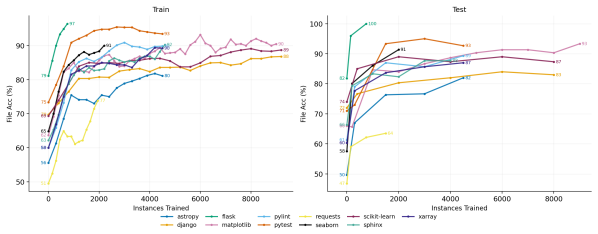
Information localization within massive repositories is a cornerstone of agentic LLM systems. While synthetic data-driven optimization has proven successful in training LLMs, little attention has been paid to optimizing the agent's working environment (the repository itself) in a data-driven manner. To bridge this gap, we present Libra, a self-evolving framework that introduces mutable "catalogs" (hierarchical Markdown files serving as navigable indices) into the repository. Libra runs an LLM-driven optimization loop where a Prompter generates synthetic queries, a frozen Solver attempts to resolve them by navigating the catalogs, and a Healer rewrites the catalogs in response to the Solver's localization failures. Evaluations across 12 SWE-bench Lite repositories demonstrate that this environmental healing yields continual, logarithmic improvements in code localization accuracy. Furthermore, these environmental improvements transfer zero-shot across different LLMs and problem sets. Although the focus of this paper is to study the general behavior of such a system, we also demonstrate that a minimalist coding agent equipped with Libra-optimized catalogs outperforms state-of-the-art baselines. Code is available at https://github.com/salesforce-misc/Libra and data at https://huggingface.co/datasets/Salesforce/Libra.
Figures




Reference graph
Works this paper leans on
-
[1]
LocAgent: Graph-guided LLM agents for code localization
URLhttps://arxiv.org/abs/2503.09089. Zhuyun Dai, Vincent Y . Zhao, Ji Ma, Yi Luan, Jianmo Ni, Jing Lu, Anton Bakalov, Kelvin Guu, Keith B. Hall, and Ming-Wei Chang. Promptagator: Few-shot dense retrieval from 8 examples. InInternational Conference on Learning Representations (ICLR), 2023. URL https://arxiv. org/abs/2209.11755. Darren Edge, Ha Trinh, Newma...
-
[2]
**No self-reference.** Never say "in this snippet", "the provided code", etc. Write as if you're a developer querying a codebase
-
[3]
However, the final question must be answerable by the file that contains the provided chunk
**Ground the question in the enclosing file.** You may explore beyond the provided chunk - read surrounding code in the same file, or read other parts of the repo for context. However, the final question must be answerable by the file that contains the provided chunk
-
[4]
**Target core logic, not names.** Don't just ask "what does this code do?" - ask about a specific detail, edge case, or mechanism inside it
-
[5]
How does the Wavefunction class determine limits
**NO EXACT IDENTIFIERS (CRITICAL).** You must NOT use the exact names of classes, functions, variables, or files in your question. Instead of asking "How does the Wavefunction class determine limits...", ask "How does the system represent quantum states when determining coordinate boundaries...". Force the evaluating agent to use semantic search
-
[6]
**Dead chunks.** If the chunk is pure boilerplate (only imports, whitespace, closing brackets) with no meaningful logic, set is_valid_chunk to false
-
[7]
Strictly follow the additional rules provided by the user if any. ### ANSWER FORMAT Use the most specific locator visible in the chunk: - Top-level function:`filepath::function_name` - Method on a class:`filepath::ClassName.method_name` - If multiple functions are relevant, pick the primary one. ### REASONING (think step by step before generating)
-
[8]
Explore the chunk's enclosing file and module and write a brief summary of the functions of the chunk, file and module in the repo
-
[9]
Identify the key elements in the chunk: functions, classes, logic branches, comments, edge cases
-
[10]
You are banned from using these in the question
**List Forbidden Words:** Explicitly list the exact class names, function names, and highly specific variable names found in the chunk. You are banned from using these in the question
-
[11]
Pick the most interesting or non-obvious aspect - a bug, an edge case, a design choice, a specific behavior. 17
-
[12]
Write a question targeting that aspect using conceptual synonyms instead of your forbidden words. ### TOOLS When using tools (Read, Grep, Bash, etc.) to explore the codebase, always use **relative paths** (e.g.`core/expr.py`), never absolute paths. The working directory is already set to the repository root. User template (prompter_user_template). Filepat...
-
[13]
A one-line summary of what the file/submodule does
-
[14]
- Simple helpers/utils - list name or declaration only
Functions/classes with **adaptive verbosity** - match detail to complexity: - Trivial/obvious - omit entirely. - Simple helpers/utils - list name or declaration only. - Moderate complexity - name + short summary. - High complexity - bullet list of key functionalities, logic flow, components, etc. Each listed section (class, function, method, etc.) MUST be...
-
[15]
Fixes must **strictly** follow these constraints: - Be concise
(Optional) brief "Caveats" note for surprises or easy-to-misuse behavior. Fixes must **strictly** follow these constraints: - Be concise. - Be definitive, not descriptive (assert what something IS, not how it works). - Respect adaptive verbosity - don't promote trivial entries to verbose ones. - Only edit the target catalog file specified in the user mess...
discussion (0)
Sign in with ORCID, Apple, or X to comment. Anyone can read and Pith papers without signing in.