REVIEW 3 major objections 1 minor 134 references
AI in the Workplace: The Impact of AI on Perceived Job Decency and Meaningfulness
T0 review · 3 major / 1 minor · reviewed 2026-06-29 · grok-4.3
Pith's one-line read Perceptions of how AI affects job decency and meaningfulness differ across IT, healthcare, and service sectors, producing different expectations for future satisfaction.
desk verdict The paper reports interview patterns from 24 workers showing sector splits in expected AI effects on decency versus meaningfulness, but the small non-probability sample limits how far those patterns can be taken. read the letter →
The pith
A machine-rendered reading of the paper's core claim, the machinery that carries it, and where it could break.
The reading
What carries the argument
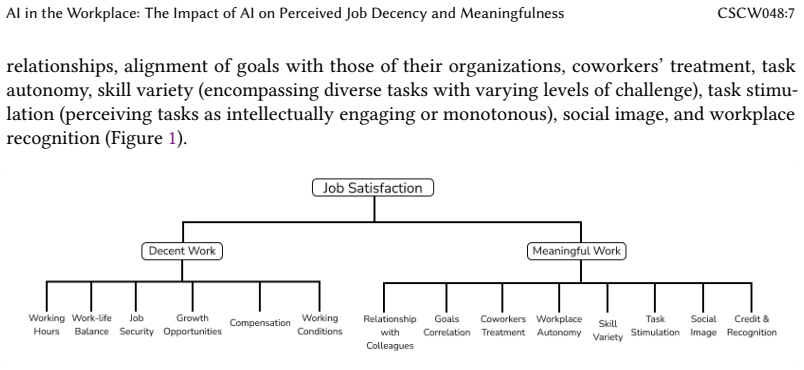
The two-dimensional lens of job decency (practical conditions such as hours) versus meaningfulness (social image and purpose) used to map anticipated AI effects in each sector.
What would settle it
A larger representative survey of the same three sectors that finds no difference in how decency and meaningfulness are expected to change with AI would falsify the domain-variation claim.
Extended reading notes
Core claim
Through interviews with 24 employees across IT, service-based, and healthcare sectors, the study finds that the anticipated impact of AI on overall job satisfaction varies with the occupational domain, with differing perceptions of its underlying decency and meaningfulness. IT and healthcare anticipate increased satisfaction with decency aspects like working hours but decreased satisfaction with meaningfulness aspects like social image due to misconceptions about AI handling most of their tasks. Conversely, service workers foresee no improvement in their working hours but a higher social standing due to the perceived status boost associated with working with AI.
Load-bearing premise
The 24 employees' stated views about future AI impacts accurately represent the broader opinions in their sectors and the decency-meaningfulness split is a reliable way to measure job satisfaction.
Editorial extensions
If this is right
- AI rollout in IT and healthcare may raise satisfaction on practical conditions while lowering it on social-image and purpose dimensions.
- Service roles may see social-status gains from AI collaboration even without changes in working hours.
- Overall satisfaction forecasts must weigh the relative importance of decency versus meaningfulness within each occupational domain.
Reading between the lines
- Clear communication about what tasks AI will and will not perform could reduce the meaningfulness drop that IT and healthcare workers anticipate.
- Sector-tailored AI introduction plans may be needed to avoid unintended drops in perceived job value.
- Tracking whether these stated perceptions predict later satisfaction scores after AI tools are introduced would test the framework's predictive value.
Signed reviews
Editorial analysis
A structured set of objections, weighed in public.
Referee Report
Summary. The paper reports on semi-structured interviews with 24 employees across IT, service-based, and healthcare sectors. It claims that anticipated effects of AI on job satisfaction differ by domain: IT and healthcare workers expect gains in decency dimensions (e.g., working hours) but losses in meaningfulness dimensions (e.g., social image) owing to misconceptions about AI task coverage, whereas service workers anticipate no hour improvements but a status boost from AI association.
Significance. If the interpretive claims survive methodological scrutiny, the work adds to HCI research on experiential outcomes of workplace AI by foregrounding domain-specific perceptions of decency versus meaningfulness rather than performance metrics alone.
major comments (3)
- [Abstract / Results] Abstract / Results paragraph: the domain-specific patterns (IT/healthcare vs. service) are asserted on the basis of 24 non-probability interviews; without reported recruitment criteria, sector balance, or participant demographics, the generalizability of the reported differences cannot be assessed and the patterns remain vulnerable to selection effects.
- [Results] Results paragraph: the interpretive step that labels IT/healthcare perceptions as 'misconceptions' and applies the decency/meaningfulness split is presented as a finding, yet the manuscript supplies no information on interview protocol, coding scheme, inter-coder reliability, or member checking; these omissions are load-bearing for the validity of the claimed distinctions.
- [Results] Results paragraph: the claim that service workers foresee 'higher social standing' rests on the same small sample and unvalidated framework; the absence of any cross-validation or alternative explanations weakens the contrast drawn with IT/healthcare.
minor comments (1)
- [Abstract] The abstract would be clearer if it stated the number of participants per sector and the exact interview questions used to elicit decency versus meaningfulness perceptions.
Simulated Author's Rebuttal
We thank the referee for their constructive comments, which have helped us identify areas for improvement in reporting and interpretation. Below we respond to each major comment and indicate the changes we will make in the revised manuscript.
read point-by-point responses
-
Referee: [Abstract / Results] Abstract / Results paragraph: the domain-specific patterns (IT/healthcare vs. service) are asserted on the basis of 24 non-probability interviews; without reported recruitment criteria, sector balance, or participant demographics, the generalizability of the reported differences cannot be assessed and the patterns remain vulnerable to selection effects.
Authors: We agree that the manuscript would benefit from greater transparency regarding the participant sample. In the revised version, we will add a detailed Methods section that specifies the recruitment criteria (purposive sampling targeting employees in IT, service, and healthcare sectors with at least one year of experience), the sector balance (approximately equal numbers across the three domains), and key participant demographics including age range, gender, and tenure. Although the study employs non-probability sampling typical of qualitative research and does not seek broad generalizability, we will explicitly discuss the implications of potential selection effects and how the domain-specific patterns should be viewed as indicative rather than representative. revision: yes
-
Referee: [Results] Results paragraph: the interpretive step that labels IT/healthcare perceptions as 'misconceptions' and applies the decency/meaningfulness split is presented as a finding, yet the manuscript supplies no information on interview protocol, coding scheme, inter-coder reliability, or member checking; these omissions are load-bearing for the validity of the claimed distinctions.
Authors: The original manuscript indeed lacked sufficient methodological detail, which we will rectify. The revised manuscript will include descriptions of the semi-structured interview protocol, which probed perceptions of job decency (e.g., working hours, physical demands) and meaningfulness (e.g., social image, task significance) in both present and future AI-influenced scenarios. We will also outline the thematic analysis coding scheme developed iteratively by the research team. Note that inter-coder reliability was not formally assessed as coding was conducted collaboratively with consensus reached through discussion, and member checking was not performed; these will be acknowledged as limitations. Regarding the 'misconceptions' label, we will revise the language to 'perceptions that may overestimate AI's current task coverage' to more accurately reflect the data without overclaiming. The decency/meaningfulness framework is drawn from established job satisfaction literature and will be better integrated with citations. revision: partial
-
Referee: [Results] Results paragraph: the claim that service workers foresee 'higher social standing' rests on the same small sample and unvalidated framework; the absence of any cross-validation or alternative explanations weakens the contrast drawn with IT/healthcare.
Authors: We recognize that the contrast between sectors is based on a modest sample and would be strengthened by additional validation. In the revision, we will include more verbatim quotes from service sector participants to substantiate the 'higher social standing' expectation and will discuss potential alternative explanations, such as the association of AI with innovation and modernity in service roles versus task displacement concerns in other sectors. The framework's application will be clarified as interpretive, and we will moderate claims to emphasize that these are observed patterns in our data. We will also add a section on study limitations highlighting the sample size and the exploratory nature of the work. revision: yes
Circularity Check
No circularity: qualitative interview study with no derivations or self-referential reductions
full rationale
The paper reports results from 24 semi-structured interviews across IT, service, and healthcare sectors, interpreting participants' stated perceptions of AI effects on job decency and meaningfulness. No equations, parameters, models, or derivation chains exist. Claims are presented as direct outcomes of the interview data without any step that reduces by construction to fitted inputs, self-citations, or renamed prior results. The analysis is self-contained against external benchmarks of primary qualitative evidence.
Assumptions & free parameters
assumptions (1)
- domain assumption Interview responses accurately capture workers' perceptions of job decency and meaningfulness.
Cite this review
Pith. "Pith review of AI in the Workplace: The Impact of AI on Perceived Job Decency and Meaningfulness." pith.science (2026). https://pith.science/paper/DY54XVSM
@misc{pith2026260528680,
  author       = {Pith},
  title        = {Pith review of: AI in the Workplace: The Impact of AI on Perceived Job Decency and Meaningfulness},
  year         = {2026},
  howpublished = {\url{https://pith.science/paper/DY54XVSM}},
  note         = {Machine review of arXiv:2605.28680}
}
read the original abstract
The proliferation of Artificial Intelligence (AI) in workplaces is transforming how we work. While existing research on human-AI collaboration at work often prioritizes performance, less is known about their experiential outcomes. Through interviews with 24 employees across Information Technology (IT), service-based, and healthcare sectors, this paper examines AI's impact on job satisfaction via perceptions of job decency and meaningfulness, now and in the future. Our results reveal that the anticipated impact of AI on overall job satisfaction varies with the occupational domain, with differing perceptions of its underlying decency and meaningfulness. For instance, IT and healthcare anticipate increased satisfaction with decency aspects like working hours but decreased satisfaction with meaningfulness aspects like social image due to misconceptions about AI handling most of their tasks. Conversely, service workers foresee no improvement in their working hours but a higher social standing due to the perceived status boost associated with working with AI.
Figures

Reference graph
Works this paper leans on
-
[1]
Hussein A Abbass. 2019. Social integration of artificial intelligence: functions, automation allocation logic and human-autonomy trust.Cognitive Computation11, 2 (2019), 159–171
2019
-
[2]
Ajay Agrawal, Joshua Gans, and Avi Goldfarb. 2017. What to expect from artificial intelligence
2017
-
[3]
Herman Aguinis and Ante Glavas. 2019. On corporate social responsibility, sensemaking, and the search for meaningfulness through work.Journal of management45, 3 (2019), 1057–1086
2019
-
[4]
Shoeb Ahmad. 2013. Paradigms of quality of work life.Journal of Human Values19, 1 (2013), 73–82
2013
-
[5]
Zeynep Akata, Dan Balliet, Maarten De Rijke, Frank Dignum, Virginia Dignum, Guszti Eiben, Antske Fokkens, Davide Grossi, Koen Hindriks, Holger Hoos, et al . 2020. A research agenda for hybrid intelligence: augmenting human intellect with collaborative, adaptive, responsible, and explainable artificial intelligence.Computer53, 8 (2020), 18–28
2020
-
[6]
Blake A Allan, Kelsey L Autin, Ryan D Duffy, and Haley M Sterling. 2020. Decent and meaningful work: A longitudinal study.Journal of Counseling Psychology67, 6 (2020), 669
2020
-
[7]
Tammy D Allen. 2012. The work–family role interface: a synthesis of the research from industrial and organizational psychology.Handbook of Psychology, Second Edition12 (2012). Proc. ACM Hum.-Comput. Interact., Vol. 10, No. 6, Article CSCW048. Publication date: October 2026. CSCW048:22 Ghosh et al
2012
-
[8]
Caroline Arnoux-Nicolas, Laurent Sovet, Lin Lhotellier, Annamaria Di Fabio, and Jean-Luc Bernaud. 2016. Perceived work conditions and turnover intentions: The mediating role of meaning of work.Frontiers in psychology7 (2016), 704
2016
Show all 134 references
-
[9]
Yuntao Bai, Andy Jones, Kamal Ndousse, Amanda Askell, Anna Chen, Nova DasSarma, Dawn Drain, Stanislav Fort, Deep Ganguli, Tom Henighan, et al. 2022. Training a helpful and harmless assistant with reinforcement learning from human feedback.arXiv preprint arXiv:2204.05862(2022)
2022 arXiv
-
[10]
Catherine Bailey and Adrian Madden. 2016. What makes work meaningful—or meaningless.MIT Sloan management review(2016)
2016
-
[11]
Matthias Baldauf, Peter Fröhlich, Shadan Sadeghian, Philippe Palanque, Virpi Roto, Wendy Ju, Lynne Baillie, and Manfred Tscheligi. 2021. Automation experience at the workplace. InExtended Abstracts of the 2021 CHI Conference on Human Factors in Computing Systems. 1–6
2021
-
[12]
Yehuda Baruch. 2006. Career development in organizations and beyond: Balancing traditional and contemporary viewpoints.Human resource management review16, 2 (2006), 125–138
2006
-
[13]
Gordon Baxter and Ian Sommerville. 2011. Socio-technical systems: From design methods to systems engineering. Interacting with computers23, 1 (2011), 4–17
2011
-
[14]
Katerina Berezina, Olena Ciftci, and Cihan Cobanoglu. 2019. Robots, artificial intelligence, and service automation in restaurants. InRobots, artificial intelligence, and service automation in travel, tourism and hospitality. Emerald Publishing Limited, 185–219
2019
-
[15]
Amisha Bhargava, Marais Bester, and Lucy Bolton. 2021. Employees’ perceptions of the implementation of robotics, artificial intelligence, and automation (RAIA) on job satisfaction, job security, and employability.Journal of Technology in Behavioral Science6, 1 (2021), 106–113
2021
-
[16]
2018.From AI to robotics: mobile, social, and sentient robots
Arkapravo Bhaumik. 2018.From AI to robotics: mobile, social, and sentient robots. CrC Press
2018
-
[17]
Frank Blackler. 1995. Knowledge, knowledge work and organizations: An overview and interpretation.Organization studies16, 6 (1995), 1021–1046
1995
-
[18]
David L Blustein, Evgenia I Lysova, and Ryan D Duffy. 2023. Understanding decent work and meaningful work. Annual Review of Organizational Psychology and Organizational Behavior10 (2023), 289–314
2023
-
[19]
Yana Boeva, Arne Berger, Andreas Bischof, Olivia Doggett, Hendrik Heuer, Juliane Jarke, Pat Treusch, Roger Andre Søraa, Zhasmina Tacheva, and Maja-Lee Voigt. 2023. Behind the Scenes of Automation: Ghostly Care-Work, Mainte- nance, and Interferences: Exploring participatory pra...
2023
-
[20]
Adam Bohr and Kaveh Memarzadeh. 2020. The rise of artificial intelligence in healthcare applications. InArtificial Intelligence in healthcare. Elsevier, 25–60
2020
-
[21]
Florent Bordot. 2022. Artificial intelligence, robots and unemployment: evidence from OECD countries.Journal of innovation economics & management1 (2022), 117–138
2022
-
[22]
autonomous systems
Jeffrey M Bradshaw, Robert R Hoffman, David D Woods, and Matthew Johnson. 2013. The seven deadly myths of" autonomous systems".IEEE Intelligent Systems28, 3 (2013), 54–61
2013
-
[23]
Adriana Braga and Robert K Logan. 2017. The emperor of strong AI has no clothes: limits to artificial intelligence. Information8, 4 (2017), 156
2017
-
[24]
I’m not mopping the floors, I’m putting a man on the moon
Andrew M Carton. 2018. “I’m not mopping the floors, I’m putting a man on the moon”: How NASA leaders enhanced the meaningfulness of work by changing the meaning of work.Administrative Science Quarterly63, 2 (2018), 323–369
2018
-
[25]
Stephen Cave and Kanta Dihal. 2019. Hopes and fears for intelligent machines in fiction and reality.Nature machine intelligence1, 2 (2019), 74–78
2019
-
[26]
Michael Chui, James Manyika, and Mehdi Miremadi. 2015. Four fundamentals of workplace automation.McKinsey Quarterly29, 3 (2015), 1–9
2015
-
[27]
Amy E Colbert, Joyce E Bono, and Radostina K Purvanova. 2016. Flourishing via workplace relationships: Moving beyond instrumental support.Academy of Management Journal59, 4 (2016), 1199–1223
2016
-
[28]
Jacob W Crandall, Mayada Oudah, Tennom, Fatimah Ishowo-Oloko, Sherief Abdallah, Jean-François Bonnefon, Manuel Cebrian, Azim Shariff, Michael A Goodrich, and Iyad Rahwan. 2018. Cooperating with machines.Nature communications9, 1 (2018), 233
2018
-
[29]
2018.Human+ machine: Reimagining work in the age of AI
Paul R Daugherty and H James Wilson. 2018.Human+ machine: Reimagining work in the age of AI. Harvard Business Press
2018
-
[30]
Paul R Daugherty and H James Wilson. 2019. Creating the symbiotic AI workforce of the future.MIT Sloan Management Review61, 1 (2019), 1–4
2019
-
[31]
Thomas H Davenport, Rajeev Ronanki, et al. 2018. Artificial intelligence for the real world.Harvard business review 96, 1 (2018), 108–116. Proc. ACM Hum.-Comput. Interact., Vol. 10, No. 6, Article CSCW048. Publication date: October 2026. AI in the Workplace: The Impact of AI o...
2018
-
[32]
Patrick Dawson. 2014. Temporal Practices: Time and Ethnographic Research in Changing Organizations.Journal of Organizational Ethnography3, 2 (2014), 130–151. doi:10.1108/JOE-05-2012-0025
2014 doi
-
[33]
David De Cremer and Garry Kasparov. 2021. AI should augment human intelligence, not replace it.Harvard Business Review18, 1 (2021)
2021
-
[34]
Dominik Dellermann, Adrian Calma, Nikolaus Lipusch, Thorsten Weber, Sascha Weigel, and Philipp Ebel. 2021. The future of human-AI collaboration: a taxonomy of design knowledge for hybrid intelligence systems.arXiv preprint arXiv:2105.03354(2021)
2021
-
[35]
Bryan J Dik and Ryan D Duffy. 2009. Calling and vocation at work: Definitions and prospects for research and practice.The counseling psychologist37, 3 (2009), 424–450
2009
-
[36]
Daniel Dorta-Afonso, Manuel González-de-la Rosa, Francisco J Garcia-Rodriguez, and Laura Romero-Domínguez. 2021. Effects of high-performance work systems (HPWS) on hospitality employees’ outcomes through their organizational commitment, motivation, and job satisfaction.Sustain...
2021
-
[37]
Ryan D Duffy, David L Blustein, Matthew A Diemer, and Kelsey L Autin. 2016. The psychology of working theory. Journal of counseling psychology63, 2 (2016), 127
2016
-
[38]
James H Dulebohn and Stephen E Werling. 2007. Compensation research past, present, and future.Human Resource Management Review17, 2 (2007), 191–207
2007
-
[39]
Yogesh K Dwivedi, Laurie Hughes, Elvira Ismagilova, Gert Aarts, Crispin Coombs, Tom Crick, Yanqing Duan, Rohita Dwivedi, John Edwards, Aled Eirug, et al. 2021. Artificial Intelligence (AI): Multidisciplinary perspectives on emerging challenges, opportunities, and agenda for re...
2021
-
[40]
Anthony Elliott, Brian McKelvey, and Glenn Bowen. 2017. Marking Time in Ethnography: Uncovering Temporal Dispositions.Time & Society26, 3 (2017), 314–336. doi:10.1177/1466138116655360
2017 doi
-
[41]
J. A. English-Lueck, Sam Ladner, and Liza Sherman. 2021. Little Dramas Everywhere: Using Ethnography to Anticipate the Future. InProceedings of EPIC 2021. EPIC. https://www.epicpeople.org/little-dramas-everywhere/
2021
-
[42]
Connor Esterwood and Lionel P Robert. 2020. Human robot team design. InProceedings of the 8th international conference on human-agent interaction. 251–253
2020
-
[43]
Patricia Findlay, Colin Lindsay, Jo McQuarrie, Marion Bennie, Emma D Corcoran, and Robert Van Der Meer. 2017. Employer choice and job quality: Workplace innovation, work redesign, and employee perceptions of job quality in a complex health-care setting.Work and Occupations44, ...
2017
-
[44]
Peter Fleming. 2019. Robots and organization studies: Why robots might not want to steal your job.Organization Studies40, 1 (2019), 23–38
2019
-
[45]
Luke Fletcher. 2019. How can personal development lead to increased engagement? The roles of meaningfulness and perceived line manager relations.The International Journal of Human Resource Management30, 7 (2019), 1203–1226
2019
-
[46]
Elmari Fouché, Sebastiaan Snr Rothmann, and Corne Van der Vyver. 2017. Antecedents and outcomes of meaningful work among school teachers.SA Journal of Industrial Psychology43, 1 (2017), 1–10
2017
-
[47]
Garoa Gomez-Beldarrain, Himanshu Verma, Euiyoung Kim, and Alessandro Bozzon. 2025. Why does Automation Adoption in Organizations Remain a Fallacy?: Scrutinizing Practitioners’ Imaginaries in an International Airport. In In CHI Conference on Human Factors in Computing Systems,(...
2025
-
[48]
Mary A Gowan. 2014. Moving from job loss to career management: The past, present, and future of involuntary job loss research.Human Resource Management Review24, 3 (2014), 258–270
2014
-
[49]
Adam M Grant. 2007. Relational job design and the motivation to make a prosocial difference.Academy of management review32, 2 (2007), 393–417
2007
-
[50]
Adam M Grant, Elizabeth M Campbell, Grace Chen, Keenan Cottone, David Lapedis, and Karen Lee. 2007. Impact and the art of motivation maintenance: The effects of contact with beneficiaries on persistence behavior.Organizational behavior and human decision processes103, 1 (2007), 53–67
2007
-
[51]
Jeffrey H Greenhaus and Tammy D Allen. 2011. Work–family balance: A review and extension of the literature. (2011)
2011
-
[52]
Jeffrey H Greenhaus and Ellen Ernst Kossek. 2014. The contemporary career: A work–home perspective.Annu. Rev. Organ. Psychol. Organ. Behav.1, 1 (2014), 361–388
2014
-
[53]
Ken Gu, Madeleine Grunde-McLaughlin, Andrew McNutt, Jeffrey Heer, and Tim Althoff. 2024. How do data analysts respond to ai assistance? a wizard-of-oz study. InProceedings of the CHI Conference on Human Factors in Computing Systems. 1–22
2024
-
[54]
Greg Guest, Arwen Bunce, and Laura Johnson. 2006. How many interviews are enough? An experiment with data saturation and variability.Field methods18, 1 (2006), 59–82
2006
-
[55]
Alicia Guo, Pat Pataranutaporn, and Pattie Maes. 2024. Exploring the Impact of AI Value Alignment in Collaborative Ideation: Effects on Perception, Ownership, and Output. InExtended Abstracts of the CHI Conference on Human Factors Proc. ACM Hum.-Comput. Interact., Vol. 10, No....
2024
-
[56]
J Richard Hackman and Greg R Oldham. 1976. Motivation through the design of work: Test of a theory.Organizational behavior and human performance16, 2 (1976), 250–279
1976
-
[57]
Wael Hafez. 2021. Human digital twin—enabling human-agents collaboration. In2021 4th International Conference on Intelligent Robotics and Control Engineering (IRCE). IEEE, 40–45
2021
-
[58]
Yuanning Han, Ziyi Qiu, Jiale Cheng, and RAY LC. 2024. When Teams Embrace AI: Human Collaboration Strategies in Generative Prompting in a Creative Design Task. InProceedings of the CHI Conference on Human Factors in Computing Systems. 1–14
2024
-
[59]
Patrick Hemmer, Monika Westphal, Max Schemmer, Sebastian Vetter, Michael Vössing, and Gerhard Satzger. 2023. Human-AI Collaboration: The Effect of AI Delegation on Human Task Performance and Task Satisfaction. InProceed- ings of the 28th International Conference on Intelligent...
2023
-
[60]
Douglas Henne and Edwin A Locke. 1985. Job dissatisfaction: What are the consequences?International journal of psychology20, 2 (1985), 221–240
1985
-
[61]
Frederick Hertzberg, Bernard Mausner, and Barbara Snyderman. 1959. The motivation to work.New York(1959)
1959
-
[62]
T Hirst. 2014. Does technological innovation increase unemployment. InThe World Economic Forum Blog [online], Agenda Retrieved (https://agenda. weforum. org/2014/11/does-technologicalinnovationincreaseunemployment
2014
-
[63]
Stanislav Hristov Ivanov. 2017. Robonomics-principles, benefits, challenges, solutions. (2017)
2017
-
[64]
Timothy A Judge, Ronald F Piccolo, Nathan P Podsakoff, John C Shaw, and Bruce L Rich. 2010. The relationship between pay and job satisfaction: A meta-analysis of the literature.Journal of vocational behavior77, 2 (2010), 157–167
2010
-
[65]
Minseo Kim and Terry A Beehr. 2020. Thriving on demand: Challenging work results in employee flourishing through appraisals and resources.International Journal of Stress Management27, 2 (2020), 111
2020
-
[66]
If the Machine Is As Good As Me, Then What Use Am I?
Charlotte Kobiella, Yarhy Said Flores López, Franz Waltenberger, Fiona Draxler, and Albrecht Schmidt. 2024. " If the Machine Is As Good As Me, Then What Use Am I?"–How the Use of ChatGPT Changes Young Professionals’ Perception of Productivity and Accomplishment. InProceedings ...
2024
-
[67]
Vegard Kolbjørnsrud, Richard Amico, and Robert J Thomas. 2016. The promise of artificial intelligence.Accenture: Dublin, Ireland(2016)
2016
-
[68]
Haiyan Kong, Xinyu Jiang, Wilco Chan, and Xiaoge Zhou. 2018. Job satisfaction research in the field of hospitality and tourism.International journal of contemporary hospitality management30, 5 (2018), 2178–2194
2018
-
[69]
Matthias Laschke, Alarith Uhde, and Marc Hassenzahl. 2020. Positive work practices. Opportunities and challenges in designing meaningful work-related technology.arXiv preprint arXiv:2003.05533(2020)
2020
-
[70]
2017.Research methods in human-computer interaction
Jonathan Lazar, Jinjuan Heidi Feng, and Harry Hochheiser. 2017.Research methods in human-computer interaction. Morgan Kaufmann
2017
-
[71]
Jenny T Liang, Chenyang Yang, and Brad A Myers. 2024. A large-scale survey on the usability of ai programming assistants: Successes and challenges. InProceedings of the 46th IEEE/ACM International Conference on Software Engineering. 1–13
2024
-
[72]
Pongsakorn Limna. 2023. Artificial Intelligence (AI) in the hospitality industry: A review article.International Journal of Computing Sciences Research7 (2023), 1306–1317
2023
-
[73]
Joseph Lindley, Dhruv Sharma, and Robert Potts. 2014. Anticipatory Ethnography: Design fiction as an input to design ethnography. InEthnographic Praxis in Industry Conference Proceedings, Vol. 2014. Wiley Online Library, 237–253
2014
-
[74]
Martin Lindvall, Claes Lundström, and Jonas Löwgren. 2021. Rapid assisted visual search: Supporting digital pathologists with imperfect AI. InProceedings of the 26th International Conference on Intelligent User Interfaces. 504–513
2021
-
[75]
Marjolein Lips-Wiersma, Jarrod Haar, and Sarah Wright. 2020. The effect of fairness, responsible leadership and worthy work on multiple dimensions of meaningful work.Journal of business ethics161 (2020), 35–52
2020
-
[76]
Marjolein Lips-Wiersma and Lani Morris. 2009. Discriminating between ‘meaningful work’and the ‘management of meaning’.Journal of business ethics88 (2009), 491–511
2009
-
[77]
Edwin A Locke. 1969. What is job satisfaction?Organizational behavior and human performance4, 4 (1969), 309–336
1969
-
[78]
Caitlin Lustig. 2019. Intersecting imaginaries: visions of decentralized autonomous systems.Proceedings of the ACM on Human-Computer Interaction3, CSCW (2019), 1–27
2019
-
[79]
Evgenia I Lysova. 2019. Meaningful Work and Family.The Oxford Handbook of Meaningful Work(2019), 404
2019
-
[80]
Evgenia I Lysova, Blake A Allan, Bryan J Dik, Ryan D Duffy, and Michael F Steger. 2019. Fostering meaningful work in organizations: A multi-level review and integration.Journal of vocational behavior110 (2019), 374–389
2019
-
[81]
Yewande Marquis, Tunboson Oyewale Oladoyinbo, Samuel Oladiipo Olabanji, Oluwaseun Oladeji Olaniyi, and Samson Abidemi Ajayi. 2024. Proliferation of AI tools: A multifaceted evaluation of user perceptions and emerging trend.Asian Journal of Advanced Research and Reports18, 1 (2...
2024
-
[82]
Frank Martela and Tapani JJ Riekki. 2018. Autonomy, competence, relatedness, and beneficence: A multicultural comparison of the four pathways to meaningful work.Frontiers in psychology9 (2018), 327587
2018
-
[83]
You’re fired,
Paul K McClure. 2018. “You’re fired, ” says the robot: The rise of automation in the workplace, technophobes, and fears of unemployment.Social Science Computer Review36, 2 (2018), 139–156
2018
-
[84]
Bertalan Meskó, Gergely Hetényi, and Zsuzsanna Győrffy. 2018. Will artificial intelligence solve the human resource crisis in healthcare?BMC health services research18 (2018), 1–4
2018
-
[85]
2017.Robots and robotics: principles, systems, and industrial applications
Mark R Miller and Rex Miller. 2017.Robots and robotics: principles, systems, and industrial applications. McGraw-Hill Education
2017
-
[86]
Steven M Miller. 2018. AI: Augmentation, more so than automation. (2018)
2018
-
[87]
Elliot G Mitchell, Rosa Maimone, Andrea Cassells, Jonathan N Tobin, Patricia Davidson, Arlene M Smaldone, and Lena Mamykina. 2021. Automated vs. human health coaching: exploring participant and practitioner experiences. Proceedings of the ACM on human-computer interaction5, CS...
2021
-
[88]
Joel Mokyr, Chris Vickers, and Nicolas L Ziebarth. 2015. The history of technological anxiety and the future of economic growth: Is this time different?Journal of economic perspectives29, 3 (2015), 31–50
2015
-
[89]
Taewoo Nam. 2019. Technology usage, expected job sustainability, and perceived job insecurity.Technological Forecasting and Social Change138 (2019), 155–165
2019
-
[90]
Sven Nyholm and Jilles Smids. 2020. Can a robot be a good colleague?Science and engineering ethics26 (2020), 2169–2188
2020
-
[91]
I.L. Office. 2014.Global Employment Trends 2014: Risk of a Jobless Recovery?International Labour Organisation (ILO). https://books.google.de/books?id=_iK5oAEACAAJ
2014
-
[92]
Songhee Oh, Jae Heon Kim, Sung-Woo Choi, Hee Jeong Lee, Jungrak Hong, and Soon Hyo Kwon. 2019. Physician confidence in artificial intelligence: an online mobile survey.Journal of medical Internet research21, 3 (2019), e12422
2019
-
[93]
Jonas Ossadnik, Katrin Muehlfeld, and Laszlo Goerke. 2023. Man or machine–or something in between? Social responses to voice assistants at work and their effects on job satisfaction.Computers in Human Behavior149 (2023), 107919
2023
-
[94]
Raja Parasuraman, Thomas B Sheridan, and Christopher D Wickens. 2008. Situation awareness, mental workload, and trust in automation: Viable, empirically supported cognitive engineering constructs.Journal of cognitive engineering and decision making2, 2 (2008), 140–160
2008
-
[95]
Karsten I Paul and Klaus Moser. 2009. Unemployment impairs mental health: Meta-analyses.Journal of Vocational behavior74, 3 (2009), 264–282
2009
-
[96]
Susana Pereira, Nuno Rebelo dos Santos, and Leonor Pais. 2019. Empirical research on decent work: A literature review. (2019)
2019
-
[97]
Michael G Pratt and Blake E Ashforth. 2003. Fostering meaningfulness in working and at work.Positive organizational scholarship: Foundations of a new discipline309 (2003), 327
2003
-
[98]
Crystal Qian and James Wexler. 2024. Take It, Leave It, or Fix It: Measuring Productivity and Trust in Human-AI Collaboration. InProceedings of the 29th International Conference on Intelligent User Interfaces. 370–384
2024
-
[99]
Marigo Raftopoulos and Juho Hamari. 2023. Human-AI collaboration in organisations: A literature review on enabling value creation. (2023)
2023
-
[100]
Brent D Rosso, Kathryn H Dekas, and Amy Wrzesniewski. 2010. On the meaning of work: A theoretical integration and review.Research in organizational behavior30 (2010), 91–127
2010
-
[101]
2016.Artificial intelligence: a modern approach
Stuart J Russell and Peter Norvig. 2016.Artificial intelligence: a modern approach. Pearson
2016
-
[102]
Shadan Sadeghian, Migle Bareikyte, Marcus Burkhardt, and Marc Hassenzahl. 2025. WorkAI: A Toolkit for the Design of AI-driven Future of Work.Proceedings of the ACM on Human-Computer Interaction9, 7 (2025), 1–27
2025
-
[103]
Shadan Sadeghian and Marc Hassenzahl. 2022. The” artificial” colleague: evaluation of work satisfaction in collabora- tion with non-human coworkers. In27th International Conference on Intelligent User Interfaces. 27–35
2022
-
[104]
Shadan Sadeghian, Alarith Uhde, and Marc Hassenzahl. 2024. The Soul of Work: Evaluation of Job Meaningfulness and Accountability in Human-AI Collaboration.Proceedings of the ACM on Human-Computer Interaction8, CSCW1 (2024), 1–26
2024
-
[105]
Vildan Salikutluk, Janik Schöpper, Franziska Herbert, Katrin Scheuermann, Eric Frodl, Dirk Balfanz, Frank Jäkel, and Dorothea Koert. 2024. An Evaluation of Situational Autonomy for Human-AI Collaboration in a Shared Workspace Setting. InProceedings of the CHI Conference on Hum...
2024
-
[106]
Kjeld Schmidt. 2002. The Problem with ‘Awareness’: Introductory Remarks on Awareness in CSCW.Computer Supported Cooperative Work (CSCW)11, 3–4 (2002), 285–298
2002
-
[107]
Emma Seppala, Timothy Rossomando, and James R Doty. 2013. Social connection and compassion: Important predictors of health and well-being.Social Research: An International Quarterly80, 2 (2013), 411–430
2013
-
[108]
Mohammed Yousef Shaheen. 2021. Applications of Artificial Intelligence (AI) in healthcare: A review.ScienceOpen Preprints(2021). Proc. ACM Hum.-Comput. Interact., Vol. 10, No. 6, Article CSCW048. Publication date: October 2026. CSCW048:26 Ghosh et al
2021
-
[109]
Alexander Sigov, Leonid Ratkin, Leonid A Ivanov, and Li Da Xu. 2024. Emerging enabling technologies for industry 4.0 and beyond.Information Systems Frontiers26, 5 (2024), 1585–1595
2024
-
[110]
Jilles Smids, Sven Nyholm, and Hannah Berkers. 2020. Robots in the workplace: a threat to—or opportunity for—meaningful work?Philosophy & Technology33, 3 (2020), 503–522
2020
-
[111]
Jonathan A Smith, Michael Larkin, and Paul Flowers. 2021. Interpretative phenomenological analysis: Theory, method and research. (2021)
2021
-
[112]
Karolina Socha-Dietrich. 2020. Empowering the health workforce: Strategies to make the most of the digital revolution. Organisation for Economic Co-operation and Development (OECD)(2020)
2020
-
[113]
John R Sparks and Joseph A Schenk. 2001. Explaining the effects of transformational leadership: an investigation of the effects of higher-order motives in multilevel marketing organizations.Journal of Organizational Behavior: The International Journal of Industrial, Occupation...
2001
-
[114]
Michael F Steger, Bryan J Dik, and Ryan D Duffy. 2012. Measuring meaningful work: The work and meaning inventory (WAMI).Journal of career Assessment20, 3 (2012), 322–337
2012
-
[115]
Lucy Suchman. 1995. Making Work Visible. InCommunications of the ACM. Vol. 38. ACM, 56–64
1995
-
[116]
Sherry E Sullivan and Yehuda Baruch. 2009. Advances in career theory and research: A critical review and agenda for future exploration.Journal of management35, 6 (2009), 1542–1571
2009
-
[117]
1974.Working: People talk about what they do all day and how they feel about what they do
Studs Terkel. 1974.Working: People talk about what they do all day and how they feel about what they do. The New Press
1974
-
[118]
Robert B. Textor. 1995.Ethnographic Futures Research: The Exploration of the Possible. Stanford University, Stanford, CA. Original method description of ethnographic futuring
1995
-
[119]
1981.The evolution of socio-technical systems
Eric L Trist. 1981.The evolution of socio-technical systems. Vol. 2. Ontario Quality of Working Life Centre Toronto
1981
-
[120]
Himanshu Verma, Jakub Mlynar, Roger Schaer, Julien Reichenbach, Mario Jreige, John Prior, Florian Evéquoz, and Adrien Depeursinge. 2023. Rethinking the role of AI with physicians in oncology: revealing perspectives from clinical and research workflows. InProceedings of the 202...
2023
-
[121]
Lauren Waardenburg. 2024. Human-AI Collaboration: A Blessing or a Curse for Safety at Work?Tecnoscienza–Italian Journal of Science & Technology Studies15, 1 (2024), 133–146
2024
-
[122]
James C Walliser, Ewart J de Visser, Eva Wiese, and Tyler H Shaw. 2019. Team structure and team building improve human–machine teaming with autonomous agents.Journal of Cognitive Engineering and Decision Making13, 4 (2019), 258–278
2019
-
[123]
Connie R Wanberg. 2012. The individual experience of unemployment.Annual review of psychology63 (2012), 369–396
2012
-
[124]
Brilliant AI doctor
Dakuo Wang, Liuping Wang, Zhan Zhang, Ding Wang, Haiyi Zhu, Yvonne Gao, Xiangmin Fan, and Feng Tian. 2021. “Brilliant AI doctor” in rural clinics: Challenges in AI-powered clinical decision support system deployment. In Proceedings of the 2021 CHI conference on human factors i...
2021
-
[125]
Divanshi Priyadarshni Wangoo. 2018. Artificial intelligence techniques in software engineering for automated software reuse and design. In2018 4th International conference on computing communication and automation (ICCCA). IEEE, 1–4
2018
-
[126]
Justin D Weisz, Shraddha Vijay Kumar, Michael Muller, Karen-Ellen Browne, Arielle Goldberg, Katrin Ellice Heintze, and Shagun Bajpai. 2025. Examining the use and impact of an ai code assistant on developer productivity and experience in the enterprise. InProceedings of the Ext...
2025
-
[127]
Susan Winter, Nicholas Berente, James Howison, and Brian Butler. 2014. Beyond the organizational ‘container’: Conceptualizing 21st century sociotechnical work.Information and Organization24, 4 (2014), 250–269
2014
-
[128]
Amy Wrzesniewski, Jane E Dutton, and Gelaye Debebe. 2003. Interpersonal sensemaking and the meaning of work. Research in organizational behavior25 (2003), 93–135
2003
-
[129]
It Might be Technically Impressive, But It’s Practically Useless to us
Qing Xiao, Xianzhe Fan, Felix Marvin Simon, Bingbing Zhang, and Motahhare Eslami. 2025. " It Might be Technically Impressive, But It’s Practically Useless to us": Motivations, Practices, Challenges, and Opportunities for Cross- Functional Collaboration around AI within the New...
2025
-
[130]
Chengyuan Xu, Kuo-Chin Lien, and Tobias Höllerer. 2023. Comparing zealous and restrained ai recommendations in a real-world human-ai collaboration task. InProceedings of the 2023 CHI Conference on Human Factors in Computing Systems. 1–15
2023
-
[131]
Yuxin Xu, Mengqiu Cheng, and Anastasia Kuzminykh. 2024. What Makes It Mine? Exploring Psychological Ownership over Human-AI Co-Creations. InGraphics Interface 2024 Second Deadline
2024
-
[132]
Sangseok You, Jeong-Hwan Kim, SangHyun Lee, Vineet Kamat, and Lionel P Robert Jr. 2018. Enhancing perceived safety in human–robot collaborative construction using immersive virtual environments.Automation in Construction 96 (2018), 161–170. Proc. ACM Hum.-Comput. Interact., Vo...
2018
-
[133]
Emily S Zhan, María D Molina, Minjin Rheu, and Wei Peng. 2024. What is there to fear? Understanding multi- dimensional fear of AI from a technological affordance perspective.International Journal of Human–Computer Interaction40, 22 (2024), 7127–7144
2024
-
[134]
Anastasios Zopiatis, Panayiotis Constanti, and Antonis L Theocharous. 2014. Job involvement, commitment, satisfac- tion and turnover: Evidence from hotel employees in Cyprus.Tourism Management41 (2014), 129–140. Received May 13, 2025; revised January 13, 2026; accepted March 1...
2014
Reviewed June 29, 2026 · model on record in the stance chip above.
Discussion (0). Continue with ORCID to comment.