REVIEW 4 major objections 5 minor 51 references
MetaMixUp: Learning Adaptive Interpolation Policy of MixUp with Meta-Learning
T0 review · 4 major / 5 minor · reviewed 2026-08-14 · deepseek-v4-flash
Pith's one-line read MetaMixUp learns each sample's interpolation weight and beats plain MixUp on five benchmarks.
desk verdict A useful per-sample MixUp regularizer with consistent empirical gains, but the meta-validation set may not be held out from training and the theory overreaches; worth a careful peer review, not a desk reject. read the letter →
The pith
A machine-rendered reading of the paper's core claim, the machinery that carries it, and where it could break.
The reading
What carries the argument
The central machinery is a bilevel meta-optimization loop. In the inner level, the network takes one gradient step on samples mixed with the current $\lambda$; in the outer level, the gradient of the validation loss with respect to $\lambda$ flows back through that step, and $\lambda$ is updated and projected into [0,1] with a sigmoid. This makes the interpolation policy continuous and trainable. A supporting theoretical object is Proposition 1, which shows that gradient Lipschitz continuity of the predictor implies an inequality bounding the MixUp interpolation error by $\lambda(1-\lambda)\kappa\|x-x'\|^2/2$, so MixUp loss acts as a lower bound on controlling the gradient's Lipschitz constant.
What would settle it
Train MetaMixUp twice on CIFAR-10: once with the 1000 meta-validation images excluded from the training set and once with them included, matching all other settings. If test error is substantially worse in the excluded case, the reported gains depend on tuning lambda on training data rather than on a genuine generalization signal.
Extended reading notes
Core claim
MetaMixUp establishes that data-adaptive interpolation policies improve MixUp. Instead of drawing lambda from a Beta distribution, it optimizes a per-sample lambda_i by differentiating a validation loss through a single gradient step of the network trained on mixed examples; the updated lambda is then used to re-mix and update the network. The paper reports test error reductions on all five supervised benchmarks tested, with CIFAR-10 error falling from 4.57% (vanilla MixUp) to 3.12% and ImageNet top-1 error from 55.06% to 47.35% under PreActResNet18. It also shows that the learned policy puts more weight on original examples when mixing would cause manifold intrusion, and that in semi-supervised learning, combining MetaMixUp with an asynchronous pseudo-labeling threshold improves pseudo-label baselines and improves MixMatch when used in its place.
Load-bearing premise
The load-bearing assumption is that the small validation set used to learn lambda measures true generalization; the paper draws it from the original training set and does not state that those images are excluded from training, so the validation signal may be tuning lambda to memorized examples rather than to out-of-sample performance.
Editorial extensions
If this is right
- If MetaMixUp is right, hand-tuning MixUp's Beta-distribution parameter becomes unnecessary: the method adapts lambda per sample pair and reports gains over every fixed setting tested.
- Because the policy is learned from validation feedback, it should transfer to new datasets without redesigning the augmentation policy, matching or beating MixUp on each benchmark tested.
- In semi-supervised learning, replacing MixUp with MetaMixUp inside MixMatch lowers test error, so the learned interpolation policy composes with other SSL techniques.
- The distribution analysis suggests the method learns to avoid mixing when it would create collisions, providing a concrete mechanism for reducing manifold intrusion.
Reading between the lines
- A direct test: if the validation subset used for lambda is held out from training, the reported gains may shrink; the paper does not state that the meta-validation images are excluded from training, so some of the improvement could come from tuning lambda to samples the network can memorize.
- The learned per-class lambda distributions could be distilled into a static class-pair schedule, making the benefit available without the two-loop meta-computation.
- The same validation-gradient mechanism could be applied to other continuous augmentation hyperparameters, such as cutout size or cropping scale.
- The lower-bound view of MixUp suggests that interpolation policies should depend on pair distance; a testable extension is to weight lambda by feature-space distance instead of per-sample meta-gradients.
Signed reviews
Editorial analysis
A structured set of objections, weighed in public.
Referee Report
Summary. The paper proposes MetaMixUp, a method that learns per-sample MixUp interpolation coefficients by gradient-based meta-learning on a validation set, rather than sampling them from a fixed Beta distribution. It also contributes a theoretical perspective linking MixUp loss to the gradient Lipschitz constant (Proposition 1), and an extension to semi-supervised learning via asynchronous pseudo-labeling (APL). In supervised experiments on MNIST, Fashion-MNIST, SVHN, CIFAR-10/100, and ImageNet, MetaMixUp reports lower test error than vanilla MixUp and AdaMixUp across several architectures; in semi-supervised experiments on CIFAR-10 and SVHN, the method improves pseudo-label baselines and gives small gains when plugged into MixMatch.
Significance. If the reported gains are real, MetaMixUp offers a simple, discriminator-free way to make MixUp data-adaptive, which is valuable for regularization and semi-supervised learning. The empirical results are broad (five supervised benchmarks, multiple architectures, SSL splits) and the SSL results in Table III include 5-run means and deviations. The paper also provides a clean analytic observation (Proposition 1) that is correct as a mathematical statement. However, the significance is tempered by several unresolved issues: the meta-validation set may overlap the training set, the supervised tables lack error bars, the APL threshold formula is inconsistent with the pseudocode, and the algorithmic description of how lambda is optimized is ambiguous. These concerns affect the credibility of the central empirical claim and the reproducibility of the method.
major comments (4)
- [IV-B] The meta-validation set is sampled from the original training set, and the paper never states that these images are removed from the training set. Section IV-B reads: 'We randomly sample 1000 images (100 per class) from the original training set to construct our meta validation set.' Since the meta-objective in Eqs. (8)-(9) evaluates the validation loss after an inner update on the training set, any overlap makes the meta-loss an in-sample quantity: the learned lambda may be optimized for memorization of those particular images rather than for generalization. This is a load-bearing ambiguity for the central claim that MetaMixUp learns a policy from held-out validation performance. Please state explicitly that the validation set is disjoint from the training set (and from the SSL unlabeled set), or rerun the experiments with a properly held-out validation set.
- [III-B / Algorithm 1] Equations (5)-(10) treat lambda as a persistent optimization variable that is updated by Eq. (10), and Eq. (6) defines lambda* as the minimizer of a bilevel objective. However, Algorithm 1 line 2 randomly initializes lambda at every iteration, and line 6 updates only that newly initialized value. Thus the meta-gradient never accumulates across iterations, and the method as written does not implement the bilevel optimization in Eq. (6). If lambda is meant to persist, line 2 should be moved before the loop; if each batch is meant to start from a random lambda, the paper should explain how a one-step correction from a fresh random base constitutes a learned policy and why Eq. (6) is the correct objective. This discrepancy affects the interpretation of the method and of the lambda distributions shown in Figures 6 and 7.
- [IV-C / Tables I and III] Table I reports a single error rate per method and dataset without error bars or a stated number of runs. Several headline improvements are small (e.g., CIFAR-10 3.12% vs 3.52% over AdaMixUp; SVHN 2.96% vs 3.12%), so the differences may not be statistically meaningful. In Table III, the improvements of MixMatch+MetaMixUp over MixMatch are within one standard deviation (e.g., 7.69 +/- 0.29 vs 7.87 +/- 0.36 on CIFAR-10 1K; 3.63 +/- 0.45 vs 3.79 +/- 0.65 on SVHN 500), which does not support the statement that MetaMixUp 'improve[s] the previous state-of-the-art results.' Please provide multiple runs with standard deviations for the supervised results and temper the claims about MixMatch improvements.
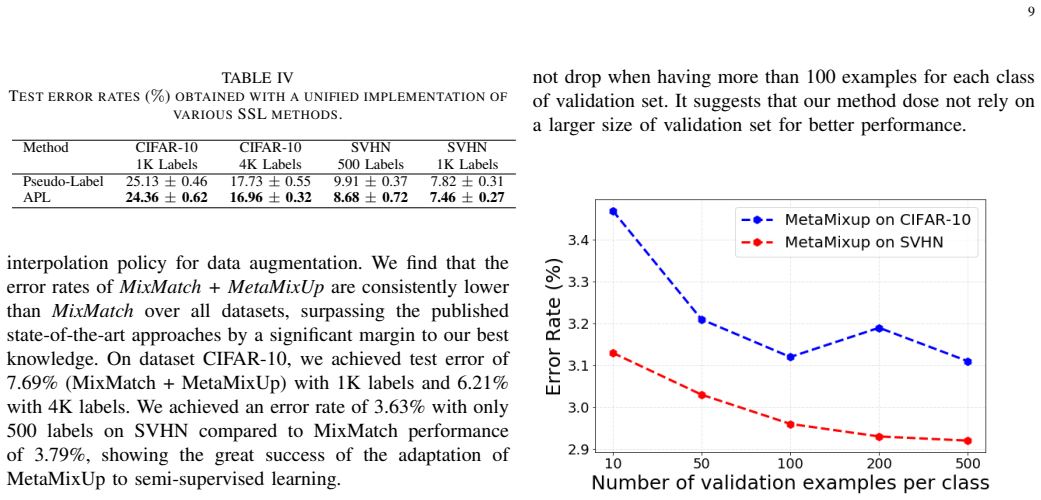
- [III-C] The APL threshold update formula is mathematically inconsistent. The text states: 'the threshold sigma is decreased by sigma_d every K epochs and is defined at t epoch, by sigma_t = sigma_{t-1} - sigma_d * [t/K] * K.' With sigma_d=0.05 and K=30, at epoch 30 this subtracts 0.05*1*30 = 1.5, making sigma negative, and the subtraction is repeated at every epoch. Algorithm 2 (lines 4-6) instead decrements by sigma_d every K epochs. Please give the correct closed-form update (e.g., sigma_t = sigma_0 - sigma_d * floor(t/K)) and make the text, the equation, and the pseudocode consistent.
minor comments (5)
- [III-A] Proposition 1 bounds |f(lambda x + (1-lambda) x') - [lambda f(x) + (1-lambda) f(x')]|, which is not the same as the MixUp loss (a loss on the mixed sample with interpolated labels). The sentence 'controlling the Lipschitz constant of the gradient necessarily requires minimizing MixUp loss' (Section III-A) and the interpretation in Section IV-D2 go beyond what the proposition establishes; please soften or substantiate the claim.
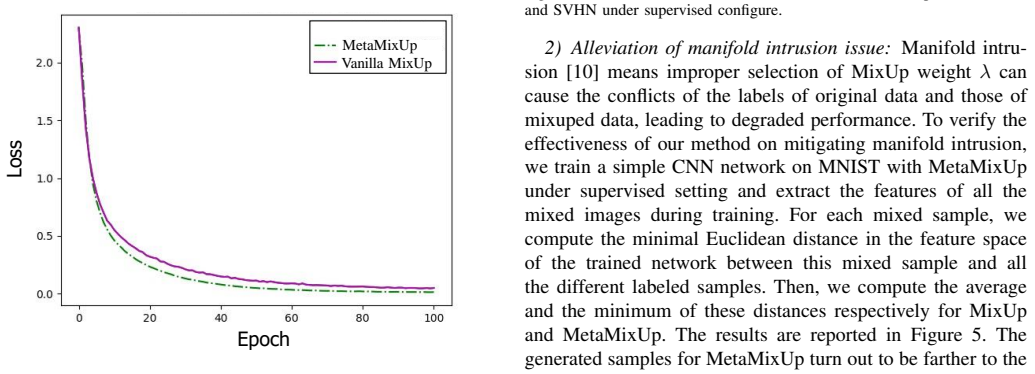
- [IV-D2] Figure 2 is described in Section IV-D as using 'ResNet-50 on CIFAR-10,' but Table I does not report any ResNet-50 results; please clarify which architecture produced the training-loss curves in Figure 2.
- [Algorithm 1] Algorithm 1 line 6 updates lambda* but does not show the sigmoid projection from Eq. (11); state where the projection is applied and whether the gradient is computed before or after projection.
- [IV-C / IV-D] There are several typos and inconsistencies: 'constast' (Section IV), 'rubust' (Section IV-C), 'nework' (Algorithm 1 line 8), and 'dose not' (Section IV-D1), plus inconsistent spelling of 'AdaMixup' vs 'AdaMixUp.'
- [Table II] In Table II, the MetaMixUp row reports error rates that match the Wide-ResNet-28-10 results in Table I, but the table does not specify the architecture; please state which architecture is used for the hyperparameter comparison.
Circularity Check
No significant circularity: the meta-objective tunes lambda on a sampled validation set; the test-set claims are independently measured, though the validation set is drawn from the training split without an explicit holdout.
full rationale
I inspected the claimed derivation chain. The core algorithm (Eqs. 4-11 and Algorithms 1-2) defines lambda as an upper-level variable optimized against a validation loss after one inner gradient step, which is a standard bilevel meta-learning formulation and is not definitionally equivalent to the test-set results reported in Tables I-III. Proposition 1 is a direct mathematical implication (P1 => P2) with a supplied proof; it does not assume the target performance claim. The paper cites prior work by its own authors ([28]-[30]) only in the hashing-related related-work discussion, and those citations are not load-bearing for MetaMixUp's method or results. The one concern is experimental: Section IV-B states that the meta-validation set is sampled from the original training set ('We randomly sample 1000 images (100 per class) from the original training set to construct our meta validation set') and does not explicitly say those images are excluded from training, so the meta-objective may be evaluated on in-sample images. This is a methodological ambiguity and a correctness risk, not a circularity: lambda is still fitted only to a validation objective, and the reported test errors are measured on an independent test split. No equation reduces the prediction to its inputs, and no self-citation is doing load-bearing work. Hence the appropriate finding is no significant circularity.
Assumptions & free parameters
free parameters (5)
- Meta step size alpha =
5.0
- Validation set size =
1000 (SL), 500 (SSL)
- Lambda initialization distribution =
unspecified
- Pseudo-label threshold sigma0 =
0.95
- Threshold decay sigma_d and period K =
sigma_d=0.05, K=30
assumptions (4)
- domain assumption The predictive function f is differentiable with kappa-Lipschitz gradient.
- ad hoc to paper A single unrolled gradient step on theta is sufficient for the meta-gradient w.r.t. lambda to provide a useful signal.
- domain assumption The meta-validation set, sampled from the training set, is a reliable proxy for generalization.
- ad hoc to paper Sigmoid projection of the unconstrained lambda preserves the optimization direction.
Cite this review
Pith. "Pith review of MetaMixUp: Learning Adaptive Interpolation Policy of MixUp with Meta-Learning." pith.science (2026). https://pith.science/paper/DZANYRDZ
@misc{pith2026190810059,
  author       = {Pith},
  title        = {Pith review of: MetaMixUp: Learning Adaptive Interpolation Policy of MixUp with Meta-Learning},
  year         = {2026},
  howpublished = {\url{https://pith.science/paper/DZANYRDZ}},
  note         = {Machine review of arXiv:1908.10059}
}
read the original abstract
MixUp is an effective data augmentation method to regularize deep neural networks via random linear interpolations between pairs of samples and their labels. It plays an important role in model regularization, semi-supervised learning and domain adaption. However, despite its empirical success, its deficiency of randomly mixing samples has poorly been studied. Since deep networks are capable of memorizing the entire dataset, the corrupted samples generated by vanilla MixUp with a badly chosen interpolation policy will degrade the performance of networks. To overcome the underfitting by corrupted samples, inspired by Meta-learning (learning to learn), we propose a novel technique of learning to mixup in this work, namely, MetaMixUp. Unlike the vanilla MixUp that samples interpolation policy from a predefined distribution, this paper introduces a meta-learning based online optimization approach to dynamically learn the interpolation policy in a data-adaptive way. The validation set performance via meta-learning captures the underfitting issue, which provides more information to refine interpolation policy. Furthermore, we adapt our method for pseudo-label based semisupervised learning (SSL) along with a refined pseudo-labeling strategy. In our experiments, our method achieves better performance than vanilla MixUp and its variants under supervised learning configuration. In particular, extensive experiments show that our MetaMixUp adapted SSL greatly outperforms MixUp and many state-of-the-art methods on CIFAR-10 and SVHN benchmarks under SSL configuration.
Figures

Figures from the paper (4 more)




Reference graph
Works this paper leans on
-
[1]
Is object localization for free? - weakly-supervised learning with convolutional neural networks,
M. Oquab, L. Bottou, I. Laptev, and J. Sivic, “Is object localization for free? - weakly-supervised learning with convolutional neural networks,” in CVPR, 2015
work page 2015
-
[2]
T. Durand, T. Mordan, N. Thome, and M. Cord, “WILDCAT: weakly supervised learning of deep convnets for image classification, pointwise localization and segmentation,” in CVPR, 2017
work page 2017
-
[3]
Virtual adversarial training: a regularization method for supervised and semi-supervised learning,
T. Miyato, S.-i. Maeda, S. Ishii, and M. Koyama, “Virtual adversarial training: a regularization method for supervised and semi-supervised learning,” IEEE transactions on pattern analysis and machine intelli- gence, 2018
work page 2018
-
[4]
A. Tarvainen and H. Valpola, “Mean teachers are better role mod- els: Weight-averaged consistency targets improve semi-supervised deep learning results,” in NeurIPS, 2017
work page 2017
-
[5]
Intriguing properties of neural networks,
C. Szegedy, W. Zaremba, I. Sutskever, J. Bruna, D. Erhan, I. J. Goodfellow, and R. Fergus, “Intriguing properties of neural networks,” CoRR, vol. abs/1312.6199, 2013
arXiv 2013
-
[6]
Shake-shake regularization of 3-branch residual networks,
X. Gastaldi, “Shake-shake regularization of 3-branch residual networks,” in 5th International Conference on Learning Representations, ICLR 2017, Toulon, France, April 24-26, 2017, Workshop Track Proceedings , 2017
work page 2017
-
[7]
Dropout: a simple way to prevent neural networks from overfitting,
N. Srivastava, G. E. Hinton, A. Krizhevsky, I. Sutskever, and R. Salakhutdinov, “Dropout: a simple way to prevent neural networks from overfitting,” Journal of Machine Learning Research, vol. 15, no. 1, pp. 1929–1958, 2014
work page 1929
-
[8]
Imagenet classification with deep convolutional neural networks,
A. Krizhevsky, I. Sutskever, and G. E. Hinton, “Imagenet classification with deep convolutional neural networks,”Commun. ACM, vol. 60, no. 6, pp. 84–90, 2017
work page 2017
Show all 51 references
-
[9]
mixup: Beyond empirical risk minimization,
H. Zhang, M. Ciss ´e, Y . N. Dauphin, and D. Lopez-Paz, “mixup: Beyond empirical risk minimization,” CoRR, vol. abs/1710.09412, 2017
2017 arXiv
-
[10]
Mixup as locally linear out-of-manifold regularization,
H. Guo, Y . Mao, and R. Zhang, “Mixup as locally linear out-of-manifold regularization,” CoRR, vol. abs/1809.02499, 2018
2018 arXiv
-
[11]
Model-agnostic meta-learning for fast adaptation of deep networks,
C. Finn, P. Abbeel, and S. Levine, “Model-agnostic meta-learning for fast adaptation of deep networks,” in Proceedings of the 34th International Conference on Machine Learning-Volume 70 . JMLR. org, 2017
2017
-
[12]
Practical bayesian optimiza- tion of machine learning algorithms,
J. Snoek, H. Larochelle, and R. P. Adams, “Practical bayesian optimiza- tion of machine learning algorithms,” in NeurIPS, 2012
2012
-
[13]
Learning unsupervised learning rules,
L. Metz, N. Maheswaranathan, B. Cheung, and J. Sohl-Dickstein, “Learning unsupervised learning rules,” CoRR, vol. abs/1804.00222, 2018
2018 arXiv
-
[14]
Pseudo-label: The simple and efficient semi-supervised learning method for deep neural networks,
D.-H. Lee, “Pseudo-label: The simple and efficient semi-supervised learning method for deep neural networks,” in Workshop on Challenges in Representation Learning, ICML , 2013
2013
-
[15]
Mixmatch: A holistic approach to semi-supervised learning,
D. Berthelot, N. Carlini, I. J. Goodfellow, N. Papernot, A. Oliver, and C. Raffel, “Mixmatch: A holistic approach to semi-supervised learning,” CoRR, vol. abs/1905.02249, 2019
1905 arXiv
-
[16]
Keeping the neural networks simple by minimizing the description length of the weights,
G. E. Hinton and D. van Camp, “Keeping the neural networks simple by minimizing the description length of the weights,” in Proceedings of the Sixth Annual ACM Conference on Computational Learning Theory, COLT 1993, Santa Cruz, CA, USA, July 26-28, 1993. , 1993, pp. 5–13
1993
-
[17]
Adam: A method for stochastic optimiza- tion,
D. P. Kingma and J. Ba, “Adam: A method for stochastic optimiza- tion,” in 3rd International Conference on Learning Representations, ICLR 2015, San Diego, CA, USA, May 7-9, 2015, Conference Track Proceedings, 2015
2015
-
[18]
Deep residual learning for image recognition,
K. He, X. Zhang, S. Ren, and J. Sun, “Deep residual learning for image recognition,” in CVPR, 2016
2016
-
[19]
Au- toaugment: Learning augmentation policies from data,
E. D. Cubuk, B. Zoph, D. Mane, V . Vasudevan, and Q. V . Le, “Au- toaugment: Learning augmentation policies from data,” arXiv preprint arXiv:1805.09501, 2018
2018 arXiv
-
[20]
Between-class learning for image classification,
Y . Tokozume, Y . Ushiku, and T. Harada, “Between-class learning for image classification,” in CVPR, 2018
2018
-
[21]
Manifold mixup: Encouraging meaningful on-manifold interpolation as a regularizer,
V . Verma, A. Lamb, C. Beckham, A. C. Courville, I. Mitliagkas, and Y . Bengio, “Manifold mixup: Encouraging meaningful on-manifold interpolation as a regularizer,” CoRR, vol. abs/1806.05236, 2018
2018 arXiv
-
[22]
Learning to learn: Introduction and overview,
S. Thrun and L. Pratt, “Learning to learn: Introduction and overview,” in Learning to learn . Springer, 1998
1998
-
[23]
Bengio, S
Y . Bengio, S. Bengio, and J. Cloutier, Learning a synaptic learning rule. Universit´e de Montr ´eal, D ´epartement d’informatique et de recherche op´erationnelle, 1990
1990
-
[24]
Optimization as a model for few-shot learning,
S. Ravi and H. Larochelle, “Optimization as a model for few-shot learning,” in ICLR, 2017
2017
-
[25]
Prototypical networks for few- shot learning,
J. Snell, K. Swersky, and R. S. Zemel, “Prototypical networks for few- shot learning,” in Advances in Neural Information Processing Systems 30: Annual Conference on Neural Information Processing Systems 2017, 4-9 December 2017, Long Beach, CA, USA , 2017, pp. 4080–4090
2017
-
[26]
A simple neural attentive meta-learner,
N. Mishra, M. Rohaninejad, X. Chen, and P. Abbeel, “A simple neural attentive meta-learner,” in 6th International Conference on Learning Representations, ICLR 2018, Vancouver, BC, Canada, April 30 - May 3, 2018, Conference Track Proceedings , 2018
2018
-
[27]
Rapid adapta- tion with conditionally shifted neurons,
T. Munkhdalai, X. Yuan, S. Mehri, and A. Trischler, “Rapid adapta- tion with conditionally shifted neurons,” in Proceedings of the 35th International Conference on Machine Learning, ICML 2018, Stock- holmsm¨assan, Stockholm, Sweden, July 10-15, 2018 , 2018, pp. 3661– 3670
2018
-
[28]
Approximate least trimmed sum of squares fitting and applications in image analysis,
F. Shen, C. Shen, A. van den Hengel, and Z. Tang, “Approximate least trimmed sum of squares fitting and applications in image analysis,”IEEE Trans. Image Processing, vol. 22, no. 5, pp. 1836–1847, 2013
2013
-
[29]
Deep asymmetric pairwise hashing,
F. Shen, X. Gao, L. Liu, Y . Yang, and H. T. Shen, “Deep asymmetric pairwise hashing,” in Proceedings of the 2017 ACM on Multimedia Conference, MM 2017, Mountain View, CA, USA, October 23-27, 2017 , 2017, pp. 1522–1530
2017
-
[30]
Supervised discrete hashing,
F. Shen, C. Shen, W. Liu, and H. T. Shen, “Supervised discrete hashing,” in IEEE Conference on Computer Vision and Pattern Recognition, CVPR 2015, Boston, MA, USA, June 7-12, 2015 , 2015, pp. 37–45
2015
-
[31]
Learning to reweight examples for robust deep learning,
M. Ren, W. Zeng, B. Yang, and R. Urtasun, “Learning to reweight examples for robust deep learning,” in ICML, 2018
2018
-
[32]
Making a science of model search: Hyperparameter optimization in hundreds of dimensions for vi- sion architectures,
J. Bergstra, D. Yamins, and D. D. Cox, “Making a science of model search: Hyperparameter optimization in hundreds of dimensions for vi- sion architectures,” in Proceedings of the 30th International Conference on Machine Learning, ICML 2013, Atlanta, GA, USA, 16-21 June 2013 , ...
2013
-
[33]
Auto-weka: combined selection and hyperparameter optimization of classification algorithms,
C. Thornton, F. Hutter, H. H. Hoos, and K. Leyton-Brown, “Auto-weka: combined selection and hyperparameter optimization of classification algorithms,” in The 19th ACM SIGKDD International Conference on Knowledge Discovery and Data Mining, KDD 2013, Chicago, IL, USA, August 11-1...
2013
-
[34]
Practical bayesian optimiza- tion of machine learning algorithms,
J. Snoek, H. Larochelle, and R. P. Adams, “Practical bayesian optimiza- tion of machine learning algorithms,” in Advances in Neural Information Processing Systems 25: 26th Annual Conference on Neural Information Processing Systems 2012. Proceedings of a meeting held December 3...
2012
-
[35]
Hyperparameter optimization with approximate gradient,
F. Pedregosa, “Hyperparameter optimization with approximate gradient,” in Proceedings of the 33nd International Conference on Machine Learn- ing, ICML 2016, New York City, NY, USA, June 19-24, 2016 , 2016, pp. 737–746
2016
-
[36]
Temporal ensembling for semi-supervised learn- ing,
S. Laine and T. Aila, “Temporal ensembling for semi-supervised learn- ing,” CoRR, vol. abs/1610.02242, 2016
2016 arXiv
-
[37]
Learning classification with unlabeled data,
V . R. de Sa, “Learning classification with unlabeled data,” in NeurIPS, 1994
1994
-
[38]
Asymmetric tri-training for unsu- pervised domain adaptation,
K. Saito, Y . Ushiku, and T. Harada, “Asymmetric tri-training for unsu- pervised domain adaptation,” in Proceedings of the 34th International Conference on Machine Learning, ICML 2017, Sydney, NSW, Australia, 6-11 August 2017 , 2017, pp. 2988–2997
2017
-
[39]
Learning semantic rep- resentations for unsupervised domain adaptation,
S. Xie, Z. Zheng, L. Chen, and C. Chen, “Learning semantic rep- resentations for unsupervised domain adaptation,” in Proceedings of the 35th International Conference on Machine Learning, ICML 2018, Stockholmsm¨assan, Stockholm, Sweden, July 10-15, 2018 , 2018, pp. 5419–5428
2018
-
[40]
Parseval networks: Improving robustness to adversarial examples,
M. Cisse, P. Bojanowski, E. Grave, Y . Dauphin, and N. Usunier, “Parseval networks: Improving robustness to adversarial examples,” in ICML. JMLR. org, 2017
2017
-
[41]
Lipschitz-margin training: Scal- able certification of perturbation invariance for deep neural networks,
Y . Tsuzuku, I. Sato, and M. Sugiyama, “Lipschitz-margin training: Scal- able certification of perturbation invariance for deep neural networks,” in NeurIPS, 2018
2018
-
[42]
Progressive neural architecture search,
C. Liu, B. Zoph, M. Neumann, J. Shlens, W. Hua, L. Li, L. Fei-Fei, A. L. Yuille, J. Huang, and K. Murphy, “Progressive neural architecture search,” in Computer Vision - ECCV 2018 - 15th European Conference, 12 Munich, Germany, September 8-14, 2018, Proceedings, Part I, 2018, pp. 19–35
2018
-
[43]
An overview of bilevel opti- mization,
B. Colson, P. Marcotte, and G. Savard, “An overview of bilevel opti- mization,” Annals OR, vol. 153, no. 1, pp. 235–256, 2007
2007
-
[44]
Scalable gradient- based tuning of continuous regularization hyperparameters,
J. Luketina, T. Raiko, M. Berglund, and K. Greff, “Scalable gradient- based tuning of continuous regularization hyperparameters,” in Proceed- ings of the 33nd International Conference on Machine Learning, ICML 2016, New York City, NY, USA, June 19-24, 2016, 2016, pp. 2952–2960
2016
-
[45]
Realistic evaluation of deep semi-supervised learning algorithms,
A. Oliver, A. Odena, C. A. Raffel, E. D. Cubuk, and I. J. Goodfellow, “Realistic evaluation of deep semi-supervised learning algorithms,” in NeurIPS, 2018
2018
-
[46]
Reading digits in natural images with unsupervised feature learning,
Y . Netzer, T. Wang, A. Coates, A. Bissacco, B. Wu, and A. Y . Ng, “Reading digits in natural images with unsupervised feature learning,” 2011
2011
-
[47]
Imagenet large scale visual recognition challenge,
O. Russakovsky, J. Deng, H. Su, J. Krause, S. Satheesh, S. Ma, Z. Huang, A. Karpathy, A. Khosla, M. S. Bernstein, A. C. Berg, and F. Li, “Imagenet large scale visual recognition challenge,” International Journal of Computer Vision , vol. 115, no. 3, pp. 211–252, 2015
2015
-
[48]
Identity mappings in deep residual networks,
K. He, X. Zhang, S. Ren, and J. Sun, “Identity mappings in deep residual networks,” in ECCV, 2016
2016
-
[49]
SGDR: stochastic gradient descent with warm restarts,
I. Loshchilov and F. Hutter, “SGDR: stochastic gradient descent with warm restarts,” in ICLR, 2017
2017
-
[50]
Wide residual networks,
S. Zagoruyko and N. Komodakis, “Wide residual networks,” in BMVC, 2016
2016
-
[51]
Self-ensembling for visual domain adaptation,
G. French, M. Mackiewicz, and M. H. Fisher, “Self-ensembling for visual domain adaptation,” in 6th International Conference on Learning Representations, ICLR 2018, Vancouver, BC, Canada, April 30 - May 3, 2018, Conference Track Proceedings , 2018
2018
Reviewed August 14, 2026 · model on record in the stance chip above.
Discussion (0). Continue with ORCID to comment.