REVIEW 4 major objections 4 minor 32 references
NeuroWorld: A Latent Brain World Model for Stimulus-Conditioned Human Brain Dynamics
T0 review · 4 major / 4 minor · reviewed 2026-08-04 · deepseek-v4-flash
Pith's one-line read NeuroWorld casts naturalistic brain activity prediction as stimulus-conditioned evolution in a learned latent state space, and reports state-of-the-art multi-step rollout on three movie-fMRI benchmarks under strictly causal stimulus access.
desk verdict A well-engineered two-stage latent world model for fMRI forecasting with a genuinely new dataset, but the 'strictly causal' claim is undercut by bidirectional stimulus encoders and an unaddressed leakage risk in the SG-MIND split. read the letter →
The pith
A machine-rendered reading of the paper's core claim, the machinery that carries it, and where it could break.
The reading
What carries the argument
The central object is the latent brain state z_t = E_phi(x_t), a low-dimensional vector per fMRI TR learned jointly with a causal predictor P_theta. Multimodal movie features are encoded into action tokens a_t and injected through adaptive layer normalization; P_theta is trained by next-latent prediction with SIGReg regularization, with no fMRI reconstruction objective. A second stage freezes this dynamics, rolls the latent forward from an observed prefix, and trains a shared decoder trunk with subject-specific linear heads to map the trajectory to ROI-level BOLD. This separation of state learning from observation decoding is what carries the causal-rollout claim.
What would settle it
Inspect the SG-MIND train/validation split for overlapping movie clips across participants: if any validation clip also appeared in training for another subject, retrain after excluding it and see whether NeuroWorld's rollout advantage over the TRIBE/MIRAGE baselines persists. A complementary test is to add an fMRI reconstruction loss to the latent dynamics stage; if that variant matches NeuroWorld's long-horizon rollout, the no-reconstruction design is not what carries the result.
Extended reading notes
Core claim
The paper's central claim is that naturalistic brain dynamics can be modeled as stimulus-conditioned evolution in a learned latent state space, and that this formulation forecasts better than regressing stimuli onto fMRI. NeuroWorld learns the latent state by next-state prediction without reconstructing the observed fMRI signal, rolls the latent forward under past-only stimulus access, and decodes it into subject-specific whole-brain responses. Across Algonauts 2025, CineBrain, and the new SG-MIND benchmark, the paper reports state-of-the-art causal rollout performance and greater robustness to long-horizon autoregressive drift, supporting the premise that encoding accuracy alone does not ma
Load-bearing premise
The reported generalization depends on validation clips being truly absent from training for every participant, but the paper does not explain how the shared pool of clips is kept out of training for all subjects when a clip appears in validation for one.
Editorial extensions
If this is right
- Whole-brain responses can be simulated for 20 to 100 TRs from a single observed fMRI prefix using only past stimuli, so future movie content cannot influence forecasts.
- Retrospective encoding accuracy is decoupled from forecasting skill: a simulator needs a representation and transition trained explicitly for next-state prediction.
- The latent world model is shared across subjects while only a linear readout is subject-specific, localizing individual differences at the decoding stage.
- Generalization to a held-out movie season and gradual drift at long horizons imply the dynamics capture general stimulus–response structure rather than memorized clips.
- Modality ablations show visual and audio streams dominate the forecast, with text adding complementary predictive signal in higher-order association regions.
Reading between the lines
- Because the dynamics are frozen and shared, the same latent world model might transfer to unseen participants by fitting only a new linear head; the paper trains only on seen subjects, but the architecture makes this a cheap test.
- If the transition is genuinely stimulus-conditioned, the framework can answer counterfactual questions about altered sensory histories, a direction the paper names but does not demonstrate.
- The SG-MIND shared pool of 291 clips permits cross-subject comparisons on identical stimuli; analyzing trajectories from different participants watching the same clip would separate stimulus-locked from subject-specific dynamics, which the paper does not report.
- A direct ablation varying the reconstruction objective under identical compute would test the paper's central design claim that 'no fMRI reconstruction' is what stabilizes rollout; the paper contrasts with BrainVista but does not run this within NeuroWorld.
Editorial analysis
A structured set of objections, weighed in public.
Referee Report
Summary. The paper introduces NeuroWorld, a two-stage latent world model for forecasting whole-brain fMRI responses during naturalistic movie viewing. Stage 1 (LDL) learns an fMRI encoder and a causal, action-conditioned latent transition via next-latent prediction without an fMRI reconstruction loss, regularized by SIGReg. Stage 2 (LRD) freezes these components, rolls latent states forward autoregressively from an observed fMRI prefix, and decodes them to subject-specific ROI-level fMRI with a shared decoder and per-subject linear heads. The model is evaluated on Algonauts 2025, CineBrain, and a newly collected SG-MIND dataset (20 participants, 8,519 clips), reporting state-of-the-art multi-step rollout performance under a claimed strictly causal stimulus-access protocol, together with ablations, horizon scaling, and interpretability analyses.
Significance. If the empirical claims are sustained, NeuroWorld is a meaningful conceptual advance: it replaces stimulus-to-response regression with an explicit, transition-sufficient latent state optimized for recursive forecasting, and it provides a larger cross-subject benchmark (SG-MIND) that the community can reuse. The paper also ships a useful set of ablations and interpretability analyses. However, the central claim of 'strictly causal stimulus access' is not yet supported, and the statistical evidence for state-of-the-art performance is incomplete. These issues are fixable but currently block acceptance.
major comments (4)
- [§IV.A.3 and Eq. (2)-(5)] The central claim of 'strictly causal stimulus access' is not established for the stimulus-action encoder A_α. The paper states that action tokens are derived from frozen pretrained Wav2Vec-Bert 2.0 and Video-JEPA 2 features, but these encoders are bidirectional/full-clip and can encode future stimulus content. Even after the hemodynamic shift, an action token used at TR t may contain information from stimulus times > t. The paper only states that P_θ is causal (Eq. 5); no causal masking or future-free extraction is described for the stimulus features themselves. This concern applies to all three benchmarks and undermines the core methodological claim. Please specify the exact temporal window and causality enforcement used in feature extraction, or rerun the evaluation with provably causal features.
- [Tables II and III] The headline results are reported as single point estimates with no error bars, confidence intervals, or significance tests. The evaluation uses one fixed 80/20 split per dataset, so it is impossible to assess whether NeuroWorld's advantages over baselines are statistically reliable, especially given the small cohorts (Algonauts n=4, CineBrain n=6). I request per-subject or bootstrapped variances, multiple splits, and paired significance tests for at least the main comparison in Table II.
- [§IV.A.2 and SG-MIND split] For SG-MIND the paper states that 'validation stimuli were held out from training to prevent data leakage,' but SG-MIND uses a common pool of 291 clips shared across participants. The paper does not describe how a clip that appears in validation for one subject is excluded from training for all other subjects. If this cross-subject clip exclusion is not implemented, the model can memorize stimulus-specific response patterns from other participants, inflating the reported SG-MIND results. Please provide the exact split protocol, e.g., clip-level partitioning across all subjects, or a clarification if the current split is at the run level only.
- [§IV.B and Table II] The causal masking of baseline models is described only as 'we modified the transformer blocks in encoders with causal masks.' This is insufficiently specified to ensure a fair comparison. If, for example, the temporal context length of TRIBE/MIRAGE is truncated or their cross-attention is masked in a way that cripples their capacity, the comparison could be biased. Please provide the exact masking procedure, the modified architecture, and ideally a sensitivity analysis showing the baselines under their original bidirectional setting (even if that setting is not causal) to quantify the cost of the causal constraint.
minor comments (4)
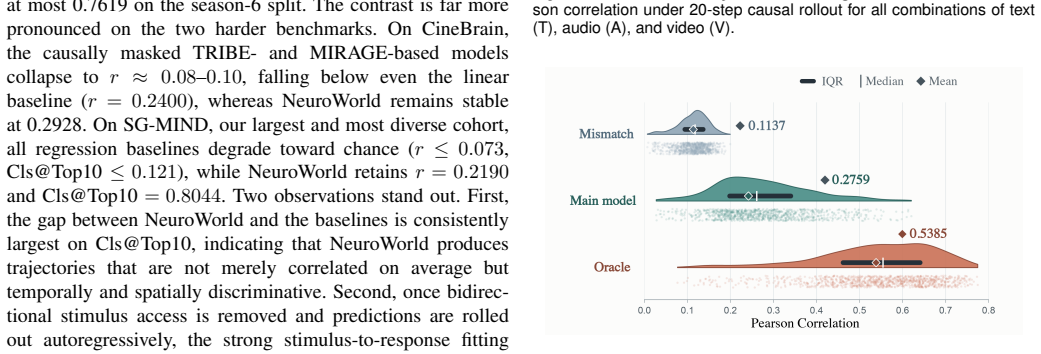
- [Fig. 6] The 'Mismatch' condition is not defined in the text. Please specify how stimulus–brain alignment is broken (e.g., time-shuffled actions, random permutation, or across-clip mismatch) and whether the same initial state is used.
- [Table I / §IV.A.3] For CineBrain, Δ=0 is stated with no justification, despite a TR of 0.8 s. If the dataset is already aligned to the hemodynamic response, please state this explicitly; otherwise the zero lag may be questionable.
- [Table II footnote] The BrainVista results are quoted from the original paper and not reproduced under the protocol. This is acknowledged, but the numbers should not appear in the main comparison table without a clear visual separation, as they are not directly comparable.
- [General] The paper says code will be made public upon acceptance. Since reproducibility is a strength of this line of work, consider releasing the split definitions and feature extraction scripts along with the final version.
Circularity Check
No significant circularity: NeuroWorld's core result is an empirical evaluation of a learned latent dynamics model; no prediction reduces to a fitted input or to a self-citation chain.
full rationale
The paper's central claim is empirical: LDL trains the fMRI encoder E_phi and predictor P_theta with a next-latent prediction loss (Eq. 7), then LRD freezes those components and trains a decoder on autoregressively rolled-out latents to predict fMRI (Eq. 13). The evaluation on held-out validation runs (Section IV.B) measures prediction of actual fMRI responses, not a quantity that was used as a training target of the same fitted parameters. The latent state z_t = E_phi(x_t) is learned from observed fMRI, and the transition target is z_{t+1} = E_phi(x_{t+1}); this is self-supervised representation learning, not circular, because the predictor never receives the future latent as an input at test time. The LRD decoder is supervised with actual fMRI, but that is standard supervised decoding rather than a fit renamed as a prediction. Self-citations to Brain-JEPA [9] and Brain Harmonix [13] appear only in related work and design motivation; the state-of-the-art claim is supported by direct comparisons on three benchmarks, not by those citations. No uniqueness theorem or ansatz is imported from the authors' prior work, and no equation in the paper is equivalent to its inputs by construction. The external concerns about strict causality of frozen stimulus encoders and potential validation-stimulus leakage across subjects are correctness/robustness issues, not circularity: they do not make the reported performance equal to a training input by construction. Therefore, no circular step is identified, and the circularity score is 0.
Assumptions & free parameters
free parameters (3)
- SIGReg strength λ
- Hemodynamic lag Δ per dataset =
3 TR (Algonauts), 6 TR (SG-MIND), 0 (CineBrain)
- Latent dimension d_z and action dimension d_a
assumptions (5)
- domain assumption BOLD fMRI at ROI level is a sufficient observable: a latent state z_t = E_phi(x_t) containing all information needed to predict future brain responses given stimulus history.
- domain assumption Stimulus features from frozen pretrained models (Video-JEPA 2, Wav2Vec-Bert-2.0, Llama-3.2-3B) adequately represent the exogenous drive to the brain.
- domain assumption Fixed hemodynamic delay and TR-grid alignment are correct for each dataset.
- domain assumption The validation split prevents stimulus leakage across subjects.
- standard math Standard calculus and stochastic optimization; the losses are standard MSE and a sketched normality statistic.
Cite this review
Pith. "Pith review of NeuroWorld: A Latent Brain World Model for Stimulus-Conditioned Human Brain Dynamics." pith.science (2026). https://pith.science/paper/DZCA2CGK
@misc{pith2026260801773,
  author       = {Pith},
  title        = {Pith review of: NeuroWorld: A Latent Brain World Model for Stimulus-Conditioned Human Brain Dynamics},
  year         = {2026},
  howpublished = {\url{https://pith.science/paper/DZCA2CGK}},
  note         = {Machine review of arXiv:2608.01773}
}
read the original abstract
Forecasting human brain activity during naturalistic experience requires modeling how endogenous neural states evolve causally under continuous sensory drive. Existing brain encoding models instead frame this as stimulus-to-response regression without strict temporal constraints, allowing future stimuli to leak into current predictions. We introduce NeuroWorld, to our knowledge the first brain world model, which casts naturalistic brain functional dynamics prediction as stimulus-conditioned evolution in a learned latent brain-state space, separating endogenous states (measured via fMRI) from exogenous multimodal stimuli across two stages. Latent Dynamics Learning (LDL) jointly learns a transition-sufficient representation and causal dynamics through next-latent prediction, without reconstructing the observed fMRI signal. Latent Rollout Decoding (LRD) freezes LDL, autoregressively rolls latent states forward from an observed fMRI prefix, and decodes them into subject-specific whole-brain responses. Across three naturalistic movie-fMRI benchmarks spanning 30 participants, including our newly collected Singapore Multimodal Imaging & Naturalistic Dataset (SG-MIND; 20 participants, 8,519 paired stimulus-response clips, 140.7 person-hours of viewing), NeuroWorld achieves state-of-the-art multi-step rollout performance under strictly causal stimulus access, with greater robustness to long-horizon autoregressive drift, supporting reliable simulation of extended brain-state trajectories. Extensive interpretability analyses characterize the functional organization of the learned dynamics, establishing latent-space world modeling as a principled framework for causal forecasting of human brain activity.
Figures


Figures from the paper (5 more)



Reference graph
Works this paper leans on
-
[1]
Tribe: Trimodal brain encoder for whole-brain fmri response prediction,
S. d’Ascoli, J. Rapin, Y . Benchetrit, H. Banville, and J.-R. King, “Tribe: Trimodal brain encoder for whole-brain fmri response prediction,”arXiv preprint arXiv:2507.22229, 2025
arXiv 2025
-
[2]
A foundation model of vision, audition, and language for in-silico neuroscience,
S. d’Ascoli, J. Rapin, Y . Benchetrit, T. Brooks, K. Begany, J. Raugel, H. Banville, and J.-R. King, “A foundation model of vision, audition, and language for in-silico neuroscience,”arXiv preprint arXiv:2605.04326, 2026
arXiv 2026
-
[3]
MIRAGE: Adaptive Multimodal Gating for Whole-Brain fMRI Encoding
A. Gokce, B. AlKhamissi, and M. Schrimpf, “Mirage: Adaptive multimodal gating for whole-brain fmri encoding,”arXiv preprint arXiv:2605.29850, 2026
work page Pith review arXiv 2026
-
[4]
A theory of cortical responses,
K. Friston, “A theory of cortical responses,”Philosophical transactions of the Royal Society B: Biological sciences, vol. 360, no. 1456, p. 815, 2005
work page 2005
-
[5]
A hierarchy of temporal receptive windows in human cortex,
U. Hasson, E. Yang, I. Vallines, D. J. Heeger, and N. Rubin, “A hierarchy of temporal receptive windows in human cortex,”Journal of neuroscience, vol. 28, no. 10, pp. 2539–2550, 2008
work page 2008
-
[6]
Slow cortical dynamics and the accumulation of information over long timescales,
C. J. Honey, T. Thesen, T. H. Donner, L. J. Silbert, C. E. Carlson, O. Devinsky, W. K. Doyle, N. Rubin, D. J. Heeger, and U. Hasson, “Slow cortical dynamics and the accumulation of information over long timescales,”Neuron, vol. 76, no. 2, pp. 423–434, 2012
work page 2012
-
[7]
A hierarchy of intrinsic timescales across primate cortex,
J. D. Murray, A. Bernacchia, D. J. Freedman, R. Romo, J. D. Wallis, X. Cai, C. Padoa-Schioppa, T. Pasternak, H. Seo, D. Leeet al., “A hierarchy of intrinsic timescales across primate cortex,”Nature neuroscience, vol. 17, no. 12, pp. 1661–1663, 2014
work page 2014
-
[8]
Brainvista: Modeling naturalistic brain dynamics as multimodal next-token prediction,
X. Yin, R. Zhao, L. Yao, and W. Cai, “Brainvista: Modeling naturalistic brain dynamics as multimodal next-token prediction,”arXiv preprint arXiv:2602.04512, 2026
Show all 32 references
-
[9]
Brain-jepa: Brain dynamics foundation model with gradient positioning and spatiotemporal masking,
Z. Dong, R. Li, Y . Wu, T. T. Nguyen, J. S. Chong, F. Ji, N. R. Tong, C. L. Chen, and J. H. Zhou, “Brain-jepa: Brain dynamics foundation model with gradient positioning and spatiotemporal masking,”Advances in Neural Information Processing Systems, vol. 37, pp. 86 048–86 073, 2024
2024
-
[10]
The algonauts project 2025 challenge: How the human brain makes sense of multimodal movies,
A. T. Gifford, D. Bersch, M. St-Laurent, B. Pinsard, J. Boyle, L. Bellec, A. Oliva, G. Roig, and R. M. Cichy, “The algonauts project 2025 challenge: How the human brain makes sense of multimodal movies,” arXiv preprint arXiv:2501.00504, 2024
2025 arXiv
-
[11]
Cinebrain: A large- scale multi-modal brain dataset during naturalistic audiovisual narrative processing,
J. Gao, Y . Liu, B. Yang, J. Feng, and Y . Fu, “Cinebrain: A large- scale multi-modal brain dataset during naturalistic audiovisual narrative processing,”arXiv preprint arXiv:2503.06940, 2025
2025
-
[12]
Brainlm: A foundation model for brain activity recordings,
J. Ortega Caro, A. H. de Oliveira Fonseca, S. Rizvi, M. Rosati, C. Averill, J. Cross, P. Mittal, E. Zappala, R. Dhodapkar, C. Abdallah et al., “Brainlm: A foundation model for brain activity recordings,” in International Conference on Learning Representations, vol. 2024, 2024,...
2024
-
[13]
Brain harmony: a multimodal foundation model unifying morphology and function into 1d tokens,
Z. Dong, R. Li, J. Chong, N. Dehestani, Y . Teng, Y . Lin, Z. Li, Y . Zhang, Y . Xie, L. Ooiet al., “Brain harmony: a multimodal foundation model unifying morphology and function into 1d tokens,”Advances in Neural Information Processing Systems, vol. 38, pp. 122 100–122 127, 2026
2026
-
[14]
Towards a general-purpose foundation model for fmri analysis,
C. Wang, Y . Jiang, Z. Peng, C. Li, C. Bang, L. Zhao, W. Fu, J. Lv, J. Sepulcre, C. Yanget al., “Towards a general-purpose foundation model for fmri analysis,”arXiv preprint arXiv:2506.11167, 2025
2025
-
[15]
Brainworld: A structural-prior-conditioned generative model for whole-brain 4d fmri dynamics,
J. Xia, W. Ye, J. Zhang, X. Pan, M. Wang, and Q. Liu, “Brainworld: A structural-prior-conditioned generative model for whole-brain 4d fmri dynamics,”arXiv preprint arXiv:2606.17742, 2026
2026 arXiv
-
[16]
Scalable diffusion models with transformers,
W. Peebles and S. Xie, “Scalable diffusion models with transformers,” inProceedings of the IEEE/CVF international conference on computer vision, 2023, pp. 4195–4205
2023
-
[17]
Lejepa: Provable and scalable self-supervised learning without the heuristics,
R. Balestriero and Y . LeCun, “Lejepa: Provable and scalable self-supervised learning without the heuristics,”arXiv preprint arXiv:2511.08544, 2025
2025 arXiv
-
[18]
Leworld- model: Stable end-to-end joint-embedding predictive architecture from pixels,
L. Maes, Q. L. Lidec, D. Scieur, Y . LeCun, and R. Balestriero, “Leworld- model: Stable end-to-end joint-embedding predictive architecture from pixels,”arXiv preprint arXiv:2603.19312, 2026
2026 arXiv
-
[19]
Methods to detect, characterize, and remove motion artifact in resting state fmri,
J. D. Power, A. Mitra, T. O. Laumann, A. Z. Snyder, B. L. Schlaggar, and S. E. Petersen, “Methods to detect, characterize, and remove motion artifact in resting state fmri,”neuroimage, vol. 84, pp. 320–341, 2014
2014
-
[20]
V-jepa 2: Self- supervised video models enable understanding, prediction and planning,
M. Assran, A. Bardes, D. Fan, Q. Garrido, R. Howes, M. Muckley, A. Rizvi, C. Roberts, K. Sinha, A. Zholuset al., “V-jepa 2: Self- supervised video models enable understanding, prediction and planning,” arXiv preprint arXiv:2506.09985, 2025
2025 arXiv
-
[21]
W2v-bert: Combining contrastive learning and masked language mod- eling for self-supervised speech pre-training,
Y .-A. Chung, Y . Zhang, W. Han, C.-C. Chiu, J. Qin, R. Pang, and Y . Wu, “W2v-bert: Combining contrastive learning and masked language mod- eling for self-supervised speech pre-training,” in2021 IEEE Automatic Speech Recognition and Understanding Workshop (ASRU). IEEE, 2021, ...
2021
-
[22]
The llama 3 herd of models,
A. Grattafiori, A. Dubey, A. Jauhri, A. Pandey, A. Kadian, A. Al-Dahle, A. Letman, A. Mathur, A. Schelten, A. Vaughanet al., “The llama 3 herd of models,”arXiv preprint arXiv:2407.21783, 2024
2024 arXiv
-
[23]
Local-global parcellation of the human cerebral cortex from intrinsic functional connectivity mri,
A. Schaefer, R. Kong, E. M. Gordon, T. O. Laumann, X.-N. Zuo, A. J. Holmes, S. B. Eickhoff, and B. T. Yeo, “Local-global parcellation of the human cerebral cortex from intrinsic functional connectivity mri,” Cerebral cortex, vol. 28, no. 9, pp. 3095–3114, 2018
2018
-
[24]
The organization of the human cerebral cortex estimated by intrinsic functional connectivity,
B. T. Yeo, F. M. Krienen, J. Sepulcre, M. R. Sabuncu, D. Lashkari, M. Hollinshead, J. L. Roffman, J. W. Smoller, L. Z ¨ollei, J. R. Polimeni et al., “The organization of the human cerebral cortex estimated by intrinsic functional connectivity,”Journal of neurophysiology, 2011
2011
-
[25]
Integration of auditory and visual information about objects in superior temporal sulcus,
M. S. Beauchamp, K. E. Lee, B. D. Argall, and A. Martin, “Integration of auditory and visual information about objects in superior temporal sulcus,”Neuron, vol. 41, no. 5, pp. 809–823, 2004
2004
-
[26]
Intersubject synchronization of cortical activity during natural vision,
U. Hasson, Y . Nir, I. Levy, G. Fuhrmann, and R. Malach, “Intersubject synchronization of cortical activity during natural vision,”science, vol. 303, no. 5664, pp. 1634–1640, 2004
2004
-
[27]
The morphospace of the brain- cognition organisation,
V . Pacella, V . Nozais, L. Talozzi, M. Abdallah, D. Wassermann, S. J. Forkel, and M. Thiebaut de Schotten, “The morphospace of the brain- cognition organisation,”Nature Communications, vol. 15, no. 1, p. 8452, 2024
2024
-
[28]
Neuromaps: structural and functional interpretation of brain maps,
R. D. Markello, J. Y . Hansen, Z.-Q. Liu, V . Bazinet, G. Shafiei, L. E. Su´arez, N. Blostein, J. Seidlitz, S. Baillet, T. D. Satterthwaiteet al., “Neuromaps: structural and functional interpretation of brain maps,” Nature methods, vol. 19, no. 11, pp. 1472–1479, 2022
2022
-
[29]
Nimare: neuroimaging meta-analysis research environment,
T. Salo, T. Yarkoni, T. E. Nichols, J.-B. Poline, M. Bilgel, K. L. Bottenhorn, D. Jarecka, J. D. Kent, A. Kimbler, D. M. Nielsonet al., “Nimare: neuroimaging meta-analysis research environment,”Aperture Neuro, vol. 3, pp. 1–32, 2023
2023
-
[30]
Parallel and distributed encoding of speech across human auditory cortex,
L. S. Hamilton, Y . Oganian, J. Hall, and E. F. Chang, “Parallel and distributed encoding of speech across human auditory cortex,”Cell, vol. 184, no. 18, pp. 4626–4639, 2021
2021
-
[31]
How does the “default mode
L. Fernandino and J. R. Binder, “How does the “default mode” network contribute to semantic cognition?”Brain and language, vol. 252, p. 105405, 2024
2024
-
[32]
Diverse frontoparietal connectivity supports semantic prediction and in- tegration in sentence comprehension,
Y . He, X. Shao, C. Liu, C. Fan, E. Jefferies, M. Zhang, and X. Li, “Diverse frontoparietal connectivity supports semantic prediction and in- tegration in sentence comprehension,”Journal of neuroscience, vol. 45, no. 5, 2025
2025
Reviewed August 4, 2026 · model on record in the stance chip above.
Discussion (0). Sign in to comment.