REVIEW 81 references
A Morse gauge and gradient-flow analysis construct the continuum Yang–Mills measure on any compact surface as a random distributional connection, recovering Witten’s partition function and Migdal–Lévy holonomy laws without lattice limits.
Reviewed by Pith at T0; open to challenge. T0 means a machine referee read the full paper against a public rubric. the ladder, T0–T4 →
A Morse-gauge continuum construction of the 2D Yang–Mills measure on any compact surface yields Witten’s partition function and Migdal–Lévy holonomy laws for admissible loops.
T0 review reviewed 2026-07-31 challenge →
load-bearing objection Solid continuum Morse-gauge construction of YM₂; one clear sign typo in the Thm 2.3 disk law that does not match their own Z_YM, almost certainly fixable.
The Yang-Mills measure on surfaces via Morse theory
The pith
A machine-rendered reading of the paper's core claim, the machinery that carries it, and where it could break.
The reading
Core claim
On any compact oriented Riemannian surface there exists a finitely additive functional MYM, upgraded to a genuine probability measure μ_YM on a weighted negative Sobolev space of g-valued 1-forms, obtained by conditioning a free Morse-gauge Gaussian-plus-Morse-complex measure so that holonomy near the Morse maximum is the identity; its partition function equals ∑_ρ e^{-c₂(ρ)υ(Σ)/2}(dim V_ρ)^{2-2g} and the law of Hol(∂D) for admissible disks D is the product of heat kernels predicted by Migdal, Witten and Lévy.
What carries the argument
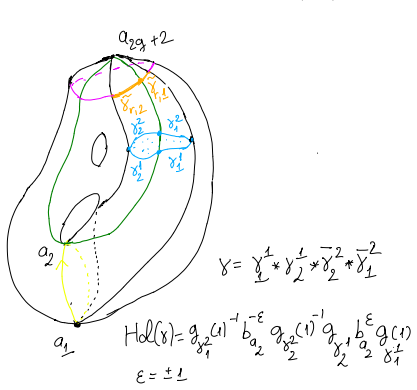
The Morse gauge: any connection is rewritten, after parallel transport along a Morse–Smale gradient flow, as a sum of the resolvent of the Lie derivative applied to the curvature plus a linear combination of integration currents on the unstable manifolds of the saddles; the same resolvent applied to white noise defines the free random connection that is later conditioned.
Load-bearing premise
The argument needs a sharp exponential contraction estimate for the Morse–Smale gradient flow on weighted L^p spaces; if that spectral-gap bound fails at the stated exponents, the free random connection cannot be constructed in the claimed Sobolev spaces.
What would settle it
Compute the law of holonomy around a small admissible disk that contains no critical points and check whether it equals the Migdal heat-kernel formula p_{υ(D)}(g) μ_G(dg); any systematic deviation would falsify the conditioning construction.
If this is right
- The continuum Yang–Mills measure on every closed surface is now available as a random distributional connection without passage through a lattice limit.
- Partition functions and Wilson-loop expectations for small loops are given by the classical Migdal–Witten–Lévy formulae and are independent of the auxiliary Morse function.
- The same Morse-gauge free field can be conditioned onto fixed Chern classes in the abelian case, producing measures supported on nontrivial line bundles.
- Random holonomies are defined pathwise via SDEs for every admissible curve, opening the way to Driver–Sengupta-type formulae for arbitrary embedded graphs.
Where Pith is reading between the lines
- Because the Morse gauge is global yet singular along unstable manifolds, it may supply a concrete analytic setting in which Gribov copies are absent for two-dimensional gauge theories.
- The same weighted contraction estimates could be tried on Morse–Smale flows in dimension three to construct continuum Maxwell or abelian Chern–Simons measures.
- Comparing the present measure with the Coulomb-gauge measure on the torus would give a direct continuum proof that the two gauge-fixed theories are equivalent.
Editorial analysis
A structured set of objections, weighed in public.
Circularity Check
No significant circularity: continuum Morse-gauge construction derives Witten/Migdal outputs from white noise, Haar data, and Hol≈Id conditioning; self-citations supply analytic tools, not the target formulas.
full rationale
The derivation chain is constructive and self-contained. Random connections are built as A(ξ,b)=L_V^{-1}(ξι_V(υ))+∑ log(b_j)[W^u(a_j)] from an independent white-noise measure and Haar measure on G^{2g} (Def. 2.5, §6–9). The free boundary measure is the product law of these inputs. The Yang–Mills measure is obtained by conditioning Hol near the Morse maximum to Id_G (Thm 9.16, informal (9.11)); the partition function Z_YM=∑_ρ e^{-c_2(ρ)υ(Σ)/2}(dim V_ρ)^{2-2g} is the heat-kernel density p_Hol,0(Id) evaluated after that conditioning (Lemma 9.12, Thm 2.3), not a fitted parameter. Disk holonomy laws are computed from the same SDEs and Markov/abelianization properties (§8, §10), recovering external Migdal–Lévy formulas as outputs. Self-citations (Dang–Rivière Ruelle/Morse decay; Nohra–Dang lattice [24]; Jia–Stewart–Sverak weighted contraction ideas) supply or motivate analytic ingredients (esp. Thm 4.1, proved in §4) and a parallel lattice comparison; they do not define Z_YM or force the holonomy laws by renaming. No parameter is tuned to data; no uniqueness theorem is imported to forbid alternatives; no ansatz is smuggled as a prediction. A possible sign error in the dim V_ρ power in Thm 2.3 (correctness, not circularity) does not make the construction reduce to its inputs by definition.
Axiom & Free-Parameter Ledger
axioms (6)
- domain assumption Existence of a perfect Morse function f with Morse–Smale gradient for a locally flat metric near Crit(f), with distinct critical values and |Crit(f)|=2g+2.
- standard math G compact connected linear Lie group; Ad-invariant inner product on g; heat kernel/Casimir spectral expansion on G.
- standard math g-valued white noise ξ exists in H^{-1-κ} and generates the stated Gaussian cylinder measures; independent restrictions to disjoint sets.
- standard math Itô/Stratonovich and Marcus canonical SDEs for reparametrized Brownian motion on G (including finitely many deterministic jumps) have unique strong solutions in G.
- ad hoc to paper Weighted L^p contraction / exponential decay for Morse–Smale gradient pullbacks on Y_{p,γ} (Theorem 4.1), refining Dang–Rivière and Jia–Stewart–Sverak.
- ad hoc to paper Yang–Mills measure is obtained by conditioning free boundary measure on Hol_0 = Id_G (regularized via Hol_r and heat-kernel abelianization).
invented entities (2)
-
Morse gauge (connections of the form ∑ b_j [W^u(a_j)] + β with ι_V(β)=0)
independent evidence
-
Free boundary Yang–Mills measure μ_free_YM / P_free_YM on Ω × G^{2g}
no independent evidence
Cite this review
Pith. "Pith review of The Yang-Mills measure on surfaces via Morse theory." pith.science (2026). https://pith.science/paper/DZXZ4DNE
@misc{pith2026260724640,
  author       = {Pith},
  title        = {Pith review of: The Yang-Mills measure on surfaces via Morse theory},
  year         = {2026},
  howpublished = {\url{https://pith.science/paper/DZXZ4DNE}},
  note         = {Machine review of arXiv:2607.24640}
}
read the original abstract
We introduce a Morse theoretical approach to the construction of the Yang--Mills measure on the space of connections of a compact Riemannian surface. This provides a direct continuous version of this measure which was previously obtained through lattice approximations by Chevyrev in the case of the flat torus and by one of the authors and Nohra for general compact Riemannian surfaces. The starting point is the new notion of a Morse gauge together with the resolution of random cohomological equations associated to Morse--Smale vector fields. This is achieved by improving exponential convergence to equilibrium results for Morse--Smale gradient flows that were obtained by two of the authors in the context of the study of Ruelle spectra and by Jia, Stewart and Sverak in the context of simplified models from fluid mechanics. Combining these random solutions with the data given by the Morse complex, we introduce a free Yang-Mills measure on space of connections and, using classical tools from stochastic differential equations, we show how to make sense of holonomies for random connections along a large class of curves. Finally, by setting a proper conditioning of this free measure through these random holonomies, we define the Yang--Mills measure and we compute its partition function together with the law of random holonomies with respect to this measure, recovering the formulas from the works of Migdal, Witten and L\'evy.
Figures


Reference graph
Works this paper leans on
-
[1]
and Gourevitch, D.Schwartz functions on Nash manifolds, International Mathematics Research Notices 2008: rnm155 (2008)
Aizenbud, A. and Gourevitch, D.Schwartz functions on Nash manifolds, International Mathematics Research Notices 2008: rnm155 (2008)
2008
-
[2]
C., Morando, P
Albeverio, S., De Vecchi, F. C., Morando, P. and Ugolini, S.Weak symmetries of stochastic differential equations driven by semimartingales with jumps, Electron. J. Probab, 25(44), 1-34 (2020)
2020
-
[3]
Applebaum, D.Lévy processes and stochastic calculus, Cambridge university press (2009)
2009
-
[4]
L., and Fickler, S.I.Quantization of the Yang-Mills field, Physical Review 127.5: 1821 (1962)
Arnowitt, R. L., and Fickler, S.I.Quantization of the Yang-Mills field, Physical Review 127.5: 1821 (1962)
1962
-
[5]
Atiyah, M.F.andBott, R.The Yang-Mills equations over Riemann surfaces, Philosophical Transactionsof the Royal Societyof London.Series A, Mathematical and Physical Sciences 308.1505: 523-615 (1983)
1983
-
[6]
Baladi, V.Positive transfer operators and decay of correlations, Singapore: World Scien- tific (2000)
2000
-
[7]
A functional approach, Springer (2018)
Baladi, V.Dynamical zeta functions and dynamical determinants for hyperbolic maps. A functional approach, Springer (2018)
2018
-
[8]
Becherer, D., and Sun, Y.Rough backward SDEs with discontinuous Young drivers, arXiv preprint arXiv:2505.20437 (2025)
Pith/arXiv arXiv 2025
-
[9]
Bonatti, C., Lorenzo J.D., and Viana, M.Dynamics beyond uniform hyperbolicity: A global geometric and probabilistic perspective, Berlin, Heidelberg: Springer Berlin Heidelberg (2005)
2005
-
[10]
Canadian Mathematical Bulletin
Bott R.On Some Recent Interactions Between Mathematics and Physics. Canadian Mathematical Bulletin. 1985;28(2):129-164
1985
-
[11]
Springer (2008)
Bowen, R.Equilibrium states and the ergodic theory of Anosov diffeomorphisms, 2nd revised ed. Springer (2008)
2008
-
[12]
Math., Vol
Bowen, R., and Ruelle, D.The ergodic theory of Axiom A flows, Inv. Math., Vol. 29, 181-202 (1975)
1975
-
[13]
Bringmann, B., and Cao, S.A para-controlled approach to the stochastic Yang-Mills equation in two dimensions, arXiv preprint arXiv:2305.07197 (2023)
Pith/arXiv arXiv 2023
-
[14]
Bringmann, B. and Cao, S.Global well-posedness of the stochastic Abelian-Higgs equa- tions in two dimensions, arXiv preprint arXiv:2403.16878 (2024)
Pith/arXiv arXiv 2024
-
[15]
and Chatterjee, S.The Yang-Mills heat flow with random distributional initial data, Communications in Partial Differential Equations 48.2: 209-251 (2023)
Cao, S. and Chatterjee, S.The Yang-Mills heat flow with random distributional initial data, Communications in Partial Differential Equations 48.2: 209-251 (2023)
2023
-
[16]
and Chatterjee, S.A state space for 3D Euclidean Yang–Mills theories, Commu- nications in Mathematical Physics 405.1: 3 (2024)
Cao, S. and Chatterjee, S.A state space for 3D Euclidean Yang–Mills theories, Commu- nications in Mathematical Physics 405.1: 3 (2024). 108
2024
-
[17]
Bruhat filtrations and Whit- taker vectors for real groups
Casselman, William, Henryk Hecht, and Dragan Milicic. "Bruhat filtrations and Whit- taker vectors for real groups." Proceedings of symposia in pure mathematics. Vol. 68. Providence, RI; American Mathematical Society; 1998, 2000
1998
-
[18]
and Lefeuvre, T.The holonomy inverse problem, Journal of the European Mathematical Society (EMS Publishing) 27.6 (2025)
Cekic, M. and Lefeuvre, T.The holonomy inverse problem, Journal of the European Mathematical Society (EMS Publishing) 27.6 (2025)
2025
-
[19]
Chevyrev, I.Yang–Mills Measure on the Two-Dimensional Torus as a Random Distri- bution, Commun. Math. Phys. 372, 1027–1058 (2019)
2019
-
[20]
Chevyrev, I. and Shen, H.Invariant measure and universality of the 2D Yang-Mills Langevin dynamic, arXiv preprint arXiv:2302.12160 (2023)
Pith/arXiv arXiv 2023
-
[21]
Chandra, A., Chevyrev, I., Hairer, M., and Shen, H.Langevin dynamic for the 2D Yang–Mills measure, Publications mathématiques de l’IHÉS, 136(1), 1-147 (2022)
2022
-
[22]
Chandra, A., Chevyrev, I., Hairer, M., and Shen, H.Stochastic quantisation of Yang–Mills–Higgs in 3d, Inventiones mathematicae, 237(2), 541-696 (2024)
2024
-
[23]
and Herscovich, E.Renormalization of quantum field theory on Riemannian manifolds, Reviews in Mathematical Physics 31.06: 1950017 (2019)
Dang, N.V. and Herscovich, E.Renormalization of quantum field theory on Riemannian manifolds, Reviews in Mathematical Physics 31.06: 1950017 (2019)
2019
-
[24]
Dang, N.V. and Nohra, E.The Yang–Mills measure on compact surfaces as a universal scaling limit of lattice gauge models, arXiv preprint arXiv:2602.08591 (2026)
arXiv 2026
-
[25]
and Nohra, E.Semiclassical analysis for Yang–Mills random connections on compact surfaces, in preparation
Dang, N.V. and Nohra, E.Semiclassical analysis for Yang–Mills random connections on compact surfaces, in preparation
-
[26]
and Rivière, G.Equidistribution of the conormal cycle of random nodal sets, Journal of the European Mathematical Society 20.12: 3017-3071 (2018)
Dang, N.V. and Rivière, G.Equidistribution of the conormal cycle of random nodal sets, Journal of the European Mathematical Society 20.12: 3017-3071 (2018)
2018
-
[27]
and Rivière, G.Spectral analysis of Morse-Smale gradient flows, Ann
Dang, N.V. and Rivière, G.Spectral analysis of Morse-Smale gradient flows, Ann. Sci. ENS, Vol. 52, 1403-1458 (2019)
2019
-
[28]
and Rivière, G.Pollicott–Ruelle spectrum and Witten Laplacians, Journal of the European Mathematical Society 23.6: 1797-1857 (2021)
Dang, N.V. and Rivière, G.Pollicott–Ruelle spectrum and Witten Laplacians, Journal of the European Mathematical Society 23.6: 1797-1857 (2021)
2021
-
[29]
and Rivière, G.Poincaré series and linking of Legendrian knots, Duke Math- ematical Journal 173.1: 1-74 (2024)
Dang, N.V. and Rivière, G.Poincaré series and linking of Legendrian knots, Duke Math- ematical Journal 173.1: 1-74 (2024)
2024
-
[30]
uniroma2.it/~liverani/Lavori/33CBM16-eBook.pdf(2021)
Demers, M.F., Kiamari, N., and Liverani, C.Transfer operators in Hyperbolic Dy- namics An introduction, Publisher: IMPAISBN: 978-65-89124-26-9,https://www.mat. uniroma2.it/~liverani/Lavori/33CBM16-eBook.pdf(2021)
2021
-
[31]
Donaldson, S.K., and Kronheimer, P.B.The geometry of four-manifolds, Oxford univer- sity press (1997)
1997
-
[32]
Driver, B.K.YM2: continuum expectations, lattice convergence, and lassos, Comm. Math. Phys., 123(4):575–616 (1989)
1989
-
[33]
K.A functional integral approaches to the Makeenko-Migdal equations
Driver, B. K.A functional integral approaches to the Makeenko-Migdal equations. Comm. Math. Phys.,370(1):49–116 (2019). 109
2019
-
[34]
J.The Heat Kernel Lefschetz Fixed Point Formula for the Spin-c Dirac Operator, Modern Birkhäuser Classics, Birkhäuser Boston, MA, 2197-1803, VIII, 247 (2011)
Duistermaat, J. J.The Heat Kernel Lefschetz Fixed Point Formula for the Spin-c Dirac Operator, Modern Birkhäuser Classics, Birkhäuser Boston, MA, 2197-1803, VIII, 247 (2011)
2011
-
[35]
Eguchi, T., Gilkey P. B. and Hanson, A. J.Gravitation, gauge theories and differential geometry, Physics Reports, Volume 66, Issue 6, Pages 213-393, (1980)
1980
-
[36]
Evans, L.C.An introduction to stochastic differential equations, AMS (2013)
2013
-
[37]
Fine, D.S.Quantum Yang-Mills on a Riemann surface, Communications in mathematical physics 140: 321-338 (1991)
1991
-
[38]
and Le Jan, Y.Hyperbolic dynamics and Brownian motion, an introduction, Oxford Science Publication (2012)
Franchi, J. and Le Jan, Y.Hyperbolic dynamics and Brownian motion, an introduction, Oxford Science Publication (2012)
2012
-
[39]
Fulton, W.Algebraic Topology: A First Course, Springer (1995)
1995
-
[40]
Gel’fand, I. M. and Vilenkin, N. Y.Generalized functions: Applications of harmonic analysis, Vol. 4. Academic press (2014)
2014
-
[41]
Griffiths, P., andHarris, J.Principles of algebraic geometry.JohnWileyandSons, (1994)
1994
-
[42]
Gross, L., King, C., and Sengupta, A.Two dimensional Yang-Mills theory via stochastic differential equations, Annals of Physics 194.1: 65-112 (1989)
1989
-
[43]
and Rhodes, R.Compactified imaginary Liouville theory, Commun
Guillarmou, C., Kupiainen, A. and Rhodes, R.Compactified imaginary Liouville theory, Commun. Am. Math. Soc. 5, 12, 571-694 (2025)
2025
-
[44]
Hadfield, C., Kandel, S., andSchiavina, M.Ruelle zeta function from field theory, Annales Henri Poincaré. Vol. 21. No. 12 (2020)
2020
-
[45]
Harvey, F.R., and Lawson, H.B.Morse theory and Stokes theorem, Surveys in differential geometry: 259-311 (2000)
2000
-
[46]
153(1), 1-25 (2001)
Harvey, F.R., and Lawson, H.B.Finite Volume Flows and Morse Theory, Annals of Math. 153(1), 1-25 (2001)
2001
-
[47]
213, 272 p
Harvey, F.R., and Lawson, H.B.A theory of characteristic currents associated with a singular connection, Astérisque, no. 213, 272 p. (1993)
1993
-
[48]
Hatcher, A.Algebraic topology, Cambridge University Press (2002)
2002
-
[49]
99-118 (1989)
Hitchin, N.J.Gauge theory on Riemann surfaces, Lectures on Riemann surfaces, World Scientific, p. 99-118 (1989)
1989
-
[50]
Jia, H., Stewart, S., and Sverak, V..On the De Gregorio Modification of the Con- stantin–Lax–Majda Model, ARMA 231 1269-1304 (2019)
2019
-
[51]
Knapp, A.W.Lie groups beyond an introduction(2023)
2023
-
[52]
Koralov, L., and Sinai, Y.G.Theory of probability and random processes, Springer (2007)
2007
-
[53]
Austriaca 14, 149 (1961) 110
Kummer, W., Acta Phys. Austriaca 14, 149 (1961) 110
1961
-
[54]
Labourie, F.Lectures on Representations of Surface Groups, EMS publishing house, pp.145, Zurich Lectures in Advanced Mathematics (2013)
2013
-
[55]
Laudenbach, F.On the Thom-Smale complex, Astérisque 205: 219-233 (1992)
1992
-
[56]
With a contributed chapter by Yann Chaubet.Société Mathématique de France (2025)
Lefeuvre, T.Microlocal analysis in hyperbolic dynamics and geometry. With a contributed chapter by Yann Chaubet.Société Mathématique de France (2025)
2025
-
[57]
Lévy, T.Yang-Mills measure on compact surfaces, American Mathematical Soc., 2003
2003
-
[58]
Lévy, T.Two-dimensional Markovian holonomy fields, Astérisque 329 (2010)
2010
-
[59]
Cham: Springer International Publishing (2020)
Lévy, T.Two-dimensional quantum Yang–Mills theory and the Makeenko–Migdal equa- tions, Frontiers in Analysis and Probability: In the Spirit of the Strasbourg-Zürich Meet- ings. Cham: Springer International Publishing (2020)
2020
-
[60]
Lévy, T.The Master Field on the Plane, Astérisque 388 (2017)
2017
-
[61]
Lévy, T.Discrete and continuous Yang-Mills measure for non-trivial bundles over com- pact surfaces, Probability theory and related fields 136.2: 171-202 (2006)
2006
-
[62]
Malgrange, B.Ideals of differentiable functions, Oxford University Press (1966)
1966
-
[63]
Migdal, A.A.Phase transitions in gauge and spin-lattice systems, Zh. Eksp. Teor. Fiz 69: 1457 (1975)
1975
-
[64]
Milnor, J.Morse theory, Princeton University Press (1963)
1963
-
[65]
Morgan, F.Geometric Measure Theory: A Beginner’s Guide, Academic Press, 272 pages (2009)
2009
-
[66]
Polyakov, A.M.Gauge fields and strings, 2018
2018
-
[67]
Berlin, Heidelberg: Springer Berlin Heidelberg, 249-361 (2012)
Protter, P.E.Stochastic differential equations, Stochastic integration and differential equations. Berlin, Heidelberg: Springer Berlin Heidelberg, 249-361 (2012)
2012
-
[68]
Reed, M., and Simon, B.Modern mathematical physics 1: Functional analysis, Academic press (1981)
1981
-
[69]
293, Springer Science & Business Media, (2013)
Revuz, D., and Yor, M.Continuous martingales and Brownian motion, Vol. 293, Springer Science & Business Media, (2013)
2013
-
[70]
Y.Loop averages and partition functions inU(N)gauge theory on two- dimensional manifolds, Modern Phys
Rusakov, B. Y.Loop averages and partition functions inU(N)gauge theory on two- dimensional manifolds, Modern Phys. Lett. A 5, no. 9, 693–703 (1990)
1990
-
[71]
and Stucker, T.Perturbative BF theory in axial, Anosov gauge, Annales Henri Poincaré
Schiavina, M. and Stucker, T.Perturbative BF theory in axial, Anosov gauge, Annales Henri Poincaré. Vol. 25. No. 10. (2024)
2024
-
[72]
Schwartz, L.Théorie des distributions, Hermann (1966)
1966
-
[73]
Sengupta, A.Gauge theory on compact surfaces, Vol. 600. American Mathematical Soc. (1997). 111
1997
-
[74]
Sepanski, M.R.Compact Lie groups, New York, NY: Springer New York, (2007)
2007
-
[75]
Shen, H., Smith, S.A., and Zhu, R.A new derivation of the finiteNmaster loop equation for lattice Yang–Mills, Electronic Journal of Probability 29:1-8 (2024)
2024
-
[76]
Shen, H., Zhu, R., and Zhu, X.A stochastic analysis approach to lattice Yang–Mills at strong coupling, Communications in Mathematical Physics, 400(2), 805-851 (2023)
2023
-
[77]
Smale, S.Differentiable dynamical systems, Bull. Am. Math. Soc. 73, No. 6, 747-817 (1967)
1967
-
[78]
151, (2016)
Viana, M., and Oliveira, K.Foundations of ergodic theoryCambridge University Press, Vol. 151, (2016)
2016
-
[79]
145, (2014)
Viana, M.Lectures on Lyapunov exponents, Cambridge University Press Vol. 145, (2014)
2014
-
[80]
Witten, E.On quantum gauge theories in two dimensions, Communications in Mathe- matical Physics 141.1: 153-209 (1991)
1991
This paper was first reviewed by grok-4.5 on July 31, 2026.
discussion (0)
Sign in with ORCID, Apple, or X to comment. Anyone can read and Pith papers without signing in.