REVIEW 4 major objections 5 minor 14 references
Positron Annihilation Lifetime Spectroscopy Using Fast Scintillators and Digital Electronics
T0 review · 4 major / 5 minor · reviewed 2026-08-14 · deepseek-v4-flash
Pith's one-line read This paper reports a fully digital positron-annihilation lifetime spectroscopy setup based on BC-418 plastic scintillators and 500 MS/s digitization with sinc interpolation and digital constant-fraction discrimination, reaching 198.3 ±…
desk verdict The 198 ps timing result is plausible and well-measured, but the PALS demonstration is under-validated: the source background is uncorrected and the component intensities disagree with the cited quartz reference. read the letter →
The pith
A machine-rendered reading of the paper's core claim, the machinery that carries it, and where it could break.
The reading
What carries the argument
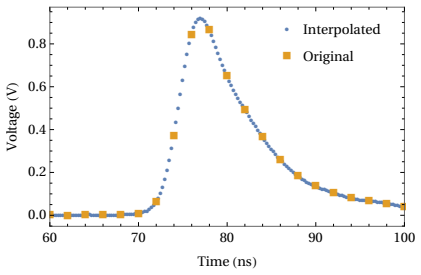
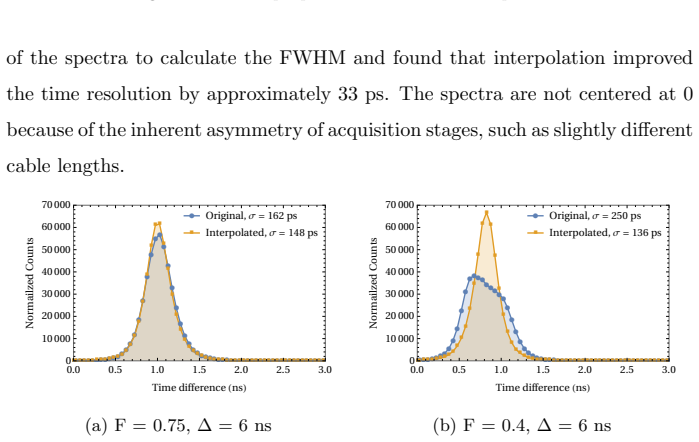
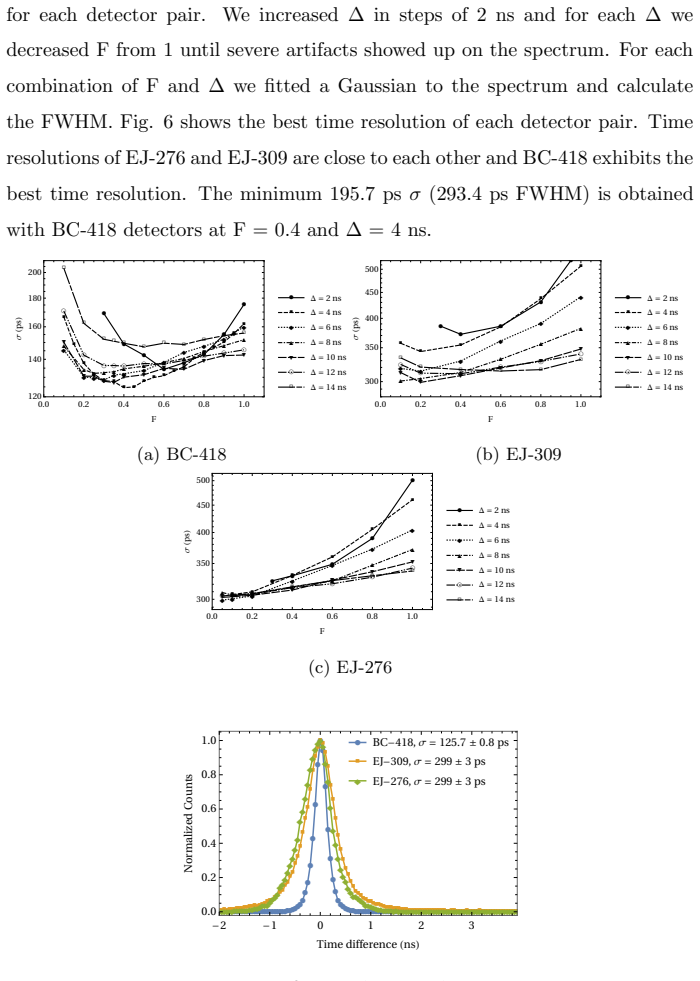
The load-bearing element is the arrival-time estimator: a Gaussian-windowed truncated sinc interpolation (Eqs. 4–6) reconstructs each pulse between 2-ns samples, and a digital constant-fraction discriminator (Eq. 7) forms $F \cdot S(i) - S(i-\Delta)$ and takes its zero crossing as the timestamp. The two free parameters, fraction $F$ and delay $\Delta$, are optimized for each detector pair by Gaussian-fitting the 60Co coincidence time-difference spectrum and minimizing its FWHM. Interpolation does the specific job of recovering the rising edge and true peak that sparse sampling misses; the paper shows this reduces the time-difference spread and removes the skewness introduced by too-small $F$ values.
What would settle it
Record 60Co coincidence pulses with a 20 GS/s digitizer, down-sample the same waveforms to 500 MS/s, and run this paper's interpolation plus CFD on the down-sampled version. If the recovered arrival-time distribution has a sigma above about 84 ps or shows a systematic shift relative to the 20 GS/s timestamps, the unbiased-reconstruction premise is wrong.
Extended reading notes
Core claim
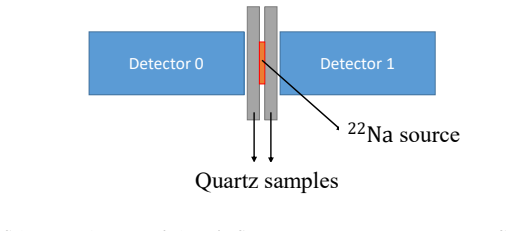
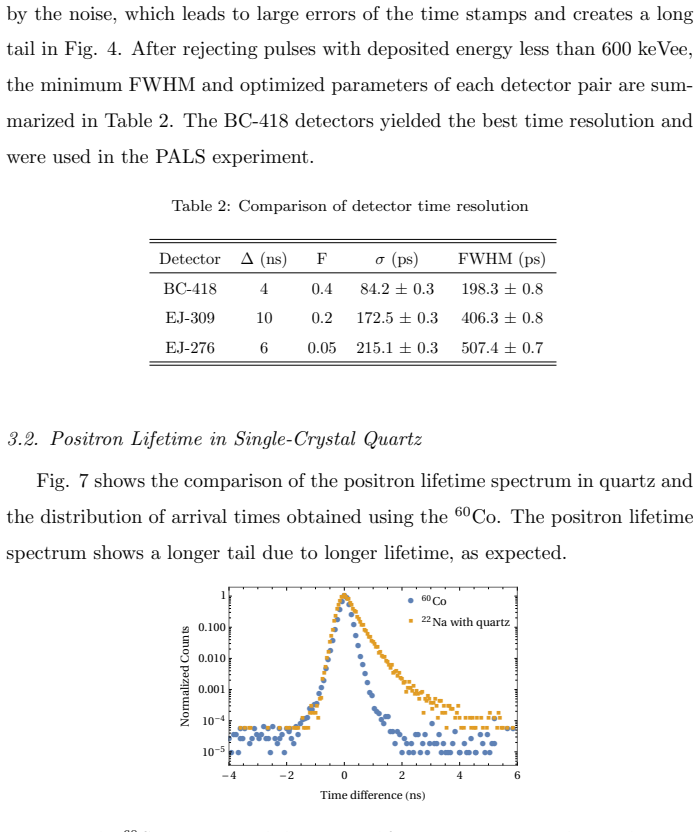
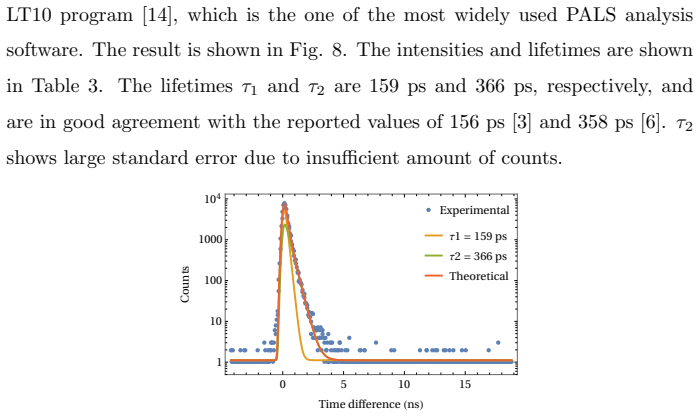
The paper establishes that a positron-annihilation lifetime spectrometer built from two BC-418 fast plastic scintillators, a 14-bit 500 MS/s digitizer, and a two-step digital timing algorithm can reach 198.3 ± 0.8 ps FWHM time resolution, sufficient to separate the short para-positronium component from the longer ortho-positronium and free-positron component in a defect-free material. Using this setup on a 22Na source sandwiched between two single-crystal quartz samples, the fitted lifetimes are $\tau_1 = 159\pm9$ ps and $\tau_2 = 366\pm22$ ps, consistent with the 156 ps and 358 ps values reported for the same material. The implication is that the digital pipeline itself drives timing performance: interpolation narrows the measured time-difference distribution, and the CFD parameters change the spread substantially across the tested detector pairs.
Load-bearing premise
The whole timing accuracy rests on the premise that voltages sampled every 2 nanoseconds can be faithfully reconstructed into a smooth pulse, so that the constant-fraction zero crossing is an unbiased arrival time; the reconstruction's window size is not specified, so the reader cannot check its error from the paper alone.
Editorial extensions
If this is right
- The BC-418 digital setup resolves two positronium lifetime components in quartz, so vacancy and defect studies can be done without analog timing electronics.
- The 198 ps FWHM makes it possible to discriminate the spin-singlet para-positronium component, something earlier systems with roughly 330 ps resolution could not do for this material.
- The same interpolation-plus-CFD algorithm transfers to any fast-timing application, including nuclear medicine and radiation imaging, where timestamp accuracy is the limiting step.
- Interpolation alone improves the timing resolution by about 33 ps at the BC-418 operating point and also makes skewed time-difference histograms symmetric.
- The authors state the optimized setup is intended next for analyzing vacancies and damage in radiation detectors exposed to high fluence.
Reading between the lines
- If the reconstruction is unbiased, the same 500 MS/s digitizer plus interpolation pipeline could be ported to positron emission tomography, where roughly 200 ps coincidence timing is a practical target and commodity digitizers could replace analog constant-fraction discriminators.
- Because BC-418 does not provide pulse-shape discrimination, the current readout separates only two lifetime components; pairing the same timing algorithm with EJ-309 or EJ-276, which do support pulse-shape discrimination, would let users reject scattered events and resolve additional components.
- A direct stress test would be to record waveforms at 20 GS/s, down-sample them to 500 MS/s, and compare the paper's timestamps with the original ones; the reported $\sigma = 84.2$ ps would be falsified by any systematic offset larger than that on synthetic pulses of known arrival time.
Signed reviews
Editorial analysis
A structured set of objections, weighed in public.
Referee Report
Summary. The paper presents a digital positron annihilation lifetime spectroscopy (PALS) setup built from organic scintillators, a 500 MS/s digitizer, and a pulse-processing chain that interpolates waveforms and applies a constant-fraction discrimination (CFD) algorithm. The authors test three detector pairs (BC-418 plastic, EJ-309 liquid, EJ-276 plastic), optimize the CFD parameters (F and Δ) and an energy threshold for each pair, and report a best time resolution of 198.3 ± 0.8 ps FWHM (σ = 84.2 ± 0.3 ps) with BC-418 detectors after rejecting pulses below 600 keVee. Using this optimized pair, they measure positron lifetimes in single-crystal quartz and report τ1 = 159 ± 9 ps and τ2 = 366 ± 22 ps, which they claim are in good agreement with literature values. The central claims are the sub-200 ps timing resolution and the demonstration that the setup can resolve the p-Ps and o-Ps components in quartz.
Significance. If the timing result is reliable, the paper provides a useful, cost-effective digital timing method that achieves competitive time resolution with fast plastic scintillators and commercially available digitizers. The open-source ROOT-based pulse-processing code is a practical contribution that could benefit PALS and other fast-timing applications. However, the PALS demonstration is not yet convincing: the fitted component intensities disagree strongly with the cited reference, and the fitting model omits the known source/Kapton contribution. The timing measurement itself is well described, with explicit parameter optimization and Gaussian fits, but the interpolation parameters and Nyquist assumptions are not fully specified, leaving some uncertainty in the timing method. Overall, the instrumentation part is promising, while the material-characterization claim needs substantial additional support.
major comments (4)
- [Sec. 2.3 and Eq. (8)] The 22Na source is sealed between two Kapton foils, yet the PALS fitting model in Eq. (8) contains no source/background term and no source-only (blank) measurement is reported. Kapton has a characteristic positron lifetime near 380 ps, so even a modest fraction of annihilations in the source assembly would inflate the fitted τ2 and alter the intensity balance. To support the assignment of τ2 to quartz o-Ps pick-off, the authors must either measure and subtract the source contribution, include a source term in the fit, or demonstrate with a blank spectrum that the source contribution is negligible.
- [Table 3 and Sec. 3.2] The fitted intensities I1/I2 = (60 ± 6)/(40 ± 6) disagree with the cited reference values (84.2 ± 0.3)/(15.8 ± 0.3) by more than four standard deviations, even though the lifetimes agree. Because the intensities directly indicate which fraction of annihilations belongs to each component, this discrepancy means the two fitted components are not cleanly identified with quartz p-Ps and o-Ps/free positron. The statement in Sec. 3.2 that the lifetimes are 'in good agreement' is therefore incomplete; the authors need to explain the intensity mismatch or substantially temper the claim that the setup can separate the positronium states.
- [Sec. 3.2 and Fig. 8] The two-component fit is adopted because the authors assert that the third (trapped o-Ps) component is undetectable in their high-purity quartz, but no statistical goodness-of-fit test or sensitivity analysis is reported. A chi-square value, residuals plot, or equivalent would allow the reader to judge whether the two-exponential model with no background term is adequate. Without such a test, the reported lifetimes cannot be distinguished from an arbitrary decomposition of a spectrum that may include source-related contributions.
- [Sec. 2.2 and Eqs. (4)-(6)] The interpolation parameters L (window width) and T (Gaussian decay constant) in Eqs. (4)-(6) are never specified, and the Nyquist condition for the 500 MS/s sampling of sub-nanosecond BC-418 pulses is not verified. Since the CFD time stamp depends on the interpolated rising edge, the missing parameters make the timing algorithm unreproducible and leave open the possibility of systematic timing bias. Although the 60Co-based timing resolution is measured directly, this issue affects the credibility of the headline timing result and should be addressed.
minor comments (5)
- [Abstract vs. Sec. 3.2/Table 3] The abstract reports τ1 = 156 ± 9 ps, while the text and Table 3 report 159 ± 9 ps; these numbers should be made consistent.
- [Sec. 3.2] The text says 'We fitted Eq. (6) to the positron lifetime spectrum' but Eq. (6) is the interpolation formula; the intended reference is the PALS fit model Eq. (8).
- [Fig. 4 caption] The caption contains the typo 'Normailzed Counts'; it should read 'Normalized Counts'.
- [Sec. 3.1] The phrase 'The minimum 195.7 ps σ (293.4 ps FWHM)' refers to the result before the 600 keVee energy cut; this should be stated explicitly to avoid confusion with the final 84.2 ps σ in Table 2.
- [Sec. 3.1] The term 'DIACFD' appears in the text; this is likely a typo for 'CFD'.
Circularity Check
No significant circularity: the timing resolution is measured with 60Co, and the quartz lifetimes are fitted to data and compared with external literature, not derived from the inputs.
full rationale
The paper's derivation chain is self-contained and empirically grounded. The claimed time resolution of 198.3 ± 0.8 ps FWHM is obtained by Gaussian fitting of a 60Co coincidence time-difference distribution, which is an external reference measurement independent of the PALS analysis. The processing parameters F and Δ are optimized against this 60Co resolution, not against the quartz lifetimes, so no fitted parameter is renamed as a prediction. The quartz lifetimes τ1 = 159 ± 9 ps and τ2 = 366 ± 22 ps are fitted to the measured PALS spectrum using the LT10 program and compared with literature values from refs. [3] and [6]; they are not derived from any quantity defined in terms of the claimed result. The interpolation algorithm (Eqs. 4–6) is a standard sinc-based reconstruction cited to Shannon and to Warburton and Hennig, and it is applied to the measured pulses rather than used to force any outcome. The only potentially self-authored citation is ref. [13] (which includes A. Di Fulvio) for the digital CFD algorithm, but this is a methodological citation and not load-bearing for the central claims. Issues such as the unsubtracted Kapton/source background, the intensity mismatch with the reference, or the Eq. (6) vs Eq. (8) typo are correctness or presentation risks, not circular reasoning.
Assumptions & free parameters
free parameters (5)
- CFD fraction F (per detector pair) =
BC-418: 0.4; EJ-309: 0.2; EJ-276: 0.05
- CFD delay Delta (per detector pair) =
BC-418: 4 ns; EJ-309: 10 ns; EJ-276: 6 ns
- Energy threshold for timing =
600 keVee
- Interpolation window L and Gaussian decay T =
not specified
- PALS spectral fit parameters =
τ1=159 ps, τ2=366 ps, I1=60%, I2=40%
assumptions (5)
- domain assumption Digitized pulses satisfy the Nyquist condition and can be exactly reconstructed by sinc interpolation.
- domain assumption A single Gaussian resolution function describes the system response at both 1.17/1.33 MeV (60Co) and 511 keV/1.27 MeV (PALS).
- ad hoc to paper The quartz PALS spectrum contains exactly two exponential components; the third (trapped o-Ps) component is undetectable.
- domain assumption Positrons annihilating in the Kapton foils and source support are a negligible component of the spectrum.
- domain assumption Constant-fraction discrimination zero crossing is an unbiased estimator of gamma arrival time.
Cite this review
Pith. "Pith review of Positron Annihilation Lifetime Spectroscopy Using Fast Scintillators and Digital Electronics." pith.science (2026). https://pith.science/paper/E2RD2JZI
@misc{pith2026190804434,
  author       = {Pith},
  title        = {Pith review of: Positron Annihilation Lifetime Spectroscopy Using Fast Scintillators and Digital Electronics},
  year         = {2026},
  howpublished = {\url{https://pith.science/paper/E2RD2JZI}},
  note         = {Machine review of arXiv:1908.04434}
}
read the original abstract
Positron Annihilation Lifetime Spectroscopy (PALS) is a non-destructive radiological technique widely used in material science studies. PALS typically relies on an analog coincidence measurement setup and allows the estimate of the positron lifetime in a material sample under investigation. The positronium trapping at vacancies in the material results in an increased lifetime. In this work, we have developed and optimized a PALS experimental setup using organic scintillators, fast digitizers, and advanced pulse processing algorithms. We tested three pairs of different organic scintillation detectors: EJ-309 liquid, EJ-276 newly developed plastic, and BC-418 plastic, and optimized the data processing parameters for each pair separately. Our high-throughput data analysis method is based on single-pulse interpolation and a constant fraction discrimination (CFD) algorithm. The setup based on the BC-418 detector achieved the best time resolution of 198.3 +- 0.8 ps. We used such optimized setup to analyze two single-crystal quartz samples and found lifetimes of 156 +- 9 ps and 366 +- 22 ps, in good agreement with the characteristic time constants of this material. The proposed experimental set up achieve an excellent time resolution, which makes it possible to accurately characterize material vacancies by discriminating between the lifetimes of either the spin singlet or triplet states of positronium. The optimized data processing algorithms are relevant to all the applications where fast timing is important, such as nuclear medicine and radiation imaging.
Figures
Figures from the paper (4 more)
Reference graph
Works this paper leans on
-
[1]
W. Brandt, S. Berko, W. W. Walker, Positronium decay in molecular sub- stances, physical review 120 (4) (1960) 1289. doi:10.1103/PhysRev.120. 1289
-
[2]
D. Gidley, A. Rich, E. Sweetman, D. West, New precision measurements of the decay rates of singlet and triplet positronium, Physical Review Letters 49 (8) (1982) 525. doi:10.1103/PhysRevLett.49.525
- [3]
- [4]
-
[5]
D. Gidley, W. Frieze, T. Dull, A. Yee, E. Ryan, H.-M. Ho, Positronium annihilation in mesoporous thin films, Physical Review B 60 (8) (1999) R5157. doi:10.1103/PhysRevB.60.R5157. 12
-
[6]
J. D. Van Horn, F. Wu, G. Corsiglia, Y. C. Jean, Asymmetric positron in- teractions with chiral quartz crystals?, in: Defect and Diffusion Forum, Vol. 373, Trans Tech Publ, 2016, pp. 221–226. doi:10.4028/www.scientific. net/DDF.373.221
- [7]
-
[8]
K. Ryts¨ ol¨ a, J. Nissil¨ a, J. Kokkonen, A. Laakso, R. Aavikko, K. Saarinen, Digital measurement of positron lifetime, Applied Surface Science 194 (1-4) (2002) 260–263. doi:10.1016/S0169-4332(02)00128-9
Show all 14 references
-
[9]
Beˇ cv´ aˇ r, J.ˇC´ ıˇ zek, I
F. Beˇ cv´ aˇ r, J.ˇC´ ıˇ zek, I. Prochazka, High-resolution positron lifetime mea- surement using ultra fast digitizers acqiris dc211, Applied Surface Science 255 (1) (2008) 111–114. doi:10.1016/j.apsusc.2008.05.184
2008 doi
-
[10]
S.pA., CoMPASS Multiparametric DAQ Software for Physics Applica- tions, CAEN S.pA
C. S.pA., CoMPASS Multiparametric DAQ Software for Physics Applica- tions, CAEN S.pA
-
[11]
C. E. Shannon, Communication in the presence of noise, Proceedings of the IEEE 86 (2) (1998) 447–457. doi:10.1109/JPROC.1998.659497
1998
-
[12]
W. K. Warburton, W. Hennig, New algorithms for improved digital pulse arrival timing with sub-gsps adcs, IEEE Transactions on Nuclear Science 64 (12) (2017) 2938–2950. doi:10.1109/TNS.2017.2766074
2017
-
[13]
Steinberger, M
W. Steinberger, M. Ruch, A. Di-Fulvio, S. Clarke, S. Pozzi, Timing perfor- mance of organic scintillators coupled to silicon photomultipliers, Nuclear Instruments and Methods in Physics Research Section A: Accelerators, Spectrometers, Detectors and Associated Equipment 922 (20...
2019 doi
-
[14]
Kansy, D
J. Kansy, D. Giebel, Study of defect structure with new software for nu- merical analysis of pal spectra, in: Journal of Physics: Conference Series, 13 Vol. 265, IOP Publishing, 2011, p. 012030. doi:10.1088/1742-6596/265/ 1/012030. 14
2011 doi
Reviewed August 14, 2026 · model on record in the stance chip above.
Discussion (0). Continue with ORCID to comment.