Complex Phase Structure and Widom line for Euler Heisenberg black holes
Pith reviewed 2026-06-30 05:19 UTC · model grok-4.3
The pith
Euler-Heisenberg AdS black holes support two critical points that merge at a degenerate point, producing a Widom line without a coexistence curve.
A machine-rendered reading of the paper's core claim, the machinery that carries it, and where it could break.
Core claim
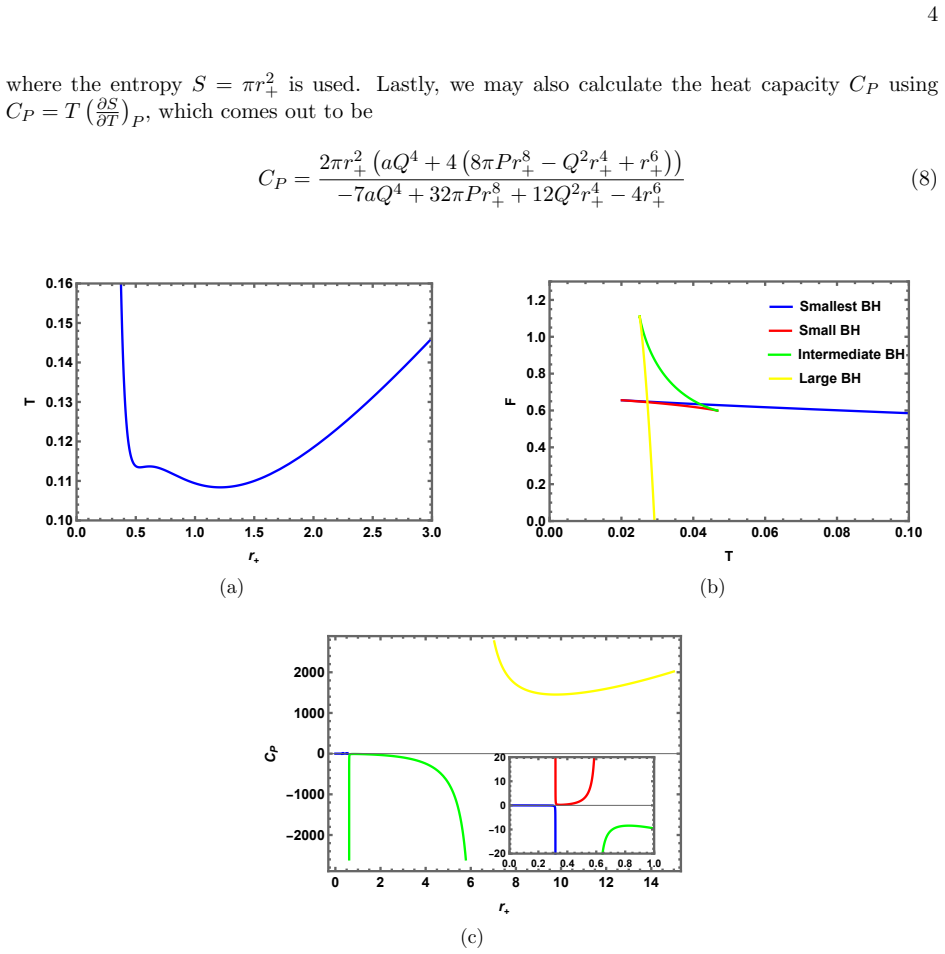
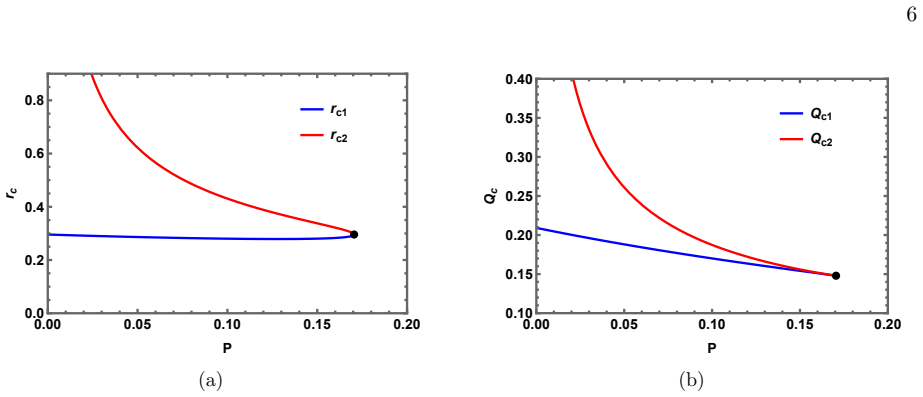
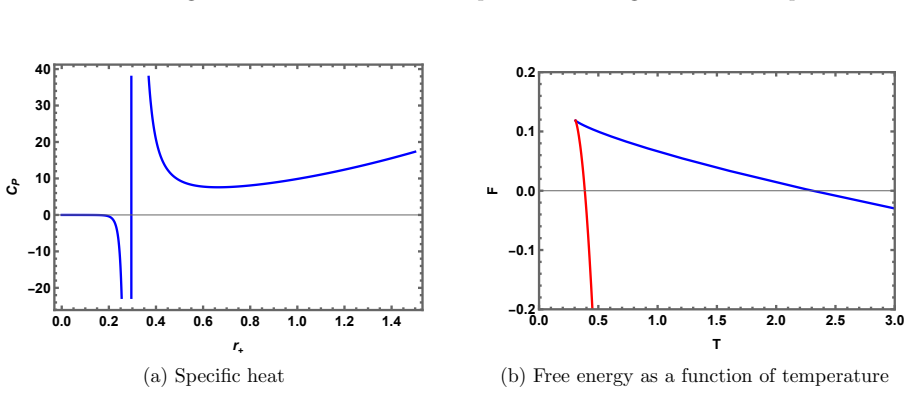
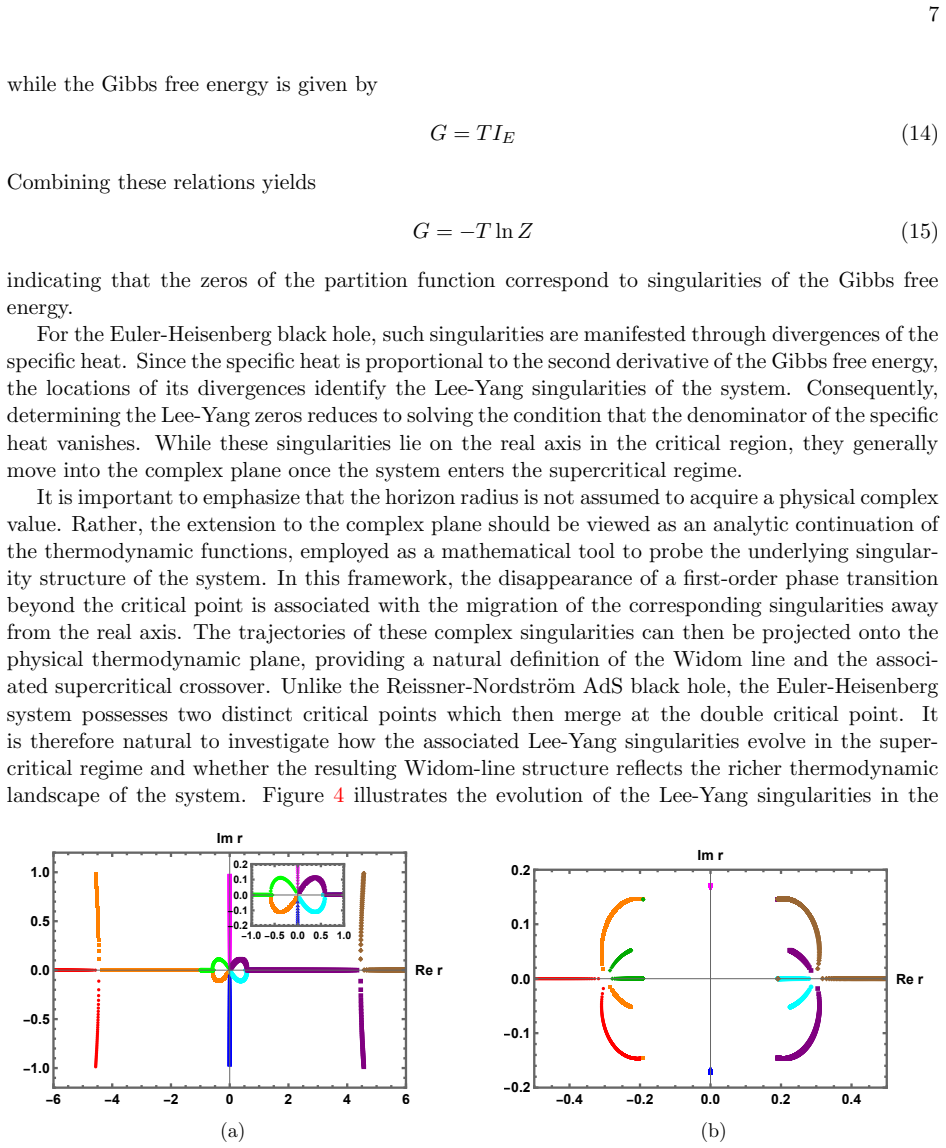
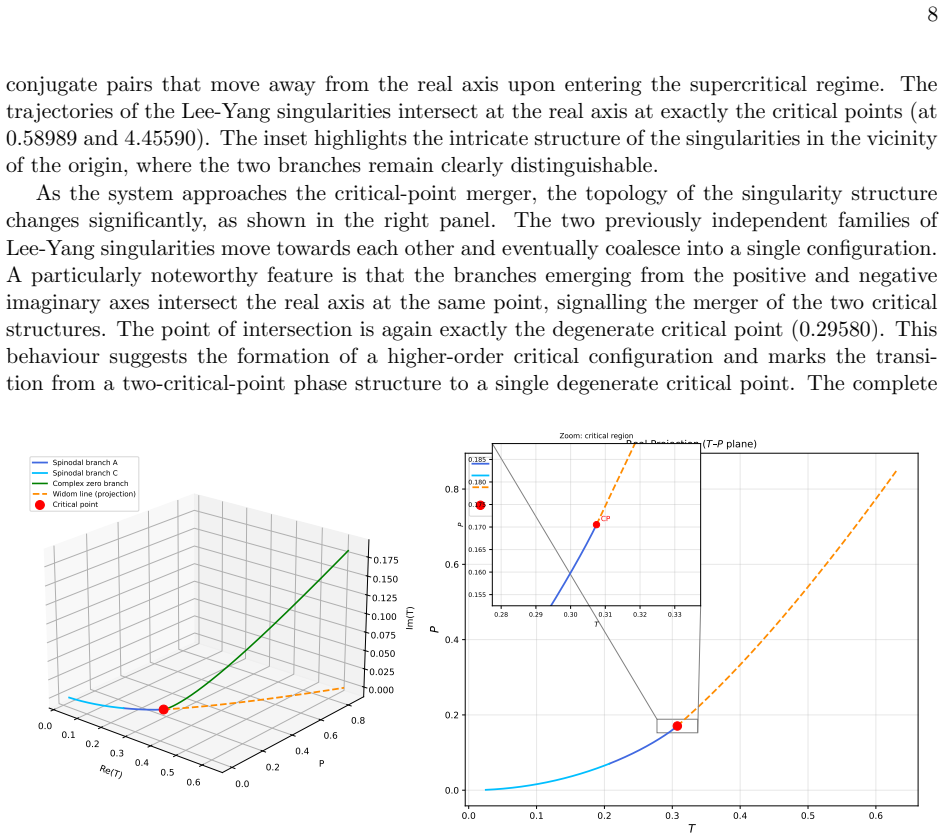
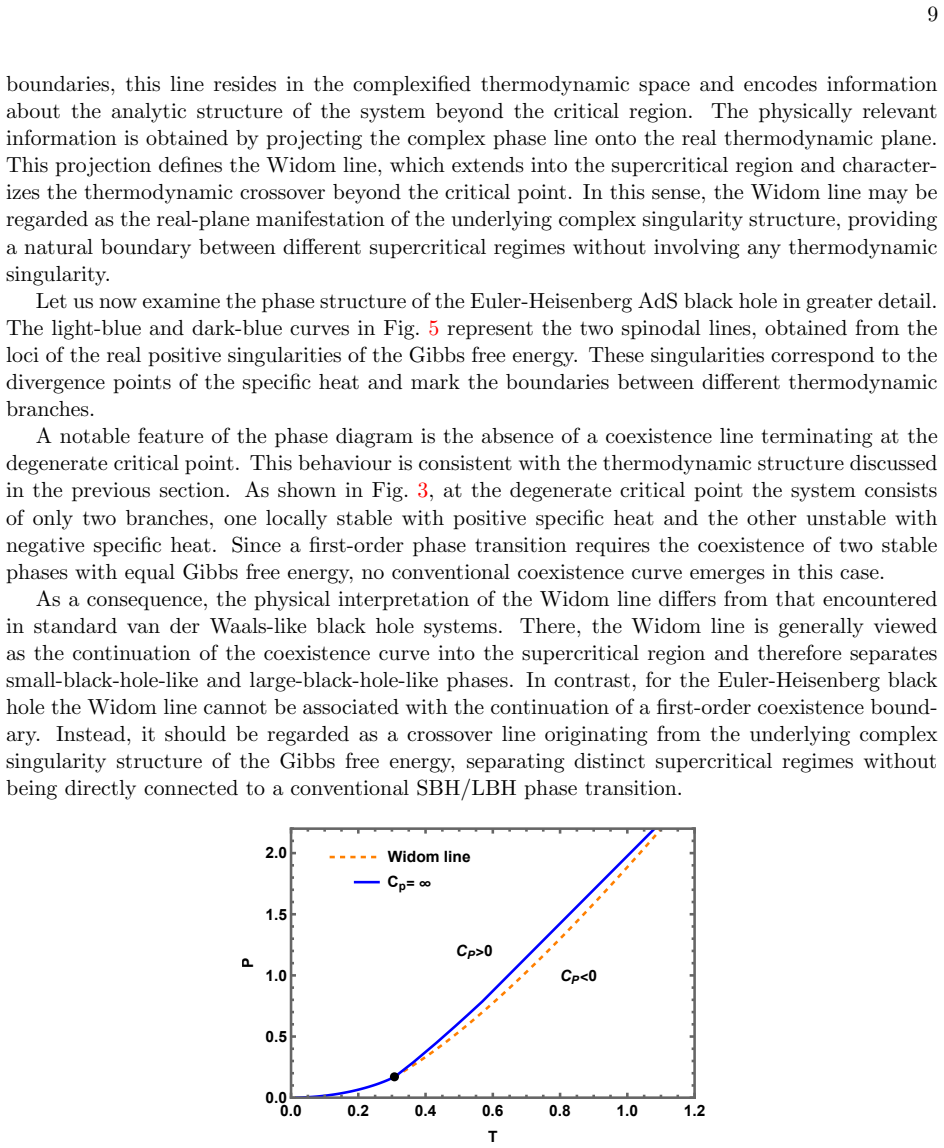
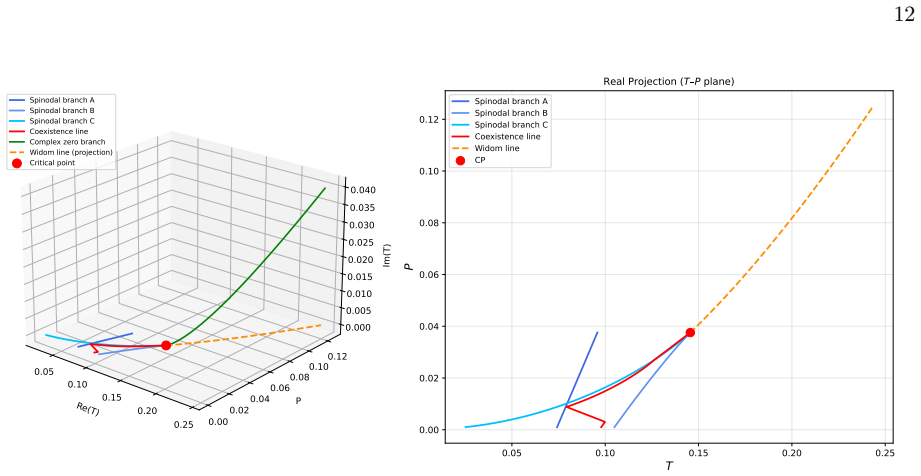
The system admits two distinct critical points associated with a four-phase thermodynamic structure and a degenerate higher-order critical point where the two criticalities merge. Extending the thermodynamic description into the complex domain determines the distribution of Lee-Yang singularities and constructs complex phase diagrams. At the degenerate critical point a well-defined Widom line emerges despite the absence of a conventional coexistence curve, acting as an effective stability boundary in the supercritical regime. In the two-critical-point regime, the complex phase diagram exhibits two distinct Widom lines.
What carries the argument
Lee-Yang singularities in the complex plane applied to the equation of state of Euler-Heisenberg AdS black holes to map phase structure and define Widom lines.
If this is right
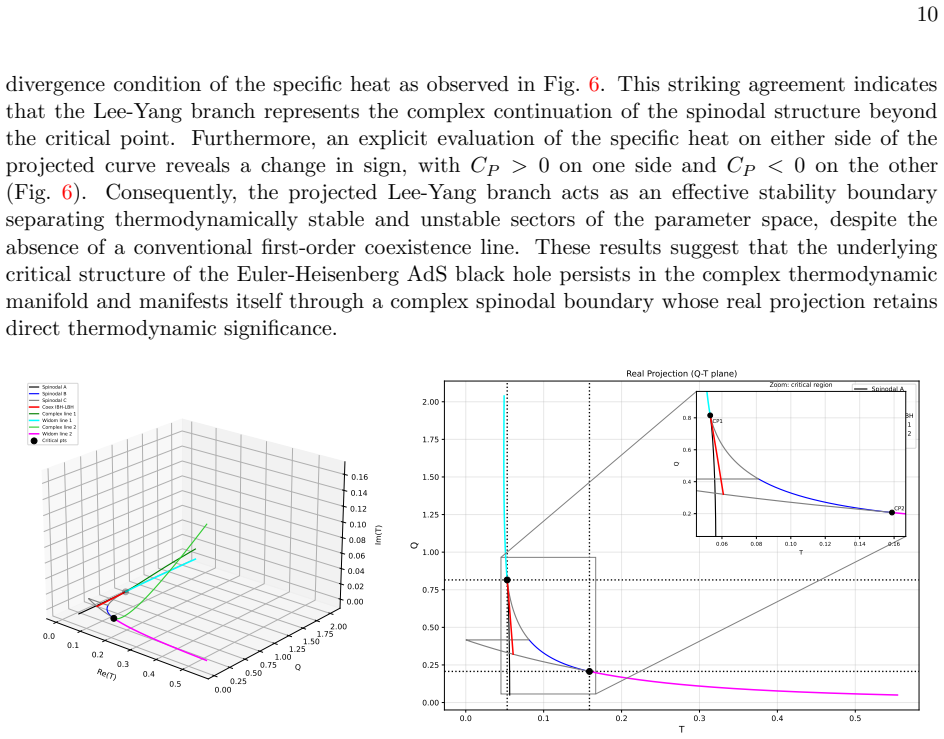
- The two-critical-point regime produces two distinct Widom lines, one tied to coexistence and one from complex singularities alone.
- A well-defined Widom line exists at the degenerate critical point as an effective stability boundary in the supercritical regime.
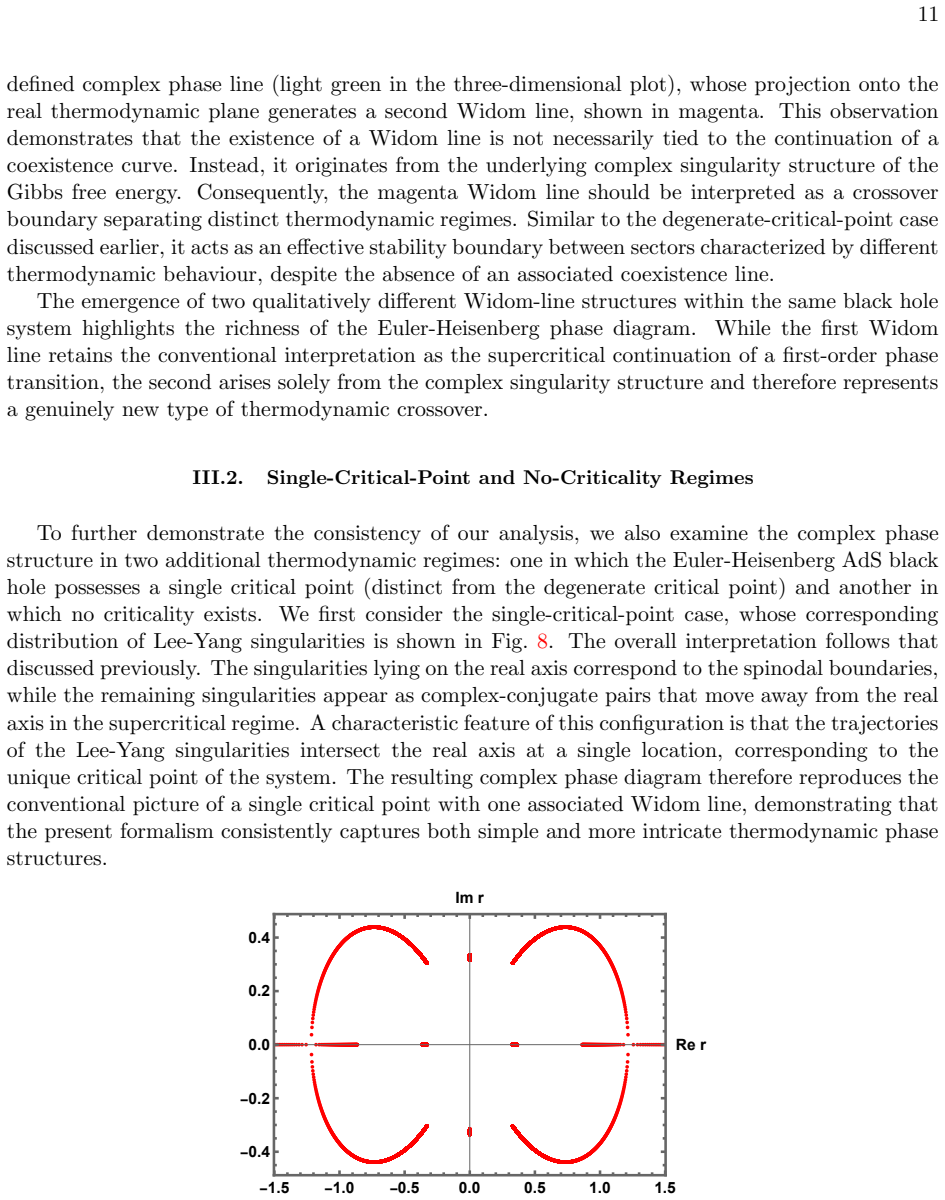
- The Lee-Yang approach reproduces standard phase structures for systems with one critical point or none.
- Complex phase diagrams consistently locate singularities for the four-phase structure.
Where Pith is reading between the lines
- The method of defining Widom lines via complex singularities may apply to other gravitational systems with multiple critical points.
- Stability boundaries in supercritical regimes could be identified more generally through singularity distributions rather than coexistence curves alone.
Load-bearing premise
The Lee-Yang formalism and its extension into the complex domain can be directly applied to the thermodynamics of Euler-Heisenberg AdS black holes to locate singularities and define Widom lines.
What would settle it
A mismatch between the computed locations of Lee-Yang zeros in the complex plane and the thermodynamic singularities derived from the black hole equation of state would falsify the claimed phase structure and Widom lines.
Figures
read the original abstract
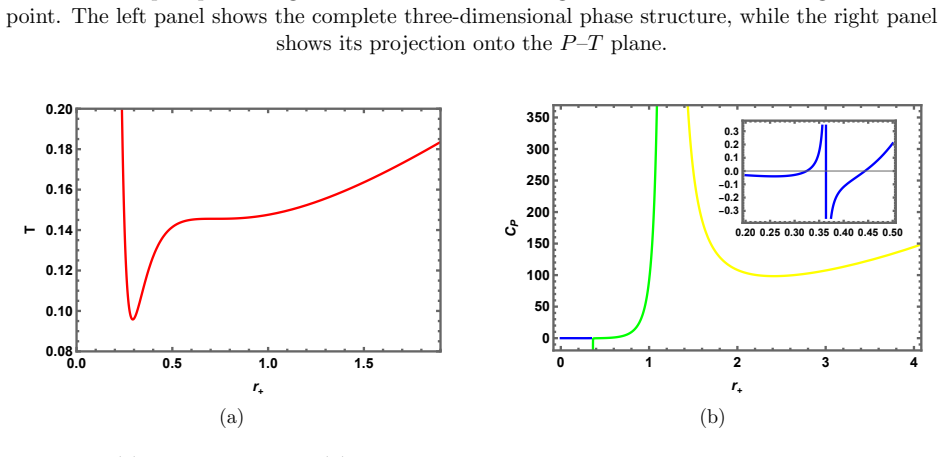
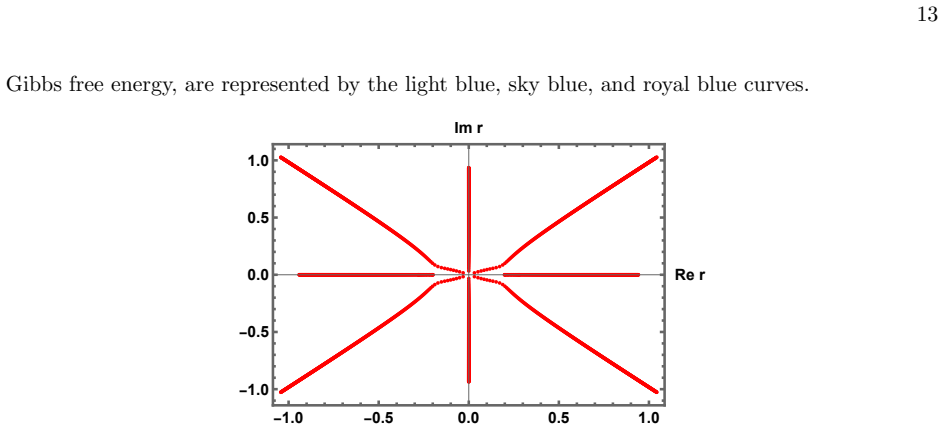
We investigate the supercritical thermodynamics of Euler-Heisenberg AdS black holes within the framework of Lee-Yang phase transition theory. We show that the system admits two distinct critical points associated with a four-phase thermodynamic structure and identify a degenerate higher-order critical point where the two criticalities merge. Extending the thermodynamic description into the complex domain, we determine the distribution of Lee-Yang singularities and construct the corresponding complex phase diagrams. At the degenerate critical point, we find that a well-defined Widom line emerges despite the absence of a conventional coexistence curve, acting as an effective stability boundary in the supercritical regime. In the two-critical-point regime, the complex phase diagram exhibits two distinct Widom lines, one associated with a coexistence curve and the other arising solely from the complex singularity structure. We further show that the Lee-Yang formalism consistently reproduces the expected phase structure for systems with a single critical point and in the absence of criticality. Our results reveal a rich supercritical phase structure and provide new insights into the origin and physical interpretation of Widom lines.
Editorial analysis
A structured set of objections, weighed in public.
Referee Report
Summary. The manuscript applies Lee-Yang zero analysis in the complex plane to the thermodynamics of Euler-Heisenberg AdS black holes. It claims that the system possesses two distinct critical points that generate a four-phase structure, identifies a degenerate higher-order critical point at which the criticalities merge, and reports that well-defined Widom lines appear in the complex phase diagram (one tied to a coexistence curve and one arising purely from singularity structure) even in the absence of a conventional coexistence curve. The formalism is asserted to reproduce standard single-critical-point and non-critical cases.
Significance. If the direct substitution of the Euler-Heisenberg-AdS free energy into the Lee-Yang formalism can be rigorously justified from the underlying gravitational action, the work would supply a concrete example of multi-critical-point structure and complex-domain Widom lines in a black-hole system, extending the range of thermodynamic analogies available in AdS/CFT and supercritical black-hole physics.
major comments (2)
- [Abstract and Introduction] Abstract and opening paragraphs of the introduction: the central claim that Lee-Yang singularities can be located and interpreted as stability boundaries rests on treating the Euler-Heisenberg-AdS free energy (obtained from the horizon or Euclidean action) as the logarithm of a partition function whose zeros obey the circle theorem or density properties of statistical mechanics. No explicit construction is supplied showing that this free energy arises as log Z for a sum over states whose analytic continuation is controlled by the same microscopic rules.
- [Sections on complex phase diagrams and Widom lines] The sections describing the two-critical-point regime and the degenerate higher-order point: the reported four-phase structure and the emergence of two distinct Widom lines are obtained by locating singularities of the extended pressure or free energy in the complex domain. Without the missing microscopic justification, these singularities remain formal features of the thermodynamic potential rather than derived properties of the gravitational theory, undermining the physical interpretation of the Widom line as an effective stability boundary.
minor comments (1)
- [Abstract] The abstract presents the main results without any equations, parameter values, or explicit checks, making it difficult to assess immediately whether the mathematical derivations support the four-phase and Widom-line claims.
Simulated Author's Rebuttal
We thank the referee for the careful reading and for highlighting the foundational assumptions in applying the Lee-Yang formalism. We respond to each major comment below, clarifying the scope of the thermodynamic analogy employed.
read point-by-point responses
-
Referee: [Abstract and Introduction] Abstract and opening paragraphs of the introduction: the central claim that Lee-Yang singularities can be located and interpreted as stability boundaries rests on treating the Euler-Heisenberg-AdS free energy (obtained from the horizon or Euclidean action) as the logarithm of a partition function whose zeros obey the circle theorem or density properties of statistical mechanics. No explicit construction is supplied showing that this free energy arises as log Z for a sum over states whose analytic continuation is controlled by the same microscopic rules.
Authors: We acknowledge that no explicit microscopic construction from the gravitational path integral is provided, as this would require a complete quantum theory of gravity. The identification of the on-shell Euclidean action with the free energy F = -T log Z follows the standard thermodynamic analogy in AdS black hole physics and AdS/CFT, as used in prior studies of phase transitions (including Lee-Yang analyses of other AdS black holes). We will add a dedicated paragraph in the introduction explicitly stating this analogy, its limitations, and references to the relevant literature. revision: partial
-
Referee: [Sections on complex phase diagrams and Widom lines] The sections describing the two-critical-point regime and the degenerate higher-order point: the reported four-phase structure and the emergence of two distinct Widom lines are obtained by locating singularities of the extended pressure or free energy in the complex domain. Without the missing microscopic justification, these singularities remain formal features of the thermodynamic potential rather than derived properties of the gravitational theory, undermining the physical interpretation of the Widom line as an effective stability boundary.
Authors: The four-phase structure and Widom lines are obtained from the analytic continuation of the thermodynamic potential, consistent with the same analogy used throughout the black-hole thermodynamics literature. We agree that these are effective features within the thermodynamic description rather than strictly microscopic. We will revise the relevant sections to emphasize the effective nature of the stability boundaries and to include a brief discussion of how the formalism reproduces standard single-critical-point cases as a consistency check. revision: partial
- Rigorous microscopic justification of the free energy as log Z arising from a sum over states controlled by the gravitational action.
Circularity Check
No significant circularity; external formalism applied to derived thermodynamics
full rationale
The derivation begins with the standard Euler-Heisenberg-AdS metric and Euclidean action to obtain the thermodynamic potential (free energy or pressure), then feeds that potential into the pre-existing Lee-Yang zero formalism for complex-plane analysis. The paper explicitly checks consistency by reproducing known single-critical-point and no-criticality phase structures, confirming the method is not tautological. No self-definitional equations, no parameters fitted to a subset and then relabeled as predictions, and no load-bearing self-citations appear in the abstract or described chain. The Widom-line and multi-critical-point results are outputs of the combined calculation rather than inputs renamed.
Axiom & Free-Parameter Ledger
axioms (2)
- domain assumption Standard assumptions of general relativity and extended phase space thermodynamics for AdS black holes.
- domain assumption Lee-Yang phase transition theory applies to black hole thermodynamic potentials.
Reference graph
Works this paper leans on
-
[1]
Gravitational radiation from colliding black holes,
S. W. Hawking, “Gravitational radiation from colliding black holes,” Phys. Rev. Lett.26, 1344-1346 (1971) doi:10.1103/PhysRevLett.26.1344
-
[2]
J. Bekenstein, “Bekenstein-Hawking entropy,” Scholarpedia3, no.10, 7375 (2008) doi:10.4249/scholarpedia.7375
-
[3]
S. W. Hawking, “Black hole explosions,” Nature248, 30-31 (1974) doi:10.1038/248030a0
-
[4]
Particle Creation by Black Holes,
S. W. Hawking, “Particle Creation by Black Holes,” Commun. Math. Phys.43, 199-220 (1975) [erratum: Commun. Math. Phys.46, 206 (1976)] doi:10.1007/BF02345020
-
[5]
J. M. Bardeen, B. Carter and S. W. Hawking, “The Four laws of black hole mechanics,” Commun. Math. Phys.31, 161-170 (1973) doi:10.1007/BF01645742
-
[6]
Thermodynamics of Black Holes,
P. C. W. Davies, “Thermodynamics of Black Holes,” Proc. Roy. Soc. Lond. A353, 499-521 (1977) doi:10.1098/rspa.1977.0047
-
[7]
Charged black holes and phase transitions,
P. Hut,“Charged black holes and phase transitions,” Monthly Notices of the Royal Astronomical Society, vol. 180, pp. 379–389, 10 1977
1977
-
[8]
The Large N Limit of Superconformal Field Theories and Supergravity
J. M. Maldacena, “The Large N limit of superconformal field theories and supergravity,” Adv. Theor. Math. Phys.2, 231-252 (1998) doi:10.4310/ATMP.1998.v2.n2.a1 [arXiv:hep-th/9711200 [hep-th]]
work page internal anchor Pith review Pith/arXiv arXiv doi:10.4310/atmp.1998.v2.n2.a1 1998
-
[9]
P-V criticality of charged AdS black holes
D. Kubiznak and R. B. Mann, “P-V criticality of charged AdS black holes,” JHEP07, 033 (2012) doi:10.1007/JHEP07(2012)033 [arXiv:1205.0559 [hep-th]]
work page internal anchor Pith review Pith/arXiv arXiv doi:10.1007/jhep07(2012)033 2012
-
[10]
Thermodynamics of black holes in anti-de Sitter space.Commun
S. W. Hawking and D. N. Page, “Thermodynamics of Black Holes in anti-De Sitter Space,” Commun. Math. Phys.87, 577 (1983) doi:10.1007/BF01208266
-
[11]
P-V criticality in the extended phase space of Gauss-Bonnet black holes in AdS space
R. G. Cai, L. M. Cao, L. Li and R. Q. Yang, “P-V criticality in the extended phase space of Gauss-Bonnet black holes in AdS space,” JHEP09, 005 (2013) doi:10.1007/JHEP09(2013)005 [arXiv:1306.6233 [gr-qc]]
work page internal anchor Pith review Pith/arXiv arXiv doi:10.1007/jhep09(2013)005 2013
-
[12]
Enthalpy and the Mechanics of AdS Black Holes
D. Kastor, S. Ray and J. Traschen, “Enthalpy and the Mechanics of AdS Black Holes,” Class. Quant. Grav.26, 195011 (2009) doi:10.1088/0264-9381/26/19/195011 [arXiv:0904.2765 [hep-th]]
work page internal anchor Pith review Pith/arXiv arXiv doi:10.1088/0264-9381/26/19/195011 2009
-
[13]
The cosmological constant and the black hole equation of state
B. P. Dolan, “The cosmological constant and the black hole equation of state,” Class. Quant. Grav. 28, 125020 (2011) doi:10.1088/0264-9381/28/12/125020 [arXiv:1008.5023 [gr-qc]]
work page internal anchor Pith review Pith/arXiv arXiv doi:10.1088/0264-9381/28/12/125020 2011
-
[14]
Pressure and volume in the first law of black hole thermodynamics
B. P. Dolan, “Pressure and volume in the first law of black hole thermodynamics,” Class. Quant. Grav. 28, 235017 (2011) doi:10.1088/0264-9381/28/23/235017 [arXiv:1106.6260 [gr-qc]]
work page internal anchor Pith review Pith/arXiv arXiv doi:10.1088/0264-9381/28/23/235017 2011
-
[15]
Compressibility of rotating black holes
B. P. Dolan, “Compressibility of rotating black holes,” Phys. Rev. D84, 127503 (2011) 15 doi:10.1103/PhysRevD.84.127503 [arXiv:1109.0198 [gr-qc]]
work page internal anchor Pith review Pith/arXiv arXiv doi:10.1103/physrevd.84.127503 2011
-
[16]
Black hole chemistry: thermodynamics with Lambda
D. Kubiznak, R. B. Mann and M. Teo, “Black hole chemistry: thermodynamics with Lambda,” Class. Quant. Grav.34, no.6, 063001 (2017) doi:10.1088/1361-6382/aa5c69 [arXiv:1608.06147 [hep-th]]
work page internal anchor Pith review Pith/arXiv arXiv doi:10.1088/1361-6382/aa5c69 2017
-
[17]
Gauss-Bonnet coupling constant as a free thermodynamical variable and the associated criticality
W. Xu, H. Xu and L. Zhao, “Gauss-Bonnet coupling constant as a free thermodynamical variable and the associated criticality,” Eur. Phys. J. C74, 2970 (2014) doi:10.1140/epjc/s10052-014-2970-8 [arXiv:1311.3053 [gr-qc]]
work page internal anchor Pith review Pith/arXiv arXiv doi:10.1140/epjc/s10052-014-2970-8 2014
-
[18]
Critical phenomena of static charged AdS black holes in conformal gravity
W. Xu and L. Zhao, “Critical phenomena of static charged AdS black holes in conformal gravity,” Phys. Lett. B736, 214-220 (2014) doi:10.1016/j.physletb.2014.07.019 [arXiv:1405.7665 [gr-qc]]
work page internal anchor Pith review Pith/arXiv arXiv doi:10.1016/j.physletb.2014.07.019 2014
-
[19]
M. Zhang, D. C. Zou and R. H. Yue, “Reentrant phase transitions and triple points of topologi- cal AdS black holes in Born-Infeld-massive gravity,” Adv. High Energy Phys.2017, 3819246 (2017) doi:10.1155/2017/3819246 [arXiv:1707.04101 [hep-th]]
work page internal anchor Pith review Pith/arXiv arXiv doi:10.1155/2017/3819246 2017
-
[20]
The widom line as the crossover between liquid-like and gas-like behaviour in supercritical fluids
G. G. Simeoni, T. Bryk, F. A. Gorelli, M. Krisch, G. Ruocco, M. Santoro et al., “The widom line as the crossover between liquid-like and gas-like behaviour in supercritical fluids”,Nature Physics6(July,
-
[21]
The widom line and dynamical crossover in supercritical water: Popular water models versus experiments
D. Corradini, M. Rovere and P. Gallo, “The widom line and dynamical crossover in supercritical water: Popular water models versus experiments”,The Journal of Chemical Physics143(09, 2015) 114502
2015
-
[22]
Correlation lengths and density fluctuations in supercritical states of carbon dioxide
K. Nishikawa and I. Tanaka, “Correlation lengths and density fluctuations in supercritical states of carbon dioxide”,Chemical Physics Letters244(1995) 149–152
1995
-
[23]
Gas or liquid? the supercritical behavior of pure fluids
E. A. Ploetz and P. E. Smith, “Gas or liquid? the supercritical behavior of pure fluids”,The Journal of Physical Chemistry B123(2019) 6554–6563
2019
-
[24]
Thermodynamic crossovers in supercritical fluids
X. Li and Y. Jin, “Thermodynamic crossovers in supercritical fluids”,Proceedings of the National Academy of Sciences121(2024) e2400313121
2024
-
[25]
Specific heats of fluid argon near the critical point
G. O. Jones and P. A. Walker, “Specific heats of fluid argon near the critical point”,Proceedings of the Physical Society. Section B69(dec, 1956) 1348
1956
-
[26]
Relation between the widom line and the dynamic crossover in systems with a liquid–liquid phase transition
L. Xu, P. Kumar, S. V. Buldyrev, S.-H. Chen, P. H. Poole, F. Sciortino et al., “Relation between the widom line and the dynamic crossover in systems with a liquid–liquid phase transition”,Proceedings of the National Academy of Sciences102(2005) 16558–16562
2005
-
[27]
Thermodynamic geometry, phase transitions, and the widom line
G. Ruppeiner, A. Sahay, T. Sarkar and G. Sengupta, “Thermodynamic geometry, phase transitions, and the widom line”,Phys. Rev. E86(Nov, 2012) 052103
2012
-
[28]
Behavior of the widom line in critical phenomena
J. Luo, L. Xu, E. Lascaris, H. E. Stanley and S. V. Buldyrev, “Behavior of the widom line in critical phenomena”,Phys. Rev. Lett.112(Apr, 2014) 135701
2014
-
[29]
Similarity law for widom lines and coexistence lines
D. T. Banuti, M. Raju and M. Ihme, “Similarity law for widom lines and coexistence lines”,Phys. Rev. E95(May, 2017) 052120
2017
-
[30]
Statistical theory of equations of state and phase transitions. 1. Theory of condensation
C.-N. Yang and T. D. Lee, “Statistical theory of equations of state and phase transitions. 1. Theory of condensation”,Phys. Rev.87(1952) 404–409
1952
-
[31]
Statistical theory of equations of state and phase transitions. 2. Lattice gas and Ising model
T. D. Lee and C.-N. Yang, “Statistical theory of equations of state and phase transitions. 2. Lattice gas and Ising model”,Phys. Rev.87(1952) 410–419
1952
-
[32]
A. Sahay and R. Jha, “Geometry of criticality, supercriticality and Hawking-Page transitions in Gauss- Bonnet-AdS black holes”,Phys. Rev. D96(2017) 126017, [arXiv:1707.03629]
work page internal anchor Pith review Pith/arXiv arXiv 2017
-
[33]
The universal crossover from thermodynamics and dynamics of supercritical RN-AdS black hole
Z.-Q. Zhao, Z.-Y. Nie, J.-F. Zhang and X. Zhang, “The universal crossover from thermodynamics and dynamics of supercritical RN-AdS black hole”,arXiv:2504.04995
-
[34]
Thermodynamic supercriticality and complex phase diagram for the AdS black hole
Z.-M. Xu and R. B. Mann, “Thermodynamic supercriticality and complex phase diagram for the AdS black hole”,arXiv:2504.05708
-
[35]
Analogous supercritical crossovers in black holes and water
S. Wang, X. Li, Y. Jin and L. Li, “Analogous supercritical crossovers in black holes and water”, arXiv:2506.10808
-
[36]
Thermodynamic supercriticality and complex phase diagram for charged Gauss-Bonnet AdS black holes,
Z. Y. Li, X. R. Chen, B. Wu and Z. M. Xu, “Thermodynamic supercriticality and complex phase diagram for charged Gauss-Bonnet AdS black holes,” Phys. Lett. B876(2026), 140438 doi:10.1016/j.physletb.2026.140438 [arXiv:2511.10357 [hep-th]]
-
[37]
F. Guo and Z. M. Xu, “Complex plane phase diagram and Widom line for the Born–Infeld black holes with reentrant phase transition,” Eur. Phys. J. C86(2026) no.5, 524 doi:10.1140/epjc/s10052-026- 15792-z [arXiv:2602.09770 [hep-th]]
work page internal anchor Pith review Pith/arXiv arXiv doi:10.1140/epjc/s10052-026- 2026
-
[38]
Perturbative study of Supercritical Crossover in Noncommutative-corrected Spacetime
A. Anand and S. Wang, “Perturbative study of Supercritical Crossover in Noncommutative-corrected Spacetime,” [arXiv:2606.09443 [hep-th]]
work page internal anchor Pith review Pith/arXiv arXiv
-
[39]
Thermodynamics of the Euler-Heisenberg-AdS black hole,
D. Magos and N. Bret´ on, “Thermodynamics of the Euler-Heisenberg-AdS black hole,” Phys. Rev. D 16 102(2020) no.8, 084011 doi:10.1103/PhysRevD.102.084011 [arXiv:2009.05904 [gr-qc]]
-
[40]
QED effects on phase transition and Ruppeiner geome- try of Euler-Heisenberg-AdS black holes*,
X. Ye, Z. Q. Chen, M. D. Li and S. W. Wei, “QED effects on phase transition and Ruppeiner geome- try of Euler-Heisenberg-AdS black holes*,” Chin. Phys. C46(2022) no.11, 115102 doi:10.1088/1674- 1137/ac814d [arXiv:2202.09053 [gr-qc]]
-
[41]
LECTURES ON NON LINEAR ELECTRODYNAMICS,
J. Plebanski, “LECTURES ON NON LINEAR ELECTRODYNAMICS,” RX-476
-
[42]
Thermodynamic topology of 4D Euler–Heisenberg-AdS black hole in differ- ent ensembles,
N. J. Gogoi and P. Phukon, “Thermodynamic topology of 4D Euler–Heisenberg-AdS black hole in differ- ent ensembles,” Phys. Dark Univ.44(2024), 101456 doi:10.1016/j.dark.2024.101456 [arXiv:2312.13577 [hep-th]]
-
[43]
Duality Rotations and TypeDSolutions to Ein- stein Equations With Nonlinear Electromagnetic Sources,
I. H. Salazar, A. Garcia and J. Plebanski, “Duality Rotations and TypeDSolutions to Ein- stein Equations With Nonlinear Electromagnetic Sources,” J. Math. Phys.28(1987), 2171-2181 doi:10.1063/1.527430
discussion (0)
Sign in with ORCID, Apple, or X to comment. Anyone can read and Pith papers without signing in.