REVIEW 5 major objections 7 minor 55 references
GraphEdge: Dynamic Graph Partition and Task Scheduling for GNNs Computing in Edge Network
T0 review · 5 major / 7 minor · reviewed 2026-08-16 · deepseek-v4-flash
Pith's one-line read GraphEdge claims that cutting the user-association graph into weakly linked subgraphs and offloading each subgraph to a single edge server minimizes system cost and cross-server communication for GNN inference in dynamic edge networks.
desk verdict Plausible GNN edge-offloading architecture with a genuinely new partition-for-aggregation idea, but a factor-N inflation in the cost model undermines the central quantitative claim. read the letter →
The pith
A machine-rendered reading of the paper's core claim, the machinery that carries it, and where it could break.
The reading
What carries the argument
The load-bearing machinery is the pair HiCut plus DRLGO. HiCut is a hierarchical traversal graph cut: it runs a breadth-first search from an unchosen vertex, counts the edges between consecutive layers, and records a candidate cut whenever the edge count falls; when the count later rises, it closes a subgraph at the recorded layer, ensuring that vertices inside a subgraph are strongly associated and vertices across subgraphs are weakly associated. This directly targets GNN message passing, since aggregation requires a server to fetch neighbor features across cut edges. DRLGO is a multi-agent deep reinforcement learning offloader built on the MADDPG scheme (multi-agent deep deterministic policy gradient): each edge server is an agent that acts on local observations, a central critic trains them together, and the reward is the negative system cost plus a penalty proportional to the number of servers a subgraph is spread across. The dynamic graph model, a mask array for joining and leaving users plus position attributes for mobility, feeds both stages at each time step. Together they convert the integer offloading problem into graph partitioning followed by learned subgraph-to-server assignment.
What would settle it
Settle it by taking the objective apart: in Eq. (12) the inter-server transfer delay $T^{\mathrm{tran}}_{k,l}$ appears inside the sum over all $N$ users, so the same transfer is counted once per user rather than once per server pair. Rewriting the objective with the transfer summed over server pairs and retraining DRLGO, or measuring actual transfer latency on a two-server testbed under the same offloading decisions, would show whether the reported cost advantage is an artifact of the counting. If the corrected or measured costs put DRLGO on par with the baselines, the central claim collapses.
Extended reading notes
Core claim
The central claim is that GNN inference cost in an edge system splits into two manageable subproblems instead of one intractable integer program. The first subproblem is graph layout: because a GNN aggregates a user's features with its neighbors' features, any edge of the user graph that crosses server boundaries forces a data transfer. HiCut traverses the graph layer by layer and cuts where the number of edges between successive BFS layers dips, producing subgraphs whose inter-subgraph edges are few. The second subproblem is offloading: given those subgraphs, DRLGO, a multi-agent actor-critic policy with centralized training and distributed execution, assigns each subgraph to an edge server, with a reward that penalizes scattering a subgraph across servers. The paper argues that this two-step procedure minimizes the system cost $T_{\mathrm{all}} + I_{\mathrm{all}}$ and adapts to dynamic user states through a mask module and position attributes in the graph model; the experiments are offered as evidence that the architecture outperforms PPO-based, greedy, and random offloading in dynamic scenarios.
Load-bearing premise
The load-bearing assumption is that the paper's equations for time and energy (Eqs. 7-13) accurately describe what a real edge server would spend, since DRLGO is trained to minimize those equations and the experiments evaluate those same equations; if the model over- or under-counts transfer cost, the claimed savings are not real.
Editorial extensions
If this is right
- A service operator can run GNN inference over geographically distributed servers while exchanging data only across subgraph boundaries; the amount of inter-server traffic is set by HiCut's cut quality, not by the raw number of user associations.
- When users join, leave, or move, the mask and position attributes update the graph and the same trained DRLGO can re-plan the offloading, so the architecture does not need to retrain from scratch at every topology change.
- The reported complexity advantage means the graph-cut stage remains usable as graphs grow: $O(N^2 + NE)$ versus the compared min-cut method's $O(V^2E)$, with the gap widening on dense graphs.
- Because DRLGO's reward couples system cost with subgraph cohesion, the learned policy should transfer across GNN models that share the aggregation step, which the experiments support by testing GCN, GAT, GraphSAGE, and SGC.
Reading between the lines
- Beyond the paper's stated claims, the cost objective in Eq. (12) sums the inter-server transfer time $T^{\mathrm{tran}}_{k,l}$ inside the loop over all $N$ users, so the same cross-server transfer appears to be counted once per user rather than once per server pair; a corrected objective could change both the training signal and the reported cost comparisons.
- A natural test the paper does not run is to replace the citation graphs with a temporal network of real mobility or social interactions, where edges appear and disappear at fine time scales; the mask and position model would then face edge churn rather than resampled static graphs, and it is an open question whether HiCut's edge-count heuristic still finds good cuts.
- The claim that cutting by BFS-layer edge-count dips is near-optimal is heuristic; comparing HiCut against exact or balanced graph-partition objectives on the same datasets would tell whether the communication savings come from the cut heuristic itself or from the subgraph-cohesive offloading reward.
Signed reviews
Editorial analysis
A structured set of objections, weighed in public.
Referee Report
Summary. This paper proposes GraphEdge, an architecture for GNN inference in edge networks. It models user data associations as a dynamic graph, partitions the graph into weakly coupled subgraphs using a BFS-based hierarchical cut (HiCut), and then uses a MADDPG-based deep reinforcement learning algorithm (DRLGO) to offload whole subgraphs to edge servers. The objective is to minimize total time and energy, including upload, inter-server communication, and GNN computation. Experiments on CiteSeer, Cora, and PubMed against PPO, greedy, and random offloading baselines report lower system cost and lower cross-server cost, with additional results on convergence and an ablation. The paper claims that DRLGO 'can minimize system cost' even in dynamic scenarios and that HiCut 'can effectively reduce cross-server communication cost.'
Significance. The manuscript addresses a relevant and timely problem: serving GNN inference over distributed edge servers with dynamic user topology. The proposed architecture is cleanly decomposed into a dynamic graph model, a graph partition algorithm (HiCut), and a multi-agent reinforcement learning offloading algorithm (DRLGO), and the simulation study is self-contained in that all methods are evaluated on the same cost equations. If the cost model were correct, the results showing DRLGO below PPO, greedy, and random baselines, together with the ablation against DRL-only, would provide preliminary evidence that graph-aware partition plus subgraph-level offloading can reduce system cost and cross-server communication. However, the load-bearing cost model issues identified in the major comments—particularly the factor-N inflation of transfer costs in Eqs. (12)-(13), the undefined indices in Eqs. (7)-(8), and the unverified optimality of HiCut—mean that the quantitative results as presented do not support the central claims. The work is a reasonable starting point, but it needs substantial correction and re-evaluation.
major comments (5)
- [3.5, Eqs. (12)-(13)] In the definitions of T_all and I_all, the terms sum_{k,l≠k} T^tran_{k,l} and sum_{k,l≠k} I^com_{k,l} do not depend on the user index n, yet they are placed inside the outer sum over n=1..N. This counts the aggregate inter-server transfer time and energy N times, overweighting cross-server communication by a factor of N relative to upload and computation costs. Because DRLGO's reward is the negative of T_all + I_all and the experimental results are computed from these same formulas, both the training objective and the evaluation metric are distorted. The transfer terms should be moved outside the user sum, or a per-user share of the transfer cost should be defined. This is a load-bearing issue: the paper's central claim is that GraphEdge minimizes the true system cost, but the minimized quantity is not a faithful statement of that cost, and the overweighted transfer term can bias the learned policy toward collocation even when that increases true time and energy.
- [3.3, Eqs. (7)-(8)] The inter-server communication model is not well defined. In Eq. (7), x_{k→l}(t) is written as sum_{i=1}^N X_i · w_ik · e_ij, but the index j is free; a sum over j (or over edges (i,j)) with a condition on the destination server, such as w_jl = 1, is missing. In Eq. (8), I^com_{k,l}(t) contains e_ij(t), w_ik(t), w_jl(t), and X_i(t) with i and j unbound and no summation; as written it is a product of scalars for a single unspecified edge, not the total energy cost of communication between servers k and l. Without a precise definition, the objective in Eqs. (12)-(13) and the HiCut cost in Eq. (15) cannot be evaluated or reproduced. These equations need to be rewritten with explicit summations over the appropriate user pairs.
- [4.2-4.3, Eq. (15)] The paper asserts that HiCut finds a cut that 'ensures minimal inter-subgraph edges' and 'ensures that the correlation between subgraphs is minimized,' but no proof or counterexample-based argument is provided. The algorithm's decision rule compares edge counts between consecutive BFS layers and records local troughs; the output depends on the choice of the BFS starting vertex, and this local heuristic is not guaranteed to yield a global minimum cut. In addition, Eq. (15) places the minimization over G_sub inside the double sum over server pairs k and l, which would allow a different partition for each pair; the intended optimization is min_{G_sub} of the sum over pairs. The authors should either supply a correctness argument for the optimality claim or explicitly present HiCut as a heuristic, and they should correct Eq. (15).
- [6.3, Fig. 10] The experiment comparing different GNN models (GCN, GAT, GraphSAGE, SGC) does not support the claimed 'strong model adaptation capability' because the cost model in Eqs. (9)-(11) depends only on the number of layers, the feature dimensions S_k, the degrees, and the server speed f_k; the GNN architecture itself appears nowhere in the cost equations. The text states that all models have three layers and 64 neurons, so for a fixed dataset and offloading plan the computed system cost is identical across the four models. The results in Fig. 10 therefore cannot demonstrate any variation due to the GNN model, and the model-adaptation claim needs reformulation or a cost model that actually reflects the different operations of GCN, GAT, GraphSAGE, and SGC.
- [5.2, Eq. (25), and Table 2] The reward function in Eq. (25) includes the subgraph-grouping term R_sp with a weight constant ζ, but the value of ζ is not reported anywhere in Table 2 or the text. Since this term shapes the learned policy in addition to the system cost C = T_all + I_all, the training objective is not fully specified and the experiments are not reproducible without this value. The authors should report ζ and, ideally, include a sensitivity analysis over ζ.
minor comments (7)
- [Table 1] Table 1 lists σ_{k,l} twice, with slightly different descriptions; one entry should be removed.
- [Eq. (13)] In Eq. (13), the first term inside the user sum is written as I^up_{i,m}, while the outer sum uses index n; the indices should be consistent.
- [Eq. (15)] Eq. (15) has a typo in the upper limit of the second sum: 'm' should presumably be 'M'.
- [Section 4.2 and Algorithm 1] In Section 4.2, d_n is described as 'the number of edges in the current layer,' but in Algorithm 1 it is incremented for neighbors of current-layer vertices that are not in the subgraph; the definition should be stated precisely.
- [Section 6.2, Fig. 6] Section 6.2 compares HiCut to the min-cut method in [36] only in terms of runtime (Fig. 6); no comparison of cut quality (e.g., number of inter-subgraph edges or resulting communication cost) is reported, so the claim that HiCut reduces cross-server communication is not directly validated against the min-cut baseline.
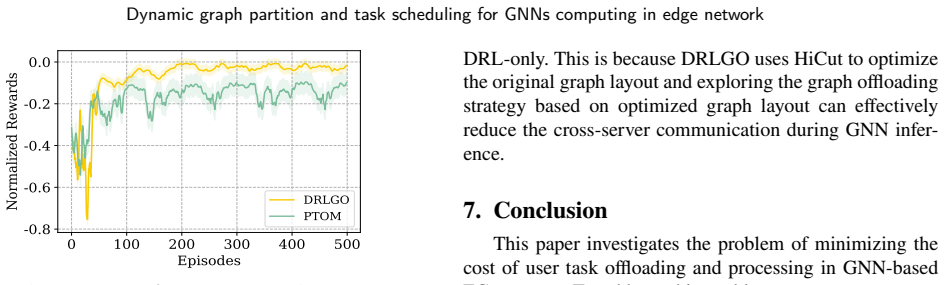
- [Fig. 12] Fig. 12 appears garbled in the manuscript version I received (the figure body consists of '/uni0000...' tokens), so the ablation result comparing DRLGO and DRL-only cannot be verified from the text.
- [Section 6.3] The paper does not compare DRLGO to an optimal offloading solution on small instances or to a standard graph partitioner such as METIS; such comparisons would strengthen the claims that the offloading is 'optimal' and that HiCut has good cut quality.
Circularity Check
No significant circularity: the HiCut and DRLGO designs are self-contained; only minor non-load-bearing self-citations appear, and evaluation/training alignment is standard practice rather than a reduction.
full rationale
The paper's derivation chain is largely self-contained. HiCut is a BFS-based heuristic that cuts between BFS layers where the edge count decreases, and the cross-server communication cost is afterwards evaluated with the same cost model (Eqs. 7, 8, 12, 13) on all compared methods, so the comparison is fair across baselines. DRLGO is trained with a reward based on the system cost plus a subgraph-grouping penalty R_sp (Eqs. 23-25); reporting that the trained policy achieves low cost on the same simulator is a standard train/evaluation loop, not a fitted input renamed as a prediction, since DRLGO must still beat PPO, greedy, and random baselines on held-out dynamic scenarios. The abstract's claim that HiCut minimizes cross-server communication is a design consequence (cutting weakly associated subgraphs and offloading each subgraph to one server lowers inter-server edge traffic by construction), but the paper does not disguise this as an external first-principles theorem. Self-citations [2], [18], and [25] appear only in the introduction and related work as examples of IoT/EC research; none is load-bearing for the graph cut, the offloading algorithm, or the experimental claims. The undefined indices in Eq. (8) and the N-fold summation of T_tran and I_com in Eqs. (12)-(13) are correctness/validity concerns about the cost model, not circularity; they do not make the derivation equivalent to its inputs.
Assumptions & free parameters
free parameters (2)
- zeta (subgraph grouping reward weight, Eq. 25)
- GNN feature dimension cap for CiteSeer =
1500
assumptions (5)
- domain assumption Wireless channel gain follows free-space path loss h = rho_0 d^{-2} (Eq. 3).
- domain assumption The aggregate and update phases of GNN layers have per-unit energy costs mu, theta, phi, independent of server and data distribution (Eqs. 10-11).
- ad hoc to paper A BFS layer whose edge count to the unassigned graph stops decreasing marks a boundary of weak association, so cutting there minimizes inter-subgraph edges.
- domain assumption Each AP is co-located with an edge server, so AP-server communication is free (Section 3.1).
- domain assumption All edge servers run identical, pre-trained GNN models; no model updates are transmitted (Section 3.1).
Cite this review
Pith. "Pith review of GraphEdge: Dynamic Graph Partition and Task Scheduling for GNNs Computing in Edge Network." pith.science (2026). https://pith.science/paper/E3ARQX2Y
@misc{pith2026250415905,
  author       = {Pith},
  title        = {Pith review of: GraphEdge: Dynamic Graph Partition and Task Scheduling for GNNs Computing in Edge Network},
  year         = {2026},
  howpublished = {\url{https://pith.science/paper/E3ARQX2Y}},
  note         = {Machine review of arXiv:2504.15905}
}
read the original abstract
With the exponential growth of Internet of Things (IoT) devices, edge computing (EC) is gradually playing an important role in providing cost-effective services. However, existing approaches struggle to perform well in graph-structured scenarios where user data is correlated, such as traffic flow prediction and social relationship recommender systems. In particular, graph neural network (GNN)-based approaches lead to expensive server communication cost. To address this problem, we propose GraphEdge, an efficient GNN-based EC architecture. It considers the EC system of GNN tasks, where there are associations between users and it needs to take into account the task data of its neighbors when processing the tasks of a user. Specifically, the architecture first perceives the user topology and represents their data associations as a graph layout at each time step. Then the graph layout is optimized by calling our proposed hierarchical traversal graph cut algorithm (HiCut), which cuts the graph layout into multiple weakly associated subgraphs based on the aggregation characteristics of GNN, and the communication cost between different subgraphs during GNN inference is minimized. Finally, based on the optimized graph layout, our proposed deep reinforcement learning (DRL) based graph offloading algorithm (DRLGO) is executed to obtain the optimal offloading strategy for the tasks of users, the offloading strategy is subgraph-based, it tries to offload user tasks in a subgraph to the same edge server as possible while minimizing the task processing time and energy consumption of the EC system. Experimental results show the good effectiveness and dynamic adaptation of our proposed architecture and it also performs well even in dynamic scenarios.
Figures


Figures from the paper (8 more)



Reference graph
Works this paper leans on
-
[1]
Tengfei Yang, Yuanyuan Li, Jiawei He, Zhiquan Liu, Fang Ren, Teng Wang, and Gaopan Hou. Secure and traceable multikey image retrieval in cloud-assisted internet of things.IEEE Internet of Things Journal, pages 1–1, 2024
work page 2024
-
[2]
Wenjing Xiao, Xin Ling, Miaojiang Chen, Junbin Liang, Salman A. Alqahtani,andMinChen. Mvpoa:Alearning-basedvehicleproposal offloading for cloud-edge-vehicle networks.IEEE Internet of Things Journal, pages 1–1, 2024. Preprint submitted to Elsevier Page 15 of 17 Dynamic graph partition and task scheduling for GNNs computing in edge network
work page 2024
-
[3]
RuikunLuo,HaiJin,QiangHe,SongWu,andXiaoyuXia. Enabling balanced data deduplication in mobile edge computing.IEEE Trans- actionsonParallelandDistributedSystems ,34(5):1420–1431,2023
work page 2023
-
[4]
RuikunLuo,QiangHe,FeifeiChen,SongWu,HaiJin,andYunYang. Ripple: Enabling decentralized data deduplication at the edge.IEEE Transactions on Parallel and Distributed Systems, 2024
work page 2024
-
[5]
RuikunLuo,QiangHe,MengxiXu,FeifeiChen,SongWu,JingYang, Yuan Gao, and Hai Jin. Edge data deduplication under uncertainties: A robust optimization approach.IEEE Transactions on Parallel and Distributed Systems, 2024
work page 2024
-
[6]
Influence maximization on social graphs: A survey
Yuchen Li, Ju Fan, Yanhao Wang, and Kian-Lee Tan. Influence maximization on social graphs: A survey. IEEE Transactions on Knowledge and Data Engineering, 30(10):1852–1872, 2018
work page 2018
-
[7]
IEEETransactions on Vehicular Technology, pages 1–16, 2023
Zhiquan Liu, Lin Wan, Jingjing Guo, Feiran Huang, Xia Feng, Libo Wang,andJianfengMa.Ppru:Aprivacy-preservingreputationupdat- ingschemeforcloud-assistedvehicularnetworks. IEEETransactions on Vehicular Technology, pages 1–16, 2023
work page 2023
-
[8]
QihuaFeng,PeiyaLi,ZhixunLu,ChaozhuoLi,ZefanWang,Zhiquan Liu,ChunhuiDuan,FeiranHuang,JianWeng,andPhilipS.Yu. Evit: Privacy-preserving image retrieval via encrypted vision transformer in cloud computing.IEEE Transactions on Circuits and Systems for Video Technology, 34(8):7467–7483, 2024
work page 2024
Show all 55 references
-
[9]
Novel transformation deep learning model for electrocardio- gram classification and arrhythmia detection using edge computing
YiboHan,PuHan,BoYuan,ZhengZhang,LuLiu,andJohnPanneer- selvam. Novel transformation deep learning model for electrocardio- gram classification and arrhythmia detection using edge computing. Journal of Grid Computing, 22(1):7, 2024
2024
-
[10]
Real-time monitoring and analysisoftrackandfieldathletesbasedonedgecomputinganddeep reinforcement learning algorithm.Alexandria Engineering Journal, 114:136–146, 2025
Xiaowei Tang, Bin Long, and Li Zhou. Real-time monitoring and analysisoftrackandfieldathletesbasedonedgecomputinganddeep reinforcement learning algorithm.Alexandria Engineering Journal, 114:136–146, 2025
2025
-
[11]
Agricultural weed identification in images and videos by integrating optimized deep learning architecture on an edge computing technology
Nitin Rai, Yu Zhang, Maria Villamil, Kirk Howatt, Michael Ostlie, and Xin Sun. Agricultural weed identification in images and videos by integrating optimized deep learning architecture on an edge computing technology. Computers and Electronics in Agriculture, 216:108442, 2024
2024
-
[12]
Pflow: An end-to-end heterogeneous acceleration frame- work for cnn inference on fpgas.Journal of Systems Architecture, 150:103113, 2024
Yi Wan, Xianzhong Xie, Lingjie Yi, Bo Jiang, Junfan Chen, and Yi Jiang. Pflow: An end-to-end heterogeneous acceleration frame- work for cnn inference on fpgas.Journal of Systems Architecture, 150:103113, 2024
2024
-
[13]
Asurveyofvideo surveillance systems in smart city.Electronics, 12(17):3567, 2023
YanjinlkhamMyagmar-OchirandWooseongKim. Asurveyofvideo surveillance systems in smart city.Electronics, 12(17):3567, 2023
2023
-
[14]
mm-casgan: A cascaded adversarial neural framework for mmwave radar point cloud enhancement.Information Fusion, 108:102388, 2024
Kareeb Hasan, Beng Oh, Nithurshan Nadarajah, and Mehmet Ra- sit Yuce. mm-casgan: A cascaded adversarial neural framework for mmwave radar point cloud enhancement.Information Fusion, 108:102388, 2024
2024
-
[15]
Cool: a conjoint perspective on spatio-temporal graph neural network for traffic fore- casting
WeiJu,YushengZhao,YifangQin,SiyuYi,JingyangYuan,Zhiping Xiao, Xiao Luo, Xiting Yan, and Ming Zhang. Cool: a conjoint perspective on spatio-temporal graph neural network for traffic fore- casting. Information Fusion, 107:102341, 2024
2024
-
[16]
Eeoa: cost and energy efficient task scheduling in a cloud-fog framework.Sensors, 23(5):2445, 2023
M Santhosh Kumar and Ganesh Reddy Karri. Eeoa: cost and energy efficient task scheduling in a cloud-fog framework.Sensors, 23(5):2445, 2023
2023
-
[17]
A cost and energy efficient taskschedulingtechniquetooffloadmicroservicesbasedapplications in mobile cloud computing.IEEE Access, 10:46633–46651, 2022
Abid Ali and Muhammad Munwar Iqbal. A cost and energy efficient taskschedulingtechniquetooffloadmicroservicesbasedapplications in mobile cloud computing.IEEE Access, 10:46633–46651, 2022
2022
-
[18]
Adaptive compression offloading and resource allocationforedgevisioncomputing
WenjingXiao,YixueHao,JunbinLiang,LongHu,SalmanAAlqah- tani, and Min Chen. Adaptive compression offloading and resource allocationforedgevisioncomputing. IEEETransactionsonCognitive Communications and Networking, 2024
2024
-
[19]
Deep reinforcement learning for trajectory path planning and distributed inference in resource- constrained uav swarms
MarwanAbdouDhuheir,EmnaBaccour,AimanErbad,SinanSabeeh Al-Obaidi, and Mounir Hamdi. Deep reinforcement learning for trajectory path planning and distributed inference in resource- constrained uav swarms. IEEE Internet of Things Journal , 10(9):8185–8201, 2022
2022
-
[20]
Joint multi-domain resource allocation and trajectory optimization in uav-assistedmaritimeiotnetworks
Li Ping Qian, Hongsen Zhang, Qian Wang, Yuan Wu, and Bin Lin. Joint multi-domain resource allocation and trajectory optimization in uav-assistedmaritimeiotnetworks. IEEEInternetofThingsJournal , 10(1):539–552, 2022
2022
-
[21]
Digital twin-assisted urllc-enabled task offloading in mobile edge network via robust combinatorial optimization.IEEE Journal on Selected Areas in Communications, 2023
Yixue Hao, Jiaxi Wang, Dongkun Huo, Nadra Guizani, Long Hu, and Min Chen. Digital twin-assisted urllc-enabled task offloading in mobile edge network via robust combinatorial optimization.IEEE Journal on Selected Areas in Communications, 2023
2023
-
[22]
Joint sensing adaptation and model placement in 6g fabric computing.IEEE Journal on Selected Areas in Communications, 41(7):2013–2024, 2023
Yixue Hao, Long Hu, and Min Chen. Joint sensing adaptation and model placement in 6g fabric computing.IEEE Journal on Selected Areas in Communications, 41(7):2013–2024, 2023
2013
-
[23]
Collaborative computation offloading and resource allocation in multi-uav-assisted iotnetworks:Adeepreinforcementlearningapproach
AbegazMohammedSeid,GordonOwusuBoateng,StephenAnokye, Thomas Kwantwi, Guolin Sun, and Guisong Liu. Collaborative computation offloading and resource allocation in multi-uav-assisted iotnetworks:Adeepreinforcementlearningapproach. IEEEInternet of Things Journal, 8(15):12203–12218, 2021
2021
-
[24]
Jointuavtrajectoryplanning,dagtaskschedul- ing, andservice functiondeployment basedon drlin uav-empowered edge computing
Xianglin Wei, Lingfeng Cai, Nan Wei, Peng Zou, Jin Zhang, and SureshSubramaniam. Jointuavtrajectoryplanning,dagtaskschedul- ing, andservice functiondeployment basedon drlin uav-empowered edge computing. IEEE Internet of Things Journal, 10(14):12826– 12838, 2023
2023
-
[25]
Sgpl: An intelligent game-based secure collab- orative communication scheme for metaverse over 5g and beyond networks.IEEEJournalonSelectedAreasinCommunications ,2023
Miaojiang Chen, Anfeng Liu, Neal N Xiong, Hongbing Song, and Victor CM Leung. Sgpl: An intelligent game-based secure collab- orative communication scheme for metaverse over 5g and beyond networks.IEEEJournalonSelectedAreasinCommunications ,2023
2023
-
[26]
Model-assistedmulti-source fusion hypergraph convolutional neural networks for intelligent few- shot fault diagnosis to electro-hydrostatic actuator
XiaoliZhao,XingjunZhu,JiahuiLiu,YuanhaoHu,TianyuGao,Liy- ongZhao,JianyongYao,andZhengLiu. Model-assistedmulti-source fusion hypergraph convolutional neural networks for intelligent few- shot fault diagnosis to electro-hydrostatic actuator. Information Fusion, 104:102186, 2024
2024
-
[27]
Enhancement of traffic forecasting through graph neural network-based information fusion techniques.Information Fusion, 110:102466, 2024
Shams Forruque Ahmed, Sweety Angela Kuldeep, Sabiha Jannat Rafa, Javeria Fazal, Mahfara Hoque, Gang Liu, and Amir H Gan- domi. Enhancement of traffic forecasting through graph neural network-based information fusion techniques.Information Fusion, 110:102466, 2024
2024
-
[28]
Neural network operators: constructive interpola- tion of multivariate functions.Neural Networks, 67:28–36, 2015
Danilo Costarelli. Neural network operators: constructive interpola- tion of multivariate functions.Neural Networks, 67:28–36, 2015
2015
-
[29]
Spectral networks and locally connected networks on graphs.arXiv preprint arXiv:1312.6203, 2013
Joan Bruna, Wojciech Zaremba, Arthur Szlam, and Yann LeCun. Spectral networks and locally connected networks on graphs.arXiv preprint arXiv:1312.6203, 2013
2013 arXiv
-
[30]
Inductive repre- sentation learning on large graphs.Advances in Neural Information Processing Systems, 30, 2017
Will Hamilton, Zhitao Ying, and Jure Leskovec. Inductive repre- sentation learning on large graphs.Advances in Neural Information Processing Systems, 30, 2017
2017
-
[31]
Spatio- temporalfusiongraphconvolutionalnetworkfortrafficflowforecast- ing
YingMa,HaijieLou,MingYan,FanghuiSun,andGuoqiLi. Spatio- temporalfusiongraphconvolutionalnetworkfortrafficflowforecast- ing. Information Fusion, 104:102196, 2024
2024
-
[32]
Fograph:Enablingreal-timedeepgraphinferencewithfog computing
Liekang Zeng, Peng Huang, Ke Luo, Xiaoxi Zhang, Zhi Zhou, and XuChen. Fograph:Enablingreal-timedeepgraphinferencewithfog computing. InProceedings of the ACM Web Conference 2022, pages 1774–1784, 2022
2022
-
[33]
Fedgraphnn: A federated learning system and bench- mark for graph neural networks.arXiv preprint arXiv:2104.07145, 2021
Chaoyang He, Keshav Balasubramanian, Emir Ceyani, Carl Yang, Han Xie, Lichao Sun, Lifang He, Liangwei Yang, Philip S Yu, Yu Rong, et al. Fedgraphnn: A federated learning system and bench- mark for graph neural networks.arXiv preprint arXiv:2104.07145, 2021
2021 arXiv
-
[34]
Reducing com- munication in graph neural network training
Alok Tripathy, Katherine Yelick, and Aydın Buluç. Reducing com- munication in graph neural network training. InSC20: International Conference for High Performance Computing, Networking, Storage and Analysis, pages 1–14. IEEE, 2020
2020
-
[35]
Distdgl: distributed graph neural network training for billion-scale graphs
Da Zheng, Chao Ma, Minjie Wang, Jinjing Zhou, Qidong Su, Xiang Song, Quan Gan, Zheng Zhang, and George Karypis. Distdgl: distributed graph neural network training for billion-scale graphs. In 2020IEEE/ACM10thWorkshoponIrregularApplications:Architec- tures and Algorithms (IA3),...
2020
-
[36]
Gnn at the edge: Cost-efficient graph neural network processing over distributed edge servers.IEEE Journal on Selected Areas in Communications, 41(3):720–739, 2022
Liekang Zeng, Chongyu Yang, Peng Huang, Zhi Zhou, Shuai Yu, and Xu Chen. Gnn at the edge: Cost-efficient graph neural network processing over distributed edge servers.IEEE Journal on Selected Areas in Communications, 41(3):720–739, 2022
2022
-
[37]
Intelligent offloading and resource allocation in heteroge- neous aerial access iot networks.IEEE Internet of Things Journal, 10(7):5704–5718, 2022
Demeke Shumeye Lakew, Anh-Tien Tran, Nhu-Ngoc Dao, and Sun- grae Cho. Intelligent offloading and resource allocation in heteroge- neous aerial access iot networks.IEEE Internet of Things Journal, 10(7):5704–5718, 2022. Preprint submitted to Elsevier Page 16 of 17 Dynamic graph...
2022
-
[38]
Multi-agent reinforcement learn- ing based resource management in mec-and uav-assisted vehicular networks
Haixia Peng and Xuemin Shen. Multi-agent reinforcement learn- ing based resource management in mec-and uav-assisted vehicular networks. IEEE Journal on Selected Areas in Communications, 39(1):131–141, 2020
2020
-
[39]
Graph-reinforcement- learning-basedtaskoffloadingformultiaccessedgecomputing
Zhenchuan Sun, Yijun Mo, and Chen Yu. Graph-reinforcement- learning-basedtaskoffloadingformultiaccessedgecomputing. IEEE Internet of Things Journal, 10(4):3138–3150, 2021
2021
-
[40]
Exploring graph neural networks for joint cruise control and task offloading in uav-enabled mobile edge computing
Kai Li, Wei Ni, Xin Yuan, Alam Noor, and Abbas Jamalipour. Exploring graph neural networks for joint cruise control and task offloading in uav-enabled mobile edge computing. In2023 IEEE 97th Vehicular Technology Conference (VTC2023-Spring), pages 1–
-
[41]
Dynamic semantic compression for cnn inference in multi-access edge computing: A graph reinforcement learning-based autoencoder.IEEE Transactions on Wireless Communications, 2024
Nan Li, Alexandros Iosifidis, and Qi Zhang. Dynamic semantic compression for cnn inference in multi-access edge computing: A graph reinforcement learning-based autoencoder.IEEE Transactions on Wireless Communications, 2024
2024
-
[42]
Dependenttaskoffloadinginedgecomputingusinggnn and deep reinforcement learning.IEEE Internet of Things Journal, 2024
Zequn Cao, Xiaoheng Deng, Sheng Yue, Ping Jiang, Ju Ren, and JinsongGui. Dependenttaskoffloadinginedgecomputingusinggnn and deep reinforcement learning.IEEE Internet of Things Journal, 2024
2024
-
[43]
Zhi Wang, Tao Gong, Shu Hui Huang, and Bo Yi. Graph neural network with soft actor-critic and attention based large model for intelligent edge routing in consumer internet of things.IEEE Trans- actions on Consumer Electronics, 2025
2025
-
[44]
Designing multithreaded algorithms for breadth-first search and st-connectivity on the cray mta-2
David A Bader and Kamesh Madduri. Designing multithreaded algorithms for breadth-first search and st-connectivity on the cray mta-2. In 2006 International Conference on Parallel Processing (ICPP’06), pages 523–530. IEEE, 2006
2006
-
[45]
Connectivity algorithm with depth first search (dfs) on simple graphs
O Riansanti, M Ihsan, and D Suhaimi. Connectivity algorithm with depth first search (dfs) on simple graphs. In Journal of Physics: Conference Series, volume 948, page 012065. IOP Publishing, 2018
2018
-
[46]
Multi-agent actor-critic for mixed cooperative- competitive environments.Advances in Neural Information Process- ing Systems, 30, 2017
RyanLowe,YiIWu,AvivTamar,JeanHarb,OpenAIPieterAbbeel, and Igor Mordatch. Multi-agent actor-critic for mixed cooperative- competitive environments.Advances in Neural Information Process- ing Systems, 30, 2017
2017
-
[47]
Multistageenergymanagement ofcoordinatedsmartbuildings:Amultiagentmarkovdecisionprocess approach
Georgios Tsaousoglou, Nikolaos Efthymiopoulos, Prodromos Makris,andEmmanouelVarvarigos. Multistageenergymanagement ofcoordinatedsmartbuildings:Amultiagentmarkovdecisionprocess approach. IEEE Transactions on Smart Grid, 13(4):2788–2797, 2022
2022
-
[48]
Data fusion and transfer learning empowered granular trust evaluation for internet of things.Information Fusion, 78:149–157, 2022
Hui Lin, Sahil Garg, Jia Hu, Xiaoding Wang, Md Jalil Piran, and M Shamim Hossain. Data fusion and transfer learning empowered granular trust evaluation for internet of things.Information Fusion, 78:149–157, 2022
2022
-
[49]
Fairness- based3-dmulti-uavtrajectoryoptimizationinmulti-uav-assistedmec system.IEEEInternetofThingsJournal ,10(13):11383–11395,2023
Yejun He, Youhui Gan, Haixia Cui, and Mohsen Guizani. Fairness- based3-dmulti-uavtrajectoryoptimizationinmulti-uav-assistedmec system.IEEEInternetofThingsJournal ,10(13):11383–11395,2023
2023
-
[50]
Chatmdg: A discourse parsing graph fusion based approach for multi-party dialogue generation
JingyangLi,ShengliSong,YixinLi,HanxiaoZhang,andGuangneng Hu. Chatmdg: A discourse parsing graph fusion based approach for multi-party dialogue generation. Information Fusion, 110:102469, 2024
2024
-
[51]
Simplifying graph convolutional networks
Felix Wu, Amauri Souza, Tianyi Zhang, Christopher Fifty, Tao Yu, and Kilian Weinberger. Simplifying graph convolutional networks. InInternationalConferenceonMachineLearning ,pages6861–6871. PMLR, 2019
2019
-
[52]
Energy– latency tradeoff for computation offloading in uav-assisted multi- access edge computing system
Kaiyuan Zhang, Xiaolin Gui, Dewang Ren, and Defu Li. Energy– latency tradeoff for computation offloading in uav-assisted multi- access edge computing system. IEEE Internet of Things Journal, 8(8):6709–6719, 2020
2020
-
[53]
Revisiting semi-supervised learning with graph embeddings
Zhilin Yang, William Cohen, and Ruslan Salakhudinov. Revisiting semi-supervised learning with graph embeddings. InInternational Conference on Machine Learning, pages 40–48. PMLR, 2016
2016
-
[54]
Collective classification in network data
Prithviraj Sen, Galileo Namata, Mustafa Bilgic, Lise Getoor, Brian Galligher, and Tina Eliassi-Rad. Collective classification in network data. AI Magazine, 29(3):93–93, 2008
2008
-
[55]
Proximal policy optimization algorithms
John Schulman, Filip Wolski, Prafulla Dhariwal, Alec Radford, and Oleg Klimov. Proximal policy optimization algorithms. arXiv preprint arXiv:1707.06347, 2017. Preprint submitted to Elsevier Page 17 of 17
2017 arXiv
Reviewed August 16, 2026 · model on record in the stance chip above.
Discussion (0). Continue with ORCID to comment.