REVIEW 4 major objections 5 minor 7 cited by
DyCoke: Dynamic Compression of Tokens for Fast Video Large Language Models
T0 review · 4 major / 5 minor · reviewed 2026-08-12 · deepseek-v4-flash
Pith's one-line read Token pruning that adapts per step speeds video LLMs 1.5x
desk verdict Credible training-free speedup with a real dynamic-pruning idea, but the refresh threshold is unspecified and the 'improving performance' claim overreaches. read the letter →
The pith
A machine-rendered reading of the paper's core claim, the machinery that carries it, and where it could break.
The reading
What carries the argument
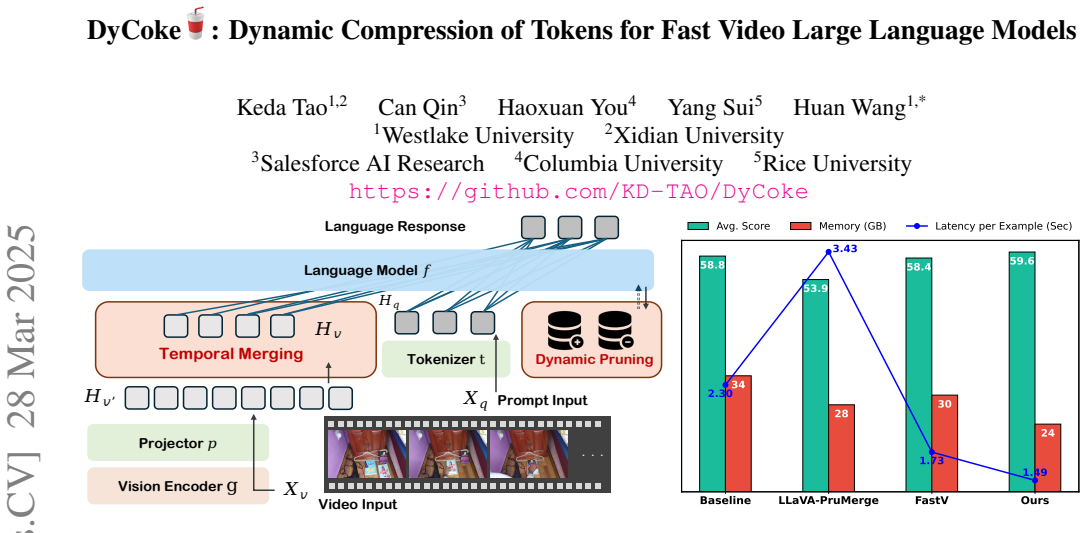
Two components carry the argument. The temporal token merging (TTM) module, applied during prefilling, groups frames into windows, merges similar tokens across even/odd frame groups using cosine similarity, and keeps full tokens in the first frame of each window, cutting visual tokens by 50-60%. The dynamic KV cache pruning module keeps a small active KV cache selected by attention scores at layer L, stores pruned tokens in a DP cache, and refreshes the active set only when the cosine similarity between successive attention distributions falls below a threshold, so tokens that become important can re-enter during later decoding steps.
What would settle it
Compute, on a sample of videos, the overlap between the top-p% visual token indices selected by layer 3 and those selected by each other layer at the same decoding step; if the average overlap is substantially below the p% retention rate (or below 50% relative overlap), the single-layer selector cannot be reliably representing all layers.
Extended reading notes
Core claim
The paper's key empirical observation is that attention in a video LLM shifts across decoding iterations: early frames may dominate at one step and later frames at another. On this basis it argues that one-shot pruning methods, which select important tokens once during prefilling, will drop tokens that later decoding steps need. DyCoke therefore maintains a small active KV cache and a separate DP cache; at each step it uses attention scores at one layer to keep the top-p% visual tokens, and it refreshes the active set only when the attention distribution changes enough. This dynamic selection is what lets the method cut tokens to roughly 15 per frame while preserving or improving output quality.
Load-bearing premise
The pruning choices are driven by attention scores from a single transformer layer (layer 3) at one decoding step, and the method assumes that layer's view of token importance matches every other layer's needs.
Editorial extensions
If this is right
- Video LLMs can run at 1.5x speed with 1.4x less memory at equal or better accuracy, without any fine-tuning or model modification.
- The same dynamic pruning mechanism could be applied to any long-context multimodal LLM where attention targets shift over time, not just video.
- Because compression removes redundant tokens, models can accept more video frames (e.g., 32 instead of 16) under a fixed compute budget, which improves performance on short and medium-length videos.
- The DP-cache design means pruned tokens are not destroyed, so mistakes in one pruning step are recoverable at the next refresh.
Reading between the lines
- The single-layer attention proxy (layer 3) could be replaced by a lightweight aggregator across layers, which might make the refresh trigger more reliable.
- The cosine-similarity refresh threshold is a free parameter; an adaptive threshold based on attention entropy could make the method more robust to videos with abrupt scene changes.
- Combining DyCoke with quantization or distillation could push video LLMs toward mobile deployment, since the method already cuts memory and compute independently of those techniques.
- The temporal merging stage operates uniformly across frames; making the merge ratio depend on local motion (e.g., merging more in static scenes) could prevent the minor information loss noted in the paper's discussion of rapid scene changes.
Signed reviews
Editorial analysis
A structured set of objections, weighed in public.
Referee Report
Summary. The manuscript proposes DyCoke, a training-free two-stage token compression method for video large language models. In the first stage (TTM), visually redundant tokens across neighboring frames are merged during prefilling on the basis of cosine similarity inside a sliding window. In the second stage, the KV cache is dynamically pruned during decoding: at a chosen transformer layer L, attention scores of the current token over visual tokens are computed, the top-p% indices are kept in the active KV cache, and the remaining tokens are stored in a DP cache; the active set is refreshed when the attention distribution changes substantially. The method is evaluated on LLaVA-OneVision 0.5B, 7B, and 72B across ActivityNet-QA, NextQA, PerceptionTest, VideoDetailCaption, VideoMME, and MVBench, reporting up to about 1.5x latency speedup and 1.4x memory reduction relative to full tokens. The authors position the method as improving accuracy while compressing tokens, and compare against FastV and LLaVA-PruMerge.
Significance. If the central claims hold, DyCoke is a practically useful plug-in: it requires no training, uses the frozen model's own attention signals, and the speedup and memory numbers are measured end-to-end on multiple model scales. The paper includes useful ablations (w/o DP, random pruning) that isolate the contribution of the dynamic mechanism, and the Fig. 2 observation that attention targets shift during decoding is well motivated. The main reservations are that the headline 'still improving the performance' is not consistent across the reported benchmarks, the DP refresh trigger is not specified, and the single-layer attention proxy is not validated against other layers; these issues matter because the accuracy-parity claim rests on them.
major comments (4)
- [Sec. 3.2, Eqs. (5)-(7)] The condition that triggers a KV/DP cache swap is described only as 'a low similarity' between successive attention distributions, with no numerical threshold or update schedule given anywhere in the paper. Since the DP mechanism is the central novelty and the paper claims that it preserves accuracy, this missing value prevents reproduction of the results in Tables 1-3 and 5 and leaves the regime where updates are too rare or too frequent unspecified. Please report the exact cosine-similarity threshold and how often the swap occurs in practice, and add a sensitivity analysis around the threshold.
- [Sec. 3.2, Eq. (5)] The importance index set I_p^(L) computed at layer L (default L=3) is used to prune the KV cache of every layer via Eq. (6), but the manuscript never checks whether attention at layer 3 is representative of other layers. Table 5 only compares aggregate scores for L=3 and L=10, not the overlap of the selected token sets. Please measure per-layer agreement between I_p^(3) and I_p^(l) (for example, Jaccard similarity of the selected index sets across decoding steps), or justify the choice of L with such data.
- [Abstract, Tables 1-3] The claim that DyCoke 'still improves the performance' is only true for selected configurations and benchmarks. For example, in Table 1 on LLaVA-OV-7B the K=0.3 setting loses on ActNet-QA (51.80 vs 51.93) and VideoDC (3.19 vs 3.30) relative to full tokens; in Table 2 the 7B MVBench average at K=0.7 is 57.5 vs 58.0 for full tokens; and in Table 5 increasing P to 0.9 drops VideoDC to 2.86 from the full-token 3.30. The abstract and introduction should be qualified to 'competitive or slightly better on several benchmarks, with large efficiency gains,' and the exact configurations used for the headline should be identified.
- [Sec. 4.1 and Table 5] The hyperparameters K, L, and P appear to be selected on the evaluation benchmarks themselves; no validation split or selection procedure is described. Given the sensitivity shown in Table 5 (for example, K=0.9, L=0, P=0.9 collapses ActivityNet accuracy to 40.21), the reported gains may reflect favorable tuning. Please clarify how these values were chosen and provide results for a fixed setting across all benchmarks, or perform selection on a small validation set.
minor comments (5)
- [Sec. 4.2, Video Description] The sentence 'As shown in Tab. 2' should refer to Table 1, since the VideoDC results appear in Table 1, not Table 2.
- [References [2] and [3]] References [2] and [3] are the same paper (Chen et al., arXiv:2403.06764); please merge them or cite distinct works.
- [Sec. 3.2, Eq. (7)] The formal update equations for the DP cache swap after the initial construction in Eq. (7) are missing; the prose describes re-adding tokens, but an exact update rule or pseudocode would improve reproducibility.
- [Notation throughout] The model names alternate between 'LLaVA-OV-0.5B' and 'LLaVA-OneVision-0.5B'; please standardize the notation.
- [Fig. 2 vs Sec. 3.2] Figure 2 reports attention averaged over all layers, while the method uses layer L only; the discrepancy should be explained because it bears on the single-layer proxy concern.
Circularity Check
No circularity: DyCoke's dynamic pruning uses the model's own attention scores as an input signal; no claim reduces to its fit or to a self-citation.
full rationale
The derivation chain is self-contained. Stage I (TTM) computes cosine similarity between tokens of adjacent frame groups and prunes/merges the most similar tokens; Stage II (DP) takes the model's own cross-attention scores at layer L, selects the top p% visual-token indices, retains those in the KV cache, and stores the rest in a DP cache for possible re-entry when the attention distribution changes. The accuracy claim is empirical, not derivational: there is no equation in which the predicted benchmark score appears as an input, and no fitted parameter is renamed as a prediction. The hyperparameters K, L, and P are swept and reported in ablation tables, which is post-hoc selection rather than circular reasoning. The only author-overlapping citation is xGen-MM-Vid [37], which includes co-author Can Qin; it appears in the related-work survey as an example of mapping video tokens to a compact set and is not load-bearing for any of DyCoke's claims. No uniqueness theorem is imported, and no ansatz is smuggled in through a self-citation. The unquantified refresh threshold and the single-layer attention proxy are reproducibility/robustness concerns, not circularity: they do not make the prediction equivalent to the input. Since no claim reduces by construction to its own inputs, the circularity score is 0.
Assumptions & free parameters
free parameters (5)
- K (TTM pruning rate) =
0.3 / 0.5 / 0.7, headline uses 0.7
- P (second-stage retention threshold) =
0.7 (0.9 in one ablation)
- L (attention evaluation layer) =
3 (10 tested)
- TTM sliding window length =
4 frames
- DP cache update similarity threshold =
not specified
assumptions (4)
- domain assumption Tokens at corresponding spatial positions in adjacent video frames with high cosine similarity carry redundant information and can be merged without loss.
- domain assumption Attention scores computed at a single transformer layer L and at one decoding step are a sufficient proxy for the importance of every visual KV entry across all layers and future steps.
- domain assumption The set of important visual tokens changes slowly across consecutive decoding iterations, so the KV cache only needs to be refreshed when the attention distribution changes substantially.
- domain assumption Low average attention score implies a token can be pruned without changing the next-token distribution.
invented entities (1)
-
Dynamic pruning cache (DP cache)
Cite this review
Pith. "Pith review of DyCoke: Dynamic Compression of Tokens for Fast Video Large Language Models." pith.science (2026). https://pith.science/paper/E3QNJ6T6
@misc{pith2026241115024,
  author       = {Pith},
  title        = {Pith review of: DyCoke: Dynamic Compression of Tokens for Fast Video Large Language Models},
  year         = {2026},
  howpublished = {\url{https://pith.science/paper/E3QNJ6T6}},
  note         = {Machine review of arXiv:2411.15024}
}
read the original abstract
Video large language models (VLLMs) have significantly advanced recently in processing complex video content, yet their inference efficiency remains constrained because of the high computational cost stemming from the thousands of visual tokens generated from the video inputs. We empirically observe that, unlike single image inputs, VLLMs typically attend visual tokens from different frames at different decoding iterations, making a one-shot pruning strategy prone to removing important tokens by mistake. Motivated by this, we present DyCoke, a training-free token compression method to optimize token representation and accelerate VLLMs. DyCoke incorporates a plug-and-play temporal compression module to minimize temporal redundancy by merging redundant tokens across frames, and applies dynamic KV cache reduction to prune spatially redundant tokens selectively. It ensures high-quality inference by dynamically retaining the critical tokens at each decoding step. Extensive experimental results demonstrate that DyCoke can outperform the prior SoTA counterparts, achieving 1.5X inference speedup, 1.4X memory reduction against the baseline VLLM, while still improving the performance, with no training.
Figures


Figures from the paper (4 more)


Forward citations
Cited by 7 Pith papers
-
CRAFT: Compression via Recursive Adaptive Fusion of Video Tokens for Vision-Language Models
CRAFT recursively merges video tokens with training-free similarity selection plus learnable gated fusion, retaining ~97% of average accuracy at 8x compression across six benchmarks.
-
AuroraLong: Bringing RNNs Back to Efficient Open-Ended Video Understanding
A 2B-parameter video-language model using an RWKV linear-RNN backbone and sorted token merging achieves competitive long-video QA accuracy with far lower memory cost than transformer-based models.
-
LLaVA-Scissor: Token Compression with Semantic Connected Components for Video LLMs
A training-free token compression method using semantic connected components in space and time keeps video understanding accuracy high even when retaining only 5-10% of visual tokens.
-
TimeChat-Online: 80% Visual Tokens are Naturally Redundant in Streaming Videos
A streaming video assistant drops temporally redundant tokens (over 80%) with minimal accuracy loss and uses the drop-ratio curve to trigger proactive responses at scene changes.
-
Video-MMLU: A Massive Multi-Discipline Lecture Understanding Benchmark
Video-MMLU: a 1,065-video lecture benchmark where most AI video models score 10-50%, but text-only models answer 40% of quiz questions without video.
-
AdaTP: Attention-Debiased Token Pruning for Video Large Language Models
AdaTP prunes visual tokens in video LLMs by debiasing attention scores, reducing FLOPs to about a quarter of the vanilla model at matching benchmark accuracy.
-
DynTok: Dynamic Compression of Visual Tokens for Efficient and Effective Video Understanding
DynTok dynamically merges similar adjacent visual tokens into groups, reducing video token counts to 44.4% with comparable or better video understanding accuracy.
Reference graph
Works this paper leans on
-
[1]
Token merging: Your vit but faster
Daniel Bolya, Cheng-Yang Fu, Xiaoliang Dai, Peizhao Zhang, Christoph Feichtenhofer, and Judy Hoffman. Token merging: Your vit but faster. arXiv preprint arXiv:2210.09461, 2022. 3
arXiv 2022
-
[3]
Liang Chen, Haozhe Zhao, Tianyu Liu, Shuai Bai, Jun- yang Lin, Chang Zhou, and Baobao Chang. An image is worth 1/2 tokens after layer 2: Plug-and-play inference ac- celeration for large vision-language models. arXiv preprint arXiv:2403.06764, 2024. 1, 2, 3, 5
arXiv 2024
-
[4]
Videollama 2: Advancing spatial- temporal modeling and audio understanding in video-llms
Zesen Cheng, Sicong Leng, Hang Zhang, Yifei Xin, Xin Li, Guanzheng Chen, Yongxin Zhu, Wenqi Zhang, Ziyang Luo, Deli Zhao, et al. Videollama 2: Advancing spatial- temporal modeling and audio understanding in video-llms. arXiv preprint arXiv:2406.07476, 2024. 1, 2
arXiv 2024
-
[5]
Mobilevlm: A fast, reproducible and strong vision language assistant for mobile devices
Xiangxiang Chu, Limeng Qiao, Xinyang Lin, Shuang Xu, Yang Yang, Yiming Hu, Fei Wei, Xinyu Zhang, Bo Zhang, Xiaolin Wei, et al. Mobilevlm: A fast, reproducible and strong vision language assistant for mobile devices. arXiv preprint arXiv:2312.16886, 2023. 1, 3
arXiv 2023
-
[6]
Mobilevlm v2: Faster and stronger baseline for vision language model
Xiangxiang Chu, Limeng Qiao, Xinyu Zhang, Shuang Xu, Fei Wei, Yang Yang, Xiaofei Sun, Yiming Hu, Xinyang Lin, Bo Zhang, et al. Mobilevlm v2: Faster and stronger baseline for vision language model. arXiv preprint arXiv:2402.03766,
-
[7]
Tim Dettmers, Mike Lewis, Younes Belkada, and Luke Zettle- moyer. Gpt3. int8 (): 8-bit matrix multiplication for trans- formers at scale. Advances in Neural Information Processing Systems, 35:30318–30332, 2022. 3
work page 2022
-
[8]
Video-mme: The first-ever comprehensive evaluation benchmark of multi-modal llms in video analysis
Chaoyou Fu, Yuhan Dai, Yondong Luo, Lei Li, Shuhuai Ren, Renrui Zhang, Zihan Wang, Chenyu Zhou, Yunhang Shen, Mengdan Zhang, et al. Video-mme: The first-ever comprehensive evaluation benchmark of multi-modal llms in video analysis. arXiv preprint arXiv:2405.21075, 2024. 5, 6
arXiv 2024
-
[9]
Lazyllm: Dynamic token pruning for efficient long context llm inference
Qichen Fu, Minsik Cho, Thomas Merth, Sachin Mehta, Mo- hammad Rastegari, and Mahyar Najibi. Lazyllm: Dynamic token pruning for efficient long context llm inference. arXiv preprint arXiv:2407.14057, 2024. 3
arXiv 2024
Show all 56 references
-
[10]
Mini-internvl: a flexible-transfer pocket multi-modal model with 5% parameters and 90% perfor- mance
Zhangwei Gao, Zhe Chen, Erfei Cui, Yiming Ren, Weiyun Wang, Jinguo Zhu, Hao Tian, Shenglong Ye, Junjun He, Xizhou Zhu, et al. Mini-internvl: a flexible-transfer pocket multi-modal model with 5% parameters and 90% perfor- mance. Visual Intelligence, 2(1):1–17, 2024. 3
2024
-
[11]
Masked autoencoders are scalable vision learners
Kaiming He, Xinlei Chen, Saining Xie, Yanghao Li, Piotr Dollár, and Ross Girshick. Masked autoencoders are scalable vision learners. In CVPR, 2022. 2
2022
-
[12]
Lita: Language instructed temporal-localization assistant
De-An Huang, Shijia Liao, Subhashree Radhakrishnan, Hongxu Yin, Pavlo Molchanov, Zhiding Yu, and Jan Kautz. Lita: Language instructed temporal-localization assistant. In ECCV, 2024. 3
2024
-
[13]
An empirical study of llama3 quan- tization: From llms to mllms
Wei Huang, Xingyu Zheng, Xudong Ma, Haotong Qin, Chengtao Lv, Hong Chen, Jie Luo, Xiaojuan Qi, Xianglong Liu, and Michele Magno. An empirical study of llama3 quan- tization: From llms to mllms. Visual Intelligence, 2(1):36,
-
[14]
Phi-2: The surprising power of small language models
Mojan Javaheripi, Sébastien Bubeck, Marah Abdin, Jy- oti Aneja, Sebastien Bubeck, Caio César Teodoro Mendes, Weizhu Chen, Allie Del Giorno, Ronen Eldan, Sivakanth Gopi, et al. Phi-2: The surprising power of small language models. Microsoft Research Blog, 1:3, 2023. 3
2023
-
[15]
Effec- tiveness assessment of recent large vision-language models
Yao Jiang, Xinyu Yan, Ge-Peng Ji, Keren Fu, Meijun Sun, Huan Xiong, Deng-Ping Fan, and Fahad Shahbaz Khan. Effec- tiveness assessment of recent large vision-language models. Visual Intelligence, 2(1):17, 2024. 3
2024
-
[16]
Chat-univi: Unified visual representation em- powers large language models with image and video under- standing
Peng Jin, Ryuichi Takanobu, Wancai Zhang, Xiaochun Cao, and Li Yuan. Chat-univi: Unified visual representation em- powers large language models with image and video under- standing. In CVPR, 2024. 2, 3
2024
-
[17]
Lmms-eval: Accelerating the development of large multimodal models, 2024
Bo Li, Peiyuan Zhang, Kaichen Zhang, Fanyi Pu, Xinrun Du, Yuhao Dong, Haotian Liu, Yuanhan Zhang, Ge Zhang, Chunyuan Li, and Ziwei Liu. Lmms-eval: Accelerating the development of large multimodal models, 2024. 6
2024
-
[18]
Llava-onevision: Easy visual task transfer
Bo Li, Yuanhan Zhang, Dong Guo, Renrui Zhang, Feng Li, Hao Zhang, Kaichen Zhang, Yanwei Li, Ziwei Liu, and Chun- yuan Li. Llava-onevision: Easy visual task transfer. arXiv preprint arXiv:2408.03326, 2024. 1, 2, 3, 11
2024 arXiv
-
[19]
Llava-next-interleave: Tackling multi-image, video, and 3d in large multimodal models
Feng Li, Renrui Zhang, Hao Zhang, Yuanhan Zhang, Bo Li, Wei Li, Zejun Ma, and Chunyuan Li. Llava-next-interleave: Tackling multi-image, video, and 3d in large multimodal models. arXiv preprint arXiv:2407.07895, 2024. 2, 3
2024 arXiv
-
[20]
Blip- 2: Bootstrapping language-image pre-training with frozen image encoders and large language models
Junnan Li, Dongxu Li, Silvio Savarese, and Steven Hoi. Blip- 2: Bootstrapping language-image pre-training with frozen image encoders and large language models. In ICML, 2023. 3
2023
-
[21]
Tp2o: Creative text pair-to-object generation using balance swap-sampling
Jun Li, Zedong Zhang, and Jian Yang. Tp2o: Creative text pair-to-object generation using balance swap-sampling. In ECCV, 2024. 2
2024
-
[22]
Videochat: Chat-centric video understanding
KunChang Li, Yinan He, Yi Wang, Yizhuo Li, Wenhai Wang, Ping Luo, Yali Wang, Limin Wang, and Yu Qiao. Videochat: Chat-centric video understanding. arXiv preprint arXiv:2305.06355, 2023. 1, 3
2023 arXiv
-
[23]
Mvbench: A comprehensive multi-modal video understand- ing benchmark
Kunchang Li, Yali Wang, Yinan He, Yizhuo Li, Yi Wang, Yi Liu, Zun Wang, Jilan Xu, Guo Chen, Ping Luo, et al. Mvbench: A comprehensive multi-modal video understand- ing benchmark. In CVPR, 2024. 1, 5, 6, 7, 11
2024
-
[24]
Llama-vid: An image is worth 2 tokens in large language models
Yanwei Li, Chengyao Wang, and Jiaya Jia. Llama-vid: An image is worth 2 tokens in large language models. In ECCV. Springer, 2024. 3
2024
-
[25]
Video-llava: Learning united visual rep- resentation by alignment before projection
Bin Lin, Yang Ye, Bin Zhu, Jiaxi Cui, Munan Ning, Peng Jin, and Li Yuan. Video-llava: Learning united visual rep- resentation by alignment before projection. arXiv preprint arXiv:2311.10122, 2023. 1, 2
2023 arXiv
-
[26]
Moe-llava: Mixture of experts for large vision-language models
Bin Lin, Zhenyu Tang, Yang Ye, Jiaxi Cui, Bin Zhu, Peng Jin, Jinfa Huang, Junwu Zhang, Yatian Pang, Munan Ning, et al. Moe-llava: Mixture of experts for large vision-language models. arXiv preprint arXiv:2401.15947, 2024. 3
2024 arXiv
-
[27]
Vila: On pre-training for visual language models
Ji Lin, Hongxu Yin, Wei Ping, Pavlo Molchanov, Mohammad Shoeybi, and Song Han. Vila: On pre-training for visual language models. In CVPR, 2024. 3
2024
-
[28]
Video- teller: Enhancing cross-modal generation with fusion and decoupling
Haogeng Liu, Qihang Fan, Tingkai Liu, Linjie Yang, Yunzhe Tao, Huaibo Huang, Ran He, and Hongxia Yang. Video- teller: Enhancing cross-modal generation with fusion and decoupling. arXiv preprint arXiv:2310.04991, 2023. 2
2023 arXiv
-
[29]
Improved baselines with visual instruction tuning
Haotian Liu, Chunyuan Li, Yuheng Li, and Yong Jae Lee. Improved baselines with visual instruction tuning. In CVPR,
-
[30]
Visual instruction tuning
Haotian Liu, Chunyuan Li, Qingyang Wu, and Yong Jae Lee. Visual instruction tuning. NeurIPS, 2024. 3
2024
-
[31]
Video detail caption, 2024
LMMs-Lab. Video detail caption, 2024. Accessed: 2024-11. 5, 6, 7
2024
-
[32]
Valley: Video assistant with large language model enhanced ability
Ruipu Luo, Ziwang Zhao, Min Yang, Junwei Dong, Da Li, Pengcheng Lu, Tao Wang, Linmei Hu, Minghui Qiu, and Zhongyu Wei. Valley: Video assistant with large language model enhanced ability. arXiv preprint arXiv:2306.07207,
-
[33]
Gpt-4 model, 2023
OpenAI. Gpt-4 model, 2023. Accessed: 2023-11-08. 5
2023
-
[34]
Per- ception test: A diagnostic benchmark for multimodal video models
Viorica Patraucean, Lucas Smaira, Ankush Gupta, Adria Re- casens, Larisa Markeeva, Dylan Banarse, Skanda Koppula, Mateusz Malinowski, Yi Yang, Carl Doersch, et al. Per- ception test: A diagnostic benchmark for multimodal video models. Advances in Neural Information Processing ...
2024
-
[35]
Learning transferable visual models from natural language supervision
Alec Radford, Jong Wook Kim, Chris Hallacy, Aditya Ramesh, Gabriel Goh, Sandhini Agarwal, Girish Sastry, Amanda Askell, Pamela Mishkin, Jack Clark, et al. Learning transferable visual models from natural language supervision. In ICML, 2021. 2, 5
2021
-
[36]
Testa: Temporal-spatial token aggregation for long-form video-language understanding
Shuhuai Ren, Sishuo Chen, Shicheng Li, Xu Sun, and Lu Hou. Testa: Temporal-spatial token aggregation for long-form video-language understanding. arXiv preprint arXiv:2310.19060, 2023. 2, 3
2023 arXiv
-
[37]
xgen-mm-vid (blip-3-video): You only need 32 tokens to represent a video even in vlms
Michael S Ryoo, Honglu Zhou, Shrikant Kendre, Can Qin, Le Xue, Manli Shu, Silvio Savarese, Ran Xu, Caiming Xiong, and Juan Carlos Niebles. xgen-mm-vid (blip-3-video): You only need 32 tokens to represent a video even in vlms. arXiv preprint arXiv:2410.16267, 2024. 3
-
[38]
Pb-llm: Partially binarized large language models
Yuzhang Shang, Zhihang Yuan, Qiang Wu, and Zhen Dong. Pb-llm: Partially binarized large language models. arXiv preprint arXiv:2310.00034, 2023. 3
2023 arXiv
-
[39]
Llava-prumerge: Adaptive token reduction for efficient large multimodal models
Yuzhang Shang, Mu Cai, Bingxin Xu, Yong Jae Lee, and Yan Yan. Llava-prumerge: Adaptive token reduction for efficient large multimodal models. arXiv preprint arXiv:2403.15388,
-
[40]
Tempme: Video temporal token merging for efficient text-video retrieval
Leqi Shen, Tianxiang Hao, Sicheng Zhao, Yifeng Zhang, Pengzhang Liu, Yongjun Bao, and Guiguang Ding. Tempme: Video temporal token merging for efficient text-video retrieval. arXiv preprint arXiv:2409.01156, 2024. 3
2024 arXiv
-
[41]
Video- mae: Masked autoencoders are data-efficient learners for self-supervised video pre-training
Zhan Tong, Yibing Song, Jue Wang, and Limin Wang. Video- mae: Masked autoencoders are data-efficient learners for self-supervised video pre-training. Advances in neural infor- mation processing systems, 35:10078–10093, 2022. 2
2022
-
[42]
Look-m: Look- once optimization in kv cache for efficient multimodal long- context inference
Zhongwei Wan, Ziang Wu, Che Liu, Jinfa Huang, Zhihong Zhu, Peng Jin, Longyue Wang, and Li Yuan. Look-m: Look- once optimization in kv cache for efficient multimodal long- context inference. arXiv preprint arXiv:2406.18139, 2024. 3
2024 arXiv
-
[43]
Tarsier: Recipes for training and evaluating large video description models
Jiawei Wang, Liping Yuan, and Yuchen Zhang. Tarsier: Recipes for training and evaluating large video description models. arXiv preprint arXiv:2407.00634, 2024. 1, 2, 3
2024 arXiv
-
[44]
Small language model meets with reinforced vision vocabu- lary
Haoran Wei, Lingyu Kong, Jinyue Chen, Liang Zhao, Zheng Ge, En Yu, Jianjian Sun, Chunrui Han, and Xiangyu Zhang. Small language model meets with reinforced vision vocabu- lary. arXiv preprint arXiv:2401.12503, 2024. 3
2024 arXiv
-
[45]
Mamballie: Implicit retinex-aware low light enhancement with global-then-local state space
Jiangwei Weng, Zhiqiang Yan, Ying Tai, Jianjun Qian, Jian Yang, and Jun Li. Mamballie: Implicit retinex-aware low light enhancement with global-then-local state space. In NeurIPS,
-
[46]
Next-qa: Next phase of question-answering to explaining temporal actions
Junbin Xiao, Xindi Shang, Angela Yao, and Tat-Seng Chua. Next-qa: Next phase of question-answering to explaining temporal actions. In CVPR, 2021. 5
2021
-
[47]
Robustmq: benchmarking robustness of quantized models
Yisong Xiao, Aishan Liu, Tianyuan Zhang, Haotong Qin, Jinyang Guo, and Xianglong Liu. Robustmq: benchmarking robustness of quantized models. Visual Intelligence, 1(1):30,
-
[48]
Novel object synthesis via adaptive text-image harmony
Zeren Xiong, Zedong Zhang, Zikun Chen, Shuo Chen, Xiang Li, Gan Sun, Jian Yang, and Jun Li. Novel object synthesis via adaptive text-image harmony. In NeurIPS, 2024. 2
2024
-
[49]
Pllava: Parameter-free llava extension from images to videos for video dense captioning
Lin Xu, Yilin Zhao, Daquan Zhou, Zhijie Lin, See Kiong Ng, and Jiashi Feng. Pllava: Parameter-free llava extension from images to videos for video dense captioning. arXiv preprint arXiv:2404.16994, 2024. 1
2024 arXiv
-
[50]
Activitynet-qa: A dataset for understanding complex web videos via question answering
Zhou Yu, Dejing Xu, Jun Yu, Ting Yu, Zhou Zhao, Yueting Zhuang, and Dacheng Tao. Activitynet-qa: A dataset for understanding complex web videos via question answering. In AAAI, 2019. 5, 6
2019
-
[51]
Tinygpt-v: Efficient multimodal large language model via small backbones
Zhengqing Yuan, Zhaoxu Li, Weiran Huang, Yanfang Ye, and Lichao Sun. Tinygpt-v: Efficient multimodal large language model via small backbones. arXiv preprint arXiv:2312.16862,
-
[52]
Video-llama: An instruction-tuned audio-visual language model for video un- derstanding
Hang Zhang, Xin Li, and Lidong Bing. Video-llama: An instruction-tuned audio-visual language model for video un- derstanding. arXiv preprint arXiv:2306.02858, 2023. 1
2023 arXiv
-
[53]
Lmms- eval: Reality check on the evaluation of large multimodal models, 2024
Kaichen Zhang, Bo Li, Peiyuan Zhang, Fanyi Pu, Joshua Adrian Cahyono, Kairui Hu, Shuai Liu, Yuanhan Zhang, Jingkang Yang, Chunyuan Li, and Ziwei Liu. Lmms- eval: Reality check on the evaluation of large multimodal models, 2024. 6
2024
-
[54]
Tinyllava: A framework of small-scale large multimodal models
Baichuan Zhou, Ying Hu, Xi Weng, Junlong Jia, Jie Luo, Xien Liu, Ji Wu, and Lei Huang. Tinyllava: A framework of small-scale large multimodal models. arXiv preprint arXiv:2402.14289, 2024. 1, 3
2024 arXiv
-
[55]
Minigpt-4: Enhancing vision-language understanding with advanced large language models
Deyao Zhu, Jun Chen, Xiaoqian Shen, Xiang Li, and Mo- hamed Elhoseiny. Minigpt-4: Enhancing vision-language understanding with advanced large language models. arXiv preprint arXiv:2304.10592, 2023. 3
2023 arXiv
-
[56]
Llava-phi: Efficient multi-modal assistant with small language model
Yichen Zhu, Minjie Zhu, Ning Liu, Zhiyuan Xu, and Yaxin Peng. Llava-phi: Efficient multi-modal assistant with small language model. In Proceedings of the 1st International Workshop on Efficient Multimedia Computing under Limited, pages 18–22, 2024. 3
2024
-
[57]
counterfactual reasoning
Jiedong Zhuang, Lu Lu, Ming Dai, Rui Hu, Jian Chen, Qiang Liu, and Haoji Hu. St 3: Accelerating multimodal large lan- guage model by spatial-temporal visual token trimming. In AAAI, 2025. 3 DyCoke : Dynamic Compression of Tokens for Fast Video Large Language Models Supplementa...
2025
Reviewed August 12, 2026 · model on record in the stance chip above.
Discussion (0). Continue with ORCID to comment.