REVIEW 3 major objections 6 minor 6 cited by
Learning Dynamic Weight Adjustment for Spatial-Temporal Trajectory Planning in Crowd Navigation
T0 review · 3 major / 6 minor · reviewed 2026-08-12 · deepseek-v4-flash
Pith's one-line read This paper claims that a reinforcement-learned policy that adjusts the five objective weights of a spatial-temporal trajectory planner online reduces active collisions and sustains high mission completion in dense crowds, including a 300…
desk verdict A sound extension of learned planner-weight adjustment to spatial-temporal trajectory optimization, but the fixed-weight baseline is too thin to support the headline safety claim. read the letter →
The pith
A machine-rendered reading of the paper's core claim, the machinery that carries it, and where it could break.
The reading
What carries the argument
The load-bearing object is the weighted spatial-temporal trajectory optimization paired with a policy network that selects its weights. The planner represents the robot trajectory as fifth-order polynomial pieces, treats jerk as the control input, and minimizes control effort plus weighted penalties on duration, velocity and acceleration feasibility, yaw rate, static obstacle clearance, and pedestrian clearance. The policy is a CNN and MLP actor trained with PPO on observations consisting of two 50x50 grid maps, one for static obstacles plus the previous plan and one for pedestrian positions and constant-velocity predictions, together with the robot's speed and heading. The mechanism works because the weight vector is low-dimensional but expressive: at 1 Hz it rescales the planner's priorities without altering the optimization structure.
What would settle it
Take the trained policy into a crowded scene whose pedestrians do not follow the social-force or constant-velocity assumptions used in training, for example groups that suddenly cross or stop, and count active collisions at 50 Hz under contact checking; if the adaptive weights do not produce fewer active collisions than the fixed balanced set ST(all=1), the central claim of transferable adaptive safety is not supported.
Extended reading notes
Core claim
The paper's central claim is that the weights in a spatial-temporal trajectory optimization should be treated as actions of a control policy rather than hand-tuned constants. The planner minimizes a cost combining control effort, trajectory duration, feasibility violations, yaw-rate excess, and proximity to static and dynamic obstacles, weighted by five factors. A PPO-trained actor outputs these five weights each second from a 50x50 grid map encoding the static environment, the previous plan, and current and predicted pedestrian positions, plus robot speed and heading. The paper reports that this dynamic adjustment outperforms six fixed-weight configurations, a dynamically weighted DWA planner, and DRL-VO in mission completeness and collision counts across the three test scenes, and that the policy visibly raises the human-avoidance weight in human-dense areas and the static-avoidance weight near obstacles. The real corridor experiment is offered as feasibility evidence that the trained policy transfers to hardware.
Load-bearing premise
The policy's reported safety and completeness gains transfer from the single simulated training corridor with 17 social-force pedestrians to the three test scenes and the real 300 m corridor; if that transfer gap is large, the gains are artifacts of the training distribution.
Editorial extensions
If this is right
- A single policy, not per-scene manual tuning, can keep a trajectory optimizer safe across scenes with very different obstacle and crowd densities.
- The learned relative scale of weights is itself a finding: static and dynamic clearance weights are kept small while time and feasibility weights dominate, contradicting the intuition that avoidance terms should be largest.
- The policy can be queried at 1 Hz while the planner replans on newer sensor data, so the framework fits onboard computers with modest inference budgets.
- Failures of single-objective weight settings, such as aggressive motion, getting stuck, and sharp yaw changes, are avoided by context-dependent adjustment.
Reading between the lines
- The same weight-prediction recipe could be applied to other optimization-based planners beyond spatial-temporal trajectory optimization; the paper establishes the recipe but tests only one planner family.
- Robustness to imperfect pedestrian tracking is not tested: training assumes clean positions and velocities from the simulator, so noisy real-world detections could degrade the predicted weights; a natural extension is training with observation noise.
- Because the reward treats slow contacts below 0.4 m/s as minor, the policy is optimized against a safety metric that ignores low-speed contact; deployments with stricter safety standards would need a different reward threshold.
Signed reviews
Editorial analysis
A structured set of objections, weighed in public.
Referee Report
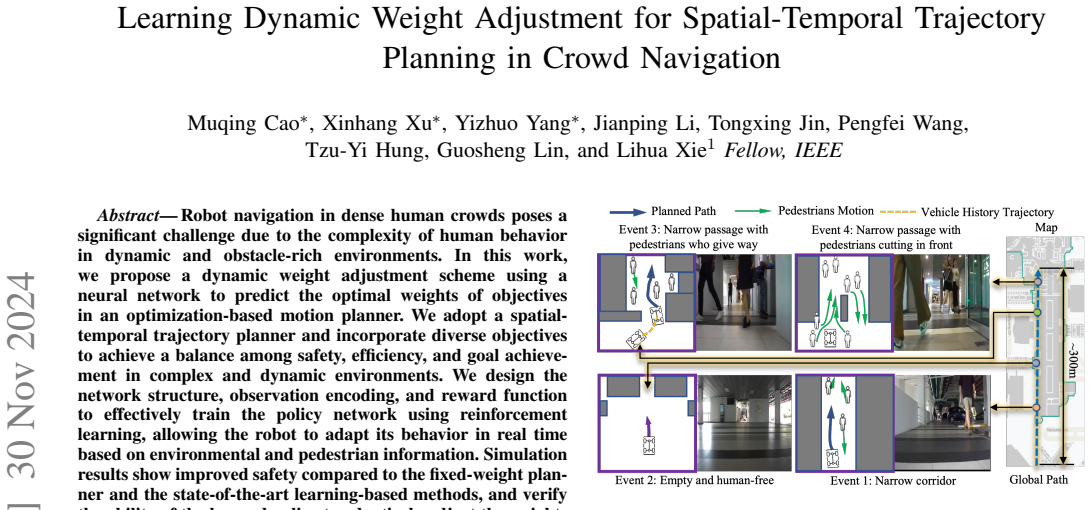
Summary. The paper proposes a reinforcement-learning-based policy that dynamically outputs the five weights of a spatial-temporal trajectory optimization planner for crowd navigation. The policy receives local occupancy maps, predicted pedestrian motion, and the robot's kinematic state, and it is trained with PPO in a single simulated indoor corridor with 17 social-force pedestrians. The authors evaluate the method in three simulated scenes against a fixed-weight version of the same planner, a learned dynamic DWA baseline (DADWA), and DRL-VO, reporting mission completeness, time, distance, collision runs, and total collision counts over 100 runs per condition. A qualitative real-world deployment in a 300 m corridor with four illustrative events is also described. The central claim is that learned dynamic weight adjustment yields lower active collision counts and high completeness compared to fixed-weight planning and the selected learning baselines.
Significance. If the claims hold, the paper makes a useful empirical contribution: it combines a modern spatial-temporal optimizer with a learned weight-selection policy, and it includes a real-world demonstration, which is relatively rare in this literature. The formulation is clearly described, the observation encoding is reasonable, and the comparison to DADWA and DRL-VO provides some context. However, the paper does not ship code or machine-checked artifacts, and the evidence for its central claim is weakened by the fixed-weight baseline construction, the absence of statistical error bars, and the narrow training distribution. The real-world experiment is only qualitative. These issues make the contribution promising but not yet fully established.
major comments (3)
- [Section V.A, Table I] The fixed-weight baseline is not a fair representation of fixed-weight planning. Only six hand-picked weight settings are evaluated: all weights equal to 1, and five settings where exactly one weight is set to 5. The paper's own introduction states that choosing appropriate weights 'often requires multiple trials' (Section I), yet no search, optimization, or per-scene tuning of the fixed weights is reported. The claimed advantage over 'fixed-weight planning' as a general class is therefore not established; a reasonably tuned fixed weight vector might achieve comparable collision counts and completeness. Please add a stronger baseline, such as grid search or Bayesian optimization over the weight space, and report the best fixed-weight performance per scene, or at least a set of random weight configurations with statistics.
- [Section V.A, evaluation protocol] The results in Table I are reported as single-point estimates over 100 runs, but no standard deviations, confidence intervals, or number of random seeds are provided. Collision counts and completeness rates are stochastic; for example, the completeness difference between the proposed method (98%) and ST(all=1) (93%) could be within noise. The total collision count advantage (81 vs 328 in Scene 1) appears large, but without variance estimates it is impossible to assess whether the differences are systematic. Please report results across multiple seeds (e.g., train the policy with 3-5 seeds and evaluate each) and provide error bars or confidence intervals for all metrics.
- [Section IV, training setup; Section VI, conclusion] The policy is trained in a single simulated corridor layout with 17 pedestrians using the social force model, and the paper's own conclusion admits that 'more diverse simulation environments' are needed to validate the consistency of the learned strategies. Because the central claim is that the policy generalizes across the three test scenes (which differ in obstacle density, pedestrian count, and layout), the paper should provide more evidence of transfer. At minimum, report an ablation with a second training environment or a quantitative analysis of when the learned weights change in the test scenes, beyond the three qualitative examples in Figure 6. Without such evidence, the cross-scene results may reflect the specific training distribution rather than a general adaptive strategy.
minor comments (6)
- [Section V.B] The real-world experiment is described only qualitatively through four events. Please report quantitative metrics such as mission completeness, number of collision events (including low-speed contacts), total distance, average speed, and the number of pedestrians encountered. This would make the feasibility claim more substantial.
- [Section III.C] The reward function and the evaluation metrics are closely aligned: the reward penalizes time and collisions, and the evaluation reports collision counts and completion time. This is not a fatal issue because comparisons to DADWA and DRL-VO remain meaningful, but the paper should explicitly acknowledge that part of the observed improvement is a check that the RL training optimized what it was asked to optimize, and it should state what additional behaviors (e.g., social comfort) are not captured by the metrics.
- [Abstract and Section V.A] The term 'state-of-the-art learning-based methods' is used, but the comparison set consists of only two methods (DADWA and DRL-VO), and DADWA is a re-implementation by the authors. Please soften this claim or add more recent baselines from the socially aware navigation literature.
- [Table I and Figure 6] The weight values in Figure 6 are presented qualitatively; please include a scale or a table of the exact weight vectors for the shown situations. Also, in the video link in the abstract, there is a space in the URL ('nSCbNaaF VM'); please correct it.
- [Section II] Equation (5) uses 'do,th - do(t)' for both static and dynamic obstacles, but the notation is slightly ambiguous because the subscript 'o' is reused. Please clarify the definitions of ds(t), dh(t), and the corresponding thresholds before the equation.
- [Section V.A] The definition of 'active collision' (contact while robot speed is above vsafe = 0.4 m/s) is reasonable, but the paper should also report the number of all contacts, or at least state that low-speed contacts were negligible or are excluded because they are not dangerous. Otherwise the reader cannot judge whether the safety improvement is partly an artifact of the threshold.
Circularity Check
No significant circularity: the dynamic-weight policy is validated against external baselines in held-out scenes; reward/evaluation overlap is objective alignment, not a reduction.
full rationale
Walking the derivation chain: Eq. (6) defines the trajectory optimization with weights w_t; Section III trains a policy π_φ to output those weights by maximizing expected cumulative reward (Eq. 8) with reward components in Eqs. (9)-(12) penalizing time, collisions, and rewarding goal arrival. Section V evaluates the resulting policy in three held-out simulated scenes and a real corridor, comparing against fixed-weight ST baselines, DADWA, and DRL-VO. The evaluation metrics (completeness, time, collided runs, TCC) overlap with the reward terms, but this is an alignment of objective and metric, not a circular derivation: the policy is not fit to the test scenes, the baselines are external, and the fixed-weight comparisons are explicitly enumerated rather than inferred. The fixed-weight baseline uses only six hand-picked settings (all weights = 1, and five settings with one weight = 5), which is a legitimate concern about baseline strength/experimental design, but it is not a circularity: the paper does not claim these are optimized fixed weights. There is no self-citation chain, no imported uniqueness theorem, and no ansatz smuggled via citation; the planner core is cited to external work [21] and the RL method to PPO [23]. The conclusion's statement that more diverse environments are needed to validate consistency is an honest limitation, not a circular step. Hence score 0.
Assumptions & free parameters
free parameters (4)
- Planner soft-limit thresholds (v_th, a_th, theta_dot_th, d_s_th, d_h_th) =
1.0 m/s, 1.0 m/s^2, 0.2 rad/s, 1.0 m, 1.0 m; real-world v_th=0.6 m/s
- Reward constants (r_time, r_collision, r_goal, early termination penalty) =
-10, -150/-50, 50, -1500
- Collision severity threshold v_safe =
0.4 m/s
- PPO hyperparameters and exploration schedule =
gamma=0.99, learning rates 1e-3/3e-4, std 0.6 decay 0.05 per 200 episodes to 0.1
assumptions (4)
- domain assumption Pedestrian motion in training and test simulations follows the social force model.
- domain assumption Pedestrian future motion is predicted by constant velocity for the observation map and planner costs.
- standard math The car-like robot is differentially flat, so trajectories can be represented as polynomial curves with jerk as control input.
- standard math PPO training converges to a performant policy.
Cite this review
Pith. "Pith review of Learning Dynamic Weight Adjustment for Spatial-Temporal Trajectory Planning in Crowd Navigation." pith.science (2026). https://pith.science/paper/E42RMH7U
@misc{pith2026241200555,
  author       = {Pith},
  title        = {Pith review of: Learning Dynamic Weight Adjustment for Spatial-Temporal Trajectory Planning in Crowd Navigation},
  year         = {2026},
  howpublished = {\url{https://pith.science/paper/E42RMH7U}},
  note         = {Machine review of arXiv:2412.00555}
}
read the original abstract
Robot navigation in dense human crowds poses a significant challenge due to the complexity of human behavior in dynamic and obstacle-rich environments. In this work, we propose a dynamic weight adjustment scheme using a neural network to predict the optimal weights of objectives in an optimization-based motion planner. We adopt a spatial-temporal trajectory planner and incorporate diverse objectives to achieve a balance among safety, efficiency, and goal achievement in complex and dynamic environments. We design the network structure, observation encoding, and reward function to effectively train the policy network using reinforcement learning, allowing the robot to adapt its behavior in real time based on environmental and pedestrian information. Simulation results show improved safety compared to the fixed-weight planner and the state-of-the-art learning-based methods, and verify the ability of the learned policy to adaptively adjust the weights based on the observed situations. The approach's feasibility is demonstrated in a navigation task using an autonomous delivery robot across a crowded corridor over a 300 m distance.
Figures


Figures from the paper (3 more)


Forward citations
Cited by 6 Pith papers
-
AEOS: Active Environment-aware Optimal Scanning Control for UAV LiDAR-Inertial Odometry in Complex Scenes
AEOS actively rotates a UAV's LiDAR using a hybrid MPC and learned cost map, cutting trajectory error versus fixed-speed and optimization-only baselines in simulations and two real scenes.
-
UA-MPC: Uncertainty-Aware Model Predictive Control for Motorized LiDAR Odometry
Uncertainty-aware model predictive control of motor speed reduces LiDAR odometry error by over 60% in simulation while keeping scanning completeness roughly unchanged.
-
ARMOR: Adaptive Meshing with Reinforcement Optimization for Real-time 3D Monitoring in Unexposed Scenes
ARMOR couples scanblock-based spatio-temporal normal smoothing with a PPO agent that selects SDF sampling and meshing parameters, reporting improved underground mesh quality over PIN-SLAM.
-
AToM: Adaptive Theory-of-Mind-Based Human Motion Prediction in Long-Term Human-Robot Interactions
An adaptive theory-of-mind predictor that fits a game-theoretic human model with an Unscented Kalman Filter can track how human behavior changes across repeated human-robot interactions, improving prediction and downs...
-
Tire Wear Aware Trajectory Tracking Control for Multi-axle Swerve-drive Autonomous Mobile Robots
A simulation study showing that adding a model-based tire-wear objective to MPC lowers that same model's wear metric by 19.19% and 65.20% for swerve-drive AGVs, without hardware validation.
-
SHIFT Planner: Speedy Hybrid Iterative Field and Segmented Trajectory Optimization with IKD-tree for Uniform Lightweight Coverage
SHIFT combines semantic-aware speed control with incremental local replanning to make robot coverage more uniform in dynamic 3D environments.
Reference graph
Works this paper leans on
-
[1]
A survey on socially aware robot navigation: Taxonomy and future challenges,
P. T. Singamaneni, P. Bachiller-Burgos, L. J. Manso, A. Garrell, A. Sanfeliu, A. Spalanzani, and R. Alami, “A survey on socially aware robot navigation: Taxonomy and future challenges,” The International Journal of Robotics Research , vol. 0, no. 0, p. 02783649241230562, 0
-
[2]
Social force model for pedestrian dynam- ics,
D. Helbing and P. Moln ´ar, “Social force model for pedestrian dynam- ics,” Phys. Rev. E , vol. 51, pp. 4282–4286, May 1995
work page 1995
-
[3]
Tra- jectron++: Dynamically-feasible trajectory forecasting with heteroge- neous data,
T. Salzmann, B. Ivanovic, P. Chakravarty, and M. Pavone, “Tra- jectron++: Dynamically-feasible trajectory forecasting with heteroge- neous data,” in Computer Vision–ECCV 2020: 16th European Confer- ence, Glasgow, UK, August 23–28, 2020, Proceedings, Part XVIII 16 , pp. 683–700, Springer, 2020
work page 2020
-
[4]
Remember intentions: Retrospective-memory-based trajectory prediction,
C. Xu, W. Mao, W. Zhang, and S. Chen, “Remember intentions: Retrospective-memory-based trajectory prediction,” in Proceedings of the IEEE/CVF Conference on Computer Vision and Pattern Recogni- tion, pp. 6488–6497, 2022
work page 2022
-
[5]
From crowd motion prediction to robot navigation in crowds,
S. Poddar, C. Mavrogiannis, and S. S. Srinivasa, “From crowd motion prediction to robot navigation in crowds,” in 2023 IEEE/RSJ Interna- tional Conference on Intelligent Robots and Systems (IROS) , pp. 6765– 6772, 2023
work page 2023
-
[6]
Reciprocal velocity obsta- cles for real-time multi-agent navigation,
J. van den Berg, M. Lin, and D. Manocha, “Reciprocal velocity obsta- cles for real-time multi-agent navigation,” in 2008 IEEE International Conference on Robotics and Automation , pp. 1928–1935, 2008
work page 2008
-
[7]
Toward socially aware robot navigation in dynamic and crowded environments: A proactive social motion model,
X.-T. Truong and T. D. Ngo, “Toward socially aware robot navigation in dynamic and crowded environments: A proactive social motion model,” IEEE Transactions on Automation Science and Engineering , vol. 14, no. 4, pp. 1743–1760, 2017
2017
-
[8]
Dynamic channel: A planning framework for crowd navigation,
C. Cao, P. Trautman, and S. Iba, “Dynamic channel: A planning framework for crowd navigation,” in 2019 International Conference on Robotics and Automation (ICRA) , pp. 5551–5557, 2019
work page 2019
Show all 23 references
-
[9]
Safe robot navigation in a crowd combining nmpc and control barrier functions,
V . Vulcano, S. G. Tarantos, P. Ferrari, and G. Oriolo, “Safe robot navigation in a crowd combining nmpc and control barrier functions,” in 2022 IEEE 61st Conference on Decision and Control (CDC) , pp. 3321–3328, 2022
2022
-
[10]
Winding through: Crowd navigation via topological invariance,
C. Mavrogiannis, K. Balasubramanian, S. Poddar, A. Gandra, and S. S. Srinivasa, “Winding through: Crowd navigation via topological invariance,” IEEE Robotics and Automation Letters , vol. 8, no. 1, pp. 121–128, 2023
2023
-
[11]
The dynamic window approach to collision avoidance,
D. Fox, W. Burgard, and S. Thrun, “The dynamic window approach to collision avoidance,” IEEE Robotics & Automation Magazine , vol. 4, no. 1, pp. 23–33, 1997
1997
-
[12]
Crowd-robot interaction: Crowd-aware robot navigation with attention-based deep reinforce- ment learning,
C. Chen, Y . Liu, S. Kreiss, and A. Alahi, “Crowd-robot interaction: Crowd-aware robot navigation with attention-based deep reinforce- ment learning,” in 2019 International Conference on Robotics and Automation (ICRA) , pp. 6015–6022, 2019
2019
-
[13]
Collision avoidance in pedestrian-rich environments with deep reinforcement learning,
M. Everett, Y . F. Chen, and J. P. How, “Collision avoidance in pedestrian-rich environments with deep reinforcement learning,” IEEE Access, vol. 9, pp. 10357–10377, 2021
2021
-
[14]
In- tention aware robot crowd navigation with attention-based interaction graph,
S. Liu, P. Chang, Z. Huang, N. Chakraborty, K. Hong, W. Liang, D. Livingston McPherson, J. Geng, and K. Driggs-Campbell, “In- tention aware robot crowd navigation with attention-based interaction graph,” in IEEE International Conference on Robotics and Automation (ICRA), pp. 1...
2023
-
[15]
Drl-vo: Learning to navigate through crowded dynamic scenes using velocity obstacles,
Z. Xie and P. Dames, “Drl-vo: Learning to navigate through crowded dynamic scenes using velocity obstacles,” IEEE Transactions on Robotics, vol. 39, no. 4, pp. 2700–2719, 2023
2023
-
[16]
Learning to navigate through crowded environments,
P. Henry, C. V ollmer, B. Ferris, and D. Fox, “Learning to navigate through crowded environments,” in 2010 IEEE International Confer- ence on Robotics and Automation , pp. 981–986, 2010
2010
-
[17]
Socially compliant mobile robot navigation via inverse reinforcement learning,
H. Kretzschmar, M. Spies, C. Sprunk, and W. Burgard, “Socially compliant mobile robot navigation via inverse reinforcement learning,” The International Journal of Robotics Research , vol. 35, no. 11, pp. 1289–1307, 2016
2016
-
[18]
Dwa-rl: Dynamically feasible deep reinforcement learning policy for robot navigation among mobile obstacles,
U. Patel, N. K. S. Kumar, A. J. Sathyamoorthy, and D. Manocha, “Dwa-rl: Dynamically feasible deep reinforcement learning policy for robot navigation among mobile obstacles,” in 2021 IEEE International Conference on Robotics and Automation (ICRA) , pp. 6057–6063, 2021
2021
-
[19]
Dynamic adaptive dynamic window approach,
M. Dobrevski and D. Sko ˇcaj, “Dynamic adaptive dynamic window approach,” IEEE Transactions on Robotics , vol. 40, pp. 3068–3081, 2024
2024
-
[20]
Appl: Adaptive planner parameter learning,
X. Xiao, Z. Wang, Z. Xu, B. Liu, G. Warnell, G. Dhamankar, A. Nair, and P. Stone, “Appl: Adaptive planner parameter learning,” Robotics and Autonomous Systems , vol. 154, p. 104132, 2022
2022
-
[21]
An efficient spatial-temporal trajectory planner for autonomous vehicles in unstructured environments,
Z. Han, Y . Wu, T. Li, L. Zhang, L. Pei, L. Xu, C. Li, C. Ma, C. Xu, S. Shen, and F. Gao, “An efficient spatial-temporal trajectory planner for autonomous vehicles in unstructured environments,” IEEE Transactions on Intelligent Transportation Systems , vol. 25, no. 2, pp. 1797...
2024
-
[22]
Differential flatness of mechanical control systems: A catalog of prototype systems,
R. M. Murray, M. Rathinam, and W. Sluis, “Differential flatness of mechanical control systems: A catalog of prototype systems,” in Proceedings of the 1995 ASME International Congress and Exposition , 1995
1995
-
[23]
Proximal policy optimization algorithms,
J. Schulman, F. Wolski, P. Dhariwal, A. Radford, and O. Klimov, “Proximal policy optimization algorithms,” arXiv preprint arXiv:1707.06347, 2017
2017 arXiv
Reviewed August 12, 2026 · model on record in the stance chip above.
Discussion (0). Continue with ORCID to comment.