Energy-Regularized Spatial Masking: A Novel Approach to Enhancing Robustness and Interpretability in Vision Models
Pith reviewed 2026-05-10 18:47 UTC · model grok-4.3
The pith
Embedding a differentiable energy minimization layer inside convolutional networks lets them autonomously select sparse, coherent spatial features for improved robustness and interpretability.
A machine-rendered reading of the paper's core claim, the machinery that carries it, and where it could break.
Core claim
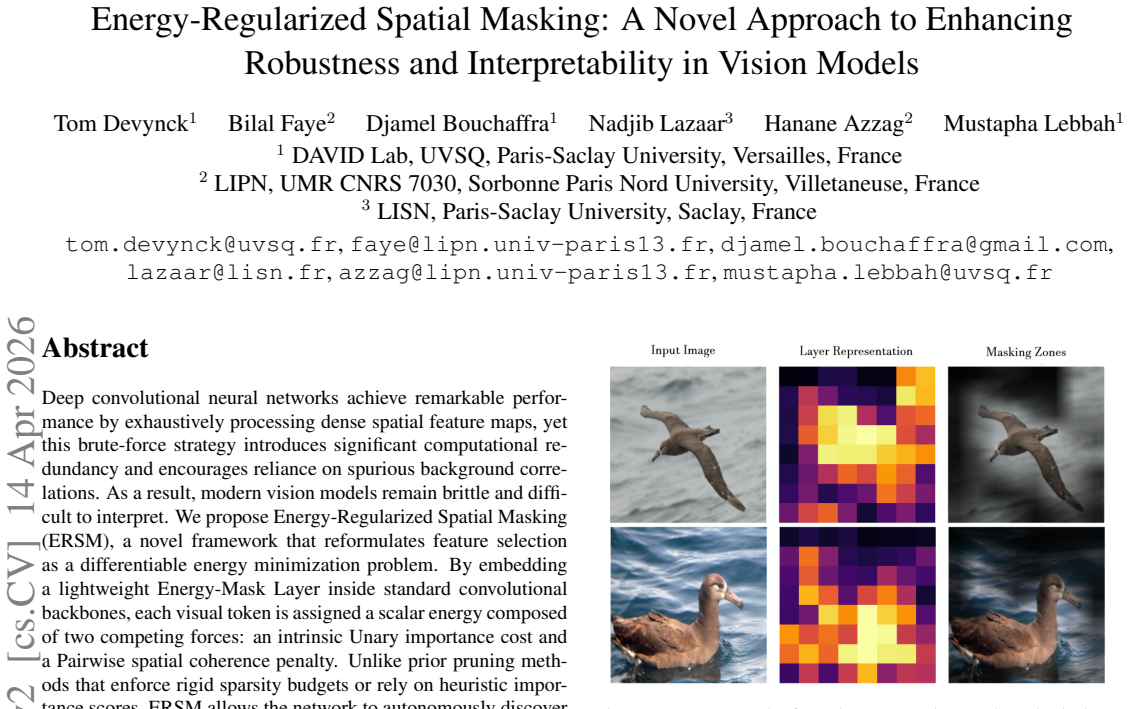
By embedding a lightweight Energy-Mask Layer inside standard convolutional backbones, each visual token is assigned a scalar energy composed of an intrinsic unary importance cost and a pairwise spatial coherence penalty. Unlike prior pruning methods that enforce rigid sparsity budgets or rely on heuristic importance scores, ERSM allows the network to autonomously discover an optimal information-density equilibrium tailored to each input. Validation on convolutional architectures shows that it produces emergent sparsity, improved robustness to structured occlusion, and highly interpretable spatial masks while preserving classification accuracy, with the learned energy ranking outperforming in
What carries the argument
The Energy-Mask Layer, which assigns each visual token a scalar energy from a unary importance cost and a pairwise spatial coherence penalty and minimizes the total energy end-to-end.
Load-bearing premise
The unary importance cost and pairwise spatial coherence penalty can be combined into a differentiable energy function whose minimization inside standard backbones yields stable training and semantically meaningful masks without additional supervision or post-hoc tuning.
What would settle it
Training models both with and without the Energy-Mask Layer on the same data and finding no measurable gain in occlusion robustness or no improvement over magnitude pruning in deletion tests would falsify the central claim.
Figures


read the original abstract
Deep convolutional neural networks achieve remarkable performance by exhaustively processing dense spatial feature maps, yet this brute-force strategy introduces significant computational redundancy and encourages reliance on spurious background correlations. As a result, modern vision models remain brittle and difficult to interpret. We propose Energy-Regularized Spatial Masking (ERSM), a novel framework that reformulates feature selection as a differentiable energy minimization problem. By embedding a lightweight Energy-Mask Layer inside standard convolutional backbones, each visual token is assigned a scalar energy composed of two competing forces: an intrinsic Unary importance cost and a Pairwise spatial coherence penalty. Unlike prior pruning methods that enforce rigid sparsity budgets or rely on heuristic importance scores, ERSM allows the network to autonomously discover an optimal information-density equilibrium tailored to each input. We validate ERSM on convolutional architectures and demonstrate that it produces emergent sparsity, improved robustness to structured occlusion, and highly interpretable spatial masks, while preserving classification accuracy. Furthermore, we show that the learned energy ranking significantly outperforms magnitude-based pruning in deletion-based robustness tests, revealing ERSM as an intrinsic denoising mechanism that isolates semantic object regions without pixel-level supervision.
Editorial analysis
A structured set of objections, weighed in public.
Referee Report
Summary. The paper proposes Energy-Regularized Spatial Masking (ERSM), a framework that embeds a lightweight Energy-Mask Layer inside standard convolutional backbones to reformulate feature selection as a differentiable energy minimization problem. Each visual token receives a scalar energy combining a unary importance cost and a pairwise spatial coherence penalty. The method claims to enable autonomous discovery of input-dependent optimal information-density equilibria, yielding emergent sparsity, improved robustness to structured occlusion, highly interpretable spatial masks, preserved classification accuracy, and superior performance over magnitude-based pruning in deletion-based robustness tests.
Significance. If the central mechanism can be shown to produce stable gradients and semantically meaningful masks without hidden relaxations or extra supervision, ERSM would offer a principled intrinsic approach to denoising and interpretability in vision models. This could reduce reliance on post-hoc pruning or explanation techniques and provide a new way to regularize against spurious correlations. The absence of any quantitative results, ablations, or algorithmic details in the manuscript, however, prevents assessment of whether these benefits are realized.
major comments (2)
- [Abstract] Abstract: The central claim that the combined energy E = unary_importance + lambda * pairwise_coherence can be minimized differentiably w.r.t. mask variables inside a standard conv backbone (producing input-dependent sparse coherent masks without extra supervision) is load-bearing but unsupported. No equations define the energy terms, no mask update rule or continuous relaxation (e.g., Gumbel or mean-field) is specified, and no analysis of gradient stability for potentially non-convex pairwise terms is given, leaving open the possibility that reported gains rely on implicit post-hoc procedures rather than the claimed intrinsic mechanism.
- [Experimental Validation] Experimental Validation (implied by abstract claims): The assertions of 'improved robustness to structured occlusion', 'highly interpretable spatial masks', 'preserving classification accuracy', and 'significantly outperforms magnitude-based pruning in deletion-based robustness tests' are presented without any quantitative results, tables, figures, ablation studies, training details, or error bars. This absence makes it impossible to verify whether the data support the empirical claims or whether the energy ranking is truly superior.
minor comments (1)
- [Abstract] Abstract: The phrase 'lightweight Energy-Mask Layer' is introduced without reference to prior energy-based models or differentiable optimization techniques in vision, which would help situate the novelty.
Simulated Author's Rebuttal
We thank the referee for their thorough review and constructive suggestions. We agree that additional technical details and empirical results are necessary to fully support our claims, and we will incorporate these in the revised manuscript.
read point-by-point responses
-
Referee: [Abstract] Abstract: The central claim that the combined energy E = unary_importance + lambda * pairwise_coherence can be minimized differentiably w.r.t. mask variables inside a standard conv backbone (producing input-dependent sparse coherent masks without extra supervision) is load-bearing but unsupported. No equations define the energy terms, no mask update rule or continuous relaxation (e.g., Gumbel or mean-field) is specified, and no analysis of gradient stability for potentially non-convex pairwise terms is given, leaving open the possibility that reported gains rely on implicit post-hoc procedures rather than the claimed intrinsic mechanism.
Authors: We acknowledge that the current manuscript, particularly the abstract, does not provide the detailed equations and algorithmic specifications. This was an oversight in the presentation. In the revised version, we will include the precise mathematical formulation of the unary importance cost and the pairwise spatial coherence penalty, specify the differentiable relaxation used for the mask variables (such as a continuous approximation via sigmoid activation), describe the mask update rule integrated into the forward pass, and provide an analysis of gradient flow and stability, including handling of the non-convex aspects through appropriate regularization. We believe this will clarify that the mechanism is fully intrinsic and differentiable without post-hoc procedures. revision: yes
-
Referee: [Experimental Validation] Experimental Validation (implied by abstract claims): The assertions of 'improved robustness to structured occlusion', 'highly interpretable spatial masks', 'preserving classification accuracy', and 'significantly outperforms magnitude-based pruning in deletion-based robustness tests' are presented without any quantitative results, tables, figures, ablation studies, training details, or error bars. This absence makes it impossible to verify whether the data support the empirical claims or whether the energy ranking is truly superior.
Authors: We agree that the manuscript as submitted lacks the quantitative experimental results, tables, figures, and ablations necessary to substantiate the claims. In the revision, we will add comprehensive experimental sections with quantitative metrics, comparison tables, ablation studies on the energy terms, training hyperparameters, and statistical error bars from multiple runs. This will allow proper verification of the robustness improvements and superiority over magnitude-based pruning. revision: yes
Circularity Check
No circularity: novel energy-based masking framework introduced as independent construction
full rationale
The paper presents ERSM as a new architectural framework that embeds a differentiable Energy-Mask Layer with unary importance cost and pairwise spatial coherence penalty inside standard convolutional backbones, allowing autonomous per-input equilibrium discovery. No equations, derivations, or predictions are shown in the provided text that reduce the claimed robustness, sparsity, or interpretability gains to previously fitted quantities, self-citations, or ansatzes by construction. The validation consists of empirical tests on architectures demonstrating emergent properties, which remain independent of any input-fitting loop. The derivation chain is self-contained as an original proposal rather than a tautological renaming or reduction.
Axiom & Free-Parameter Ledger
free parameters (1)
- Balance weights between unary and pairwise energy terms
axioms (1)
- domain assumption The energy minimization problem can be embedded as a differentiable layer without destabilizing standard back-propagation training.
invented entities (1)
-
Energy-Mask Layer
no independent evidence
Lean theorems connected to this paper
-
IndisputableMonolith/Cost/FunctionalEquation.leanwashburn_uniqueness_aczel unclear?
unclearRelation between the paper passage and the cited Recognition theorem.
Ei = λunary · softplus(W⊤mask p̂i + bi) + λpair · softplus(∑j∈N(i) p̂i⊤p̂j)
-
IndisputableMonolith/Foundation/BranchSelection.leanbranch_selection unclear?
unclearRelation between the paper passage and the cited Recognition theorem.
Lreg = 1/N ∑ mi · Ei with mi = σ(−Eunaryi)
What do these tags mean?
- matches
- The paper's claim is directly supported by a theorem in the formal canon.
- supports
- The theorem supports part of the paper's argument, but the paper may add assumptions or extra steps.
- extends
- The paper goes beyond the formal theorem; the theorem is a base layer rather than the whole result.
- uses
- The paper appears to rely on the theorem as machinery.
- contradicts
- The paper's claim conflicts with a theorem or certificate in the canon.
- unclear
- Pith found a possible connection, but the passage is too broad, indirect, or ambiguous to say the theorem truly supports the claim.
discussion (0)
Sign in with ORCID, Apple, or X to comment. Anyone can read and Pith papers without signing in.