REVIEW 5 major objections 5 minor 34 references
RIO: 3D Object Instance Re-Localization in Changing Indoor Environments
T0 review · 5 major / 5 minor · reviewed 2026-08-14 · deepseek-v4-flash
Pith's one-line read Re-localizing moved objects in changing rooms hits 30.58% recall with a new benchmark
desk verdict 3RScan is the real prize and it is solid; the RIO benchmark numbers need metric reconciliation and annotation-quality evidence before the method claims can be fully trusted. read the letter →
The pith
A machine-rendered reading of the paper's core claim, the machinery that carries it, and where it could break.
The reading
What carries the argument
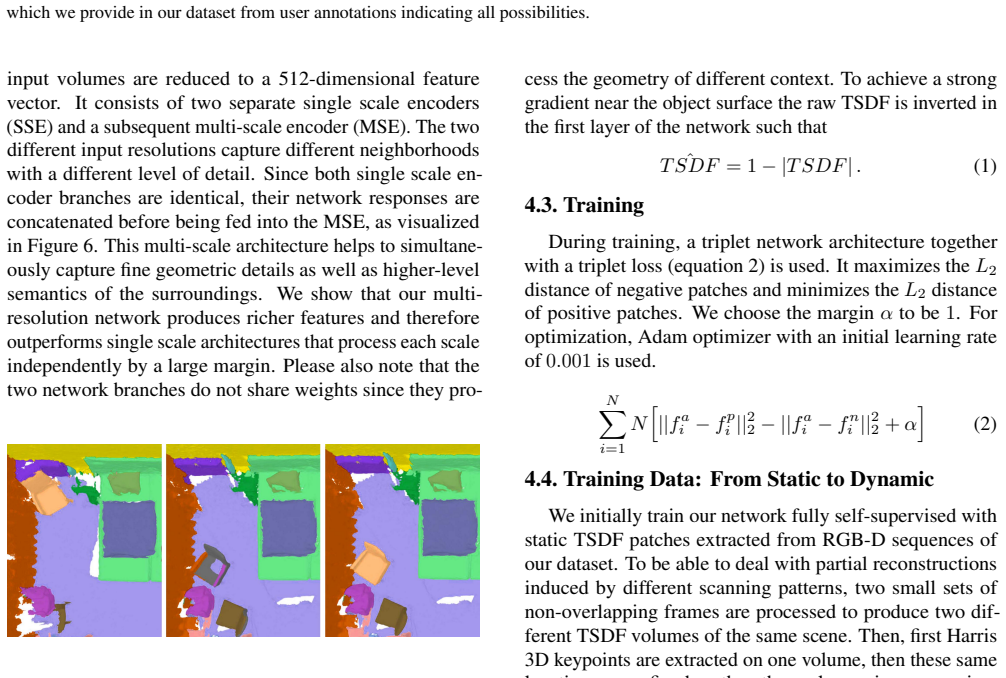
The central object is the multi-scale, fully-convolutional 3D correspondence network. Its input is a $32\times32\times32$ TSDF patch extracted at two spatial scales, $(0.6\,\text{m})^3$ for fine detail and $(1.2\,\text{m})^3$ for surrounding context, and it inverts the TSDF as $\widehat{\text{TSDF}} = 1 - |\text{TSDF}|$ so gradients are strong near surfaces. Two single-scale encoders feed a multi-scale encoder that outputs the descriptor, and a triplet loss pulls matching patches together while pushing negatives apart. The other load-bearing mechanism is the dataset's annotation pipeline: object poses are computed by Procrustes on manually placed keypoint correspondences, the global scan alignment comes from 2D/3D ICP, and symmetry classes (C2, C4, C∞) are recorded so evaluation tolerates ambiguous rotations.
What would settle it
Re-derive a random subset of the 3,289 annotated object transformations with an independent protocol, such as per-object ICP against the raw RGB-D frames or a second team of annotators, and recompute the recall table: if the margin between RIO-multiscale and SHOT narrows or the 30.58% figure shifts by more than a few points, the reported accuracies are partly artifacts of the keypoint-annotation protocol. As a complementary check, run the same pipeline restricted to the non-rigid instances the paper sets aside; near-zero recall there is the expected, testable boundary of the method.
Extended reading notes
Core claim
On its own terms, the paper establishes two coupled results. First, 3RScan is claimed to be the first large-scale real-world RGB-D dataset with multiple time steps of the same environments, dense instance-level semantic labels whose IDs stay consistent across re-scans, and explicit ground-truth transformations for moved, added, and removed objects, together with symmetry annotations (C2, C4, C∞) so ambiguous poses can be scored fairly. Second, object re-localization is cast as correspondence matching between multi-scale TSDF patches: a network with two single-scale encoders, one at $(0.6\,\text{m})^3$ and one at $(1.2\,\text{m})^3$ resolution, feeding a multi-scale encoder that outputs a 512-dimensional descriptor, trained with a triplet loss first on self-supervised static patches and then fine-tuned (with early layers frozen) on dynamic patches sampled from the moved-object alignments. Combined with RANSAC and an SVD-based 6DoF pose optimization, the method reaches 30.58% class-averaged recall at $<0.2\,\text{m}$ and $<20^\circ$, with overall instance-level recall of 23.76%, and lifts matching F1 from 85.58 (static-only) to 94.37 (fine-tuned).
Load-bearing premise
The benchmark's ground-truth poses are computed from a few manually clicked keypoint correspondences fit with Procrustes, layered on a global 2D/3D ICP scan alignment with no reported uncertainty, and the method only models rigid changes, so noisy alignments or any non-rigid move would silently corrupt the training labels and every reported accuracy.
Editorial extensions
If this is right
- 3RScan supplies a public benchmark with a hidden test set and automatic server-side evaluation, so future re-localization methods can be compared on identical ground rather than on each lab's own scans.
- Multi-scale context is the decisive design choice: the multi-scale network trained on static data alone already beats every single-scale variant by a wide margin, pointing future descriptors toward encoding neighborhood context.
- Fine-tuning on dynamic patches nearly doubles re-localization recall (from 17.75 to 23.76 at the loose threshold) and lifts matching F1 to 94.37, showing that change-specific training data, not architecture alone, carries much of the gain.
- Hand-crafted descriptors remain competitive on richly structured objects such as beds and sofas, so the learned approach's edge is concentrated on less distinctive, portable objects.
- Because 22% of annotated instances are symmetric and are scored against all valid poses, the reported recall is neither inflated nor deflated by ambiguity.
Reading between the lines
- The large jump from static-only to fine-tuned features, with recall saturating near 30%, suggests context scale and dynamic training data are the two main levers; a natural next experiment is fusing RGB texture with geometry or adding a third mid-range scale, which the released data and benchmark make straightforward to test.
- The benchmark is built on the rigid-motion assumption, and the paper names non-rigid changes (curtains, blankets) without evaluating them; isolating those instances in the released annotations would quantify how much of the remaining 70% error is deformation rather than matching failure.
- The manual-keypoint/Procrustes ground truth has no reported uncertainty; perturbing ground-truth poses by a few centimeters and degrees and re-running evaluation would reveal how much of the margin over SHOT is real versus inherited from the annotation protocol.
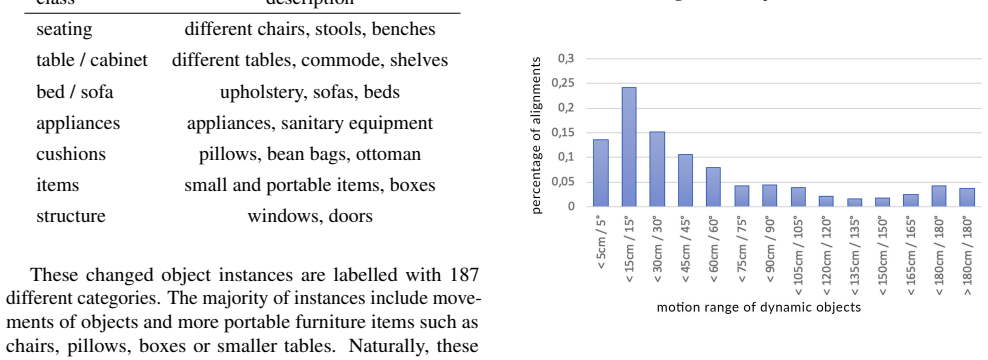
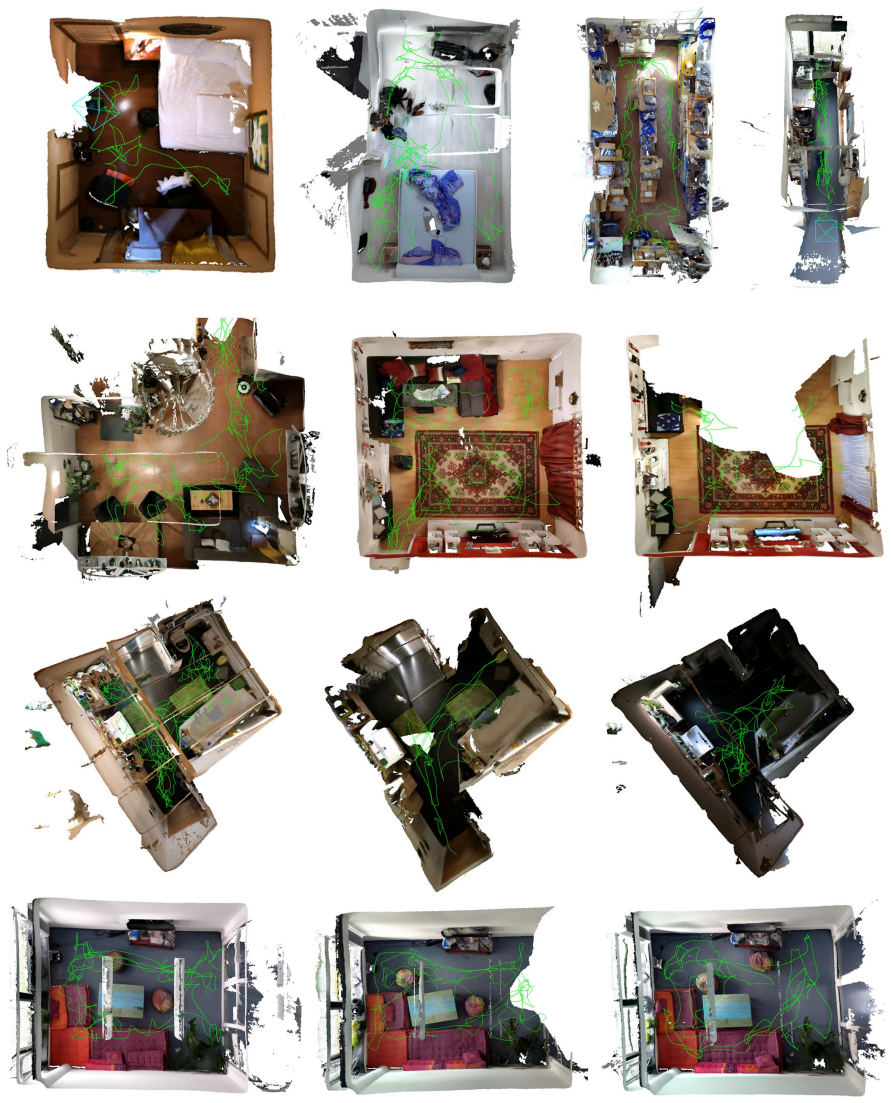
- Held against prior real data with change annotations (only 23 scans of 3 rooms), the dataset's 1,482 scans and 3,289 object transformations change what can be trained and benchmarked for long-term scene understanding even independently of the network results.
Signed reviews
Editorial analysis
A structured set of objections, weighed in public.
Referee Report
Summary. The paper introduces a new task, 3D object instance re-localization (RIO), together with a large-scale dataset, 3RScan, containing 1482 RGB-D scans of 478 environments captured at multiple time steps with instance-consistent semantic labels and 6DoF annotations for moved objects. The authors propose a multi-scale fully-convolutional 3D correspondence network operating on TSDF patches, trained with a triplet loss and fine-tuned on dynamic patches, and they evaluate it on a new benchmark against hand-crafted baselines (FPFH, SHOT) and a learned baseline (3DMatch). The paper reports that the proposed method outperforms the baselines, with a class-averaged recall of 30.58% at the 0.2 m / 20 degree threshold.
Significance. If the results hold, 3RScan is a valuable community resource for long-term scene understanding, being the first large-scale real-world RGB-D dataset with repeated scans of the same environments, instance-consistent labels, and ground-truth 6DoF annotations for changed objects. The hidden test set and server-side evaluation are commendable. The multi-scale TSDF descriptor also appears to be an effective and transferable approach for matching geometry under change. However, the trustworthiness of the headline numbers rests on the accuracy of the ground-truth pose annotations, which are not quantified in the paper, and the reported metric in the abstract is not the same as the instance-level recall in Table 4. These issues need to be addressed before the quantitative claims can be fully accepted.
major comments (5)
- [Abstract; Table 4; Table 5] The abstract reports an 'accuracy of 30.58%', but Table 4 reports 23.76% instance-level recall at the <0.2 m, 20 degree threshold; the 30.58% figure is the macro-averaged per-class accuracy from Table 5. The paper should state which metric is the headline, report both numbers consistently, and explain why the class-averaged number is preferred. As written, the abstract overstates the performance relative to the instance-level results.
- [Sec. 3.3.2; Supplemental 'Scene Matching and Alignment'] The ground-truth 6DoF poses are obtained by manual keypoint correspondences and Procrustes alignment, and the global scan-to-scan transformation T is computed by 2D/3D ICP. The paper reports no quantitative quality measure for these annotations, such as residual keypoint errors, ICP fitness scores, or inter-annotator agreement. Since these annotations are used both for the dynamic fine-tuning (Sec. 4.4) and for evaluation at tight thresholds (t<=10 cm/20 cm, r<=10 deg/20 deg), annotation noise propagates into all reported recalls and into the learned method itself. The paper should provide a quality analysis of the ground-truth poses and a sensitivity analysis of the benchmark scores to plausible annotation noise.
- [Sec. 4.4; Abstract/Introduction] The paper describes the dynamic fine-tuning as 'self-supervised' while stating that 'correspondence pairs are generated in a self-supervised fashion while using the ground truth pose annotations of our training set.' This is contradictory: using ground-truth object poses to generate positive training pairs is supervised training. The static pre-training is self-supervised, but the dynamic stage is supervised by the dataset's 6DoF annotations. The claims in the abstract and introduction should be corrected to distinguish these two stages and avoid overstating the method's self-supervision.
- [Sec. 5.2; Table 4] The text states that 3DMatch was trained on static 30x30x30 patches from 3RScan, but Table 4 labels the method '3DMatch (dynamic)'. This inconsistency makes it unclear whether the learned baseline was fine-tuned on dynamic patches or not. The paper should clarify the exact training protocol for 3DMatch and, if it was not given dynamic fine-tuning, either perform that fine-tuning or relabel the row and temper the comparison accordingly.
- [Tables 3-5] All reported numbers are single-run point estimates without error bars or confidence intervals. For example, Table 5 shows 0.00 vs 10.34 for the 'cushion' class, which is unlikely to be statistically meaningful with small sample sizes. Reporting standard deviations over multiple runs, or at least per-instance counts and confidence intervals, would make the claimed improvements more credible.
minor comments (5)
- [Eq. (2)] The triplet loss equation appears to have a stray 'N' inside the summation; it should be sum_{i=1}^{N} [ ||f_a^i - f_p^i||_2^2 - ||f_a^i - f_n^i||_2^2 + alpha ].
- [Sec. 4.1] The phrase 'their corresponding voxel sizes are 1.875 cm and 3.75 cm' should specify which scale corresponds to which voxel size (0.6 m => 1.875 cm, 1.2 m => 3.75 cm).
- [Sec. 5.1] The metrics in Table 3 (F1, accuracy, precision, FPR, ER) are said to be computed 'at 95% recall', but the paper does not explain how the operating threshold is selected; please define the protocol.
- [Sec. 4.2] The network takes fixed-size 32x32x32 patches and outputs a single 512-dimensional vector; calling it 'fully-convolutional' may be misleading to readers, since there is no dense prediction.
- [Sec. 3.2] The paper states that 'changes are mostly rigid' but the method only solves rigid transformations; it should explicitly state whether non-rigid changed objects (e.g., curtains) are excluded from the benchmark or handled separately.
Circularity Check
No significant circularity: dataset construction, supervised training, and benchmark evaluation are distinct stages, and the reported results are empirical rather than derived from the inputs by construction.
full rationale
The paper's central claims are (1) the introduction of the 3RScan dataset and RIO benchmark, and (2) a learned multi-scale correspondence network that outperforms FPFH, SHOT, and 3DMatch on that benchmark. Neither claim reduces to its own inputs by construction. The benchmark ground truth is an independently produced annotation layer: global scan alignment is computed via 2D/3D ICP, per-object 6DoF poses come from manual keypoint correspondences plus Procrustes, and symmetry labels follow an established annotation scheme. The network is trained on the train split and evaluated on a held-out test split with fixed thresholds (`t <= 10 cm, r <= 10 deg` and `t <= 20 cm, r <= 20 deg`), so the reported recall numbers are standard supervised evaluation, not a tautology. Section 4.4 says correspondence pairs are 'generated in a self-supervised fashion while using the ground truth pose annotations,' which is a misnomer for supervised training, but it does not make the evaluation circular: the GT annotations define the learning signal, not the predicted output at test time. The citations to Scan2CAD and ScanNet are annotation-tool and preprocessing provenance or baseline references, not load-bearing derivations; no uniqueness theorem or pre-baked ansatz is imported from those works to force the result. Possible concerns about unquantified annotation noise and the Table 4 label '3DMatch (dynamic)' conflicting with the static training description in Sec. 5.2 are evidence-quality and reporting-fairness issues, not circularity. The descriptor network is a new learned component, and its advantage over the baselines is an empirical outcome, not a built-in consequence of the dataset definition.
Assumptions & free parameters
free parameters (4)
- TSDF patch spatial scales =
1.2 m and 0.6 m patch widths; 3.75 cm and 1.875 cm voxels
- Triplet loss margin alpha =
1
- Success thresholds for the benchmark =
t<=10 cm/r<=10 deg and t<=20 cm/r<=20 deg
- Network architecture hyperparameters =
not specified
assumptions (5)
- domain assumption Moved objects can be treated as rigid bodies
- domain assumption Ground-truth pose annotations are accurate
- domain assumption Global scan-to-scan alignments are correct
- domain assumption Instance IDs are consistent across re-scans
- domain assumption Symmetry classes assigned by annotators are correct
Cite this review
Pith. "Pith review of RIO: 3D Object Instance Re-Localization in Changing Indoor Environments." pith.science (2026). https://pith.science/paper/E5SDBGL3
@misc{pith2026190806109,
  author       = {Pith},
  title        = {Pith review of: RIO: 3D Object Instance Re-Localization in Changing Indoor Environments},
  year         = {2026},
  howpublished = {\url{https://pith.science/paper/E5SDBGL3}},
  note         = {Machine review of arXiv:1908.06109}
}
read the original abstract
In this work, we introduce the task of 3D object instance re-localization (RIO): given one or multiple objects in an RGB-D scan, we want to estimate their corresponding 6DoF poses in another 3D scan of the same environment taken at a later point in time. We consider RIO a particularly important task in 3D vision since it enables a wide range of practical applications, including AI-assistants or robots that are asked to find a specific object in a 3D scene. To address this problem, we first introduce 3RScan, a novel dataset and benchmark, which features 1482 RGB-D scans of 478 environments across multiple time steps. Each scene includes several objects whose positions change over time, together with ground truth annotations of object instances and their respective 6DoF mappings among re-scans. Automatically finding 6DoF object poses leads to a particular challenging feature matching task due to varying partial observations and changes in the surrounding context. To this end, we introduce a new data-driven approach that efficiently finds matching features using a fully-convolutional 3D correspondence network operating on multiple spatial scales. Combined with a 6DoF pose optimization, our method outperforms state-of-the-art baselines on our newly-established benchmark, achieving an accuracy of 30.58%.
Figures



Figures from the paper (15 more)




Reference graph
Works this paper leans on
-
[1]
CAD-model recognition and 6DOF pose estimation using 3D cues
Aitor Aldoma, Markus Vincze, Nico Blodow, David Gos- sow, Suat Gedikli, Radu Bogdan Rusu, and Gary Bradski. CAD-model recognition and 6DOF pose estimation using 3D cues. In International Conference on Computer Vision (ICCV), 2011
work page 2011
-
[2]
Scan2CAD: Learning CAD model alignment in RGB-D scans
Armen Avetisyan, Manuel Dahnert, Angela Dai, Manolis Savva, Angel Xuan Chang, and Matthias Nießner. Scan2CAD: Learning CAD model alignment in RGB-D scans. In Confer- ence on Computer Vision and Pattern Recognition (CVPR), 2019
work page 2019
-
[3]
Matterport3D: Learning from RGB- D data in indoor environments
Angel Xuan Chang, Angela Dai, Thomas Funkhouser, Maciej Halber, Matthias Nießner, Manolis Savva, Shuran Song, Andy Zeng, and Yinda Zhang. Matterport3D: Learning from RGB- D data in indoor environments. In International Conference on 3D Vision (3DV), 2017
work page 2017
-
[4]
ScanNet: Richly-annotated 3D reconstructions of indoor scenes
Angela Dai, Angel Xuan Chang, Manolis Savva, Maciej Halber, Tom Funkhouser, and Matthias Nießner. ScanNet: Richly-annotated 3D reconstructions of indoor scenes. In International Conference on Computer Vision and Pattern Recognition (CVPR), 2017
work page 2017
-
[5]
3DMV: Joint 3D-Multi- View Prediction for 3D Semantic Scene Segmentation
Angela Dai and Matthias Nießner. 3DMV: Joint 3D-Multi- View Prediction for 3D Semantic Scene Segmentation. In European Conference on Computer Vision (ECCV), 2018
work page 2018
-
[6]
Angela Dai, Matthias Nießner, Michael Zoll ¨ofer, Shahram Izadi, and Christian Theobalt. BundleFusion: Real-time Glob- ally Consistent 3D Reconstruction using On-the-fly Surface Re-integration. In ACM Transactions on Graphics (TOG), 2017
work page 2017
-
[7]
PPF-FoldNet: Unsupervised Learning of Rotation Invariant 3D Local De- scriptors
Haowen Deng, Tolga Birdal, and Slobodan Ilic. PPF-FoldNet: Unsupervised Learning of Rotation Invariant 3D Local De- scriptors. In European Conference on Computer Vision (ECCV), 2018
work page 2018
-
[8]
Marius Fehr, Fadri Furrer, Dryanovski Ivan, J ¨urgen Sturm, Igor Gilitschenski, Roland Siegwart, and Cesar Cadena. TSDF-based change detection for consistent long-term dense reconstruction and dynamic object discovery. InInternational Conference on Robotics and Automation (ICRA), 2017
work page 2017
Show all 34 references
-
[9]
RGBD Datasets: Past, Present and Future
Michael Firman. RGBD Datasets: Past, Present and Future. In Conference on Computer Vision and Pattern Recognition Workshops (CVPR), 2016
2016
-
[10]
3D-SIS: 3D Semantic Instance Segmentation of RGB-D Scans
Ji Hou, Angela Dai, and Matthias Nießner. 3D-SIS: 3D Semantic Instance Segmentation of RGB-D Scans. In Confer- ence on Computer Vision and Pattern Recognition (CVPR), 2019
2019
-
[11]
InteriorNet: Mega-scale Multi-sensor Photo-realistic Indoor Scenes Dataset
Wenbin Li, Sajad Saeedi, John McCormac, Ronald Clark, Di- mos Tzoumanikas, Qing Ye, Yuzhong Huang, Rui Tang, and Stefan Leutenegger. InteriorNet: Mega-scale Multi-sensor Photo-realistic Indoor Scenes Dataset. In British Machine Vision Conference (BMVC), 2018
2018
-
[12]
Fusion++: V olumetric Object-Level SLAM
John McCormac, Ronald Clark, Michael Bloesch, Andrew Davison, and Stefan Leutenegger. Fusion++: V olumetric Object-Level SLAM. In International Conference on 3D Vision (3DV), 2018
2018
-
[13]
SemanticFusion: Dense 3D Semantic Map- ping with Convolutional Neural Networks
John McCormac, Ankur Handa, Andrew Davison, and Stefan Leutenegger. SemanticFusion: Dense 3D Semantic Map- ping with Convolutional Neural Networks. In International Conference on Robotics and Automation (ICRA), 2017
2017
-
[14]
SceneNet RGB-D: Can 5M Synthetic Im- ages Beat Generic ImageNet Pre-training on Indoor Segmen- tation? In International Conference on Computer Vision (ICCV), 2017
John McCormac, Ankur Handa, Stefan Leutenegger, and Andrew Davison. SceneNet RGB-D: Can 5M Synthetic Im- ages Beat Generic ImageNet Pre-training on Indoor Segmen- tation? In International Conference on Computer Vision (ICCV), 2017
2017
-
[15]
Fast and Accurate Semantic Mapping through Geometric-based Incremental Segmentation
Yoshikatsu Nakajima, Keisuke Tateno, Federico Tombari, and Hideo Saito. Fast and Accurate Semantic Mapping through Geometric-based Incremental Segmentation. In International Conference on Intelligent Robots and Systems (IROS), 2018
2018
-
[16]
Indoor Segmentation and Support Inference from RGBD Images
Pushmeet Kohli Nathan Silberman, Derek Hoiem and Rob Fergus. Indoor Segmentation and Support Inference from RGBD Images. In European Conference on Computer Vision (ECCV), 2012
2012
-
[17]
KinectFusion: Real-Time Dense Surface Mapping and Track- ing
Richard Newcombe, Shahram Izadi, Otmar Hilliges, David Molyneaux, David Kim, Andrew Davison, Pushmeet Kohli, Jamie Shotton, Steve Hodges, and Andrew Fitzgibbon. KinectFusion: Real-Time Dense Surface Mapping and Track- ing. In International Symposium on Mixed and Augmented Real...
2011
-
[18]
Real-time 3D Reconstruction at Scale using V oxel Hashing
Matthias Nießner, Michael Zollh ¨ofer, Shahram Izadi, and Marc Stamminger. Real-time 3D Reconstruction at Scale using V oxel Hashing. In ACM Transactions on Graphics (TOG), 2013
2013
-
[19]
PointNet: Deep learning on point sets for 3D classifi- cation and segmentation
Charles Ruizhongtai Qi, Hao Su, Kaichun Mo, and Leonidas Guibas. PointNet: Deep learning on point sets for 3D classifi- cation and segmentation. In Conference on Computer Vision and Pattern Recognition (CVPR), 2017
2017
-
[20]
Pointnet++: Deep hierarchical feature learning on point sets in a metric space
Charles Ruizhongtai Qi, Li Yi, Hao Su, and Leonidas Guibas. Pointnet++: Deep hierarchical feature learning on point sets in a metric space. In Conference on Neural Information Processing Systems (NeurIPS), 2017
2017
-
[21]
Fully-convolutional point networks for large-scale point clouds
Dario Rethage, Johanna Wald, J¨urgen Sturm, Nassir Navab, and Federico Tombari. Fully-convolutional point networks for large-scale point clouds. In European Conference on Computer Vision (ECCV), 2018
2018
-
[22]
Fast point feature histograms (FPFH) for 3D registration
Radu Bogdan Rusu, Nico Blodow, and Michael Beetz. Fast point feature histograms (FPFH) for 3D registration. In In- ternational Conference on Robotics and Automation (ICRA), 2009
2009
-
[23]
3D is here: Point Cloud Library (PCL)
Radu Bogdan Rusu and Steve Cousins. 3D is here: Point Cloud Library (PCL). In International Conference on Robotics and Automation (ICRA), 2011
2011
-
[24]
SLAM++: Simultaneous Localisation and Mapping at the Level of Objects
Renato Salas-Moreno, Richard Newcombe, Hauke Strasdat, Paul Kelly, and Andrew Davison. SLAM++: Simultaneous Localisation and Mapping at the Level of Objects. In Confer- ence on Computer Vision and Pattern Recognition (CVPR), 2013
2013
-
[25]
SUN RGB-D: A RGB-D scene understanding benchmark suite
Shuran Song, Samuel Lichtenberg, and Jianxiong Xiao. SUN RGB-D: A RGB-D scene understanding benchmark suite. In Conference on Computer Vision and Pattern Recognition (CVPR), 2015
2015
-
[26]
Semantic Scene Completion from a Single Depth Image
Shuran Song, Fisher Yu, Andy Zeng, Angel Xuan Chang, Manolis Savva, and Thomas Funkhouser. Semantic Scene Completion from a Single Depth Image. In Conference on Computer Vision and Pattern Recognition, 2017
2017
-
[27]
Unique Signatures of Histograms for Local Surface Descrip- tion
Federico Tombari, Samuele Salti, and Luigi Di Stefano. Unique Signatures of Histograms for Local Surface Descrip- tion. In European Conference on Computer Vision (ECCV), 2010
2010
-
[28]
Learning to navigate the energy landscape
Julien Valentin, Angela Dai, Matthias Nießner, Pushmeet Kohli, Philip Torr, Shahram Izadi, and Cem Keskin. Learning to navigate the energy landscape. In International Conference on 3D Vision (3DV), 2016
2016
-
[29]
SemanticPaint: Interactive 3D Labeling and Learning at Your Fingertips
Julien Valentin, Vibhav Vineet, Ming-Ming Cheng, David Kim, Jamie Shotton, Pushmeet Kohli, Matthias Nießner, Anto- nio Criminisi, Shahram Izadi, and Philip Torr. SemanticPaint: Interactive 3D Labeling and Learning at Your Fingertips. In ACM Transactions on Graphics (TOG), 2015
2015
-
[30]
Real-Time Fully Incremental Scene Understanding on Mobile Platforms
Johanna Wald, Keisuke Tateno, J¨urgen Sturm, Nassir Navab, and Federico Tombari. Real-Time Fully Incremental Scene Understanding on Mobile Platforms. In International Confer- ence On Intelligent Robots and Systems (IROS), 2018
2018
-
[31]
ElasticFusion: Dense SLAM Without A Pose Graph
Thomas Whelan, Stefan Leutenegger, Renato Salas Moreno, Ben Glocker, and Andrew Davison. ElasticFusion: Dense SLAM Without A Pose Graph. In Robotics: Science and Systems, 2015
2015
-
[32]
3DMatch: Learn- ing Local Geometric Descriptors from RGB-D Reconstruc- tions
Andy Zeng, Shuran Song, Matthias Nießner, Matthew Fisher, Jianxiong Xiao, and Thomas Funkhouser. 3DMatch: Learn- ing Local Geometric Descriptors from RGB-D Reconstruc- tions. In Conference on Computer Vision and Pattern Recog- nition (CVPR), 2017
2017
-
[33]
Dataset Scanning Interface We tailored a mobile app running on Google Tango with pre-annotation functionality as a scan- ning interface (see Figure 9)
Supplemental Material In this supplemental document, we provide additional information about the proposed dataset such as statistics, scene examples and a detailed description about the annota- tion process. Dataset Scanning Interface We tailored a mobile app running on Google...
-
[34]
When an object is selected in the re-scan (see green dot) its instance segmentation from the reference scan is automatically segmented
where each scene is rendered next to its corresponding reference. When an object is selected in the re-scan (see green dot) its instance segmentation from the reference scan is automatically segmented. Please note, that this requires the instance IDs to be consistent across sc...
1947
Reviewed August 14, 2026 · model on record in the stance chip above.
Discussion (0). Continue with ORCID to comment.