PineAPPLv1: fast and flexible theory predictions for present and future colliders
Pith reviewed 2026-06-27 03:02 UTC · model grok-4.3
The pith
PineAPPLv1 supplies interpolation tables that support convolutions with any number of polarised and unpolarised PDFs and FFs, including mixed space-like and time-like evolution.
A machine-rendered reading of the paper's core claim, the machinery that carries it, and where it could break.
Core claim
PineAPPLv1 stores interpolation coefficients in a grid format that encodes partonic cross sections for an arbitrary number of convolutions with initial- and final-state particles of any polarisation; the library simultaneously accepts polarised and unpolarised distributions obeying space-like or time-like evolution and permits independent scale variations for each hard scale in the process.
What carries the argument
The new representation of interpolation coefficients stored in the grid, which encodes the partonic cross sections so they can be convolved with multiple PDFs and FFs of mixed polarisation and evolution type.
If this is right
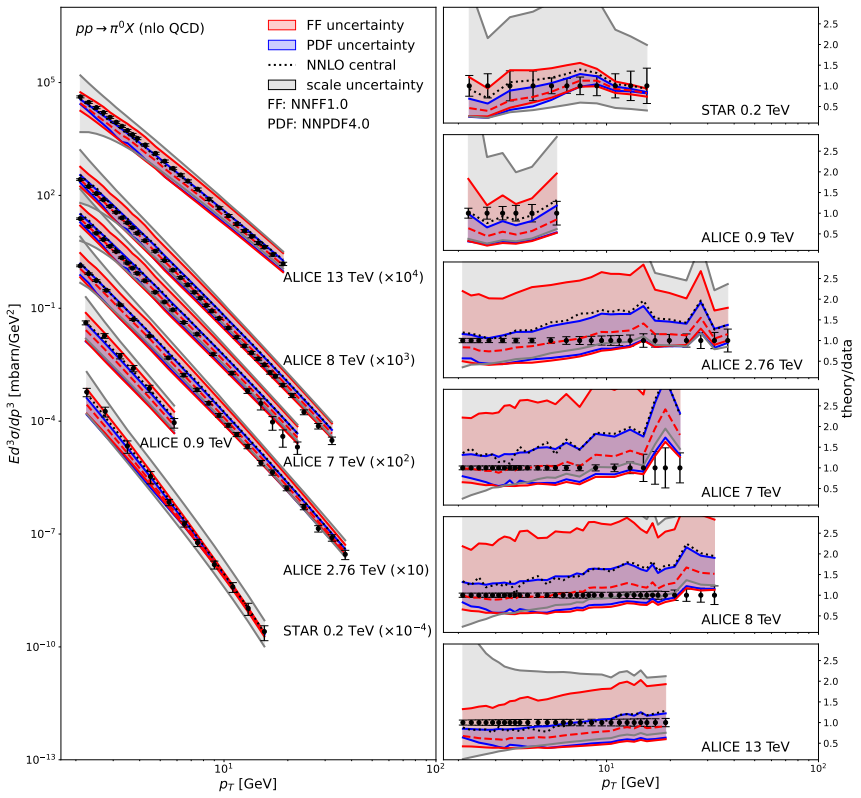
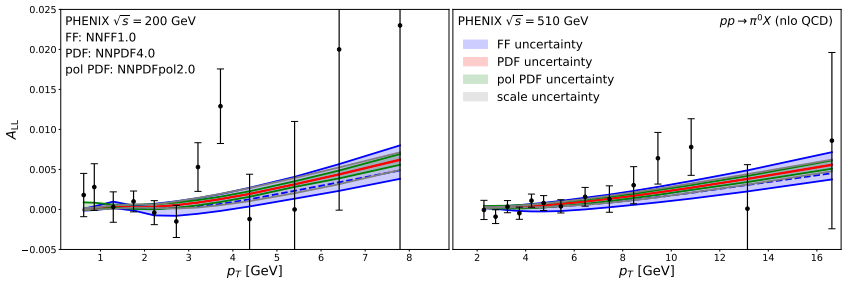
- Predictions for single-inclusive pion production can be obtained with simultaneous PDF, FF and scale uncertainties in both unpolarised and polarised proton-proton collisions.
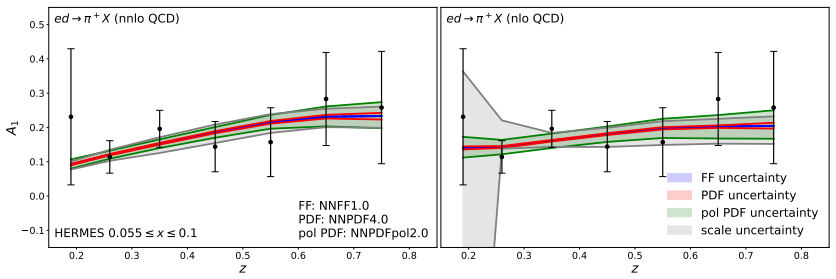
- The same framework supplies predictions for semi-inclusive deep-inelastic scattering that include fragmentation functions together with PDFs.
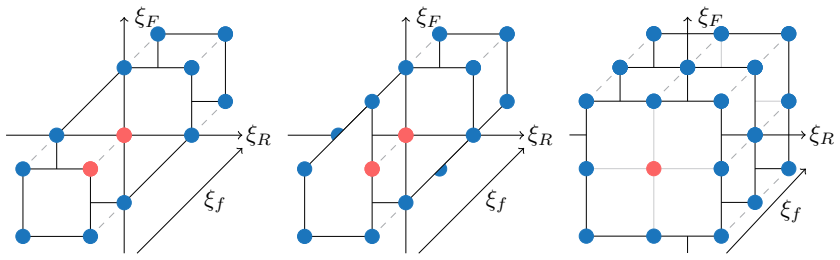
- Control over independent scale choices becomes available whenever a scattering process is characterised by more than one hard scale.
- An arbitrary number of convolutions is supported, even though typical processes use only a few.
Where Pith is reading between the lines
- Global fits that combine many observables could incorporate additional final-state fragmentation data at negligible extra cost.
- Processes at future high-energy colliders that involve several identified hadrons in the final state could be treated uniformly within one interpolation framework.
Load-bearing premise
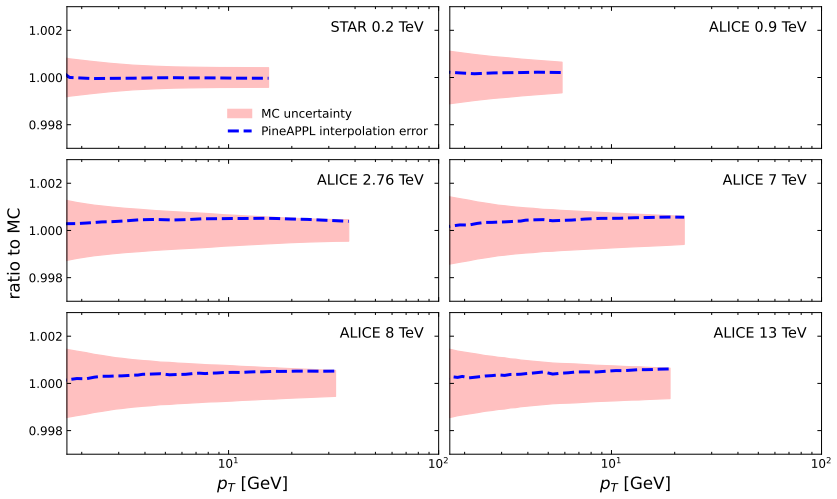
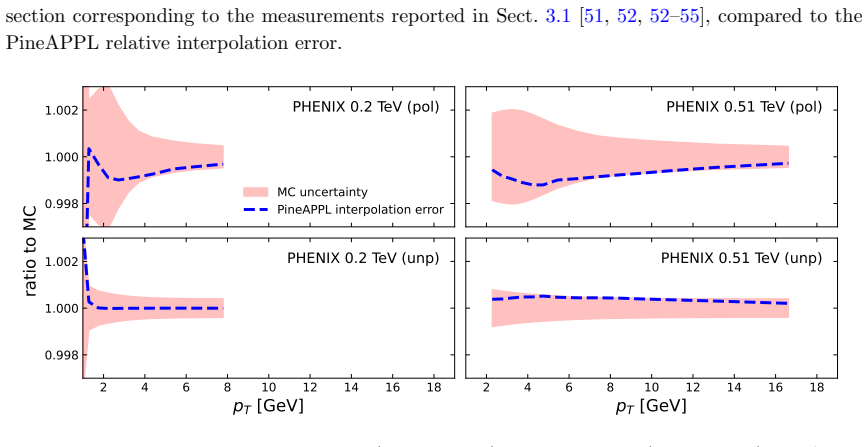
The interpolation tables stored in the grid accurately represent the underlying partonic cross sections for arbitrary numbers of convolutions without introducing significant numerical errors or loss of flexibility when handling mixed polarization and scale choices.
What would settle it
A side-by-side numerical comparison of PineAPPLv1 output against an exact partonic calculation for a process that requires three or more convolutions, such as double-inclusive hadron production, that shows differences exceeding the interpolation tolerance.
Figures
read the original abstract
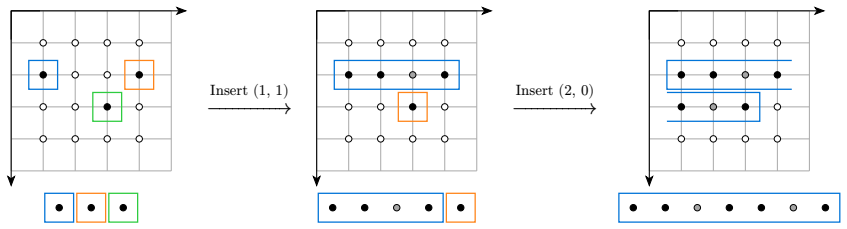
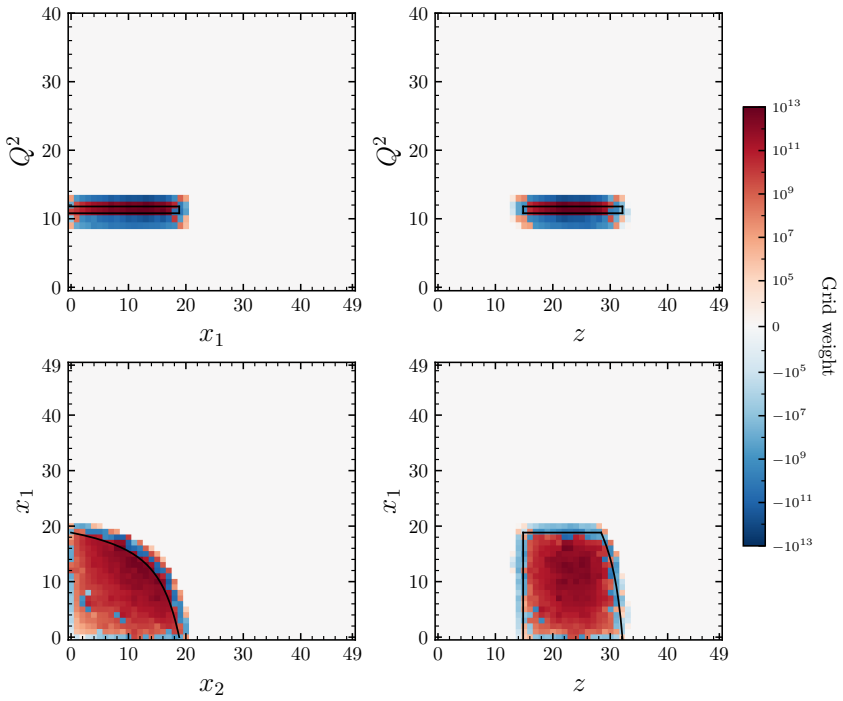
We present PineAPPLv1, a library designed to provide accurate and flexible interpolation tables of partonic cross sections that can be convolved with parton distribution functions (PDFs) and fragmentation functions (FFs) for the fast evaluation of high-energy physical observables. The core feature of the new release is the support of multiple convolutions involving initial- and final-state hadronic particles, with any polarisation, that are associated with PDFs and FFs. The library simultaneously supports polarised and unpolarised distributions that obey space-like or time-like evolution, and is developed for an arbitrary number of them, even if physical processes typically only require a few. Control of scale choices when more than one scale characterises a scattering process is also possible. We describe the technical details of the new representation of interpolation coefficients stored in the grid, and we demonstrate the capabilities of the library in a few phenomenological cases of interest. Specifically, we compute predictions for single-inclusive pion production in unpolarised and polarised proton-proton collisions and in semi-inclusive deep-inelastic scattering. We show how, in each case, PDF, FF, and scale uncertainties compare to each other and highlight the potential of PineAPPL as an essential ingredient for precision physics at current and future colliders.
Editorial analysis
A structured set of objections, weighed in public.
Referee Report
Summary. The manuscript presents PineAPPLv1, a library for generating interpolation tables of partonic cross sections that support fast convolution with PDFs and FFs. The core new capability is support for multiple convolutions involving initial- and final-state hadronic particles with arbitrary polarization, simultaneously handling polarised/unpolarised distributions obeying space-like or time-like evolution for an arbitrary number of such distributions. The paper describes the technical representation of the interpolation coefficients in the grid, control of scale choices, and demonstrates the library via single-inclusive pion production in unpolarised/polarised pp collisions and SIDIS, comparing PDF, FF, and scale uncertainties.
Significance. If the interpolation tables accurately represent the underlying partonic cross sections for arbitrary numbers of convolutions without significant numerical errors, the library would be a useful addition for precision phenomenology at present and future colliders by enabling efficient evaluation of observables with complex multi-convolution structures and mixed polarizations. The explicit demonstrations in phenomenological cases provide concrete checks of its intended use.
major comments (2)
- [Technical details of the new representation of interpolation coefficients] The description of the new grid representation (mentioned in the abstract and technical-details paragraph) does not include quantitative validation tests, numerical error budgets, or direct comparisons to independent calculations for cases with more than two convolutions or mixed polarization/evolution types. This is load-bearing for the central claim that the tables support arbitrary numbers without loss of accuracy or flexibility.
- [Phenomenological cases of interest] In the phenomenological demonstrations (single-inclusive pion production in pp and SIDIS), the comparisons focus on PDF/FF/scale uncertainties but supply no explicit checks of interpolation accuracy against known analytic or alternative numerical results for the multi-convolution scenarios.
minor comments (2)
- The abstract states the library 'is developed for an arbitrary number' of distributions; a brief statement on practical limits (e.g., memory or CPU scaling) would improve clarity.
- Consider adding a short table or paragraph contrasting supported features with the previous PineAPPL version and with other public interpolation libraries.
Simulated Author's Rebuttal
We thank the referee for their careful reading of the manuscript and for the constructive comments. We address each major comment below and indicate the revisions we will make.
read point-by-point responses
-
Referee: [Technical details of the new representation of interpolation coefficients] The description of the new grid representation (mentioned in the abstract and technical-details paragraph) does not include quantitative validation tests, numerical error budgets, or direct comparisons to independent calculations for cases with more than two convolutions or mixed polarization/evolution types. This is load-bearing for the central claim that the tables support arbitrary numbers without loss of accuracy or flexibility.
Authors: We agree that explicit quantitative validation strengthens the central claim. The representation is formulated to be general for an arbitrary number of convolutions (as described in the technical section), and the phenomenological examples already include a three-convolution process (single-inclusive pion production in pp collisions) with mixed polarization. Nevertheless, we will add a new subsection containing numerical error budgets, interpolation accuracy tests, and direct comparisons to independent calculations for a triple-convolution case involving mixed polarization and evolution types. revision: yes
-
Referee: [Phenomenological cases of interest] In the phenomenological demonstrations (single-inclusive pion production in pp and SIDIS), the comparisons focus on PDF/FF/scale uncertainties but supply no explicit checks of interpolation accuracy against known analytic or alternative numerical results for the multi-convolution scenarios.
Authors: The demonstrations are intended to illustrate the new multi-convolution and polarization capabilities together with the resulting uncertainty comparisons. We acknowledge that dedicated accuracy benchmarks against alternative calculations would be useful. In the revised manuscript we will include such explicit checks (e.g., against known unpolarised results or direct numerical evaluations) for the multi-convolution cases presented. revision: yes
Circularity Check
No significant circularity: software library release
full rationale
The paper presents PineAPPLv1 as a software library implementing grid-based interpolation for multi-convolution observables involving PDFs and FFs (polarized/unpolarized, space-/time-like). No mathematical derivation, fitted parameters, or predictions are claimed; the work consists of technical implementation details and phenomenological demonstrations. No load-bearing steps reduce to self-definition, self-citation chains, or fitted inputs by construction. The reader's assessment of score 0.0 is confirmed by inspection of the full text.
Axiom & Free-Parameter Ledger
Reference graph
Works this paper leans on
-
[1]
J. Campbell and T. Neumann,Precision Phenomenology with MCFM,JHEP12(2019) 034 [arXiv:1909.09117]
arXiv 2019
-
[2]
T. Neumann and J. Campbell,Fiducial Drell-Yan production at the LHC improved by transverse-momentum resummation at N4LLp+N3LO,Phys. Rev. D107(2023), no. 1, L011506 [arXiv:2207.07056]
arXiv 2023
-
[3]
T. Carli, D. Clements, A. Cooper-Sarkar, C. Gwenlan, G.P. Salam, F. Siegert, P. Starovoitov and M. Sutton,A posteriori inclusion of parton density functions in NLO QCD final-state calculations at hadron colliders: The APPLGRID Project,Eur. Phys. J. C66(2010) 503–524 [arXiv:0911.2985]
Pith/arXiv arXiv 2010
-
[4]
fastNLO: Fast pQCD Calculations for PDF Fits
T. Kluge, K. Rabbertz and M. Wobisch,FastNLO: Fast pQCD calculations for PDF fits, in 14th International Workshop on Deep Inelastic Scattering, pp. 483–486, 9, 2006, doi:10.1142/9789812706706_0110[hep-ph/0609285]. [5]fastNLOcollaboration, M. Wobisch, D. Britzger, T. Kluge, K. Rabbertz and F. Stober, Theory-Data Comparisons for Jet Measurements in Hadron-I...
work page internal anchor Pith review Pith/arXiv arXiv doi:10.1142/9789812706706_0110 2006
-
[5]
S. Carrazza, E.R. Nocera, C. Schwan and M. Zaro,PineAPPL: combining EW and QCD corrections for fast evaluation of LHC processes,JHEP12(2020) 108 [arXiv:2008.12789]
arXiv 2020
-
[6]
NNLOJET: a parton-level event generator for jet cross sections at NNLO QCD accuracy
C. Schwan, T.R. Rabemananjara, A. Candido, F. Hekhorn, T. Sharma, S. Carrazza, A. Barontini, J. Wissmann and J.M. Cruz-Martinez,NNPDF/pineappl: v1.0.0, June, 2025. doi:10.5281/zenodo.15635174. [8]NNLOJETcollaboration, A. Huss et al.,NNLOJET: a parton-level event generator for jet cross sections at NNLO QCD accuracy,arXiv:2503.22804
work page internal anchor Pith review Pith/arXiv arXiv doi:10.5281/zenodo.15635174 2025
-
[7]
J. Cruz-Martinez, A. Huss and C. Schwan,Fast interpolation grids for the Drell–Yan process, Eur. Phys. J. C85(2025), no. 4, 459 [arXiv:2501.13167]
arXiv 2025
-
[8]
J. Alwall, R. Frederix, S. Frixione, V. Hirschi, F. Maltoni, O. Mattelaer, H.S. Shao, T. Stelzer, P. Torrielli and M. Zaro,The automated computation of tree-level and next-to-leading order differential cross sections, and their matching to parton shower simulations,JHEP07(2014) 079 [arXiv:1405.0301]
Pith/arXiv arXiv 2014
-
[9]
R. Frederix, S. Frixione, V. Hirschi, D. Pagani, H.S. Shao and M. Zaro,The automation of next-to-leading order electroweak calculations,JHEP07(2018) 185 [arXiv:1804.10017], [Erratum: JHEP 11, 085 (2021)]
arXiv 2018
-
[10]
M. Grazzini, S. Kallweit and M. Wiesemann,Fully differential NNLO computations with MATRIX,Eur. Phys. J. C78(2018), no. 7, 537 [arXiv:1711.06631]. – 22 –
Pith/arXiv arXiv 2018
-
[11]
S. Devoto, T. Jeˇ zo, S. Kallweit and C. Schwan,Matrix HAWAII: PineAPPL interpolation grids with MATRIX,Eur. Phys. J. C86(2026), no. 4, 399 [arXiv:2506.14486]
Pith/arXiv arXiv 2026
-
[12]
C. Anastasiou, L.J. Dixon, K. Melnikov and F. Petriello,High precision QCD at hadron colliders: Electroweak gauge boson rapidity distributions at NNLO,Phys. Rev. D69(2004) 094008 [hep-ph/0312266]
Pith/arXiv arXiv 2004
-
[13]
J. Cruz-Martinez, T. Hasenack, F. Hekhorn, G. Magni, E.R. Nocera, T.R. Rabemananjara, J. Rojo, T. Sharma and G. van Seeventer,NNPDFpol2.0: unbiased global determination of polarized PDFs and their uncertainties at next-to-next-to-leading order,arXiv:2503.11814
-
[14]
A. Candido, F. Hekhorn, G. Magni, T.R. Rabemananjara and R. Stegeman,Yadism: yet another deep-inelastic scattering module,Eur. Phys. J. C84(2024), no. 7, 698 [arXiv:2401.15187]
arXiv 2024
-
[15]
A. Candido and F. Hekhorn,N3PDF/yadism: Flavor Number Schemes, July, 2020. doi:10.5281/zenodo.3929499
-
[16]
A. Barontini, A. Candido, F. Hekhorn, G. Magni and R. Stegeman,An FONLL prescription with coexisting flavor number PDFs,JHEP10(2024) 004 [arXiv:2408.07383]
arXiv 2024
-
[17]
F. Hekhorn, G. Magni, E.R. Nocera, T.R. Rabemananjara, J. Rojo, A. Schaus and R. Stegeman,Heavy quarks in polarised deep-inelastic scattering at the electron-ion collider, Eur. Phys. J. C84(2024), no. 2, 189 [arXiv:2401.10127]
arXiv 2024
-
[18]
A. Candido, A. Garcia, G. Magni, T. Rabemananjara, J. Rojo and R. Stegeman,Neutrino Structure Functions from GeV to EeV Energies,JHEP05(2023) 149 [arXiv:2302.08527]
arXiv 2023
-
[19]
J.M. Cruz-Martinez, M. Fieg, T. Giani, P. Krack, T. M¨ akel¨ a, T.R. Rabemananjara and J. Rojo,The LHC as a Neutrino-Ion Collider,Eur. Phys. J. C84(2024), no. 4, 369 [arXiv:2309.09581]
arXiv 2024
-
[20]
R. Mammen Abraham, J. Adhikary, J.L. Feng, M. Fieg, F. Kling, J. Li, J. Pei, T.R. Rabemananjara, J. Rojo and S. Trojanowski,FPF@FCC: neutrino, QCD, and BSM physics opportunities with far-forward experiments at a 100 TeV Proton Collider,JHEP01 (2025) 094 [arXiv:2409.02163]
arXiv 2025
-
[21]
A. Accardi et al.,Electron Ion Collider: The Next QCD Frontier: Understanding the glue that binds us all,Eur. Phys. J. A52(2016), no. 9, 268 [arXiv:1212.1701]
Pith/arXiv arXiv 2016
-
[22]
R. Abdul Khalek et al.,Science Requirements and Detector Concepts for the Electron-Ion Collider: EIC Yellow Report,Nucl. Phys. A1026(2022) 122447 [arXiv:2103.05419]
Pith/arXiv arXiv 2022
- [23]
- [24]
- [25]
- [26]
- [27]
- [28]
-
[29]
S. Goyal, S.-O. Moch, V. Pathak, N. Rana and V. Ravindran,Next-to-Next-to-Leading Order QCD Corrections to Semi-Inclusive Deep-Inelastic Scattering,Phys. Rev. Lett.132(2024), no. 25, 251902 [arXiv:2312.17711]
arXiv 2024
-
[30]
S. Goyal, R.N. Lee, S.-O. Moch, V. Pathak, N. Rana and V. Ravindran, Next-to-Next-to-Leading Order QCD Corrections to Polarized Semi-Inclusive Deep-Inelastic Scattering,Phys. Rev. Lett.133(2024) 211905 [arXiv:2404.09959]
arXiv 2024
- [31]
-
[32]
S. Goyal, R.N. Lee, S.-O. Moch, V. Pathak, N. Rana and V. Ravindran,NNLO QCD corrections to unpolarized and polarized SIDIS,Phys. Rev. D111(2025), no. 9, 094007 [arXiv:2412.19309]
arXiv 2025
-
[33]
S. Goyal, S.-O. Moch, V. Pathak, N. Rana and V. Ravindran,Soft and virtual corrections to semi-inclusive DIS up to four loops in QCD,Phys. Rev. D113(2026), no. 3, 034004 [arXiv:2506.24078]
arXiv 2026
-
[34]
S. Goyal, S.-O. Moch, V. Pathak and V. Ravindran,NNLO QCD corrections to unpolarized and polarized electroweak structure functions in semi-inclusive deep-inelastic scattering, arXiv:2603.30012
- [35]
-
[36]
L. Bonino, A. Gehrmann-De Ridder, T. Gehrmann, A. Huss, F. Merlotti and G. Stagnitto, Precise QCD Predictions for Hadron-in-jet Production ine +e− Collisions, arXiv:2602.12344
-
[37]
T. Kaufmann, A. Mukherjee and W. Vogelsang,Hadron Fragmentation Inside Jets in Hadronic Collisions,Phys. Rev. D92(2015), no. 5, 054015 [arXiv:1506.01415], [Erratum: Phys.Rev.D 101, 079901 (2020)]
Pith/arXiv arXiv 2015
-
[38]
I. Borsa, R. Sassot and M. Stratmann,Probing the Sea Quark Content of the Proton with One-Particle-Inclusive Processes,Phys. Rev. D96(2017), no. 9, 094020 [arXiv:1708.01630]
Pith/arXiv arXiv 2017
-
[39]
R. Angeles-Martinez et al.,Transverse Momentum Dependent (TMD) parton distribution functions: status and prospects,Acta Phys. Polon. B46(2015), no. 12, 2501–2534 [arXiv:1507.05267]
Pith/arXiv arXiv 2015
-
[40]
M. Doradau, R.T. Martinez, R. Sassot and M. Stratmann,Pion nuclear fragmentation functions revisited,Phys. Rev. D111(2025), no. 3, 034045 [arXiv:2411.08222]
arXiv 2025
-
[41]
M. Boglione, M. di Mauro, F. Donato, E.R. Nocera, J. Rittenhouse West and A. Signori, – 24 – Proton-Proton to Antinucleon Cross Sections for Cosmic Ray Applications, arXiv:2605.04150
-
[42]
PineAPPL github repository
“PineAPPL github repository.”https://github.com/NNPDF/pineappl
-
[43]
A. Buckley, J. Ferrando, S. Lloyd, K. Nordstr¨ om, B. Page, M. R¨ ufenacht, M. Sch¨ onherr and G. Watt,LHAPDF6: parton density access in the LHC precision era,Eur. Phys. J. C75 (2015) 132 [arXiv:1412.7420]
Pith/arXiv arXiv 2015
-
[44]
T.R. Rabemananjara,NeoPDF: a fast interpolation library for collinear and transverse momentum-dependent parton distributions,Eur. Phys. J. C85(2025), no. 12, 1480 [arXiv:2510.05079]
arXiv 2025
-
[45]
C. Schwan, A. Candido, F. Hekhorn, T.R. Rabemananjara, S. Carrazza, T. Sharma, A. Barontini, J. Wissmann and J.M. Cruz-Martinez,NNPDF/pineappl: v0.8.7, Jan., 2025. doi:10.5281/zenodo.14719930
-
[46]
S. Caletti, A. Gehrmann-De Ridder, A. Huss, A.R. Garcia and G. Stagnitto,QCD predictions for vector boson plus hadron production at the LHC,JHEP10(2024) 027 [arXiv:2405.17540]
arXiv 2024
-
[47]
D. d’Enterria, K.J. Eskola, I. Helenius and H. Paukkunen,Confronting current NLO parton fragmentation functions with inclusive charged-particle spectra at hadron colliders,Nucl. Phys. B883(2014) 615–628 [arXiv:1311.1415]
Pith/arXiv arXiv 2014
-
[48]
A. Banfi, G.P. Salam and G. Zanderighi,Phenomenology of event shapes at hadron colliders, JHEP06(2010) 038 [arXiv:1001.4082]. [51]STARcollaboration, B.I. Abelev et al.,Longitudinal double-spin asymmetry and cross section for inclusive neutral pion production at midrapidity in polarized proton collisions at√s= 200GeV,Phys. Rev. D80(2009) 111108 [arXiv:0911...
Pith/arXiv arXiv 2010
-
[49]
D. de Florian,Next-to-leading order QCD corrections to one hadron production in polarized pp collisions at RHIC,Phys. Rev. D67(2003) 054004 [hep-ph/0210442]. – 25 –
Pith/arXiv arXiv 2003
-
[50]
Light hadron fragmentation at NNLO in QCD
M. Czakon, T. Generet, A. Mitov and R. Poncelet, “Light hadron fragmentation at NNLO in QCD.” https://www.precision.hep.phy.cam.ac.uk/results/fragmentation-functions/. [60]NNPDFcollaboration, R.D. Ball et al.,The path to proton structure at 1% accuracy,Eur. Phys. J. C82(2022), no. 5, 428 [arXiv:2109.02653]. [61]NNPDFcollaboration, V. Bertone, S. Carrazza,...
arXiv 2022
-
[51]
T. Sharma. in preparation. [64]COMPASScollaboration, M.G. Alekseev et al.,Quark helicity distributions from longitudinal spin asymmetries in muon-proton and muon-deuteron scattering,Phys. Lett. B 693(2010) 227–235 [arXiv:1007.4061]
Pith/arXiv arXiv 2010
-
[52]
Bertone, J.-P
V. Bertone, J.-P. Lansberg, E.R. Nocera and T.R. Rabemananjara. in preparation
-
[53]
B. Jager, A. Schafer, M. Stratmann and W. Vogelsang,Next-to-leading order QCD corrections to high p(T) pion production in longitudinally polarized pp collisions,Phys. Rev. D67(2003) 054005 [hep-ph/0211007]. – 26 –
Pith/arXiv arXiv 2003
discussion (0)
Sign in with ORCID, Apple, or X to comment. Anyone can read and Pith papers without signing in.