REVIEW 4 major objections 5 minor 105 references
Learning Algebraic Models of Quantum Entanglement
T0 review · 4 major / 5 minor · reviewed 2026-08-14 · deepseek-v4-flash
Pith's one-line read Trained neural networks classify quantum entanglement by learning algebraic varieties, and a 5-qubit network decides degeneracy with about 98% test accuracy, equivalent to evaluating the nullity of the 2x5 hyperdeterminant.
desk verdict A useful ML-on-varieties idea with solid 3-qubit checks, but the paper overclaims a 2x5 hyperdeterminant result that its own histograms only weakly support. read the letter →
The pith
A machine-rendered reading of the paper's core claim, the machinery that carries it, and where it could break.
The reading
What carries the argument
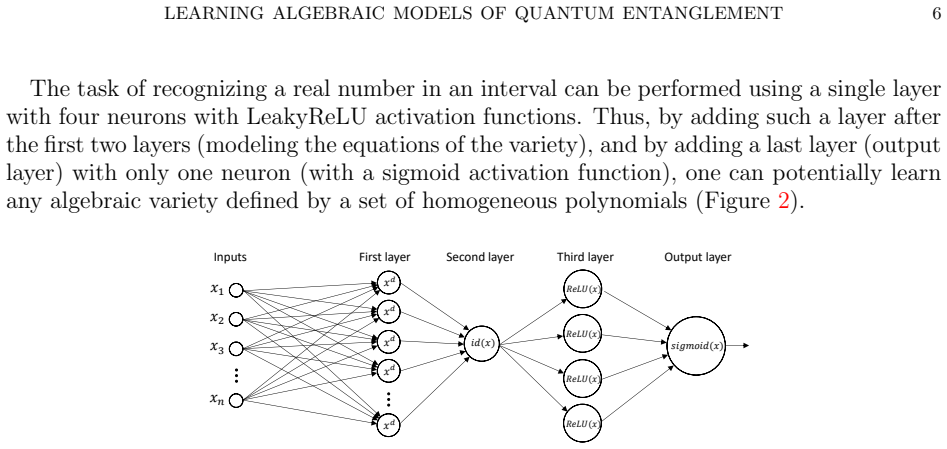
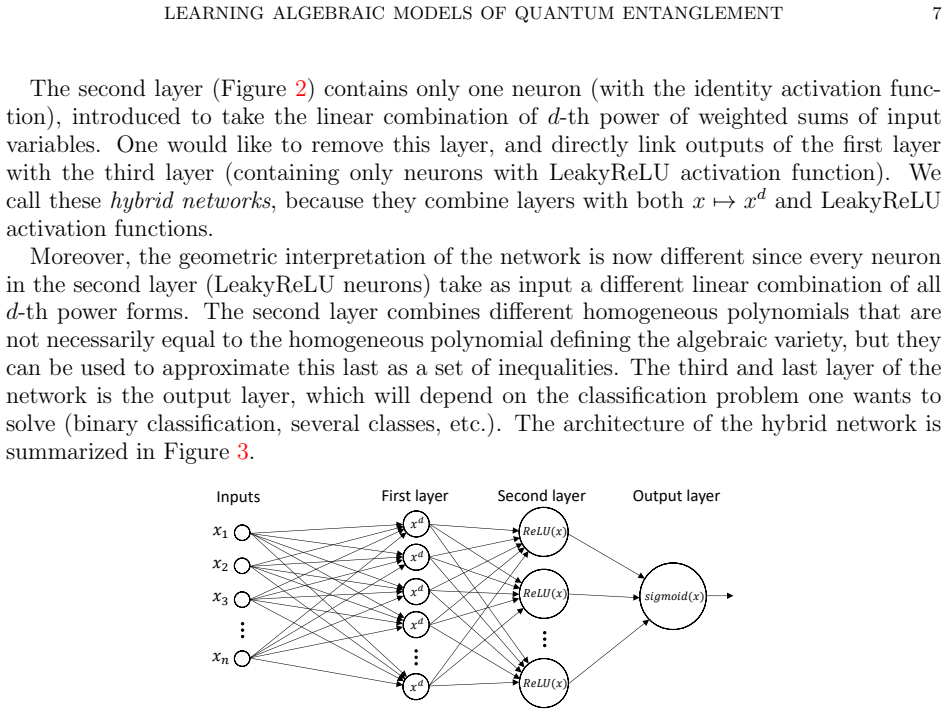
The machinery is the correspondence between entanglement classes and algebraic varieties, combined with neural architectures that can represent the defining polynomials. Separable states form the Segre variety; its dual variety is the zero locus of the hyperdeterminant and parametrizes degenerate states; secant varieties give the border-rank filtration. To learn these, the authors use feed-forward networks whose early layers compute $d$-th powers of linear forms, sized by the Alexander–Hirschowitz theorem, which says a general degree-$d$ form is a sum of roughly $\binom{d+n-1}{d}/n$ $d$-th powers of linear forms, so the network can in principle express the variety's defining polynomial. LeakyReLU and hybrid variants then convert the polynomial value into a binary or multi-class decision. This design is what lets the network approximate membership even when the actual defining equation, such as the degree-128 five-qubit hyperdeterminant, is unavailable.
What would settle it
Construct a five-qubit tensor by zeroing all entries within Hamming distance 1 of $|00000\rangle$, applying a random invertible change of basis in each mode, and renormalizing; this is algebraically guaranteed degenerate. If the trained network labels many such certified-degenerate tensors as non-degenerate, then the claimed equivalence to evaluating the hyperdeterminant fails.
Extended reading notes
Core claim
The central claim is that trained neural networks can act as classifiers for algebraic models of pure-state entanglement without needing the model's defining equations. Concretely, the paper demonstrates three tasks: deciding whether a state is separable, whether it is degenerate, and which border-rank stratum it lies in. The flagship result is the five-qubit degeneracy classifier, which reaches 98.83% test accuracy on real tensors of format $2\times 2\times 2\times 2\times 2$; because a state is degenerate exactly when its hyperdeterminant vanishes, the authors claim this is an original way to evaluate the nullity of the five-qubit hyperdeterminant, for which no efficient explicit evaluation is known. They further show that classifiers can be applied to individual states by sampling SLOCC-equivalent points and taking a consensus vote, and use this to predict that four standard five-qubit states are degenerate while two known non-degenerate states are correctly labeled.
Load-bearing premise
For the border-rank classifiers, the load-bearing premise is that a sum of $k+1$ random rank-one tensors has border rank exactly $k+1$, but such a sum is only guaranteed to have border rank at most $k+1$ and can be lower, so the reported border-rank accuracies depend on these generated labels rather than on verified border rank.
Editorial extensions
If this is right
- A trained five-qubit degeneracy network can label individual states as degenerate or not, so quantum information tasks that need the nullity of the hyperdeterminant can use the network as a proxy.
- The same binary classifiers, combined, distinguish the three-qubit entanglement classes: separable, bi-separable, W, and GHZ.
- The method is presented as generalizing to systems where no complete SLOCC classification or invariant algebra is known, such as five-qubit systems.
- Once trained, evaluating the network is cheaper than computing singular values of flattenings, and flattenings stop detecting rank above the flattening size while a network can be trained to detect higher ranks.
Reading between the lines
- A natural next test is to train the same architecture on formats such as $3\times 3\times 3$ where the hyperdeterminant is computable in principle, and compare against exact labels to calibrate how much of the reported accuracy is genuinely algebraic rather than statistical.
- A testable extension is to generate border-rank training labels from algebraically certified strata rather than random sums of rank-one tensors, which would separate the network's learning capacity from label noise.
- If the five-qubit degeneracy result generalizes, it offers a practical heuristic for algebraic geometry decision problems in which the defining discriminant is known to exist but is computationally out of reach.
Signed reviews
Editorial analysis
A structured set of objections, weighed in public.
Referee Report
Summary. The paper proposes using supervised neural networks to learn membership on algebraic varieties that classify entanglement types of pure quantum states. It presents classifiers for separability (Segre variety), degeneracy (dual variety / hyperdeterminant zero set), and border rank, for systems up to 5 binary qubits and claims to include 3 qutrits. The central advertised result is a 98.83% test accuracy for distinguishing degenerate from non-degenerate 5-qubit states, which the authors describe as an original method for evaluating the nullity of the 2×5 hyperdeterminant. The paper also reports border-rank classification accuracies of about 84% for 4 qubits and 80% for 5 qubits, with labels generated by summing k+1 rank-one tensors. Predictions for individual states are made by majority voting over randomly SLOCC-transformed copies of the state, with 3-qubit sanity checks against known GHZ, W, and biseparable classes.
Significance. If the main claims were valid, the paper would offer a practical, scalable alternative to computing high-degree invariants such as the 5-qubit hyperdeterminant, and it would extend machine-learning classification of entanglement beyond the 2-qubit and bipartite cases that dominate prior work. The paper has real strengths: the separability experiments in Section 3.1 are grounded in rank-one flattenings; the 3-qubit sanity checks in Figures 5–8 correctly reproduce the known SLOCC classes; and the authors are explicit in Section 3.3.1 that the sampling process is a modeling assumption rather than a guarantee of adversarial robustness. However, the two headline results—an 'original result' for 2×5 hyperdeterminant nullity and border-rank classification—are not supported by the evidence as presented. The external validation for the 5-qubit degeneracy classifier is near chance, and the border-rank labels are not certified. The contribution is therefore currently an interesting proof-of-concept with overclaimed scope rather than an established method.
major comments (4)
- [Section 3.3.2, Tables 5–6] The border-rank labels are not certified. For tensors generated by summing k+1 rank-one tensors, the border rank is at most k+1, and the manuscript does not prove that the random construction lands outside the variety of tensors of border rank at most k almost surely. Since the test set is generated by the identical process, the reported 84% and 80% accuracies in Table 6 measure the network's ability to reproduce the number of summands in the generating process, not necessarily the border rank. The abstract's claim of 'border rank classification' therefore requires either a proof that the labels are exact (for example, by dimension counts for the secant varieties in these formats) or external validation on states whose border rank is certified by independent means.
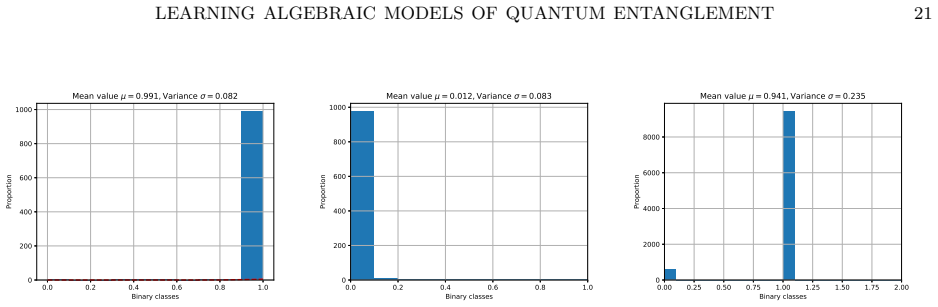
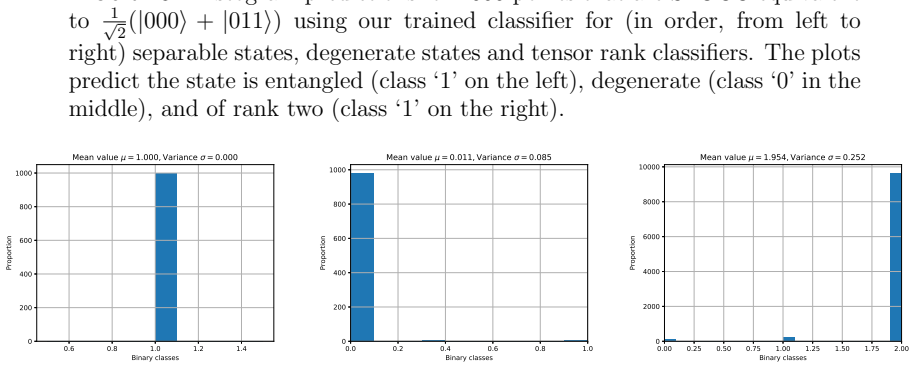
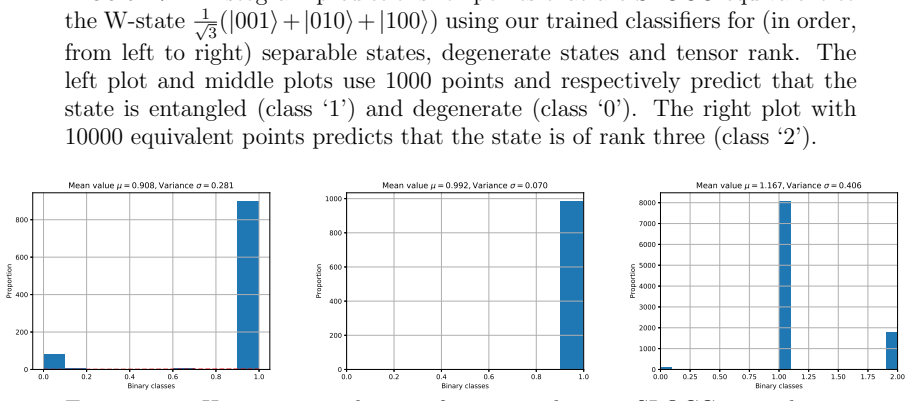
- [Section 4.3, Figures 9–10] The central claim in Section 3.2.3 that the 5-qubit network provides 'an original result for the evaluation of the nullity of the hyperdeterminant for 2×5 real tensors' is not supported by the external validation. For the states |Φ1⟩–|Φ4⟩ the per-sample degenerate vote is only 60.8%, 61.1%, 66.2%, and 66.7%, and for the known non-degenerate states |δ1⟩ and |δ2⟩ the non-degenerate vote is only 63.1% and 66.5%. These are near-chance scores, despite the captions describing the predictions as categorical. The 98.83% test accuracy in Table 4 is measured on data generated by the same sampling procedure used for training, so it does not transfer to the SLOCC orbits used to advertise the result. An independent algebraic certificate for these six states is needed before the nullity claim can be maintained.
- [Section 3.2.1] The sampling procedure for degenerate states is asserted to 'uniformly sample' the degenerate variety, but no proof or reference is given. The authors themselves note in Section 3.3.1 that pushing a uniform sample through a rational parameterization need not produce a uniform sample, and the same caveat applies to applying random SLOCC transformations to a seed in the coordinate subspace. Because the degenerate/non-degenerate classifier is trained and evaluated exclusively on this sampling process, the paper should either prove that the process is representative of the full degenerate variety or substantially weaken the corresponding claims.
- [Abstract and Section 3.3] The abstract states that border-rank classification is demonstrated for 'up to 5 binary qubits and 3 qutrits,' but Section 3.3 contains border-rank experiments only for 2×2×2, 2×4, and 2×5 tensors (Tables 5 and 6). No 3×3×3 border-rank experiment appears anywhere in the manuscript, so the 3-qutrit part of the claim is unsupported.
minor comments (5)
- [Throughout] The notation '2×5' is used for the 5-qubit tensor space C^2⊗C^2⊗C^2⊗C^2⊗C^2 (five factors), which is nonstandard because '2×5' normally denotes a 2-by-5 matrix; this shorthand should be defined explicitly at first use.
- [Figures 9–10] The captions say that all states are predicted degenerate or non-degenerate, but the histograms show majority fractions of only 61–67%; the captions should report the actual vote fractions and the number of orbit points sampled.
- [Section 4.1] The statement that a 'consensus was reached' gives no quantitative threshold; the authors should specify the majority fraction, the sample size, and the variability across repeated SLOCC samples.
- [Table 6] No error bars or repeated training runs are reported; given the variance visible in Figures 9–10, confidence intervals for the accuracies would materially strengthen the presentation.
- [Typos and references] There are several presentation issues: 'the class r correspond' should be 'the class r corresponds'; Example 1 contains 'illustrates illustrates'; and reference [18] contains an unresolved LaTeX insertion ('[Pleaseinsert...]').
Circularity Check
No significant circularity is present: the classifiers are trained on externally grounded algebraic labels, and the weak out-of-distribution evidence is a correctness concern, not a circular reduction.
full rationale
The paper's derivation chain is not circular. Separability labels are certified by the rank-one flattening criterion (Prop. 3.1), and degenerate-state labels are produced from the standard SLOCC-zero-support characterization listed as condition (3) in Sec. 3.2, which is equivalent to hyperdeterminant vanishing; the reported test accuracy is an empirical claim about generalization, not a quantity defined by the network's own outputs. The border-rank labels in Sec. 3.3.2 are assigned by summing r+1 random rank-one tensors and calling the resulting class 'border rank r+1'; although the paper gives no proof, for generic real tensors this construction lands in the open dense part of the (r+1)-st secant variety, so the label is a standard algebraic sampling device rather than a self-referential fit. Self-citations such as [42] and [49] are contextual or corroborated by independent references and do not carry the central argument. The histograms in Sec. 4.3 are weak and arguably contradict the claimed consensus, but a failed out-of-distribution generalization is a correctness issue, not circularity: the prediction is not equivalent by construction to the training labels. Hence no step reduces by definition to its inputs.
Assumptions & free parameters
free parameters (2)
- Trained network weights and biases =
Not disclosed
- Network architecture and training hyperparameters =
e.g., (100,50,25,16,1) layers, Nadam optimizer
assumptions (6)
- standard math A state is separable if and only if all its 1-flattenings have rank 1.
- standard math The Alexander-Hirschowitz theorem gives the generic number of powers of linear forms needed to represent a homogeneous polynomial.
- standard math A tensor is degenerate exactly when its hyperdeterminant vanishes.
- standard math The SLOCC classification of 3-qubit states consists of separable, biseparable, W, and GHZ classes, distinguished by tensor rank and the Cayley hyperdeterminant.
- ad hoc to paper Applying random SLOCC transformations to one degenerate seed produces a representative sample of the full degenerate variety.
- ad hoc to paper A sum of k+1 random rank-one tensors has border rank exactly k+1.
Cite this review
Pith. "Pith review of Learning Algebraic Models of Quantum Entanglement." pith.science (2026). https://pith.science/paper/E6ZUJLUD
@misc{pith2026190810247,
  author       = {Pith},
  title        = {Pith review of: Learning Algebraic Models of Quantum Entanglement},
  year         = {2026},
  howpublished = {\url{https://pith.science/paper/E6ZUJLUD}},
  note         = {Machine review of arXiv:1908.10247}
}
read the original abstract
We review supervised learning and deep neural network design for learning membership on algebraic varieties. We demonstrate that these trained artificial neural networks can predict the entanglement type for quantum states. We give examples for detecting degenerate states, as well as border rank classification for up to 5 binary qubits and 3 qutrits (ternary qubits).
Figures

Figures from the paper (7 more)




Reference graph
Works this paper leans on
-
[1]
H. Abo, G. Ottaviani, and C. Peterson, Induction for secant varieties of Segre varieties , Trans. Amer. Math. Soc. 361 (2009), no. 2, 767–792
2009
-
[2]
Anthony and P
M. Anthony and P. L Bartlett, Neural network learning: Theoretical foundations, Cambridge University Press, 2009
2009
-
[3]
Barron and R
A. Barron and R. Barron, Statistical learning networks: A unifying view , Proceedings of the 20th Symposium Computer Science and Statistics (1988)
1988
-
[4]
K. Baur, J. Draisma, and W. A. de Graaf, Secant dimensions of minimal orbits: computations and conjectures, Experiment. Math. 16 (2007), no. 2, 239–250
2007
-
[5]
M. J. S. Beach, I. D. Vlugt, A. Golubeva, P. Huembeli, B. Kulchytskyy, X. Luo, R. G. Melko, E. Merali, and G. Torlai, QuCumber: wavefunction reconstruction with neural networks , SciPost Phys. 7 (2019), 9
2019
-
[6]
E. C. Behrman and J. E. Steck, Dynamic learning of pairwise and three-way entanglement , 2011 Third World Congress on Nature and Biologically Inspired Computing, 2011, pp. 99–104
2011
-
[7]
Belkin, D
M. Belkin, D. Hsu, S. Ma, and S. Mandal, Reconciling modern machine-learning practice and the classical bias–variance trade-off, PNAS 116 (2019), no. 32, 15849–15854
2019
-
[8]
Berkovits, Extracting many-particle entanglement entropy from observables using supervised ma- chine learning, Phys
R. Berkovits, Extracting many-particle entanglement entropy from observables using supervised ma- chine learning, Phys. Rev. B 98 (2018), no. 24
2018
Show all 105 references
-
[9]
Biamonte, P
J. Biamonte, P. Wittek, N. Pancotti, P. Rebentrost, N. Wiebe, and S. Lloyd, Quantum machine learn- ing, Nature 549 (2017), no. 7671, 195–202 (English (US))
2017
-
[10]
D. Bini, M. Capovani, F. Romani, and G. Lotti, O(n2.7799) complexity for n× n approximate matrix multiplication, Inform. Process. Lett. 8 (1979), no. 5, 234–235
1979
-
[11]
C. M. Bishop, Neural networks for pattern recognition, Oxford University Press, Inc., USA, 1995
1995
-
[12]
Borne, M
P. Borne, M. Benrejeb, and J. Hagg` ege,Les r´ eseaux de neurones: pr´ esentation et applications, Vol. 15, Editions OPHRYS, 2007
2007
-
[13]
M. C. Brambilla and G. Ottaviani, On the alexander–hirschowitz theorem, Journal of Pure and Applied Algebra 212 (2008), no. 5, 1229–1251
2008
-
[14]
Breiding, S
P. Breiding, S. Kaliˇ snik, B. Sturmfels, and M. Weinstein, Learning algebraic varieties from samples , Revista Matem´ atica Complutense31 (2018), no. 3, 545–593
2018
-
[15]
Brylinski, Algebraic measures of entanglement , Mathematics of quantum computation, 2002, pp
J.-L. Brylinski, Algebraic measures of entanglement , Mathematics of quantum computation, 2002, pp. 19–40
2002
-
[16]
Carlini, N
E. Carlini, N. Grieve, and L. Oeding, Four lectures on secant varieties , Connections between algebra, combinatorics, and geometry, 2014, pp. 101–146
2014
-
[17]
M. Che, L. Qi, Y. Wei, and G. Zhang, Geometric measures of entanglement in multipartite pure states via complex-valued neural networks , Neurocomputing 313 (2018), 25–38
2018
-
[18]
Chen and D
L. Chen and D. [Pleaseinsert“PrerenderUnicode–˝intopreamble]. ¯Dokovi´ c,Proof of the Gour-Wallach conjecture, Phys. Rev. A 88 (2013), no. 4
2013
-
[19]
Cheng, B
X. Cheng, B. Khomtchouk, N. Matloff, and P. Mohanty, Polynomial regression as an alternative to neural nets (2018). arXiv:1806.06850
2018 arXiv
-
[20]
Chiantini, G
L. Chiantini, G. Ottaviani, and N. Vannieuwenhoven, An algorithm for generic and low-rank specific identifiability of complex tensors , SIAM J. Math. Anal. 35 (2014), no. 4, 1265–1287. LEARNING ALGEBRAIC MODELS OF QUANTUM ENTANGLEMENT 17
2014
-
[21]
Chollet et al., Keras, 2015
F. Chollet et al., Keras, 2015. Available at https://keras.io
2015
-
[22]
Chterental and D
O. Chterental and D. Z. Djokovic, Normal forms and tensor ranks of pure states of four qubits (2006). arXiv:quant-ph/0612184
2006 arXiv
-
[23]
Cirrincione and M
G. Cirrincione and M. Cirrincione, Neural-based orthogonal data fitting: The EXIN neural networks , Vol. 66, John Wiley & Sons, 2011
2011
-
[24]
B. C. Cs´ aji et al., Approximation with artificial neural networks , Faculty of Sciences, Etvs Lornd University, Hungary 24 (2001), no. 48, 7
2001
-
[25]
Cybenko, Approximation by superpositions of a sigmoidal function, Mathematics of Control, Signals, and Systems 5 (1989), no
G. Cybenko, Approximation by superpositions of a sigmoidal function, Mathematics of Control, Signals, and Systems 5 (1989), no. 4, 455–455
1989
-
[26]
Dadok and V
J. Dadok and V. Kac, Polar representations, J. Algebra 92 (1985), no. 2, 504–524
1985
-
[27]
de Silva and L.-H
V. de Silva and L.-H. Lim, Tensor rank and the ill-posedness of the best low-rank approximation problem, SIAM J. Matrix Anal. Appl. 30 (2008), 1084–1127
2008
-
[28]
Dozat, Incorporating Nesterov momentum into Adam, 2016
T. Dozat, Incorporating Nesterov momentum into Adam, 2016. Available at http://cs229.stanford. edu/proj2015/054_report.pdf
2016
-
[29]
Dreyfus, J-M Martinez, M
G. Dreyfus, J-M Martinez, M. Samuelides, M. B Gordon, F. Badran, S. Thiria, and L. H´ erault,R´ eseaux de neurones-m´ ethodologie et applications, Eyrolles, 2002
2002
-
[30]
O Duda, P
R. O Duda, P. E Hart, et al., Pattern classification and scene analysis , Vol. 3, Wiley New York, 1973
1973
-
[31]
Dufresne, P
E. Dufresne, P. Edwards, H. Harrington, and J. Hauenstein, Sampling real algebraic varieties for topo- logical data analysis, 2019 18th IEEE International Conference On Machine Learning And Applications (ICMLA), 2019, pp. 1531–1536
2019
-
[32]
D¨ ur, G
W. D¨ ur, G. Vidal, and J. I. Cirac, Three qubits can be entangled in two inequivalent ways , Phys. Rev. A 62 (2000), 062314
2000
-
[33]
I. M. Gelfand, M. M. Kapranov, and A. V. Zelevinsky, Discriminants, resultants, and multidimensional determinants, Mathematics: Theory & Applications, Boston: Birkh¨ auser, Boston, MA, 1994
1994
-
[34]
G. J. Gibson and C. F. N. Cowan, On the decision regions of multilayer perceptrons , Proc. IEEE 78 (1990), no. 10, 1590–1594
1990
-
[35]
Gour and N
G. Gour and N. R Wallach, All maximally entangled four-qubit states , J. Math. Phys. 51 (2010), no. 11, 112201
2010
-
[36]
Govender, Determination of quantum entanglement concurrence using multilayer perceptron neural networks., Ph.D
Lishen. Govender, Determination of quantum entanglement concurrence using multilayer perceptron neural networks., Ph.D. Thesis, 2017
2017
-
[37]
J. Gray, L. Banchi, A. Bayat, and S. Bose, Machine-learning-assisted many-body entanglement mea- surement, Phys. Rev. Lett. 121 (2018), no. 15
2018
-
[38]
Hanin, Universal function approximation by deep neural nets with bounded width and ReLU activa- tions, Mathematics 7 (2019), no
B. Hanin, Universal function approximation by deep neural nets with bounded width and ReLU activa- tions, Mathematics 7 (2019), no. 10, 992
2019
-
[39]
H Hassoun et al., Fundamentals of artificial neural networks , MIT press, 1995
M. H Hassoun et al., Fundamentals of artificial neural networks , MIT press, 1995
1995
-
[40]
Haykin, Neural networks: a comprehensive foundation , Prentice hall, 1999
S. Haykin, Neural networks: a comprehensive foundation , Prentice hall, 1999
1999
-
[41]
Hern´ andez-Mederos and J
V. Hern´ andez-Mederos and J. Estrada-Sarlabous, Sampling points on regular parametric curves with control of their distribution , Computer Aided Geometric Design 20 (2003), no. 6, 363–382
2003
-
[42]
Holweck and H
F. Holweck and H. Jaffali, Three-qutrit entanglement and simple singularities , J. Physics A 49 (2016), no. 46, 465301
2016
-
[43]
Holweck, H
F. Holweck, H. Jaffali, P. Levay, and J.-G. Luque, Maximally entangled symmetric states , (in prepara- tion) (2019)
2019
-
[44]
Holweck, H
F. Holweck, H. Jaffali, and I. Nounouh, Grover’s algorithm and the secant varieties , Quantum Infor- mation Processing 15 (2016), no. 11, 4391–4413
2016
-
[45]
Holweck, J.-G
F. Holweck, J.-G. Luque, and M. Planat, Singularity of type d4 arising from four qubit systems , J. Physics A 47 (2014), no. 13, 135301
2014
-
[46]
Holweck, J.-G
F. Holweck, J.-G. Luque, and J.-Y. Thibon, Geometric descriptions of entangled states by auxiliary varieties, J. Math. Phys. 53 (2012), no. 10, 102203
2012
-
[47]
Holweck, J.-G
F. Holweck, J.-G. Luque, and J.-Y. Thibon, Entanglement of four-qubit systems: A geometric atlas with polynomial compass ii (the tame world) , J. Math. Phys. 58 (2017), no. 2, 022201
2017
-
[48]
Holweck, J.-G
F. Holweck, J.-G. Luque, and J.-Y. Thibon, Entanglement of four qubit systems: A geometric atlas with polynomial compass i (the finite world) , J. Math. Phys. 55 (2014), no. 1, 12202
2014
-
[49]
Holweck and L
F. Holweck and L. Oeding, Hyperdeterminants from the E8 Discriminant (2018). arXiv:1810.05857. LEARNING ALGEBRAIC MODELS OF QUANTUM ENTANGLEMENT 18
2018
-
[50]
Hornik, Approximation capabilities of multilayer feedforward networks , Neural Networks 4 (1991), no
K. Hornik, Approximation capabilities of multilayer feedforward networks , Neural Networks 4 (1991), no. 2, 251–257
1991
-
[51]
Huggins, B
P. Huggins, B. Sturmfels, J. Yu, and D. Yuster, The hyperdeterminant and triangulations of the 4-cube , Math. Comp. 77 (2008), no. 263, 1653–1679
2008
-
[52]
A. G. Ivakhnenko, Polynomial theory of complex systems , IEEE Transactions on Systems, Man, and Cybernetics 4 (1971), 364–378
1971
-
[53]
Jaffali and F
H. Jaffali and F. Holweck, Quantum entanglement involved in Grover’s and Shor’s algorithms: the four-qubit case, Quantum Information Processing 18 (2019), no. 5, 133
2019
-
[54]
Kac, Some remarks on nilpotent orbits , J
V. Kac, Some remarks on nilpotent orbits , J. Algebra 64 (1980), no. 1, 190–213
1980
-
[55]
Kerenidis, J
I. Kerenidis, J. Landman, A. Luongo, and A. Prakash, q-means: A quantum algorithm for unsupervised machine learning, Advances in neural information processing systems, 2019, pp. 4136–4146
2019
-
[56]
Khanna, Foundations of neural networks , Reading: Addison Wesley (1990)
T. Khanna, Foundations of neural networks , Reading: Addison Wesley (1990)
1990
-
[57]
Kileel, M
J. Kileel, M. Trager, and J. Bruna, On the expressive power of deep polynomial neural networks , Advances in neural information processing systems, 2019, pp. 10310–10319
2019
-
[58]
S. Y. Kung, K. Diamantaras, W. D. Mao, and J. S. Taur, Generalized perceptron networks with non- linear discriminant functions , Neural Networks (1992), 245–279
1992
-
[59]
J. M. Landsberg, Tensors: geometry and applications , Graduate Studies in Mathematics, vol. 128, American Mathematical Society, Providence, RI, 2012
2012
-
[60]
, Geometry and complexity theory , Cambridge Studies in Advanced Mathematics, Cambridge University Press, 2017
2017
-
[61]
1, 013008
B P Lanyon and N K Langford, Experimentally generating and tuning robust entanglement between photonic qubits, New Journal of Physics 11 (2009jan), no. 1, 013008
-
[62]
Li and E
H.-X. Li and E. S. Lee, Interpolation functions of feedforward neural networks , Computers & Mathe- matics With Applications 46 (2003), no. 12, 1861–1874
2003
-
[63]
R. P. Lippmann, An introduction to computing with neural nets , ACM Sigarch Computer Architecture News 16 (1988), no. 1, 7–25
1988
-
[64]
Llanas and F
B. Llanas and F. J. Sainz, Constructive approximate interpolation by neural networks , J. Comput. Appl. Math. 188 (2006), no. 2, 283–308
2006
-
[65]
Lloyd, M
S. Lloyd, M. Mohseni, and P. Rebentrost, Quantum principal component analysis , Nature Physics 10 (2014), no. 9, 631–633
2014
-
[66]
S. Lu, S. Huang, K. Li, J. Li, J. Chen, D. Lu, Z. Ji, Y. Shen, D. Zhou, and B. Zeng, Separability- entanglement classifier via machine learning , Phys. Rev. A 98 (2018), no. 1
2018
-
[67]
Z. Lu, H. Pu, F. Wang, Z. Hu, and L. Wang, The expressive power of neural networks: A view from the width, neural information processing systems (2017), 6231–6239
2017
-
[68]
Luque and J.-Y
J.-G. Luque and J.-Y. Thibon, Polynomial invariants of four qubits , Phys. Rev. A 67 (2003), no. 4, 42303
2003
-
[69]
Physics A 39 (2006), no
, Algebraic invariants of five qubits , J. Physics A 39 (2006), no. 2, 371–377
2006
-
[70]
Ma and M.-H
Y.-C. Ma and M.-H. Yung, Transforming Bell’s inequalities into state classifiers with machine learning, npj Quantum Information 4 (2018), no. 1, 34
2018
-
[71]
W. S. McCulloch and W. Pitts, A logical calculus of the ideas immanent in nervous activity , Bull. Math. Biol. 52 (1990), no. 4, 99–115
1990
-
[72]
Miyake, Classification of multipartite entangled states by multidimensional determinants, Phys
A. Miyake, Classification of multipartite entangled states by multidimensional determinants, Phys. Rev. A 67 (2003), 012108
2003
-
[73]
Miyake and F
A. Miyake and F. Verstraete, Multipartite entanglement in 2 × 2× n quantum systems , Phys. Rev. A 69 (2004), no. 1, 12101
2004
-
[74]
Miyake and M
A. Miyake and M. Wadati, Multipartite entanglement and hyperdeterminants , Quantum Information & Computation 2 (2002), no. 7, 540–555
2002
-
[75]
H. P. Nautrup, N. Delfosse, V. Dunjko, H. J Briegel, and N. Friis, Optimizing quantum error correction codes with reinforcement learning, Quantum 3 (2019), 215
2019
-
[76]
M. A. Nielsen and I. L. Chuang, Quantum computation and quantum information: 10th anniversary edition, 10th ed., Cambridge University Press, New York, NY, USA, 2011
2011
-
[77]
S.-K. Oh, W. Pedrycz, and B.-J. Park, Polynomial neural networks architecture: analysis and design , Computers & Electrical Engineering 29 (2003), no. 6, 703 –725. LEARNING ALGEBRAIC MODELS OF QUANTUM ENTANGLEMENT 19
2003
-
[78]
H. C. Ong, C., L. Chee Kang, and Y. Yeow Wui, Non linear approximations using multi-layered per- ceptions and polynomial regressions, Proceedings of the 2nd IMT-GT Regional Conference on Mathe- matics, Statistics and Applications, Universiti Sains Malaysia, Penang, June 13-15 (2006)
2006
-
[79]
Osterloh and J
A. Osterloh and J. Siewert, Entanglement monotones and maximally entangled states in multipartite qubit systems, International Journal of Quantum Information 4 (2006), no. 3, 531–540
2006
-
[80]
Pagani and P
L. Pagani and P. J. Scott, Curvature based sampling of curves and surfaces, Computer Aided Geometric Design 59 (2018), 32–48
2018
-
[81]
Y. Quek, S. Fort, and H. K. Ng, Adaptive quantum state tomography with neural networks. (2018). arXiv:1812.06693
2018 arXiv
-
[82]
Raturi, Large data analysis via interpolation of functions: Interpolating polynomials vs artificial neural networks, American Journal of Intelligent Systems 8 (2018), no
R. Raturi, Large data analysis via interpolation of functions: Interpolating polynomials vs artificial neural networks, American Journal of Intelligent Systems 8 (2018), no. 1, 6–11
2018
-
[83]
Rebentrost, M
P. Rebentrost, M. Mohseni, and S. Lloyd, Quantum support vector machine for big data classification , Phys. Rev. Lett. 113 (2014), no. 13, 130503
2014
-
[84]
Schuld, I
M. Schuld, I. Sinayskiy, and F. Petruccione, The quest for a quantum neural network , Quantum Infor- mation Processing 13 (2014), no. 11, 2567–2586
2014
-
[85]
2, 172– 185
, An introduction to quantum machine learning , Contemporary Physics 56 (2015), no. 2, 172– 185
2015
-
[86]
Segre, Sulle corrispondenze quadrilineari tra forme di 1.a specie e su alcune loro rappresentazioni spaziali, Annali Mat
C. Segre, Sulle corrispondenze quadrilineari tra forme di 1.a specie e su alcune loro rappresentazioni spaziali, Annali Mat. pura ed applicata 29 (1920), 105–140 (Italian)
1920
-
[87]
Sheng and L
Y.-B. Sheng and L. Zhou, Distributed secure quantum machine learning , Science Bulletin 62 (2017), no. 14, 1025–1029
2017
-
[88]
Shin and J
Y. Shin and J. Ghosh, Approximation of multivariate functions using ridge polynomial networks , Pro- ceedings 1992 IJCNN international joint conference on neural networks, 1992, pp. 380–385
1992
-
[89]
3, 610–622
, Ridge polynomial networks, IEEE Transactions on Neural Networks 6 (1995), no. 3, 610–622
1995
-
[90]
D. F. Specht, Generation of polynomial discriminant functions for pattern recognition , IEEE Transac- tions on Electronic Computers 16 (1967), no. 3, 308–319
1967
-
[91]
Sutskever, J
I. Sutskever, J. Martens, G. E. Dahl, and G. E. Hinton, On the importance of initialization and momentum in deep learning , Proceedings of the 30th international conference on machine learning, 2013, pp. 1139–1147
2013
-
[92]
Vemuri, Artificial neural networks: concepts and control applications , Los Alamitos, CA: IEEE Computer Society Press (1992)
V R. Vemuri, Artificial neural networks: concepts and control applications , Los Alamitos, CA: IEEE Computer Society Press (1992)
1992
-
[93]
Verstraete, J Dehaene, B D
F. Verstraete, J Dehaene, B D. Moor, and H. Verschelde, Four qubits can be entangled in nine different ways, Phys. Rev. A 65 (2002), no. 5, 52112
2002
-
[94]
`E. B. Vinberg and A. G. `Elaˇ svili,A classification of the three-vectors of nine-dimensional space, Trudy Sem. Vektor. Tenzor. Anal. 18 (1978), 197–233
1978
-
[95]
Wang, Learning to detect entanglement (2017)
B. Wang, Learning to detect entanglement (2017). arXiv:1709.03617
2017 arXiv
-
[96]
Wang and D
L. Wang and D. L. Alkon, Artificial neural networks: oscillations, chaos, and sequence processing , Neural Networks Technology Series, IEEE Computer Society Press, 1993
1993
-
[97]
Weyman and A
J. Weyman and A. Zelevinsky, Singularities of hyperdeterminants , Ann. Inst. Fourier (Grenoble) 46 (1996), no. 3, 591–644
1996
-
[98]
Widrow and M
B. Widrow and M. A. Lehr, 30 years of adaptive neural networks: perceptron, madaline, and backprop- agation, Proc. IEEE 78 (1990), no. 9, 1415–1442
1990
-
[99]
Wiebe, D
N. Wiebe, D. Braun, and S. Lloyd, Quantum algorithm for data fitting , Phys. Rev. Lett. 109 (2012), 050505
2012
-
[100]
Wiebe, A
N. Wiebe, A. Kapoor, and K. M. Svore, Quantum deep learning , Quantum Info. Comput. 16 (2016), no. 7-8, 541–587
2016
-
[101]
Wi´ sniewska and M
J. Wi´ sniewska and M. Sawerwain, Detecting entanglement in quantum systems with artificial neural network, Intelligent information and database systems, 2015, pp. 358–367
2015
-
[102]
I. H. Witten, E. Frank, M. A. Hall, and C. J. Pal, Data mining, fourth edition: Practical machine learning tools and techniques , 4th ed., Morgan Kaufmann Publishers Inc., San Francisco, CA, USA, 2016
2016
-
[103]
Wossnig and S
L. Wossnig and S. Severini, Quantum machine learning: Challenges and opportunities , Bulletin of the American Physical Society (2019). LEARNING ALGEBRAIC MODELS OF QUANTUM ENTANGLEMENT 20
2019
-
[104]
W. Xu, X. Zhao, and G. Long, Efficient generation of multi-photon w states by joint-measurement , Progress in Natural Science 18 (2008), no. 1, 119 –122
2008
-
[105]
Yang, C.-l
M. Yang, C.-l. Ren, Y.-c. Ma, Y. Xiao, X.-J. Ye, L.-L. Song, J.-S. Xu, M.-H. Yung, C.-F. Li, and G.-C. Guo, Experimental simultaneous learning of multiple nonclassical correlations , Phys. Rev. Lett. 123 (2019), no. 19, 190401. Histograms 0.0 0.5 1.0 1.5 2.0 2.5 3.0 3.5 4.0 Bi...
2019
Reviewed August 14, 2026 · model on record in the stance chip above.
Discussion (0). Continue with ORCID to comment.