REVIEW 4 major objections 5 minor 51 references
Magnetoelastic coupling in stripe-domain states of yttrium iron garnet
T0 review · 4 major / 5 minor · reviewed 2026-08-12 · deepseek-v4-flash
Pith's one-line read In stripe-domain YIG, strong local magnon-phonon coupling hides behind 99% coherent cancellation.
desk verdict Solid experimental observation of a phonon comb in stripe-domain YIG, with a plausible but not yet quantitatively secured cancellation mechanism. read the letter →
The pith
A machine-rendered reading of the paper's core claim, the machinery that carries it, and where it could break.
The reading
What carries the argument
The central object is the projected two-dimensional magnetoelastic overlap integrand $I^{2D}_{xy,i}(x,y)=\epsilon_{xy,n}(x,y)[m^0_x\,\delta m^*_{y,i}+m^0_y\,\delta m^*_{x,i}]$, integrated over the YIG cross-section to form the coherent projected overlap $I^{2D}_{xy,i}=\int_{A_\mathrm{YIG}} I^{2D}_{xy,i}\,\mathrm{d}A$, with the absolute value taken only after integration so that destructive interference survives. The cancellation is quantified by $\eta_i = |\int I^{2D}_{xy,i}\,\mathrm{d}A|/\int |I^{2D}_{xy,i}|\,\mathrm{d}A$, the fraction of absolute local overlap that remains coherent. This overlap metric is combined with a coupled harmonic-oscillator model for the magnon-phonon response and a fully coupled finite-element model of the YIG/GGG/YIG heterostructure, and together they explain both the weak experimental coupling and the mode-selective launching of propagating shear phonons.
What would settle it
A full three-dimensional finite-element overlap calculation that includes all shear-strain channels and a realistically relaxed stripe texture, using the same material parameters and drive, would settle the claim: if the coherent survival fraction for the lowest three modes comes out near unity rather than $10^{-3}$, the cancellation mechanism is wrong.
Extended reading notes
Core claim
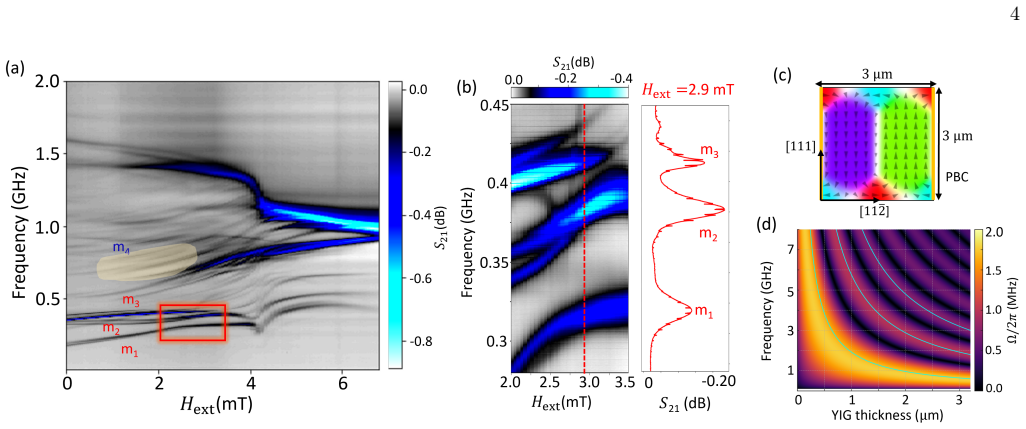
The central claim is that weak magnetoelastic coupling in the stripe-domain state is a cancellation phenomenon. The local magnetoelastic interaction, carried by the shear magnetoelastic constant $B_2$ and the $\epsilon_{xy}$ strain channel, is strong throughout the YIG film, but the overlap integrand changes sign between neighboring domains and oscillates in phase across domain-wall regions, so the net coherent integral collapses. Quantitatively, the survival fraction $\eta_i$ (the ratio of the coherent integral to the integral of the absolute local overlap) is $1.49\times10^{-3}$, $5.37\times10^{-3}$, and $3.09\times10^{-3}$ for the three lowest modes, meaning more than 99% of the local overlap is canceled. The measured coupling rates and sub-unity cooperativities follow from this cancellation, and the fully coupled simulations confirm that the net interfacial strain launched into the substrate is governed by the spatial symmetry of the dynamic magnetization, not by the local coupling strength.
Load-bearing premise
The load-bearing assumption is that the two-dimensional finite-element overlap calculation, which keeps only the $\epsilon_{xy}$ shear channel and assumes ideal translationally invariant stripe domains, captures the full three-dimensional magnetoelastic overlap; the paper itself notes that it reproduces the overall scale and mode dependence but not the detailed mode-by-mode ordering.
Editorial extensions
If this is right
- The weak-coupling regime ($C\sim10^{-1}$) means the observable signature of magnon-phonon interaction in stripe-domain YIG is a phonon-comb modulation rather than a resolved avoided crossing.
- Because the interaction is limited by the broad magnon linewidths (5.8–9.0 MHz) rather than by the narrow phonon linewidth (0.14 MHz), reducing magnon inhomogeneous broadening is a direct route toward stronger effective coupling.
- If cancellation is tied to the stripe texture, then altering the texture through field history, strain, or lateral patterning should tune the net magnetoelastic coupling.
- The simulated remote excitation of a second YIG layer, at $10^{-4}$–$10^{-3}$ of the driven amplitude, shows that long-lived GGG shear phonons can transfer dynamics across the substrate even in the weak-coupling regime.
- Only magnon modes with spatially asymmetric dynamic displacement produce net interfacial strain and launch propagating phonons; spatially symmetric modes cancel and remain dark to the phonon field.
Reading between the lines
- A testable consequence is that deliberately breaking the stripe symmetry—by tilting the field, patterning the film, or writing domain walls—should recover a large fraction of the hidden coupling, effectively switching magnon-phonon coupling on and off.
- If the mechanism is generic, the same cancellation argument should apply to other nonuniform magnetic textures such as vortex cores, bubble lattices, and labyrinth domains, giving a design rule: net coupling is controlled by the Fourier content of the texture that matches the phonon strain profile.
- The 2D projected calculation omits the $\epsilon_{yz}$ and $\epsilon_{zx}$ shear channels; a full 3D overlap calculation with a realistic relaxed texture could either confirm the $10^{-3}$ survival fraction or correct the mode ordering.
- Because the cancellation is coherence-limited rather than dissipation-limited, placing the YIG/GGG structure in a high-Q acoustic cavity or a periodic array might turn the suppressed coupling into an enhanced, resonant transduction channel.
Editorial analysis
A structured set of objections, weighed in public.
Referee Report
Summary. The manuscript reports broadband FMR measurements on a 3-µm YIG film on a GGG substrate in a low-field stripe-domain state. A field-independent periodic modulation with spacing 3.54 MHz is observed and identified as a comb of confined thickness-shear phonon modes, with a predicted free spectral range of 3.51 MHz. The authors fit the peak–dip features with a coupled harmonic-oscillator model, extracting coupling rates g = 0.33–0.54 MHz and cooperativities C = 0.08–0.35. To explain the weak coupling, they perform 2D finite-element/micromagnetic overlap calculations and introduce a projected overlap metric η, concluding that more than 99% of the local magnetoelastic overlap cancels across the stripe texture. Fully coupled YIG/GGG/YIG simulations show phonon-mediated remote excitation of a second YIG layer and suggest that propagating-phonon generation requires spatially asymmetric magnon modes.
Significance. The experimental observation of the field-independent phonon comb, with a FSR matching the thickness-shear prediction to within about 1%, is solid and lends support to the identification of confined shear phonons. The proposed mechanism, if quantitatively established, would be conceptually interesting: magnetic texture would become a control parameter for magnon–phonon coupling, and the design rule for asymmetric magnon modes would guide future devices. The manuscript is clearly written and the combination of FMR, analytical fitting, and finite-element modelling is appropriate. However, the central quantitative claim of >99% cancellation is not yet supported by the calculation as presented.
major comments (4)
- [Section III, Eqs. (9)–(12)] The central cancellation claim rests on the two-dimensional projected metric I^2D_xy,i, which retains only the ε_xy shear channel from the full linearized magnetoelastic energy density in Eq. (9). The omitted ε_yz and ε_zx terms have the same prefactor 2B2 and involve m0y δm_z + m0z δm_y and m0z δm_x + m0x δm_z; no bound is given to show that the xy projection dominates the signed overlap. Because η_i is a ratio of a signed integral to an absolute integral, a small numerator in the xy projection does not imply a small full overlap. The >99% cancellation statement in the abstract and conclusions therefore needs a 3D evaluation or a justified inequality.
- [Section III, Table I and Eq. (12)] The measured coupling rates order as g3 > g2 > g1, while the computed η values order as η2 > η3 > η1. The paper acknowledges in Section III that the 2D calculation 'reproduces the overall scale and mode dependence of the coupling, but not the detailed mode-by-mode ordering.' Since the mode dependence of the coupling is one of the main experimental results, a metric that fails to reproduce the ordering cannot quantitatively explain the measured weak coupling; at present it provides only qualitative support.
- [Section III, Eq. (7) and text following Eq. (11)] The text states that the absolute coupling strength is taken from the experimental peak–dip splitting and that I^2D_xy,i is used only as a relative projected overlap metric. There is no direct comparison between the computed overlap (or a 3D extension) and the extracted g_i,n values. Without such a comparison, the claim that the cancellation mechanism is responsible for the measured weak coupling is not quantitatively validated.
- [Section II, Eq. (5)] The 'sizable local magnetoelastic coupling' is supported by Eq. (5), which assumes a uniformly out-of-plane magnetized film. The actual film is in a stripe-domain state, and the authors note that Eq. (5) should be an upper bound. It would be helpful to state whether the local (non-cancelled) coupling is computed directly in the stripe state, e.g., from the absolute overlap denominator in Eq. (12), or whether it is only inferred from the uniform-film expression.
minor comments (5)
- [Section III, after Fig. 5] The word 'YIg' appears in the sentence about phonon-mediated coupling between the two layers; it should be 'YIG'.
- [Section II, COMSOL description] 'COMSOL Multiphysicsv. 6.2' is missing a space; it should read 'COMSOL Multiphysics v. 6.2'.
- [Eq. (1)] The second line defines the phonon amplitude response to magnon mode i, but for multiple magnon modes a sum over i in the u_n equation would make the reciprocal coupling explicit; please clarify the notation.
- [Eq. (6) and Table I] Please state explicitly whether the fitted Γ corresponds to the κ_m used in Eq. (1) and Table I, since Γ is called a half-width parameter.
- [Fig. 2(d)] The color axis and units for the calculated coupling strength are not labelled; please add the axis label and scale.
Circularity Check
No significant circularity: the FSR prediction and the overlap-cancellation mechanism use independent inputs, not the measured coupling.
full rationale
The claimed derivation chain is self-contained against external benchmarks. The phonon-comb spacing is predicted from the thickness-shear FSR formula, delta_f_ph = v_T/[2(d+s)], with a literature transverse sound velocity for GGG and known layer thicknesses, giving 3.51 MHz versus the measured 3.54 MHz; no measured coupling rate enters this prediction. The coupling rates g_i,n in Table I are extracted by fitting the peak-dip spectra, but they are not used as inputs to the overlap calculation. The cancellation metric eta in Eq. (12) is computed from finite-element solutions for the dynamic magnetization and strain using literature magnetoelastic constants and a micromagnetic equilibrium texture; the measured g values are used only for later comparison. The stripe-domain equilibrium is drawn from the authors' prior work (Ref. [41]), but the stripe state is also directly observed in the present spectrum and qualitatively reproduced by micromagnetic simulation, so this self-citation is not load-bearing and does not force the weak-coupling conclusion. The acknowledged limitations of the two-dimensional, epsilon_xy-only overlap and the imperfect mode-order match (eta_2 > eta_3 > eta_1 versus g_3 > g_2 > g_1) are quantitative accuracy concerns, not circular steps: a projected 2D metric can fail to reproduce mode ordering without the conclusion being equivalent to its inputs. No parameter fitted to the target claim is renamed as a prediction, and no uniqueness theorem is imported from the authors' prior work. Therefore the derivation does not reduce to its own inputs by construction.
Assumptions & free parameters
free parameters (5)
- Magnon-phonon coupling rate g for mode m1 =
0.33 +/- 0.01 MHz
- Magnon-phonon coupling rate g for mode m2 =
0.40 +/- 0.04 MHz
- Magnon-phonon coupling rate g for mode m3 =
0.54 +/- 0.03 MHz
- Effective magnon linewidth kappa_m for modes m1-m3 =
8.99, 8.39, 5.84 MHz
- Phonon linewidth kappa_ph =
0.14 MHz
assumptions (5)
- standard math Coupled harmonic oscillator model (Eq. 1) with reciprocal coupling between magnon and phonon modes.
- standard math Frequency-domain magnetoelastic field (Eq. 2) with cubic magnetoelastic constants B1, B2.
- domain assumption The stripe-domain equilibrium m0 from micromagnetic simulation is representative of the experimental state at H_ext = 2.72 mT.
- domain assumption The 2D x-y cross-section, retaining only the epsilon_xy shear channel, captures the dominant magnetoelastic overlap.
- domain assumption Transverse sound velocity v_T = 3.53e3 m/s for GGG along [111] from Ref. [48].
Cite this review
Pith. "Pith review of Magnetoelastic coupling in stripe-domain states of yttrium iron garnet." pith.science (2026). https://pith.science/paper/E75ILKKS
@misc{pith2026260808353,
  author       = {Pith},
  title        = {Pith review of: Magnetoelastic coupling in stripe-domain states of yttrium iron garnet},
  year         = {2026},
  howpublished = {\url{https://pith.science/paper/E75ILKKS}},
  note         = {Machine review of arXiv:2608.08353}
}
abstract
We study magnetoelastic coupling in stripe-domain magnetic states of $3\,\mathrm{\mu m}$-thick YIG thin films grown on a GGG substrate. Broadband ferromagnetic resonance reveals low-frequency stripe-domain magnon branches modulated by a field-independent phonon comb with a frequency spacing of $3.5\,\mathrm{MHz}$, matching the value predicted for confined thickness-shear modes of the GGG substrate. Analytical fitting yields coupling rates that vary between $0.33$--$0.54\,\mathrm{MHz}$ and cooperativities of order $10^{-1}$, indicating that the system is in the weak-coupling regime without resolvable avoided-crossing gaps. Magnon-phonon mode-overlap calculations using finite-element simulations show that the weak coupling arises from phase and domain-sign cancellation: the local magnetoelastic coupling is sizable, but more than $99\%$ of the coherent overlap cancels across the stripe texture. Fully coupled simulations further demonstrate phonon-mediated excitation of a remote YIG layer and show that efficient propagating-phonon generation requires spatially asymmetric magnon modes, establishing magnetic texture as a control parameter for magnon--phonon coupling.
Figures


Figures from the paper (2 more)


Reference graph
Works this paper leans on
-
[41]
D. Prestwood, C. E. A. Barker, K. D. Stenning, C. W. F. Freeman, T. Wei, T. Kikkawa, T. Dion, D. Stoeffler, Y. Henry, M. Bailleul, N. Naushad, W. Griggs, T. Thom- son, M. Cubukcu, J. C. Gartside, E. Saitoh, W. R. Bran- ford, and H. Kurebayashi, Phys. Rev. B113, 134410 (2026)
work page 2026
-
[1]
B. Flebus, D. Grundler, B. Rana, Y. Otani, I. Bar- sukov, A. Barman, G. Gubbiotti, P. Landeros, J. Aker- man, U. Ebels, P. Pirro, V. E. Demidov, K. Schultheiss, G.Csaba, Q.Wang, F.Ciubotaru, D.E.Nikonov, P.Che, R. Hertel, T. Ono, D. Afanasiev, J. Mentink, T. Rasing, B. Hillebrands, S. V. Kusminskiy, W. Zhang, C. R. Du, A. Finco, T. van der Sar, Y. K. Luo,...
work page 2024
- [2]
-
[3]
R. Schlitz, B. Flebus, A. A. Serga, and B. Hillebrands, Phys. Rev. B102, 014306 (2020)
work page 2020
-
[4]
K. An, A. N. Litvinenko, R. Kohno, A. A. Fuad, V. V. Naletov, L. Vila, U. Ebels, G. de Loubens, H. Hurd- equint, N. Beaulieu,et al., Phys. Rev. B101, 060407 (2020)
work page 2020
- [5]
-
[6]
L. Cornelissen, J. Liu, R. Duine, J. B. Youssef, and B. Van Wees, Nat. Phys.11, 1022 (2015)
work page 2015
-
[7]
D. Lachance-Quirion, Y. Tabuchi, A. Gloppe, K. Us- ami, and Y. Nakamura, Appl. Phys. Express12, 070101 (2019)
work page 2019
Show all 51 references
-
[8]
Bienfait, K
A. Bienfait, K. J. Satzinger, Y. Zhong, H.-S. Chang, M.- H. Chou, C. R. Conner, É. Dumur, J. Grebel, G. A. Peairs, R. G. Povey,et al., Science364, 368 (2019)
2019
-
[9]
Hioki, Y
T. Hioki, Y. Hashimoto, and E. Saitoh, Commun. Phys. 5, 115 (2022)
2022
-
[10]
A. V. Chumak, V. I. Vasyuchka, A. A. Serga, and B. Hillebrands, Nat. Phys.11, 453 (2015)
2015
-
[11]
Spencer, R
E. Spencer, R. LeCraw, and A. Clogston, Phys. Rev. Lett.3, 32 (1959). 9
1959
-
[12]
Serga, A
A. Serga, A. Chumak, and B. Hillebrands, J. Phys. D: Appl. Phys.43, 264002 (2010)
2010
-
[13]
Cherepanov, I
V. Cherepanov, I. Kolokolov, and V. L’vov, Phys. Rep. 229, 81 (1993)
1993
-
[14]
Kajiwara, K
Y. Kajiwara, K. Harii, S. Takahashi, J. Ohe, K. Uchida, M. Mizuguchi, H. Umezawa, H. Kawai, K. Ando, K. Takanashi, S. Maekawa, and E. Saitoh, Nature464, 262 (2010)
2010
-
[15]
Kurebayashi, O
H. Kurebayashi, O. Dzyapko, V. E. Demidov, D. Fang, A. J. Ferguson, and S. O. Demokritov, Nat. Mater.10, 660 (2011)
2011
-
[16]
O. Lee, K. Yamamoto, M. Umeda, C. W. Zollitsch, M. Elyasi, T. Kikkawa, E. Saitoh, G. E. W. Bauer, and H. Kurebayashi, Phys. Rev. Lett.130, 046703 (2023)
2023
-
[17]
Makiuchi, T
T. Makiuchi, T. Hioki, H. Shimizu, K. Hoshi, M. Elyasi, K. Yamamoto, N. Yokoi, A. A. Serga, B. Hillebrands, G. E. W. Bauer, and E. Saitoh, Nat. Mater.23, 627 (2024)
2024
-
[18]
C. Dubs, O. Surzhenko, R. Thomas, J. Osten, T. Schnei- der, K. Lenz, J. Grenzer, R. Hübner, and E. Wendler, Phys. Rev. Mater.4, 024416 (2020)
2020
-
[19]
Spencer, R
E. Spencer, R. Denton, and R. Chambers, Phys. Rev. 125, 1950 (1962)
1962
-
[20]
Polzikova, S
N. Polzikova, S. Alekseev, V. Luzanov, and A. Raevskiy, J. Magn. Magn. Mater.479, 38 (2019)
2019
-
[21]
Kittel, Phys
C. Kittel, Phys. Rev.110, 836 (1958)
1958
-
[22]
Bömmel and K
H. Bömmel and K. Dransfeld, Phys. Rev. Lett.3, 83 (1959)
1959
-
[23]
Dreher, M
L. Dreher, M. Weiler, M. Pernpeintner, H. Huebl, R. Gross, M. S. Brandt, and S. T. Goennenwein, Phys. Rev. B86, 134415 (2012)
2012
-
[24]
Zhang, C.-L
X. Zhang, C.-L. Zou, L. Jiang, and H. X. Tang, Sci. Adv. 2, e1501286 (2016)
2016
-
[25]
Kikkawa, K
T. Kikkawa, K. Shen, B. Flebus, R. A. Duine, K.-i. Uchida, Z. Qiu, G. E. W. Bauer, and E. Saitoh, Phys. Rev. Lett.117, 207203 (2016)
2016
-
[26]
L. J. Cornelissen, K. Oyanagi, T. Kikkawa, Z. Qiu, T. Kuschel, G. E. W. Bauer, B. J. van Wees, and E. Saitoh, Phys. Rev. B96, 104441 (2017)
2017
-
[27]
Pomerantz, Phys
M. Pomerantz, Phys. Rev. Lett.7, 312 (1961)
1961
-
[28]
T. M. Reeder and D. K. Winslow, IEEE Trans. Microw. Theory Tech.17, 927 (1969)
1969
-
[29]
Chowdhury, P
P. Chowdhury, P. Dhagat, and A. Jander, IEEE Trans. Magn.51, 1 (2015)
2015
-
[30]
Popa and S
B.-I. Popa and S. A. Cummer, Nat. Commun.5, 3398 (2014)
2014
-
[31]
Matthews and R
H. Matthews and R. LeCraw, Phys. Rev. Lett.8, 397 (1962)
1962
-
[32]
Comstock and R
R. Comstock and R. LeCraw, J. Appl. Phys.34, 3022 (1963)
1963
-
[33]
Garanin and E
D. Garanin and E. Chudnovsky, Phys. Rev. B92, 024421 (2015)
2015
-
[34]
Streib, H
S. Streib, H. Keshtgar, and G. E. Bauer, Phys. Rev. Lett. 121, 027202 (2018)
2018
-
[35]
Schlitz, L
R. Schlitz, L. Siegl, T. Sato, W. Yu, G. E. Bauer, H. Huebl, and S. T. Goennenwein, Phys. Rev. B106, 014407 (2022)
2022
-
[36]
H. Man, Z. Shi, G. Xu, Y. Xu, X. Chen, S. Sullivan, J. Zhou, K. Xia, J. Shi, and P. Dai, Phys. Rev. B96, 100406 (2017)
2017
-
[37]
T. Sato, W. Yu, S. Streib, and G. E. Bauer, Phys. Rev. B104, 014403 (2021)
2021
-
[38]
K. An, C. Kim, K.-W. Moon, R. Kohno, G. Olivetti, G. De Loubens, N. Vukadinovic, J. Ben Youssef, C. Hwang, and O. Klein, Phys. Rev. Appl.20, 014046 (2023)
2023
-
[39]
J. Xu, C. Zhong, X. Zhou, X. Han, D. Jin, S. K. Gray, L. Jiang, and X. Zhang, Phys. Rev. Appl.16, 024009 (2021)
2021
-
[40]
Hubert and R
A. Hubert and R. Schäfer,Magnetic Domains: The Analysis of Magnetic Microstructures(Springer, Berlin, 1998)
1998
-
[42]
P. F. Herskind, A. Dantan, J. P. Marler, M. Albert, and M. Drewsen, Nat. Phys.5, 494 (2009)
2009
-
[43]
S. Khan, O. Lee, T. Dion, C. W. Zollitsch, S. Seki, Y. Tokura, J. D. Breeze, and H. Kurebayashi, Phys. Rev. B104, L100402 (2021)
2021
-
[44]
C. W. Zollitsch, S. Khan, V. T. T. Nam, I. A. Verzh- bitskiy, D. Sagkovits, J. O’Sullivan, O. W. Kennedy, M. Strungaru, E. J. G. Santos, J. J. L. Morton, G. Eda, and H. Kurebayashi, Nat. Commun.14, 2619 (2023)
2023
-
[45]
6.2,https: //www.comsol.com(2023), Stockholm, Sweden
COMSOL AB, COMSOL Multiphysics® v. 6.2,https: //www.comsol.com(2023), Stockholm, Sweden
2023
-
[46]
Zhang, W
J. Zhang, W. Yu, X. Chen, and J. Xiao, AIP Adv.13, 055108 (2023)
2023
-
[47]
Yamamoto, W
K. Yamamoto, W. Yu, T. Yu, J. Puebla, M. Xu, S. Maekawa, and G. Bauer, J. Phys. Soc. Jpn.89, 113702 (2020)
2020
-
[48]
Spencer, R
E. Spencer, R. Denton, T. Bateman, W. Snow, and L. Van Uitert, J. Appl. Phys.34, 3059 (1963)
1963
-
[49]
A. E. Miroshnichenko, S. Flach, and Y. S. Kivshar, Rev. Mod. Phys.82, 2257 (2010)
2010
-
[50]
Z. Li, X. Zhang, D. Zhang, B. Liu, H. Meng, J. Xu, Z. Zhong, X. Tang, H. Zhang, and L. Jin, APL Mater. 10, 021101 (2022)
2022
-
[51]
Harder, Z
M. Harder, Z. X. Cao, Y. S. Gui, X. L. Fan, and C.-M. Hu, Phys. Rev. B84, 054423 (2011)
2011
Reviewed August 12, 2026 · model on record in the stance chip above.
Discussion (0). Continue with ORCID to comment.