REVIEW 5 major objections 75 references
Boson-fermion universality of mesoscopic entanglement fluctuations in free systems
T0 review · 5 major / 0 minor · reviewed 2026-08-12 · deepseek-v4-flash
Pith's one-line read This paper argues that after a quench, the long-time entanglement entropy and Rényi entropies of a coupled harmonic oscillator chain fluctuate with exactly the same universal distribution and variance scaling as free fermions.
desk verdict Solid bosonic extension with convincing numerics, but the ergodic reduction leans on an unproved incommensurability assumption and the 'universality' claim needs a generic-parameter qualifier. read the letter →
The pith
A machine-rendered reading of the paper's core claim, the machinery that carries it, and where it could break.
The reading
What carries the argument
The engine of the argument is the map from time evolution to uniform sampling of an $N$-dimensional torus, together with the modified logarithmic Sobolev inequality for product probability measures, a concentration inequality for functions of many independent random variables. The covariance matrix $C(t)=C_0+C_1(t)$ is block-Toeplitz, with $2\times 2$ blocks depending only on the oscillator displacement, and because the normal-mode frequencies are assumed incommensurate, the trajectory $\varphi(t)=\omega t$ is dense on $\mathbb{T}^N$. This makes the long-time statistics of $O(t)$ equal to the statistics of $\tilde O(\varphi)=\frac14\,\mathrm{Tr}_A\,h(\tilde C(\varphi))$ with $\varphi$ uniform; since $\tilde O$ is highly nonlinear in $\varphi$, the logarithmic Sobolev inequality bounds the moment-generating function and yields the asymmetric sub-Gaussian/sub-Gamma tails. The variance follows from the identity $\mathrm{Var}(O)=\frac12\langle|\partial_\varphi O|^2\rangle$, whose leading terms split into a subsystem-edge contribution $\sim 1/L$ and a bulk contribution $\sim L_A^3/L^2$.
What would settle it
Take a chain length where an integer relation or a near-integer relation exists among the frequencies $\omega_k=\omega\sqrt{1+(4K/\omega^2)\sin^2(k/2)}$, for instance by tuning $K/\omega^2$ so that several $s_k$ coincide rationally, and simulate $S(t)$ over times long compared with the revival scale. If the empirical upper and lower deviation probabilities deviate from Eq. (113), for example the upper tail becomes Gaussian or sub-exponential or the variance crossover shifts, then the assumed ergodicity on $\mathbb{T}^N$ fails and the claimed universality is not as general as stated.
Extended reading notes
Core claim
The central discovery is that, after a global quench, the persistent temporal fluctuations of entanglement in a finite harmonic oscillator chain are statistically the same as sample-to-sample fluctuations of disorder ensembles in mesoscopic physics, and strictly the same for bosons as for fermions. Concretely, for the entanglement entropy $S$ and Rényi entropies $S_n$, the probability $P(|O-\langle O\rangle|\ge \epsilon)$ has a sub-Gaussian upper tail $e^{-\epsilon^2/(2b_+)}$ and a sub-Gamma lower tail $e^{-\epsilon^2/(2(b_-+c\epsilon))}$, independent of the probe and of the chain's microscopic parameters after rescaling; the variance satisfies $\mathrm{Var}(O)\sim 1/L$ for small subsystems and $\sim L_A^3/L^2$ for larger ones, crossing at $L_A\sim L^{1/3}$. The authors attribute the universality to two shared structures: the entanglement probe is a nonlinear function of a block-Toeplitz covariance matrix whose time dependence enters only through $N=L/2+1$ phases, and those phases uniformly sample an $N$-dimensional torus, so the product probability measure triggers concentration of measure.
Load-bearing premise
The load-bearing premise is that the $N=L/2+1$ normal-mode frequencies of the quenched chain are incommensurate, so the phase trajectory densely covers the torus; the paper assumes this after Eq. (64) and does not prove it for the specific dispersion $\omega_k=\omega\sqrt{1+(4K/\omega^2)\sin^2(k/2)}$ or bound the effect of near-resonances.
Editorial extensions
If this is right
- Free-boson and free-fermion systems in the same quench setting cannot be distinguished by the statistics of entropy or Rényi fluctuations: both give the same asymmetric tail law.
- The variance scaling law $\mathrm{Var}(O)=1/L+L_A^3/L^2$ is universal after rescaling, so measurements of fluctuation size can determine the subsystem and total sizes but not the microscopic coupling or the probe.
- The fluctuation regime is a distinct long-time stage of entanglement dynamics, after linear growth and revivals, and in finite systems it persists as reproducible quasi-periodic oscillations rather than decaying to a thermal value.
- The same concentration-of-measure argument applies to any Gaussian initial state of the chain, not only the vacuum, so the universality is expected to survive other Gaussian preparations.
- The paper's conjecture extends the universality to anyonic and supersymmetric systems, since the two minimal ingredients, a product probability measure and a nonlinear probe, are not statistics-specific.
Reading between the lines
- Editorial extension: one can test the authors' universality in higher-dimensional harmonic lattices or long-range coupled chains; the derivation only uses Toeplitz structure and an incommensurate spectrum, so the same tails should appear, though the paper does not compute them.
- Editorial extension: because the fluctuation amplitude vanishes as $1/\sqrt{L}$, the law sets a quantitative reproducibility floor for entanglement-based quantum simulators: at fixed subsystem fraction the run-to-run spread shrinks only as a power of system size.
- Editorial extension: the negative answer to whether particle statistics can be read off from temporal entanglement noise suggests that detecting statistics requires probes sensitive to the sign or spectral location of the covariance spectrum, such as entanglement negativity or occupation-number full counting, rather than entropy-type functionals.
- Editorial extension: a concrete experimental protocol implied but not developed by the paper is to record $S(t)$ over many revival periods in a trapped-ion or optical-lattice chain with deliberately incommensurate normal-mode frequencies and compare the empirical tail ratio to Eq. (113); the paper's own numerics go up to $L=10^8$ for the scaling check, not to a physical device.
Editorial analysis
A structured set of objections, weighed in public.
Referee Report
Summary. The paper studies the long-time entanglement dynamics of a quenched coupled harmonic oscillator chain, treating the time series of entanglement entropy and Rényi entropies as emergent mesoscopic fluctuations. It claims that, for any entanglement probe and any microscopic parameters, the fluctuations obey the same asymmetric distribution found earlier for free fermions: a sub-Gaussian upper tail and a sub-Gamma lower tail, with variance scaling $\mathrm{Var}(O)=a/L+bL_A^3/L^2$ that becomes universal after rescaling. The argument proceeds by (i) mapping the time evolution to an ergodic orbit on a high-dimensional torus, (ii) importing the concentration-of-measure machinery of the authors' previous work, and (iii) deriving the variance scaling from the Toeplitz structure of the bosonic covariance matrix. The analytical predictions are compared with extensive exact numerics including a data collapse for the variance.
Significance. If correct, the central claim is significant: it would establish a boson-fermion universality in mesoscopic entanglement fluctuations, extending a previously fermionic theory to a canonical continuous-variable bosonic model and showing that the universal statistics are insensitive to particle statistics. The paper is also valuable for its explicit numerical verification: the statistical equivalence in Fig. 3, the proportionality in Fig. 6, the scaling collapses in Fig. 7, and the tabulated concentration parameters in Table I provide reproducible checks of the main formulas. The subject is timely and the claimed universality is a falsifiable prediction that could be tested in finite oscillator chains.
major comments (5)
- [Sec. VI and Table I] The paper claims universality of the full distribution Irrespective of entanglement probes, but the direct numerical verification of the tail formula (113) is shown only for the entanglement entropy $S$ (Fig. 5). For $S_2$ and $S_3$, the numerics verify only the variance proportionality (Fig. 6) and the variance scaling (Fig. 7), not the asymmetric tail distribution. The concentration parameters for $S_2$ in Table I are close to those for $S$, but the tail distribution for $S_2$ and $S_3$ is not displayed. Given the abstract's claim of probe-independence, a direct numerical test of the P± tails for at least one Rényi entropy would materially strengthen the claim.
- [Sec. III B, Eq. (64)] The incommensurability condition as written omits $x_0$: it states $x_1=\dots=x_{N-1}=0$, but the sum in (64) includes $k=0$, so the condition should read $x_0=x_1=\dots=x_{N-1}=0$. Please correct this typo, which could confuse a reader checking the condition.
- [Sec. IV C, Eq. (111)] Eq. (111) as printed, $b_+/b_+=c_+/c_+=b_-/b_-=c_-/c_-$, is trivially equal to 1 and cannot be the intended statement; presumably the tilded and untilded constants are being identified. Please rewrite the equation to express the intended relation between the constants in (109) and those in (112).
- [Sec. V D, Eq. (142)] The rescaling statement following Eq. (142) appears dimensionally inconsistent: rescaling $O$ by $\sqrt{ab}$ and $L,L_A$ by $\sqrt{a/b}$ does not map (141) into $1/L+L_A^3/L^2$. A correct rescaling would be, for example, $L\to bL$, $L_A\to (ab^2)^{1/3}L_A$, and $O\to O/\sqrt{a}$ (up to relabeling). Please correct the stated factors.
- [Throughout] There are several typos that should be fixed: 'incommensurality' in Sec. III B; 'eigenvlaues' in Sec. II D; 'Heinsenberg' in Appendix A; and 'suppressed notion' in Appendix E. In Fig. 5(b), the explicit fitting functions in the inset are not described in the caption or text; please list the fitted forms used for the sub-Gaussian and sub-Gamma curves.
Circularity Check
The universal asymmetric tail distribution is partly calibrated on the same numerical data that is later cited as confirmation; the bosonic variance scaling is otherwise independently derived, and the fermion comparison rests on external prior work.
-
fitted input called prediction
[Sec. IV C, Eqs. (109)-(113); Sec. VI, Fig. 5; Table I in Appendix B]
"At this moment we cannot determine this signature analytically. Thus we resort to numerical analysis detailed in Sec. VI. We find that ... c+ is negative, while c− is always negative; see Table I ... Having determined the signature of c±, we can conclude that the upper tail is sub-Gaussian ... and the lower is sub-Gamma by (108). ... Their explicit forms confirm the analytical prediction Eq. (113). More precisely, P+(ϵ) can be fitted with a sub-Gaussian form and P−(ϵ) by a sub-Gamma form."
The headline tail distribution Eq. (113) is not obtained as a closed first-principles derivation: the sign of c± that selects sub-Gaussian versus sub-Gamma is read off numerically simulated distributions (Table I), and the 'upgrade' of the modified log-Sobolev inequality to an approximate equality (Eq. 110) is calibrated with numerical constants b±, c± obtained from the same ab initio data. The later numerical section then 'confirms' the same fitted functional forms. Thus the qualitative asymmetry and tail shapes are partly inputs from the data rather than predictions independent of it; what remains genuinely derived is the bounding family of tail forms and the variance scaling exponents.
full rationale
The bosonic calculation is largely independent: the block-Toeplitz structure, the expansion of Var(S) into edge and bulk contributions, and the resulting 1/L and L_A^3/L^2 scaling are derived from the model, not imported from the fermion result. The comparison with free fermions via Ref. [32] is external published work and is not used to force the bosonic equations. The rescaling leading to Eq. (142) is a standard amplitude normalization and is not circular, since the exponents are derived rather than inserted. The assumed incommensurability of normal-mode frequencies (Eq. 64) is a correctness and rigor gap, not a circularity, because it is an external condition on the spectrum rather than an output equivalent to the claimed universality. The main circularity concern is the tail distribution: its qualitative form is selected using numerically determined signs and constants, then the same numerical data is presented as confirming the prediction. Because the concentration inequalities do provide a genuine constraint and the variance scaling is independently tested, the circularity is partial, not total.
Assumptions & free parameters
free parameters (2)
- b±, c± concentration parameters =
e.g., for rA=0.2, LA=25: b+=0.0091, b-=0.0092, c+=-0.0246, c-=-0.0434 (Table I)
- Coefficient C in Var(O)=C⟨|∂φO|²⟩ =
C ≈ 1/2 (Eq. 143)
assumptions (6)
- domain assumption Incommensurability of the normal-mode frequencies ω_0,...,ω_{N-1} (Eq. 64)
- standard math Modified logarithmic Sobolev inequality (Eq. 71) and concentration-of-measure framework
- ad hoc to paper Approximate equality (110)-(112) upgrading the inequality to an equality with numerical constants
- ad hoc to paper Statistical uncorrelatedness of (φ_m-φ_m±)² r_m and the φ_m-average of (∂φ_m O)² in Appendix E
- domain assumption Exponential decay of C0 matrix elements with distance |r-r'|
- domain assumption Gaussianity of the pre-quench vacuum and evolving state
Cite this review
Pith. "Pith review of Boson-fermion universality of mesoscopic entanglement fluctuations in free systems." pith.science (2026). https://pith.science/paper/E7QPTJET
@misc{pith2026241114687,
  author       = {Pith},
  title        = {Pith review of: Boson-fermion universality of mesoscopic entanglement fluctuations in free systems},
  year         = {2026},
  howpublished = {\url{https://pith.science/paper/E7QPTJET}},
  note         = {Machine review of arXiv:2411.14687}
}
abstract
Entanglement fluctuations associated with Schr\"{o}dinger evolution of wavefunctions offer a unique perspective on various fundamental issues ranging from quantum thermalization to state preparation in quantum devices. Very recently, a subset of present authors have shown that in a class of free-fermion lattice models and interacting spin chains, entanglement dynamics enters into a new regime at long time, with entanglement probes displaying persistent temporal fluctuations, whose statistics falls into the seemingly disparate paradigm of mesoscopic fluctuations in condensed matter physics. This motivate us to revisit here entanglement dynamics of a canonical bosonic model in many-body physics, i.e., a coupled harmonic oscillator chain. We find that when the system is driven out of equilibrium, the long-time entanglement dynamics exhibits strictly the same statistical behaviors as that of free-fermion models. Specifically, irrespective of entanglement probes and microscopic parameters, the statistical distribution of entanglement fluctuations is flanked by asymmetric tails: sub-Gaussian for upward fluctuations and sub-Gamma for downward; moreover, the variance exhibits a crossover from the scaling $\sim 1/L$ to $\sim L_A^3/L^2$, as the subsystem size $L_A$ increases ($L$ the total system size). This insensitivity to the particle statistics, dubbed boson-fermion universality, is contrary to the common wisdom that statistical phenomena of many-body nature depend strongly on particle statistics. Together with our previous work, the present work indicates rich fluctuation phenomena in entanglement dynamics awaiting in-depth explorations.
Figures


Figures from the paper (5 more)


Reference graph
Works this paper leans on
-
[32]
Borgonovi, F
F. Borgonovi, F. Izrailev, L. Santos, and V. Zelevinsky, Quantum chaos and thermalization in isolated systems of interacting particles, Phys. Rep. 626, 1 (2016)
2016
-
[1]
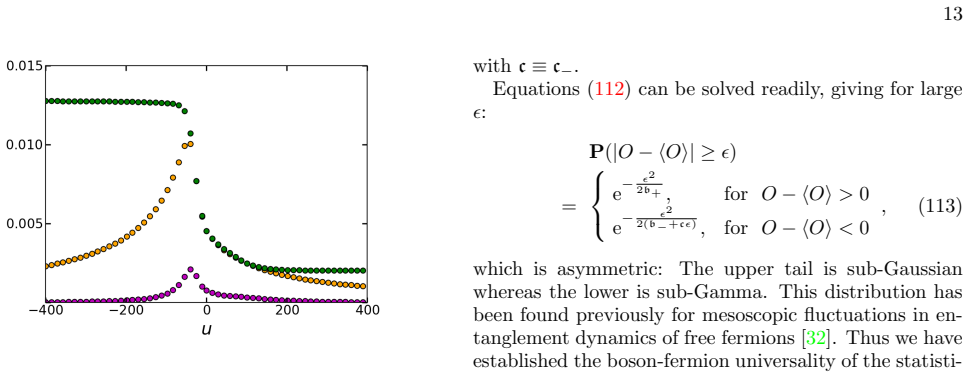
Concentration of the product probability measure A fundamental difficulty in addressing the statistics of an entanglement probe O(φ) is that it depends on the random variables φ in a highly nonlinear manner. To overcome this difficulty we observe that P is a product probability measure [60], P = µ0 × · · · ×µN −1 (67) over the product space TN = T0 × · · ...
-
[2]
Modified logarithmic Sobolev inequality Owing to the product structure of the probability mea- sure Eqs. (67) and (68), a generic multivariable random entanglement probe function O(φ) obeys a very general inequality, the so-called modified logarithmic Sobolev in- equality [33]: u OeuO − euO ln euO ≤ N −1X m=0 euO ϕ(−u(O − Om)) , ∀u ∈ R, (71) where ϕ(x) ≡ ...
-
[3]
Coleman, Introduction to Many-Body Physics (Cam- bridge University Press, 2015)
P. Coleman, Introduction to Many-Body Physics (Cam- bridge University Press, 2015)
2015
-
[4]
Kitaev, Fault-tolerant quantum computation by anyons, Ann
A. Kitaev, Fault-tolerant quantum computation by anyons, Ann. Phys. (N.Y.) 303, 2 (2003)
2003
-
[5]
Upper tail We begin with the upper tail analysis. Let u >0 and set Om in the inequality (75) as the infimum of O(φ) over φm with the rest of ( N − 1) variables φi (i ̸= m) held fixed [33], denoted as O+ m (cf. Appendix B): O+ m(φ′ m) ≡ inf φm O(φ). (77) This ensures that the variableu(O−O+ m) in the inequality (75) is nonnegative. Next, we Taylor expand ϕ...
-
[6]
To start we set Om = O− m defined as [33] (cf
Lower tail For the lower tail, we carry out the same analysis with u <0. To start we set Om = O− m defined as [33] (cf. Ap- pendix B) O− m(φ′ m) ≡ sup φm O(φ). (102) This ensures that u(O − O− m) is nonnegative. With the introduction of b− ≡ N −1X m=0 (O − O− m)2 , (103) we can rewrite Eq. (76) as H(u) = b− 2 + δF−(u), (104) similar to Eq. (81), where δF−...
-
[7]
K. J. Satzinger et al. , Realizing topologically ordered states on a quantum processor, Science 374, 1237 (2021)
work page 2021
Show all 75 references
-
[8]
(E7) 21 This bound suggests that ( ∂φm S)2 at given φm is the same order as its average, i.e., (∂φmO)2 = rm(φ) Z dφm 2π (∂φmO)2, r m(φ) = O(1)
(E5) and Z dφm 2π (∂φm O)2 = A2 0 + 1 2 (A2 1 + A2 2), (E6) we obtain (∂φm O)2 ≤ 6 Z dφm 2π (∂φmO)2. (E7) 21 This bound suggests that ( ∂φm S)2 at given φm is the same order as its average, i.e., (∂φmO)2 = rm(φ) Z dφm 2π (∂φmO)2, r m(φ) = O(1). (E8) Substituting it into Eq. (E...
-
[9]
P. W. Anderson, Resonating valence bonds: a new kind of insulator?, Mat. Res. Bull. 8, 153 (2008)
2008
-
[10]
(b) The left-hand side of the mod- ified logarithmic Sobolev inequality (75) for different ratios rA with fixed LA = 25 generated with ab initio data
L = 124. (b) The left-hand side of the mod- ified logarithmic Sobolev inequality (75) for different ratios rA with fixed LA = 25 generated with ab initio data. All lines approach the asymptote (dash line) ln Ns/u2 at large u, where Ns = 500 is the sampling size used. Appendix ...
-
[11]
On one hand, for practical ap- plications it is necessary to control these fluctuations
and numerical [17, 25, 26] experiments on long-time entanglement dynamics. On one hand, for practical ap- plications it is necessary to control these fluctuations. On the other hand, understanding their statistical be- haviors especially their out-of-equilibrium properties is ...
1929
-
[12]
Li and F
H. Li and F. D. M. Haldane, Entanglement spectrum as a generalization of entanglement entropy: identification of topological order in non-abelian fractional quantum hall effect states, Phys. Rev. Lett. 101, 010504 (2008)
2008
-
[13]
Chen, Z.-C
X. Chen, Z.-C. Gu, and X.-G. Wen, Local unitary trans- formation, long-range quantum entanglement, wave func- 22 tion renormalization, and topological order, Phys. Rev. B 82, 155138 (2010)
2010
-
[14]
Islam et al
R. Islam et al. , Measuring entanglement entropy in a quantum many-body system, Nature 528, 77 (2015)
2015
-
[15]
Popescu, A
S. Popescu, A. J. Short, and A. Winters, Entanglement and the foundations of statistical mechanics, Nat. Phys. 2, 754 (2018)
2018
-
[16]
Semeghini et al
G. Semeghini et al. , Probing topological spin liquids on a programmable quantum simulator, Science 374, 1242 (2021)
2021
-
[17]
M. K. Joshi et al., Exploring large-scale entanglement in quantum simulation, Nature 624, 539 (2023)
2023
-
[18]
A. H. Karamlou et al. , Probing entanglement in a 2D hard-core Bose-Hubbard lattice, Nature 629, 561 (2024)
2024
-
[19]
Islam et al
R. Islam et al. , Quantum thermalization through entan- glement in an isolated many-body system, Science 353, 794 (2016)
2016
-
[20]
Bernien et al., Probing many-body dynamics on a 51- atom quantum simulator, Nature 551, 579 (2017)
H. Bernien et al., Probing many-body dynamics on a 51- atom quantum simulator, Nature 551, 579 (2017)
2017
-
[21]
C. J. Turner, A. A. Michailidis, D. A. Abanin, M. Serbyn, and Z. Papi´ c, Weak ergodicity breaking from quantum many-body scars, Nat. Phys. 14, 745 (2018)
2018
-
[22]
D. N. Page, Average entropy of a subsystem, Phys. Rev. Lett. 71, 1291 (1993)
1993
-
[23]
D’Alessio, Y
L. D’Alessio, Y. Kafri, A. Polkovnikov and M. Rigol, From quantum chaos and eigenstate thermalization to statistical mechanics and thermodynamics, Adv. Phys. 65, 239 (2016)
2016
-
[24]
Vidmar, L
L. Vidmar, L. Hackl, E. Bianchi, and M. Rigol, Entangle- ment entropy of eigenstates of quadratic fermionic hamil- tonians, Phys. Rev. Lett. 119, 020601 (2017)
2017
-
[25]
Y. O. Nakagawa, M. Watanabe, H. Fujita, and S. Sug- iura, Universality in volume-law entanglement of scram- bled pure quantum states, Nat. Commun. 9, 1635 (2018)
2018
-
[26]
X.-H. Yu, Z. Gong, and J. I. Cirac, Free-fermion page curve: Canonical typicality and dynamical emergence, Phys. Rev. Res. 5, 013044 (2023)
2023
-
[27]
Bianchi, L
E. Bianchi, L. Hackl, M. Kieburg, M. Rigol, and L. Vid- mar, Volume-law entanglement entropy of typical pure quantum states, PRX Quantum 3, 030201 (2022)
2022
-
[28]
F. H. L. Essler and M. Fagotti, Quench dynamics and relaxation in isolated integrable quantum spin chains, J. Stat. Mech. 2016, 064002 (2016)
2016
-
[29]
Calabrese and J
P. Calabrese and J. Cardy, Evolution of entanglement entropy in one-dimensional systems, J. Stat. Mech.2005, P04010 (2005)
2005
-
[30]
Gogolin and J
C. Gogolin and J. Eisert, Equilibration, thermalisation, and the emergence of statistical mechanics in closed quantum systems, Rep. Prog. Phys. 79, 056001 (2016)
2016
-
[31]
M. B. Plenio, J. Hartley, and J. Eisert, Dynamics and manipulation of entanglement in coupled harmonic sys- tems with many degrees of freedom, New J. Phys. 6, 36 (2004)
2004
-
[33]
M. G. Nezhadhaghighi and M. A. Rajabpour, Entangle- ment dynamics in short- and long-range harmonic oscil- lators, Phys. Rev. B 90, 205438 (2014)
2014
-
[34]
Faiez, D
D. Faiez, D. ˇSafr´ anek, J. M. Deutsch, and A. Aguirre, Typical and extreme entropies of long-lived isolated quantum systems, Phys. Rev. A 101, 052101 (2020)
2020
-
[35]
von Neumann, Beweis des ergodensatzes und desh- theorems in der neuen mechanik, Z
J. von Neumann, Beweis des ergodensatzes und desh- theorems in der neuen mechanik, Z. Phys. 57, 30 (1929)
1929
-
[36]
von Neumann, Proof of the ergodic theorem and the h-theorem in quantum mechanics, Euro
J. von Neumann, Proof of the ergodic theorem and the h-theorem in quantum mechanics, Euro. Phys. J. H 35, 201 (2010)
2010
-
[37]
Goldstein, J
S. Goldstein, J. L. Lebowitz, R. Tumulka, and N. Zangh ` ı, Long-time behavior of macroscopic quantum systems, Euro. Phys. J. H 35, 173 (2010)
2010
-
[38]
Modak, V
R. Modak, V. Alba, and P. Calabrese, Entanglement re- vivals as a probe of scrambling in finite quantum systems, J. Stat. Mech. 2020, 083110 (2020)
2020
-
[39]
Peschel and M.-C
I. Peschel and M.-C. Chung, Density matrices for a chain of oscillators, J. Phys. A: Math. Gen. 32, 8419 (1999)
1999
-
[40]
L.-K. Lim, C. Lou, and C. Tian, Mesoscopic fluctua- tions in entanglement dynamics, Nat. Commun. 15, 1775 (2024)
2024
-
[41]
Boucheron, G
S. Boucheron, G. Lugosi, and P. Massart, Concentration Inequalities: A Nonasymptotic Theory of Independence (Oxford University Press, 2013)
2013
-
[42]
Ping, Introduction to Wave Scattering, Localization and Mesoscopic Phenomena (Springer, Germany, 2nd edition, 2006)
S. Ping, Introduction to Wave Scattering, Localization and Mesoscopic Phenomena (Springer, Germany, 2nd edition, 2006)
2006
-
[43]
Akkermans and G
E. Akkermans and G. Montambaux, Mesoscopic Physics of Electrons and Photons (Cambridge University Press, 2007)
2007
-
[44]
C. L. Kane, Telegraph noise and fractional statistics in the quantum Hall effect, Phys. Rev. Lett. 90, 226902 (2003)
2003
-
[45]
Grosfeld, S
E. Grosfeld, S. H. Simon, and A. Stern, Switching noise as a probe of statistics in the fractional quantum Hall effect, Phys. Rev. Lett. 96, 226803 (2006)
2006
-
[46]
Rosenow and S
B. Rosenow and S. H. Simon, Telegraph noise and the Fabry-Perot quantum Hall interferometer, Phys. Rev. B 85, 201302 (2012)
2012
-
[47]
Coser, E
A. Coser, E. Tonni, and P. Calabrese, Entanglement neg- ativity after a global quantum quench, J. Stat. Mech. 2014, P12017 (2014)
2014
-
[48]
Audenaert, J
K. Audenaert, J. Eisert, M. B. Plenio, and R. F. Werner, Entanglement properties of the harmonic chain, Phys. Rev. A 66, 042327 (2002)
2002
-
[49]
Botero and B
A. Botero and B. Reznik, Spatial structures and local- ization of vacuum entanglement in the linear harmonic chain, Phys. Rev. A 70, 052329 (2004)
2004
-
[50]
M. B. Plenio, J. Eisert, J. Dreißig, and M. Cramer, En- tropy, entanglement, and area: Analytical results for harmonic lattice systems, Phys. Rev. Lett. 94, 060503 (2005)
2005
-
[51]
Eisert, M
J. Eisert, M. Cramer, and M. B. Plenio, Colloquium: Area laws for the entanglement entropy, Rev. Mod. Phys. 82, 277 (2010)
2010
-
[52]
J. S. Cotler, M. P. Hertzberg, M. Mezei, and M. T. Mueller, Entanglement growth after a global quench in free scalar field theory, J. High Energ. Phys. 2016, 166
2016
-
[53]
Hackl, E
L. Hackl, E. Bianchi, R. Modak, and M. Rigol, Entan- glement production in bosonic systems: Linear and log- arithmic growth, Phys. Rev. A 97, 032321 (2018)
2018
-
[54]
Alba and P
V. Alba and P. Calabrese, Entanglement dynamics after quantum quenches in generic integrable systems, SciPost Phys. 4, 017 (2018)
2018
-
[55]
N. J. Higham, Functions of Matrices (Society for Indus- trial and Applied Mathematics (SIAM), 2008)
2008
-
[56]
Adesso and F
G. Adesso and F. Illuminati, Entanglement in continuous-variable systems: recent advances and current perspectives, J. Phys. A: Math. Theor. 40, 7821 (2007)
2007
-
[57]
Thus the persistent fluctuations displayed in long-time entangle- ment fluctuations, exemplified in Fig
C(t) is quasi-periodic in t, and so is O(t). Thus the persistent fluctuations displayed in long-time entangle- ment fluctuations, exemplified in Fig. 2 for O = S, are quasi-periodic oscillations. They are reproducible, i.e., given identical initial state and quench protocol th...
-
[58]
Williamson, On the algebraic problem concerning the 23 normal forms of linear dynamical systems, Amer
J. Williamson, On the algebraic problem concerning the 23 normal forms of linear dynamical systems, Amer. J. Math. 58, 141 (1936)
1936
-
[59]
Peschel, Calculation of reduced density matrices from correlation functions, J
I. Peschel, Calculation of reduced density matrices from correlation functions, J. Phys. A: Math. Gen. 36, L205 (2003)
2003
-
[60]
Vidal, J
G. Vidal, J. I. Latorre, E. Rico, and A. Kitaev, Entan- glement in quantum critical phenomena, Phys. Rev. Lett. 90, 227902 (2003)
2003
-
[61]
Peschel and V
I. Peschel and V. Eisler, Reduced density matrices and entanglement entropy in free lattice models, J. Phys. A: Math. Theor. 42, 504003 (2009)
2009
-
[62]
T. Shi, E. Demler and J. I. Cirac, Variational study of fermionic and bosonic systems with non-Gaussian states: Theory and applications, Ann. Phys. 390, 245 (2018)
2018
-
[63]
T. Shi, E. Demler and J. I. Cirac, Variational approach for many-body systems at finite temperature, Phys. Rev. Lett. 125, 180602 (2020)
2020
-
[64]
Schachenmayer, B
J. Schachenmayer, B. P. Lanyon, C. F. Roos, and A. J. Daley, Entanglement growth in quench dynamics with variable range interactions, Phys. Rev. X 3, 031015 (2013)
2013
-
[65]
A. M. Samoilenko, Quasiperiodic oscillations, Scholarpe- dia 2, 1783 (2007)
2007
-
[66]
V. I. Arnold, Mathematical Methods of Classical Mechan- ics (Springer New York, NY, 1989)
1989
-
[67]
Kac, Statistical Independence in Probability, Analysis and Number Theory (Mathematical Association of Amer- ica, 1959)
M. Kac, Statistical Independence in Probability, Analysis and Number Theory (Mathematical Association of Amer- ica, 1959)
1959
-
[68]
Ledoux, The concentration of measure phenomenon (AMS, Providence, 2001)
M. Ledoux, The concentration of measure phenomenon (AMS, Providence, 2001)
2001
-
[69]
Tao, Topics in Random Matrix Theory (Graduate Studies in Mathematics v
T. Tao, Topics in Random Matrix Theory (Graduate Studies in Mathematics v. 132, American Mathematical Society, 2012)
2012
-
[70]
V. D. Milman and G. Schechtman, Asymptotic Theory of Finite Dimensional Normed Spaces (Springer Berlin, Heidelberg, 1982)
1982
-
[71]
P. Fang, L. Zhao, and C. Tian, Concentration-of-measure theory for structures and fluctuations of waves, Phys. Rev. Lett. 121, 140603 (2018)
2018
-
[72]
Isoard, N
M. Isoard, N. Milazzo, N. Pavloff, and O. Giraud, Bi- partite and tripartite entanglement in a Bose-Einstein acoustic black hole, Phys. Rev. A 104, 063302 (2021)
2021
-
[73]
Steinhauer, Observation of quantum Hawking radia- tion and its entanglement in an analogue black hole, Nat
J. Steinhauer, Observation of quantum Hawking radia- tion and its entanglement in an analogue black hole, Nat. Phys. 12, 959 (2016)
2016
-
[74]
Shi et al
Y. Shi et al. , Quantum simulation of Hawking radiation and curved spacetime with a superconducting on-chip black hole, Nat. Commun. 14, 3263 (2023)
2023
-
[75]
Calabrese and J
P. Calabrese and J. Cardy, Quantum quenches in ex- tended systems, J. Stat. Mech. 2007, P06008 (2007)
2007
Reviewed August 12, 2026 · model on record in the stance chip above.
Discussion (0). Continue with ORCID to comment.