REVIEW 4 major objections 5 minor 65 references
A sparse 3D refiner fixes the local distortions that 2D decoders inject into single-image geometry.
Reviewed by Pith at T0; open to challenge. T0 means a machine referee read the full paper against a public rubric. the ladder, T0–T4 →
T0 review · deepseek-v4-flash
2026-08-01 16:30 UTC pith:E7UFAUY3
load-bearing objection A well-ablated 3D-refinement architecture that plausibly improves fine-detail geometry, but the headline local evaluation protocol is too fragile to fully establish the central claim. the 4 major comments →
MoGe-3: Fine-Detail Monocular Geometry Estimation with Self-Guided Sparse Volumetric Refinement
The pith
A machine-rendered reading of the paper's core claim, the machinery that carries it, and where it could break.
Core claim
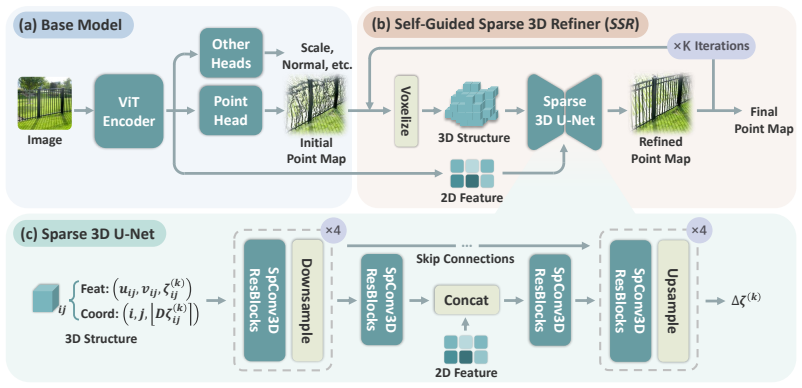
MoGe-3 claims that fine-detail monocular geometry errors are largely an architectural artifact. Because standard decoders aggregate features by image-plane adjacency, geometrically distant surfaces that touch in the image contaminate each other, over-smoothing thin structures. SSR addresses this by voxelizing the predicted point map into a thin sparse shell using fixed image axes (u,v) and a quantized log-depth axis, then running a sparse 3D U-Net that aggregates features only among 3D-adjacent voxels, with the occupied voxel set re-derived from the latest prediction each iteration. The refiner predicts residual log-depth updates; after three iterations the default ViT-L model beats MoGe-2 o
What carries the argument
Self-Guided Sparse 3D Refiner (SSR): an iterative module that takes the current point map, voxelizes it as (i, j, quantized log-depth) to form a sparse voxel shell with exactly one voxel per pixel, processes it with a sparse 3D U-Net whose downsampling depends on scene geometry, injects 2D backbone features at the bottleneck, and adds the predicted log-depth residual to update the shell. Its two properties: projection-aligned, scale-invariant shell; geometry-coherent receptive field that decouples features across depth discontinuities.
Load-bearing premise
The headline fine-detail claim rests on local metrics computed with the authors' mask-selection and per-segment-alignment protocol on two synthetic datasets; if that protocol does not reflect real-world fine-detail 3D fidelity, the claim is not established for real images.
What would settle it
Evaluate the same models on a real-world high-fidelity dataset (e.g., ScanNet++-style or LiDAR scans of thin structures) using the paper's fine-detail masks but with only a single global-scale alignment — no per-segment translation — and compare local δ0.01 between MoGe-3 and MoGe-2. If the gap shrinks toward zero, the central claim fails; if it persists, the claim survives.
If this is right
- If the diagnosis is right, adding 3D-aware refinement to any existing monocular depth or point-map model should improve local fidelity, because the bottleneck is the 2D decoding geometry, not the encoder.
- The gains saturate and remain stable beyond the training iteration count (K=3 up to K=7), suggesting the residual updates are a convergent correction rather than overfitting to a fixed loop.
- Voxel resolution has a clear optimum near D=200; too coarse misses fine structure, too fine starves the sparse convolutions of occupancy, guiding future implementations.
- Global metrics also improve, so the refiner sharpens details without destabilizing the overall scene layout.
- SSR remains effective on a stronger ViT-G backbone, so it is complementary to encoder scaling.
Where Pith is reading between the lines
- The local evaluation protocol (per-segment translation with shared global scale) can absorb constant depth offsets within each segment, so the reported δ0.01 gains likely overstate real-world thin-structure accuracy at absolute depths; a variant that removes the per-segment shift would be a sharper test.
- The paper's own boundary-F1 result (third, behind InfiniDepth) hints that image-space edge sharpness is not fully controlled by 3D refinement; combining SSR with pixel-space or generative decoding might push both 2D edges and 3D fidelity.
- A natural extension is to apply SSR on real sensor data (e.g., LiDAR or high-res RGB-D) where fine-detail ground truth exists, to test whether the synthetic-data gains transfer.
- The regression-based limitation acknowledged by the authors suggests the next step is hybrid 3D refinement with a generative boundary model to remove fly-points.
Editorial analysis
A structured set of objections, weighed in public.
Referee Report
Summary. MoGe-3 proposes a Self-Guided Sparse 3D Refinement (SSR) module attached to a MoGe-2 base model. The initial 2D point map is voxelized in a log-depth coordinate space, iteratively refined by a sparse 3D U-Net that aggregates features according to 3D spatial locality, and the predicted log-depth residuals update the point map. The paper claims this 3D inductive bias corrects an architectural mismatch in 2D decoders and significantly improves fine-detail geometry, reporting zero-shot global, local, and boundary metrics on nine datasets, together with ablations over voxel resolution, feature injection, 2D vs 3D refinement, and iteration count.
Significance. If the fine-detail claim holds, the paper is a meaningful step: it provides a clean architectural argument for 3D sparse refinement over 2D decoding and includes several well-controlled experiments. The parameter-matched 2D refiner ablation (Table 3), the iteration sweep beyond the training horizon (Fig. 4), and the honest D-sweep are strengths, and the promise of released code/models supports reproducibility. However, the headline local-accuracy result currently rests on a narrow evaluation protocol: two synthetic datasets, hand-set mask thresholds, and per-segment translation alignment. The paper needs additional validation or careful qualification before the abstract's claim of 'significantly outperforming existing approaches in recovering fine detailed 3D geometry' is fully established for real images.
major comments (4)
- [Appendix B.2, Eq. (18); Table 1/C.2] The central fine-detail claim is supported only by local metrics on Spring and Synth4K, computed after fitting a per-segment translation t_i (Eq. 18) for every SAM2 segment. This removes per-object depth offsets before computing Rel and δ0.01. For thin structures with limited internal depth variation, a smoothed or planar prediction can be translated to match the GT segment and still score well. Please report the same local metrics without per-segment translation, or with only a single global shift, and analyze the distribution of fitted shifts. As written, the local protocol may measure within-segment shape after discarding exactly the per-object depth errors that are part of 3D geometric fidelity.
- [Sec. 4.3; Table C.1 (metric depth block)] The text states that the method achieves 'best global performance across all three evaluation settings' and 'consistently outperforms' prior work. This is contradicted by per-dataset metric-depth results: on NYUv2 the ViT-L model gives Rel 8.43 vs MoGe-2's 6.90, and on ETH3D 14.8 vs 9.99, with corresponding δ1 regressions. The averaged metric-depth gains are driven by other datasets. This does not invalidate the method, but the wording overstates consistency. Report per-dataset variability and qualify the global claim.
- [Sec. 4.3; Table 1/C.3] Boundary F1 is the only real-data metric with a local component, and the method ranks third behind InfiniDepth and Depth Pro. The paper argues that F1 is a 2D pixel-level metric and does not capture 3D geometric quality. That argument is reasonable, but it also means the claim of superior fine-detail 3D recovery on real images has no direct quantitative support. Either add real-data local geometry evaluation (e.g., manually annotated or semi-automatic fine-structure masks on real dense depth) or explicitly limit the fine-detail claim to the synthetic benchmarks.
- [Sec. 3.3, A.3] The refiner receives gradients only from synthetic samples, while the base model sees the full real/synthetic mixture. This design choice is understandable, but it heightens the need for real-world fine-detail validation. The current evaluation does not demonstrate that the 3D refiner's synthetic-trained residual corrections transfer to real thin structures beyond what is visible in averaged global metrics and a few qualitative examples. Please provide additional real-data evidence or temper the real-image claim in the abstract and Sec. 5.
minor comments (5)
- [Sec. 4.2] For local metrics, the text says thresholds of 0.01 for point maps and 1.01 for depth maps, but Table 1 headings read simply 'δ0.01'. Clarify the depth threshold in the table or caption to avoid ambiguity.
- [Sec. 4.5, Table 3] The ablation models are trained with K=3 but evaluated at K=5, while the jointly trained model in Fig. 4 is trained with K=3 and evaluated up to K=7. State this explicitly in the ablation text; the current phrasing could be misread as training at K=5.
- [Sec. 3.2.1, Eq. (3)] The notation ⌊·⌉ is used for rounding but defined only in passing. Define it explicitly at first use.
- [Sec. 4.4] For Pixel-Perfect Depth and InfiniDepth, the paper uses MoGe-2 intrinsics to lift depth to point maps. This is stated in the text, but the qualitative figure caption should repeat it, since the comparison may otherwise appear unfair or unfair in the opposite direction.
- [Sec. 5, Limitations] The limitations paragraph focuses on regression-based boundary sharpness. Given the evaluation concerns above, consider also acknowledging that the local fine-detail metric uses per-segment alignment and synthetic data.
Circularity Check
No significant circularity: the method is a constructive architecture change validated against external benchmarks and controlled ablations.
full rationale
The derivation chain is not circular. MoGe-3 builds on the publicly defined MoGe-2 base model and adds an SSR module whose residual updates are learned under an affine-invariant loss (Eq. 1) inherited from earlier work; no equation in the method reduces to its own target. The sparse voxel shell is constructed from the current point map, but the U-Net output is a learned log-depth residual (Eqs. 3-5), and the ablations (2D Conv vs. SSR, D sweep, feature injection) provide independent evidence for the architectural claims. Quantitative claims are checked against external datasets (NYUv2, KITTI, ETH3D, etc.) and against prior models including the authors' own MoGe-2. The per-segment alignment in Appendix B.2 is an explicitly disclosed evaluation choice applied equally to all baselines, so it is a validity/generalizability concern rather than a circular reduction; it does not force the method's margin over other methods, since within-segment shape errors remain measurable under the same protocol. The Limitations section candidly notes regression-based boundary ambiguity, further supporting that the paper does not hide its weaknesses. Therefore, no load-bearing step reduces by construction to its input.
Axiom & Free-Parameter Ledger
free parameters (4)
- Voxel resolution D (log-depth quantization) =
D = 200
- Refinement iterations K =
K = 3 at training; applied up to 7 at inference
- Local fine-detail metric thresholds (evaluation protocol) =
3.0·σ_MAD; element sizes {3,5,9,17}; ρ≥0.3; |Si|≥5; |Si|≤0.05HW; δ 0.01 / 1.01
- Loss weights and local partition scales =
(λg,λl,λe,λm,λn,λs) = (1.0,1.0,1.0,0.1,0.1,0.1); α ∈ {4,16,64}
axioms (4)
- domain assumption The architectural-mismatch hypothesis: 2D decoding of 3D geometry mixes features across depth discontinuities and causes the observed fine-detail distortions.
- domain assumption Pixel-accurate synthetic ground truth transfers to real-world fine-detail geometry.
- domain assumption Fixing image coordinates (u,v) and refining only log-depth is sufficient to correct the observed distortions.
- domain assumption Per-segment translation alignment with a shared global scale is a fair measure of local geometric fidelity.
read the original abstract
Monocular geometry estimation has recently achieved impressive performance across diverse scenes. However, state-of-the-art models still face notable distortion in local 3D structure, especially in fine details, like thin structures and small objects. We attribute this limitation to an architectural mismatch: most current models decode 3D geometry within a 2D parameterization, where feature interactions are governed by image-plane proximity rather than true 3D spatial relationships. This inadvertently mixes features from geometrically distant surfaces, resulting in over-smoothed geometry particularly around thin or elongated structure. In this paper, we propose MoGe-3, a fine-detail monocular geometry estimation model with Self-Guided Sparse 3D Refinement (SSR) that lifts monocular geometry modeling from 2D image space to 3D space for high-fidelity metric-scale point maps. MoGe-3 lifts the coarse point map from a foundation base model onto a sparse voxel shell and refines it via SSR. The SSR employs sparse convolutions that aggregate features based on 3D spatial locality, avoiding feature mixing across depth discontinuities. Extensive experiments on diverse datasets demonstrate that MoGe-3 significantly outperforms existing approaches in recovering fine detailed 3D geometry across both quantitative metrics and qualitative visualizations. Project page: https://qft-333.github.io/moge3page/
Figures



Reference graph
Works this paper leans on
-
[1]
Apollo synthetic dataset, 2019
Baidu Apollo. Apollo synthetic dataset, 2019. URL https://developer.apollo.auto/ synthetic.html. Accessed: 2025-03-06
2019
-
[2]
ARKitscenes - a diverse real-world dataset for 3d indoor scene understanding using mobile RGB-d data
Gilad Baruch, Zhuoyuan Chen, Afshin Dehghan, Tal Dimry, Yuri Feigin, Peter Fu, Thomas Gebauer, Brandon Joffe, Daniel Kurz, Arik Schwartz, and Elad Shulman. ARKitscenes - a diverse real-world dataset for 3d indoor scene understanding using mobile RGB-d data. In Thirty-fifth Conference on Neural Information Processing Systems Datasets and Benchmarks Track (...
2021
-
[3]
Zoedepth: Zero-shot transfer by combining relative and metric depth, 2023
Shariq Farooq Bhat, Reiner Birkl, Diana Wofk, Peter Wonka, and Matthias Müller. Zoedepth: Zero-shot transfer by combining relative and metric depth, 2023. URL https://arxiv.org/ abs/2302.12288
Pith/arXiv arXiv 2023
-
[4]
Richter, and Vladlen Koltun
Aleksei Bochkovskii, Amaël Delaunoy, Hugo Germain, Marcel Santos, Yichao Zhou, Stephan R. Richter, and Vladlen Koltun. Depth pro: Sharp monocular metric depth in less than a second,
-
[5]
D. J. Butler, J. Wulff, G. B. Stanley, and M. J. Black. A naturalistic open source movie for optical flow evaluation. In A. Fitzgibbon et al. (Eds.), editor,European Conf. on Computer Vision (ECCV), Part IV , LNCS 7577, pages 611–625. Springer-Verlag, October 2012. 10
2012
-
[6]
4d spatio-temporal convnets: Minkowski convolutional neural networks, 2019
Christopher Choy, JunYoung Gwak, and Silvio Savarese. 4d spatio-temporal convnets: Minkowski convolutional neural networks, 2019. URL https://arxiv.org/abs/1904. 08755
2019
-
[7]
Objaverse: A universe of annotated 3d objects, 2022
Matt Deitke, Dustin Schwenk, Jordi Salvador, Luca Weihs, Oscar Michel, Eli VanderBilt, Ludwig Schmidt, Kiana Ehsani, Aniruddha Kembhavi, and Ali Farhadi. Objaverse: A universe of annotated 3d objects, 2022. URLhttps://arxiv.org/abs/2212.08051
Pith/arXiv arXiv 2022
-
[8]
Mid-air: A multi-modal dataset for extremely low altitude drone flights
Michael Fonder and Marc Van Droogenbroeck. Mid-air: A multi-modal dataset for extremely low altitude drone flights. InConference on Computer Vision and Pattern Recognition Workshop (CVPRW), June 2019
2019
-
[9]
Geowizard: Unleashing the diffusion priors for 3d geometry estimation from a single image, 2024
Xiao Fu, Wei Yin, Mu Hu, Kaixuan Wang, Yuexin Ma, Ping Tan, Shaojie Shen, Dahua Lin, and Xiaoxiao Long. Geowizard: Unleashing the diffusion priors for 3d geometry estimation from a single image, 2024. URLhttps://arxiv.org/abs/2403.12013
Pith/arXiv arXiv 2024
-
[10]
Jakob Geyer, Yohannes Kassahun, Mentar Mahmudi, Xavier Ricou, Rupesh Durgesh, Andrew S. Chung, Lorenz Hauswald, Viet Hoang Pham, Maximilian Mühlegg, Sebastian Dorn, Tiffany Fernandez, Martin Jänicke, Sudesh Mirashi, Chiragkumar Savani, Martin Sturm, Oleksandr V orobiov, Martin Oelker, Sebastian Garreis, and Peter Schuberth. A2D2: Audi Autonomous Driving D...
2020
-
[11]
3d semantic segmentation with submanifold sparse convolutional networks, 2017
Benjamin Graham, Martin Engelcke, and Laurens van der Maaten. 3d semantic segmentation with submanifold sparse convolutional networks, 2017. URL https://arxiv.org/abs/ 1711.10275
Pith/arXiv arXiv 2017
-
[12]
Gómez, Manuel Silva, Antonio Seoane, Agnés Borràs, Mario Noriega, German Ros, Jose A
Jose L. Gómez, Manuel Silva, Antonio Seoane, Agnés Borràs, Mario Noriega, German Ros, Jose A. Iglesias-Guitian, and Antonio M. López. All for one, and one for all: Urbansyn dataset, the third musketeer of synthetic driving scenes.Neurocomputing, 637:130038, 2025. ISSN 0925-2312. doi: 10.1016/j.neucom.2025.130038. URL http://dx.doi.org/10.1016/j. neucom.20...
arXiv 2025
-
[13]
Mu Hu, Wei Yin, Chi Zhang, Zhipeng Cai, Xiaoxiao Long, Hao Chen, Kaixuan Wang, Gang Yu, Chunhua Shen, and Shaojie Shen. Metric3d v2: A versatile monocular geometric foundation model for zero-shot metric depth and surface normal estimation.IEEE Transactions on Pattern Analysis and Machine Intelligence, 46(12):10579–10596, December 2024. ISSN 1939-3539. doi...
arXiv 2024
-
[14]
Deep- mvs: Learning multi-view stereopsis
Po-Han Huang, Kevin Matzen, Johannes Kopf, Narendra Ahuja, and Jia-Bin Huang. Deep- mvs: Learning multi-view stereopsis. InIEEE Conference on Computer Vision and Pattern Recognition (CVPR), 2018
2018
-
[15]
On the importance of accurate geometry data for dense 3d vision tasks
HyunJun Jung, Patrick Ruhkamp, Guangyao Zhai, Nikolas Brasch, Yitong Li, Yannick Verdie, Jifei Song, Yiren Zhou, Anil Armagan, Slobodan Ilic, et al. On the importance of accurate geometry data for dense 3d vision tasks. InProceedings of the IEEE/CVF Conference on Computer Vision and Pattern Recognition, pages 780–791, 2023
2023
-
[16]
Repurposing diffusion-based image generators for monocular depth estimation,
Bingxin Ke, Anton Obukhov, Shengyu Huang, Nando Metzger, Rodrigo Caye Daudt, and Kon- rad Schindler. Repurposing diffusion-based image generators for monocular depth estimation,
-
[17]
Tobias Koch, Lukas Liebel, Marco Körner, and Friedrich Fraundorfer. Comparison of monocular depth estimation methods using geometrically relevant metrics on the ibims-1 dataset.Computer Vision and Image Understanding (CVIU), 191:102877, 2020. doi: 10.1016/j.cviu.2019.102877
arXiv 2020
-
[19]
EDEN: Multimodal Synthetic Dataset of Enclosed garDEN Scenes
Hoang-An Le, Partha Das, Thomas Mensink, Sezer Karaoglu, and Theo Gevers. EDEN: Multimodal Synthetic Dataset of Enclosed garDEN Scenes. InProceedings of the IEEE/CVF Winter Conference of Applications on Computer Vision (WACV), 2021. 11
2021
-
[20]
Matrixcity: A large-scale city dataset for city-scale neural rendering and beyond, 2023
Yixuan Li, Lihan Jiang, Linning Xu, Yuanbo Xiangli, Zhenzhi Wang, Dahua Lin, and Bo Dai. Matrixcity: A large-scale city dataset for city-scale neural rendering and beyond, 2023. URL https://arxiv.org/abs/2309.16553
Pith/arXiv arXiv 2023
-
[21]
Megadepth: Learning single-view depth prediction from internet photos, 2018
Zhengqi Li and Noah Snavely. Megadepth: Learning single-view depth prediction from internet photos, 2018. URLhttps://arxiv.org/abs/1804.00607
Pith/arXiv arXiv 2018
-
[22]
Chen, Zhenyu Li, Guang Shi, Jiashi Feng, and Bingyi Kang
Haotong Lin, Sili Chen, Junhao Liew, Donny Y . Chen, Zhenyu Li, Guang Shi, Jiashi Feng, and Bingyi Kang. Depth anything 3: Recovering the visual space from any views, 2025. URL https://arxiv.org/abs/2511.10647
Pith/arXiv arXiv 2025
-
[23]
Spring: A high-resolution high-detail dataset and benchmark for scene flow, optical flow and stereo
Lukas Mehl, Jenny Schmalfuss, Azin Jahedi, Yaroslava Nalivayko, and Andrés Bruhn. Spring: A high-resolution high-detail dataset and benchmark for scene flow, optical flow and stereo. In Proc. IEEE/CVF Conference on Computer Vision and Pattern Recognition (CVPR), 2023
2023
-
[24]
Indoor segmentation and support inference from rgbd images
Pushmeet Kohli Nathan Silberman, Derek Hoiem and Rob Fergus. Indoor segmentation and support inference from rgbd images. InECCV, 2012
2012
-
[25]
3d ken burns effect from a single image,
Simon Niklaus, Long Mai, Jimei Yang, and Feng Liu. 3d ken burns effect from a single image,
-
[26]
Dinov2: Learning robust visual features without supervision, 2024
Maxime Oquab, Timothée Darcet, Théo Moutakanni, Huy V o, Marc Szafraniec, Vasil Khalidov, Pierre Fernandez, Daniel Haziza, Francisco Massa, Alaaeldin El-Nouby, Mahmoud Assran, Nicolas Ballas, Wojciech Galuba, Russell Howes, Po-Yao Huang, Shang-Wen Li, Ishan Misra, Michael Rabbat, Vasu Sharma, Gabriel Synnaeve, Hu Xu, Hervé Jegou, Julien Mairal, Patrick La...
Pith/arXiv arXiv 2024
-
[27]
Unidepth: Universal monocular metric depth estimation, 2024
Luigi Piccinelli, Yung-Hsu Yang, Christos Sakaridis, Mattia Segu, Siyuan Li, Luc Van Gool, and Fisher Yu. Unidepth: Universal monocular metric depth estimation, 2024. URL https: //arxiv.org/abs/2403.18913
Pith/arXiv arXiv 2024
-
[28]
Unik3d: Universal camera monocular 3d estimation, 2025
Luigi Piccinelli, Christos Sakaridis, Mattia Segu, Yung-Hsu Yang, Siyuan Li, Wim Abbeloos, and Luc Van Gool. Unik3d: Universal camera monocular 3d estimation, 2025. URL https: //arxiv.org/abs/2503.16591
Pith/arXiv arXiv 2025
-
[29]
URLhttps://arxiv.org/abs/1909.05483
Pith/arXiv arXiv 1909
-
[30]
Vision transformers for dense prediction
René Ranftl, Alexey Bochkovskiy, and Vladlen Koltun. Vision transformers for dense prediction. CoRR, abs/2103.13413, 2021. URLhttps://arxiv.org/abs/2103.13413
Pith/arXiv arXiv 2021
-
[31]
Sam 2: Segment anything in images and videos, 2024
Nikhila Ravi, Valentin Gabeur, Yuan-Ting Hu, Ronghang Hu, Chaitanya Ryali, Tengyu Ma, Haitham Khedr, Roman Rädle, Chloe Rolland, Laura Gustafson, Eric Mintun, Junting Pan, Kalyan Vasudev Alwala, Nicolas Carion, Chao-Yuan Wu, Ross Girshick, Piotr Dollár, and Christoph Feichtenhofer. Sam 2: Segment anything in images and videos, 2024. URL https: //arxiv.org...
Pith/arXiv arXiv 2024
-
[32]
3dvnet: Multi-view depth prediction and volumetric refinement
Alexander Rich, Noah Stier, Pradeep Sen, and Tobias Höllerer. 3dvnet: Multi-view depth prediction and volumetric refinement. In2021 International Conference on 3D Vision (3DV), pages 700–709. IEEE, 2021
2021
-
[33]
Unidepthv2: Universal monocular metric depth estimation made simpler
Luigi Piccinelli, Christos Sakaridis, Yung-Hsu Yang, Mattia Segu, Siyuan Li, Wim Abbeloos, and Luc Van Gool. Unidepthv2: Universal monocular metric depth estimation made simpler. arXiv preprint arXiv:2502.20110, 2025
Pith/arXiv arXiv 2025
-
[34]
German Ros, Laura Sellart, Joanna Materzynska, David Vazquez, and Antonio M. Lopez. The synthia dataset: A large collection of synthetic images for semantic segmentation of urban scenes. InThe IEEE Conference on Computer Vision and Pattern Recognition (CVPR), June 2016
2016
-
[35]
BAD SLAM: Bundle adjusted direct RGB-D SLAM
Thomas Schöps, Torsten Sattler, and Marc Pollefeys. BAD SLAM: Bundle adjusted direct RGB-D SLAM. InConference on Computer Vision and Pattern Recognition (CVPR), 2019. 12
2019
-
[36]
Oriane Siméoni, Huy V . V o, Maximilian Seitzer, Federico Baldassarre, Maxime Oquab, Cijo Jose, Vasil Khalidov, Marc Szafraniec, Seungeun Yi, Michaël Ramamonjisoa, Francisco Massa, Daniel Haziza, Luca Wehrstedt, Jianyuan Wang, Timothée Darcet, Théo Moutakanni, Leonel Sentana, Claire Roberts, Andrea Vedaldi, Jamie Tolan, John Brandt, Camille Couprie, Julie...
Pith/arXiv arXiv 2025
-
[37]
Mike Roberts, Jason Ramapuram, Anurag Ranjan, Atulit Kumar, Miguel Angel Bautista, Nathan Paczan, Russ Webb, and Joshua M. Susskind. Hypersim: A photorealistic synthetic dataset for holistic indoor scene understanding, 2021. URLhttps://arxiv.org/abs/2011.02523
Pith/arXiv arXiv 2021
-
[38]
Searching efficient 3d architectures with sparse point-voxel convolution, 2020
Haotian Tang, Zhijian Liu, Shengyu Zhao, Yujun Lin, Ji Lin, Hanrui Wang, and Song Han. Searching efficient 3d architectures with sparse point-voxel convolution, 2020. URL https: //arxiv.org/abs/2007.16100
Pith/arXiv arXiv 2020
-
[39]
Smd-nets: Stereo mixture density networks
Fabio Tosi, Yiyi Liao, Carolin Schmitt, and Andreas Geiger. Smd-nets: Stereo mixture density networks. InConference on Computer Vision and Pattern Recognition (CVPR), 2021
2021
-
[40]
Sparsity invariant cnns
Jonas Uhrig, Nick Schneider, Lukas Schneider, Uwe Franke, Thomas Brox, and Andreas Geiger. Sparsity invariant cnns. InInternational Conference on 3D Vision (3DV), 2017
2017
-
[41]
Scalability in perception for autonomous driving: Waymo open dataset
Pei Sun, Henrik Kretzschmar, Xerxes Dotiwalla, Aurelien Chouard, Vijaysai Patnaik, Paul Tsui, James Guo, Yin Zhou, Yuning Chai, Benjamin Caine, Vijay Vasudevan, Wei Han, Jiquan Ngiam, Hang Zhao, Aleksei Timofeev, Scott Ettinger, Maxim Krivokon, Amy Gao, Aditya Joshi, Yu Zhang, Jonathon Shlens, Zhifeng Chen, and Dragomir Anguelov. Scalability in perception...
2020
-
[42]
Flow-motion and depth network for monocular stereo and beyond.CoRR, abs/1909.05452, 2019
Kaixuan Wang and Shaojie Shen. Flow-motion and depth network for monocular stereo and beyond.CoRR, abs/1909.05452, 2019. URLhttp://arxiv.org/abs/1909.05452
Pith/arXiv arXiv 1909
-
[43]
Qiang Wang, Shizhen Zheng, Qingsong Yan, Fei Deng, Kaiyong Zhao, and Xiaowen Chu. Irs: A large naturalistic indoor robotics stereo dataset to train deep models for disparity and surface normal estimation, 2021. URLhttps://arxiv.org/abs/1912.09678
Pith/arXiv arXiv 2021
-
[44]
Ruicheng Wang, Sicheng Xu, Cassie Dai, Jianfeng Xiang, Yu Deng, Xin Tong, and Jiaolong Yang. Moge: Unlocking accurate monocular geometry estimation for open-domain images with optimal training supervision, 2025. URLhttps://arxiv.org/abs/2410.19115
Pith/arXiv arXiv 2025
-
[46]
URLhttp://arxiv.org/abs/1908.00463
Pith/arXiv arXiv 1908
-
[47]
Tartanair: A dataset to push the limits of visual slam,
Wenshan Wang, Delong Zhu, Xiangwei Wang, Yaoyu Hu, Yuheng Qiu, Chen Wang, Yafei Hu, Ashish Kapoor, and Sebastian Scherer. Tartanair: A dataset to push the limits of visual slam,
-
[48]
Argoverse 2: Next generation datasets for self-driving perception and forecasting
Benjamin Wilson, William Qi, Tanmay Agarwal, John Lambert, Jagjeet Singh, Siddhesh Khandelwal, Bowen Pan, Ratnesh Kumar, Andrew Hartnett, Jhony Kaesemodel Pontes, Deva Ramanan, Peter Carr, and James Hays. Argoverse 2: Next generation datasets for self-driving perception and forecasting. InProceedings of the Neural Information Processing Systems Track on D...
2021
-
[49]
Synscapes: A photorealistic synthetic dataset for street scene parsing.CoRR, abs/1810.08705, 2018
Magnus Wrenninge and Jonas Unger. Synscapes: A photorealistic synthetic dataset for street scene parsing.CoRR, abs/1810.08705, 2018. URLhttp://arxiv.org/abs/1810.08705
Pith/arXiv arXiv 2018
-
[50]
Moge-2: Accurate monocular geometry with metric scale and sharp details, 2025
Ruicheng Wang, Sicheng Xu, Yue Dong, Yu Deng, Jianfeng Xiang, Zelong Lv, Guangzhong Sun, Xin Tong, and Jiaolong Yang. Moge-2: Accurate monocular geometry with metric scale and sharp details, 2025. URLhttps://arxiv.org/abs/2507.02546
Pith/arXiv arXiv 2025
-
[51]
Sparse convolutional networks for surface reconstruction from noisy point clouds
Tao Wang, Jing Wu, Ze Ji, and Yu-Kun Lai. Sparse convolutional networks for surface reconstruction from noisy point clouds. InProceedings of the IEEE/CVF Winter Conference on Applications of Computer Vision, pages 3212–3221, 2024
2024
-
[52]
Second: Sparsely embedded convolutional detection.Sensors, 18(10), 2018
Yan Yan, Yuxing Mao, and Bo Li. Second: Sparsely embedded convolutional detection.Sensors, 18(10), 2018. ISSN 1424-8220. doi: 10.3390/s18103337. URL https://www.mdpi.com/ 1424-8220/18/10/3337
-
[53]
Depth anything: Unleashing the power of large-scale unlabeled data, 2024
Lihe Yang, Bingyi Kang, Zilong Huang, Xiaogang Xu, Jiashi Feng, and Hengshuang Zhao. Depth anything: Unleashing the power of large-scale unlabeled data, 2024. URL https: //arxiv.org/abs/2401.10891
Pith/arXiv arXiv 2024
-
[54]
Lihe Yang, Bingyi Kang, Zilong Huang, Zhen Zhao, Xiaogang Xu, Jiashi Feng, and Hengshuang Zhao. Depth anything v2, 2024. URLhttps://arxiv.org/abs/2406.09414
Pith/arXiv arXiv 2024
-
[55]
Blendedmvs: A large-scale dataset for generalized multi-view stereo networks, 2020
Yao Yao, Zixin Luo, Shiwei Li, Jingyang Zhang, Yufan Ren, Lei Zhou, Tian Fang, and Long Quan. Blendedmvs: A large-scale dataset for generalized multi-view stereo networks, 2020. URLhttps://arxiv.org/abs/1911.10127
Pith/arXiv arXiv 2020
-
[56]
Native and compact structured latents for 3d generation.arXiv preprint arXiv:2512.14692, 2025
Jianfeng Xiang, Xiaoxue Chen, Sicheng Xu, Ruicheng Wang, Zelong Lv, Yu Deng, Hongyuan Zhu, Yue Dong, Hao Zhao, Nicholas Jing Yuan, et al. Native and compact structured latents for 3d generation.arXiv preprint arXiv:2512.14692, 2025. 13
Pith/arXiv arXiv 2025
-
[57]
Pixel-perfect depth with semantics-prompted diffusion transformers, 2025
Gangwei Xu, Haotong Lin, Hongcheng Luo, Xianqi Wang, Jingfeng Yao, Lianghui Zhu, Yuechuan Pu, Cheng Chi, Haiyang Sun, Bing Wang, Guang Chen, Hangjun Ye, Sida Peng, and Xin Yang. Pixel-perfect depth with semantics-prompted diffusion transformers, 2025. URL https://arxiv.org/abs/2510.07316
arXiv 2025
-
[58]
Hao Yu, Haotong Lin, Jiawei Wang, Jiaxin Li, Yida Wang, Xueyang Zhang, Yue Wang, Xiaowei Zhou, Ruizhen Hu, and Sida Peng. Infinidepth: Arbitrary-resolution and fine-grained depth estimation with neural implicit fields, 2026. URLhttps://arxiv.org/abs/2601.03252
arXiv 2026
-
[59]
Taskonomy: Disentangling task transfer learning, 2018
Amir Zamir, Alexander Sax, William Shen, Leonidas Guibas, Jitendra Malik, and Silvio Savarese. Taskonomy: Disentangling task transfer learning, 2018. URL https://arxiv.org/ abs/1804.08328
Pith/arXiv arXiv 2018
-
[60]
Structured3d: A large photo-realistic dataset for structured 3d modeling
Jia Zheng, Junfei Zhang, Jing Li, Rui Tang, Shenghua Gao, and Zihan Zhou. Structured3d: A large photo-realistic dataset for structured 3d modeling. InEuropean Conference on Computer Vision (ECCV), 2020
2020
-
[61]
Omniworld: A multi-domain and multi-modal dataset for 4d world modeling, 2025
Yang Zhou, Yifan Wang, Jianjun Zhou, Wenzheng Chang, Haoyu Guo, Zizun Li, Kaijing Ma, Xinyue Li, Yating Wang, Haoyi Zhu, Mingyu Liu, Dingning Liu, Jiange Yang, Zhoujie Fu, Junyi Chen, Chunhua Shen, Jiangmiao Pang, Kaipeng Zhang, and Tong He. Omniworld: A multi-domain and multi-modal dataset for 4d world modeling, 2025. URL https://arxiv. org/abs/2509.1220...
arXiv 2025
-
[62]
Scannet++: A high-fidelity dataset of 3d indoor scenes
Chandan Yeshwanth, Yueh-Cheng Liu, Matthias Nießner, and Angela Dai. Scannet++: A high-fidelity dataset of 3d indoor scenes. InProceedings of the International Conference on Computer Vision (ICCV), 2023
2023
-
[63]
Metric3d: Towards zero-shot metric 3d prediction from a single image, 2023
Wei Yin, Chi Zhang, Hao Chen, Zhipeng Cai, Gang Yu, Kaixuan Wang, Xiaozhi Chen, and Chunhua Shen. Metric3d: Towards zero-shot metric 3d prediction from a single image, 2023. URLhttps://arxiv.org/abs/2307.10984
Pith/arXiv arXiv 2023
-
[2019]
URLhttp://arxiv.org/abs/1907.01341
Pith/arXiv arXiv 1907
-
[2020]
URLhttps://arxiv.org/abs/2003.14338
Pith/arXiv arXiv 2003
-
[2024]
URLhttps://arxiv.org/abs/2312.02145
-
[2025]
URLhttps://arxiv.org/abs/2410.02073
discussion (0)
Sign in with ORCID, Apple, or X to comment. Anyone can read and Pith papers without signing in.