REVIEW 5 major objections 5 minor 59 references
LIDAR: Lightweight Adaptive Cue-Aware Fusion Vision Mamba for Multimodal Segmentation of Structural Cracks
T0 review · 5 major / 5 minor · reviewed 2026-08-06 · deepseek-v4-flash
Pith's one-line read LIDAR claims that a Mamba-based segmenter with per-image crack-guided scanning and frequency-domain fusion beats larger multimodal baselines on crack datasets at a fraction of the parameter count.
desk verdict Solid subfield-level paper with a new leak-prone adaptive scanning trick; the EDG-SS gain is tiny and the mask generation may touch the test split. read the letter →
The pith
A machine-rendered reading of the paper's core claim, the machinery that carries it, and where it could break.
The reading
What carries the argument
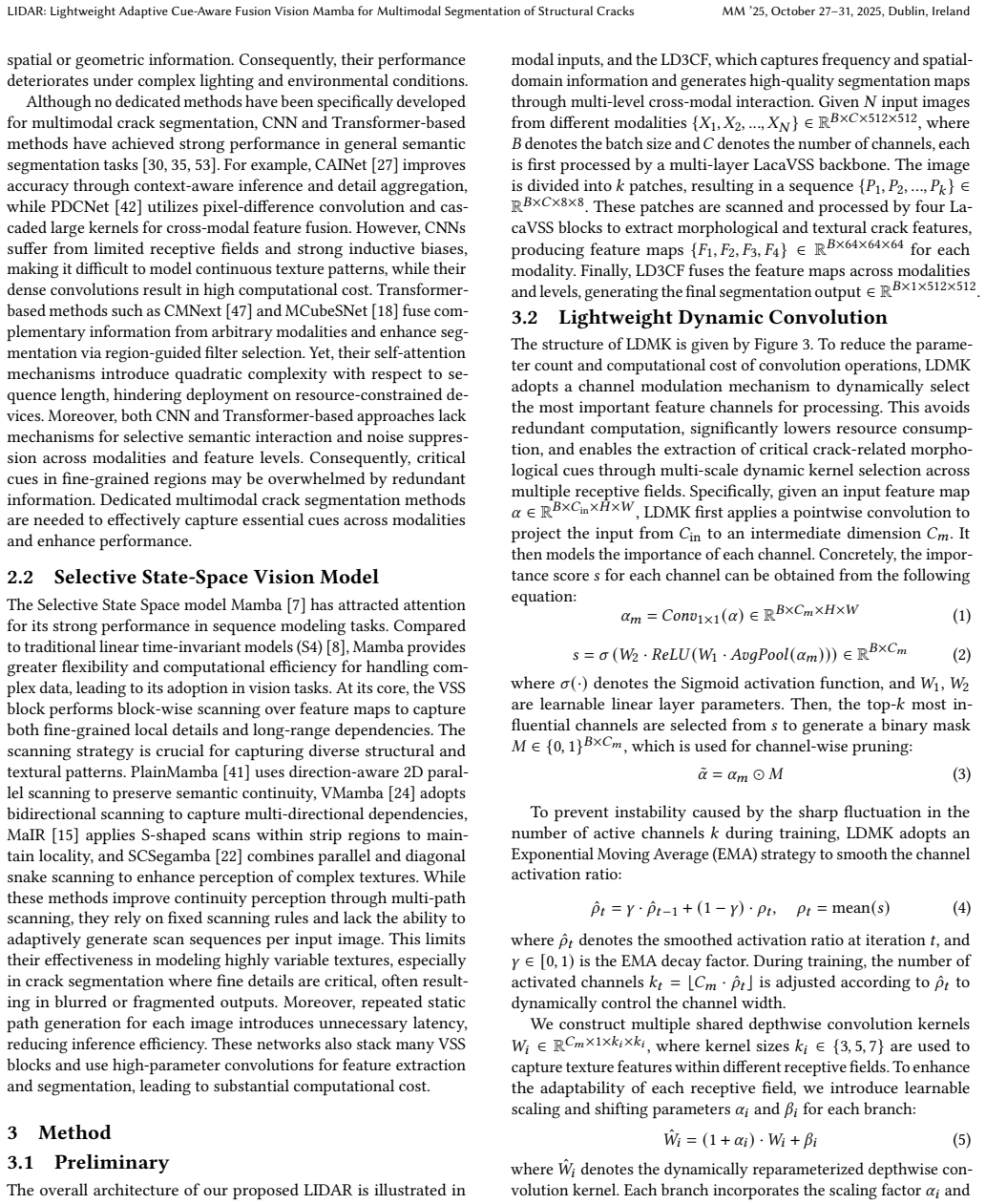
The load-bearing object is the mask-guided Efficient Dynamic Guided Scanning Strategy (EDG-SS). It turns a crack mask into an integral image, scores each 8x8 patch by the crack mass inside it, and sorts patches into four scan sequences (horizontal and vertical, forward and reverse) with crack patches first; LacaVSS then feeds those ordered patch sequences into the Mamba SS2D state-space update. Two supporting mechanisms complete the architecture: the Adaptive Frequency Domain Perceptron (AFDP) in LD3CF, which applies a real FFT, direction-aware convolutions, and a learnable soft radial frequency mask to amplify high-frequency crack components while suppressing low-frequency background, followed by dual-pooling fusion and cross-scale gating; and the Lightweight Dynamically Modulated Multi-Kernel convolution (LDMK), which prunes channels via a smoothed top-k score and reparameterizes shared depthwise kernels of sizes 3, 5, and 7 with learned gain and bias, so morphological detail is extracted at low cost.
What would settle it
Rerun LIDAR on CrackDepth with EDG-SS scan orders built from the ground-truth masks instead of the model's 10-epoch self-generated masks; if the ground-truth-guided version fails to beat the fixed-scanning baselines by the reported margin, the adaptive-scanning advantage is an artifact of training-set information flow.
Extended reading notes
Core claim
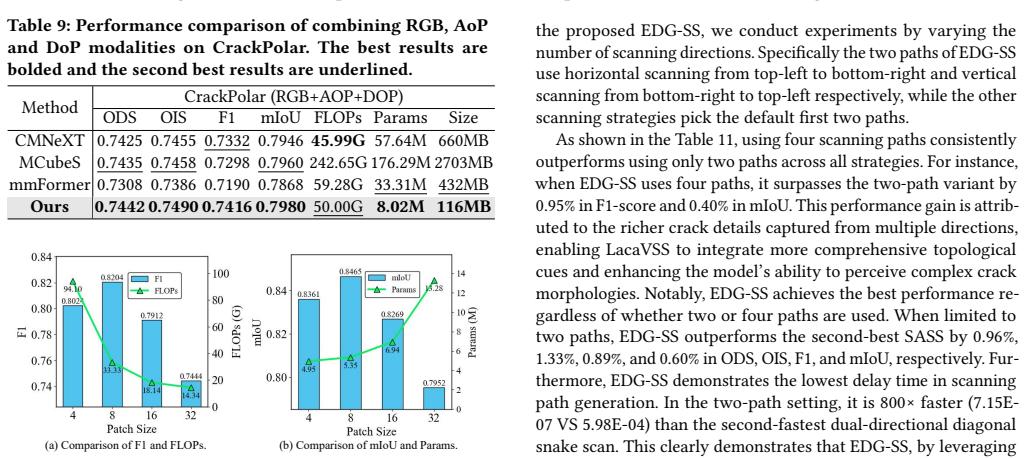
The paper's central claim is that adaptive, cue-aware scanning and frequency-domain fusion are enough to make a small Mamba network outperform larger CNN and transformer fusion models on multimodal crack segmentation. On the CrackDepth dataset with RGB plus degree-of-polarization input, LIDAR reports 0.8204 F1 and 0.8465 mIoU while using 5.35M parameters and 33.33 GFLOPs; the comparison tables show it ahead of methods such as Sigma, CMNeXT, CMX, CAINet, and MCubeS, several of which use many more parameters. The architecture derives this from three mechanisms: LacaVSS, which scans image patches in an order set by pre-computed crack masks; LD3CF, which separates high-frequency crack texture from low-frequency background using a learnable Fourier-domain mask and then fuses modalities by dual pooling and cross-scale gating; and LDMK, which prunes channels and reparameterizes 3x3, 5x5, and 7x7 depthwise kernels to capture morphology cheaply. The paper also claims the adaptive scan adds only 7.15E-07 seconds of path-generation latency because the order is precomputed and read from a file.
Load-bearing premise
The comparison that carries the paper runs on three datasets, two of which were collected by the authors (CrackDepth and CrackPolar), so if those datasets' annotations or acquisition conditions favor LIDAR's design—or if the compared baselines were not tuned fairly on them—the claimed consistent superiority may not transfer to other crack imagery; a second load-bearing premise is that the masks guiding the adaptive scan come from a 10-epoch pretraining of LIDAR itself on the same data.
Editorial extensions
If this is right
- On the four dual-modal settings in Table 1, LIDAR reports the best F1 and mIoU in every row, with the largest margin on IRTCrack (F1 0.8625 vs 0.8545 for Sigma).
- LIDAR reports the best F1 and mIoU in all four polarization multi-modal settings in Table 2, while keeping the smallest parameter count and model size among compared methods.
- The EDG-SS scanning strategy shortens scanning-path generation to 7.15E-07 seconds, roughly 874 times faster than the next-fastest fixed scanning baseline, according to Table 5.
- Replacing standard convolutions with LDMK cuts FLOPs from 156.14G to 33.33G and parameters from 20.56M to 5.35M while improving F1 from 0.8075 to 0.8204 on CrackDepth (Table 4).
- The authors introduce two new datasets, CrackDepth and CrackPolar, covering RGB paired with light-field depth and with five polarization-derived images, and state they will release code and datasets.
Reading between the lines
- EDG-SS should transfer to any segmentation task with thin, elongated foreground structures such as road markings, retinal vessels, or power lines, where an inexpensive pre-mask can tell a state-space model where to spend sequence capacity.
- The frequency-domain gating idea suggests a testable RGB-only variant: if AFDP alone accounts for most of the gain, the benefit may be independent of fusion, and unimodal crack segmentation could improve without extra sensors.
- Because EDG-SS derives its masks from the same model pretrained for 10 epochs on the same data, an independent check with ground-truth masks or masks from a different model would separate the scanning mechanism's benefit from label leakage.
- Evaluating LIDAR on public crack datasets beyond IRTCrack would test whether the reported superiority is architectural or specific to the two new author-collected datasets.
Editorial analysis
A structured set of objections, weighed in public.
Referee Report
Summary. The paper proposes LIDAR, a lightweight vision-Mamba network for multimodal structural crack segmentation. The architecture combines a Lightweight Adaptive Cue-Aware Visual State Space module (LacaVSS) with a mask-guided Efficient Dynamic Guided Scanning Strategy (EDG-SS), a Lightweight Dynamically Modulated Multi-Kernel convolution (LDMK), and a Lightweight Dual Domain Dynamic Collaborative Fusion module (LD3CF). The authors evaluate LIDAR on three datasets (IRTCrack, plus two self-collected datasets CrackDepth and CrackPolar) across dual-modal and multi-modal settings, reporting state-of-the-art segmentation performance with low parameter counts and FLOPs. The paper includes ablations for each component, scanning strategy, patch size, and layer count, and provides code and datasets.
Significance. If the results hold, the paper would make a practical contribution to crack segmentation by showing that a Mamba-based architecture can fuse RGB with depth, infrared, or polarization cues at a fraction of the parameter cost of transformer baselines. The introduction of two new multimodal crack datasets is also potentially valuable, and the extensive ablations (Tables 4-6, 10-13) are a strength. However, the central contribution—the adaptive EDG-SS scanning—is currently supported by a very small ablation gain and is entangled with a possible information leak from the mask-generation procedure, so the significance of the claimed architectural advance cannot be assessed without clarification and additional experiments.
major comments (5)
- [Section 3.3] The mask-generation procedure for EDG-SS is described as follows: a 10-epoch pretraining is run, then the pretrained weights are used to 'traverse all RGB images in the dataset' and generate initial masks, which determine the scanning order for training and testing. The paper does not state that the traversal is restricted to the training split. If test images are included, the test-time scanning order is derived from the model's own outputs on those very images, which constitutes a form of test-time information leakage and invalidates the reported improvement as evidence for a general adaptive-scanning principle. Even under the favorable reading that only training images are used, the ablation in Table 5 shows that EDG-SS gains only 0.0011 F1 over the 'w/o pre' variant (0.8204 vs 0.8193), which is within plausible seed-to-seed variation. The authors should specify the exact split used for mask generation, and report the EDG-SS ablation with masks generated strictly from the training split, using multiple seeds to establish statistical significance.
- [Section 4.1 and Supplementary B] The two new datasets, CrackDepth and CrackPolar, are introduced without any train/validation/test split description, annotation protocol, annotator count, or inter-annotator agreement metrics. The paper also does not state how the SOTA baselines were split and tuned on these datasets. Since all main comparisons in Tables 1-2 are evaluated on these self-collected datasets, the absence of this information makes the comparisons non-reproducible and raises the risk that the reported superiority is an artifact of favorable splits or unequal tuning. Please provide the split ratios, a description of the annotation process, and at least a basic measure of annotation consistency.
- [Section 4.3 and Tables 1-2] Several quantitative claims in the text do not match the numbers in the tables. For example, the text states that on CrackDepth LIDAR surpasses Sigma by 0.55%, 0.24%, 0.70%, and 0.33% in ODS, OIS, F1, and mIoU, but Table 1 shows differences of 0.45%, 0.61%, 0.57%, and 0.28%, respectively; on IRTCrack the claimed 0.94% F1 improvement over the second-best is not supported by the table (the largest F1 gap to a listed baseline is 0.80% versus Sigma). Moreover, no error bars, standard deviations, or significance tests are reported, and several margins in Table 1 are below 0.5%. Without statistical evidence, the claim of 'consistently superior performance' is not adequately supported. The numerical claims should be corrected, and the authors should report variance across at least three runs or conduct significance testing.
- [Section 3.2, Eqs. (2)-(3)] The LDMK module selects the top-k channels according to a score s and multiplies the feature map by a binary mask M. The top-k operation is non-differentiable, but the paper does not describe how gradients are propagated through this selection during training (for example, via a straight-through estimator, a soft top-k relaxation, or a Gumbel trick). Since LDMK is presented as a core lightweight component and is used throughout the network, this missing training detail is load-bearing for the reproducibility of the method. Please clarify the gradient computation for the channel-selection step.
- [Table 5 and Section 3.3] The 'Delay Time' comparison reports EDG-SS at 7.15E-07s versus 6.25E-04s for the next-fastest strategy, claiming a 874x speedup. However, EDG-SS sequences are precomputed offline and stored in a JSON file, so the reported delay excludes the 10-epoch pretraining and the cost of generating masks and scanning sequences for all images. The comparison is therefore not a fair measure of runtime for the full pipeline. The authors should report the total offline preprocessing cost and the online inference delay separately, or compare all methods under the same online-only conditions.
minor comments (5)
- [Section 4.1] The heading 'Datesets' is a typo and should read 'Datasets'.
- [Table 1] The last column header 'CrackDepth (RGB+DOP)' appears to be a mislabel: DOP is a polarization quantity described under the CrackPolar dataset, not a depth modality. This should likely be 'CrackPolar (RGB+DoP)' or clarified otherwise.
- [Abstract and Section 4.1] The abstract refers to 'the light-field depth dataset' while the dataset is named CrackDepth; the naming should be consistent throughout.
- [Section 3.4, Eq. (15)] The learnable parameters r (frequency separation radius) and tau (temperature) are introduced but their initialization and ranges are not specified; please add these details.
- [Table 5] The ablation variants 'w/o pre' and 'w/o pre&integral' are not defined in the main text. Please describe what each variant removes (e.g., no pretrained masks, no integral-image mechanism) to make the ablation interpretable.
Circularity Check
EDG-SS adaptivity is generated by the same model pretrained on the same (possibly test) data; the claimed adaptive-scanning advantage reduces to a self-fitted input.
-
fitted input called prediction
[Section 3.3 (Eqs. 8-11) and Section 4.2; Table 5]
"During pre-training, the EDG-SS in LacaVSS is replaced by the base parallel scanning strategy, and the model is trained for 10 epochs on the multimodal crack dataset to obtain a pre-trained weight file. This weight file is then used to traverse all RGB images in the dataset and generate initial masks that represent general crack contours. These masks are subsequently used by EDG-SS to generate personalized scanning sequences for each multimodal image group before formal training. ... All scanning sequences of the training and testing images are saved in a JSON file."
The 'adaptive' scan order O_(d)_s in Eq. (11) is a deterministic function of the mask M through the integral-image scores in Eqs. (8)-(9). That mask is produced by a 10-epoch pretraining of the same LIDAR model on the same dataset, and the paper explicitly says the resulting sequences cover 'training and testing images.' Thus the test-time input permutation is not an independent, fixed rule but a function of the model's own fitted output on the test data (or at least on the same dataset without a stated train/test split). The ablation 'w/o pre' vs. EDG-SS (F1 0.8193 vs. 0.8204) therefore measures the effect of injecting the model's own pretrained masks into the pipeline, not the general value of content-adaptive scanning.
full rationale
The only significant circularity is the EDG-SS mask-generation protocol. The paper does not state that the 10-epoch pretraining excludes the test split, and it explicitly saves scanning sequences for 'training and testing images'; hence the adaptive scan order used at test time is derived from a model fitted to the same data. This makes the central 'adaptive scanning' claim partially self-referential, though the final segmentation still requires the full network, so the paper does not reduce entirely to its inputs. The other comparisons against published baselines are standard benchmarking, and the self-citations to the authors' SCSegamba are used as a baseline, not as a load-bearing uniqueness or ansatz argument. The two new datasets are author-collected, which is a verifiability concern rather than circularity. Overall score 6: one key component's reported benefit is substantially attributable to a fitted input derived from the model itself.
Assumptions & free parameters
free parameters (4)
- EMA decay gamma =
not reported
- temperature tau =
not reported
- top-k channel selection fraction =
derived from EMA-smoothed mean score
- frequency separation radius r =
learnable
assumptions (3)
- ad hoc to paper The pretrained masks used by EDG-SS are valid crack priors.
- domain assumption The self-collected datasets have accurate pixel-level ground truth.
- standard math The S6/Mamba state-space update in Equation 13 is applied correctly to reordered patch sequences.
invented entities (1)
-
Adaptive scanning order derived from pretrained masks (EDG-SS)
Cite this review
Pith. "Pith review of LIDAR: Lightweight Adaptive Cue-Aware Fusion Vision Mamba for Multimodal Segmentation of Structural Cracks." pith.science (2026). https://pith.science/paper/EALDR3KF
@misc{pith2026250722477,
  author       = {Pith},
  title        = {Pith review of: LIDAR: Lightweight Adaptive Cue-Aware Fusion Vision Mamba for Multimodal Segmentation of Structural Cracks},
  year         = {2026},
  howpublished = {\url{https://pith.science/paper/EALDR3KF}},
  note         = {Machine review of arXiv:2507.22477}
}
read the original abstract
Achieving pixel-level segmentation with low computational cost using multimodal data remains a key challenge in crack segmentation tasks. Existing methods lack the capability for adaptive perception and efficient interactive fusion of cross-modal features. To address these challenges, we propose a Lightweight Adaptive Cue-Aware Vision Mamba network (LIDAR), which efficiently perceives and integrates morphological and textural cues from different modalities under multimodal crack scenarios, generating clear pixel-level crack segmentation maps. Specifically, LIDAR is composed of a Lightweight Adaptive Cue-Aware Visual State Space module (LacaVSS) and a Lightweight Dual Domain Dynamic Collaborative Fusion module (LD3CF). LacaVSS adaptively models crack cues through the proposed mask-guided Efficient Dynamic Guided Scanning Strategy (EDG-SS), while LD3CF leverages an Adaptive Frequency Domain Perceptron (AFDP) and a dual-pooling fusion strategy to effectively capture spatial and frequency-domain cues across modalities. Moreover, we design a Lightweight Dynamically Modulated Multi-Kernel convolution (LDMK) to perceive complex morphological structures with minimal computational overhead, replacing most convolutional operations in LIDAR. Experiments on three datasets demonstrate that our method outperforms other state-of-the-art (SOTA) methods. On the light-field depth dataset, our method achieves 0.8204 in F1 and 0.8465 in mIoU with only 5.35M parameters. Code and datasets are available at https://github.com/Karl1109/LIDAR-Mamba.
Figures


Figures from the paper (9 more)



Reference graph
Works this paper leans on
-
[1]
Roman Bachmann, David Mizrahi, Andrei Atanov, and Amir Zamir. 2022. Multi- mae: Multi-modal multi-task masked autoencoders. In European Conference on Computer Vision. Springer, 348–367
work page 2022
-
[2]
Zhuangzhuang Chen, Zhuonan Lai, Jie Chen, and Jianqiang Li. 2024. Mind marginal non-crack regions: Clustering-inspired representation learning for crack segmentation. In Proceedings of the IEEE/CVF Conference on Computer Vision and Pattern Recognition . 12698–12708
work page 2024
-
[3]
Xu Cheng, Tian He, Fan Shi, Meng Zhao, Xiufeng Liu, and Shengyong Chen
-
[4]
Xiaoyu Dong and Naoto Yokoya. 2024. Understanding dark scenes by contrasting multi-modal observations. In Proceedings of the IEEE/CVF Winter Conference on Applications of Computer Vision. 840–850
work page 2024
-
[5]
Rohit Girdhar, Mannat Singh, Nikhila Ravi, Laurens Van Der Maaten, Armand Joulin, and Ishan Misra. 2022. Omnivore: A single model for many visual modal- ities. In Proceedings of the IEEE/CVF conference on computer vision and pattern recognition. 16102–16112
work page 2022
-
[6]
Karan Goel, Albert Gu, Chris Donahue, and Christopher Ré. 2022. It’s raw! audio generation with state-space models. In International conference on machine learning. PMLR, 7616–7633
work page 2022
-
[7]
Albert Gu and Tri Dao. 2023. Mamba: Linear-time sequence modeling with selective state spaces. arXiv preprint arXiv:2312.00752 (2023)
arXiv 2023
-
[8]
Albert Gu, Karan Goel, Ankit Gupta, and Christopher Ré. 2022. On the parame- terization and initialization of diagonal state space models. Advances in Neural Information Processing Systems 35 (2022), 35971–35983
2022
Show all 59 references
-
[9]
Albert Gu, Isys Johnson, Aman Timalsina, Atri Rudra, and Christopher Ré. 2022. How to train your hippo: State space models with generalized orthogonal basis projections. arXiv preprint arXiv:2206.12037 (2022)
2022 arXiv
-
[10]
Hang Guo, Jinmin Li, Tao Dai, Zhihao Ouyang, Xudong Ren, and Shu-Tao Xia
-
[11]
Zhiwei Hao, Zhongyu Xiao, Yong Luo, Jianyuan Guo, Jing Wang, Li Shen, and Han Hu. 2024. PrimKD: Primary Modality Guided Multimodal Fusion for RGB-D Semantic Segmentation. In Proceedings of the 32nd ACM International Conference on Multimedia. 1943–1951
2024
-
[12]
Shruti Jadon. 2020. A survey of loss functions for semantic segmentation. In 2020 IEEE conference on computational intelligence in bioinformatics and computational biology (CIBCB). IEEE, 1–7
2020
-
[13]
Achref Jaziri, Martin Mundt, Andres Fernandez, and Visvanathan Ramesh. 2024. Designing a hybrid neural system to learn real-world crack segmentation from fractal-based simulation. In Proceedings of the IEEE/CVF Winter Conference on Applications of Computer Vision. 8636–8646
2024
-
[14]
Hong Lang, Ye Yuan, Jiang Chen, Shuo Ding, Jian John Lu, and Yong Zhang. 2024. Augmented concrete crack segmentation: Learning complete representation to defend background interference in concrete pavements. IEEE Transactions on Instrumentation and Measurement (2024)
2024
-
[15]
Boyun Li, Haiyu Zhao, Wenxin Wang, Peng Hu, Yuanbiao Gou, and Xi Peng. 2025. MaIR: A Locality- and Continuity-Preserving Mamba for Image Restoration. In IEEE Conference on Computer Vision and Pattern Recognition
2025
-
[16]
Shuxin Li, Xu Cheng, Fan Shi, Hanwei Zhang, Hongning Dai, Houxiang Zhang, and Shengyong Chen. 2025. A Novel Robustness-Enhancing Adversarial Defense Approach to AI-Powered Sea State Estimation for Autonomous Marine Vessels. IEEE Transactions on Systems, Man, and Cybernetics: S...
2025
-
[17]
Yan Li, Yifei Xing, Xiangyuan Lan, Xin Li, Haifeng Chen, and Dongmei Jiang
-
[18]
Yupeng Liang, Ryosuke Wakaki, Shohei Nobuhara, and Ko Nishino. 2022. Mul- timodal material segmentation. In Proceedings of the IEEE/CVF Conference on Computer Vision and Pattern Recognition . 19800–19808
2022
-
[19]
Jianghai Liao, Yuanhao Yue, Dejin Zhang, Wei Tu, Rui Cao, Qin Zou, and Qingquan Li. 2022. Automatic tunnel crack inspection using an efficient mo- bile imaging module and a lightweight CNN. IEEE Transactions on Intelligent Transportation Systems 23, 9 (2022), 15190–15203
2022
-
[20]
Fangyu Liu, Jian Liu, and Linbing Wang. 2022. Asphalt pavement crack detec- tion based on convolutional neural network and infrared thermography. IEEE Transactions on Intelligent Transportation Systems 23, 11 (2022), 22145–22155
2022
-
[21]
Fangyu Liu, Jian Liu, and Linbing Wang. 2022. Asphalt pavement fatigue crack severity classification by infrared thermography and deep learning. Automation in Construction 143 (2022), 104575
2022
-
[22]
Hui Liu, Chen Jia, Fan Shi, Xu Cheng, and Shengyong Chen. 2025. SCSegamba: Lightweight Structure-Aware Vision Mamba for Crack Segmentation in Struc- tures. In Proceedings of the IEEE/CVF Conference on Computer Vision and Pattern Recognition
2025
-
[23]
Huajun Liu, Xiangyu Miao, Christoph Mertz, Chengzhong Xu, and Hui Kong
-
[24]
Yue Liu, Yunjie Tian, Yuzhong Zhao, Hongtian Yu, Lingxi Xie, Yaowei Wang, Qixiang Ye, and Yunfan Liu. 2024. VMamba: Visual State Space Model. arXiv preprint arXiv:2401.10166 (2024)
2024 arXiv
-
[25]
Yahui Liu, Jian Yao, Xiaohu Lu, Renping Xie, and Li Li. 2019. DeepCrack: A deep hierarchical feature learning architecture for crack segmentation. Neurocomput- ing 338 (2019), 139–153
2019
-
[26]
Xiaoyong Lu and Songlin Du. 2025. JamMa: Ultra-lightweight Local Feature Matching with Joint Mamba. In Proceedings of the IEEE/CVF Conference on Com- puter Vision and Pattern Recognition
2025
-
[27]
Ying Lv, Zhi Liu, and Gongyang Li. 2024. Context-aware interaction network for rgb-t semantic segmentation. IEEE Transactions on Multimedia 26 (2024), 6348–6360
2024
-
[28]
Xianping Ma, Xiaokang Zhang, Man-On Pun, and Ming Liu. 2024. A multilevel multimodal fusion transformer for remote sensing semantic segmentation. IEEE Transactions on Geoscience and Remote Sensing (2024)
2024
-
[29]
Liu Mushui, Jun Dan, Ziqian Lu, Yunlong Yu, Yingming Li, and Xi Li. 2024. CM-UNet: Hybrid CNN-Mamba UNet for Remote Sensing Image Semantic Seg- mentation. arXiv preprint arXiv:2405.10530 (2024)
2024 arXiv
-
[30]
Y. Peng, M. Sonka, and D. Z. Chen. 2024. Group Vision Transformer. InProceedings of the 32nd ACM International Conference on Multimedia . 2623–2631
2024
-
[31]
Mark Sandler, Andrew Howard, Menglong Zhu, Andrey Zhmoginov, and Liang- Chieh Chen. 2018. Mobilenetv2: Inverted residuals and linear bottlenecks. In Proceedings of the IEEE conference on computer vision and pattern recognition (CVPR). 4510–4520
2018
-
[32]
Daniel Seichter, Söhnke Benedikt Fischedick, Mona Köhler, and Horst-Michael Groß. 2022. Efficient multi-task rgb-d scene analysis for indoor environments. In 2022 International joint conference on neural networks (IJCNN) . IEEE, 1–10
2022
-
[33]
Carole H Sudre, Wenqi Li, Tom Vercauteren, Sebastien Ourselin, and M Jorge Car- doso. 2017. Generalised dice overlap as a deep learning loss function for highly unbalanced segmentations. Springer, 240–248
2017
-
[34]
Zifu Wan, Yuhao Wang, Silong Yong, Pingping Zhang, Simon Stepputtis, Katia Sycara, and Yaqi Xie. 2025. Sigma: Siamese Mamba Network for Multi-Modal Semantic Segmentation. In Proceedings of the IEEE/CVF Winter Conference on Applications of Computer Vision
2025
-
[35]
H. Wang, X. Liang, T. Zhang, et al. 2024. PSSD-Transformer: Powerful Sparse Spike-Driven Transformer for Image Semantic Segmentation. In Proceedings of the 32nd ACM International Conference on Multimedia . 758–767
2024
-
[36]
Jin Wang, Zhigao Zeng, Pradip Kumar Sharma, Osama Alfarraj, Amr Tolba, Jianming Zhang, and Lei Wang. 2024. Dual-path network combining CNN and transformer for pavement crack segmentation. Automation in Construction 158 (2024), 105217
2024
-
[37]
Yingqian Wang, Longguang Wang, Zhengyu Liang, Jungang Yang, Wei An, and Yulan Guo. 2022. Occlusion-aware cost constructor for light field depth estima- tion. In Proceedings of the IEEE/CVF conference on computer vision and pattern recognition. 19809–19818
2022
-
[38]
Chao Xiang, Jingjing Guo, Ran Cao, and Lu Deng. 2023. A crack-segmentation algorithm fusing transformers and convolutional neural networks for complex detection scenarios. Automation in Construction 152 (2023), 104894
2023
-
[39]
Chaodong Xiao, Minghan Li, Zhengqiang Zhang, Deyu Meng, and Lei Zhang
-
[40]
X. Xue, D. Yu, L. Liu, et al. 2023. Transformer-based Open-world Instance Seg- mentation with Cross-task Consistency Regularization. In Proceedings of the 31st ACM International Conference on Multimedia . 2507–2515. Supplementary material MM ’25, October 27–31, 2025, Dublin, Ireland
2023
-
[41]
Chenhongyi Yang, Zehui Chen, Miguel Espinosa, Linus Ericsson, Zhenyu Wang, Jiaming Liu, and Elliot J. Crowley. 2024. PlainMamba: Improving Non- Hierarchical Mamba in Visual Recognition. arXiv:2403.17695 [cs.CV]
2024 arXiv
-
[42]
Jun Yang, Lizhi Bai, Yaoru Sun, Chunqi Tian, Maoyu Mao, and Guorun Wang. 2023. Pixel difference convolutional network for RGB-D semantic segmentation. IEEE Transactions on Circuits and Systems for Video Technology 34, 3 (2023), 1481–1492
2023
-
[43]
Hanrong Ye and Dan Xu. 2022. Taskprompter: Spatial-channel multi-task prompt- ing for dense scene understanding. In The Eleventh International Conference on Learning Representations
2022
-
[44]
In The Thirteenth International Conference on Learning Representa- tions
Spatial-Mamba: Effective Visual State Space Models via Structure-Aware State Fusion. In The Thirteenth International Conference on Learning Representa- tions
-
[45]
Hang Zhang, Allen A Zhang, Zishuo Dong, Anzheng He, Yang Liu, You Zhan, and Kelvin CP Wang. 2024. Robust semantic segmentation for automatic crack detection within pavement images using multi-mixing of global context and local image features. IEEE Transactions on Intelligent T...
2024
-
[46]
Jiaming Zhang, Huayao Liu, Kailun Yang, Xinxin Hu, Ruiping Liu, and Rainer Stiefelhagen. 2023. CMX: Cross-modal fusion for RGB-X semantic segmentation with transformers. IEEE Transactions on intelligent transportation systems 24, 12 (2023), 14679–14694
2023
-
[47]
Jiaming Zhang, Ruiping Liu, Hao Shi, Kailun Yang, Simon Reiß, Kunyu Peng, Haodong Fu, Kaiwei Wang, and Rainer Stiefelhagen. 2023. Delivering arbitrary- modal semantic segmentation. In Proceedings of the IEEE/CVF Conference on Computer Vision and Pattern Recognition . 1136–1147
2023
-
[48]
Jingwei Zhang, Anh Tien Nguyen, Xi Han, Vincent Quoc-Huy Trinh, Hong Qin, Dimitris Samaras, and Mahdi S Hosseini. 2025. 2DMamba: Efficient State Space Model for Image Representation with Applications on Giga-Pixel Whole Slide Image Classification. In Proceedings of the IEEE/CV...
2025
-
[49]
Weihao Yu and Xinchao Wang. 2025. MambaOut: Do We Really Need Mamba for Vision?. In Proceedings of the IEEE/CVF Conference on Computer Vision and Pattern Recognition
2025
-
[50]
Yao Zhang, Nanjun He, Jiawei Yang, Yuexiang Li, Dong Wei, Yawen Huang, Yang Zhang, Zhiqiang He, and Yefeng Zheng. 2022. mmformer: Multimodal medical transformer for incomplete multimodal learning of brain tumor segmentation. In International Conference on Medical Image Computi...
2022
-
[51]
Zixiang Zhao, Haowen Bai, Jiangshe Zhang, Yulun Zhang, Kai Zhang, Shuang Xu, Dongdong Chen, Radu Timofte, and Luc Van Gool. 2024. Equivariant multi- modality image fusion. In Proceedings of the IEEE/CVF conference on computer vision and pattern recognition . 25912–25921
2024
-
[52]
Wujie Zhou, Enquan Yang, Jingsheng Lei, Jian Wan, and Lu Yu. 2022. PGDENet: Progressive guided fusion and depth enhancement network for RGB-D indoor scene parsing. IEEE Transactions on Multimedia 25 (2022), 3483–3494
2022
-
[53]
Zhou and T
X. Zhou and T. Chen. 2024. Bsbp-RWKV: Background Suppression with Boundary Preservation for Efficient Medical Image Segmentation. In Proceedings of the 32nd ACM International Conference on Multimedia . 4938–4946
2024
-
[54]
Tianjie Zhang, Donglei Wang, and Yang Lu. 2023. ECSNet: An accelerated real- time image segmentation CNN architecture for pavement crack detection. IEEE Transactions on Intelligent Transportation Systems 24, 12 (2023), 15105–15112
2023
-
[59]
Lianghui Zhu, Bencheng Liao, Qian Zhang, Xinlong Wang, Wenyu Liu, and Xinggang Wang. 2024. Vision Mamba: Efficient Visual Representation Learning with Bidirectional State Space Model. In International Conference on Machine Learning
2024
-
[2021]
In Proceedings of the IEEE/CVF international conference on computer vision
Crackformer: Transformer network for fine-grained crack detection. In Proceedings of the IEEE/CVF international conference on computer vision . 3783– 3792
-
[2023]
IEEE Transactions on Intelligent Transportation Systems 25, 5 (2023), 3445–3456
Selective feature fusion and irregular-aware network for pavement crack detection. IEEE Transactions on Intelligent Transportation Systems 25, 5 (2023), 3445–3456
2023
-
[2024]
In European Conference on Computer Vision
Mambair: A simple baseline for image restoration with state-space model. In European Conference on Computer Vision . Springer, 222–241
-
[2025]
In Proceedings of the IEEE/CVF Conference on Computer Vision and Pattern Recognition
AlignMamba: Enhancing Multimodal Mamba with Local and Global Cross- modal Alignment. In Proceedings of the IEEE/CVF Conference on Computer Vision and Pattern Recognition
Reviewed August 6, 2026 · model on record in the stance chip above.
Discussion (0). Sign in to comment.