REVIEW 3 major objections 1 minor 59 references
GIRL-DETR: Gradient-Isolated Reinforcement Learning for Video Moment Retrieval
T0 review · 3 major / 1 minor · reviewed 2026-06-28 · grok-4.3
Pith's one-line read GIRL-DETR freezes the backbone after supervised training so reinforcement learning can directly optimize tIoU in the detection head of lightweight video moment retrieval models.
desk verdict GIRL-DETR shows a workable way to add RL post-training to a small VMR model by freezing the backbone and tuning only the head, but the gains hinge on whether those frozen features are already good enough. read the letter →
The pith
A machine-rendered reading of the paper's core claim, the machinery that carries it, and where it could break.
The reading
What carries the argument
Gradient isolation via backbone freezing combined with three-stage progressive reinforcement learning (TPRL) applied solely to the detection head after cross-modal interaction and text-guided gating in a DETR framework.
What would settle it
An experiment that applies RL to the full unfrozen model and obtains equal or higher tIoU gains without feature degradation would falsify the necessity of gradient isolation.
Extended reading notes
Core claim
After supervised convergence, freezing the backbone protects the feature manifold while the detection head applies three-stage progressive reinforcement learning to directly maximize the non-differentiable tIoU metric, thereby resolving surrogate loss degradation through an orthogonal decoupling of state representation and metric optimization.
Load-bearing premise
Freezing the backbone after supervised convergence fully protects the feature manifold while still allowing the detection head alone to produce meaningful improvements through RL without requiring any further adaptation of the earlier cross-modal representations.
Editorial extensions
If this is right
- Resolves optimization stagnation caused by misalignment between surrogate losses and non-differentiable metrics in late training stages.
- Enables stable RL post-training on lightweight VMR networks without disrupting fragile cross-modal feature representations.
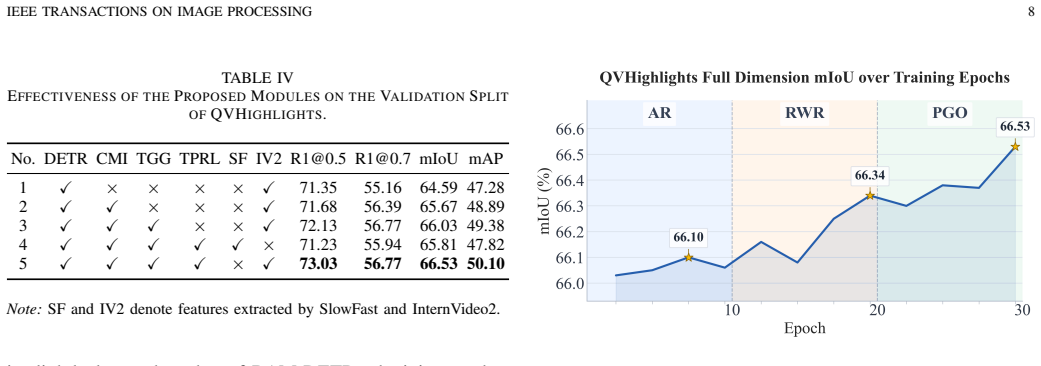
- Delivers substantial accuracy gains on Charades-STA, QVHighlights, and TACoS while updating only a small fraction of parameters.
- Establishes a practical pathway for applying RL to other lightweight detection architectures where direct metric optimization is desired.
Reading between the lines
- The same isolation principle may generalize to other multimodal detection tasks where pretrained representations are fragile and evaluation metrics are non-differentiable.
- Adaptive or partial freezing schedules could be tested to determine whether complete isolation is always optimal or if limited backbone updates become beneficial after the RL phase stabilizes.
- The method highlights a broader design choice between joint end-to-end optimization and staged training when combining supervised pretraining with reinforcement learning.
Editorial analysis
A structured set of objections, weighed in public.
Referee Report
Summary. The paper introduces GIRL-DETR for video moment retrieval, which performs supervised pre-training with cross-modal interaction (CMI), text-guided gating (TGG), and a transformer encoder-decoder, then freezes the backbone and applies three-stage progressive reinforcement learning (TPRL) via gradient isolation to the detection head alone in order to directly maximize the non-differentiable tIoU metric. The central claim is that this orthogonal decoupling resolves surrogate-loss degradation, protects the learned feature manifold, and yields substantial accuracy gains on Charades-STA, QVHighlights, and TACoS with only minimal parameter updates.
Significance. If the empirical claims hold, the work supplies a practical route for applying RL post-training to lightweight VMR architectures without catastrophic disruption of cross-modal representations, addressing a recognized mismatch between surrogate objectives and evaluation metrics. The explicit separation of representation learning from metric optimization is a clear methodological contribution.
major comments (3)
- [Abstract] Abstract: the claim that 'freezing the backbone network ... while the detection head directly optimizes ... tIoU' produces meaningful gains rests on the untested assumption that the supervised cross-modal features already supply high-SNR inputs sufficient for head-only RL; no ablation comparing frozen vs. unfrozen backbones or measuring residual misalignment after the supervised phase is referenced, rendering the orthogonal-decoupling argument unverifiable from the given text.
- [Abstract] Abstract: the statement that the method 'achieves substantial accuracy improvements' is presented without any numerical results, tables, or error bars; in the absence of concrete metrics (e.g., R@1, mIoU deltas) or comparisons against the supervised baseline, the magnitude and reliability of the reported gains cannot be assessed.
- [Abstract] Abstract: the TPRL strategy is described only at a high level ('three-stage progressive'); the manuscript supplies neither the stage-transition thresholds, the precise reward formulation, nor the gradient-isolation implementation details that would allow verification that the RL update truly leaves the frozen CMI+TGG+encoder manifold untouched.
minor comments (1)
- [Abstract] The abstract repeatedly uses the phrase 'lightweight temporal localization framework' without defining the parameter count or architectural constraints that distinguish it from prior DETR-style VMR models.
Simulated Author's Rebuttal
We thank the referee for the constructive feedback on our manuscript. We address each major comment below and indicate the revisions we will make.
read point-by-point responses
-
Referee: [Abstract] Abstract: the claim that 'freezing the backbone network ... while the detection head directly optimizes ... tIoU' produces meaningful gains rests on the untested assumption that the supervised cross-modal features already supply high-SNR inputs sufficient for head-only RL; no ablation comparing frozen vs. unfrozen backbones or measuring residual misalignment after the supervised phase is referenced, rendering the orthogonal-decoupling argument unverifiable from the given text.
Authors: We acknowledge that an explicit ablation comparing frozen versus unfrozen backbones during the RL phase would strengthen the orthogonal-decoupling claim. While the current results show gains with minimal parameter updates after freezing, we agree the assumption requires direct verification. We will add this ablation study in the revised manuscript. revision: yes
-
Referee: [Abstract] Abstract: the statement that the method 'achieves substantial accuracy improvements' is presented without any numerical results, tables, or error bars; in the absence of concrete metrics (e.g., R@1, mIoU deltas) or comparisons against the supervised baseline, the magnitude and reliability of the reported gains cannot be assessed.
Authors: We will revise the abstract to include concrete numerical results, such as the specific R@1 and mIoU deltas on Charades-STA, QVHighlights, and TACoS relative to the supervised baseline. revision: yes
-
Referee: [Abstract] Abstract: the TPRL strategy is described only at a high level ('three-stage progressive'); the manuscript supplies neither the stage-transition thresholds, the precise reward formulation, nor the gradient-isolation implementation details that would allow verification that the RL update truly leaves the frozen CMI+TGG+encoder manifold untouched.
Authors: We agree that additional details are required for full verification. We will expand the methods section to include the stage-transition thresholds, precise reward formulation, and gradient-isolation implementation details. revision: yes
Circularity Check
No significant circularity detected in derivation chain
full rationale
The paper presents a two-phase procedure: supervised training of the full model (CMI + TGG + encoder + head) to convergence, followed by freezing the backbone and applying TPRL only to the detection head to directly maximize the external non-differentiable metric tIoU. No equations, self-definitions, or fitted-parameter renamings are shown that would make the reported accuracy gains tautological with the method's own inputs. The decoupling is an explicit design choice rather than a derived necessity, and the central claim rests on benchmark results rather than load-bearing self-citations or uniqueness theorems imported from prior author work. This is a standard non-circular empirical method description.
Assumptions & free parameters
free parameters (1)
- TPRL stage transition thresholds
assumptions (2)
- domain assumption Freezing the backbone after supervised training protects the established feature manifold from disruption by subsequent RL updates.
- domain assumption The detection head alone can meaningfully optimize tIoU via RL without further updates to cross-modal features.
Cite this review
Pith. "Pith review of GIRL-DETR: Gradient-Isolated Reinforcement Learning for Video Moment Retrieval." pith.science (2026). https://pith.science/paper/EAU3UKR4
@misc{pith2026260600775,
  author       = {Pith},
  title        = {Pith review of: GIRL-DETR: Gradient-Isolated Reinforcement Learning for Video Moment Retrieval},
  year         = {2026},
  howpublished = {\url{https://pith.science/paper/EAU3UKR4}},
  note         = {Machine review of arXiv:2606.00775}
}
read the original abstract
Video Moment Retrieval (VMR) task requires accurately localizing temporal boundaries aligned with natural language queries, but many models suffer from a misalignment between continuous surrogate losses and non-differentiable metrics, leading to optimization stagnation during the late stages of training and trapping boundary predictions in suboptimal solutions. Although Reinforcement Learning (RL) post-training successfully optimizes localization results for large models, applying it directly to lightweight networks easily disrupts the fragile feature representations established during the supervised phase. To overcome this optimization bottleneck, we propose Gradient-Isolated Reinforcement Learning for DETR (GIRL-DETR), introducing RL post-training into a lightweight temporal localization framework for the first time. The input video and text features first establish early alignment through Cross-Modal Interaction (CMI) before entering the transformer encoder. Subsequently, a Text-Guided Gating (TGG) mechanism dynamically injects semantic priors into the queries before the transformer decoder generates candidate proposals, providing high signal-to-noise ratio inputs for temporal prediction. After the supervised training reaches convergence, the backbone network is frozen to protect the feature manifold, while the detection head directly optimizes the non-differentiable evaluation metric tIoU to enhance localization accuracy through a Three-stage Progressive Reinforcement Learning (TPRL) strategy. This approach achieves an orthogonal decoupling of state representation and metric optimization. Experiments on Charades-STA, QVHighlights, and TACoS demonstrate that GIRL-DETR effectively resolves surrogate loss degradation and achieves substantial accuracy improvements with minimal parameter updates, providing a robust new pathway for RL applications in lightweight VMR models.
Figures


Figures from the paper (3 more)


Reference graph
Works this paper leans on
-
[1]
Tall: Temporal activity localization via language query,
J. Gao, C. Sun, Z. Yang, and R. Nevatia, “Tall: Temporal activity localization via language query,” inProc. IEEE Int. Conf. Comput. Vis. (ICCV), 2017, pp. 5267–5275
2017
-
[2]
Localizing moments in video with natural language,
L. Anne Hendricks, O. Wang, E. Shechtman, J. Sivic, T. Darrell, and B. Russell, “Localizing moments in video with natural language,” in Proc. IEEE Int. Conf. Comput. Vis. (ICCV), 2017, pp. 5803–5812
2017
-
[3]
Maban: Multi-agent boundary-aware network for natural language moment retrieval,
X. Sun, H. Wang, and B. He, “Maban: Multi-agent boundary-aware network for natural language moment retrieval,”IEEE Trans. Image Process., vol. 30, pp. 5589–5599, 2021
2021
-
[4]
Temporal sentence grounding in videos: A survey and future directions,
H. Zhang, A. Sun, W. Jing, and J. T. Zhou, “Temporal sentence grounding in videos: A survey and future directions,”IEEE Trans. Pattern Anal. Mach. Intell., vol. 45, no. 8, pp. 10 443–10 465, 2023
2023
-
[5]
Video moment localization via deep cross-modal hashing,
Y . Hu, M. Liu, X. Su, Z. Gao, and L. Nie, “Video moment localization via deep cross-modal hashing,”IEEE Trans. Image Process., vol. 30, pp. 4667–4677, 2021
2021
-
[6]
Local correspondence network for weakly supervised temporal sentence grounding,
W. Yang, T. Zhang, Y . Zhang, and F. Wu, “Local correspondence network for weakly supervised temporal sentence grounding,”IEEE Trans. Image Process., vol. 30, pp. 3252–3262, 2021
2021
-
[7]
Video moment retrieval with cross-modal neural architecture search,
X. Yang, S. Wang, J. Dong, J. Dong, M. Wang, and T.-S. Chua, “Video moment retrieval with cross-modal neural architecture search,”IEEE Trans. Image Process., vol. 31, pp. 1204–1216, 2022. IEEE TRANSACTIONS ON IMAGE PROCESSING 12
2022
-
[8]
Bam-detr: Boundary-aligned moment detection transformer for temporal sentence grounding in videos,
P. Lee and H. Byun, “Bam-detr: Boundary-aligned moment detection transformer for temporal sentence grounding in videos,” inProc. Eur. Conf. Comput. Vis. (ECCV). Springer, 2024, pp. 220–238
2024
Show all 59 references
-
[9]
Bmrn: Boundary matching and refine- ment network for temporal moment localization with natural language,
M. Seol, J. Kim, and J. Moon, “Bmrn: Boundary matching and refine- ment network for temporal moment localization with natural language,” inProc. IEEE/CVF Conf. Comput. Vis. Pattern Recognit. (CVPR), 2023, pp. 5571–5579
2023
-
[10]
Time-r1: Post-training large vision language model for temporal video grounding,
Y . Wang, Z. Wang, B. Xu, Y . Du, K. Lin, Z. Xiao, Z. Yue, J. Ju, L. Zhang, D. Yanget al., “Time-r1: Post-training large vision language model for temporal video grounding,”Adv. Neural Inf. Process. Syst. (NIPS), vol. 38, pp. 83 330–83 364, 2026
2026
-
[11]
Datasets and recipes for video temporal grounding via reinforcement learning,
R. Chen, T. Luo, Z. Fan, H. Zou, Z. Feng, G. Xie, H. Zhang, Z. Wang, Z. Liu, and Z. Huaijian, “Datasets and recipes for video temporal grounding via reinforcement learning,” inProc. Conf. Empir. Methods Nat. Lang. Process. (EMNLP), 2025, pp. 983–992
2025
-
[12]
Detecting moments and highlights in videos via natural language queries,
J. Lei, T. L. Berg, and M. Bansal, “Detecting moments and highlights in videos via natural language queries,”Adv. Neural Inf. Process. Syst. (NIPS), vol. 34, pp. 11 846–11 858, 2021
2021
-
[13]
Correlation-guided calibration of query dependency for video temporal grounding,
W. Moon, S. Hyun, S. Lee, and J. pil Heo, “Correlation-guided calibration of query dependency for video temporal grounding,” Pattern Recognit., vol. 174, p. 112984, 2025. [Online]. Available: https://api.semanticscholar.org/CorpusID:284322691
2025
-
[14]
Tr-detr: Task-reciprocal transformer for joint moment retrieval and highlight detection,
H. Sun, M. Zhou, W. Chen, and W. Xie, “Tr-detr: Task-reciprocal transformer for joint moment retrieval and highlight detection,” inProc. AAAI Conf. Artif. Intell., vol. 38, no. 5, 2024, pp. 4998–5007
2024
-
[15]
Umt: Unified multi-modal transformers for joint video moment retrieval and highlight detection,
Y . Liu, S. Li, Y . Wu, C.-W. Chen, Y . Shan, and X. Qie, “Umt: Unified multi-modal transformers for joint video moment retrieval and highlight detection,” inProc. IEEE/CVF Conf. Comput. Vis. Pattern Recognit. (CVPR), 2022, pp. 3042–3051
2022
-
[16]
Bridging the gap: A unified video comprehension framework for moment retrieval and highlight detection,
Y . Xiao, Z. Luo, Y . Liu, Y . Ma, H. Bian, Y . Ji, Y . Yang, and X. Li, “Bridging the gap: A unified video comprehension framework for moment retrieval and highlight detection,” inProc. IEEE/CVF Conf. Comput. Vis. Pattern Recognit. (CVPR), 2024, pp. 18 709–18 719
2024
-
[17]
Training language models to follow instructions with human feedback,
L. Ouyang, J. Wu, X. Jiang, D. Almeida, C. Wainwright, P. Mishkin, C. Zhang, S. Agarwal, K. Slama, A. Rayet al., “Training language models to follow instructions with human feedback,”Adv. Neural Inf. Process. Syst. (NIPS), vol. 35, pp. 27 730–27 744, 2022
2022
-
[18]
Aligning large multimodal models with factually augmented rlhf,
Z. Sun, S. Shen, S. Cao, H. Liu, C. Li, Y . Shen, C. Gan, L. Gui, Y .-X. Wang, Y . Yanget al., “Aligning large multimodal models with factually augmented rlhf,” inFindings Assoc. Comput. Linguist. (ACL), 2024, pp. 13 088–13 110
2024
-
[19]
Video-r1: Reinforcing video reasoning in mllms,
K. Feng, K. Gong, B. Li, Z. Guo, Y . Wang, T. Peng, J. Wu, X. Zhang, B. Wang, and X. Yue, “Video-r1: Reinforcing video reasoning in mllms,” Adv. Neural Inf. Process. Syst. (NIPS), vol. 38, pp. 99 114–99 137, 2026
2026
-
[20]
Simple statistical gradient-following algorithms for connectionist reinforcement learning,
R. J. Williams, “Simple statistical gradient-following algorithms for connectionist reinforcement learning,”Mach. Learn., vol. 8, no. 3, pp. 229–256, 1992
1992
-
[21]
Policy gradient methods for reinforcement learning with function approximation,
R. S. Sutton, D. McAllester, S. Singh, and Y . Mansour, “Policy gradient methods for reinforcement learning with function approximation,”Adv. Neural Inf. Process. Syst. (NIPS), vol. 12, 1999
1999
-
[22]
Overcoming catastrophic forgetting in neural networks,
J. Kirkpatrick, R. Pascanu, N. Rabinowitz, J. Veness, G. Desjardins, A. A. Rusu, K. Milan, J. Quan, T. Ramalho, A. Grabska-Barwinska et al., “Overcoming catastrophic forgetting in neural networks,”Proc. Natl. Acad. Sci., vol. 114, no. 13, pp. 3521–3526, 2017
2017
-
[23]
Learning without forgetting,
Z. Li and D. Hoiem, “Learning without forgetting,”IEEE Trans. Pattern Anal. Mach. Intell., vol. 40, no. 12, pp. 2935–2947, 2017
2017
-
[24]
Context-aware biaffine localizing network for temporal sentence grounding,
D. Liu, X. Qu, J. Dong, P. Zhou, Y . Cheng, W. Wei, Z. Xu, and Y . Xie, “Context-aware biaffine localizing network for temporal sentence grounding,” inProc. IEEE/CVF Conf. Comput. Vis. Pattern Recognit. (CVPR), 2021, pp. 11 235–11 244
2021
-
[25]
Grounding action descriptions in videos,
M. Regneri, M. Rohrbach, D. Wetzel, S. Thater, B. Schiele, and M. Pinkal, “Grounding action descriptions in videos,”Trans. Assoc. Comput. Linguist., vol. 1, pp. 25–36, 2013
2013
-
[26]
To find where you talk: Temporal sentence localization in video with attention based location regression,
Y . Yuan, T. Mei, and W. Zhu, “To find where you talk: Temporal sentence localization in video with attention based location regression,” inProc. AAAI Conf. Artif. Intell., vol. 33, no. 01, 2019, pp. 9159–9166
2019
-
[27]
Learning 2d temporal adjacent networks for moment localization with natural language,
S. Zhang, H. Peng, J. Fu, and J. Luo, “Learning 2d temporal adjacent networks for moment localization with natural language,” inProc. AAAI Conf. Artif. Intell., vol. 34, no. 07, 2020, pp. 12 870–12 877
2020
-
[28]
Span-based localizing network for natural language video localization,
H. Zhang, A. Sun, W. Jing, and J. T. Zhou, “Span-based localizing network for natural language video localization,” inProc. 58th Annu. Meet. Assoc. Comput. Linguist. (ACL), 2020, pp. 6543–6554
2020
-
[29]
Dense regression network for video grounding,
R. Zeng, H. Xu, W. Huang, P. Chen, M. Tan, and C. Gan, “Dense regression network for video grounding,” inProc. IEEE/CVF Conf. Comput. Vis. Pattern Recognit. (CVPR), 2020, pp. 10 287–10 296
2020
-
[30]
Learning modality interaction for temporal sentence localization and event captioning in videos,
S. Chen, W. Jiang, W. Liu, and Y .-G. Jiang, “Learning modality interaction for temporal sentence localization and event captioning in videos,” inProc. Eur. Conf. Comput. Vis. (ECCV). Springer, 2020, pp. 333–351
2020
-
[31]
Multi-modal interaction graph convolutional network for temporal language localization in videos,
Z. Zhang, X. Han, X. Song, Y . Yan, and L. Nie, “Multi-modal interaction graph convolutional network for temporal language localization in videos,”IEEE Trans. Image Process., vol. 30, pp. 8265–8277, 2021
2021
-
[32]
On pursuit of designing multi-modal transformer for video grounding,
M. Cao, L. Chen, M. Z. Shou, C. Zhang, and Y . Zou, “On pursuit of designing multi-modal transformer for video grounding,” inProc. Conf. Empir. Methods Nat. Lang. Process. (EMNLP), 2021, pp. 9810–9823
2021
-
[33]
Query-dependent video representation for moment retrieval and highlight detection,
W. Moon, S. Hyun, S. Park, D. Park, and J.-P. Heo, “Query-dependent video representation for moment retrieval and highlight detection,” in Proc. IEEE/CVF Conf. Comput. Vis. Pattern Recognit. (CVPR), 2023, pp. 23 023–23 033
2023
-
[34]
Knowing where to focus: Event-aware transformer for video grounding,
J. Jang, J. Park, J. Kim, H. Kwon, and K. Sohn, “Knowing where to focus: Event-aware transformer for video grounding,” inProc. IEEE Int. Conf. Comput. Vis. (ICCV), 2023, pp. 13 846–13 856
2023
-
[35]
Deep reinforcement learning from human preferences,
P. F. Christiano, J. Leike, T. Brown, M. Martic, S. Legg, and D. Amodei, “Deep reinforcement learning from human preferences,”Adv. Neural Inf. Process. Syst., vol. 30, 2017
2017
-
[36]
Learning to summarize with human feedback,
N. Stiennon, L. Ouyang, J. Wu, D. Ziegler, R. Lowe, C. V oss, A. Rad- ford, D. Amodei, and P. F. Christiano, “Learning to summarize with human feedback,”Adv. Neural Inf. Process. Syst., vol. 33, pp. 3008– 3021, 2020
2020
-
[37]
Llama 2: Open foundation and fine-tuned chat models,
H. Touvron, L. Martin, K. Stone, P. Albert, A. Almahairi, Y . Babaei, N. Bashlykov, S. Batra, P. Bhargava, S. Bhosaleet al., “Llama 2: Open foundation and fine-tuned chat models,”arXiv preprint arXiv:2307.09288, 2023
2023 arXiv
-
[38]
Direct preference optimization: Your language model is secretly a reward model,
R. Rafailov, A. Sharma, E. Mitchell, C. D. Manning, S. Ermon, and C. Finn, “Direct preference optimization: Your language model is secretly a reward model,”Adv. Neural Inf. Process. Syst. (NIPS), vol. 36, pp. 53 728–53 741, 2023
2023
-
[39]
Qlora: Efficient finetuning of quantized llms,
T. Dettmers, A. Pagnoni, A. Holtzman, and L. Zettlemoyer, “Qlora: Efficient finetuning of quantized llms,”Adv. Neural Inf. Process. Syst., vol. 36, pp. 10 088–10 115, 2023
2023
-
[40]
Lora: Low-rank adaptation of large language models
E. J. Hu, Y . Shen, P. Wallis, Z. Allen-Zhu, Y . Li, S. Wang, L. Wang, W. Chenet al., “Lora: Low-rank adaptation of large language models.” Proc. 10th Int. Conf. Learn. Represent. (ICLR), 2022
2022
-
[41]
Parameter-efficient transfer learning for nlp,
N. Houlsby, A. Giurgiu, S. Jastrzebski, B. Morrone, Q. De Laroussilhe, A. Gesmundo, M. Attariyan, and S. Gelly, “Parameter-efficient transfer learning for nlp,” inProc. Int. Conf. Mach. Learn. (ICML). PMLR, 2019, pp. 2790–2799
2019
-
[42]
Active object localization with deep reinforcement learning,
J. C. Caicedo and S. Lazebnik, “Active object localization with deep reinforcement learning,” inProc. IEEE Int. Conf. Comput. Vis. (ICCV), 2015, pp. 2488–2496
2015
-
[43]
Read, watch, and move: Reinforcement learning for temporally grounding natural language descriptions in videos,
D. He, X. Zhao, J. Huang, F. Li, X. Liu, and S. Wen, “Read, watch, and move: Reinforcement learning for temporally grounding natural language descriptions in videos,” inProc. AAAI Conf. Artif. Intell., vol. 33, no. 01, 2019, pp. 8393–8400
2019
-
[44]
Tree-structured policy based pro- gressive reinforcement learning for temporally language grounding in video,
J. Wu, G. Li, S. Liu, and L. Lin, “Tree-structured policy based pro- gressive reinforcement learning for temporally language grounding in video,” inProc. AAAI Conf. Artif. Intell., vol. 34, no. 07, 2020, pp. 12 386–12 393
2020
-
[45]
Deepseekmath: Pushing the limits of mathematical reasoning in open language models,
Z. Shao, P. Wang, Q. Zhu, R. Xu, J. Song, X. Bi, H. Zhang, M. Zhang, Y . Li, Y . Wuet al., “Deepseekmath: Pushing the limits of mathematical reasoning in open language models,”arXiv preprint arXiv:2402.03300, 2024
2024 arXiv
-
[46]
Spatiotem- poral contrastive modeling for video moment retrieval,
Y . Wang, K. Li, G. Chen, Y . Zhang, D. Guo, and M. Wang, “Spatiotem- poral contrastive modeling for video moment retrieval,”World Wide Web, vol. 26, no. 4, pp. 1525–1544, 2023
2023
-
[47]
Momentdiff: Generative video moment retrieval from random to real,
P. Li, C.-W. Xie, H. Xie, L. Zhao, L. Zhang, Y . Zheng, D. Zhao, and Y . Zhang, “Momentdiff: Generative video moment retrieval from random to real,”Adv. Neural Inf. Process. Syst. (NIPS), vol. 36, pp. 65 948– 65 966, 2023
2023
-
[48]
Univtg: Towards unified video-language temporal grounding,
K. Q. Lin, P. Zhang, J. Chen, S. Pramanick, D. Gao, A. J. Wang, R. Yan, and M. Z. Shou, “Univtg: Towards unified video-language temporal grounding,” inProc. IEEE Int. Conf. Comput. Vis. (ICCV), 2023, pp. 2794–2804
2023
-
[49]
Prior knowledge integration via llm encoding and pseudo event regulation for video moment retrieval,
Y . Jiang, W. Zhang, X. Zhang, X.-Y . Wei, C. W. Chen, and Q. Li, “Prior knowledge integration via llm encoding and pseudo event regulation for video moment retrieval,” inProc. 32nd ACM Int. Conf. Multimedia, 2024, pp. 7249–7258
2024
-
[50]
Diversifying query: Region-guided transformer for temporal sentence grounding,
X. Sun, L. Shi, L. Wang, S. Zhou, K. Xia, Y . Wang, and G. Hua, “Diversifying query: Region-guided transformer for temporal sentence grounding,” inProc. AAAI Conf. Artif. Intell., vol. 39, no. 7, 2025, pp. 7131–7139
2025
-
[51]
Maskable retentive network for video moment retrieval,
J. Hu, D. Guo, K. Li, Z. Si, X. Yang, and M. Wang, “Maskable retentive network for video moment retrieval,” inProc. 32nd ACM Int. Conf. Multimedia, 2024, pp. 1476–1485. IEEE TRANSACTIONS ON IMAGE PROCESSING 13
2024
-
[52]
Sa-detr: Span aware detection transformer for moment retrieval,
T. Xiong, W. Wei, K. Xu, and D. Chen, “Sa-detr: Span aware detection transformer for moment retrieval,” inProc. 31st Int. Conf. Comput. Linguist. (COLING), 2025, pp. 7634–7647
2025
-
[53]
Query-aware video encoder for video moment retrieval,
J. Hao, H. Sun, P. Ren, J. Wang, Q. Qi, and J. Liao, “Query-aware video encoder for video moment retrieval,”Neurocomputing, vol. 483, pp. 72–86, 2022
2022
-
[54]
An image is worth 16x16 words: Transformers for image recognition at scale,
A. Dosovitskiy, L. Beyer, A. Kolesnikov, D. Weissenborn, X. Zhai, T. Unterthiner, M. Dehghani, M. Minderer, G. Heigold, S. Gellyet al., “An image is worth 16x16 words: Transformers for image recognition at scale,”arXiv preprint arXiv:2010.11929, 2020
2010 arXiv
-
[55]
Learning transferable visual models from natural language supervision,
A. Radford, J. W. Kim, C. Hallacy, A. Ramesh, G. Goh, S. Agarwal, G. Sastry, A. Askell, P. Mishkin, J. Clarket al., “Learning transferable visual models from natural language supervision,” inProc. Int. Conf. Mach. Learn. (ICML). PMLR, 2021, pp. 8748–8763
2021
-
[56]
Blip: Bootstrapping language-image pre-training for unified vision-language understanding and generation,
J. Li, D. Li, C. Xiong, and S. Hoi, “Blip: Bootstrapping language-image pre-training for unified vision-language understanding and generation,” inProc. Int. Conf. Mach. Learn. (ICML). PMLR, 2022, pp. 12 888– 12 900
2022
-
[57]
Internvideo2: Scaling video foundation mod- els for multimodal video understanding. arxiv 2024,
Y . Wang, K. Li, X. Li, J. Yu, Y . He, G. Chen, B. Pei, R. Zheng, J. Xu, Z. Wanget al., “Internvideo2: Scaling video foundation mod- els for multimodal video understanding. arxiv 2024,”arXiv preprint arXiv:2403.15377, vol. 2, 2024
2024
-
[58]
Slowfast networks for video recognition,
C. Feichtenhofer, H. Fan, J. Malik, and K. He, “Slowfast networks for video recognition,” inProc. IEEE Int. Conf. Comput. Vis. (ICCV), 2019, pp. 6202–6211
2019
-
[59]
Video- lights: Feature refinement and cross-task alignment transformer for joint video highlight detection and moment retrieval,
D. Paul, M. R. Parvez, N. Mohammed, and S. Rahman, “Video- lights: Feature refinement and cross-task alignment transformer for joint video highlight detection and moment retrieval,”arXiv preprint arXiv:2412.01558, 2024. Shihang Zhangis currently pursuing the B.E. de- gree with...
2024
Reviewed June 28, 2026 · model on record in the stance chip above.
Discussion (0). Sign in to comment.