A convolutional neural network surrogate for hierarchical homogenization: fast elastic moduli prediction of digital rocks
Pith reviewed 2026-06-25 20:32 UTC · model grok-4.3
The pith
A lightweight 3D CNN with hierarchical homogenization predicts effective elastic moduli of digital rocks from micro-CT images.
A machine-rendered reading of the paper's core claim, the machinery that carries it, and where it could break.
Core claim
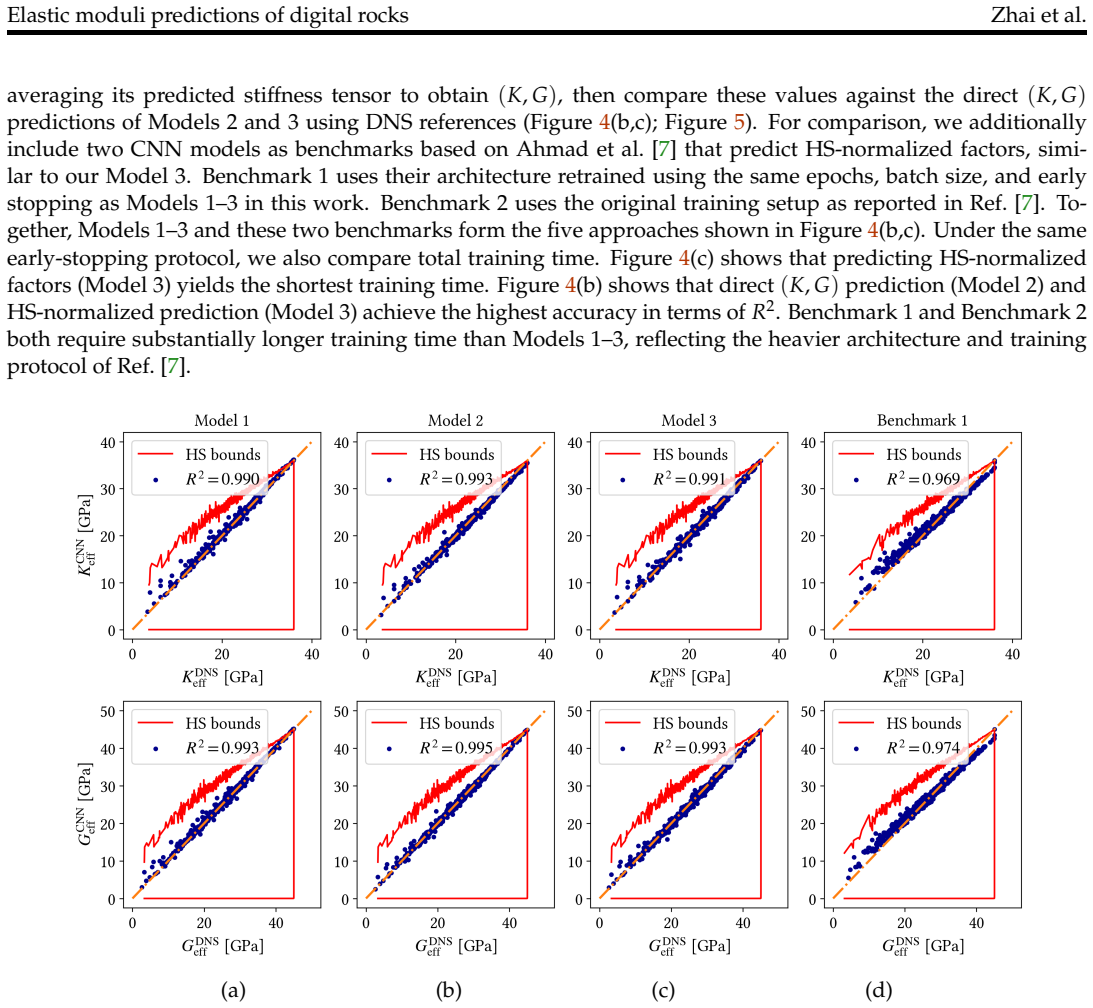
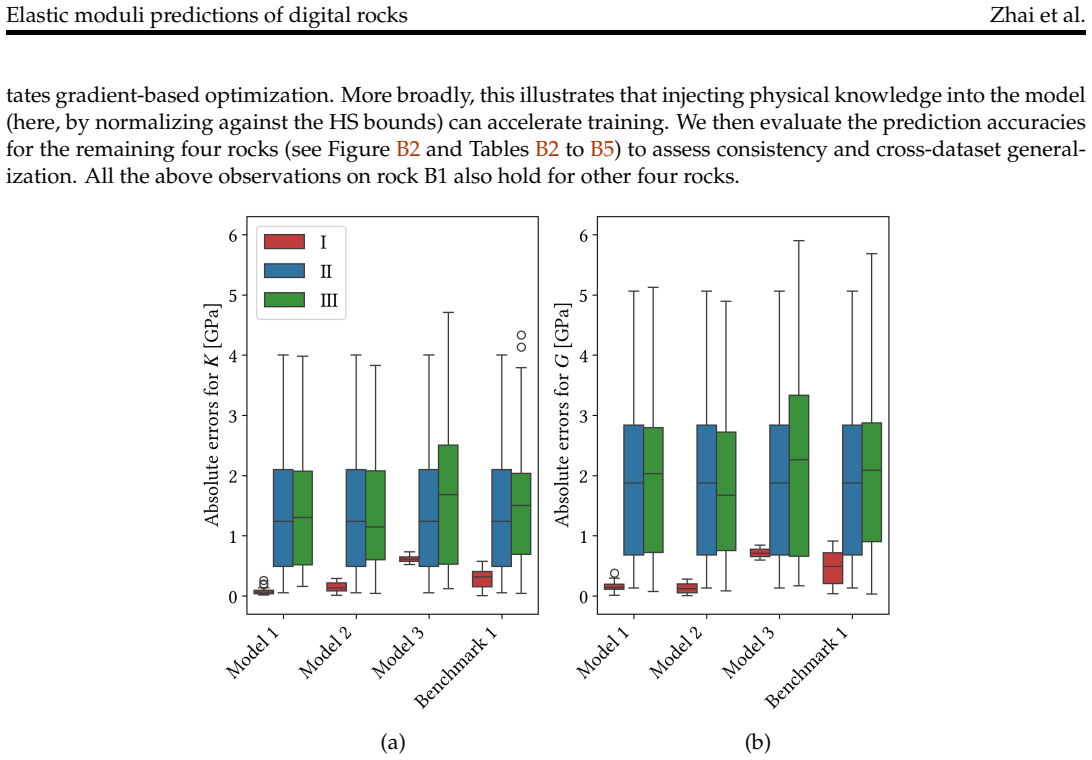
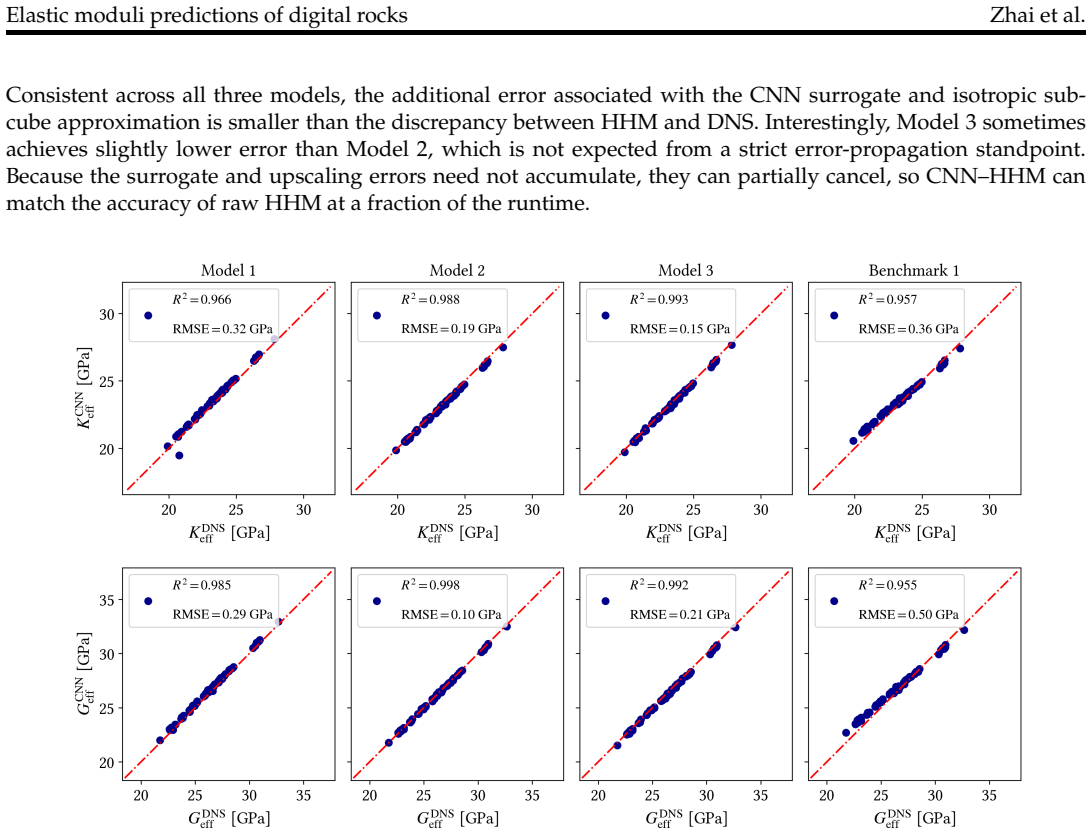
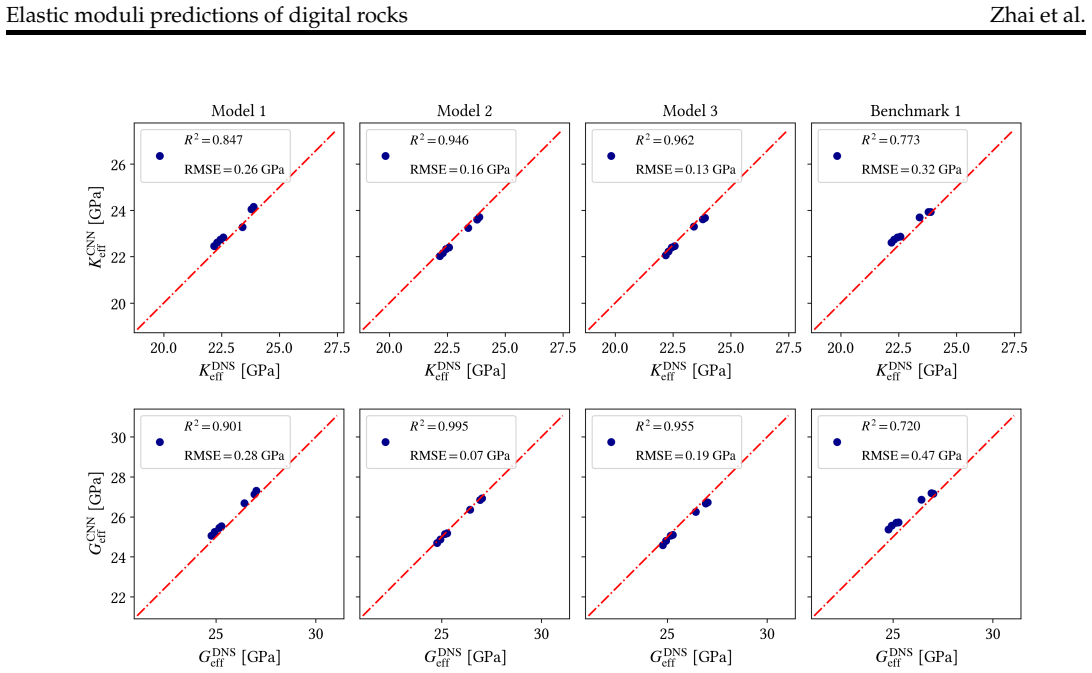
The authors establish that a shared convolutional backbone CNN trained on subcube elastic properties, when paired with hierarchical homogenization, yields effective moduli that match direct numerical simulation results for multiple rock types. The Hashin-Shtrikman normalized factor target provides the best overall speed-accuracy trade-off while guaranteeing physical consistency, and the isotropic (K, G) target serves as a slightly more accurate alternative.
What carries the argument
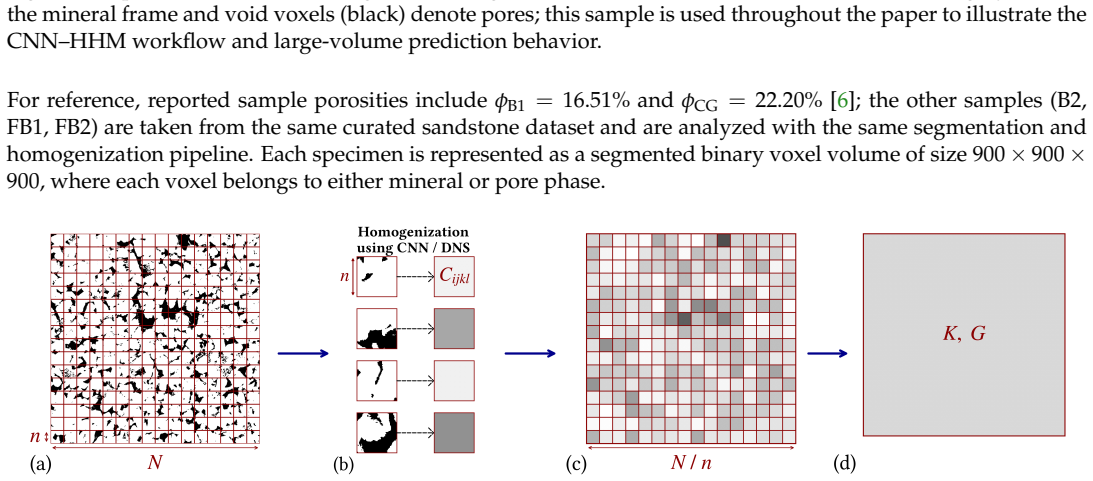
The hierarchical homogenization scheme that divides a large rock image into subcubes for independent CNN predictions of elastic moduli and then upscales the results to the full sample.
Load-bearing premise
The hierarchical homogenization step can accurately combine independent subcube predictions into the full-sample effective moduli without significant error from the division into subcubes or from the CNN approximation inside each subcube.
What would settle it
Perform the full CNN-plus-homogenization procedure on a rock sample whose size still permits direct numerical simulation and check whether the predicted effective moduli match the DNS values within the reported agreement range.
Figures
read the original abstract
Digital rock physics (DRP) aims to estimate effective rock properties (e.g., elastic moduli) directly from 3D micro-CT images. However, direct numerical simulations (DNS) on high-resolution large 3D scans are often computationally prohibitive and severely limit the application of DRP. To address this bottleneck, we combine a lightweight 3D convolutional neural network (CNN) with hierarchical homogenization (HHM) and apply it to determine effective elastic moduli. In this scheme, a large rock image is divided into subcubes. The CNN replaces costly DNS by directly predicting subcube elastic moduli, while HHM upscales subcube-level predictions to the full rock. Using a shared convolutional backbone, we systematically compare three training targets: (i) full anisotropic $6\times6$ stiffness tensors, (ii) isotropic bulk and shear moduli $(K, G)$, and (iii) Hashin--Shtrikman (HS)-normalized factors. Across multiple rock types, all three models agree well with DNS results while substantially reducing the computational cost. Moreover, training from scratch on each rock type is fast enough that transfer learning is unnecessary. Across all three targets, the accuracy is comparable. In our comparative study, the HS-normalized factor offers the best overall speed--accuracy trade-off while guaranteeing physical consistency, making it a convenient default. The isotropic $(K, G)$ target is a slightly more accurate alternative.
Editorial analysis
A structured set of objections, weighed in public.
Referee Report
Summary. The manuscript proposes combining a lightweight 3D CNN surrogate with hierarchical homogenization (HHM) to predict effective elastic moduli of digital rocks from large 3D micro-CT images. The image is partitioned into subcubes; the CNN replaces DNS by predicting local 6x6 stiffness tensors, isotropic (K,G), or HS-normalized factors; HHM then assembles the subcube predictions into full-sample moduli. Across rock types the authors claim that all three targets agree well with DNS while substantially lowering cost, with the HS target providing the best speed-accuracy trade-off and built-in physical consistency.
Significance. If the accuracy claims are quantitatively substantiated, the method would address a central computational bottleneck in digital rock physics by enabling rapid evaluation of large volumes without full DNS. The systematic comparison of three training targets and the explicit physical-consistency guarantee of the HS formulation are useful contributions. The absence of reported error metrics, validation-set sizes, and an isolated test of the HHM upscaling step currently prevents a full assessment of whether the headline claim holds.
major comments (3)
- [Abstract] Abstract: the statement that “all three models agree well with DNS results” supplies no quantitative error metrics (e.g., MAPE, R², or maximum relative error), no validation-set sizes, and no description of how the training data were generated or split. Without these numbers the strength of support for the central accuracy claim cannot be evaluated.
- [Methods / Results] The manuscript provides no separate error budget that isolates the contribution of the hierarchical homogenization operator from the CNN approximation error inside each subcube. A direct test—applying HHM to DNS-computed subcube tensors and comparing the result to full-sample DNS—would be required to confirm that division into subcubes does not introduce substantial artifacts.
- [Results] The weakest assumption—that HHM correctly assembles independent subcube predictions without significant inter-subcube interaction error—is not tested. The reported agreement with DNS therefore conflates CNN interpolation accuracy with the validity of the hierarchical upscaling step.
minor comments (1)
- [Abstract] Notation for the three targets should be introduced once with explicit symbols (e.g., C_{ij} for the 6×6 tensor, K/G for isotropic moduli, and the HS factor) and used consistently thereafter.
Simulated Author's Rebuttal
We thank the referee for the constructive comments on our manuscript. We address each major comment below and will incorporate the suggested clarifications and additional analyses in the revised version.
read point-by-point responses
-
Referee: [Abstract] Abstract: the statement that “all three models agree well with DNS results” supplies no quantitative error metrics (e.g., MAPE, R², or maximum relative error), no validation-set sizes, and no description of how the training data were generated or split. Without these numbers the strength of support for the central accuracy claim cannot be evaluated.
Authors: We agree that the abstract should be self-contained with respect to the central accuracy claim. Although the Results section reports MAPE, R², maximum relative errors, an 80/20 train/validation split, and DNS-based data generation details, we will revise the abstract to include representative quantitative metrics (e.g., MAPE values and R² for each target) and a concise statement on validation-set size and data preparation. revision: yes
-
Referee: [Methods / Results] The manuscript provides no separate error budget that isolates the contribution of the hierarchical homogenization operator from the CNN approximation error inside each subcube. A direct test—applying HHM to DNS-computed subcube tensors and comparing the result to full-sample DNS—would be required to confirm that division into subcubes does not introduce substantial artifacts.
Authors: The referee correctly notes the absence of an isolated error budget for the HHM step. In the revised manuscript we will add this analysis: we will apply the HHM operator to the DNS-computed subcube stiffness tensors and compare the upscaled moduli against the corresponding full-sample DNS results. This will quantify the HHM contribution separately from CNN prediction error. revision: yes
-
Referee: [Results] The weakest assumption—that HHM correctly assembles independent subcube predictions without significant inter-subcube interaction error—is not tested. The reported agreement with DNS therefore conflates CNN interpolation accuracy with the validity of the hierarchical upscaling step.
Authors: We agree that the current presentation does not separate the two error sources and that the overall DNS agreement therefore conflates them. The new HHM-only test described in response to the previous comment will directly address this point by isolating the inter-subcube interaction error. We will include the results and a discussion of their implications in the revised Results section. revision: yes
Circularity Check
No significant circularity detected
full rationale
The paper describes a standard supervised ML surrogate: a CNN is trained on DNS-computed subcube elastic properties (one of three targets) and then combined via HHM to predict full-sample moduli, with accuracy measured against independent full-sample DNS. This setup does not reduce any claimed result to its inputs by construction, nor does it invoke self-citations, uniqueness theorems, or ansatzes that are load-bearing. The validation on held-out full samples is external to the training data, and no equations or steps in the abstract exhibit self-definitional or fitted-input-called-prediction patterns. The method is explicitly data-driven rather than a first-principles derivation.
Axiom & Free-Parameter Ledger
free parameters (1)
- CNN network weights
axioms (2)
- domain assumption Hierarchical homogenization accurately recovers the effective moduli of the full sample from independent subcube predictions.
- domain assumption The subcube size is small enough that boundary effects between subcubes do not dominate the upscaling error.
Reference graph
Works this paper leans on
-
[1]
Saenger, Ratnan- abha Sain, Nishank Saxena, Sarah Ricker, Andreas Wiegmann, and Xin Zhan
Heiko Andrä, Nicolas Combaret, Jack Dvorkin, Erik Glatt, Junehee Han, Matthias Kabel, Youngseuk Keehm, Fabian Krzikalla, Minhui Lee, Claudio Madonna, Mike Marsh, Tapan Mukerji, Erik H. Saenger, Ratnan- abha Sain, Nishank Saxena, Sarah Ricker, Andreas Wiegmann, and Xin Zhan. Digital rock physics bench- marks—part i: Imaging and segmentation.Computers & Geo...
2013
-
[2]
Saenger, Ratnan- abha Sain, Nishank Saxena, Sarah Ricker, Andreas Wiegmann, and Xin Zhan
Heiko Andrä, Nicolas Combaret, Jack Dvorkin, Erik Glatt, Junehee Han, Matthias Kabel, Youngseuk Keehm, Fabian Krzikalla, Minhui Lee, Claudio Madonna, Mike Marsh, Tapan Mukerji, Erik H. Saenger, Ratnan- abha Sain, Nishank Saxena, Sarah Ricker, Andreas Wiegmann, and Xin Zhan. Digital rock physics bench- marks—part ii: Computing effective properties.Computer...
2013
-
[3]
Schepp, Benedikt Ahrens, Martin Balcewicz, Mandy Duda, Mathias Nehler, Maria Osorno, David Uribe, Holger Steeb, Benoit Nigon, Ferdinand Stöckhert, Donald A
Laura L. Schepp, Benedikt Ahrens, Martin Balcewicz, Mandy Duda, Mathias Nehler, Maria Osorno, David Uribe, Holger Steeb, Benoit Nigon, Ferdinand Stöckhert, Donald A. Swanson, Mirko Siegert, Marcel G. Gurris, and Erik H. Saenger. Digital rock physics and laboratory considerations on a high-porosity volcanic rock.Scientific Reports, 10:5840, 2020
2020
-
[4]
Validation of digital rock physics algorithms.Minerals, 9(11):669, 2019
Rongrong Lin and Leon Thomsen. Validation of digital rock physics algorithms.Minerals, 9(11):669, 2019
2019
-
[5]
Alpak, Jesse Dietderich, Sander Hunter, and Ruarri J
Nishank Saxena, Ronny Hofmann, Faruk O. Alpak, Jesse Dietderich, Sander Hunter, and Ruarri J. Day- Stirrat. Effect of image segmentation & voxel size on micro-ct computed effective transport & elastic prop- erties.Marine and Petroleum Geology, 86:972–990, September 2017
2017
-
[6]
Computation of effective elastic moduli of rocks using hierarchical homogenization.Journal of the Mechanics and Physics of Solids, 2023
Rasool Ahmad, Mingliang Liu, Michael Ortiz, Tapan Mukerji, and Wei Cai. Computation of effective elastic moduli of rocks using hierarchical homogenization.Journal of the Mechanics and Physics of Solids, 2023
2023
-
[7]
Rasool Ahmad, Mingliang Liu, Michael Ortiz, Tapan Mukerji, and Wei Cai. Homogenizing elastic properties of large digital rock images by combining cnn with hierarchical homogenization method.arXiv preprint arXiv:2305.06519, 2023
arXiv 2023
-
[8]
Machine learning assisted prediction of porosity and related properties using digital rock images.ACS Omega, 9(28):30205–30223, June 2024
Md Irfan Khan and Aaditya Khanal. Machine learning assisted prediction of porosity and related properties using digital rock images.ACS Omega, 9(28):30205–30223, June 2024
2024
-
[9]
Predicting permeability from 3d rock images based on cnn with physical information.Journal of Hydrology, 606:127473, March 2022
Pengfei Tang, Dongxiao Zhang, and Heng Li. Predicting permeability from 3d rock images based on cnn with physical information.Journal of Hydrology, 606:127473, March 2022
2022
-
[10]
Generalizable permeability prediction of digital porous media via a novel multi-scale 3d convolutional neural network.Water Resources Research, 58(3), March 2022
Mohamed Elmorsy, Wael El-Dakhakhni, and Benzhong Zhao. Generalizable permeability prediction of digital porous media via a novel multi-scale 3d convolutional neural network.Water Resources Research, 58(3), March 2022
2022
-
[11]
Deep 3d convolutional neural network applied to ct segmented image for rock properties prediction
Leandro Passos de Figueiredo, Fernando Bordignon, Rodrigo Exterkoetter, Bruno Barbosa Rodrigues, and Maury Duarte. Deep 3d convolutional neural network applied to ct segmented image for rock properties prediction. InSEG Technical Program Expanded Abstracts 2019, page xxx–xxx. Society of Exploration Geo- physicists, August 2019
2019
-
[12]
Image-based velocity estimation of rock using convolutional neural networks.Neural Networks, 111:89–97, March 2019
Sadegh Karimpouli and Pejman Tahmasebi. Image-based velocity estimation of rock using convolutional neural networks.Neural Networks, 111:89–97, March 2019
2019
-
[13]
Digital rock reconstruction with user-defined properties using condi- tional generative adversarial networks.Transport in Porous Media, 144(1):255–281, January 2022
Qiang Zheng and Dongxiao Zhang. Digital rock reconstruction with user-defined properties using condi- tional generative adversarial networks.Transport in Porous Media, 144(1):255–281, January 2022
2022
-
[14]
Reconstructing high fidelity digital rock images using deep convolutional neural networks.Scientific Reports, 12(1), March 2022
Majid Bizhani, Omid Haeri Ardakani, and Edward Little. Reconstructing high fidelity digital rock images using deep convolutional neural networks.Scientific Reports, 12(1), March 2022
2022
-
[15]
Zhiyu Hou and Danping Cao. Estimating elastic parameters from digital rock images based on multi-task learning with multi-gate mixture-of-experts.Journal of Petroleum Science and Engineering, 213:110310, June 2022
2022
-
[16]
Transferable 3d convolutional neural networks for elastic constants prediction in nanoporous metals.Materials & Design, 260:114896, December 2025
Sergei Zorkaltsev, Rafał Topolnicki, Tal-El Carmon, Santhosh Mathesan, Paweł Dłotko, Dan Mordehai, and Maciej Haranczyk. Transferable 3d convolutional neural networks for elastic constants prediction in nanoporous metals.Materials & Design, 260:114896, December 2025
2025
-
[17]
Hashin and S
Z. Hashin and S. Shtrikman. A variational approach to the theory of the elastic behaviour of multiphase materials.Journal of the Mechanics and Physics of Solids, 11(2):127–140, March 1963
1963
-
[18]
Geodict: Digital material research software
Math2Market GmbH. Geodict: Digital material research software. Software, 2023. 17 Elastic moduli predictions of digital rocks Zhai et al
2023
-
[19]
Moulinec and P
H. Moulinec and P . Suquet. A numerical method for computing the overall response of nonlinear composites with complex microstructure.Computer Methods in Applied Mechanics and Engineering, 157(1–2):69–94, April 1998
1998
-
[20]
Goldfarb, Ken Ikeda, Richard A
Eric J. Goldfarb, Ken Ikeda, Richard A. Ketcham, Kyle T. Spikes, Maša Prodanovi´ c, and Nicola Tisato. Pre- dictive digital rock physics without segmentation.Computers & Geosciences, 159:105008, 2022
2022
-
[21]
Teubner Verlag, Leipzig, 1928
Woldemar Voigt.Lehrbuch der Kristallphysik. Teubner Verlag, Leipzig, 1928
1928
-
[22]
A. Reuss. Berechnung der fließgrenze von mischkristallen auf grund der plastizitätsbedingung für einkristalle.Zeitschrift für Angewandte Mathematik und Mechanik, 9(1):49–58, 1929
1929
-
[23]
R. Hill. The elastic behaviour of a crystalline aggregate.Proceedings of the Physical Society. Section A, 65(5):349– 354, 1952
1952
-
[24]
On some variational principles in anisotropic and nonhomogeneous elasticity.Journal of the Mechanics and Physics of Solids, 10(4):335–342, 1962
Z am Hashin and SJJotM Shtrikman. On some variational principles in anisotropic and nonhomogeneous elasticity.Journal of the Mechanics and Physics of Solids, 10(4):335–342, 1962. 18
1962
discussion (0)
Sign in with ORCID, Apple, or X to comment. Anyone can read and Pith papers without signing in.