REVIEW 4 major objections 5 minor 41 references
DesignLab: Designing Slides Through Iterative Detection and Correction
T0 review · 4 major / 5 minor · reviewed 2026-08-06 · deepseek-v4-flash
Pith's one-line read DesignLab claims that separating a trained design reviewer from a trained design contributor and alternating them in a loop progressively polishes rough presentation drafts and outperforms single-step, script-based, and commercial design…
desk verdict A genuinely new two-role iterative design system with a real generalization gap; deserves review if authors test on independent drafts and add statistics. read the letter →
The pith
A machine-rendered reading of the paper's core claim, the machinery that carries it, and where it could break.
The reading
What carries the argument
The load-bearing mechanism is the separation of detection from correction. Two fine-tuned language models share a slide's JSON representation: the reviewer is trained to classify which elements are wrong by marking them TENTATIVE, and the contributor is trained to reconstruct the correct element only where that tag appears. Rough drafts are simulated by controlled perturbations, such as removing shapes, shifting positions, changing colors, and resetting fonts, so the reviewer learns error types and the contributor learns their fixes. At inference, all elements start tagged, the contributor applies a first repair, and the reviewer repeatedly inspects the result until no TENTATIVE elements remain, which gives the loop a natural stopping point.
What would settle it
Collect naturally occurring draft/final slide pairs, such as versioned presentation files, and compare DesignLab's iterative loop with a single-step refinement on those pairs; if the loop does not win on genuine drafts, or the reviewer's detection accuracy drops sharply, the synthetic-perturbation training would be the point of failure.
Extended reading notes
Core claim
The central claim is that the iterative coupling of a trained design reviewer and a trained design contributor can refine an imperfect slide into a polished design, and that this process outperforms both single-step generation and script-based refinement. On the paper's terms, the reviewer reads the slide's JSON structure and labels flawed elements with a TENTATIVE tag; the contributor then revises only the tagged elements. The updated slide returns to the reviewer, and the cycle continues until no element is tagged, so that quality accumulates across rounds instead of being attempted in one pass. In head-to-head comparisons with a single-step method, a script-based agent, and a commercial designer, the refined slides are preferred by an automated multimodal judge and by human raters, with users rating the slides higher after each revision round.
Load-bearing premise
The paper's load-bearing premise is that randomly perturbing finished slides produces drafts similar enough to genuine early-stage slides that the reviewer and contributor trained on those pairs will transfer to real drafts; the 77 manually created evaluation drafts resemble those perturbations, so that premise remains largely untested against naturally occurring drafts.
Editorial extensions
If this is right
- A user can hand over a rough draft and receive a sequence of concrete improvements, with the system stopping automatically once the reviewer finds nothing to flag.
- Because the models output and edit the same JSON structure, users can act as reviewer too, tagging specific elements manually or choosing between branched design candidates.
- The loop's convergence suggests that perceived quality rises with each revision round and then levels off, so the stopping rule aligns with diminishing returns.
- The two-role design keeps the system usable on limited hardware, since each model is small enough to run under typical memory limits and completes a step in under thirty seconds.
Reading between the lines
- Beyond the paper, the same reviewer/contributor split could transfer to other structured design media, such as posters, web layouts, or user-interface mockups, whenever a design can be serialized into elements and attributes.
- The strongest open question is whether the perturbation distribution covers real draft flaws; if genuine drafts contain error types not sampled by the simulator, the reviewer will miss them, so a natural-draft benchmark would test the transfer.
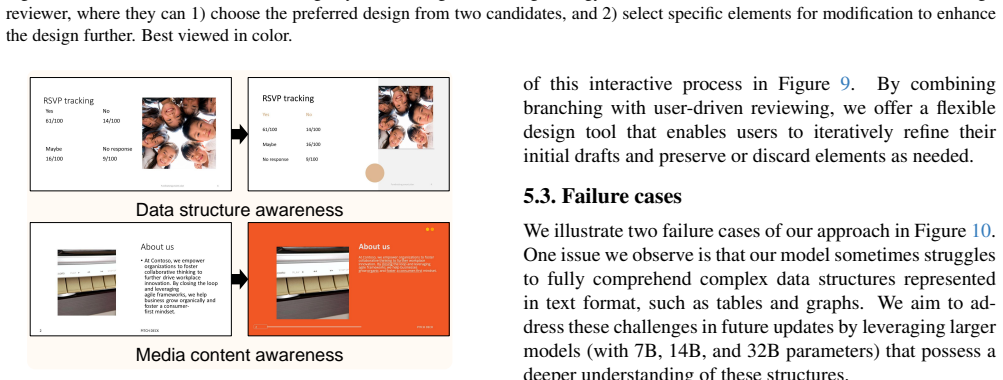
- Because the system currently ignores image and video content, adding visual metadata, such as dominant colors or content tags, could plausibly fix the reported color-mismatch failures without switching to token-heavy image inputs.
- The branching and user-review features suggest a practical workflow in which the system proposes several refined candidates and the user merges or rejects them, which could be evaluated for subjective control and efficiency beyond aesthetic preference.
Editorial analysis
A structured set of objections, weighed in public.
Referee Report
Summary. DesignLab is a slide-refinement system that separates design review from design correction: a fine-tuned LLM "reviewer" labels elements as TENTATIVE and a fine-tuned LLM "contributor" revises those elements, in an iterative loop until the reviewer detects no further issues. Rough drafts are simulated for training by applying controlled perturbations (element removal, position shifts, color changes, font resets) to final slides from a large internal collection. The authors evaluate on 77 manually created rough drafts, comparing against WebRPG, AutoPresent, and PowerPoint Designer, and report GPT-4o pairwise preferences, a user study, and a qualitative interactive scenario. The central claim is that separating detection from correction and iterating yields progressively polished slides that outperform single-step and template-based baselines.
Significance. If the empirical claims hold, DesignLab is a useful contribution: it explicitly targets the iterative refinement loop that most slide-generation tools omit, decomposes design critique into a discriminative reviewer and a generative contributor, and demonstrates a lightweight (1.5B-parameter) system with interactive branching. The synthetic-perturbation training pipeline is a practical solution to the scarcity of paired rough/final slides, and the authors plan to release the manually created rough drafts as a benchmark. However, the current evaluation does not independently establish that the synthetic training distribution transfers to genuine real-world rough drafts, and the preference-based comparisons lack statistical grounding. These are load-bearing limitations because the method's advantage is framed entirely in terms of real-world draft refinement.
major comments (4)
- [Section 3.3/4.1, Table 3] The load-bearing assumption that simulated perturbations approximate real rough drafts is not tested. Training defines rough drafts exclusively through the perturbation taxonomy in Section 3.3 and D.2 (removing shapes, shifting positions, changing colors, resetting fonts), and the only evaluation set, Section 4.1, is 77 drafts manually created by the authors to exhibit 'typical early-stage imperfections' of the same kinds. This makes the evaluation in-distribution by construction and does not validate transfer to independent drafts. The internal evidence underscores the risk: Table 3 reports shape-placement recall of only 0.149, meaning the reviewer misses roughly 85% of shifted elements even on simulated perturbations, and Section 5.2 explicitly routes placement flaws to interactive user review. Since misalignment is a common real-world defect, the automated loop is likely to stop while genuine flaws remain. The authors should add an independent evaluation on real rough drafts (e.g., from public slide repositories or user-collected drafts) and report reviewer/contributor performance separately on drafts that do not follow the perturbation taxonomy.
- [Section 4.5, Figure 5] The GPT-4o preference results are reported only as aggregate percentages without error bars, confidence intervals, or significance tests. For instance, 'Ours vs. AutoPresent' is 24.7% to 72.7%, which leaves 2.6% unaccounted for (presumably ties), and the corresponding WebRPG and PowerPoint Designer comparisons also have non-negligible tie rates that are not reported. With 77 drafts and pairwise comparisons, a bootstrap or sign-test calculation is needed to determine whether the reported differences are reliable. Without this, the central claim that DesignLab 'outperforms existing design-generation methods, including a commercial tool' is not statistically supported. Please report per-pair counts, tie rates, and confidence intervals or p-values for each comparison.
- [Section 4.5, Figure 8] The user study evaluating iterative refinement lacks inferential statistics. The text says 32 users rated 45 slide pairs (90 slides) before and after a revision and that Figure 8 shows 'a clear trend of increasing aesthetic scores,' but no repeated-measures test (e.g., paired t-test, Wilcoxon, or mixed-effects model) is reported, and the shaded 'one standard deviation' range does not convey within-subject variation. Additionally, the selection of 45 slides from the 77-draft set is not described, so possible selection bias cannot be assessed. Please add a statistical analysis and the slide-sampling procedure.
- [Section 4.2/4.5, Table 2] The fairness of the AutoPresent and PowerPoint Designer comparisons is not quantified. The text calls AutoPresent's failure rate 'high' but gives no numeric execution-failure rate, and the PowerPoint Designer 'no suggestion' cases are only described qualitatively; both affect the denominator of preference win rates and the qualitative comparisons in Figure 4. Please report the number of drafts where each baseline failed or produced no output, and describe how such cases were treated in the GPT-4o preference evaluation (e.g., excluded from the denominator, or scored as an automatic loss).
minor comments (5)
- [Section 5.1, Table 3] The prose in Section 5.1 mentions 'duplicate shapes' as a perturbation type, but Table 3 and Section D.2 describe 'Shape Removal' and shape duplication separately; please align the terminology.
- [Figure 5] The preference percentages in Figure 5 do not sum to 100% for several comparisons; please specify the tie rates explicitly in the figure or caption.
- [References] Reference [4] contains page numbers '3, 1' that appear to be a citation artifact; please correct the page or section numbering.
- [Section 3.4] The sentence 'We fine-tune a LLM for this task' should read 'an LLM.'
- [Section 5.3] The failure cases are acknowledged but not quantified; reporting the frequency of data-structure and media-content failures would help calibrate the scope of the current model.
Circularity Check
No circular derivation: the synthetic-perturbation training premise is an external-validity assumption, not a self-referential construction.
full rationale
DesignLab makes no first-principles claim whose output is equivalent to its input by construction. Section 3.3 creates rough drafts by perturbing final slides, and Sections 3.4 and 4.3 train the reviewer and contributor on those pairs, but the contribution is an alternating detect-and-correct loop evaluated on a separate, manually created 77-slide test set (Section 4.1), by GPT-4o preference (Figure 5) and by user studies (Figures 8 and 11). The 77 drafts are described as closely reflecting the type of real-world drafts the authors aim to improve; that is a distributional assumption, not a circular equation, because the evaluation does not reuse the training pairs and the claimed improvement is not derived from the perturbation definitions. The low placement recall of 0.149 in Table 3 is an acknowledged limitation that the paper routes to interactive user review in Section 5.2, and the failure cases in Section 5.3 are likewise stated limitations; these weaken external validity but do not make the prediction forced by a fitted parameter. The only self-citation, Talk to Your Slides [17], appears in Section 4.2 in a bracket listing agent-based systems, and DesignLab's results do not depend on it. There is no imported uniqueness theorem, no ansatz smuggled in via citation, and no renamed known result. Overall, the paper is self-contained against external benchmarks, and the residual risk is unvalidated generalization from synthetic perturbations rather than circularity.
Assumptions & free parameters
free parameters (2)
- Perturbation types and severity ranges =
Not specified (e.g., shift positions, alter colors, change fonts, remove/duplicate shapes)
- Maximum iteration limit =
Not explicitly stated (converges within 2-3 in practice)
assumptions (3)
- domain assumption The JSON representation of slides captures sufficient design information for refinement, and media content can be excluded without catastrophic loss.
- domain assumption Randomly perturbed slides are a valid proxy for real rough drafts.
- domain assumption GPT-4o pairwise preference reflects design quality.
Cite this review
Pith. "Pith review of DesignLab: Designing Slides Through Iterative Detection and Correction." pith.science (2026). https://pith.science/paper/EBDDGGV3
@misc{pith2026250717202,
  author       = {Pith},
  title        = {Pith review of: DesignLab: Designing Slides Through Iterative Detection and Correction},
  year         = {2026},
  howpublished = {\url{https://pith.science/paper/EBDDGGV3}},
  note         = {Machine review of arXiv:2507.17202}
}
read the original abstract
Designing high-quality presentation slides can be challenging for non-experts due to the complexity involved in navigating various design choices. Numerous automated tools can suggest layouts and color schemes, yet often lack the ability to refine their own output, which is a key aspect in real-world workflows. We propose DesignLab, which separates the design process into two roles, the design reviewer, who identifies design-related issues, and the design contributor who corrects them. This decomposition enables an iterative loop where the reviewer continuously detects issues and the contributor corrects them, allowing a draft to be further polished with each iteration, reaching qualities that were unattainable. We fine-tune large language models for these roles and simulate intermediate drafts by introducing controlled perturbations, enabling the design reviewer learn design errors and the contributor learn how to fix them. Our experiments show that DesignLab outperforms existing design-generation methods, including a commercial tool, by embracing the iterative nature of designing which can result in polished, professional slides.
Figures


Figures from the paper (8 more)




Reference graph
Works this paper leans on
-
[1]
Qwen-vl: A frontier large vision-language model with versatile abilities
Jinze Bai, Shuai Bai, Shusheng Yang, Shijie Wang, Sinan Tan, Peng Wang, Junyang Lin, Chang Zhou, and Jingren Zhou. Qwen-vl: A frontier large vision-language model with versatile abilities. arXiv preprint, 2023. 8
work page 2023
-
[2]
Lay- outdm: Transformer-based diffusion model for layout gener- ation
Shang Chai, Liansheng Zhuang, and Fengying Yan. Lay- outdm: Transformer-based diffusion model for layout gener- ation. In CVPR, 2023. 1, 2
work page 2023
-
[3]
Posta: A go-to framework for customized artistic poster gen- eration
Haoyu Chen, Xiaojie Xu, Wenbo Li, Jingjing Ren, Tian Ye, Songhua Liu, Ying-Cong Chen, Lei Zhu, and Xinchao Wang. Posta: A go-to framework for customized artistic poster gen- eration. In CVPR, 2025. 1
work page 2025
-
[4]
Extensible markup language (xml) 1.1
World Wide Web Consortium. Extensible markup language (xml) 1.1. Technical report, World Wide Web Consortium,
-
[5]
Generating automatic feedback on ui mockups with large language models
Peitong Duan, Jeremy Warner, Yang Li, and Bjoern Hart- mann. Generating automatic feedback on ui mockups with large language models. 2024. 1
work page 2024
-
[6]
Gptq: Accurate post-training quantization for gener- ative pre-trained transformers
Elias Frantar, Saleh Ashkboos, Torsten Hoefler, and Dan Al- istarh. Gptq: Accurate post-training quantization for gener- ative pre-trained transformers. ICLR, 2023. 2
work page 2023
-
[7]
Doc2ppt: Automatic presentation slides generation from scientific documents
Tsu-Jui Fu, William Yang Wang, Daniel McDuff, and Yale Song. Doc2ppt: Automatic presentation slides generation from scientific documents. In AAAI, 2022. 2
work page 2022
-
[8]
Autopresent: Designing structured visuals from scratch
Jiaxin Ge, Zora Zhiruo Wang, Xuhui Zhou, Yi-Hao Peng, Sanjay Subramanian, Qinyue Tan, Maarten Sap, Alane Suhr, Daniel Fried, Graham Neubig, et al. Autopresent: Designing structured visuals from scratch. arXiv preprint, 2025. 2, 3, 4, 6
work page 2025
Show all 41 references
-
[9]
The llama 3 herd of models
Aaron Grattafiori, Abhimanyu Dubey, Abhinav Jauhri, Ab- hinav Pandey, Abhishek Kadian, Ahmad Al-Dahle, Aiesha Letman, Akhil Mathur, Alan Schelten, Alex Vaughan, et al. The llama 3 herd of models. arXiv preprint, 2024. 2
2024
-
[10]
Layout- transformer: Layout generation and completion with self- attention
Kamal Gupta, Justin Lazarow, Alessandro Achille, Larry S Davis, Vijay Mahadevan, and Abhinav Shrivastava. Layout- transformer: Layout generation and completion with self- attention. In ICCV, 2021. 2
2021
-
[11]
Retrieval-augmented layout transformer for content-aware layout generation
Daichi Horita, Naoto Inoue, Kotaro Kikuchi, Kota Yam- aguchi, and Kiyoharu Aizawa. Retrieval-augmented layout transformer for content-aware layout generation. In CVPR,
-
[12]
Ppsgen: Learning to generate presentation slides for academic papers
Yue Hu and Xiaojun Wan. Ppsgen: Learning to generate presentation slides for academic papers. In IJCAI, 2013. 2
2013
-
[13]
Towards flexible multi-modal document models
Naoto Inoue, Kotaro Kikuchi, Edgar Simo-Serra, Mayu Otani, and Kota Yamaguchi. Towards flexible multi-modal document models. In CVPR, 2023. 2
2023
-
[14]
OpenCOLE: Towards Reproducible Automatic Graphic Design Generation
Naoto Inoue, Kento Masui, Wataru Shimoda, and Kota Ya- maguchi. OpenCOLE: Towards Reproducible Automatic Graphic Design Generation. In CVPRW, 2024. 2
2024
-
[15]
Cole: A hierarchical generation frame- work for graphic design
Peidong Jia, Chenxuan Li, Zeyu Liu, Yichao Shen, Xingru Chen, Yuhui Yuan, Yinglin Zheng, Dong Chen, Ji Li, Xi- aodong Xie, et al. Cole: A hierarchical generation frame- work for graphic design. arXiv preprint, 2023. 1, 2
2023
-
[16]
Mistral 7b
Albert Q Jiang, A Sablayrolles, A Mensch, C Bamford, D Singh Chaplot, Ddl Casas, F Bressand, G Lengyel, G Lam- ple, L Saulnier, et al. Mistral 7b. arxiv. arXiv preprint, 2023. 2
2023
-
[17]
Talk to your slides: Language- driven agents for efficient slide editing.arXiv e-prints, pages arXiv–2505, 2025
Kyudan Jung, Hojun Cho, Jooyeol Yun, Soyoung Yang, Jae- hyeok Jang, and Jaegul Choo. Talk to your slides: Language- driven agents for efficient slide editing.arXiv e-prints, pages arXiv–2505, 2025. 4
2025
-
[18]
A study of bfloat16 for deep learning training
Dhiraj Kalamkar, Dheevatsa Mudigere, Naveen Mellem- pudi, Dipankar Das, Kunal Banerjee, Sasikanth Avan- cha, Dharma Teja V ooturi, Nataraj Jammalamadaka, Jianyu Huang, Hector Yuen, et al. A study of bfloat16 for deep learning training. arXiv preprint, 2019. 2
2019
-
[19]
Multimodal markup document models for graphic design completion
Kotaro Kikuchi, Naoto Inoue, Mayu Otani, Edgar Simo- Serra, and Kota Yamaguchi. Multimodal markup document models for graphic design completion. arXiv preprint, 2024. 2
2024
-
[20]
Gonzalez, Hao Zhang, and Ion Stoica
Woosuk Kwon, Zhuohan Li, Siyuan Zhuang, Ying Sheng, Lianmin Zheng, Cody Hao Yu, Joseph E. Gonzalez, Hao Zhang, and Ion Stoica. Efficient memory management for large language model serving with pagedattention. In ACM SIGOPS, 2023. 2
2023
-
[21]
Awq: Activation-aware weight quantization for llm compression and acceleration
Ji Lin, Jiaming Tang, Haotian Tang, Shang Yang, Wei-Ming Chen, Wei-Chen Wang, Guangxuan Xiao, Xingyu Dang, Chuang Gan, and Song Han. Awq: Activation-aware weight quantization for llm compression and acceleration. In ML- Sys, 2024. 2
2024
-
[22]
Deepseek-v3 technical report
Aixin Liu, Bei Feng, Bing Xue, Bingxuan Wang, Bochao Wu, Chengda Lu, Chenggang Zhao, Chengqi Deng, Chenyu Zhang, Chong Ruan, et al. Deepseek-v3 technical report. arXiv preprint, 2024. 2
2024
-
[23]
Visual instruction tuning, 2023
Haotian Liu, Chunyuan Li, Qingyang Wu, and Yong Jae Lee. Visual instruction tuning, 2023. 8
2023
-
[24]
Llava-next: Im- proved reasoning, ocr, and world knowledge, 2024
Haotian Liu, Chunyuan Li, Yuheng Li, Bo Li, Yuanhan Zhang, Sheng Shen, and Yong Jae Lee. Llava-next: Im- proved reasoning, ocr, and world knowledge, 2024. 8
2024
-
[25]
Decoupled weight decay regularization
Ilya Loshchilov and Frank Hutter. Decoupled weight decay regularization. ICLR, 2019. 4
2019
-
[26]
Powerpoint designer, 2025
Microsoft. Powerpoint designer, 2025. 4, 6
2025
-
[27]
Gpt-4o, 2024
OpenAI. Gpt-4o, 2024. 2, 6
2024
-
[28]
Dreamstruct: Under- standing slides and user interfaces via synthetic data genera- tion
Yi-Hao Peng, Faria Huq, Yue Jiang, Jason Wu, Xin Yue Li, Jeffrey P Bigham, and Amy Pavel. Dreamstruct: Under- standing slides and user interfaces via synthetic data genera- tion. In ECCV. Springer, 2024. 1
2024
-
[29]
Toolformer: Lan- guage models can teach themselves to use tools
Timo Schick, Jane Dwivedi-Yu, Roberto Dess `ı, Roberta Raileanu, Maria Lomeli, Eric Hambro, Luke Zettlemoyer, Nicola Cancedda, and Thomas Scialom. Toolformer: Lan- guage models can teach themselves to use tools. In NIPS,
-
[30]
Webrpg: Automatic web rendering parameters generation for visual presentation
Zirui Shao, Feiyu Gao, Hangdi Xing, Zepeng Zhu, Zhi Yu, Jiajun Bu, Qi Zheng, and Cong Yao. Webrpg: Automatic web rendering parameters generation for visual presentation. In ECCV. Springer, 2024. 1, 2, 4
2024
-
[31]
Edward Sun, Yufang Hou, Dakuo Wang, Yunfeng Zhang, and Nancy X. R. Wang. D2S: Document-to-slide genera- tion via query-based text summarization. In Proceedings of the 2021 Conference of the North American Chapter of the Association for Computational Linguistics: Human Lan- gua...
2021
-
[32]
Qwen2.5: A party of foundation models, 2024
Qwen Team. Qwen2.5: A party of foundation models, 2024. 4, 2 9
2024
-
[33]
V oyager: An open-ended embodied agent with large language models
Guanzhi Wang, Yuqi Xie, Yunfan Jiang, Ajay Mandlekar, Chaowei Xiao, Yuke Zhu, Linxi Fan, and Anima Anandku- mar. V oyager: An open-ended embodied agent with large language models. arXiv preprint, 2023. 4
2023
-
[34]
Finetuned language models are zero-shot learn- ers
Jason Wei, Maarten Bosma, Vincent Y Zhao, Kelvin Guu, Adams Wei Yu, Brian Lester, Nan Du, Andrew M Dai, and Quoc V Le. Finetuned language models are zero-shot learn- ers. ICLR, 2022. 2
2022
-
[35]
Chain-of-thought prompting elicits reasoning in large lan- guage models
Jason Wei, Xuezhi Wang, Dale Schuurmans, Maarten Bosma, Fei Xia, Ed Chi, Quoc V Le, Denny Zhou, et al. Chain-of-thought prompting elicits reasoning in large lan- guage models. NIPS, 2022. 3
2022
-
[36]
Uiclip: a data-driven model for assessing user interface design
Jason Wu, Yi-Hao Peng, Xin Yue Amanda Li, Amanda Swearngin, Jeffrey P Bigham, and Jeffrey Nichols. Uiclip: a data-driven model for assessing user interface design. In Proceedings of the 37th Annual ACM Symposium on User Interface Software and Technology, 2024. 1
2024
-
[37]
Canvasvae: Learning to generate vector graphic documents
Kota Yamaguchi. Canvasvae: Learning to generate vector graphic documents. In ICCV, 2021. 2, 4
2021
-
[38]
Qwen2 technical report
An Yang, Baosong Yang, Binyuan Hui, Bo Zheng, Bowen Yu, Chang Zhou, Chengpeng Li, Chengyuan Li, Dayiheng Liu, Fei Huang, Guanting Dong, Haoran Wei, Huan Lin, Jialong Tang, Jialin Wang, Jian Yang, Jianhong Tu, Jian- wei Zhang, Jianxin Ma, Jin Xu, Jingren Zhou, Jinze Bai, Jinzhe...
2024
-
[39]
React: Synergizing rea- soning and acting in language models
Shunyu Yao, Jeffrey Zhao, Dian Yu, Nan Du, Izhak Shafran, Karthik Narasimhan, and Yuan Cao. React: Synergizing rea- soning and acting in language models. In ICLR, 2023. 4
2023
-
[40]
Creatiposter: Towards editable and control- lable multi-layer graphic design generation
Zhao Zhang, Yutao Cheng, Dexiang Hong, Maoke Yang, Gonglei Shi, Lei Ma, Hui Zhang, Jie Shao, and Xing- long Wu. Creatiposter: Towards editable and control- lable multi-layer graphic design generation. arXiv preprint arXiv:2506.10890, 2025. 1
2025 arXiv
-
[41]
reviewer
Hao Zheng, Xinyan Guan, Hao Kong, Jia Zheng, Hongyu Lin, Yaojie Lu, Ben He, Xianpei Han, and Le Sun. Ppta- gent: Generating and evaluating presentations beyond text- to-slides. arXiv preprint, 2025. 2, 6 10 DesignLab: Designing Slides Through Iterative Detection and Correction...
2025
Reviewed August 6, 2026 · model on record in the stance chip above.
Discussion (0). Sign in to comment.