REVIEW 4 major objections 7 minor 5 references
Existing LoRA fusion methods fail on true cross-domain tasks under cloud–edge privacy; a simple conflict fix recovers some gains.
Reviewed by Pith at T0; open to challenge. T0 means a machine referee read the full paper against a public rubric. the ladder, T0–T4 →
On a new composite cross-domain benchmark, standard LoRA fusion under cloud-edge prune-train-recover often loses to the base model; a shared-subspace conflict gate recovers modest accuracy.
T0 review reviewed 2026-07-13 challenge →
load-bearing objection Useful negative result on LoRA fusion for composite cross-domain queries under prune-train-recover, but the conflict story is not cleanly isolated from pruning/recovery artifacts. the 4 major comments →
Can LoRA Fusion Support Cross-Domain Tasks in Cloud-Edge Collaboration?
The pith
A machine-rendered reading of the paper's core claim, the machinery that carries it, and where it could break.
The reading
Core claim
Under a realistic prune-train-recover cloud–edge setting, existing LoRA fusion methods cannot integrate distributed domain knowledge for true cross-domain problem solving: on the new MMLU-CD benchmark they underperform the base LLaMA-3-8B in seven of nine evaluations. The authors locate the failure in representation conflicts among domain-specific LoRA adapters and show that a simple conflict-resolution module (LoRA-CR) restores and improves fusion performance by up to 3.8 percent.
What carries the argument
LoRA-CR: a plug-and-play pre-processing module that projects recovered LoRA updates into a shared SVD subspace, scores direction-wise conflict via energy-weighted cosine misalignment, gates and attenuates conflicting components, then reconstructs de-conflicted adapters for any downstream fusion operator.
Load-bearing premise
That the automatically synthesized MMLU-CD questions genuinely require joint multi-domain reasoning rather than single-domain shortcuts or generator artifacts, so that poor fusion scores on them prove existing methods cannot support cross-domain tasks.
What would settle it
A controlled re-evaluation on a human-authored cross-domain suite (or a verified subset free of single-domain solvability) where the same fusion methods without LoRA-CR still underperform the base model and LoRA-CR still yields the reported gains.
Editorial analysis
A structured set of objections, weighed in public.
Referee Report
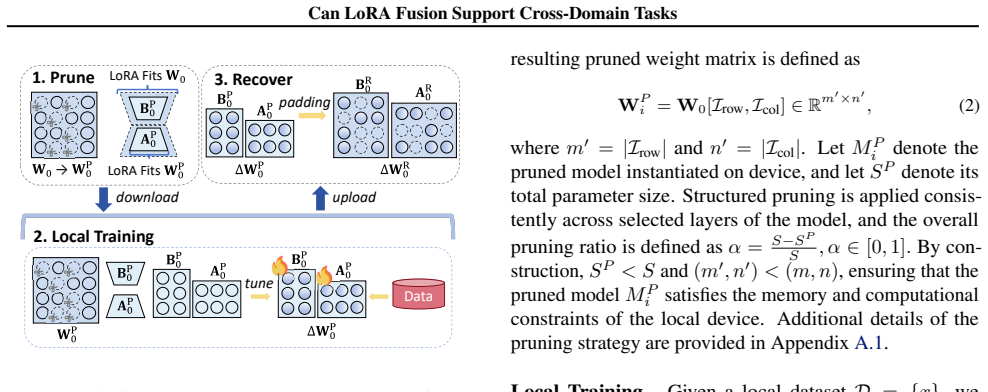
Summary. The paper studies privacy-preserving cloud–edge collaboration for cross-domain LLM problem solving: domain data stay on edges, LoRA adapters are trained locally and fused in the cloud. It identifies two limitations of prior pipelines—(i) the assumption that edges can host cloud-scale models and (ii) evaluation only on single-domain or multi-distribution single-instance tests—and addresses them with a prune–train–recover framework (structured prune, local LoRA, zero-pad recovery) and a new benchmark MMLU-CD built by pairing MMLU domain pools and synthesizing composite multi-choice items with DeepSeek-R1 plus human filtering. Under this setup with LLaMA-3-8B and three domain pairs, FedAvg, FFA-LoRA, and FedSA-LoRA underperform the base model in seven of nine settings (Fig. 3). The authors attribute this to representation conflicts among domain LoRAs and propose LoRA-CR, a plug-and-play SVD-subspace conflict gate (Algo. 1, Thm. 6.1) that improves fusion accuracy by up to 3.8% (Tab. 2) and slightly lowers their conflict score (Fig. 4).
Significance. The problem framing is timely: privacy-constrained multi-edge domain adaptation for queries that truly span domains is practically important and under-evaluated. The negative pilot result, if isolated, would be a useful corrective to LoRA-fusion literature that mainly reports multi-domain single-instance aggregation. MMLU-CD and the prune–train–recover pipeline are concrete artifacts that other groups can reuse. LoRA-CR is simple, fusion-agnostic, and accompanied by an explicit direction-wise conflict metric; even as an exploratory module it usefully surfaces conflict mitigation as a design axis. Strengths include a clear research question, an honest negative observation, and transparent reporting of cases where fusion still fails after de-confliction (e.g., SC&STEM for some methods). The contribution is primarily empirical and systems-oriented rather than theoretical.
major comments (4)
- The central negative claim (Sec. 5.3 Observation; Fig. 3: fusion underperforms base LLaMA-3-8B in 7/9 settings) is not cleanly isolated from prune–train–recover artifacts. The manuscript never reports single-domain accuracy of each recovered LoRA (or of the pruned edge model) on held-out Hum/SC/STEM MMLU splits, nor an unpruned full-model LoRA-fusion control on MMLU-CD. With default α=0.6 structured pruning (LLM-Pruner) and zero-pad recovery (Eqs. 2–4), underperformance can equally be explained by weak/noisy domain adapters, recovery misalignment of low-rank factors, or fusion of near-null updates that degrade the base—rather than genuine multi-domain representation conflict. Without these controls, the attribution in Sec. 6.1 and the claim that “existing LoRA fusion methods fail to integrate distributed domain knowledge” remain under-supported.
- Fig. 5 shows LoRA-CR gains grow with pruning ratio, and Fig. 4 reports only tiny absolute drops in the average conflict score (on the order of 0.07–0.23 percentage points relative to scores ~0.13–0.14). That pattern is consistent with the prune–recover confound above: heavier pruning may intensify adapter noise or subspace collapse, so LoRA-CR’s accuracy gains need not be primarily “conflict resolution among domain specialists.” Please either (i) add single-domain specialist and unpruned fusion ablations that hold the fusion operator fixed, or (ii) substantially qualify the causal claim that parameter conflicts among useful domain LoRAs are the primary failure mode.
- MMLU-CD validity is load-bearing for the research question (Sec. 5.2–5.3, Tab. 1, construction prompts in Tab. 5). Items are synthesized by pairing MMLU questions and prompting DeepSeek-R1, then “lightly” human-filtered. The paper does not report: fraction of candidates rejected, inter-annotator agreement, whether single-domain models or single-domain LoRAs can solve a non-trivial fraction of composites, or leakage checks against generator artifacts. If many items are solvable from one domain or from stylistic cues, underperformance of fused LoRAs does not license the claim that existing fusion cannot support true cross-domain cloud–edge problem solving. A short validation suite (single-domain baselines on MMLU-CD; human “requires both domains?” labels on a subsample) is needed.
- Experimental scope is narrow relative to the strength of the abstract/conclusion claims: one backbone (LLaMA-3-8B), N=2 clients per pair, LoRA rank 8, default α=0.6, three synthetic pairs, no multi-seed error bars or variance (Tab. 2, Fig. 3). Appendix A.5.1 also mixes “N=2” with three-domain language. For a systems paper asserting that existing fusion “fails” under cloud–edge collaboration, at least one additional backbone and multi-seed reporting (or bootstrap CIs) are needed before the negative result can be treated as robust rather than setup-specific.
minor comments (7)
- Fig. 4 caption/text: conflict reduction is described as “~0.2%” / “approximately ∼0.2%” while the plotted before/after values and the “0.07% / 0.15% / 0.23%” annotations are easy to misread as relative vs absolute; clarify units and whether ¯c is a fraction or percent.
- Notation: LoRA scaling α and pruning ratio α are both called α (Sec. 5.1 vs A.5.2); disambiguate (e.g., α_prune vs α_LoRA).
- Hyphenation of “cloud–edge” / “cloud-edge” and “prune-train-recover” / “prune–train–recover” is inconsistent across title, abstract, and body.
- Algo. 1 line 1: SVD([ΔW^R_1,…,ΔW^R_N]) should state the concatenation axis and the retained rank r explicitly, matching the proof in A.3.
- Related work on model merging / task arithmetic (TIES, AdaMerging, CAT Merging, etc.) is cited in the appendix but only lightly connected in Sec. 2 to the cross-domain fusion failure mode; a short paragraph linking LoRA-CR to that literature would help readers place the method.
- Table 2 “Avg. Δ” for FedSA-LoRA is written +3.34 while the three subset deltas average closer to +3.33; minor rounding consistency check.
- Impact statement and conclusion restate the same points; consider tightening one of them for length.
Circularity Check
No significant circularity: empirical accuracy claims on held-out MMLU-CD are independent of the authors' conflict metric and of any self-referential definition.
full rationale
This is an empirical systems paper whose central negative claim (existing LoRA fusion underperforms the base LLaMA-3-8B on MMLU-CD in 7/9 settings) and positive claim (LoRA-CR recovers up to +3.8% accuracy) are measured directly against a held-out composite test set. The conflict score c_k (Thm. 6.1 / Eq. 8) is a post-hoc geometric diagnostic defined from the recovered adapters via SVD; it is not algebraically forced to equal or determine accuracy, nor is any free parameter fitted to the test labels and then re-reported as a prediction. Prune-train-recover (Eqs. 2–4) and the fusion operators are standard constructions applied to new data; no uniqueness theorem, ansatz, or load-bearing self-citation is invoked to force the result. Mild self-reference exists only in using the authors' own metric to interpret the gains, which does not make the accuracy numbers circular. The derivation chain is therefore self-contained against external benchmarks.
Axiom & Free-Parameter Ledger
free parameters (4)
- structured pruning ratio α =
0.6 (default); also 0.4, 0.8
- LoRA rank r and scaling α_LoRA =
r=8, α=16
- number of edge clients N and domain pairing =
N=2 per pair
- shared subspace rank / SVD truncation for LoRA-CR =
r matching LoRA rank (8)
axioms (4)
- domain assumption Zero-padding recovered LoRA factors along structured prune indices yields updates that remain meaningful for fusion analysis on the full backbone.
- ad hoc to paper MMLU-CD composite questions require joint multi-domain knowledge and are not solvable from one domain or from generator artifacts.
- ad hoc to paper Direction-wise cosine misalignment in a shared SVD subspace is a valid primary explanation of LoRA fusion failure on cross-domain tasks.
- domain assumption Standard next-token LoRA fine-tuning on pruned MMLU in-domain splits produces domain-specialized adapters suitable for fusion.
invented entities (3)
-
MMLU-CD benchmark
no independent evidence
-
prune-train-recover framework
no independent evidence
-
LoRA-CR conflict-resolution module
no independent evidence
Cite this review
Pith. "Pith review of Can LoRA Fusion Support Cross-Domain Tasks in Cloud-Edge Collaboration?." pith.science (2026). https://pith.science/paper/EBJPBTO5
@misc{pith2026260523913,
  author       = {Pith},
  title        = {Pith review of: Can LoRA Fusion Support Cross-Domain Tasks in Cloud-Edge Collaboration?},
  year         = {2026},
  howpublished = {\url{https://pith.science/paper/EBJPBTO5}},
  note         = {Machine review of arXiv:2605.23913}
}
read the original abstract
Cloud-hosted large language models (LLMs) commonly rely on LoRA for domain adaptation, yet domain data are distributed across multiple edge devices and cannot be uploaded due to privacy constraints. This raises a fundamental question: how can knowledge from multiple private edges be integrated into a cloud LLM for cross-domain problem solving? A natural solution is to train LoRA adapters locally and fuse them in the cloud; however, existing pipelines rely on unrealistic assumptions that edge devices can host cloud-scale LLMs and are evaluated mainly on single-domain tasks. To address these limitations, we propose a prune-train-recover framework that enables local LoRA training on pruned models and privacy-preserving cloud integration. We further introduce MMLU-CD, a cross-domain benchmark that composes multiple domain samples into a single instance, enabling explicit evaluation of cross-domain problem solving. This allows us to ask a concrete question: Can existing LoRA fusion methods support cross-domain tasks in cloud-edge collaboration? Our empirical answer is negative. Existing LoRA fusion methods perform poorly on MMLU-CD, often underperforming the base LLM, revealing their inability to support cross-domain problem solving. We attribute this failure to parameter conflicts among LoRA adapters and propose a simple conflict-resolution module, LoRA-CR, which mitigates conflicting updates and improves LoRA fusion performance by up to 3.8%. These results identify conflict mitigation as a critical yet largely overlooked factor in cloud-edge LoRA fusion, warranting further investigation in future research.
Figures



Reference graph
Works this paper leans on
-
[1]
Choi, J., Kim, D., Lee, C., and Hong, S
URL https://openreview.net/forum? id=xR9msNaREW. Choi, J., Kim, D., Lee, C., and Hong, S. Revisiting weight averaging for model merging.arXiv preprint arXiv:2412.12153, 2024. Das, A. K. et al. European union’s general data protection- regulation, 2018: A brief overview.Annals of Library and Information Studies (ALIS), 65(2):139–140, 2018. Dubey, A., Jauhr...
-
[2]
URL https://aclanthology.org/2025. emnlp-main.793/. Feng, Y ., Zhang, Z., Gu, N., Chen, Y ., Fu, P., Lin, Z., Wang, S., Sun, Y ., Wu, H., Wang, W., et al. Blink: Dynamic visual token resolution for enhanced multimodal under- standing.arXiv preprint arXiv:2512.10548, 2025. Golub, G. H. and Van Loan, C. F.Matrix computations. JHU press, 2013. Gu, N., Zhang,...
Pith/arXiv arXiv 2025
-
[3]
Yes" •If they are too unrelated→
URL https://openreview.net/forum? id=NLPzL6HWNl. 10 Can LoRA Fusion Support Cross-Domain Tasks Wang, F., Chen, J., Yang, S., Al-Lawati, A., Tang, L., Liu, H., and Wang, S. A survey on collaborating small and large language models for performance, cost- effectiveness, cloud-edge privacy, and trustworthiness. arXiv preprint arXiv:2510.13890, 2025a. Wang, F....
arXiv 2022
-
[4]
Generate four options (A–D) with only one correct answer
-
[5]
prompt":
Ensure the integration of domains is logical and natural. Output Format: { "prompt": "Integrated Question...", "completion": "(X) Correct Answer..." } A.4. Conflict Resolution Functionf CR The proposed conflict detection metric provides a quantitative estimate of conflict strength for each shared latent direction, inspired by recent findings that destruct...
2023
This paper was first reviewed by grok-4.5 on July 13, 2026.
discussion (0)
Sign in with ORCID, Apple, or X to comment. Anyone can read and Pith papers without signing in.