REVIEW 6 major objections 4 minor 47 references
Autonomous Learning for Face Recognition in the Wild via Ambient Wireless Cues
T0 review · 6 major / 4 minor · reviewed 2026-08-14 · deepseek-v4-flash
Pith's one-line read No hand-labelling: WiFi MAC presence can supervise face recognition fine-tuning, reaching >0.85 F1 and 95.8% rank-1 accuracy.
desk verdict A credible systems contribution showing WiFi MAC presence can substitute for manual face labelling, held back by an overstated 'zero effort' claim and incomplete evaluation reporting. read the letter →
The pith
A machine-rendered reading of the paper's core claim, the machinery that carries it, and where it could break.
The reading
What carries the argument
The load-bearing machinery is the event vector: for a face cluster, a binary vector over events indicating which events contain its member images; for a device, a binary vector over events indicating where its MAC address was sniffed. Identity association becomes a bipartite matching that minimizes the squared difference between cluster event vectors and device event vectors, solved by a standard assignment algorithm. The second mechanism is the stochastic center loss, a fuzzy analogue of center loss in which each image contributes to every identity center weighted by its soft label, used together with a softmax loss; this lets the network be fine-tuned on probabilistic labels without committing to hard assignments that early errors would corrupt.
What would settle it
Deploy AutoTune in one of the same buildings but force every participant's phone to rotate its MAC address every few minutes, while cameras, lighting, and event segmentation remain unchanged; if the claimed mechanism is what carries the result, labeling F1 should collapse toward the level produced by appearance-only clustering, whereas if it does not collapse, some other cue such as RSS patterns or non-random identifiers is secretly doing the work.
Extended reading notes
Core claim
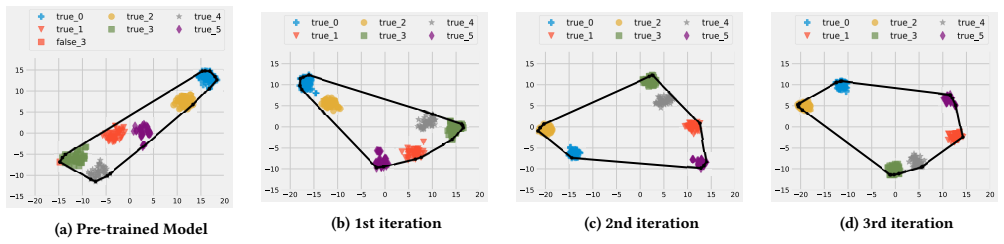
The central discovery is that a weak, noisy cross-modality signal—whether a phone's MAC address was sniffed during a time window—carries enough information to assign identities to face images, provided the assignment is done at the level of events rather than individual snapshots. AutoTune clusters faces by appearance plus event-level attendance overlap, matches the resulting clusters to device IDs by comparing event-attendance vectors with a bipartite assignment, and converts the matching votes into soft probability labels over identities. These soft labels are then used to fine-tune a pre-trained face representation network with a stochastic center loss, and the refined model in turn corrects the event-attendance observations, iterating until convergence. The paper's claim is that after a handful of iterations this loop turns a generic pre-trained model into a building-specific recognizer, and that the iterative soft labeling is what makes the noisy supervision usable.
Load-bearing premise
The whole label chain assumes that each person of interest owns one WiFi device whose MAC address is known to the system and stays linked to that person; if devices randomize their MAC addresses or are shared, the event vectors have no correct identity and the soft labels inherit the error.
Editorial extensions
If this is right
- A face recognition system for a fixed environment can be bootstrapped from unlabelled surveillance video plus sniffed MAC addresses, eliminating the need for enrolment by hand.
- The recognizer improves with time: more days and events sharpen the event vectors, with gains tapering after about eight days in the deployments.
- The loop tolerates noisy observations: simulated false-alarm faces, false-alarm devices, and non-POI visitors degrade F1 gracefully, staying above roughly 0.83 for most tested noise levels.
- Soft labels and the stochastic center loss are what separate AutoTune from a deterministic hard-label version, adding about 15–22% in F1 in the two deployments.
- Model update and association must run in tandem: one-off association without iterative fine-tuning lags by roughly 12–19% in rank-1 identification.
Reading between the lines
- If MAC randomization becomes widespread, the device event vectors lose their identity anchor; a natural extension is to replace static MAC addresses with rotating pseudonyms plus a second signal, such as BLE beacons or location fingerprints, to re-identify the same device across events.
- The event-vector formalism is not face-specific: the same co-occurrence matching could weakly supervise other per-person models, such as voice, gait, or appearance attributes, from ambient sensor logs.
- A testable extension is to deliberately worsen the WiFi sniffer's RSS threshold or inject randomized device identities and measure the F1 drop; the paper's simulation predicts graceful degradation until roughly 40–50% false alarms.
- In a privacy-sensitive deployment, the same technique could run with on-device hashing of MAC addresses, using only event co-occurrence rather than raw addresses, preserving the label chain while reducing identifiable data.
Signed reviews
Editorial analysis
A structured set of objections, weighed in public.
Referee Report
Summary. AutoTune is a self-training pipeline that uses sniffed WiFi MAC addresses as weak supervision to associate face images with identities across spatio-temporal events, producing soft labels with which a pre-trained FaceNet is fine-tuned. The core claims are: (i) cross-modality clustering with an attendance prior plus bipartite matching yields accurate image-to-identity labels; (ii) iterative model and attendance updates improve both labeling and online identification; and (iii) two real deployments (a UK office/meeting/kitchen site and a China common room) achieve >0.85 F1 for labeling and rank-1 identification of 95.8% (UK) and 98.0% (CHN) with no manual image annotation. The abstract and conclusion extend this to "entirely no user effort."
Significance. The paper's contribution is potentially valuable: it empirically demonstrates that noisy wireless presence can seed an environment-specific face recognition system, and it includes a real two-site evaluation with held-out test days and a public code link. The soft-label voting and stochastic center loss are reasonable mechanisms for dealing with label noise. The reported F1 and rank-1 numbers are concrete and falsifiable. The main caveats are that the evaluation protocol and the self-reinforcement dynamics are not fully described, and the autonomy claim is narrower than the validated setting.
major comments (6)
- [§3.1 and Abstract] The claim of "entirely no user effort" rests on the assumption in §3.1 that the mapping from device MAC addresses L to user identities I is known. In practice, MAC randomization on modern OSes, shared devices, and devices left behind break the premise that one MAC is a stable proxy for one person; this is not modelled or evaluated anywhere in §7.4. The authors should either limit the claim to settings where this mapping is provided as an enrolment step, or add an experiment that injects MAC instability and shows the pipeline still recovers. As written, the headline autonomy claim is broader than the validated system.
- [§7.2-7.3] The paper reports precision/recall/F1 for offline labeling and rank-1 accuracy for online identification, but never specifies how the ground-truth image-to-identity labels were obtained, who annotated them, or how the 5,580 and 2,840 held-out test images were labelled. Without this protocol, the reported >0.85 F1 and the 95.8%/98.0% rank-1 numbers cannot be independently audited. Please add an explicit annotation description and, ideally, release the evaluation labels.
- [§5.2, Eq. (6)] Equation (6) defines u^{τ+1}_k = u^τ_k - γ(u^τ_k - bu^τ_k), so the WiFi-derived attendance vector is progressively replaced by the model's own posterior bu^τ_k. This is a self-reinforcing loop in which the only independent supervision signal can be overwritten by the learner's predictions. The paper reports convergence iterations but no analysis or experiment distinguishes convergence to a correct fixed point from convergence to an incorrect self-consistent labeling, and the simulation study in §7.4 does not seed initial label errors to test collapse. The authors should run an ablation with Eq. (6) disabled, or with deliberately corrupted initial WiFi labels, to demonstrate that the feedback improves rather than merely stabilizes the loop.
- [§4.2 and §5.1, Eq. (2)] There is an inconsistency between the soft-label definition and the softmax loss. Section 4.2 defines each label y_i as a probability vector (y_{i,1},...,y_{i,m}), but Eq. (2) writes L_softmax with a hard index y_i in W^T_{y_i} and b_{y_i}. The text says soft labels are compatible with cross-entropy, yet the formula has not been updated to Σ_i Σ_k y_{i,k} log p_{i,k}. Please clarify which loss is actually minimized; this is central to the claimed contribution of stochastic center loss.
- [§4.1 and §6.3] The implemented clustering objective is under-specified. Section 4.1 derives a joint log-likelihood with a hyperparameter β that trades off attendance overlap and face-feature distance, but Section 6.3 states that agglomerative clustering uses Euclidean distance on "heterogeneous features." The paper does not say how the binary attendance vector is scaled relative to the face embedding z_i, nor how Eq. 4.1's β is realized in a Euclidean-distance implementation. This makes the method non-reproducible and prevents a reader from knowing whether the experimental comparisons reflect the proposed model or an arbitrary feature weighting.
- [§7.2, §7.3, §7.2.5] All headline numbers are point estimates with no standard deviations, confidence intervals, or significance tests, and the ID update rate (called γ in Eq. (6) and β in §7.2.5/Fig. 8) is tuned on the same datasets from which the final results are reported. The claimed margins over OA (12.5% and 19%) could therefore be optimistic. At minimum, the authors should state that the update rate was selected on a validation split and report variance over runs or over bootstrap resamples of the test sets.
minor comments (4)
- [§5.2, §7.2.5, Fig. 8] The update rate is denoted γ in Eq. (6), but Section 7.2.5 and the Fig. 8 caption call it β. Please unify the notation; β is already used for the attendance-similarity weight in §4.1.
- [Table 1 and §6.1] Table 1 reports an event duration of 3 hours for the UK site, while §6.1 states that a day is split into 12 fixed 2-hour intervals. Also, §7.3.2 says the UK dataset has 20 POI, whereas Table 1 lists 24 POI. Please correct these inconsistencies.
- [§4.1, §5.1, §6.2] There are several typos and notation glitches: "loд" in §4.1, "detials" in §6.2, and "back prorogation" in §5.1. The Algorithm 1 initialization line "compute attendance vector u0 τ = 1" should be rewritten as u^0 and τ ← 1.
- [§7.2.5] The discussion of the ID update rate says "the convergence becomes faster when the update increases" but notes a fluctuation at 0.15; a table of the actual convergence iterations would be more informative than reading values off Fig. 8.
Circularity Check
No significant circularity: the WiFi-to-identity mapping and held-out test set anchor the self-training loop; self-citations are non-load-bearing baselines.
full rationale
The derivation chain starts from an explicit assumption that the mapping from MAC addresses to user identities is known (Section 3.1), supplying an external anchor independent of the face model. Cross-modality clustering (Section 4.1) combines face features from the pre-trained FaceNet with WiFi attendance vectors, and cluster labeling (Section 4.2) matches cluster event vectors against device event vectors using a bipartite assignment; neither step defines its target in terms of its own output. The model update (Section 5.1) uses soft labels from that association, which is a standard self-training/EM-style feedback loop rather than a definitional circularity. The user attendance update in Eq. 6 does blend the model's predictions back into the WiFi observations, but it is a controlled correction with a small fixed rate (gamma=0.05 in the experiments) and the paper explicitly warns that large rates make the observations 'quickly become the same as the model predictions' (Section 7.2.5), so it is not an unacknowledged overwriting. More importantly, the reported face identification accuracy is measured on a held-out test set 'collected on different days' with no overlap with labeling images (Section 7.3.1), so the headline numbers are not fitted quantities derived from the training loop. The only self-citations are [16] (the OA baseline used for comparison) and [17] (related work on speaker identity), neither of which supplies a load-bearing theorem or uniqueness argument. Consequently, no prediction reduces to its input by construction, and the central claim retains independent empirical content.
Assumptions & free parameters
free parameters (5)
- beta (attendance similarity weight in Section 4.1) =
not reported for final experiments
- gamma (attendance update rate, Section 5.2) =
0.05 (best in Fig. 8; safe region 0.05 to 0.1)
- lambda (center loss weight, Eq. 2) =
not reported
- RSS threshold for WiFi acceptance =
-55 dBm
- Event duration =
2 hours (12 intervals per day)
assumptions (5)
- domain assumption Mapping from device MAC addresses to user identities is known.
- domain assumption Pre-trained FaceNet features are discriminative enough to cluster unseen identities in the new environment.
- domain assumption Device presence, as sensed by WiFi sniffing, correlates with the device owner being visible to the camera in the same event.
- domain assumption Agglomerative clustering with average linkage produces meaningful clusters in the combined feature-attendance space.
- standard math Hungarian algorithm solves the bipartite assignment problem.
Cite this review
Pith. "Pith review of Autonomous Learning for Face Recognition in the Wild via Ambient Wireless Cues." pith.science (2026). https://pith.science/paper/EBOOTWFS
@misc{pith2026190809002,
  author       = {Pith},
  title        = {Pith review of: Autonomous Learning for Face Recognition in the Wild via Ambient Wireless Cues},
  year         = {2026},
  howpublished = {\url{https://pith.science/paper/EBOOTWFS}},
  note         = {Machine review of arXiv:1908.09002}
}
read the original abstract
Facial recognition is a key enabling component for emerging Internet of Things (IoT) services such as smart homes or responsive offices. Through the use of deep neural networks, facial recognition has achieved excellent performance. However, this is only possibly when trained with hundreds of images of each user in different viewing and lighting conditions. Clearly, this level of effort in enrolment and labelling is impossible for wide-spread deployment and adoption. Inspired by the fact that most people carry smart wireless devices with them, e.g. smartphones, we propose to use this wireless identifier as a supervisory label. This allows us to curate a dataset of facial images that are unique to a certain domain e.g. a set of people in a particular office. This custom corpus can then be used to finetune existing pre-trained models e.g. FaceNet. However, due to the vagaries of wireless propagation in buildings, the supervisory labels are noisy and weak.We propose a novel technique, AutoTune, which learns and refines the association between a face and wireless identifier over time, by increasing the inter-cluster separation and minimizing the intra-cluster distance. Through extensive experiments with multiple users on two sites, we demonstrate the ability of AutoTune to design an environment-specific, continually evolving facial recognition system with entirely no user effort.
Figures


Figures from the paper (3 more)



Reference graph
Works this paper leans on
-
[1]
Alexandre Alahi, Albert Haque, and Li Fei-Fei. 2015. RGB-W: When vision meets wireless. In 2015 IEEE International Conference on Computer Vision (ICCV) . IEEE, 3289–3297
work page 2015
-
[2]
Doug Beeferman and Adam Berger. 2000. Agglomerative clustering of a search engine query log. InProceedings of the sixth ACM SIGKDD international conference on Knowledge discovery and data mining . ACM, 407–416
work page 2000
-
[3]
Lacey Best-Rowden, Hu Han, Charles Otto, Brendan F Klare, and Anil K Jain
-
[4]
Qiong Cao, Li Shen, Weidi Xie, Omkar M Parkhi, and Andrew Zisserman. 2018. VGGFace2: A dataset for recognising faces across pose and age. InIEEE Conference on Automatic Face and Gesture Recognition
work page 2018
-
[5]
De Cheng, Yihong Gong, Sanping Zhou, Jinjun Wang, and Nanning Zheng. 2016. Person re-identification by multi-channel parts-based cnn with improved triplet loss function. InProceedings of the IEEE Conference on Computer Vision and Pattern Recognition. 1335–1344
work page 2016
-
[6]
Chris Fraley and Adrian E Raftery. 1998. How many clusters? Which clustering method? Answers via model-based cluster analysis. The computer journal 41, 8 (1998), 578–588
work page 1998
-
[7]
Andrea Frome, Greg S Corrado, Jon Shlens, Samy Bengio, Jeff Dean, Tomas Mikolov, et al. 2013. Devise: A deep visual-semantic embedding model. In Ad- vances in neural information processing systems . 2121–2129
2013
-
[8]
Geoffrey Hinton, Oriol Vinyals, and Jeff Dean. 2015. Distilling the knowledge in a neural network. arXiv preprint arXiv:1503.02531 (2015)
arXiv 2015
Show all 47 references
-
[9]
Gary B Huang, Manu Ramesh, Tamara Berg, and Erik Learned-Miller. 2007. La- beled faces in the wild: A database for studying face recognition in unconstrained environments. Technical Report. Technical Report 07-49, University of Mas- sachusetts, Amherst
2007
-
[10]
Roy Jonker and Ton Volgenant. 1986. Improving the Hungarian assignment algorithm. Operations Research Letters 5, 4 (1986), 171–175
1986
-
[11]
Andrej Karpathy and Li Fei-Fei. 2015. Deep visual-semantic alignments for generating image descriptions. In Proceedings of the IEEE conference on computer vision and pattern recognition . 3128–3137
2015
-
[12]
Alex Krizhevsky, Ilya Sutskever, and Geoffrey E Hinton. 2012. Imagenet classifica- tion with deep convolutional neural networks. In Advances in neural information processing systems. 1097–1105
2012
-
[13]
Yann LeCun, Yoshua Bengio, and Geoffrey Hinton. 2015. Deep learning. nature 521, 7553 (2015), 436
2015
-
[14]
Weiyang Liu, Yandong Wen, Zhiding Yu, Ming Li, Bhiksha Raj, and Le Song
-
[15]
Weiyang Liu, Yan-Ming Zhang, Xingguo Li, Zhiding Yu, Bo Dai, Tuo Zhao, and Le Song. 2017. Deep Hyperspherical Learning. In Advances in Neural Information Processing Systems. 3953–3963
2017
-
[16]
Chris Xiaoxuan Lu, Xuan Kan, Stefano Rosa, Bowen Du, Hongkai Wen, An- drew Markham, and Niki Trigoni. 2017. Towards Self-supervised Face Labeling via Cross-modality Association. In Proceedings of the 15th ACM Conference on Embedded Network Sensor Systems
2017
-
[17]
Chris Xiaoxuan Lu, Hongkai Wen, Sen Wang, Andrew Markham, and Niki Trigoni
-
[18]
Xiaoxuan Lu, Hongkai Wen, Han Zou, Hao Jiang, Lihua Xie, and Niki Trigoni
-
[19]
Xiaoxuan Lu, Han Zou, Hongming Zhou, Lihua Xie, and Guang-Bin Huang. 2016. Robust extreme learning machine with its application to indoor positioning.IEEE transactions on cybernetics 46, 1 (2016), 194–205
2016
-
[20]
In ACM/IEEE International Conference on Information Processing in Sensor Networks (IPSN)
SCAN: learning speaker identity from noisy sensor data. In ACM/IEEE International Conference on Information Processing in Sensor Networks (IPSN). IEEE, 67–78
-
[21]
Andrew Owens, Jiajun Wu, Josh H McDermott, William T Freeman, and Antonio Torralba. 2016. Ambient sound provides supervision for visual learning. In European Conference on Computer Vision . Springer, 801–816
2016
-
[22]
Savvas Papaioannou, Hongkai Wen, Zhuoling Xiao, Andrew Markham, and Niki Trigoni. 2015. Accurate positioning via cross-modality training. In Proceedings of the 13th ACM Conference on Embedded Networked Sensor Systems . ACM, 239–251
2015
-
[23]
Omkar M Parkhi, Andrea Vedaldi, Andrew Zisserman, et al . 2015. Deep Face Recognition.. In BMVC, Vol. 1. 6
2015
-
[24]
Arsha Nagrani, Samuel Albanie, and Andrew Zisserman. 2018. Seeing Voices and Hearing Faces: Cross-modal biometric matching. arXiv preprint arXiv:1804.00326 (2018)
2018 arXiv
-
[25]
Scott Reed, Honglak Lee, Dragomir Anguelov, Christian Szegedy, Dumitru Erhan, and Andrew Rabinovich. 2014. Training deep neural networks on noisy labels with bootstrapping. arXiv preprint arXiv:1412.6596 (2014)
2014 arXiv
-
[26]
Florian Schroff, Dmitry Kalenichenko, and James Philbin. 2015. FaceNet: A unified embedding for face recognition and clustering. In Proceedings of the IEEE conference on computer vision and pattern recognition . 815–823
2015
-
[27]
Yi Sun, Yuheng Chen, Xiaogang Wang, and Xiaoou Tang. 2014. Deep learning face representation by joint identification-verification. In Advances in neural information processing systems. 1988–1996
2014
-
[28]
David Martin Powers. 2011. Evaluation: from precision, recall and F-measure to ROC, informedness, markedness and correlation. (2011)
2011
-
[29]
Christian Szegedy, Sergey Ioffe, Vincent Vanhoucke, and Alexander A Alemi
-
[30]
Yaniv Taigman, Ming Yang, Marc’Aurelio Ranzato, and Lior Wolf. 2014. Deepface: Closing the gap to human-level performance in face verification. In Proceedings of the IEEE conference on computer vision and pattern recognition . 1701–1708
2014
-
[31]
Xiaoyang Tan, Songcan Chen, Zhi-Hua Zhou, and Fuyan Zhang. 2006. Face recognition from a single image per person: A survey. Pattern recognition 39, 9 (2006), 1725–1745
2006
-
[32]
Yi Sun, Xiaogang Wang, and Xiaoou Tang. 2014. Deep learning face represen- tation from predicting 10,000 classes. In Proceedings of the IEEE Conference on Computer Vision and Pattern Recognition . 1891–1898
2014
-
[33]
Subhashini Venugopalan, Huijuan Xu, Jeff Donahue, Marcus Rohrbach, Raymond Mooney, and Kate Saenko. 2014. Translating videos to natural language using deep recurrent neural networks. arXiv preprint arXiv:1412.4729 (2014)
2014 arXiv
-
[34]
Inception-v4, inception-resnet and the impact of residual connections on learning.. In AAAI
-
[35]
Stefan Wager, Sida Wang, and Percy S Liang. 2013. Dropout training as adaptive regularization. In Advances in neural information processing systems . 351–359
2013
-
[36]
Junjue Wang, Brandon Amos, Anupam Das, Padmanabhan Pillai, Norman Sadeh, and Mahadev Satyanarayanan. 2018. Enabling Live Video Analytics with a Scal- able and Privacy-Aware Framework.ACM Transactions on Multimedia Computing, Communications, and Applications (TOMM) 14, 3s (2018), 64
2018
-
[37]
Jin Teng, Boying Zhang, Junda Zhu, Xinfeng Li, Dong Xuan, and Yuan F Zheng
-
[38]
IEEE/ACM Transactions on Networking (TON) 22, 4 (2014), 1285–1296
EV-Loc: integrating electronic and visual signals for accurate localization. IEEE/ACM Transactions on Networking (TON) 22, 4 (2014), 1285–1296
2014
-
[39]
Kaipeng Zhang, Zhanpeng Zhang, Zhifeng Li, and Yu Qiao. 2016. Joint face detection and alignment using multitask cascaded convolutional networks. IEEE Signal Processing Letters 23, 10 (2016), 1499–1503
2016
-
[40]
Oriol Vinyals, Alexander Toshev, Samy Bengio, and Dumitru Erhan. 2015. Show and tell: A neural image caption generator. InComputer Vision and Pattern Recog- nition (CVPR), 2015 IEEE Conference on . IEEE, 3156–3164
2015
-
[41]
C Lawrence Zitnick, Devi Parikh, and Lucy Vanderwende. 2013. Learning the visual interpretation of sentences. In Computer Vision (ICCV), 2013 IEEE Interna- tional Conference on. IEEE, 1681–1688
2013
-
[43]
Yandong Wen, Kaipeng Zhang, Zhifeng Li, and Yu Qiao. 2016. A discriminative feature learning approach for deep face recognition. In ECCV
2016
-
[44]
Xuanli Lisa Xie and Gerardo Beni. 1991. A validity measure for fuzzy clustering. IEEE Transactions on pattern analysis and machine intelligence 13, 8 (1991), 841– 847
1991
-
[46]
Wenyi Zhao, Rama Chellappa, P Jonathon Phillips, and Azriel Rosenfeld. 2003. Face recognition: A literature survey.ACM computing surveys (CSUR) 35, 4 (2003), 399–458
2003
-
[2014]
IEEE Transactions on Information Forensics and Security 9, 12 (2014), 2144–2157
Unconstrained face recognition: Identifying a person of interest from a media collection. IEEE Transactions on Information Forensics and Security 9, 12 (2014), 2144–2157
2014
-
[2016]
In IEEE 12th Interna- tional Conference on Wireless and Mobile Computing, Networking and Communi- cations (WiMob)
Robust occupancy inference with commodity WiFi. In IEEE 12th Interna- tional Conference on Wireless and Mobile Computing, Networking and Communi- cations (WiMob)
-
[2017]
In The IEEE Conference on Computer Vision and Pattern Recognition (CVPR)
Sphereface: Deep hypersphere embedding for face recognition. In The IEEE Conference on Computer Vision and Pattern Recognition (CVPR)
Reviewed August 14, 2026 · model on record in the stance chip above.
Discussion (0). Continue with ORCID to comment.