REVIEW 4 major objections 4 minor 47 references
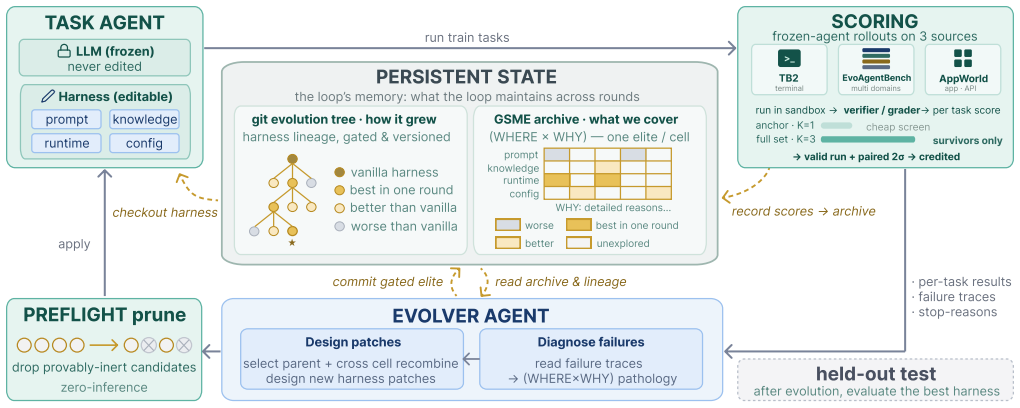
A self-evolving loop improves a frozen model's harness by +9 to +15.5 percentage points on held-out tests, with every credited gain gated by a paired 2-sigma significance test on a sealed test set.
Reviewed by Pith at T0; open to challenge. T0 means a machine referee read the full paper against a public rubric. the ladder, T0–T4 →
T0 review · deepseek-v4-flash
2026-08-02 04:03 UTC pith:ECFAJECQ
load-bearing objection A carefully disciplined self-evolution loop with a load-bearing audit gap: the sealed-test guarantee is procedural, not mechanical, but the protocol is honest enough to deserve a serious referee. the 4 major comments →
Self-Evolving Agent Harnesses via Gated Semantic Quality-Diversity
The pith
A machine-rendered reading of the paper's core claim, the machinery that carries it, and where it could break.
Core claim
The paper's central claim is that a frozen model's harness can be improved automatically by a self-evolution loop whose every credited improvement is real, in the specific sense of clearing a paired 2σ significance bar on a sealed test withheld from all decisions. The loop's GSME archive organizes candidate edits by the (where × why) pathology they address — the harness surface touched and the diagnosed failure mode — rather than by the tasks they fix, which is the anti-overfitting bias. The claimed empirical result is credited held-out gains of +9 to +15.5 percentage points on six domains, with 86–147% retention of training gain, and a pathology-to-patch matching law: the winning patch chan
What carries the argument
The central object is the Gated Semantic MAP-Elites (GSME) archive combined with a strict three-gate credit pipeline. Each candidate harness edit is placed in a categorical archive cell indexed by (where × why): the harness surface it touches (prompt, knowledge, runtime, config) and the diagnosed failure pathology it addresses (e.g., thinking-runaway, premature finalization). Credit is decided only by deterministic code: a validity gate re-runs infrastructure failures, an activation gate requires the mechanism to have fired, and a paired 2σ significance test on per-task differences decides acceptance. The sealed test, withheld from the evolver and scored once after evolution, is the arbiter
Load-bearing premise
The sealed test is never read by the evolving agent is enforced only by procedure, not mechanism — the evolver runs in the same environment that holds the test tasks, so any observed test signal would invalidate every credited gain and retention ratio; the paper flags mechanical enforcement as future work.
What would settle it
Re-run the evolution loop with the sealed test placed in a separate container with no read access and every filesystem read by the evolver logged; reproduce the six credited sealed gains and the 86–147% retention under mechanical withholding. Alternatively, audit the evolution tree's git history and the evolver's command history for any read of the held-out task files — a single such read would falsify the 'sealed' property and make the generalization claims uninterpretable.
If this is right
- If the central claim holds, harness optimization is a dependable lever for frozen, mid-capability models: credited held-out gains of +9 to +15.5 percentage points, with no overfitting collapse, across tasks the evolving agent never saw.
- The winning patch is portable exactly as far as the pathology it targets is shared: the same careless-to-submit-verify match recurs across two model families, while a patch mismatched to a model's pathology is near-zero in effect.
- What reliably transfers is the diagnose-and-credit loop, not any specific harness; a new model still needs its own diagnosis even if a pathology recurs.
- A deterministic 'mean improves' rule would have credited phantom gains, including a mechanism whose activation beacon never fired; the paired significance and activation gates are necessary, not cosmetic.
- The evolved harness expands the set of solvable tasks, since best-of-3 pass also rises on every credited domain, not just per-attempt hit rate.
Where Pith is reading between the lines
- If the pathology-to-patch law extends beyond the two families tested, harness evolution could become a two-step procedure: first diagnose the model's dominant failure mode cheaply, then fetch the matched patch from a library — turning an expensive per-model evolution run into a lookup.
- The anti-overfitting design could transfer to other self-improvement loops with verifiable per-task rewards (skill acquisition, memory editing): key the archive by the failure type rather than the task identity, and gate credit with paired significance.
- The paper's own caveat that mechanical sealing is future work implies a direct audit: instrument the evolver's filesystem access and re-run with the test set physically inaccessible; the retention numbers are only convincing if they survive that check.
- The loop's reliance on per-task verifiers means the method inherits any verifier gameability; in weak-verifier domains, an extension would need a meta-verifier or reward-model calibration before the same guarantees apply.
Editorial analysis
A structured set of objections, weighed in public.
Referee Report
Summary. The paper proposes a self-evolving harness framework for frozen LLM agents. A stronger evolver diagnoses failures and proposes patches, while deterministic code owns sampling, measurement, and paired per-task significance testing. Candidate patches populate a categorical MAP-Elites archive keyed on (where × why) pathology cells. The authors report that the train-selected harness improves over vanilla on a sealed test across six credited benchmarks (+9 to +15.5pp, retention 86–147%), with SWE-bench reported as preliminary. They also claim a cross-model pathology-to-patch matching law on AppWorld across Qwen and Gemini models.
Significance. If the sealed-test guarantees are trustworthy, the paper makes a strong methodological contribution: it demonstrates a disciplined loop in which the proposing model is separated from the crediting machinery, every credited gain passes a paired 2σ gate on a withheld set, and the archive keyed on pathology rather than task identity is a plausible anti-overfitting inductive bias. The honest reporting of SWE-bench, the documented rejection of a wrong hypothesis, and the release of per-task differences are commendable and increase confidence in the experimental core. The cross-model dissociation, if confirmed, is a valuable result for the harness-optimization literature. However, the central claim is currently undermined by unresolved questions about sealed-test integrity and by an internal contradiction in the number of times the test set was used.
major comments (4)
- [§3.4 and §3.2] The sealed-test guarantee is procedural rather than mechanical. The evolver (Claude Opus 4.8 via Claude Code) operates in the same git-tracked environment that contains the test tasks, and no access log for the test set is provided. The manuscript itself states 'Enforcing the withholding mechanically is future work.' Because the headline conclusion is that the gains generalize, the possibility that the evolving agent observed the test set during evolution makes the credited sealed-test numbers uninterpretable as currently presented. This needs to be fixed, either by sandboxing the test set with access logging or by rerunning the main experiments under mechanical separation.
- [§4.6 vs §3.4/§4.3] The protocol says the sealed test is 'scored once' and that 'each credited number is a single sealed comparison' (Algorithm 1, §4.3). Yet §4.6 reports that on GDPval 'a recovery+VF variant reached the highest sealed score (+11.5pp)' despite being ranked below on train. This implies that more than one candidate harness was scored on the sealed test. If true, the 'scored once' claim is false and the argument that no multiple-comparison correction is needed collapses; if false, the statement needs clarification. Please disclose exactly how many harnesses were evaluated on the sealed test and whether the reported +9.2pp is the single pre-registered comparison or a post-hoc selection.
- [Abstract and Table 1] The abstract claims 'Across seven domains ... its credited gains there are +9 to +15.5pp and retain 86–147% of the training gain.' Table 1 shows SWE-bench with +5.1pp, z=0.78, retention 37%, explicitly not credited. Thus the credited-gain claim covers six domains, not seven. The abstract and §1 should be revised to avoid overclaiming: six credited benchmarks plus one preliminary result.
- [§4.1] The six credited benchmarks are said to use 'disjoint train/sealed-test splits' and SWE-bench's split is 'disjoint by construction,' but the construction is not documented. For each benchmark, specify how the split was made (e.g., provided by EvoAgentBench, random with seed, temporal split) and report any overlap check. Without this, the held-out status of the test set cannot be independently audited.
minor comments (4)
- [§3.4] The definition of pass@1 with K=3 attempts is unusual (per-task success over K attempts, not the standard first-sample pass@1). Please flag this at first use to avoid confusion with standard pass@1 notation.
- [§4.4 / Table 2] The 'thinking-off' ablation is described as 'blanket thinking-off toggle' but the table footnote says 'thinking disabled only after a detected runaway.' Please make the condition unambiguous in the table caption.
- [App. B, Lemma 1] The lemma refers to a 'posterior mean' without stating the prior. If a Beta prior is assumed, give the prior parameters; otherwise clarify that the variance reduction is computed for the empirical Bernoulli variance.
- [§4.3] The sentence 'researcher degrees of freedom are spent on train' is true only if the sealed test is never used for any model selection. The GDPval discrepancy in §4.6 makes this sentence potentially misleading; after fully resolving the test-usage question, revisit this wording.
Circularity Check
No significant circularity: credit decisions are structurally separated from proposals by deterministic gates and a single sealed evaluation.
full rationale
The credit loop is not circular because the paper explicitly separates proposing from crediting: 'why is an LLM-assigned hypothesis, not ground truth... credit comes solely from the paired-2σ gate' (§4.4), and it shows a wrong hypothesis being rejected ('the loop diagnosed a knowledge gap... the gate rejected it'). The GSME why-label only steers exploration; Proposition 2 states deployment selects 'arg max f, whose definition contains no label' (App. B), so a mislabeled pathology cannot propagate into the final choice. The train-selected harness is scored once on a sealed test (§3.4, Algorithm 1), and the main results use full K=3 re-evaluation; the score-borrowing estimator is validated 'against ground truth rather than relied upon to produce it' (App. B). The one flagged weakness is that the seal is procedural, not mechanical: 'Enforcing the withholding mechanically is future work' (§3.4). If the evolving agent read the test set, the credited gains would be uninterpretable, but the paper provides no such evidence and this is a data-integrity limitation rather than a reduction of the conclusion to its inputs. A possible author-overlap citation (Zhang et al. 2025c, Agentic Context Engineering) appears only in a related-work list ('which our knowledge lever subsumes as one editable surface among four') and is not load-bearing. No equation equates a prediction to a fitted parameter or a renamed fit.
Axiom & Free-Parameter Ledger
free parameters (6)
- K (attempts per task) =
3
- Paired-2σ credit threshold =
z ≥ 1.96
- Anchor screen margin =
1.5σ (K=1)
- Termination patience/cap =
P=10, R=20
- Tree-aware borrowing constants =
unspecified (λ, η, Δ, α0 cap)
- Retention ratio definition =
sealedΔ ÷ trainΔ
axioms (7)
- standard math Paired per-task pass@1 differences are approximately normal, so a z ≥ 1.96 threshold on the sealed set is a valid significance test for the credited gain (§3.4).
- standard math Beta-posterior variance identity (Lemma 1) and weighted Hoeffding bound (Theorem 1) hold as stated; proofs are sketches.
- domain assumption Per-task verifiers (harbor, lcb_runner, LLM judge, graded rubrics) faithfully measure task success.
- domain assumption The sealed test is genuinely never read by the evolving agent during evolution.
- domain assumption Train and sealed-test tasks are drawn from the same distribution, making retention (sealedΔ/trainΔ) interpretable as generalization.
- domain assumption The LLM diagnoser's why-labels are useful steering signals for search.
- ad hoc to paper The K=1 anchor screen with 1.5σ margin culls only egregious losers and never a future champion.
invented entities (2)
-
GSME archive (Gated Semantic MAP-Elites)
no independent evidence
-
(where × why) descriptor space
no independent evidence
read the original abstract
An LLM agent's real-task performance is shaped as much by the harness around its model as by the frozen model itself: its prompts, injected knowledge, runtime control, and configuration. In deployment the harness is often the only lever available, so improving it automatically is the natural way to raise performance without touching the weights. The hard part is not generating changes but knowing which one truly helped. Self-generated feedback is noisy, and an apparent gain can be a measurement artifact or an edit that merely overfits the tasks it was tuned on. We present a self-evolving agent-harness framework that separates proposing changes from crediting them: a language model diagnoses failures and proposes patches, while all sampling, measurement, and significance testing are owned by deterministic code, so every credited improvement is trustworthy by construction. Patches populate a gated, categorical quality-diversity archive (GSME) keyed on the (WHERE x WHY) pathology an edit addresses rather than the tasks it fixes, an anti-overfitting inductive bias; generalization is measured on a sealed test scored only after evolution. Across seven domains with a frozen open-weight model, the harness is train-selected and scored once on a sealed test; its credited gains there are +9 to +15.5pp and retain 86-147% of the training gain, evidence they generalize rather than overfit. The winning patch tracks the model's dominant pathology, not its size or family: changing the model can change the pathology and the patch, while the same pathology-to-patch match recurs across two model families. What transfers is the diagnose-and-credit loop, not any specific harness.
Figures


Reference graph
Works this paper leans on
-
[1]
Transactions on Machine Learning Research , year=
A Survey of Self-Evolving Agents: What, When, How, and Where to Evolve on the Path to Artificial Super Intelligence , author=. Transactions on Machine Learning Research , year=
-
[2]
2026 , eprint=
Self-Harness: Harnesses That Improve Themselves , author=. 2026 , eprint=
2026
-
[3]
2026 , eprint=
From Failed Trajectories to Reliable LLM Agents: Diagnosing and Repairing Harness Flaws , author=. 2026 , eprint=
2026
-
[4]
2026 , eprint=
Agentic Harness Engineering: Observability-Driven Automatic Evolution of Coding-Agent Harnesses , author=. 2026 , eprint=
2026
-
[5]
International Conference on Machine Learning (ICML) , year=
VeRO: A Harness for Agents to Optimize Agents , author=. International Conference on Machine Learning (ICML) , year=
-
[6]
2026 , eprint=
Meta-Harness: End-to-End Optimization of Model Harnesses , author=. 2026 , eprint=
2026
-
[7]
2026 , eprint=
SkillOpt: Executive Strategy for Self-Evolving Agent Skills , author=. 2026 , eprint=
2026
-
[8]
2026 , eprint=
HarnessX: A Composable, Adaptive, and Evolvable Agent Harness Foundry , author=. 2026 , eprint=
2026
-
[9]
2026 , eprint=
Adapting the Interface, Not the Model: Runtime Harness Adaptation for Deterministic LLM Agents , author=. 2026 , eprint=
2026
-
[10]
2025 , eprint=
Agentic Context Engineering: Evolving Contexts for Self-Improving Language Models , author=. 2025 , eprint=
2025
-
[11]
2026 , eprint=
Next-Generation Agentic Reinforcement Learning Systems Enable Self-Evolving Agents , author=. 2026 , eprint=
2026
-
[12]
International Conference on Learning Representations (ICLR) , year=
Darwin G\"odel Machine: Open-Ended Evolution of Self-Improving Agents , author=. International Conference on Learning Representations (ICLR) , year=
-
[13]
2025 , eprint=
A Self-Improving Coding Agent , author=. 2025 , eprint=
2025
-
[14]
International Conference on Learning Representations (ICLR) , year=
Automated Design of Agentic Systems , author=. International Conference on Learning Representations (ICLR) , year=. 2408.08435 , archivePrefix=
-
[15]
International Conference on Learning Representations (ICLR) , year=
GEPA: Reflective Prompt Evolution Can Outperform Reinforcement Learning , author=. International Conference on Learning Representations (ICLR) , year=. 2507.19457 , archivePrefix=
-
[16]
International Conference on Learning Representations (ICLR) , year=
AFlow: Automating Agentic Workflow Generation , author=. International Conference on Learning Representations (ICLR) , year=. 2410.10762 , archivePrefix=
-
[17]
2026 , eprint=
Empirical-MCTS: Continuous Agent Evolution via Dual-Experience Monte Carlo Tree Search , author=. 2026 , eprint=
2026
-
[18]
International Conference on Learning Representations (ICLR) , year=
Large Language Models Are Human-Level Prompt Engineers , author=. International Conference on Learning Representations (ICLR) , year=. 2211.01910 , archivePrefix=
-
[19]
International Conference on Learning Representations (ICLR) , year=
Large Language Models as Optimizers , author=. International Conference on Learning Representations (ICLR) , year=. 2309.03409 , archivePrefix=
-
[20]
arXiv preprint arXiv:2309.16797 , year=
Promptbreeder: Self-Referential Self-Improvement Via Prompt Evolution , author=. arXiv preprint arXiv:2309.16797 , year=
-
[21]
International Conference on Learning Representations (ICLR) , year=
DSPy: Compiling Declarative Language Model Calls into Self-Improving Pipelines , author=. International Conference on Learning Representations (ICLR) , year=. 2310.03714 , archivePrefix=
-
[22]
Nature , volume=
Mathematical discoveries from program search with large language models , author=. Nature , volume=
-
[23]
arXiv preprint arXiv:1504.04909 , year=
Illuminating search spaces by mapping elites , author=. arXiv preprint arXiv:1504.04909 , year=
-
[24]
IEEE Transactions on Evolutionary Computation , volume=
Quality and Diversity Optimization: A Unifying Modular Framework , author=. IEEE Transactions on Evolutionary Computation , volume=
-
[25]
IEEE Congress on Evolutionary Computation (CEC) , year=
Diverse Prompts: Illuminating the Prompt Space of Large Language Models with MAP-Elites , author=. IEEE Congress on Evolutionary Computation (CEC) , year=. 2504.14367 , archivePrefix=
-
[26]
arXiv preprint arXiv:2605.09781 , year=
Parameter-Efficient Neuroevolution for Diverse LLM Generation: Quality-Diversity Optimization via Prompt Embedding Evolution , author=. arXiv preprint arXiv:2605.09781 , year=
-
[27]
arXiv preprint arXiv:2605.30621 , year=
Harness Updating Is Not Harness Benefit: Disentangling Evolution Capabilities in Self-Evolving LLM Agents , author=. arXiv preprint arXiv:2605.30621 , year=
-
[28]
arXiv preprint arXiv:2605.29225 , year=
BenchTrace: A Benchmark for Testing Reflection Ability and Controlled Evolution in LLM Agents , author=. arXiv preprint arXiv:2605.29225 , year=
-
[29]
arXiv preprint arXiv:2601.00828 , year=
Decomposing LLM Self-Correction: The Accuracy-Correction Paradox and Error Depth Hypothesis , author=. arXiv preprint arXiv:2601.00828 , year=
-
[30]
arXiv preprint arXiv:2509.25370 , year=
Where LLM Agents Fail and How They can Learn From Failures , author=. arXiv preprint arXiv:2509.25370 , year=
-
[31]
International Conference on Machine Learning (ICML) , year=
Which Agent Causes Task Failures and When? On Automated Failure Attribution of LLM Multi-Agent Systems , author=. International Conference on Machine Learning (ICML) , year=. 2505.00212 , archivePrefix=
-
[32]
Annual Meeting of the Association for Computational Linguistics (ACL) , year=
Seeing the Whole Elephant: A Benchmark for Failure Attribution in LLM-based Multi-Agent Systems , author=. Annual Meeting of the Association for Computational Linguistics (ACL) , year=. 2604.22708 , archivePrefix=
-
[33]
arXiv preprint arXiv:2603.25001 , year=
Rethinking Failure Attribution in Multi-Agent Systems: A Multi-Perspective Benchmark and Evaluation , author=. arXiv preprint arXiv:2603.25001 , year=
-
[34]
arXiv preprint arXiv:2504.11343 , year=
A Minimalist Approach to LLM Reasoning: from Rejection Sampling to Reinforce , author=. arXiv preprint arXiv:2504.11343 , year=
-
[35]
arXiv preprint arXiv:2505.14970 , year=
Self-Evolving Curriculum for LLM Reasoning , author=. arXiv preprint arXiv:2505.14970 , year=
-
[36]
arXiv preprint arXiv:2603.26499 , year=
AIRA\_2: Overcoming Bottlenecks in AI Research Agents , author=. arXiv preprint arXiv:2603.26499 , year=
-
[37]
arXiv preprint arXiv:2605.22505 , year=
Towards Direct Evaluation of Harness Optimizers via Priority Ranking , author=. arXiv preprint arXiv:2605.22505 , year=
-
[38]
arXiv preprint arXiv:2606.03108 , year=
EvoTrainer: Co-Evolving LLM Policies and Training Harnesses for Autonomous Agentic Reinforcement Learning , author=. arXiv preprint arXiv:2606.03108 , year=
-
[39]
arXiv preprint arXiv:2605.22568 , year=
Measuring Security Without Fooling Ourselves: Why Benchmarking Agents Is Hard , author=. arXiv preprint arXiv:2605.22568 , year=
-
[40]
arXiv preprint arXiv:2505.18102 , year=
CapBencher: Give Your LLM Benchmark a Built-in Alarm for Test-Set Overfitting , author=. arXiv preprint arXiv:2505.18102 , year=
-
[41]
arXiv preprint arXiv:2605.13941 , year=
EvolveMem: Self-Evolving Memory Architecture via AutoResearch for LLM Agents , author=. arXiv preprint arXiv:2605.13941 , year=
-
[42]
International Conference on Learning Representations (ICLR) , year=
ReasoningBank: Scaling Agent Self-Evolving with Reasoning Memory , author=. International Conference on Learning Representations (ICLR) , year=
-
[43]
arXiv preprint arXiv:2605.21951 , year=
Dynamic Mixture of Latent Memories for Self-Evolving Agents , author=. arXiv preprint arXiv:2605.21951 , year=
-
[44]
arXiv preprint arXiv:2509.24771 , year=
LatentEvolve: Self-Evolving Test-Time Scaling in Latent Space , author=. arXiv preprint arXiv:2509.24771 , year=
-
[45]
Maia Polo, Felipe and Weber, Lucas and Choshen, Leshem and Sun, Yuekai and Guo, Gui and Yurochkin, Mikhail , booktitle=. tiny. 2024 , note=
2024
-
[46]
North American Chapter of the Association for Computational Linguistics (NAACL) , year=
Efficient Benchmarking (of Language Models) , author=. North American Chapter of the Association for Computational Linguistics (NAACL) , year=
-
[47]
Biometrika , volume=
Inference and missing data , author=. Biometrika , volume=
discussion (0)
Sign in with ORCID, Apple, or X to comment. Anyone can read and Pith papers without signing in.