REVIEW 3 major objections 6 minor 14 references
Large language models can split and time large stock orders without market-impact models or task-specific training, beating standard execution baselines on real exchange data.
Reviewed by Pith at T0; open to challenge. T0 means a machine referee read the full paper against a public rubric. the ladder, T0–T4 →
T0 review · grok-4.5
2026-07-31 08:13 UTC pith:ECVPD43D
load-bearing objection First real LLM parent-order execution study with careful backtests; the 0.65 bp win is real against weak baselines, not yet against the RL frontier they cite. the 3 major comments →
Can Large Language Models Execute Parent Orders?
The pith
A machine-rendered reading of the paper's core claim, the machinery that carries it, and where it could break.
Core claim
The paper’s central claim is that LLMs can be used for parent-order execution—not only for choosing what to trade—via a hierarchical plan-then-execute design that needs neither explicit market assumptions nor task-specific policy training, and that this approach outperforms standard static and learning-based execution strategies on Shenzhen Stock Exchange Level-1 parent orders by about 0.65 basis points against the strongest baseline (roughly 1 bp versus TWAP) at full completion under both aggressive and passive order submission.
What carries the argument
PACE (Plan-Ahead Controlled Execution): a Planner that scores fixed future time slots and blends LLM allocation weights with TWAP using a confidence-gated mixture, plus an Executor that each minute multiplies the TWAP baseline quantity by a controlled adjustment from short-horizon market context and the Planner’s long-horizon assessment.
Load-bearing premise
That a Level-1 Ask1/Bid1 matching simulator on randomly generated morning parent orders is a fair enough stand-in for real institutional execution cost that a sub-basis-point price gap counts as genuine economic outperformance.
What would settle it
Re-run the same parent-order set (or live paper-trading) with a fuller book, realistic queue priority and partial fills, and no final-minute sweep bailout; if PACE’s value-weighted basis-point edge over TWAP and the best baseline disappears or reverses while completion stays comparable, the central performance claim fails.
If this is right
- Execution desks could deploy LLM planners/executors as inference-time overlays on TWAP without retraining when markets or mandates change.
- For large annual notional, even ~1 bp average improvement versus TWAP implies multi-million-dollar annual cost differences at the scale the paper cites.
- Confidence scores from the Planner become a usable live filter or throttle for how far to deviate from TWAP.
- LLM agents may systematically front-load child orders under time pressure, which would change how desks set urgency and risk limits relative to human traders.
- The same hierarchical split of long-horizon allocation and short-horizon adjustment can be stress-tested on other venues and order types without new impact models.
Where Pith is reading between the lines
- If confidence truly predicts better fills, routing more notional to high-confidence plans (and defaulting to TWAP otherwise) is a natural production control loop the paper only measures, not productizes.
- The larger sell-side gains the authors link to short-sale frictions suggest the method’s edge may shrink in markets where shorting is freer and bad news prices in faster.
- Because the Executor can still beat TWAP without the Planner, much of the value may live in minute-level judgment rather than multi-slot foresight—worth isolating in A/B live tests.
- Adding news or cross-asset context, as the conclusion sketches, would test whether the same hierarchy scales beyond pure price-volume snapshots.
Editorial analysis
A structured set of objections, weighed in public.
Referee Report
Summary. The paper asks whether large language models can be used for parent-order execution and proposes PACE, a hierarchical inference-time framework that splits the problem into a long-horizon Planner (slot preference scores mixed with TWAP via λ and confidence c) and a short-horizon Executor (per-minute TWAP adjustments via γ and score z_t). Neither stage uses an explicit impact model nor task-specific policy training. On randomly generated Shenzhen Level-1 parent orders (April data), PACE is compared to TWAP, Almgren–Chriss, and XGB/LSTM direction-scaling baselines under aggressive and passive submission (with final-minute sweep). The strongest variant (DeepSeek-v4-flash) improves value-weighted price performance by about 1.0–1.1 bps over TWAP and 0.65 bps over the best baseline at 100% completion. Ablations, hyperparameter sweeps, bootstrap intervals, volatility splits, and depth-limited matching support the empirical claim. A behavioral section reports that higher Planner confidence predicts better bp and that the Executor front-loads rather than procrastinating under time pressure.
Significance. If the result holds under a more competitive baseline set and a more realistic execution simulator, the paper would be a genuine first step extending LLMs in finance from security selection to how to execute, with a reusable hierarchical protocol and publicly linked code. The design is simple and assumption-light relative to classical stochastic-control and RL execution work, and the behavioral contrasts with human overconfidence and deadline procrastination are a distinctive contribution beyond pure leaderboard comparison. The reported economic translation (multi-million USD savings on $100B notional) is directionally useful for motivating the problem, even if the absolute bps edge is small. Strengths that should be credited include the module/prompt ablations, bootstrap CIs, sweep decomposition, depth-limited matching check, and the explicit separation of planning from execution.
major comments (3)
- [Table 1; §4.1; Appendix 6.4] Table 1 and App. 6.4 / Eq. (13): the claim that PACE “outperforms … learning-based baselines” and exceeds the strongest baseline by 0.65 bps rests on XGB/LSTM models that only predict a 3-class next-minute mid-price direction and scale the TWAP slice by a fixed η when the sign is favorable. These are not trained on execution cost, inventory, or impact, and they are substantially weaker than the hierarchical RL / PPO / oracle-distillation execution policies cited in §2 (e.g., Fang et al. 2021; Lin & Beling 2021; Ning et al. 2021; Niu et al. 2024). Under a pure Level-1 cross matcher, a multi-minute trend planner can beat myopic direction scalers without establishing superiority to the learning-based execution frontier the paper invokes. Either add at least one competitive adaptive execution baseline trained on the same parent-order objective, or reframe the claim as outperformance over sta
- [§3.4; Algorithm 1; §4.2] §3.4 and Alg. 1: the Matcher fills on Ask1/Bid1 crossing (optional depth cap; passive then final-minute sweep) and does not model transient or permanent market impact from the strategy’s own flow. Parent-order execution cost is defined largely by impact and information leakage (Kyle 1985; Almgren–Chriss), so a ~0.65 bp wbp gap on a no-impact Level-1 cross can be a simulator artifact rather than institutional cost reduction. The economic reading in §4.2 (USD millions on $100B) inherits this gap. A load-bearing robustness check is needed: e.g., a simple temporary-impact or participation-rate penalty, or depth depletion beyond one level, with the same parent orders.
- [Appendix 6.2; Figure 3; Table 8] App. 6.2: all parent orders start at a fixed 10:30, use 10–60 minute windows, and quantities 100–10k shares drawn independently of stock ADV and liquidity. Gains are heterogeneous (Fig. 3: larger on sells and shorter windows) and bootstrap CIs for the headline DS-v4-f gain are wide (Table 8: aggressive [0.15, 2.12]). The central empirical claim would be much stronger with ADV-scaled quantities, staggered start times across the day, and reporting of effect sizes conditional on participation rate. Without that, external validity of the 0.65 bp headline remains limited.
minor comments (6)
- [§3.3 Eq. (5)] Eq. (5): the mix of uniform TWAP weights and softmax(a_n) is clear, but the interaction of λ with confidence c is easy to misread; a one-line note that effective LLM weight is λc (and thus shrinks to TWAP when c is low) would help.
- [Table 1] Table 1 reports only wbp and states 100% cr for all methods; for passive+sweep this is expected, but a column for pre-sweep fill fraction (as in Table 10) in the main table would make the passive comparison easier to interpret.
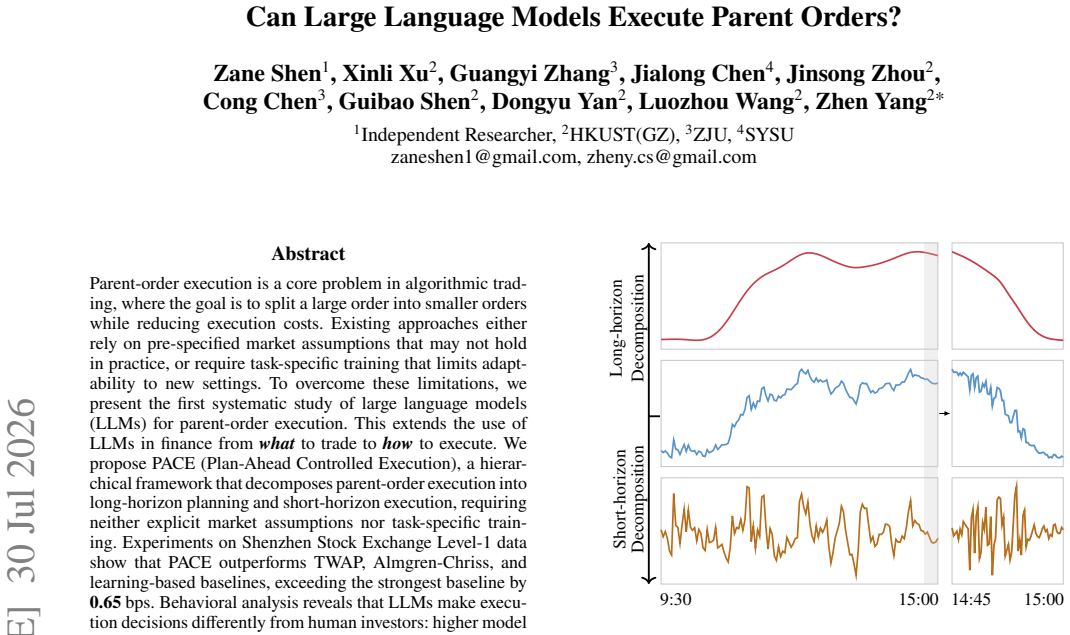
- [Figure 1; §1] Fig. 1 caption invokes the HP filter as motivation for hierarchical decomposition, but HP is not used in PACE; clarify that the figure is illustrative only so readers do not expect a filter-based module.
- [§4.1] Model names ChatGPT-5.4 and DeepSeek-v4-flash / Xu et al. 2026 should be pinned to exact API snapshots or checkpoints where possible, given rapid model churn and the eight-repeat protocol.
- [Abstract; §1] Minor prose/spacing artifacts appear throughout (e.g., missing spaces after commas in “trading,wherethegoal”); a full copy-edit pass is needed before camera-ready.
- [§2] Related Work could more sharply separate “LLMs for trading agents” from execution microstructure so the novelty claim (“howto execute”) is not blurred with portfolio or crypto trading agents already cited.
Circularity Check
No significant circularity: headline gains are empirical backtest comparisons, not quantities forced equal to fitted inputs by construction.
full rationale
PACE’s central claim is an out-of-sample comparison of realized average execution price versus a TWAP price benchmark (Eqs. 7–10, Table 1) on April Shenzhen Level-1 parent orders, against TWAP, Almgren–Chriss, XGB, and LSTM baselines. The Planner/Executor formulas (Eqs. 5–6) blend LLM scores with a TWAP reference via free knobs λ and γ; those knobs are tuned and ablated, but wbp is not identically equal to the objective used to define success, nor is any reported “prediction” a refit of the evaluation target. ML baselines are trained on prior months to predict next-minute direction and only scale TWAP (App. 6.4); AC uses a κ grid—standard tuning, not self-definitional circularity. Behavioral regressions of bp on Planner confidence c and of z on time pressure (Tabs. 4–5) are post-hoc associations, not claims that performance is derived from c by construction. There is no load-bearing self-citation uniqueness theorem, no ansatz smuggled in as a forced law, and no renaming of a known closed-form optimum as a first-principles derivation. Weak-baseline or matcher-fidelity concerns are external validity/correctness issues, not circular reduction of the result to its inputs. Score 0 is appropriate.
Axiom & Free-Parameter Ledger
free parameters (5)
- λ (Planner LLM-allocation strength) =
0.3
- γ (Executor deviation from TWAP) =
0.5
- τ (sub-plan duration) and Δ (decision interval) =
τ=5 min, Δ=1 min
- AC κ and ML η =
κ=0.5; best η in grid
- Parent-order sampler bounds =
see App. 6.2
axioms (5)
- domain assumption Mid-price (Ask1+Bid1)/2 is an adequate price proxy for history and TWAP benchmark P_TWAP.
- domain assumption Fills occur when aggressive/passive orders cross displayed Ask1/Bid1 (optional depth cap); unfilled passive residual is swept in the last minute.
- domain assumption Value-weighted bp versus window TWAP price is the right primary performance metric at forced 100% completion.
- ad hoc to paper Commercial LLM APIs with default parameters and eight repeats sufficiently control stochasticity for strategy comparison.
- ad hoc to paper Removing stock IDs and dates from prompts adequately prevents leakage while preserving decision quality.
invented entities (1)
-
PACE (Plan-Ahead Controlled Execution) hierarchical Planner/Executor protocol
no independent evidence
read the original abstract
Parent-order execution is a core problem in algorithmic trading, where the goal is to split a large order into smaller orders while reducing execution costs. Existing approaches either rely on pre-specified market assumptions that may not hold in practice, or require task-specific training that limits adaptability to new settings. To overcome these limitations, we present the first systematic study of large language models (LLMs) for parent-order execution. This extends the use of LLMs in finance from what to trade to how to execute. We propose PACE (Plan-Ahead Controlled Execution), a hierarchical framework that decomposes parent-order execution into long-horizon planning and short-horizon execution, requiring neither explicit market assumptions nor task-specific training. Experiments on Shenzhen Stock Exchange Level-1 data show that PACE outperforms TWAP, Almgren-Chriss, and learning-based baselines, exceeding the strongest baseline by 0.65 bps. Behavioral analysis reveals that LLMs make execution decisions differently from human investors: higher model confidence predicts better performance rather than worse returns, and the model trades earlier rather than procrastinating toward the deadline. These findings suggest that LLMs can complement human traders in execution decisions.
Figures


Reference graph
Works this paper leans on
-
[7]
Table 8 shows that DS-v4-f has positive 95% confidence intervals under both order-submission settings, while GPT-5.4 remains close to the significance bound- ary
6.3 Robustness Analysis Statistical robustness.We use 5,000 bootstrap resamples over parent orders to test whether PACE’s gains are statisti- cally robust. Table 8 shows that DS-v4-f has positive 95% confidence intervals under both order-submission settings, while GPT-5.4 remains close to the significance bound- ary. These results support the statistical ...
2026
-
[11]
Tradin- gAgents: Multi-Agents LLM Financial Trading Framework. arXiv:2412.20138. Xie, Q.; Han, W.; Zhang, X.; Lai, Y.; Peng, M.; Lopez- Lira, A.; and Huang, J
-
[12]
PIXIU: A Large Language Model, Instruction Data and Evaluation Benchmark for Fi- nance. arXiv:2306.05443. Xu, A.; Lin, B.; Xue, B.; Wang, B.; Xu, B.; Wu, B.; Zhang, B.;Lin,C.;Dong,C.;Ling,C.;etal.2026.DeepSeek-V4:To- wards Highly Efficient Million-Token Context Intelligence. arXiv:2606.19348. Xu, H.; Bohne, J.; Polak, P.; Byrd, D.; Rosenberg, D.; and Kazantsev, G
Pith/arXiv arXiv 2026
-
[13]
Fin- GPT: Open-Source Financial Large Language Models. arXiv:2306.06031. Yang, Y.; Zhang, Y.; Wu, M.; Zhang, K.; Zhang, Y.; Yu, H.; Hu, Y.; and Wang, B
-
[633]
Wang, Y.; Xu, J.; Zhang, H.; Huang, S.-L.; Sun, D. D.; and Zhang,X.-P.2026.FactorMiner:ASelf-EvolvingAgentwith Skills and Experience Memory for Financial Alpha Discov- ery. arXiv:2602.14670. Wu, S.; Irsoy, O.; Lu, S.; Dabravolski, V.; Dredze, M.; Gehrmann, S.; Kambadur, P.; Rosenberg, D.; and Mann, G
arXiv 2026
-
[913]
InterpretingEmergentExtremeEventsin Multi-Agent Systems
Tang, L.; Mei, J.; Liu, D.; Qian, C.; Cheng, D.; Shao, J.; andHu,X.2026a. InterpretingEmergentExtremeEventsin Multi-Agent Systems. arXiv:2601.20538. Tang, Z.; Yin, X.; Chen, W.; Chen, Z.; Zheng, Y.; Ye, W.; Wang, K.; and Lin, L. 2026b. Alphaagentevo: Evolution- oriented alpha mining via self-evolving agentic reinforce- ment learning. InThe Fourteenth Inte...
-
[1998]
Białkowski,J.;Darolles,S.;andLeFol,G.2008
Optimal control of execution costs.Journal of financial markets, 1(1): 1–50. Białkowski,J.;Darolles,S.;andLeFol,G.2008. Improving VWAP strategies: A dynamic volume approach.Journal of Banking & Finance, 32(9): 1709–1722. Cartea, Á.; and Jaimungal, S
2008
-
[2001]
Almgren,R.;andLorenz,J.2006
Optimal execution of portfolio transactions.Journal of Risk, 3: 5–40. Almgren,R.;andLorenz,J.2006. Bayesianadaptivetrading with a daily cycle.Journal of Trading, 1(4): 38–46. Barth,D.2018. Thecostsandbeliefsimpliedbydirectstock ownership.Management Science, 64(11): 5263–5288. Bertsimas, D.; and Lo, A. W
2006
-
[2015]
Journal of financial economics, 116(2): 257–270
High frequency market microstructure. Journal of financial economics, 116(2): 257–270. Shah,R.;Chawla,K.;Eidnani,D.;Shah,A.;Du,W.;Chava, S.;Raman,N.;Smiley,C.;Chen,J.;andYang,D.2022.When FLUEmeetsFLANG:Benchmarksandlargepretrainedlan- guagemodelforfinancialdomain.InProceedingsofthe2022 ConferenceonEmpiricalMethodsinNaturalLanguagePro- cessing, 2322–2335. ...
2022
-
[2019]
Dynamic portfolio execution.Management Science, 65(5): 2015–
2015
-
[2023]
BloombergGPT: A Large Language Model for Finance. arXiv:2303.17564. Xiao, Y.; Sun, E.; Luo, D.; and Wang, W
-
[2024]
Fang,Y.;Ren,K.;Liu,W.;Zhou,D.;Zhang,W.;Bian,J.;Yu, Y.;andLiu,T.-Y.2021
On parametric optimalexecutionandmachinelearningsurrogates.Quanti- tative Finance, 24(1): 15–34. Fang,Y.;Ren,K.;Liu,W.;Zhou,D.;Zhang,W.;Bian,J.;Yu, Y.;andLiu,T.-Y.2021. Universaltradingfororderexecution with oracle policy distillation. InProceedings of the AAAI Conference on Artificial Intelligence, volume 35, 107–115. Frei,C.;andWestray,N.2015.Optimalexe...
2021
-
[2025]
InProceedings of the 63rd An- nual Meeting of the Association for Computational Linguis- tics (Volume 1: Long Papers), 2509–2525
Investorbench: A benchmark for financial decision-making tasks with llm-based agent. InProceedings of the 63rd An- nual Meeting of the Association for Computational Linguis- tics (Volume 1: Long Papers), 2509–2525. Li,K.;Cucuringu,M.;Sánchez-Betancourt,L.;andWilli,T. 2024a. Mixturesofexpertsforscalingupneuralnetworksin orderexecution.InProceedingsofthe5th...
2021
-
[2026]
QuantaAlpha: An Evolutionary Framework for LLM-Driven Alpha Mining. arXiv:2602.07085. Hochreiter, S.; and Schmidhuber, J
discussion (0)
Sign in with ORCID, Apple, or X to comment. Anyone can read and Pith papers without signing in.