REVIEW 2 major objections 4 minor 1 cited by
Arguzz: Testing zkVMs for Soundness and Completeness Bugs
T0 review · 2 major / 4 minor · reviewed 2026-08-15 · deepseek-v4-flash
Pith's one-line read ARGUZZ found eleven previously unknown bugs in production zkVMs by combining product-program metamorphic testing with malicious-prover fault injection, including a critical RISC Zero soundness flaw worth a $50,000 bounty.
desk verdict ARGUZZ earns its keep: eleven vendor-confirmed zkVM bugs and a clever product-program oracle, but the rewrite rules need a semantics proof before the completeness claims are airtight. read the letter →
The pith
A machine-rendered reading of the paper's core claim, the machinery that carries it, and where it could break.
The reading
What carries the argument
The load-bearing object is the product program: instead of executing an original circuit and its transformed twin separately and comparing outputs externally, ARGUZZ compiles both into Rust functions and merges them into a single zkVM program whose expected output is the known constant SUCCESS, returned only when all variants agree. That gives the fuzzer a built-in oracle with no separate checking step, and bundling $k$ variants tests a $k$-safety hyperproperty in one run while paying trace-padding cost once. The second mechanism is instruction-modification fault injection: guided by the trace collected during the normal run, ARGUZZ rewrites one decoded instruction (for example, replacing a remainder's divisor with its dividend) at a deliberately chosen step, so the inconsistency is localized and the rest of the trace re-stabilizes around the faulty state, the configuration most likely to slip past imprecise constraints. A fairness scheduler picks the least-frequently injected instruction, and an inline-assembly extension to the CIRCIL circuit language forces coverage of rare RISC-V instructions such as mulhsu, which is what exposed the Jolt sumcheck failure.
What would settle it
Re-run ARGUZZ's metamorphic campaigns with the $r / r$ rule (and any rule that introduces a fresh variable, such as add-sub-random-value) guarded by a nonzero condition on $r$ or disabled entirely, and check whether all eight reported completeness bugs still reproduce; any crash that disappears is attributable to the rewrite rule, not the zkVM. As a check on the soundness claims, apply each vendor's patch to the constraint system and confirm that the corresponding fault-injected proof, such as $7 \bmod 5 = 0$ in RISC Zero, is then rejected by the unmodified verifier.
Extended reading notes
Core claim
The central claim is that zkVM correctness can be tested end-to-end without access to the VM's internals beyond its execution stage: generate a random circuit, apply semantics-preserving algebraic rewrites, translate both into Rust, and fuse them into a single product program whose only correct outputs are the constants SUCCESS (all variants agree) and OOPS (they disagree). This turns metamorphic testing into a single-execution oracle while cutting prover overhead, because trace padding to the next power of two is paid once rather than per program. The second half of the claim is that underconstrained constraint systems, the source of soundness bugs, escape such equality checks, so ARGUZZ additionally re-runs the product program with a fault injected into one executed instruction, letting the altered value ripple through normal data dependencies, and reports a soundness bug only when the program's output changes and the unmodified verifier still accepts the proof. The paper reports eleven previously unknown bugs across RISC Zero, Nexus, and Jolt: three soundness bugs, all found by fault injection (a missing constraint on three-register instructions in RISC Zero, an unconstrained store operand in Nexus, an unconstrained lui immediate in Jolt), and eight completeness bugs found by the metamorphic product programs, ranging from off-by-one cycle counts and memory-size miscalculations to sumcheck failures on rare instructions such as mulhsu.
Load-bearing premise
The load-bearing premise is that every metamorphic rewrite rule preserves the exact behavior of the Rust program on every input, so a crash or output mismatch in the merged product program can only be caused by the zkVM, yet the rule that rewrites the constant 1 into $r / r$ introduces a division-by-zero panic when $r = 0$, which would make a transformed program crash without any zkVM defect.
Editorial extensions
If this is right
- Soundness bugs that escape metamorphic testing can be exposed by fault injection: all three soundness bugs ARGUZZ found were triggered by the instruction-modification injection, which simulates a malicious prover that the unmodified verifier then fails to catch.
- Because the expected output of a product program is known in advance, completeness bugs show up as crashes or mismatches on the unmodified VM, and the paper reports eight such bugs across RISC Zero, Nexus, and Jolt, including an off-by-one cycle-counting error in RISC Zero.
- The merged single-run design makes testing affordable on slow prover stacks: proving time is dominated by padded trace size, and bundling several equivalent functions pays the power-of-two padding once instead of once per function.
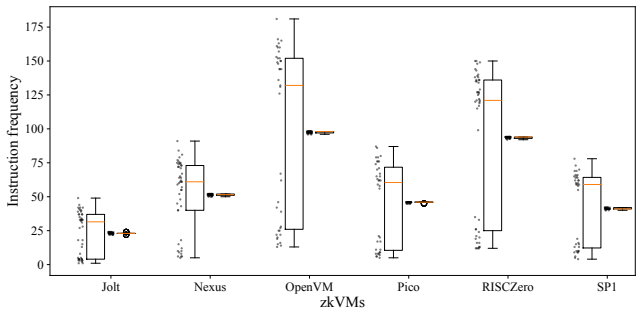
- Inline assembly in generated circuits raises instruction coverage by roughly 15 to 45 percent across the six zkVMs and is directly responsible for at least one found bug, the Jolt mulhsu sumcheck failure.
- Bug-refinding experiments show the approach is practical on modest hardware: all soundness bugs were rediscovered within hours on 4-CPU campaigns, two of the completeness bugs in under 20 minutes.
Reading between the lines
- The metamorphic rewrite rules are taken to preserve Rust semantics exactly, but at least one rule, rewriting the constant 1 into $r / r$, introduces a division-by-zero panic when $r = 0$; if any of the eight reported completeness crashes came from such a rewrite, it would be a false positive rather than a zkVM defect, and re-running with that rule disabled would settle it.
- The product-program oracle is not tied to zkVMs: since the paper notes any technique producing programs with known outputs could replace it, the same merge-and-compare construction could be applied to other proof-producing stacks, such as zkEVMs, validity-rollup provers, or differential testing of RISC-V compilers.
- The pattern behind the RISC Zero bug, a missing operand-binding constraint shared by every three-register instruction, suggests that zkVM constraint systems could be audited by enumerating instruction encodings by shape and probing each family for symmetric operand behavior, a check a fuzzer could automate directly.
- The fact that fault injection, not metamorphic testing, found every soundness bug suggests the two techniques probe disjoint failure modes, and a testing budget should fund their combination rather than either alone.
Signed reviews
Editorial analysis
A structured set of objections, weighed in public.
Referee Report
Summary. The paper presents ARGUZZ, a fuzzer for zero-knowledge VMs (zkVMs) that combines a product-program variant of metamorphic testing with fault injection. It generates semantically equivalent Rust program pairs, merges them into a single program with a known output, and runs the merged program inside six real-world zkVMs (RISC Zero, Nexus, Jolt, SP1, OpenVM, Pico). Fault injection into the VM's execution stage mimics a malicious prover to expose overly weak constraints. The paper reports eleven previously unknown bugs across three zkVMs — three soundness bugs and eight completeness bugs — including a RISC Zero soundness bug that earned a $50,000 bounty. Controlled experiments evaluate bug refinding, instruction-coverage gains from an inline-assembly extension, a fairer fault-injection scheduler, and the impact of instruction-modification injection.
Significance. If the results hold, ARGUZZ would be a valuable, first-of-its-kind tool for systematically testing zkVMs, an area of critical and growing importance for blockchain and cryptographic infrastructure. The empirical contribution is notable: the reported bugs were confirmed and fixed by the respective development teams, and the RISC Zero soundness bug survived prior audits. The product-program encoding of the metamorphic oracle is a sensible efficiency improvement, and the fault-injection scheduler is a thoughtful design element. However, the central claim of detecting completeness bugs rests on the semantic preservation of the metamorphic rewrite rules, which is asserted rather than proven; the counterexample in the 'one-div' rule is a concrete threat to the oracle's soundness and therefore to the completeness-bug findings. Reproducibility is also limited by the absence of an artifact and unpinned VM versions.
major comments (2)
- [Appendix A, Step 6] The rewrite rule 'one-div' in Appendix A (1 → $r/ $r) is not semantics-preserving for $r = 0. In Rust, integer division by zero panics, so the transformed Rust function crashes while the original function returns 1. Since Step 6 in §2 classifies any crash of the product program on the unmodified VM as a completeness bug, a randomly generated $r = 0 would produce a false positive. The same appendix also lists 'and-to-rem' (?a & 1 → ?a % 2) and its reverse, which are equivalent only for unsigned integers; for signed types, negative operands break the equivalence because '%' preserves the dividend's sign while '&' does not. Because eight of the eleven reported bugs are completeness bugs detected via the metamorphic oracle, this unsoundness is load-bearing. Please add a side condition excluding $r = 0 (or another provably semantics-preserving encoding), restrict or justify the signedness assumptions for the modulo/bitwise rules, and re-validate the reported completeness bugs under the corrected rule set.
- [§4.1, Experiments in the wild] The experimental setup is not reproducible as reported. The paper tests 'main branches' of six zkVMs at various dates but provides no commit hashes, no build configurations, no Rust toolchain versions, and no artifact or repository link for ARGUZZ itself. Without pinned versions of the systems under test and of the fuzzer, the refinding results in Table 4 and the coverage numbers in RQ4 cannot be verified or compared against the current state of the zkVMs. Please release the ARGUZZ artifact and provide exact commit hashes and setup instructions for all tested zkVMs, as is standard for systems papers in this venue.
minor comments (4)
- [Figure 15] The instruction label 'eany' appears in the top plot; this is likely a typographical error for 'ecall' and should be corrected.
- [§4.2, RQ6] Table 3 reports that the vast majority of instruction-modification injections produce OOPS with a non-zero exit code, but the paper does not discuss whether such crashes were ever investigated as potential completeness bugs and discarded. A brief explanation of the triage process for these cases would clarify the oracle's precision.
- [Step 3, §3.1] The CIRCIL-to-Rust translation is described as 'direct and preserves circuit semantics,' but the inline-assembly macro in Figure 6b uses 'register' constraints without specifying a clobber list; the paper should confirm that the assembly snippets are correct under the Rust inline-asm rules and across the tested Rust compiler versions.
- [§5, Related Work] When discussing the novelty claim, the paper may want to explicitly note that MTZK targets ZK compilers rather than full zkVM execution pipelines, which it already does; adding a sentence on how ARGUZZ's fault-injection mechanism differs from the error-handling fault injection in FUZZERR and similar tools would strengthen the related-work contrast.
Circularity Check
No significant circularity: ARGUZZ's bug findings are externally confirmed and its rewrite rules are enumerated and checkable; the one-div rule is a correctness risk, not a circular derivation.
full rationale
ARGUZZ does not derive its bug findings from a fitted parameter or from a self-citation chain. The metamorphic oracle is generated by applying rewrite rules listed in Appendix A, most of which are ordinary algebraic identities; the product program encodes the comparison internally, and the claimed 'known expected output' (SUCCESS) is simply the equality of the original and transformed functions. The central empirical contribution, eleven bugs in RISC Zero, Nexus, and Jolt, was externally confirmed: RISC Zero awarded a $50,000 bounty and developers issued fixes, and the bug-refinding experiment checks that applying the fixes removes the bugs. That makes the results externally falsifiable rather than circular. The one substantive concern is that the paper asserts the Appendix A transformations are semantics-preserving without proving it, and at least one rule is not: 'one-div' rewrites 1 to $r / $r, which panics under Rust semantics when $r = 0, while Step 6 classifies any product-program crash as a completeness bug. Similarly, 'and-to-rem' and 'rem-to-and' are not equivalent for signed Rust integers. This is a real correctness risk in the oracle and could cause false completeness-bug reports, but it is not a circular derivation: the reported bugs were acknowledged and fixed by the respective developers, and none is shown to be caused by these specific rules. The self-citation to CIRCUZZ supplies the transformation framework, but the rules are enumerated in the paper and are independently checkable, so the citation is not load-bearing in the sense of an unverified unique theorem. No fitted input is renamed as a prediction, and no known result is repackaged under new coordinates. Accordingly, the circularity score is 1.
Assumptions & free parameters
assumptions (3)
- ad hoc to paper Each metamorphic rewrite rule in Appendix A preserves Rust program semantics inside the zkVM.
- domain assumption The unmodified verifier is the trusted component; fault injection into the prover that yields a verified OOPS output implies a soundness bug.
- domain assumption The six selected zkVMs are representative and their main branches at the time of testing contained the buggy behavior, with vendor confirmation of each report.
Cite this review
Pith. "Pith review of Arguzz: Testing zkVMs for Soundness and Completeness Bugs." pith.science (2026). https://pith.science/paper/EDDZZXG4
@misc{pith2026250910819,
  author       = {Pith},
  title        = {Pith review of: Arguzz: Testing zkVMs for Soundness and Completeness Bugs},
  year         = {2026},
  howpublished = {\url{https://pith.science/paper/EDDZZXG4}},
  note         = {Machine review of arXiv:2509.10819}
}
abstract
Zero-knowledge virtual machines (zkVMs) are increasingly deployed in decentralized applications and blockchain rollups since they enable verifiable off-chain computation. These VMs execute general-purpose programs, frequently written in Rust, and produce succinct cryptographic proofs. However, zkVMs are complex, and bugs in their constraint systems or execution logic can cause critical soundness (accepting invalid executions) or completeness (rejecting valid ones) issues. We present Arguzz, the first automated tool for testing zkVMs for soundness and completeness bugs. To detect such bugs, Arguzz combines a novel variant of metamorphic testing with fault injection. In particular, it generates semantically equivalent program pairs, merges them into a single Rust program with a known output, and runs it inside a zkVM. By injecting faults into the VM, Arguzz mimics malicious or buggy provers to uncover overly weak constraints. We used Arguzz to test six real-world zkVMs (RISC Zero, Nexus, Jolt, SP1, OpenVM, and Pico) and found eleven bugs in three of them. One RISC Zero bug resulted in a $50,000 bounty, despite prior audits, demonstrating the critical need for systematic testing of zkVMs.
Figures


Figures from the paper (17 more)








Forward citations
Cited by 1 Pith paper
-
ZKP Security Tools and Verification: Coverage, Effectiveness, Adoption, and Challenges
Six Circom-focused ZKP tools detect 45.7% of 70 real bugs in isolation but only 19.6% on full codebases; formal verification is mostly constraint-soundness, and practitioners still run human-led workflows with heavy LLM use.
Reference graph
Works this paper leans on
-
[1]
gnark: A fast zk-SNARK library that offers a high- level API to design circuits. https://docs.gnark. consensys.io
-
[2]
Jolt.https://github.com/a16z/jolt
- [3]
-
[4]
Noir.https://noir-lang.org
-
[5]
RISC Zero.https://github.com/risc0/risc0
-
[6]
Mining API error- handling specifications from source code
Mithun Acharya and Tao Xie. Mining API error- handling specifications from source code. InFASE, volume 5503 ofLNCS, pages 370–384. Springer, 2009
work page 2009
-
[7]
Jean Arlat, Martine Aguera, Louis Amat, Yves Crouzet, Jean-Charles Fabre, Jean-Claude Laprie, Eliane Martins, and David Powell. Fault injection for dependability validation: A methodology and some applications.TSE, 16:166–182, 1990
work page 1990
-
[8]
Jolt: SNARKs for virtual machines via lookups
Arasu Arun, Srinath Setty, and Justin Thaler. Jolt: SNARKs for virtual machines via lookups. Cryptol- ogy ePrint Archive, Paper 2023/1217, 2023. https: //eprint.iacr.org/2023/1217
work page 2023
Show all 47 references
-
[9]
Barr, Mark Harman, Phil McMinn, Muzammil Shahbaz, and Shin Yoo
Earl T. Barr, Mark Harman, Phil McMinn, Muzammil Shahbaz, and Shin Yoo. The oracle problem in software testing: A survey.TSE, 41:507–525, 2015
2015
-
[10]
Fuzztruction: Using fault injection-based fuzzing to leverage implicit domain knowledge
Nils Bars, Moritz Schloegel, Tobias Scharnowski, Nico Schiller, and Thorsten Holz. Fuzztruction: Using fault injection-based fuzzing to leverage implicit domain knowledge. InSecurity, pages 1847–1864. USENIX, 2023
2023
-
[11]
No peer, no cry: Network application fuzzing via fault injection
Nils Bars, Moritz Schloegel, Nico Schiller, Lukas Bern- hard, and Thorsten Holz. No peer, no cry: Network application fuzzing via fault injection. InCCS, pages 750–764. ACM, 2024
2024
-
[12]
Relational verification using product programs
Gilles Barthe, Juan Manuel Crespo, and César Kunz. Relational verification using product programs. InFM, volume 6664 ofLNCS, pages 200–214. Springer, 2011
2011
-
[13]
D’Argenio, and Tamara Rezk
Gilles Barthe, Pedro R. D’Argenio, and Tamara Rezk. Secure information flow by self-composition. InCSFW, pages 100–114. IEEE Computer Society, 2004
2004
-
[14]
Cir- com: A circuit description language for building zero- knowledge applications.Trans
Marta Bellés-Muñoz, Miguel Isabel, Jose Luis Muñoz- Tapia, Albert Rubio, and Jordi Baylina Melé. Cir- com: A circuit description language for building zero- knowledge applications.Trans. Dependable Secur. Com- put., 20:4733–4751, 2023
2023
-
[15]
Clarke, and Yunshan Zhu
Armin Biere, Alessandro Cimatti, Edmund M. Clarke, and Yunshan Zhu. Symbolic model checking without BDDs. InTACAS, volume 1579 ofLNCS, pages 193–
-
[16]
A survey of compiler testing.Comput
Junjie Chen, Jibesh Patra, Michael Pradel, Yingfei Xiong, Hongyu Zhang, Dan Hao, and Lu Zhang. A survey of compiler testing.Comput. Surv., 53:4:1–4:36, 2020
2020
-
[17]
Tsong Yueh Chen, S. C. Cheung, and Siu-Ming Yiu. Metamorphic testing: A new approach for generating next test cases. Technical Report HKUST–CS98–01, HKUST, 1998
1998
-
[18]
A general framework for dy- namic stub injection
Maria Christakis, Patrick Emmisberger, Patrice Gode- froid, and Peter Müller. A general framework for dy- namic stub injection. InICSE, pages 586–596. IEEE Computer Society/ACM, 2017
2017
-
[19]
Clark and Dhiraj K
Jeffrey A. Clark and Dhiraj K. Pradhan. Fault injection: A method for validating computer-system dependability. Computer, 28:47–56, 1995
1995
-
[20]
Clarkson and Fred B
Michael R. Clarkson and Fred B. Schneider. Hyperprop- erties. InCSF, pages 51–65. IEEE Computer Society, 2008
2008
-
[21]
Abstract interpreta- tion: A unified lattice model for static analysis of pro- grams by construction or approximation of fixpoints
Patrick Cousot and Radhia Cousot. Abstract interpreta- tion: A unified lattice model for static analysis of pro- grams by construction or approximation of fixpoints. In POPL, pages 238–252. ACM, 1977
1977
-
[22]
Finding and under- standing defects in static analyzers by constructing au- tomated oracles.PACMSE, 1:1656–1678, 2024
Weigang He, Peng Di, Mengli Ming, Chengyu Zhang, Ting Su, Shijie Li, and Yulei Sui. Finding and under- standing defects in static analyzers by constructing au- tomated oracles.PACMSE, 1:1656–1678, 2024
2024
-
[23]
Fuzzing processing pipelines for zero-knowledge circuits
Christoph Hochrainer, Anastasia Isychev, Valentin Wüstholz, and Maria Christakis. Fuzzing processing pipelines for zero-knowledge circuits. InCCS. ACM,
-
[24]
Tsai, and Ravishankar K
Mei-Chen Hsueh, Timothy K. Tsai, and Ravishankar K. Iyer. Fault injection techniques and tools.Computer, 30:75–82, 1997
1997
-
[25]
DifuzzRTL: Dif- ferential fuzz testing to find CPU bugs
Jaewon Hur, Suhwan Song, Dongup Kwon, Eunjin Baek, Jangwoo Kim, and Byoungyoung Lee. DifuzzRTL: Dif- ferential fuzz testing to find CPU bugs. InS&P, pages 1286–1303. IEEE Computer Society, 2021
2021
-
[26]
Automatically detecting error handling bugs us- ing error specifications
Suman Jana, Yuan Kang, Samuel Roth, and Baishakhi Ray. Automatically detecting error handling bugs us- ing error specifications. InSecurity, pages 345–362. USENIX, 2016. 29
2016
-
[27]
Fuzzing error handling code using context-sensitive software fault injection
Zu-Ming Jiang, Jia-Ju Bai, Kangjie Lu, and Shi-Min Hu. Fuzzing error handling code using context-sensitive software fault injection. InSecurity, pages 2595–2612. USENIX, 2020
2020
-
[28]
Interrogation testing of program analyzers for soundness and precision issues
David Kaindlstorfer, Anastasia Isychev, Valentin Wüstholz, and Maria Christakis. Interrogation testing of program analyzers for soundness and precision issues. InASE, pages 319–330. ACM, 2024
2024
-
[29]
TheHuzz: Instruction fuzzing of processors using golden-reference models for finding software-exploitable vulnerabilities
Rahul Kande, Addison Crump, Garrett Persyn, Patrick Jauernig, Ahmad-Reza Sadeghi, Aakash Tyagi, and Jeyavijayan Rajendran. TheHuzz: Instruction fuzzing of processors using golden-reference models for finding software-exploitable vulnerabilities. InSecurity, pages 3219–3236. US...
2022
-
[30]
Dory: Efficient, transparent arguments for generalised inner products and polynomial commit- ments.Cryptol
Jonathan Lee. Dory: Efficient, transparent arguments for generalised inner products and polynomial commit- ments.Cryptol. ePrint Arch., page 1274, 2020
2020
-
[31]
IFIZZ: Deep-state and efficient fault-scenario generation to test IoT firmware
Peiyu Liu, Shouling Ji, Xuhong Zhang, Qinming Dai, Kangjie Lu, Lirong Fu, Wenzhi Chen, Peng Cheng, Wen- hai Wang, and Raheem Beyah. IFIZZ: Deep-state and efficient fault-scenario generation to test IoT firmware. InASE, pages 805–816. IEEE Computer Society, 2021
2021
-
[32]
Metamorphic testing of Datalog engines
Muhammad Numair Mansur, Maria Christakis, and Valentin Wüstholz. Metamorphic testing of Datalog engines. InESEC/FSE, pages 639–650. ACM, 2021
2021
-
[33]
Detecting critical bugs in SMT solvers using blackbox mutational fuzzing
Muhammad Numair Mansur, Maria Christakis, Valentin Wüstholz, and Fuyuan Zhang. Detecting critical bugs in SMT solvers using blackbox mutational fuzzing. In ESEC/FSE, pages 701–712. ACM, 2020
2020
-
[34]
Dependency-aware metamorphic test- ing of Datalog engines
Muhammad Numair Mansur, Valentin Wüstholz, and Maria Christakis. Dependency-aware metamorphic test- ing of Datalog engines. InISSTA, pages 236–247. ACM, 2023
2023
-
[35]
LFI: A prac- tical and general library-level fault injector
Paul Dan Marinescu and George Candea. LFI: A prac- tical and general library-level fault injector. InDSN, pages 379–388. IEEE Computer Society, 2009
2009
-
[36]
McMillan
Kenneth L. McMillan. Interpolation and model check- ing. InHandbook of Model Checking, pages 421–446. Springer, 2018
2018
-
[37]
ECSTATIC: An extensible framework for testing and debugging configurable static analysis
Austin Mordahl, Zenong Zhang, Dakota Soles, and Shiyi Wei. ECSTATIC: An extensible framework for testing and debugging configurable static analysis. InICSE, pages 550–562. IEEE Computer Society, 2023
2023
-
[38]
Sánchez, and Antonio Ruiz Cortés
Sergio Segura, Gordon Fraser, Ana B. Sánchez, and Antonio Ruiz Cortés. A survey on metamorphic testing. TSE, 42:805–824, 2016
2016
-
[39]
Fuzzing API error handling behaviors using coverage guided fault injec- tion
Shashank Sharma, Sai Ritvik Tanksalkar, Sourag Cheru- pattamoolayil, and Aravind Machiry. Fuzzing API error handling behaviors using coverage guided fault injec- tion. InAsiaCCS. ACM, 2024
2024
-
[40]
Cascade: CPU fuzzing via intricate program generation
Flavien Solt, Katharina Ceesay-Seitz, and Kaveh Razavi. Cascade: CPU fuzzing via intricate program generation. InSecurity. USENIX, 2024
2024
-
[41]
Secure information flow as a safety problem
Tachio Terauchi and Alex Aiken. Secure information flow as a safety problem. InSAS, volume 3672 ofLNCS, pages 352–367. Springer, 2005
2005
-
[42]
Validating SMT solvers via semantic fusion
Dominik Winterer, Chengyu Zhang, and Zhendong Su. Validating SMT solvers via semantic fusion. InPLDI, pages 718–730. ACM, 2020
2020
-
[43]
MTZK: Testing and exploring bugs in zero-knowledge (ZK) compilers
Dongwei Xiao, Zhibo Liu, Yiteng Peng, and Shuai Wang. MTZK: Testing and exploring bugs in zero-knowledge (ZK) compilers. InNDSS. The Internet Society, 2025
2025
-
[44]
MorFuzz: Fuzzing processor via runtime instruction morphing enhanced synchronizable co-simulation
Jinyan Xu, Yiyuan Liu, Sirui He, Haoran Lin, Yajin Zhou, and Cong Wang. MorFuzz: Fuzzing processor via runtime instruction morphing enhanced synchronizable co-simulation. InSecurity, pages 1307–1324. USENIX, 2023
2023
-
[45]
Finding and understand- ing bugs in software model checkers
Chengyu Zhang, Ting Su, Yichen Yan, Fuyuan Zhang, Geguang Pu, and Zhendong Su. Finding and understand- ing bugs in software model checkers. InESEC/FSE, pages 763–773. ACM, 2019
2019
-
[46]
Statfier: Automated testing of static analyzers via semantic-preserving program transformations
Huaien Zhang, Yu Pei, Junjie Chen, and Shin Hwei Tan. Statfier: Automated testing of static analyzers via semantic-preserving program transformations. InES- EC/FSE, pages 237–249. ACM, 2023
2023
-
[47]
Understanding and detecting annotation-induced faults of static analyzers.PACMSE, 1:722–744, 2024
Huaien Zhang, Yu Pei, Shuyun Liang, and Shin Hwei Tan. Understanding and detecting annotation-induced faults of static analyzers.PACMSE, 1:722–744, 2024. 30
2024
Reviewed August 15, 2026 · model on record in the stance chip above.
Discussion (0). Continue with ORCID to comment.