REVIEW 2 major objections 5 minor 64 references
Driven quantum dot coupled to a fractional quantum Hall edge
T0 review · 2 major / 5 minor · reviewed 2026-08-14 · deepseek-v4-flash
Pith's one-line read One formula captures the early edge current of a driven quantum dot.
desk verdict A genuinely useful perturbative calculation of driven current in a dot–FQH-edge system, with two printed prefactor typos that a referee should catch before the formulas are used. read the letter →
The pith
A machine-rendered reading of the paper's core claim, the machinery that carries it, and where it could break.
The reading
What carries the argument
The engine of the argument is the spin-boson mapping: a unitary transformation absorbs the dot-edge density-density interaction into a renormalized vertex exponent $\tilde{\gamma} = \gamma(1 - g/(2\pi v))$, leaving a two-level system ('spin') coupled to an Ohmic bosonic bath with spectral function $J(\omega) = 2\pi\alpha\omega e^{-a\omega/v}$, where $\alpha = \tilde{\gamma}^2/2$. In this picture the dot occupation is the spin polarization and the edge current is the spin current. The paper computes this current to second order in tunneling by two routes, vertex-operator propagators in bosonization and NIBA path integrals for the spin, proves the two expressions identical, and packages the result as Eq. (25), a single time integral over the bias phase and bath correlation functions.
What would settle it
On a $\nu = 1/3$ Laughlin edge, drive one quantum dot with a sinusoidal bias $\epsilon(t) = \epsilon_0 \cos\Omega t$ with $\epsilon_0 \ll \Omega$ and measure the downstream current at early times. The paper predicts an amplitude and phase given by Eq. (29); a measured phase shift or amplitude that disagrees with it, or an integrated pulse charge equal to exactly one electron charge rather than $\tilde{q} = q(1 - g/(2\pi v))$, would falsify the central claim.
Extended reading notes
Core claim
The central claim is that a driven dot on a Laughlin edge is a physical realization of the spin-boson model, and that the edge current is the same observable as the spin current of that model. The paper shows, to second order in tunneling, that the current obtained from vertex-operator correlation functions in the bosonized description equals the current obtained from the NIBA path-integral solution of the spin-boson model; both collapse into the single integral formula Eq. (25). This formula is proposed as an experimentally usable description of the early-time current for any filling fraction and any value of the dimensionless dissipation $\alpha = \tilde{\gamma}^2/2$. The same analysis carries the conclusion that interactions renormalize the emitted charge to $\tilde{q} = q(1 - g/(2\pi v))$, so a full current pulse transfers less than one electron (or quasiparticle) charge; the paper notes that the existing integer-Hall experiment cannot yet resolve this deviation.
Load-bearing premise
The calculation assumes the edge is one chiral Luttinger mode with linear dispersion, coupled point-like to a single dot level through short-range density-density interactions, so all interaction effects are contained in the Ohmic spectral function $J(\omega)=2\pi\alpha\omega e^{-a\omega/v}$; if the real edge carries extra modes, non-linear dispersion, or longer-range interactions, the central prediction changes.
Editorial extensions
If this is right
- Experimental current traces from a time-driven dot on a Laughlin edge can be compared directly with Eq. (25), giving access to the renormalized coupling $\tilde{\gamma}$ and the edge temperature.
- For a sinusoidal bias with $\epsilon_0 \ll \Omega$, the current is periodic with a phase shift relative to the bias, Eq. (29), and that phase shift is an experimentally verifiable signature.
- The integrated charge of a current pulse is $\tilde{q}$ rather than $q$, so single-electron source pulses on interacting edges are not charge-quantized even though the early-time current looks like a clean pulse.
- At $\alpha = 1/2$ (an integer Hall edge) the perturbative result agrees with an exact free-fermion solution at short times, and at small $\alpha$ it agrees with the generalized master equation, establishing a wide regime of validity for the formula.
- Because the Kubo and NIBA derivations coincide, techniques developed for the spin-boson model can be imported into the quantum-dot-on-edge setting.
Reading between the lines
- If the same spin-boson dictionary holds beyond weak tunneling, the broader set of numerical methods developed for the spin-boson model (stochastic Schrodinger equations, tensor networks, Bethe ansatz) could supply full-time predictions for the quantum Hall emitter in regimes where perturbation theory breaks down; the paper flags this as future work.
- Because the central formula assumes exactly one chiral Luttinger mode with linear dispersion, a precise comparison with experiment on a $\nu = 1/3$ edge would also test whether the real edge behaves as an ideal Luttinger liquid at the driving energy scale.
- The logarithmic cutoff dependence of the sinusoidal-drive current for $\alpha > 1/2$ means a measurement of the phase-shift amplitude could constrain the microscopic edge length scale $a$, which is otherwise hard to access experimentally.
Signed reviews
Editorial analysis
A structured set of objections, weighed in public.
Referee Report
Summary. The manuscript studies a single-level quantum dot coupled to a chiral Luttinger edge of a Laughlin fractional quantum Hall state, with a short-range density-density interaction between the dot and the edge. The authors map the model to the spin-boson model with an Ohmic spectral function, then compute the time-dependent current on the edge by two second-order perturbative methods: the Kubo formula in the bosonized representation and the non-interacting blip approximation (NIBA) in the spin-boson representation. They claim that the two current formulas, Eq. (17) and Eq. (23), are equivalent, and they present benchmarks against two non-perturbative approaches: an exact solution for the integer quantum Hall case (Appendix D) and a generalized master equation valid for small coupling. The paper also derives analytical limiting forms for the current, including a zero-bias result and a sinusoidal-drive result, and discusses the implications for charge quantization in current pulses.
Significance. If the central results hold, the paper provides a simple and experimentally usable formula for the time-dependent current in a driven quantum-dot--FQHE-edge device, including a predicted phase shift relative to the driving bias. The controlled second-order perturbative derivation, the explicit mapping to the spin-boson model, the exact IQH solution in Appendix D, and the numerical comparisons to the generalized master equation are genuine strengths and provide independent checks of the main formula. The paper does not claim machine-checked proofs or released code, but the analytical derivations are sufficiently detailed for the central steps to be verified. The main quantitative claims are conditional on correcting the prefactor and consistency errors discussed below.
major comments (2)
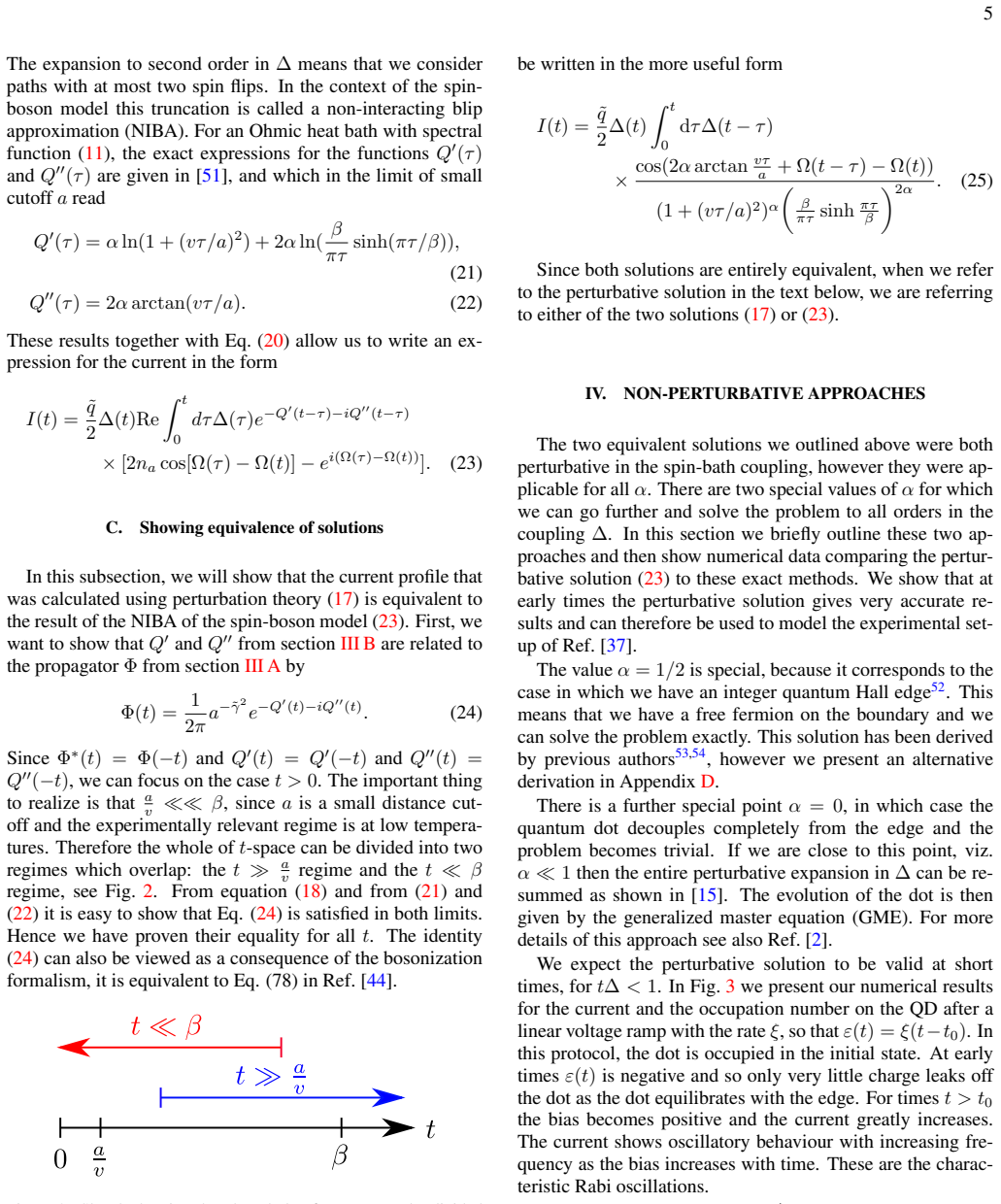
- [§III.C, Eq. (24) and Appendix C (Eqs. (C2)–(C3))] The displayed identity (24) has the wrong prefactor. At τ=0, Eq. (18) gives Φ(0) = (2π)^{-1} a^{-γ̃²}, while the right-hand side of Eq. (24) as printed evaluates to a^{γ̃²}/(2π). The correct identity is Φ(t) = (a^{-γ̃²}/(2π)) e^{-Q'(t)-iQ''(t)}. With the printed prefactor, substitution into Eq. (C2) followed by Δ² = 2λ̃² a^{-γ̃²}/π produces an extra factor a^{2γ̃²}/4, so Eq. (C3) does not follow as written. After correcting the prefactor, the algebra leading to Eq. (25) goes through; the final formula is independently supported by the benchmarks in Fig. 3, so I regard this as a fixable error rather than an irreparable one, but it must be corrected for the displayed proof of equivalence to be valid.
- [§V.B, Eq. (29) and Appendix E] The analytical small-amplitude result in Eq. (29) is not consistent with the derivation in Appendix E. Substituting γ̃²=3, so that Δ²=2λ̃²a^{-3}/π, and ω_c=v/a into Eq. (E12) gives a sin Ωt coefficient proportional to λ̃² ε0 Ω (ln(aΩ/v)+γ_E)/(4π v³), whereas Eq. (29) as printed contains λ̃² Ω/(2π ε0 v³), i.e. it has ε0 in the denominator rather than the numerator. In addition, the exponential in the cos Ωt term appears as e^{+aΩ/v} if Eq. (29) is read in the natural way, while Appendix E gives e^{-aΩ/v} (equivalently π/(2e^{aΩ/v})). Since Fig. 4 claims excellent agreement between Eq. (29) and the full expression Eq. (25), the authors must reconcile Eq. (29), Appendix E, and the plotting convention used in Fig. 4.
minor comments (5)
- [§III.C, Eq. (24) and Appendix C] The notation 1/(2πa^{-γ̃²}) is ambiguous and is the source of the prefactor error; the correct expression should be written explicitly as (a^{-γ̃²}/(2π)) e^{-Q'(t)-iQ''(t)}.
- [§V.B, Eq. (29)] The cos Ωt term should be typeset unambiguously as π/(2e^{aΩ/v}) (or equivalently (π/2)e^{-aΩ/v}) to match the exponential factor derived in Appendix E.
- [Fig. 3 caption and §IV] The caption states that the plotted quantity is -dN/d(tΔ), while the text refers to the current; please clarify the relation to the current operator in Eq. (14), including the charge prefactor q̃.
- [§III.C] The claim that Eq. (24) follows by checking the two overlapping limits t≫a/v and t≪β is plausible, but the actual limiting forms are not displayed; once the prefactor is fixed, it would be helpful to show the two limits explicitly.
- [§V.A] The sentence after Eq. (27) explaining why α<1/2 requires a finite temperature as an infrared cutoff could be expanded for clarity, since the zero-bias integral is otherwise convergent for α<1/2 only because of the temperature-dependent term.
Circularity Check
No significant circularity: the current formulas are derived from the model Hamiltonian by two independent perturbative methods and benchmarked against exact and master-equation results, with no fitted parameter renamed as a prediction.
full rationale
The derivation chain is self-contained. Equation (17) is obtained from the Kubo formula applied to the bosonized Hamiltonian, with the vertex correlator (18) taken from standard bosonization results (Ref. [44]), while Eq. (23) is the standard NIBA expression from Refs. [14,51]. The claimed equivalence of (17) and (23) is presented as a cross-check of two independent second-order perturbative calculations, and neither formula is fitted to the other. The parameters entering the result, including the renormalized coupling tilde gamma and charge tilde q, are fixed by the original Hamiltonian through the unitary transformation in Sec. IIB, not by matching the predicted current. The benchmarks in Fig. 3 compare the perturbative expression against an exact IQH solution derived independently in Appendix D and against the GME taken from Ref. [2]; these are external checks rather than inputs to the derivation. Self-citations to Ref. [2] concern the interaction rescaling and the GME benchmark, but the rescaling is also justified within this paper, and the GME comparison is an independent benchmark, so the self-citations are not load-bearing in a circular sense. Even if the printed prefactor in Eq. (24) is algebraically incorrect, as a skeptical reader might note, that is a correctness issue internal to an equivalence proof, not a case of a prediction reducing to its inputs by construction.
Assumptions & free parameters
free parameters (1)
- short-distance cutoff a
assumptions (6)
- standard math Chiral Laughlin edge is described by a free boson field with vertex operators of the form (4)-(5) and the two-point correlator (A7) from bosonization (Ref. [44]).
- domain assumption The spin-boson mapping of Furusaki and Matveev (Ref. [3]) applies, with Ohmic spectral function J(ω)=2παω e^{-aω/v} in Eq. (11).
- domain assumption The dot-edge Coulomb interaction has the short-range form (7) and is fully eliminated by renormalizing γ to γ̃ (Eq. 8).
- domain assumption The quantum dot is a single-level system represented by spin operators, with Klein factors canceling in the current (Appendix B).
- domain assumption The Kubo formula (16) with the perturbation switched on at t=0 gives the leading-order current.
- standard math The identity (24) relating Φ(t) to Q'(t) and Q''(t) holds for all times, as it is equivalent to Eq. (78) of Ref. [44].
Cite this review
Pith. "Pith review of Driven quantum dot coupled to a fractional quantum Hall edge." pith.science (2026). https://pith.science/paper/EDOW24DA
@misc{pith2026190805658,
  author       = {Pith},
  title        = {Pith review of: Driven quantum dot coupled to a fractional quantum Hall edge},
  year         = {2026},
  howpublished = {\url{https://pith.science/paper/EDOW24DA}},
  note         = {Machine review of arXiv:1908.05658}
}
read the original abstract
We study a model of a quantum dot coupled to a quantum Hall edge of the Laughlin state, taking into account short-range interactions between the dot and the edge. This system has been studied experimentally in electron quantum optics in the context of single particle sources. We consider driving the dot out of equilibrium by a time-dependent bias voltage. We calculate the resulting current on the edge by applying the Kubo formula to the bosonized Hamiltonian. The Hamiltonian of this system can also be mapped to the spin-boson model and in this picture, the current can be perturbatively calculated using the non-interacting blip approximation (NIBA). We show that both methods of solution are in fact equivalent. We present numerics demonstrating that the perturbative approaches capture the essential physics at early times, although they fail to capture the charge quantization (or lack thereof) in the current pulses integrated over long times.
Figures


Figures from the paper (1 more)

Reference graph
Works this paper leans on
-
[1]
author author C. B\"auerle , author D. C. \ Glattli , author T. Meunier , author F. Portier , author P. Roche , author P. Roulleau , author S. Takada , \ and\ author X. Waintal ,\ https://doi.org/10.1088\ journal Reports on Progress in Physics \ volume 81 ,\ pages 056503 ( year 2018 ) NoStop
-
[2]
author author G. Wagner , author D. X. \ Nguyen , author D. L. \ Kovrizhin , \ and\ author S. H. \ Simon ,\ 10.1103/PhysRevLett.122.127701 journal journal Phys. Rev. Lett. \ volume 122 ,\ pages 127701 ( year 2019 ) NoStop
-
[3]
Occupation of a resonant level coupled to a chiral Luttinger liquid
author author A. Furusaki \ and\ author K. A. \ Matveev ,\ 10.1103/PhysRevLett.88.226404 journal journal Phys. Rev. Lett \ volume 88 ,\ eid 226404 ( year 2002 ) ,\ http://arxiv.org/abs/cond-mat/0112426 cond-mat/0112426 NoStop
work page Pith review arXiv 2002
-
[4]
Weiss ,\ @noop title Quantum dissipative systems ,\ Vol
author author U. Weiss ,\ @noop title Quantum dissipative systems ,\ Vol. volume 13 \ ( publisher World scientific ,\ year 2012 ) NoStop
2012
-
[5]
author author A. J. \ Leggett , author S. Chakravarty , author A. T. \ Dorsey , author M. P. A. \ Fisher , author A. Garg , \ and\ author W. Zwerger ,\ 10.1103/RevModPhys.59.1 journal journal Rev. Mod. Phys. \ volume 59 ,\ pages 1 ( year 1987 ) NoStop
-
[6]
author author P. P. \ Orth , author A. Imambekov , \ and\ author K. Le Hur ,\ https://doi.org/10.1103/PhysRevB.87.014305 journal journal Phys. Rev. B \ volume 87 ,\ pages 014305 ( year 2013 ) NoStop
-
[7]
Quantum Phase Transitions in Spin-Boson Systems: Dissipation and Light Phenomena
author author K. Le Hur ,\ @noop journal journal ArXiv e-prints \ ( year 2009 ) ,\ http://arxiv.org/abs/0909.4822 arXiv:0909.4822 [cond-mat.other] NoStop
work page Pith review arXiv 2009
-
[8]
author author K. L. \ Hur , author L. Henriet , author L. Herviou , author K. Plekhanov , author A. Petrescu , author T. Goren , author M. Schiro , author C. Mora , \ and\ author P. P. \ Orth ,\ http://www.sciencedirect.com/science/article/pii/S1631070518300355 journal journal Comptes Rendus Physique \ ( year 2018 ) NoStop
work page 2018
Show all 64 references
-
[9]
Sassetti \ and\ author U
author author M. Sassetti \ and\ author U. Weiss ,\ 10.1103/PhysRevLett.65.2262 journal journal Phys. Rev. Lett. \ volume 65 ,\ pages 2262 ( year 1990 ) NoStop
1990 doi
-
[10]
Bulla , author H.-J
author author R. Bulla , author H.-J. \ Lee , author N.-H. \ Tong , \ and\ author M. Vojta ,\ 10.1103/PhysRevB.71.045122 journal journal Phys. Rev. B \ volume 71 ,\ pages 045122 ( year 2005 ) NoStop
2005 doi
-
[11]
Le Hur \ and\ author M.-R
author author K. Le Hur \ and\ author M.-R. \ Li ,\ 10.1103/PhysRevB.72.073305 journal journal Phys. Rev. B \ volume 72 ,\ pages 073305 ( year 2005 ) NoStop
2005 doi
-
[12]
Schoelkopf , author A
author author R. Schoelkopf , author A. Clerk , author S. Girvin , author K. Lehnert , \ and\ author M. Devoret ,\ in\ @noop booktitle Quantum noise in mesoscopic physics \ ( publisher Springer ,\ year 2003 )\ pp.\ pages 175--203 NoStop
2003
-
[13]
Makhlin , author G
author author Y. Makhlin , author G. Sch \"o n , \ and\ author A. Shnirman ,\ in\ @noop booktitle New Directions in Mesoscopic Physics (Towards Nanoscience) \ ( publisher Springer ,\ year 2003 )\ pp.\ pages 197--224 NoStop
2003
-
[14]
Grifoni , author E
author author M. Grifoni , author E. Paladino , \ and\ author U. Weiss ,\ 10.1007/s100510050903 journal journal The European Physical Journal B \ volume 10 ,\ pages 719 ( year 1999 ) NoStop
1999 doi
-
[15]
Hartmann , author I
author author L. Hartmann , author I. Goychuk , author M. Grifoni , \ and\ author P. H \"a nggi ,\ https://doi.org/10.1103/PhysRevE.61.R4687 journal journal Phys. Rev. E \ volume 61 ,\ pages R4687 ( year 2000 ) NoStop
-
[16]
Cedraschi \ and\ author M
author author P. Cedraschi \ and\ author M. Buttiker ,\ https://doi.org/10.1006/aphy.2001.6116 journal journal Annals of Physics \ volume 289 ,\ pages 1 ( year 2001 ) NoStop
2001
-
[17]
author author F. B. \ Anders \ and\ author A. Schiller ,\ 10.1103/PhysRevLett.95.196801 journal journal Phys. Rev. Lett. \ volume 95 ,\ pages 196801 ( year 2005 ) NoStop
2005 doi
-
[18]
author author M. L. \ Wall , author A. Safavi-Naini , \ and\ author A. M. \ Rey ,\ 10.1103/PhysRevA.94.053637 journal journal Phys. Rev. A \ volume 94 ,\ pages 053637 ( year 2016 ) NoStop
2016 doi
-
[19]
Strathearn , author P
author author A. Strathearn , author P. Kirton , author D. Kilda , author J. Keeling , \ and\ author B. W. \ Lovett ,\ 10.1038/s41467-018-05617-3 journal journal Nature Communications \ volume 9 ,\ pages 3322 ( year 2018 ) NoStop
2018 doi
-
[20]
author author K. H. \ Yang , author Y. Chen , author H. Y. \ Wang , \ and\ author B. Y. \ Liu ,\ 10.1016/j.physleta.2013.01.020 journal journal Phys. Lett. A \ volume 377 ,\ pages 687 ( year 2013 ) NoStop
2013 doi
-
[21]
Galda , author I
author author A. Galda , author I. V. \ Yurkevich , \ and\ author I. V. \ Lerner ,\ 10.1209/0295-5075/93/17009 journal journal EPL \ volume 93 ,\ pages 17009 ( year 2011 ) NoStop
2011 doi
-
[22]
Rylands , author N
author author C. Rylands , author N. Andrei , author M. Goldstein , author Y. Weiss , \ and\ author R. Berkovits ,\ 10.1209/0295-5075/86/67012 journal journal EPL \ volume 86 ,\ pages 67012 ( year 2009 ) NoStop
2009 doi
-
[23]
Goldstein , author Y
author author M. Goldstein , author Y. Weiss , \ and\ author R. Berkovits ,\ 10.1016/j.physe.2009.06.064 journal journal Physica E \ volume 42 ,\ pages 610 ( year 2010 ) NoStop
2009 doi
-
[24]
Komnik \ and\ author A
author author A. Komnik \ and\ author A. O. \ Gogolin ,\ 10.1103/PhysRevB.68.235323 journal journal Phys. Rev. B \ volume 68 ,\ pages 235323 ( year 2003 ) NoStop
2003 doi
-
[25]
a chter , author V. Meden , \ and\ author K. Sch \
author author P. W \" a chter , author V. Meden , \ and\ author K. Sch \" o nhammer ,\ 10.1103/PhysRevB.76.125316 journal journal Phys. Rev. B \ volume 76 ,\ pages 125316 ( year 2007 ) NoStop
2007 doi
-
[26]
Goldstein , author Y
author author M. Goldstein , author Y. Gefen , \ and\ author R. Berkovits ,\ 10.1103/PhysRevB.83.245112 journal journal Phys. Rev. B \ volume 83 ,\ pages 245112 ( year 2011 ) NoStop
2011 doi
-
[27]
Goldstein \ and\ author R
author author M. Goldstein \ and\ author R. Berkovits ,\ 10.1103/PhysRevLett.104.106403 journal journal Phys. Rev. Lett \ volume 104 ,\ pages 106403 ( year 2010 a ) ,\ http://arxiv.org/abs/0907.0424 arXiv:0907.0424 NoStop
2010 arXiv
-
[28]
Goldstein \ and\ author R
author author M. Goldstein \ and\ author R. Berkovits ,\ 10.1103/PhysRevB.82.235315 journal journal Phys. Rev. B. \ volume 82 ,\ pages 235315 ( year 2010 b ) NoStop
2010 doi
-
[29]
Goldstein \ and\ author R
author author M. Goldstein \ and\ author R. Berkovits ,\ 10.1103/PhysRevB.82.161307 journal journal Phys. Rev. B \ volume 82 ,\ pages 161307 ( year 2010 c ) ,\ http://arxiv.org/abs/1101.3723 arXiv:1101.3723 NoStop
2010 arXiv
-
[30]
author author G. A. \ Fiete , author W. Bishara , \ and\ author C. Nayak ,\ 10.1103/PhysRevB.82.035301 journal journal Phys. Rev. B \ volume 82 ,\ pages 035301 ( year 2010 ) NoStop
2010 doi
-
[31]
Yang , author C.-H
author author G. Yang , author C.-H. \ Hsu , author P. Stano , author J. Klinovaja , \ and\ author D. Loss ,\ 10.1103/PhysRevB.93.075301 journal journal Phys. Rev. B \ volume 93 ,\ pages 075301 ( year 2016 ) NoStop
2016 doi
-
[32]
Vannucci , author F
author author L. Vannucci , author F. Ronetti , author D. Ferraro , author J. Rech , author T. Jonckheere , author T. Martin , \ and\ author M. Sassetti ,\ http://stacks.iop.org/1742-6596/969/i=1/a=012143 journal journal Journal of Physics: Conference Series \ volume 969 ,\ pa...
2018
-
[33]
Vannucci , author F
author author L. Vannucci , author F. Ronetti , author J. Rech , author D. Ferraro , author T. Jonckheere , author T. Martin , \ and\ author M. Sassetti ,\ 10.1103/PhysRevB.95.245415 journal journal Phys. Rev. B \ volume 95 ,\ pages 245415 ( year 2017 ) NoStop
-
[34]
Chevallier , author J
author author D. Chevallier , author J. Rech , author T. Jonckheere , author C. Wahl , \ and\ author T. Martin ,\ 10.1103/PhysRevB.82.155318 journal journal Phys. Rev. B \ volume 82 ,\ pages 155318 ( year 2010 ) NoStop
2010 doi
-
[35]
Ronetti , author L
author author F. Ronetti , author L. Vannucci , author D. Ferraro , author T. Jonckheere , author J. Rech , author T. Martin , \ and\ author M. Sassetti ,\ 10.1103/PhysRevB.98.075401 journal journal Phys. Rev. B \ volume 98 ,\ pages 075401 ( year 2018 ) NoStop
-
[36]
Litinski , author P
author author D. Litinski , author P. W. \ Brouwer , \ and\ author M. Filippone ,\ 10.1103/PhysRevB.96.085429 journal journal Phys. Rev. B \ volume 96 ,\ pages 085429 ( year 2017 ) NoStop
2017 doi
-
[37]
F \`e ve , author A
author author G. F \`e ve , author A. Mah \'e , author J.-M. \ Berroir , author T. Kontos , author B. Placais , author D. Glattli , author A. Cavanna , author B. Etienne , \ and\ author Y. Jin ,\ 10.1126/science.1141243 journal journal Science \ volume 316 ,\ pages 1169 ( year...
-
[38]
Hermelin , author S
author author S. Hermelin , author S. Takada , author M. Yamamoto , author S. Tarucha , author A. D. \ Wieck , author L. Saminadayar , author C. B \" a uerle , \ and\ author T. Meunier ,\ 10.1038/nature10416 journal journal Nature \ volume 477 ,\ pages 435 ( year 2011 ) NoStop
-
[39]
author author R. P. \ McNeil , author M. Kataoka , author C. J. \ Ford , author C. H. \ Barnes , author D. Anderson , author G. A. \ Jones , author I. Farrer , \ and\ author D. A. \ Ritchie ,\ 10.1038/nature10444 journal journal Nature \ volume 477 ,\ pages 439 ( year 2011 ) NoStop
-
[40]
Dubois , author T
author author J. Dubois , author T. Jullien , author F. Portier , author P. Roche , author A. Cavanna , author Y. Jin , author W. Wegscheider , author P. Roulleau , \ and\ author D. C. \ Glattli ,\ 10.1038/nature12713 journal journal Nature \ volume 502 ,\ pages 659 ( year 201...
-
[41]
Bocquillon , author V
author author E. Bocquillon , author V. Freulon , author F. D. \ Parmentier , author J.-M. \ Berroir , author B. Placais , author C. Wahl , author J. Rech , author T. Jonckheere , author T. Martin , author C. Grenier , author D. Ferraro , author P. Degiovanni , \ and\ author G...
-
[42]
Grenier , author R
author author C. Grenier , author R. Herv\'e , author G. F\`eve , \ and\ author P. Degiovanni ,\ 10.1142/S0217984911026772 journal journal Modern Physics Letters B \ volume 25 ,\ pages 1053 ( year 2011 ) NoStop
2011 doi
-
[43]
\ Wen ,\ 10.1142/s0217979292000840 journal journal Int
author author X.-G. \ Wen ,\ 10.1142/s0217979292000840 journal journal Int. J. Mod. Phys. B \ volume 06 ,\ pages 1711 ( year 1992 ) NoStop
1992 doi
-
[44]
von Delft \ and\ author H
author author J. von Delft \ and\ author H. Schoeller ,\ 10.1002/(SICI)1521-3889(199811)7:4<225::AID-ANDP225>3.0.CO;2-L journal journal Annalen der Physik \ volume 7 ,\ pages 225 ( year 1998 ) NoStop
1998 doi
-
[45]
Porras , author F
author author D. Porras , author F. Marquardt , author J. von Delft , \ and\ author J. I. \ Cirac ,\ 10.1103/PhysRevA.78.010101 journal journal Phys. Rev. A \ volume 78 ,\ pages 010101 ( year 2008 ) NoStop
2008 doi
-
[46]
Lemmer , author C
author author A. Lemmer , author C. Cormick , author D. Tamascelli , author T. Schaetz , author S. F. \ Huelga , \ and\ author M. B. \ Plenio ,\ http://stacks.iop.org/1367-2630/20/i=7/a=073002 journal journal New Journal of Physics \ volume 20 ,\ pages 073002 ( year 2018 ) NoStop
2018
-
[47]
akangas , author J. Braum\
author author J. Lepp\"akangas , author J. Braum\"uller , author M. Hauck , author J.-M. \ Reiner , author I. Schwenk , author S. Zanker , author L. Fritz , author A. V. \ Ustinov , author M. Weides , \ and\ author M. Marthaler ,\ 10.1103/PhysRevA.97.052321 journal journal Phy...
-
[48]
Magazz \`u , author P
author author L. Magazz \`u , author P. Forn-D \'i az , author R. Belyansky , author J.-L. \ Orgiazzi , author M. A. \ Yurtalan , author M. R. \ Otto , author A. Lupascu , author C. M. \ Wilson , \ and\ author M. Grifoni ,\ 10.1038/s41467-018-04348-9 journal journal Nature Com...
-
[49]
author author R. P. \ Feynman \ and\ author F. Vernon Jr ,\ 10.1016/0003-4916(63)90068-X journal journal Annals of physics \ volume 281 ,\ pages 547 ( year 2000 ) NoStop
2000 doi
-
[50]
note Our Hamiltonian differs from that in [ @citealpnum Grifoni1999 ] by a minus sign in the definition of (t) and (t) , hence the expressions below differ in the sign of (t) from the results in that paper. Stop
-
[51]
Grifoni , author M
author author M. Grifoni , author M. Winterstetter , \ and\ author U. Weiss ,\ 10.1103/PhysRevE.56.334 journal journal Phys. Rev. E \ volume 56 ,\ pages 334 ( year 1997 ) NoStop
1997 doi
-
[52]
note We did not consider the =1/2 case in our previous work OurLetter , since that paper was focussed on the effect of Coulomb interactions on the current and these would renormalize away from 1/2 for an integer quantum Hall edge. Ref. OurLetter studied the generalized master ...
-
[53]
Iwahori \ and\ author N
author author K. Iwahori \ and\ author N. Kawakami ,\ 10.1103/PhysRevA.94.063647 journal journal Phys. Rev. A \ volume 94 ,\ pages 063647 ( year 2016 ) NoStop
2016 doi
-
[54]
Keeling , author A
author author J. Keeling , author A. Shytov , \ and\ author L. Levitov ,\ https://doi.org/10.1103/PhysRevLett.101.196404 journal journal Phys. Rev. Lett \ volume 101 ,\ pages 196404 ( year 2008 ) NoStop
2008 doi
-
[55]
note We always consider a v as our shortest time scale. Stop
-
[56]
author author V. S. \ Khrapai , author A. A. \ Shashkin , author M. G. \ Trokina , author V. T. \ Dolgopolov , author V. Pellegrini , author F. Beltram , author G. Biasiol , \ and\ author L. Sorba ,\ 10.1103/PhysRevLett.99.086802 journal journal Phys. Rev. Lett \ volume 99 ,\ ...
-
[57]
note The term o cos (2 o arctan (v /a)) vanishes in this limit for = 1 2 = 2n+1 2 NoStop
-
[58]
note G. Fux, J. Keeling and L. Brendon, Private communication. Stop
-
[59]
Moskalets , author G
author author M. Moskalets , author G. Haack , \ and\ author M. B \"u ttiker ,\ Single-electron source: Adiabatic versus nonadiabatic emission journal journal Phys. Rev. B \ volume 87 ,\ pages 125429 ( year 2013 ) NoStop
2013
-
[60]
[ @citealpnum vonDelft1998 ]
note It can be derived easily from equation (87) of Ref. [ @citealpnum vonDelft1998 ]. Stop
-
[61]
note We explicitly set the chemical potential of the IQH edge to =0 . Stop
-
[62]
note The LHS is O ( ) and thus can be neglected. Stop
-
[63]
note The situation is much more complicated if the fermion hat 05E is neither chiral nor free. Stop
-
[64]
note In this section, we omit all the (x,t) arguments for simplicity. Stop
Reviewed August 14, 2026 · model on record in the stance chip above.
Discussion (0). Continue with ORCID to comment.